Origins of Cosmic Rays in the Galactic-extragalactic Transition Energy Range
Pith reviewed 2026-06-26 02:53 UTC · model grok-4.3
The pith
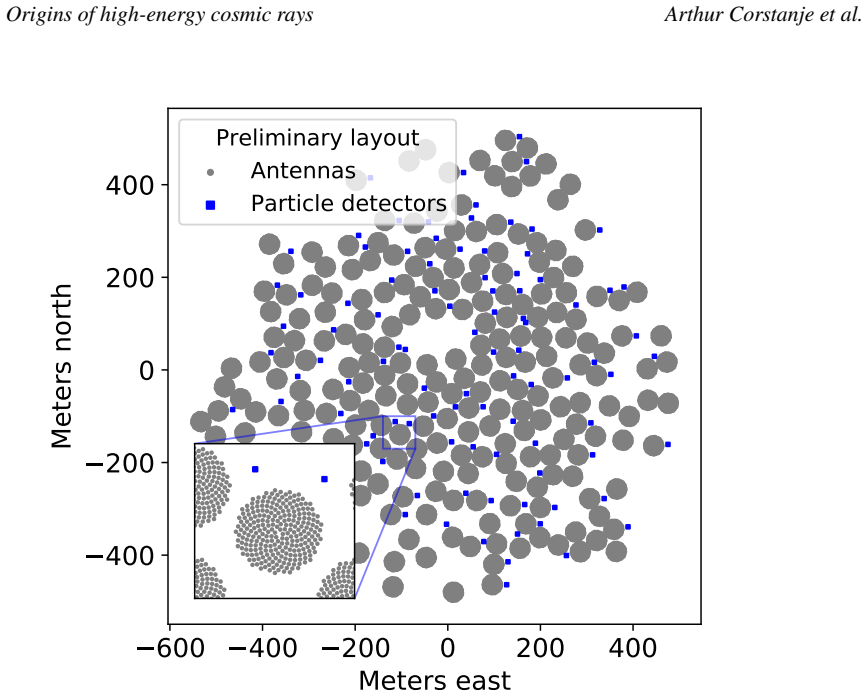
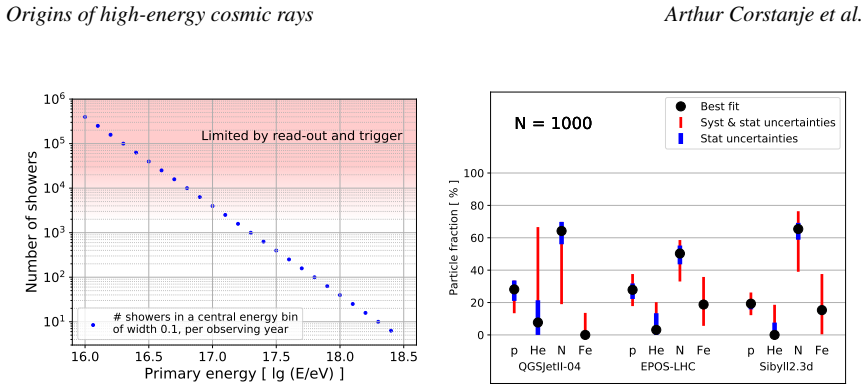
SKA-Low augmented with particle detectors can measure cosmic ray mass composition between 10^16 and 10^18 eV to identify the galactic-extragalactic transition.
A machine-rendered reading of the paper's core claim, the machinery that carries it, and where it could break.
Core claim
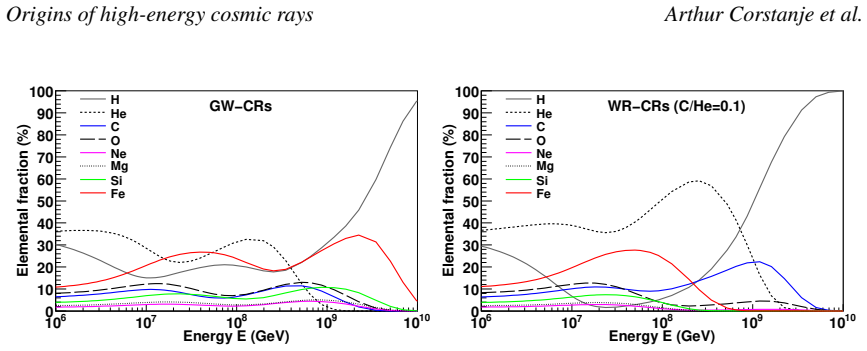
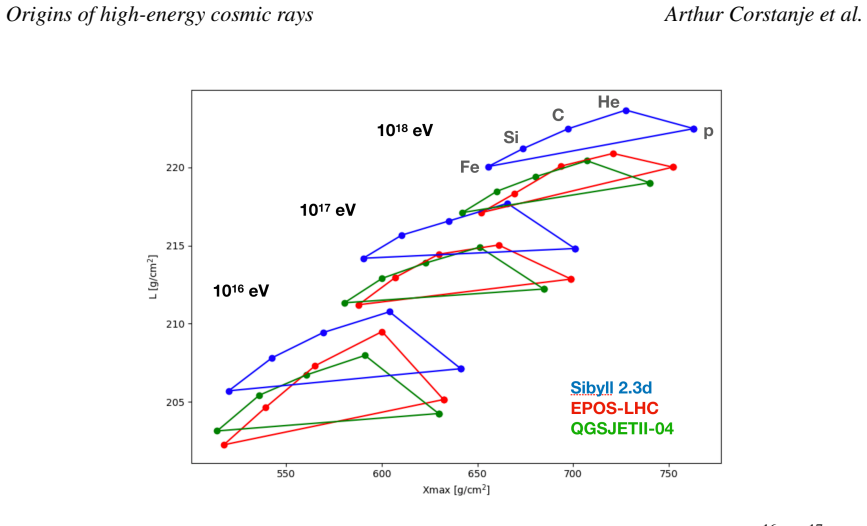
The paper claims that SKA-Low, augmented with an array of small particle detectors, is well suited to measure the mass composition of cosmic rays in the 10^16 to 10^18 eV range, building on LOFAR experience, thereby providing essential information for comparing to source and propagation models from both source abundances and the charge-dependent maximum energy.
What carries the argument
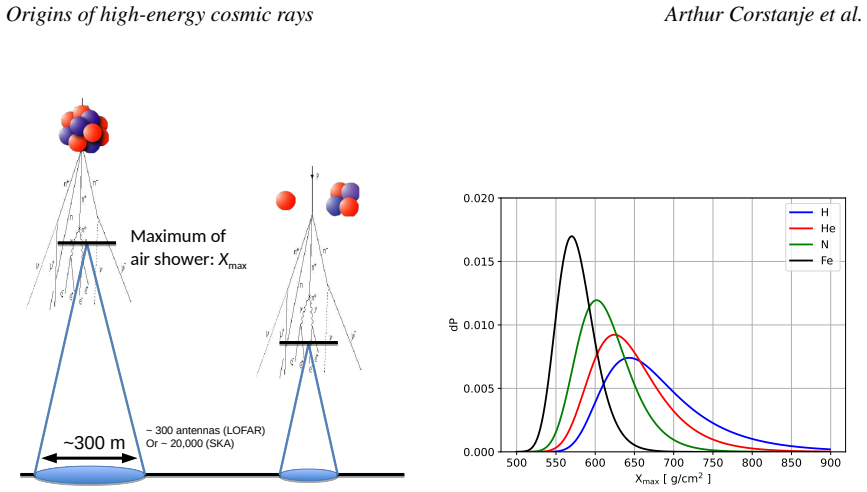
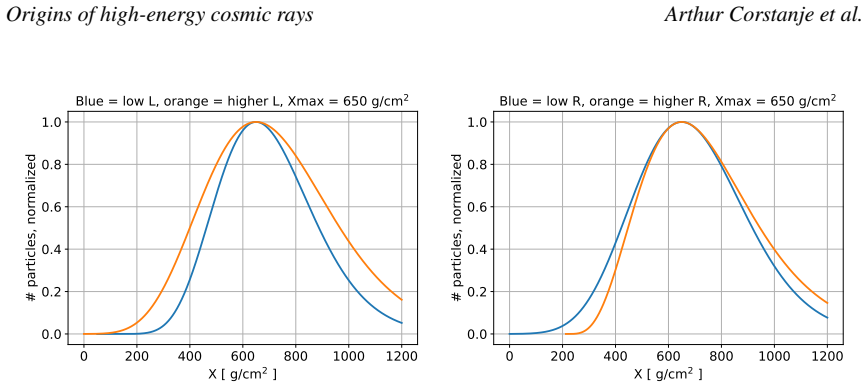
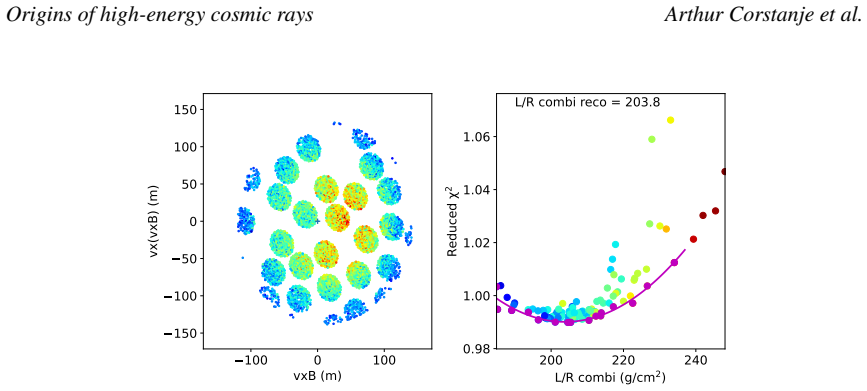
Hybrid radio detection of cosmic-ray air showers at SKA-Low frequencies combined with ground particle detectors to extract mass-sensitive observables such as shower depth and muon content.
If this is right
- Tighter bounds on the maximum energy galactic accelerators can impart to particles of given charge.
- Clearer separation of galactic and extragalactic flux contributions around the transition energy.
- Direct constraints on the elemental abundances at galactic sources from measured composition.
- Improved input for propagation models that predict how composition evolves with energy.
Where Pith is reading between the lines
- The same hybrid setup could test whether specific candidate galactic sources, such as young supernova remnants, match the observed composition cutoff.
- Extending the energy reach slightly higher might reveal the onset of the extragalactic component without relying solely on spectral features.
- Calibration against LOFAR data could serve as a benchmark for applying similar methods at even higher energies with future arrays.
Load-bearing premise
Radio detection techniques validated at LOFAR will scale directly to SKA-Low without introducing major new systematic limitations in the 10^16-10^18 eV range.
What would settle it
SKA-Low hybrid data yielding mass composition results that deviate systematically from independent measurements by other observatories in any overlapping energy bins.
Figures
read the original abstract
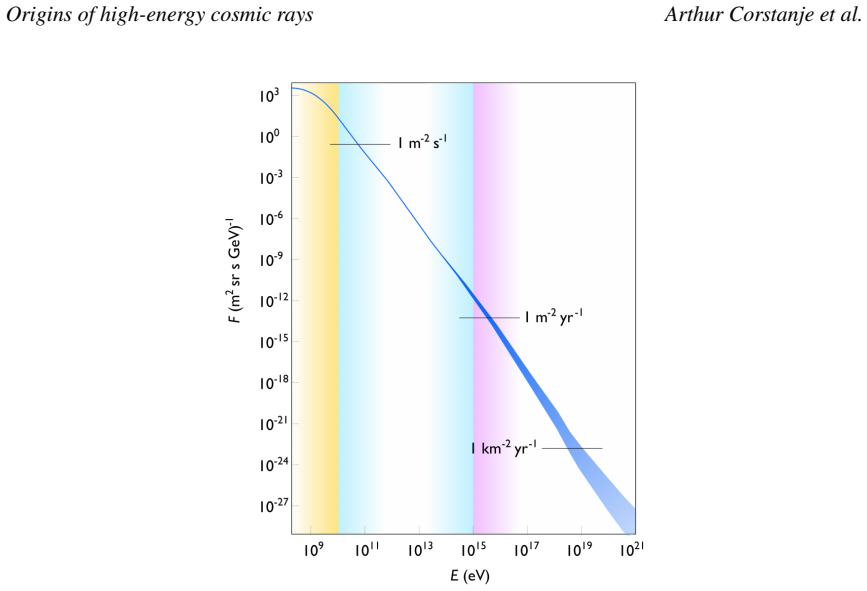
Cosmic rays arrive at Earth with energies ranging from $10^9$ to over $10^{20}$ eV. One of the open questions in high-energy cosmic ray science concerns the origin of the highest-energy cosmic rays that can be accelerated by Galactic sources, and the transition energy beyond which only extragalactic sources can provide. Measuring the mass composition gives essential information for comparing measurements to source and propagation models, both from the abundances at the source and from the maximum attainable energy which is proportional to the particle charge (and hence its mass). The highest-energy cosmic rays from the Galaxy are found in a range of $10^{16}$ to $10^{18}$ eV which is well suited for radio detection. Building on a decade of experience in measuring cosmic rays at LOFAR, we show that SKA-Low, augmented with an array of small particle detectors, is well suited to advance the field by measuring the mass composition of cosmic rays across this energy range.
Editorial analysis
A structured set of objections, weighed in public.
Referee Report
Summary. The manuscript proposes that SKA-Low, augmented with an array of small particle detectors and building on a decade of LOFAR experience in radio detection of cosmic rays, is well suited to measure the mass composition of cosmic rays in the 10^{16} to 10^{18} eV range. This range is identified as critical for understanding the transition from Galactic to extragalactic cosmic ray sources, since mass composition constrains source abundances and maximum acceleration energies (proportional to charge).
Significance. If the suitability claim holds and the proposed hybrid measurements can be realized with the required precision, the work would advance high-energy cosmic ray astrophysics by supplying mass composition data in an energy window where existing instruments have limited reach, enabling tighter tests of source and propagation models.
major comments (1)
- [Abstract] Abstract: The assertion that LOFAR-validated radio techniques will transfer directly to SKA-Low (with particle-detector augmentation) to deliver accurate mass composition measurements rests on an unquantified assumption. No error budget, simulation results, or scaling tests are presented to bound potential new systematics arising from differences in frequency coverage, antenna response, baseline density, or hybrid trigger/reconstruction methods. This transferability is the load-bearing step for the central suitability claim.
Simulated Author's Rebuttal
We thank the referee for their constructive review and the recommendation for major revision. We address the single major comment below, focusing on the scope and limitations of the current manuscript as a conceptual proposal.
read point-by-point responses
-
Referee: [Abstract] Abstract: The assertion that LOFAR-validated radio techniques will transfer directly to SKA-Low (with particle-detector augmentation) to deliver accurate mass composition measurements rests on an unquantified assumption. No error budget, simulation results, or scaling tests are presented to bound potential new systematics arising from differences in frequency coverage, antenna response, baseline density, or hybrid trigger/reconstruction methods. This transferability is the load-bearing step for the central suitability claim.
Authors: We agree that the manuscript does not include new quantitative error budgets, dedicated simulations, or explicit scaling tests for SKA-Low-specific parameters. The central claim is framed as a proposal that builds directly on validated LOFAR techniques rather than asserting identical performance. In revision we will expand the discussion (likely in a new subsection) to qualitatively address the listed differences, citing existing LOFAR publications on frequency response, baseline effects, and hybrid reconstruction. We will explicitly note that a full error budget requires instrument-specific simulations that lie outside the present scope. This addition will clarify the evidential basis without changing the proposal nature of the work. revision: partial
Circularity Check
No circularity; proposal paper with no derivations or self-referential predictions
full rationale
The manuscript is a forward-looking proposal paper. Its central claim is that SKA-Low (augmented by particle detectors) is well suited to measure cosmic-ray mass composition in the 10^16–10^18 eV range, building on LOFAR experience. No equations, fits, predictions, or derivation chains appear in the provided abstract or framing. The text contains no self-definitional steps, fitted inputs renamed as predictions, load-bearing self-citations, uniqueness theorems, or ansatzes. The transferability assertion is presented as an assumption grounded in cited prior instrument work rather than a mathematical reduction to the paper's own inputs. This is the most common honest non-finding for proposal-style documents; the derivation chain is empty by construction.
Axiom & Free-Parameter Ledger
axioms (1)
- domain assumption Radio detection of extensive air showers can determine primary cosmic ray mass composition
Reference graph
Works this paper leans on
-
[1]
ISSN 0168-9002. doi: 10.1016/j.nima.2003.12.012. S. Andringa, R. Conceição, and M. Pimenta. Astroparticle Physics, 34(6):360–367,
-
[2]
ISSN 0927-6505. doi: https://doi.org/10.1016/j.astropartphys.2010.10.002. URL https://www. sciencedirect.com/science/article/pii/S0927650510001830. W. D. Apel et al. JCAP, 09:025,
-
[3]
doi: 10.1088/1475-7516/2014/09/025. T. Bergmann et al. Astroparticle Physics, 26(6):420–432,
-
[4]
doi: https:// doi.org/10.1016/j.astropartphys.2006.08.005
ISSN 0927-6505. doi: https:// doi.org/10.1016/j.astropartphys.2006.08.005. URL https://www.sciencedirect.com/science/ article/pii/S0927650506001228. S. Buitink et al. Phys. Rev. D, 90(8):082003,
-
[5]
doi: 10.1103/PhysRevD.90.082003. S. Buitink et al. Nature, 531:70,
-
[6]
doi: 10.1038/nature16976. S. Buitink et al. PoS, ARENA2022:046,
-
[7]
doi: 10.22323/1.424.0046. S. Buitink et al. In Advancing Astrophysics with the SKA – II (AASKAII)
-
[8]
doi: 10.1016/j.astropartphys.2014.06.001. A. Corstanje et al. Phys. Rev. D, 103(10):102006,
-
[9]
doi: 10.1103/PhysRevD.103.102006. A. Corstanje et al. PoS, ARENA2022:024,
-
[10]
doi: 10.22323/1.424.0024. A. Corstanje et al. Phys. Rev. D , 112:023017, Jul
-
[11]
E.deOñaWilhelmietal.NatureAstron.,8(4):425–431,2024
doi: 10.1103/l8mt-994v. URL https: //link.aps.org/doi/10.1103/l8mt-994v. E. de Lera Acedo et al. Experimental Astronomy, 39(3):567–594, July
-
[12]
doi: 10.1007/s10686-015-9439-0
ISSN 1572-9508. doi: 10.1007/s10686-015-9439-0. URL http://dx.doi.org/10.1007/s10686-015-9439-0 . A. De Oliveira-Costa et al. Monthly Notices of the Royal Astronomical Society , 388(1):247–260, 07
-
[13]
ISSN 0035-8711. doi: 10.1111/j.1365-2966.2008.13376.x. URL https://doi.org/10. 1111/j.1365-2966.2008.13376.x. E. de Oña Wilhelmi et al. Nature Astron., 8(4):425–431,
-
[14]
doi: 10.1038/s41550-024-02224-9. M. Desmet, K. Watanabe, T. Huege, and S. Buitink. SMIET: Fast and accurate synthesis of radio pulses from extensive air shower using simulated templates,
-
[15]
URLhttps://arxiv.org/abs/ 2505.10459. C. Glaser et al. Eur. Phys. J. C, 80(2):77,
-
[16]
doi: 10.1140/epjc/s10052-020-7612-8. D. Heck et al. CORSIKA: a Monte Carlo code to simulate extensive air showers.Forschungszentrum Karlsruhe GmbH, Karlsruhe (Germany), Feb
-
[17]
Huege, M
T. Huege, M. Ludwig, and C. W. James.ARENA 2012, AIP Conf. Proc. 1535, pages 128–132,
2012
-
[18]
doi: 10.1063/1.4807534. K.-H. Kampert and M. Unger. Astroparticle Physics, 35(10):660 – 678,
-
[19]
doi: 10.1016/j.astropartphys.2012.02.004
ISSN 0927-6505. doi: 10.1016/j.astropartphys.2012.02.004. S. Navas et al. Phys. Rev. D, 110(3):030001,
-
[20]
doi: 10.1103/PhysRevD.110.030001. S. Navas et al. https://pdg.lbl.gov/2025/reviews/contents_sports.html,
-
[21]
Nelles et al
A. Nelles et al. Journal of Cosmology and Astroparticle Physics , 2015(05):018,
2015
-
[22]
doi: 10.1051/epjconf/20125202001. T. Pierog et al. Phys. Rev. C, 92:034906, Sep
-
[23]
doi: 10.1103/PhysRevC.92.034906. Pierre Auger Collaboration. EPJ Web Conf. , 210:06002,
-
[24]
doi: 10.1051/epjconf/ 201921006002. URL https://doi.org/10.1051/epjconf/201921006002. F. Riehn et al. Phys. Rev. D, 102(6):063002,
-
[25]
doi: 10.1103/PhysRevD.102.063002. P . Schellart et al. JCAP, 10:014,
-
[26]
doi: 10.1088/1475-7516/2014/10/014. F. Schlüter and T. Huege. JINST, 16(07):P07048,
-
[28]
doi: 10.1088/ 1748-0221/16/07/P07048. URL https://doi.org/10.1088/1748-0221/16/07/P07048. O. Scholten, T. N. G. Trinh, K. D. de Vries, and B. M. Hare. Phys. Rev. D, 97:023005, Jan
-
[29]
doi: 10.1103/PhysRevD.97.023005. URL https://link.aps.org/doi/10.1103/PhysRevD.97. 023005. O. Scholten, T. N. G. Trinh, et al. Phys. Rev. D, 110:103036, Nov
-
[30]
doi: 10.1103/PhysRevD. 110.103036. URL https://link.aps.org/doi/10.1103/PhysRevD.110.103036. H. Schoorlemmer and W. R. Carvalho. Eur. Phys. J. C , 81(12):1120,
-
[31]
Gravitational collapse for the K-essence emergent Vaidya spacetime
doi: 10.1140/epjc/ s10052-021-09925-9. Telescope Array Collaboration. The cosmic-ray composition between 2 PeV and 2 EeV observed with the TALE detector in monocular mode,
-
[32]
doi: 10.1016/j.nima.2014.08.021. S. Thoudam et al. Astropart. Phys., 73:34–43, 2016a. doi: 10.1016/j.astropartphys.2015.06.005. S. Thoudam et al. A&A, 595:A33, 2016b. doi: 10.1051/0004-6361/201628894. M. P . van Haarlem et al. Astronomy and Astrophysics, 556:A2,
-
[33]
URL https: //link.aps.org/doi/10.1103/695x-41m3
doi: 10.1103/695x-41m3. URL https: //link.aps.org/doi/10.1103/695x-41m3. K. Watanabe et al. In Advancing Astrophysics with the SKA – II (AASKAII)
-
[34]
ISSN 0035-8711. doi: 10.1093/mnras/stw2525. URL https://doi.org/10.1093/mnras/ stw2525. 23
discussion (0)
Sign in with ORCID, Apple, or X to comment. Anyone can read and Pith papers without signing in.