REVIEW 3 major objections 5 minor 15 references
RSMA-Assisted OFDM-OTFS Hybrid Framework for Mixed-Mobility Multiuser Systems
T0 review · 3 major / 5 minor · reviewed 2026-07-10 · grok-4.5
Pith's one-line read An RSMA common stream spanning the full band lets OFDM users fight Doppler ICI while sharing spectrum with OTFS users, beating pure orthogonal allocation in rate and outage when enough power is given to that common layer.
desk verdict Solid hybrid RSMA design for mixed OFDM/OTFS users that cleanly shows the OFDM-vs-OTFS power trade-off under imperfect SIC; simulation-backed and worth a referee look, with the usual caveats on perfect delay/Doppler knowledge and thin analysis. read the letter →
The pith
A machine-rendered reading of the paper's core claim, the machinery that carries it, and where it could break.
The reading
What carries the argument
The full-band OFDM-only common stream of RSMA, whose power fraction pc is the single control knob that trades OFDM robustness against ICI for OTFS private-stream power.
What would settle it
Repeat the Monte-Carlo campaign of Figures 1–4 after deliberately injecting realistic delay and Doppler estimation errors into every receiver; if the reported sum-rate and outage gains over OMA disappear or reverse, the central claim fails.
Extended reading notes
Core claim
When a single RSMA common stream that contains only OFDM messages is transmitted over the entire bandwidth, OFDM receivers can decode it first and cancel the bulk of the Doppler-induced interference before decoding their private streams, while OTFS receivers simply cancel the same common stream and then equalize their own delay-Doppler signals. The resulting hybrid system outperforms pure orthogonal frequency allocation in total sum-rate and OFDM outage, even under residual channel-estimation errors, as long as enough power is assigned to the common layer.
Load-bearing premise
Every receiver is assumed to know the exact delay and Doppler of every multipath so that estimation errors affect only the complex gains; if those timing parameters are also wrong, both the ICI model and the OTFS equalizer break.
Editorial extensions
If this is right
- Operators can keep legacy OFDM handsets in high-speed cells simply by turning on a full-band common RSMA layer whose power is set according to the current mobility mix.
- Increasing the common-stream power fraction improves OFDM reliability and sum-rate while steadily degrading OTFS throughput, giving a single dial for cell-level fairness.
- Channel-estimation quality becomes a first-order design parameter: under large gain-error variance the common stream can still help OFDM users only when its power share is high enough to overcome residual interference.
- The same architecture extends immediately to any mixture of TF-domain and DD-domain waveforms that must share a doubly selective channel.
Reading between the lines
- Because OTFS users never contribute to the common stream, the scheme is inherently asymmetric; a dual common stream for OTFS users might close the residual OTFS performance gap relative to pure OMA.
- The reported gains are obtained with fixed equal power split among private streams; joint optimization of all power coefficients under imperfect CSI would likely enlarge the region where RSMA dominates OMA.
- If delay-Doppler estimation errors prove as harmful as the weakest-assumption note suggests, the practical value of the framework will hinge on whether low-overhead pilots can keep those errors small enough for the residual-interference analysis to remain valid.
Editorial analysis
A structured set of objections, weighed in public.
Referee Report
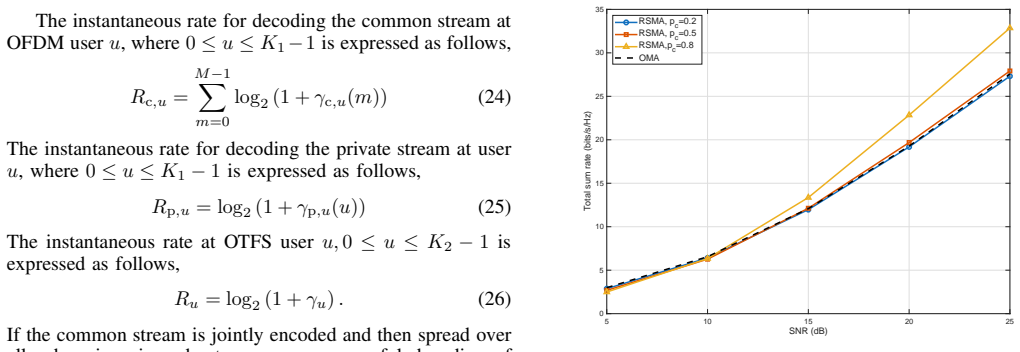
Summary. The paper proposes a downlink RSMA framework that enables coexistence of OFDM and OTFS users under mixed mobility. OFDM users split messages into a common stream that occupies the entire bandwidth (to combat ICI) and private streams on dedicated subcarriers; OTFS users occupy the remaining subcarriers in the DD domain, cancel the common stream via SIC, and do not contribute to it. Channel estimation errors are modeled only on path gains (delay/Doppler assumed known), residual interference after imperfect SIC is included for both receiver types, and OTFS detection uses MMSE equalization after block-circulant diagonalization. Monte-Carlo results (10^5 trials) show that sufficiently large common-stream power share pc improves total sum-rate and OFDM rate/outage relative to a frequency-domain OMA baseline, at the expense of OTFS performance, with sensitivity to estimation-error variance.
Significance. If the reported gains hold under the stated model, the work supplies a concrete, practically motivated architecture for mixed-waveform 6G vehicular networks that neither pure OFDM-RSMA nor pure OTFS-RSMA papers currently address. The explicit inclusion of residual SIC interference and the clear OFDM–OTFS power-allocation trade-off are useful design insights. Strengths include consistent SINR derivations (Eqs. 11–15, 21–23) and extensive Monte-Carlo evaluation that isolates the effects of pc and σe^{2}. The absence of closed-form outage/rate expressions and of any optimization of the free power factors limits analytical depth, yet the numerical evidence is sufficient to establish the qualitative superiority claim under the paper’s assumptions.
major comments (3)
- After Eq. (9) the model states that “delay and Doppler of each path are known at the receiver and estimation errors mainly affect the path gains.” All residual-interference terms (Ic,u in (12), residual SIC in (13)–(14), and the DD-domain MMSE SINR (21)–(23) that employs Eu) rest on this premise. Because the central performance claims (Figs. 1, 2a, 4a) are obtained under perfect delay/Doppler knowledge, the manuscript should either (i) quantify sensitivity to imperfect delay/Doppler taps or (ii) explicitly restrict the claimed superiority to the perfect-tap case. Without such qualification the practical relevance of the reported gains remains unclear.
- Section IV compares against an OMA baseline that is described only as “similar o power and frequency allocations and ICI.” No explicit statement is given of how the common-stream power is re-allocated in OMA, whether OTFS users still occupy L subcarriers, or how residual interference is treated. A short table or paragraph specifying the OMA resource map and power split is needed so that the relative gains can be independently verified.
- The outage definition in Section III (Rc,u < Rc or Cu + Rp,u < R0) is statistically coupled through the same channel realization, yet only empirical outage curves are provided. Because the paper’s strongest claim concerns outage improvement, at least an approximate closed-form expression (or a high-SNR diversity-order argument) for the OFDM-user outage under the residual-interference model would substantially strengthen the result.
minor comments (5)
- Notation for the common power density alternates between pc0 and pc; a single consistent symbol would improve readability.
- Figure captions (especially Figs. 2–4) should state the exact values of K1, K2, M, N, L and the mobility ranges used, rather than relying solely on the text.
- The sentence “OTFS users do not participate in the common stream” appears both in the abstract and Introduction; a single precise statement of the encoding rule would suffice.
- Reference [5] is the authors’ own prior OTFS-NOMA work; a brief sentence clarifying the technical distinction from the present RSMA hybrid would help readers place the contribution.
- In Eq. (1) the summation index runs over both OFDM and OTFS users while su(m) is defined piecewise; adding a short clarifying remark after (2) would avoid ambiguity.
Circularity Check
No significant circularity: SINR/rate/outage expressions are derived from the signal model and evaluated by independent Monte-Carlo simulation; power factors are free parameters, not fitted predictions.
full rationale
The paper constructs an explicit downlink signal model (Eqs. 1–9), derives residual-interference SINRs for the OFDM common/private streams under imperfect CSI (Eqs. 11–15) and the MMSE-equalized OTFS SINR (Eqs. 21–23), then defines rates and outage events from those SINRs. All numerical claims (Figs. 1–4) are obtained by 10^5 Monte-Carlo draws of the doubly-selective channels under the stated model; the common-stream power pc is swept as a free design knob rather than fitted to any target curve. The single self-citation that supplies a background DD-domain representation ([5]) is not used to force uniqueness, forbid alternatives, or manufacture the reported RSMA-versus-OMA gains. Consequently the derivation chain does not reduce by construction to its own inputs, and the performance superiority is an independent numerical outcome under the paper’s assumptions.
Assumptions & free parameters
free parameters (4)
- common-stream power share pc
- channel estimation error variance σe^{2}
- private power factors pu and common power density pc0
- target rate R0 = 0.5 b/s/Hz
assumptions (5)
- domain assumption Delay and Doppler of each multipath are known perfectly at every receiver; estimation errors affect only complex path gains.
- domain assumption Path gains are i.i.d. CN(0,1/Pu) and the TF-domain channel is obtained from the standard circular-delay / Doppler-shift construction (Eqs. 5–8).
- domain assumption OTFS frames occupy L contiguous residual subcarriers and are equalized by the MMSE filter of Eq. (19) after common-stream cancellation.
- domain assumption Common rate Rc is set to the minimum of the instantaneous common rates across OFDM users so that every OFDM user can decode the common stream (Eq. 27).
- standard math Additive noise is white Gaussian and independent across subcarriers / DD bins.
Cite this review
Pith. "Pith review of RSMA-Assisted OFDM-OTFS Hybrid Framework for Mixed-Mobility Multiuser Systems." pith.science (2026). https://pith.science/paper/UNXMJDPG
@misc{pith2026260708532,
  author       = {Pith},
  title        = {Pith review of: RSMA-Assisted OFDM-OTFS Hybrid Framework for Mixed-Mobility Multiuser Systems},
  year         = {2026},
  howpublished = {\url{https://pith.science/paper/UNXMJDPG}},
  note         = {Machine review of arXiv:2607.08532}
}
read the original abstract
In future 6G vehicular networks, users employing orthogonal frequency division multiplexing (OFDM) and orthogonal time frequency space (OTFS) waveforms may coexist under diverse mobility conditions, where both can experience high-mobility and low-mobility profiles. Since OFDM users can suffer severe inter-carrier interference (ICI) and OTFS users occupy larger spectrum resources, rate-splitting multiple access (RSMA) is a flexible framework that can efficiently handle these heterogeneous aspects. In this work, we propose a novel RSMA-assisted system to provide downlink communication to multiple OFDM and OTFS users. A common stream comprising the common messages of OFDM users spans the whole bandwidth to help OFDM users manage the ICI induced by potential high Doppler effects. OTFS users do not participate in the common stream. The private streams of OFDM users and the streams of OTFS users are transmitted over disjoint frequency bands. During the SIC process implemented at all receivers, channel estimation errors are taken into account. The simulation results highlight the impact of the power allocation factors and channel estimation errors on the system performance, and demonstrate the superiority of the proposed framework over orthogonal multiplexing in terms of outage probability and rate performance.
Figures


Figures from the paper (1 more)

Reference graph
Works this paper leans on
-
[1]
Fundamental trade- offs on green wireless networks,
Y . Chen, S. Zhang, S. Xu, and G. Y . Li, “Fundamental trade- offs on green wireless networks,” IEEE Commun. Mag. , vol. 49, no. 6, pp. 30–37, 2011
work page 2011
-
[2]
Int ercarrier interference mitigation for communication compatible OFD M radar,
J.-H. Park, Y .-J. Y oon, W. Cho, D. Ham, and S.-C. Kim, “Int ercarrier interference mitigation for communication compatible OFD M radar,” IEEE Trans. V eh. Technol., vol. 73, no. 4, pp. 5930–5934, 2023
work page 2023
-
[3]
P . Raviteja, K. T. Phan, Y . Hong, and E. Viterbo, “Interfe rence can- cellation and iterative detection for orthogonal time freq uency space modulation,” IEEE Trans. Wirel. Commun. , vol. 17, no. 10, pp. 6501– 6515, 2018
work page 2018
-
[4]
OTFS-NOMA: An efficient approach for exploiting heterogenous user mobili ty profiles,
Z. Ding, R. Schober, P . Fan, and H. V . Poor, “OTFS-NOMA: An efficient approach for exploiting heterogenous user mobili ty profiles,” IEEE Trans. Commun. , vol. 67, no. 11, pp. 7950–7965, 2019
work page 2019
-
[5]
OTFS-NOMA system for MIMO communication networks with spatial diversity,
W. Hedhly, L. Musavian, and N. Thomos, “OTFS-NOMA system for MIMO communication networks with spatial diversity,” in IEEE Int. Conf. Commun. (ICC) , 2024, pp. 569–574
work page 2024
-
[6]
Rate-splitting multiple access: Fundamentals, sur vey, and future research trends,
Y . Mao, O. Dizdar, B. Clerckx, R. Schober, P . Popovski, an d H. V . Poor, “Rate-splitting multiple access: Fundamentals, sur vey, and future research trends,” IEEE Commun. Sur . & Tut. , vol. 24, no. 4, pp. 2073– 2126, 2022
-
[7]
Ra te splitting for MIMO wireless networks: A promising PHY -layer strategy for LTE evolution,
B. Clerckx, H. Joudeh, C. Hao, M. Dai, and B. Rassouli, “Ra te splitting for MIMO wireless networks: A promising PHY -layer strategy for LTE evolution,” IEEE Commun. Mag. , vol. 54, no. 5, pp. 98–105, 2016
work page 2016
-
[8]
Cross-domain transmi ssion scheme for uplink OTFS-RSMA based on heterogeneous mobile u ser grouping,
Q. Huai, W. Y uan, Y . Wu, and P . Fan, “Cross-domain transmi ssion scheme for uplink OTFS-RSMA based on heterogeneous mobile u ser grouping,” IEEE Commun. Let. , vol. 28, no. 5, pp. 1181–1185, 2024
work page 2024
Show all 15 references
-
[9]
Power allocatio n for high mobility OTFS-RSMA system with path-selective one-tap rec eiver,
J. Liu, Y . L. Guan, Y . Ge, and B. Clerckx, “Power allocatio n for high mobility OTFS-RSMA system with path-selective one-tap rec eiver,” IEEE Wirel. Commun. Let. , 2024
2024
-
[10]
Downlink OTFS-RSMA cross-domain transmission scheme and sum-rate maximizati on,
Q. Huai, W. Y uan, Y . Wu, and P . Fan, “Downlink OTFS-RSMA cross-domain transmission scheme and sum-rate maximizati on,” IEEE Commun. Let. , 2025
2025
-
[11]
Refined Metrics, Sensing Lim- its, and Resource Allocation in OTFS-RSMA LEO ISAC,
B. F. Costa and T. Abr˜ ao, “Refined Metrics, Sensing Lim- its, and Resource Allocation in OTFS-RSMA LEO ISAC,” arXiv preprint:2506.02624, 2025
2025 arXiv
-
[12]
Mult icarrier rate- splitting multiple access: Superiority of OFDM-RSMA over O FDMA and OFDM-NOMA,
M. M. S ¸ ahin, O. Dizdar, B. Clerckx, and H. Arslan, “Mult icarrier rate- splitting multiple access: Superiority of OFDM-RSMA over O FDMA and OFDM-NOMA,” IEEE Commun. Let. , vol. 27, no. 11, pp. 3088– 3092, 2023
2023
-
[13]
OFDM-RSMA: Robust transmission under inter-carr ier interfer- ence,
——, “OFDM-RSMA: Robust transmission under inter-carr ier interfer- ence,” IEEE Trans. Commun. , 2024
2024
-
[14]
Power -Aware Optimization in RSMA-OFDM Systems with AF Relay Integratio n,
S. Rajkumar, U. Chaudhary, and D. N. K. Jayakody, “Power -Aware Optimization in RSMA-OFDM Systems with AF Relay Integratio n,” in Int. Conf. Wirel. Commun. Sig. Proces. Netw. (WiSPNET) , 2025, pp. 1–6
2025
-
[15]
Residu al transceiver hardware impairments on cooperative noma networks,
X. Li, J. Li, Y . Liu, Z. Ding, and A. Nallanathan, “Residu al transceiver hardware impairments on cooperative noma networks,” IEEE Trans. Wirel. Commun., vol. 19, no. 1, pp. 680–695, 2019
2019
Reviewed July 10, 2026 · model on record in the stance chip above.
Discussion (0). Continue with ORCID to comment.