REVIEW 4 major objections 6 minor 74 references
Gamma-ray emission from particle illumination and shock-cloud interaction in the W51 Complex
T0 review · 4 major / 6 minor · reviewed 2026-08-03 · deepseek-v4-flash
Pith's one-line read W51's ultra-high-energy gamma rays come from an old proton population trapped in a dense molecular cloud, not from the current supernova shock.
desk verdict A useful direct-interaction analysis plus an interesting but overclaimed illumination fit; the illumination claim depends on a miswritten diffusion equation and an assumed D0. read the letter →
The pith
A machine-rendered reading of the paper's core claim, the machinery that carries it, and where it could break.
The reading
What carries the argument
The mechanism that carries the argument is the energy-dependent diffusion timescale t_D = R^2 / D(E), with D(E) = D0 (E/E0)^δ, evaluated for a 30-pc W51B cloud using D0 = 10^26 cm^2/s at E0 = 4 GeV and δ = 0.33 (Kolmogorov turbulence). This choice makes the escape time exceed 50,000 years over the relevant energy range, so a 420-year injection remains confined for the fitted 18,000-year age. The time-dependent transport equation is then solved (including pp losses, synchrotron, inverse Compton, and bremsstrahlung) to produce the predicted gamma-ray spectrum; the pion-decay component from the confined protons dominates the UHE band.
What would settle it
Measure the diffusion coefficient inside W51B—for example from cosmic-ray gradient or secondary-to-primary ratio mapping—or observe the >100 TeV emission with arcminute-scale resolution: if the UHE morphology follows the W51C shell rather than the cloud, or if the confinement time is found to be shorter than 18,000 years, the illumination scenario is ruled out.
Extended reading notes
Core claim
The central claim is that a hadronic accelerator injecting particles into a dense environment, together with efficient confinement inside the cloud, naturally reproduces the observed UHE spectrum of W51 as measured by LHAASO through pion decay from proton-proton interactions. Concretely, the authors model the W51B giant molecular cloud as a roughly 30 pc, 10^5 solar-mass region with average density about 105 cm^-3 and magnetic field about 7 microgauss, and inject a power-law proton spectrum up to 400 TeV over 420 years. Evolving that population for 18,000 years with a strongly suppressed diffusion coefficient of 10^26 cm^2/s at 4 GeV (Kolmogorov energy dependence) keeps the protons inside th
Load-bearing premise
The whole result depends on the assumption that diffusion inside the W51B cloud is strongly suppressed (D0 = 10^26 cm^2/s), because with the typical interstellar diffusion coefficient the injected protons would escape in far less than 18,000 years and the UHE flux would not survive.
Editorial extensions
If this is right
- If correct, the >100 TeV photons from W51 do not require the current W51C shock to be a working PeVatron; the protons could have been accelerated during an early, more efficient phase of the remnant or by another source in the complex.
- The direct shock-cloud interaction picture remains the explanation for the GeV emission, implying the W51C-B region contains two coexisting particle populations with different histories.
- Dense molecular clouds would act as archives of past acceleration: old remnants embedded in such clouds could keep shining at ultra-high energies long after their shocks weaken, changing how UHE sources are interpreted.
- The required total injected energy of about 10^49 erg is comfortably within the energy budget of a supernova, and the 18-kyr evolution age matches the estimated SNR age, making a young-SNR origin plausible but not required.
- Since neither model produces the observed radio flux, the radio-emitting electrons must belong to a separate population, a prediction that can be checked by spatially resolved radio-gamma comparisons.
Reading between the lines
- Editorial extension: the confinement premise would apply to any dense cloud near a historical accelerator, so the same framework suggests searching for UHE gamma-ray halos around other middle-aged or old SNRs embedded in massive molecular clouds—objects that shock acceleration alone cannot explain.
- Editorial extension: the 18-kyr coincidence with the SNR age may be a selection effect; within the illumination picture, any accelerator that injected particles into W51B within the last diffusion timescale would produce a similar spectrum, so the true source could be a star cluster or stellar wind.
- Editorial extension: the model predicts a distinct morphology—compact GeV emission from the interaction zone and extended UHE emission tracing the cloud—which is testable by next-generation gamma-ray observatories; if high-resolution data place the UHE emission on the SNR shell instead of the cloud, the illumination scenario is wrong.
- Editorial extension: a fully converged scan of injection duration, cloud density, magnetic field, and evolution age would show whether the 420-yr/18-kyr solution is unique; the paper's preliminary MCMC check is not sufficient to establish uniqueness.
Editorial analysis
A structured set of objections, weighed in public.
Referee Report
Summary. The paper examines the gamma-ray emission from the W51 Complex in two hadronic frameworks. In the direct-interaction scenario, the SNR W51C shock interacting with the W51B molecular clouds is modeled with freshly accelerated particles, adiabatic compression, and reacceleration of Galactic cosmic rays. The authors find that this scenario can reproduce the Fermi-LAT and part of the MAGIC data but cannot reach the LHAASO UHE fluxes. In the proposed illumination scenario, a population of protons is injected into the W51B GMC, evolves for ~18 kyr under energy-dependent diffusion, and produces the observed >100 TeV emission through pion decay. The paper concludes that dense molecular clouds can confine historical CR populations and that this mechanism, rather than the current SNR shock, naturally explains the LHAASO UHE emission.
Significance. If the illumination result is robust, the paper would strengthen the emerging picture that middle-aged SNRs can appear as UHE gamma-ray sources through historical particle injection into dense molecular clouds, and it would identify the W51B GMC as a long-lived CR reservoir. The direct-interaction modeling is a useful contribution: it incorporates shock-cloud compression and Galactic CR reacceleration in a physically motivated way and gives a clear negative result for UHE production, consistent with theoretical expectations for a ~18 kyr SNR. The paper is also honest about its limitations, explicitly noting that propagation losses are not modeled and that the MCMC check is not fully converged. However, the illumination scenario is a parameterized fit to the LHAASO spectrum rather than a prediction, and its central confinement premise depends on an assumed, unmeasured diffusion coefficient. The internally inconsistent diffusion-time expression in Eq. (9) must be resolved before the numerical results can be accepted.
major comments (4)
- [Sec. 3.2, Eq. (9); Appendix A] There is a sign error in the energy dependence of the diffusion time. From Eq. (7) t_D = R^2/D(E) and Eq. (8) D(E)=D0(E/E0)^delta with delta=0.33, one obtains t_D = 2.46e6 (E/E0)^(-delta) yr, not 2.46e6 (E/E0)^delta yr as printed. As printed, t_D grows with energy and gives t_D(400 TeV) ~ 1.1e8 yr, artificially trapping UHE protons. With the physically correct negative exponent, t_D(400 TeV) ~ 5.5e4 yr and t_D(100 TeV) ~ 9e4 yr. Appendix A's statement that escape begins only after ~50 kyr is consistent with the negative exponent, so Eq. (9) is likely a typographical error. However, the GAMERA calculation depends on which expression was actually implemented. The authors must correct Eq. (9), state explicitly which form the code uses, and re-evaluate Fig. 5 and the fitted parameters if the code used the printed positive exponent.
- [Sec. 3.2, Eq. (8)] The entire confinement argument rests on the assumed value D0=1e26 cm^2/s. This is cited to literature on dense regions, but it is not measured or independently constrained for W51B. The sensitivity is severe: with D0=1e27 cm^2/s, still a suppressed value, the correct-sign t_D(100 TeV) becomes ~9e3 yr, shorter than the adopted age of 18 kyr, so the UHE protons would escape before producing the observed flux. Please provide a sensitivity scan over D0 (and delta) or an observational constraint on the diffusion coefficient in W51B. Without this, the statement that the cloud 'efficiently confines' the particles is an assumption, not a result.
- [Sec. 4.2, Table 1; Appendix B] The UHE 'explanation' in the illumination scenario is a fit rather than a predictive model. The proton luminosity, spectral index, maximum energy, injection duration, and evolution age are all adjusted to match the LHAASO spectrum. The MCMC consistency check in Appendix B fixes the injection spectrum and luminosity, varies only t_inj, age, B_MC, and n_MC, and is explicitly not converged; it therefore does not independently validate the key injection parameters. The paper should reframe the illumination result as demonstrating that a parameterized injection model with suppressed diffusion can fit the data, and should quantify the acceptable parameter region, e.g. by reporting a chi-square or contour limits from the MCMC, rather than calling the match 'natural'.
- [Sec. 4.2, first paragraph after Table 1] The model starts with particles already injected at the GMC and explicitly neglects propagation and energy losses between any real accelerator and the cloud. The statement that the inferred injection history is 'compatible with a young SNR origin' is therefore not directly supported by the model. This caveat is stated in Sec. 4.2, but it is load-bearing for the conclusion that a historical accelerator in the W51 Complex is responsible for the UHE emission. Either add a simple estimate of transport losses (adiabatic, pp, and diffusive escape) over the distance from W51C to W51B, or explicitly restrict the conclusion to the statement that the GMC alone can confine such a population if injection occurred in situ.
minor comments (6)
- [Sec. 1] Typo: 'escpaed' should be 'escaped'.
- [Fig. 4 caption] Typo: 'per-existing' should be 'pre-existing'.
- [Sec. 4.1] The notation k_T=2/3 for the Kolmogorov perturbation spectrum is not defined. Clarify its relation to the diffusion index delta=1/3 used in the illumination scenario.
- [References] The reference 'Wu, H., Zha, M., Bing, Z., Cao, Z., & Aharion, F.' contains a typo: 'Aharion' should be 'Aharonian'.
- [Appendix B] Fig. B.1 shows 'Parameter Posteriors' but the text does not report the median or credible intervals. Please add the numerical ranges shown in the figure so the reader can compare them with the adopted best-fit values.
- [Sec. 3.2] Equation (9) uses E_{pr,el} without defining the subscript convention. Define it in the text, e.g. as the particle kinetic energy for protons/electrons respectively.
Circularity Check
Illumination 'explanation' of the LHAASO UHE spectrum is a spectral fit to those same data, with confinement assumed via D0.
-
fitted input called prediction
[Sec. 4.2 (Table 1, Fig. 5); Sec. 5]
""The remaining parameters are constrained through spectral fitting, primarily guided by the UHE data. ... An important result is that reproducing the characteristic LHAASO spectrum, using the injected particle population listed in Table 1, requires a relatively large system age. ... We find that age≈18,000 years provides an optimal fit to the data.""
The illumination model's injected luminosity, spectral index, Emax, injection duration (tinj≈420 yr) and evolution age (age≈18 kyr) are all varied to reproduce the same LHAASO UHE points that are then said to be 'naturally' explained. The resulting spectrum in Fig. 5 is therefore a fit, not an independent prediction: with these five free parameters plus an assumed diffusion coefficient chosen for confinement, the model can be tuned to pass through the measured spectrum by construction. The conclusion in Sec. 5 that 'a hadronic accelerator ... can naturally reproduce the observed UHE emission' reduces to this fitted parameterization; no independent data set or first-principles relation fixes the parameters, and the MCMC check is explicitly unconverged.
full rationale
Self-citations are not the problem: the direct shock-cloud calculation built on Cardillo et al. (2016) is used with fixed shock parameters and fails against the LHAASO UHE points, which is a genuine falsifiable result. The circularity is confined to the illumination branch. There, Sec. 4.2 states that the remaining parameters are constrained by spectral fitting guided by the UHE data, and Table 1 plus the text give the fitted injection luminosity (4.5×10^38 erg/s), spectral index (2.3), Emax (400 TeV), tinj (~420 yr) and age (~18 kyr) as the inputs that reproduce Fig. 5. Presenting that reproduction as 'naturally' explaining the observed UHE emission is a fitted-input-called-prediction: the model is normalized and shaped on the same data it claims to explain. The confinement premise is likewise inserted, not derived: D0=10^26 cm^2/s is adopted 'considering a better particle confinement,' guaranteeing tD>age at the fitted age; a typical ISM D0 would remove the UHE protons before they radiate. Separately, Eq. 9 appears to have a sign error relative to Eqs. 7-8 (Appendix A is consistent with the opposite sign), which is a correctness risk, not a circularity, but it means the numerical confinement result is not verifiable from the text. Appendix B's MCMC is explicitly not fully converged. Net effect: the central illumination claim is a parameterized fit, so partial circularity, score 6.
Assumptions & free parameters
free parameters (13)
- Alfvén parameter b (direct interaction) =
3
- Injection index α (direct interaction) =
4.4
- Interaction timescale t_int =
11,000 yr
- Turbulence correlation length L_c =
3×10^17 cm
- CR acceleration efficiency ξ_CR =
1.5e-3
- Proton injection luminosity L_p (illumination) =
4.5e38 erg/s
- Injection spectral index (illumination) =
2.3
- Maximum injected proton energy =
400 TeV
- Injection duration t_inj =
420 yr
- System age (evolution time) =
18,000 yr
- MC density n_MC =
105 cm^-3
- MC magnetic field B_MC =
7 µG
- Diffusion coefficient D0 =
10^26 cm^2/s
assumptions (5)
- domain assumption Crushed-cloud compression formalism (Blandford & Cowie 1982; Cardillo et al. 2016)
- domain assumption Hadronic pion-decay γ-rays dominate the UHE emission
- domain assumption Strongly suppressed diffusion (D0=10^26 cm^2/s, δ=0.33) inside the GMC
- domain assumption W51B approximated as a uniform cloud of size ~30 pc and constant density
- ad hoc to paper Injected spectrum is a single power law to 400 TeV with no propagation losses between accelerator and cloud
Cite this review
Pith. "Pith review of Gamma-ray emission from particle illumination and shock-cloud interaction in the W51 Complex." pith.science (2026). https://pith.science/paper/UNXMVYJI
@misc{pith2026260729488,
  author       = {Pith},
  title        = {Pith review of: Gamma-ray emission from particle illumination and shock-cloud interaction in the W51 Complex},
  year         = {2026},
  howpublished = {\url{https://pith.science/paper/UNXMVYJI}},
  note         = {Machine review of arXiv:2607.29488}
}
abstract
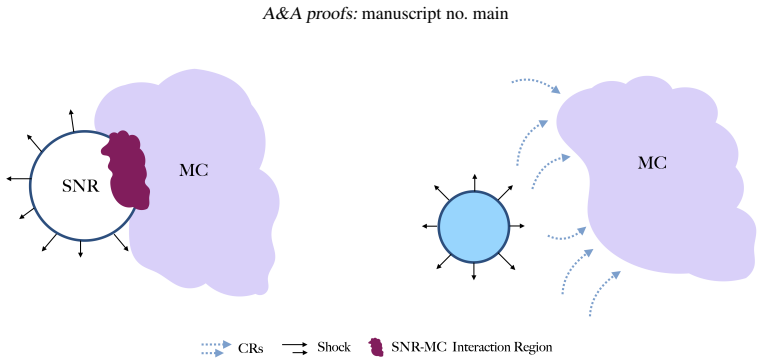
In the current era of very-high-energy (VHE) and ultra-high-energy (UHE) $\gamma$-ray astronomy, understanding Galactic PeVatrons and their acceleration mechanisms remains a primary objective. Recent LHAASO observations of the W51 Complex make it an ideal laboratory for investigating the origin of UHE emission, particularly due to the presence of massive and dense molecular environment surrounding multiple potential particle accelerators. In this work, we study two hadronic scenarios for the W51 Complex. First, we model the direct interaction between the SNR W51C and the nearby clouds in W51B, incorporating fresh particle acceleration, shock-driven adiabatic compression, and reacceleration of permeating Galactic cosmic rays. Second, we explore an accelerator-independent illumination scenario in which the W51B cloud acts as a long-term confinement region for high-energy particles injected during an earlier epoch. We find that the direct shock-cloud interaction scenario successfully reproduces the GeV emission observed by Fermi-LAT, but fails to account for the UHE emission detected by LHAASO. In contrast, the illumination scenario naturally explains the UHE spectrum, indicating that dense molecular clouds can efficiently confine and sustain energetic hadronic populations over long timescales. Although the inferred injection history is compatible with a young SNR origin, the source-independent nature of the illumination framework also permits other accelerators within the W51 Complex. Our results therefore identify dense molecular environments as the key structures sustaining historical PeVatron activity and shaping the observed UHE $\gamma$-ray emission.
Figures


Figures from the paper (2 more)


Reference graph
Works this paper leans on
-
[1]
Neutral pion emission from accelerated protons in the supernova remnant
Giuliani, A and others , journal=. Neutral pion emission from accelerated protons in the supernova remnant. 2011 , publisher=
2011
-
[2]
Nature , volume=
Ultrahigh-energy photons up to 1.4 petaelectronvolts from 12 -ray galactic sources , author=. Nature , volume=
-
[3]
The Astrophysical Journal Letters , volume=
Does or did the supernova remnant Cassiopeia A operate as a PeVatron? , author=. The Astrophysical Journal Letters , volume=. 2024 , publisher=
2024
-
[4]
arXiv preprint arXiv:2212.10677 , year=
What sources are the dominant Galactic cosmic-ray accelerators? , author=. arXiv preprint arXiv:2212.10677 , year=
-
[5]
The Astronomy and Astrophysics Review , volume=
The origin of galactic cosmic rays , author=. The Astronomy and Astrophysics Review , volume=. 2013 , publisher=
2013
-
[6]
Universe , volume=
The hunt for pevatrons: The case of supernova remnants , author=. Universe , volume=. 2021 , publisher=
2021
-
[7]
Handbook of X-ray and Gamma-ray Astrophysics , pages=
Nonthermal processes and particle acceleration in supernova remnants , author=. Handbook of X-ray and Gamma-ray Astrophysics , pages=. 2022 , publisher=
2022
-
[8]
International Journal of Modern Physics D , volume=
The origin of Galactic cosmic rays: challenges to the standard paradigm , author=. International Journal of Modern Physics D , volume=. 2019 , publisher=
2019
Show all 74 references
-
[9]
Astronomy & Astrophysics , volume=
LHAASO J2108+ 5157 as a molecular cloud illuminated by a supernova remnant , author=. Astronomy & Astrophysics , volume=. 2024 , publisher=
2024
-
[10]
Astronomy & Astrophysics , volume=
Dissecting the emission from LHAASO J0341+ 5258: Implications for future multiwavelength observations , author=. Astronomy & Astrophysics , volume=. 2024 , publisher=
2024
-
[11]
Supernova remnant
Cardillo, Martina and Amato, Elena and Blasi, Pasquale , journal=. Supernova remnant. 2016 , publisher=
2016
-
[12]
Astronomy & Astrophysics , volume=
The supernova remnant W44: Confirmations and challenges for cosmic-ray acceleration , author=. Astronomy & Astrophysics , volume=. 2014 , publisher=
2014
-
[13]
Astrophysical Journal, Part 1, vol
Radio emission from supernova remnants in a cloudy interstellar medium , author=. Astrophysical Journal, Part 1, vol. 260, Sept. 15, 1982, p. 625-634. Research supported by the Alfred P. Sloan Foundation , volume=
1982
-
[14]
The Astrophysical Journal , volume=
Disentangling the radio emission of the supernova remnant W51C , author=. The Astrophysical Journal , volume=. 2017 , publisher=
2017
-
[15]
Astronomy & Astrophysics , volume=
Molecular chemistry induced by a J-shock toward supernova remnant W51C , author=. Astronomy & Astrophysics , volume=. 2025 , publisher=
2025
-
[16]
Monthly Notices of the Royal Astronomical Society , volume=
Limits on compression of cosmic rays in supernova remnants , author=. Monthly Notices of the Royal Astronomical Society , volume=. 2023 , publisher=
2023
-
[17]
Evidence for particle acceleration approaching PeV energies in the
Cao, Zhen and others , journal=. Evidence for particle acceleration approaching PeV energies in the. 2024 , publisher=
2024
-
[18]
Koo, Bon-Chul and Kim, Kee-Tae and Seward, Frederick D , journal=
-
[19]
On the non-thermal emission from the supernova remnant
Fang, Jun and Zhang, Li , journal=. On the non-thermal emission from the supernova remnant. 2010 , publisher=
2010
-
[20]
HIGH-VELOCITY H i IS NOT ASSOCIATED WITH THE TeV SUPERNOVA REMNANT
Tian, WW and Leahy, DA , journal=. HIGH-VELOCITY H i IS NOT ASSOCIATED WITH THE TeV SUPERNOVA REMNANT. 2013 , publisher=
2013
-
[21]
Cardillo, Martina and others , journal=. The. 2019 , publisher=
2019
-
[22]
Interaction between the W51C Supernova Remnant and a Molecular Cloud. I. HI 21 Centimeter Line Observations , author=. The Astrophysical Journal , volume=. 1997 , publisher=
1997
-
[23]
Revealing
Jogler, T and Funk, S , journal=. Revealing. 2016 , publisher=
2016
-
[24]
Morphological and spectral properties of the
Aleksi. Morphological and spectral properties of the. Astronomy & astrophysics , volume=. 2012 , publisher=
2012
-
[25]
Astronomy & Astrophysics , volume=
The HI/OH/Recombination line survey of the inner Milky Way (THOR)-Survey overview and data release 1 , author=. Astronomy & Astrophysics , volume=. 2016 , publisher=
2016
-
[26]
Astronomy & Astrophysics , volume=
The HI/OH/Recombination line survey of the inner Milky Way (THOR): data release 2 and H I overview , author=. Astronomy & Astrophysics , volume=. 2020 , publisher=
2020
-
[27]
Applied Sciences , volume=
The LHAASO PeVatron bright sky: What we learned , author=. Applied Sciences , volume=. 2023 , publisher=
2023
-
[28]
arXiv preprint arXiv:2509.14867 , year=
Studying SNR-MC interactions as galactic PeVatrons in the era of CTAO and ASTRI Mini-Array , author=. arXiv preprint arXiv:2509.14867 , year=
-
[29]
Research in Astronomy and Astrophysics , year=
Investigating the Origin of Ultra-High-Energy -ray Sources fromSupernova Remnants Interacting with Molecular Clouds , author=. Research in Astronomy and Astrophysics , year=
-
[30]
Publications of the Astronomical Society of Japan , volume=
Massive star formation in W51 A triggered by cloud--cloud collisions , author=. Publications of the Astronomical Society of Japan , volume=. 2021 , publisher=
2021
-
[31]
Journal of High Energy Astrophysics , volume=
Exploring the supernova remnant contribution to the first LHAASO source catalog via passively illuminated interstellar clouds , author=. Journal of High Energy Astrophysics , volume=. 2024 , publisher=
2024
-
[32]
2012 , month =
Inoue, Tsuyoshi and Inutsuka, Shu-ichiro , title =. 2012 , month =. doi:10.1088/0004-637X/759/1/35 , url =
2012 doi
-
[33]
Science , volume=
Detection of the characteristic pion-decay signature in supernova remnants , author=. Science , volume=. 2013 , publisher=
2013
-
[34]
and Aharonian, F
Gabici, S. and Aharonian, F. A. and Casanova, S. , title =. Monthly Notices of the Royal Astronomical Society , volume =. 2009 , month =. doi:10.1111/j.1365-2966.2009.14832.x , url =
2009
-
[35]
On the emissivity of pi\^
Aharonian, FA and Atoyan, AM , journal=. On the emissivity of pi\^
-
[36]
, keywords =
Ultrahigh-energy -Rays from Past Explosions in Our Galaxy. , keywords =. doi:10.3847/1538-4357/ac4757 , archivePrefix =. 2112.08757 , primaryClass =
-
[37]
, keywords =
Dissecting the emission from LHAASO J0341+5258: Implications for future multiwavelength observations. , keywords =. doi:10.1051/0004-6361/202347258 , archivePrefix =. 2309.04729 , primaryClass =
-
[38]
Astronomy & Astrophysics , volume=
The dense gas mass fraction in the W51 cloud and its protoclusters , author=. Astronomy & Astrophysics , volume=. 2015 , publisher=
2015
-
[39]
The Astrophysical Journal , volume=
OH (1720 MHz) masers: a multiwavelength study of the interaction between the W51C supernova remnant and the W51B star forming region , author=. The Astrophysical Journal , volume=. 2013 , publisher=
2013
-
[40]
The Astrophysical Journal , volume=
Chandra observations of the W51C supernova remnant , author=. The Astrophysical Journal , volume=
-
[41]
1--0.1) , author=
XMM-Newton observation of the Galactic supernova remnant W51C (G49. 1--0.1) , author=. Astronomy & Astrophysics , volume=. 2014 , publisher=
2014
-
[42]
39th International Cosmic Ray Conference , pages=
Redefining the High-Energy gamma-ray morphology of the W51 complex with Fermi: detection of two extended components associated with W51B and W51C , author=. 39th International Cosmic Ray Conference , pages=
-
[43]
Astrophysics Source Code Library , pages=
GAMERA: Source modeling in gamma astronomy , author=. Astrophysics Source Code Library , pages=
-
[44]
The Astrophysical Journal , volume=
Diffuse galactic continuum gamma rays: a model compatible with EGRET data and cosmic-ray measurements , author=. The Astrophysical Journal , volume=. 2004 , publisher=
2004
-
[45]
Annual Review of Astronomy and Astrophysics , volume=
Magnetic fields in molecular clouds , author=. Annual Review of Astronomy and Astrophysics , volume=. 2012 , publisher=
2012
-
[46]
Astronomy & Astrophysics , volume=
Multiple accelerated particle populations in the Cygnus Loop with Fermi-LAT , author=. Astronomy & Astrophysics , volume=. 2021 , publisher=
2021
-
[47]
Astronomy & Astrophysics , volume=
The hi/oh/recombination line survey of the inner milky way (thor)-survey overview and data release 1 , author=. Astronomy & Astrophysics , volume=. 2016 , publisher=
2016
-
[48]
Astronomy & Astrophysics , volume=
A young supernova remnant illuminating nearby molecular clouds with cosmic rays , author=. Astronomy & Astrophysics , volume=. 2016 , publisher=
2016
-
[49]
Monthly Notices of the Royal Astronomical Society , volume =
Li, Hui and Chen, Yang , title =. Monthly Notices of the Royal Astronomical Society , volume =. 2012 , month =. doi:10.1111/j.1365-2966.2012.20270.x , url =
2012
-
[50]
31st International Cosmic Ray Conference (ICRC 2009) , year=
Discovery of a VHE gamma-ray source in the W51 region , author=. 31st International Cosmic Ray Conference (ICRC 2009) , year=
2009
-
[51]
The Astrophysical Journal , volume=
Milagro observations of multi-TeV emission from Galactic sources in the Fermi bright source list , author=. The Astrophysical Journal , volume=. 2009 , publisher=
2009
-
[52]
The Astrophysical Journal , volume=
3HWC: the third HAWC catalog of very-high-energy gamma-ray sources , author=. The Astrophysical Journal , volume=. 2020 , publisher=
2020
-
[53]
Brazilian Journal of Physics , volume=
Very local interstellar spectra for galactic electrons, protons and helium , author=. Brazilian Journal of Physics , volume=. 2014 , publisher=
2014
-
[54]
Publications of the Astronomical Society of the Pacific , volume=
emcee: the MCMC hammer , author=. Publications of the Astronomical Society of the Pacific , volume=. 2013 , publisher=
2013
-
[55]
Monthly Notices of the Royal Astronomical Society , volume=
Turbulent amplification of magnetic field and diffusive shock acceleration of cosmic rays , author=. Monthly Notices of the Royal Astronomical Society , volume=. 2004 , publisher=
2004
-
[56]
Astronomy & Astrophysics , volume=
On the spectrum of high-energy cosmic rays produced by supernova remnants in the presence of strong cosmic-ray streaming instability and wave dissipation , author=. Astronomy & Astrophysics , volume=. 2005 , publisher=
2005
-
[57]
Universe , volume=
Supernova Remnants in Gamma Rays , author=. Universe , volume=. 2024 , publisher=
2024
-
[58]
Handbook of X-ray and Gamma-ray Astrophysics , pages=
The Cherenkov telescope array , author=. Handbook of X-ray and Gamma-ray Astrophysics , pages=. 2024 , publisher=
2024
-
[59]
arXiv preprint arXiv:1907.07737 , year=
The southern wide-field Gamma-ray observatory (SWGO): A next-generation ground-based survey instrument for VHE Gamma-ray astronomy , author=. arXiv preprint arXiv:1907.07737 , year=
1907 arXiv
-
[60]
Journal of High Energy Astrophysics , volume=
The astri mini-array of cherenkov telescopes at the observatorio del teide , author=. Journal of High Energy Astrophysics , volume=. 2022 , publisher=
2022
-
[61]
Universe , volume=
Science with the ASTRI Mini-Array: From Experiment to Open Observatory , author=. Universe , volume=. 2024 , publisher=
2024
-
[62]
The Astrophysical Journal , volume=
Galactic cosmic rays in the local interstellar medium: Voyager 1 observations and model results , author=. The Astrophysical Journal , volume=. 2016 , publisher=
2016
-
[63]
Nature Astronomy , volume=
Cosmic ray measurements from Voyager 2 as it crossed into interstellar space , author=. Nature Astronomy , volume=. 2019 , publisher=
2019
-
[64]
Astroparticle Physics , volume=
On the cosmic ray spectrum from type II supernovae expanding in their red giant presupernova wind , author=. Astroparticle Physics , volume=. 2015 , publisher=
2015
-
[65]
Monthly Notices of the Royal Astronomical Society , volume=
Exploring particle escape in supernova remnants through gamma rays , author=. Monthly Notices of the Royal Astronomical Society , volume=. 2019 , publisher=
2019
-
[66]
Monthly Notices of the Royal Astronomical Society , volume=
From cosmic ray source to the Galactic pool , author=. Monthly Notices of the Royal Astronomical Society , volume=. 2014 , publisher=
2014
-
[67]
arXiv preprint arXiv:1009.5291 , year=
Constraints on the cosmic ray diffusion coefficient in the W28 region from gamma-ray observations , author=. arXiv preprint arXiv:1009.5291 , year=
-
[68]
Science , volume=
Peta--electron volt gamma-ray emission from the Crab Nebula , author=. Science , volume=. 2021 , publisher=
2021
-
[69]
Observation of cosmic-ray acceleration and escape from SNR W44 by LHAASO
Wu, Hanrong and Zha, Min and Bing, Zhang and Cao, Zhen and Aharion, Felix. Observation of cosmic-ray acceleration and escape from SNR W44 by LHAASO. Proceedings of 39th International Cosmic Ray Conference PoS(ICRC2025). doi:10.22323/1.501.0882
-
[70]
National Science Review , volume=
Ultrahigh-energy gamma-ray emission associated with black hole--jet systems , author=. National Science Review , volume=. 2025 , publisher=
2025
-
[71]
arXiv preprint arXiv:1203.3234 , year=
Fermi-LAT Discovery of GeV Gamma-ray Emission from the Vicinity of SNR W44 , author=. arXiv preprint arXiv:1203.3234 , year=
-
[72]
Astronomy & astrophysics , volume=
Cosmic-ray acceleration and escape from supernova remnant W44 as probed by Fermi-LAT and MAGIC , author=. Astronomy & astrophysics , volume=. 2025 , publisher=
2025
-
[73]
Interaction between the W51C Supernova Remnant and a Molecular Cloud. II. Discovery of Shocked CO and HCO+ , author=. The Astrophysical Journal , volume=
-
[74]
The Astrophysical Journal , volume=
Fermi LAT discovery of extended gamma-ray emission in the direction of supernova remnant W51C , author=. The Astrophysical Journal , volume=. 2009 , publisher=
2009
Reviewed August 3, 2026 · model on record in the stance chip above.
Discussion (0). Continue with ORCID to comment.