REVIEW 3 major objections 5 minor 247 references
Identifying and Distinguishing Quenching Galaxies with Spatially Resolved Star Formation in the Hubble Frontier Fields
T0 review · 3 major / 5 minor · reviewed 2026-08-01 · deepseek-v4-flash
Pith's one-line read The paper claims it can count the two main galaxy quenching pathways—inside-out and outside-in—directly from the spatial pattern of star formation, finding 129 inside-out and 70 outside-in among 1,437 Frontier Fields galaxies.
desk verdict First real-galaxy census of inside-out vs outside-in quenching from a TNG-trained classifier, but the simulation-to-observation label transfer is unvalidated, so the counts and trends are conditional. read the letter →
The pith
A machine-rendered reading of the paper's core claim, the machinery that carries it, and where it could break.
The reading
What carries the argument
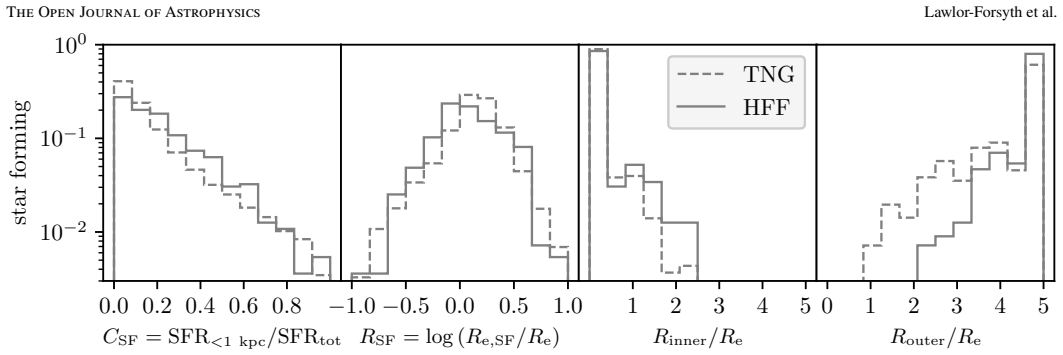
The argument is carried by four morphological metrics of star-formation placement—the concentration of star formation in the inner kiloparsec, the ratio of the star-forming half-light radius to the stellar half-light radius, and inner/outer truncation radii where the specific star-formation profile drops sharply—together with distance from the star-forming main sequence. These five features are measured from 20-annulus spectral energy distribution fits and passed to a k-nearest-neighbors classifier (five neighbors, inverse-distance weighting) whose training set is roughly 69,000 simulated galaxies with known star-forming/inside-out/outside-in labels. The kNN transfer is the mechanism that co
What would settle it
Take the 199 classified galaxies and measure their specific star-formation radial profiles with an independent tracer—e.g., Hα or rest-optical integral-field spectroscopy from a near-infrared space telescope. If a majority of the 129 inside-out candidates do not show centrally suppressed star formation, or the 70 outside-in candidates do not show outer truncation, then the simulation-to-real label transfer is the broken link. A second direct test: rerun the classifier with the same observed metrics but with training labels from an independent simulation with weaker AGN feedback; if the inside-
Extended reading notes
Core claim
The paper's central discovery is an empirical census: in 1,437 non-quenched Frontier Fields galaxies (stellar mass ≥ 10^8 solar masses, star formation rate ≥ 10^-3 solar masses per year, redshifts 0.14–0.67), four morphological metrics measuring where star formation lives inside a galaxy identify 129 galaxies whose star-formation distribution matches the inside-out quenching signature and 70 matching the outside-in signature. The inside-out population is more massive by Δlog M* = 0.8 (+0.2, −0.1) dex and is cluster-dominated (106/129); the outside-in population is field-dominated (25/70 in clusters). In clusters the inside-out fraction rises from small values at low mass to roughly 30% of al
Load-bearing premise
The claim collapses if the simulated galaxies used as the training set, after being degraded into mock observations, carry inside-out/outside-in labels that do not correspond to the same physical quenching mechanisms at work in real Frontier Fields galaxies; the paper explicitly concedes in Section 5.3 that the simulation's AGN feedback and environmental gas removal may be stronger than in the real Universe.
Editorial extensions
If this is right
- If the census is right, inside-out quenching is not confined to massive field centrals: it is also the dominant quenching mode for massive cluster galaxies, so environment does not uniquely select outside-in quenching.
- The 0.8 dex mass gap between the two pathways makes stellar mass the primary axis on which quenching mode is decided, with cluster membership adding another ~0.8 dex of mass to both populations.
- The mass-independence of the outside-in fraction (≲10% in clusters and field) implies that environment-driven outer-to-inner quenching affects only a minority of recently star-forming galaxies at these redshifts.
- For the most massive inside-out galaxies the fraction grows with phase-space-inferred infall time, suggesting long cluster residence promotes this pathway—possibly by funneling gas onto a central active nucleus—while the lack of infall-time dependence for outside-in is consistent with a fast (~1–1.5 Gyr) quenching event.
- The pipeline is designed to be applied to wide-area surveys now in planning, where the authors expect the same metrics to deliver quenching-pathway samples numbering in the thousands to millions.
Reading between the lines
- Editorial inference: If the simulation's AGN feedback is as strong as the paper itself allows (Section 5.3), the 129-galaxy inside-out count may be an overestimate of the real population; re-running the classifier with a simulation with weaker feedback is a direct way to bracket this uncertainty.
- Editorial inference: A simulation-free check is available: apply the same annulus metrics to galaxies with independent quenching signatures—such as jellyfish galaxies undergoing ram-pressure stripping or type-1 AGN hosts—and see whether they are labeled outside-in and inside-out respectively; this can be done with existing space-based imaging and spectroscopy.
- Editorial inference: If the method scales as the authors argue, the inside-out-to-outside-in number ratio as a function of stellar mass, environment, and infall time becomes a summary statistic that next-generation cosmological simulations can be tuned to match.
- Editorial inference: The cluster/field mass offset (0.8 dex) for both pathways may partly reflect the selection function of the Frontier Fields (lensed deeper, more massive cluster galaxies), so the environmental comparison should be re-examined in volume-limited surveys before adopting it as a physical result.
Editorial analysis
A structured set of objections, weighed in public.
Referee Report
Summary. The paper applies the morphological quenching metrics developed in Papers I/II (C_SF, R_SF, R_inner, R_outer) to 1,437 Hubble Frontier Fields galaxies with M* >= 1e8 Msun and SFR >= 1e-3 Msun/yr, deriving annular SED fits with FAST++. A k-nearest-neighbor classifier trained on 69,493 TNG50 galaxies, using the four metrics plus ΔSFMS, labels 129 galaxies as inside-out and 70 as outside-in quenching candidates. The paper then reports that inside-out candidates are ~0.8 dex more massive than outside-in candidates, that inside-out candidates are predominantly in clusters (106/129) while outside-in candidates are mainly in the field (25/70 in clusters), that the cluster inside-out fraction rises with stellar mass to ~30% of the non-quenched population, and that outside-in fractions are roughly mass-independent. The final sections discuss literature comparisons, survey feasibility, and limitations.
Significance. If the classification transfer from TNG50 to observed galaxies is valid, this would be one of the first observational censuses of inside-out versus outside-in quenching pathways using spatially resolved star-formation morphology at z ~ 0.3, with a valuable cluster-versus-field contrast. The paper has real strengths: careful sample construction, detailed annular photometry and SED fitting, explicit treatment of bCGs and PSF matching, and a welcome transparency about limitations. The comparison with independent CANUCS/UNCOVER SED catalogs in Appendix D is a useful consistency check. However, the central scientific claims — the counts, the mass offset, and the cluster/field fractions — all depend on the unvalidated assumption that TNG50 morphological neighborhoods correspond to real quenching pathways. The manuscript itself acknowledges that the Figure 5 agreement is by construction and that TNG's AGN feedback and environmental gas removal may be too strong. These are load-bearing caveats rather than routine disclaimers, so the significance is conditional on additional validation.
major comments (3)
- [§3.4, §4, Figure 5] The kNN transfer is validated only circularly. Every observed galaxy's inside-out/outside-in label is inherited from the nearest TNG50 training galaxies in the same metric space, so the KS-test agreement in Figure 5 is unsurprising; the text concedes this ('by construction these distributions should be similar', Section 4). This is not an independent test of the label transfer. The headline numbers (129/70), the 0.8 dex mass offset, and the 106/129 cluster fraction are all downstream of this transfer. I ask for a concrete validation or sensitivity analysis: e.g., leave-one-out cross-validation on the TNG training set, a mock-recovery test where synthetic observed galaxies with known injected profiles are classified, training on an independent simulation, or a threshold-based direct classifier as a cross-check. Without one of these, the central demographic claims are not established.
- [§3.4, §4, Figures 8–9] The near-exclusive green-valley membership of the classified quenching candidates is admitted in Section 4 to be 'likely a consequence' of including ΔSFMS in the kNN feature set. But Figures 8 and 9 then compute fractions relative to the non-quenched and green-valley samples. If the classifier is strongly influenced by ΔSFMS, the mass and environment trends of the resulting fractions could be partly manufactured by the classifier itself rather than discovered in the data. The random-forest feature-importance statement (ΔSFMS importance 0.25) does not resolve this, because it measures predictive power in the TNG training set, not independence of the HFF classification. Please rerun the classification without ΔSFMS, or with ΔSFMS replaced by a balanced control variable, and report whether the counts, the 0.8 dex mass offset, and the cluster/field fractions survive.
- [§5.3, Paper I comparison] Section 5.3 states that TNG's AGN feedback and environmental gas removal may be too strong, citing literature. This matters directly: the paper's observed clustering of inside-out candidates (106/129 in clusters) reverses the Paper I simulation expectation that inside-out galaxies are predominantly field galaxies. The kNN transfer is therefore being asked to support a qualitatively new claim precisely in the regime where the simulation's physical fidelity is most doubtful. The comparison of metric distributions in Figure 5 cannot detect this bias, since the training and target samples are matched by construction. A concrete test is needed: for example, compare the resolved SFR/sSFR profiles of observed candidates with TNG profiles at matched M*, environment, and ΔSFMS; or retrain on TNG after suppressing/boosting AGN-driven central suppression and see whether the HFF classifications rema
minor comments (5)
- [§2.3, Figure 6 caption] The phrase 'numbering 682, excluding 556 kNN-classified star forming galaxies' is confusing. Clarify the bookkeeping: 1437 primary − 199 pathway candidates − 556 star forming = 682 unclassified non-quenched galaxies.
- [§3.4] State explicitly which distance metric is used for the kNN classifier (Euclidean, standardized Mahalanobis, etc.). The text mentions inverse-distance weighting and k=5 but not the metric.
- [§4, Figure 5] Because the KS p-values in Figure 5 are acknowledged to be non-independent, consider moving this figure to an appendix or clearly labeling it as a sanity check rather than a validation.
- [§5.1] The comparison with Nelson et al. (2021) concerns 0.7 < z < 1.5, which does not fully overlap with this paper's 0.14 < z < 0.67. A sentence noting the redshift offset and its possible effect on quenching stage would help.
- [Appendix D] The statement of 'substantial overlap' with CANUCS/UNCOVER is qualitative and no figure is shown. Adding a quantitative comparison (e.g., the fraction of each sample in the same ΔSFMS bins) would strengthen this useful cross-check.
Circularity Check
Two supporting results—the Figure 5 metric-distribution 'agreement' and the green-valley exclusivity of candidates—are substantially built into the kNN classifier by construction; the central 129/70 demographics are not definitionally forced but rest on an unvalidated simulation-to-observation label transfer.
-
self definitional
[Section 4, Figure 5 paragraph]
"Of course, by construction these distributions should be similar, as in Section 3.4 we used the simulated galaxies as the training set, in order to classify the sample galaxies according to their morphological metrics."
Each HFF galaxy's inside-out/outside-in label is inherited from its k nearest TNG50 galaxies in the same standardized four-metric space (Section 3.4). Therefore the metric distributions of the labeled HFF galaxies are pulled toward the TNG populations used as the training set, so the reported KS agreement (p = 0.54...0.99) is expected and cannot validate the transfer. The paper presents this as 'encouraging' evidence, but the agreement is guaranteed by the labeling rule rather than by physical fidelity.
-
fitted input called prediction
[Section 4, after Figure 7]
"In both the field and cluster, inside-out and outside-in quenching galaxies are almost exclusively found in the green valley (also see Appendix D), which is likely a consequence of including the distance from the SFMS, ΔSFMS, in the kNN classification above."
ΔSFMS is one of the five kNN features. Because TNG quenching labels preferentially populate low ΔSFMS, a target galaxy far from the green valley is unlikely to be assigned an inside-out/outside-in label. The exclusivity result is thus at least partly created by the classifier input, as the paper concedes ('likely a consequence'); reporting it as a finding (and using it as the parent population in Figure 8) is partially circular. The random-forest importance (0.25) shows metrics matter too, so the effect is partial, not total.
full rationale
The central demographic claims (129 inside-out, 70 outside-in; 0.8 dex mass offset; 106/129 in clusters) are not definitionally forced: they are conditional on the kNN label transfer, and the cluster/field asymmetry actually reverses the Paper I expectation that inside-out galaxies are field-dominated, so the demographics have independent content given the transfer. The transfer itself, however, is justified by citation to the same authors' Papers I/II, whose TNG50-derived labels are not independently validated against observed quenching mechanisms; §5.3 concedes that TNG AGN feedback and environmental gas removal may be too strong, so the simulated morphological neighborhoods may not correspond to real quenching pathways. That is a correctness risk rather than circularity. The genuinely circular elements are the two supporting results: Figure 5's distributional 'validation' is by the paper's own admission a by-construction artifact of training-set reuse, and the near-exclusive green-valley membership is 'likely a consequence' of including ΔSFMS as a classifier input. These two steps mean part of the claimed support and one secondary finding reduce to the classifier's inputs; hence a partial-circularity score of 6 rather than a total collapse of the derivation.
Assumptions & free parameters
free parameters (7)
- SFMS ridge-line slope alpha and intercept beta =
not quoted; fitted to COSMOS-Web galaxies with M* <= 10^10.1 and extrapolated above
- Green valley threshold Delta_SFMS = -0.5 dex =
-0.5 dex
- kNN hyperparameters k=5, inverse-distance weighting =
k = 5
- Truncation metric thresholds: log sSFR <= -10.5 and |d log sSFR/dr| >= 1 =
-10.5 yr^-1, +/-1
- SFR averaging timescale = 100 Myr =
100 Myr
- Cluster membership boundary R_2D <= 0.5 R_200 and |V_LoS| <= 3.5 sigma_LoS =
0.5, 3.5
- H-band SNR threshold >= 3 in all 20 annuli out to 5 R_e =
SNR >= 3
assumptions (7)
- domain assumption The hybrid delayed-tau SFH with a multiplicative R in the final 100 Myr, BC03 SSPs, Chabrier IMF, and Calzetti dust describe the stellar populations in every annulus well enough for reliable M* and SFR radial profiles.
- domain assumption TNG50 internal inside-out/outside-in labels transfer to real HFF galaxies after mock-observation degradation.
- domain assumption FAST++ integrated and annular fits recover M* and SFR with the accuracy found in the mock tests of Paper II when applied to real HFF data.
- domain assumption COSMOS-Web CIGALE-derived SFRs and M* define an unbiased star-forming main sequence for 0.25 < z < 0.6 that can be applied to the HFF sample.
- domain assumption The Dou & Yu (2025) / Lawlor-Forsyth (2026) phase-space-to-infall-time mapping, calibrated on TNG300/TNG-Cluster, applies to HFF cluster galaxies at 0.14 < z < 0.67.
- domain assumption The SFR >= 10^-3 Msun/yr cut cleanly separates 'quenched' from 'non-quenched primary' galaxies without biasing quenching-pathway fractions.
- standard math kNN, KS tests, bootstrap resampling, and binomial errors are adequate statistical tools for the sample sizes used here.
Cite this review
Pith. "Pith review of Identifying and Distinguishing Quenching Galaxies with Spatially Resolved Star Formation in the Hubble Frontier Fields." pith.science (2026). https://pith.science/paper/UO4HUJIS
@misc{pith2026260721560,
  author       = {Pith},
  title        = {Pith review of: Identifying and Distinguishing Quenching Galaxies with Spatially Resolved Star Formation in the Hubble Frontier Fields},
  year         = {2026},
  howpublished = {\url{https://pith.science/paper/UO4HUJIS}},
  note         = {Machine review of arXiv:2607.21560}
}
abstract
We investigate the nature and prevalence of different quenching signatures for 1437 galaxies with $M_{*} \geqslant 10^{8}~\mathrm{M}_{\odot}$ and $\text{SFR} \geqslant 10^{-3}~M_{\odot}~\text{yr}^{-1}$ in the Hubble Frontier Fields through spatially resolved spectral energy distribution fitting with \texttt{FAST++}. We use the morphological metrics previously presented in our series of investigations to quantify the distribution of star formation, and use a $k$-nearest neighbors algorithm to classify quenching galaxies into different quenching pathways, including an inside-out pathway and an outside-in pathway. We find 129 galaxies have morphologies consistent with an inside-out quenching pathway, and 70 are consistent with an outside-in pathway. Inside-out quenching galaxies are $0.8^{+0.2}_{-0.1}~\text{dex}$ more massive compared to outside-in quenching galaxies, where both populations are more massive in clusters than the field, by $0.8^{+0.3}_{-0.1}~\text{dex}$. Inside-out quenching galaxies are found more often in clusters (106/129), compared to outside-in quenching galaxies (25/70). In clusters, the fraction of inside-out quenching galaxies strongly increases with mass, representing ${\sim}$30% of the non-quenched galaxy population at high masses. A milder evolution is seen in the field. The fraction of outside-in quenching galaxies is independent of mass, representing ${\lesssim}$10% of the non-quenched population, in both the cluster and field. We find no strong dependence for the fraction of any population with estimated infall time, except massive inside-out quenching galaxies, which increase in fraction with increasing infall time.
Figures


Figures from the paper (8 more)


Reference graph
Works this paper leans on
-
[1]
G., Moore, B., & Bower, R
Abadi, M. G., Moore, B., & Bower, R. G. 1999, MNRAS, 308, 947 Abdurro’uf, & Akiyama, M. 2018, MNRAS, 479, 5083 Abdurro’uf, Lin, Y.-T., Hirashita, H., et al. 2022, ApJ, 926, 81 Abdurro’uf, Coe, D., Jung, I., et al. 2023, ApJ, 945, 117
1999
-
[2]
Abell, G. O. 1958, ApJS, 3, 211
1958
-
[3]
O., Corwin, Jr., H
Abell, G. O., Corwin, Jr., H. G., & Olowin, R. P. 1989, ApJS, 70, 1
1989
-
[4]
Akeson, R., Armus, L., Bachelet, E., et al. 2019, arXiv:1902.05569
arXiv 2019
-
[5]
C., Helton, J
Alberts, S., Williams, C. C., Helton, J. M., et al. 2024, ApJ, 975, 85
2024
-
[6]
1993, A&AS, 97, 851
Alongi, M., Bertelli, G., Bressan, A., et al. 1993, A&AS, 97, 851
1993
-
[7]
1993, ARA&A, 31, 473
Antonucci, R. 1993, ARA&A, 31, 473
1993
-
[8]
C., Ilbert, O., Ciesla, L., et al
Arango-Toro, R. C., Ilbert, O., Ciesla, L., et al. 2025, A&A, 696, A159
2025
Show all 247 references
-
[9]
1999, MNRAS, 310, 540
Arnouts, S., Cristiani, S., Moscardini, L., et al. 1999, MNRAS, 310, 540
1999
-
[10]
2002, MNRAS, 329, 355 Astropy Collaboration, Robitaille, T
Arnouts, S., Moscardini, L., Vanzella, E., et al. 2002, MNRAS, 329, 355 Astropy Collaboration, Robitaille, T. P., Tollerud, E. J., et al. 2013, A&A, 558, A33 Astropy Collaboration, Price-Whelan, A. M., Sip˝ocz, B. M., et al. 2018, AJ, 156, 123 Astropy Collaboration, Price-Whel...
2002
-
[11]
2025, arXiv:2511.07542
Atek, H., Chisholm, J., Kokorev, V., et al. 2025, arXiv:2511.07542
2025
-
[12]
L., Morris, S
Balogh, M. L., Morris, S. L., Yee, H. K. C., Carlberg, R. G., & Ellingson, E. 1997, ApJL, 488, L75
1997
-
[13]
L., Morris, S
Balogh, M. L., Morris, S. L., Yee, H. K. C., Carlberg, R. G., & Ellingson, E. 1999, ApJ, 527, 54
1999
-
[14]
L., Navarro, J
Balogh, M. L., Navarro, J. F., & Morris, S. L. 2000, ApJ, 540, 113
2000
-
[15]
L., Schade, D., Morris, S
Balogh, M. L., Schade, D., Morris, S. L., et al. 1998, ApJL, 504, L75
1998
-
[16]
L., McGee, S
Balogh, M. L., McGee, S. L., Mok, A., et al. 2016, MNRAS, 456, 4364
2016
-
[17]
C., Flynn, K., & Gebhardt, K
Beers, T. C., Flynn, K., & Gebhardt, K. 1990, AJ, 100, 32
1990
-
[18]
2018, MNRAS, 477, 3014
Belfiore, F., Maiolino, R., Bundy, K., et al. 2018, MNRAS, 477, 3014
2018
-
[19]
F., Wolf, C., Meisenheimer, K., et al
Bell, E. F., Wolf, C., Meisenheimer, K., et al. 2004, ApJ, 608, 752
2004
-
[20]
1996, A&AS, 117, 393
Bertin, E., & Arnouts, S. 1996, A&AS, 117, 393
1996
-
[21]
E., et al
Bezanson, R., Labbe, I., Whitaker, K. E., et al. 2024, ApJ, 974, 92
2024
-
[22]
2007, MNRAS, 380, 339
Birnboim, Y., Dekel, A., & Neistein, E. 2007, MNRAS, 380, 339
2007
-
[23]
Bluck, A. F. L., Conselice, C. J., Ormerod, K., et al. 2024, ApJ, 961, 163 B¨ohringer, H., Schuecker, P., Guzzo, L., et al. 2004, A&A, 425, 367
2024
-
[24]
2019, A&A, 622, A103
Boquien, M., Burgarella, D., Roehlly, Y., et al. 2019, A&A, 622, A103
2019
-
[25]
2022, A&ARv, 30, 3
Boselli, A., Fossati, M., & Sun, M. 2022, A&ARv, 30, 3
2022
-
[26]
M., Popping, G., et al
Bottrell, C., Yesuf, H. M., Popping, G., et al. 2024, MNRAS, 527, 6506
2024
-
[27]
G., Benson, A
Bower, R. G., Benson, A. J., Malbon, R., et al. 2006, MNRAS, 370, 645 Bradaˇc, M., Huang, K.-H., Fontana, A., et al. 2019, MNRAS, 489, 99
2006
-
[28]
2025, astropy/photutils: 2.3.0, 2.3.0, Zenodo, doi: 10.5281/zenodo.17129028
Bradley, L., Sip˝ocz, B., Robitaille, T., et al. 2025, astropy/photutils: 2.3.0, 2.3.0, Zenodo, doi: 10.5281/zenodo.17129028
2025 doi
-
[29]
B., van Dokkum, P
Brammer, G. B., van Dokkum, P. G., & Coppi, P. 2008, ApJ, 686, 1503
2008
-
[30]
B., van Dokkum, P
Brammer, G. B., van Dokkum, P. G., Franx, M., et al. 2012, ApJS, 200, 13
2012
-
[31]
N., Phillipps, S., Kelvin, L
Bremer, M. N., Phillipps, S., Kelvin, L. S., et al. 2018, MNRAS, 476, 12
2018
-
[32]
1993, A&AS, 100, 647
Bressan, A., Fagotto, F., Bertelli, G., & Chiosi, C. 1993, A&AS, 100, 647
1993
-
[33]
Brinchmann, J., Charlot, S., White, S. D. M., et al. 2004, MNRAS, 351, 1151
2004
-
[34]
2003, MNRAS, 344, 1000
Bruzual, G., & Charlot, S. 2003, MNRAS, 344, 1000
2003
-
[35]
2013, in Secular Evolution of Galaxies, ed
Calzetti, D. 2013, in Secular Evolution of Galaxies, ed. J. Falc´on-Barroso & J. H. Knapen, Vol. 419 (Cambridge Univ. Press)
2013
-
[36]
C., et al
Calzetti, D., Armus, L., Bohlin, R. C., et al. 2000, ApJ, 533, 682
2000
-
[37]
B., Grillo, C., Rosati, P., et al
Caminha, G. B., Grillo, C., Rosati, P., et al. 2017, A&A, 600, A90
2017
-
[38]
2003, MNRAS, 342, 345
Cappellari, M., & Copin, Y. 2003, MNRAS, 342, 345
2003
-
[39]
C., Leja, J., Johnson, B
Carnall, A. C., Leja, J., Johnson, B. D., et al. 2019, ApJ, 873, 44
2019
-
[40]
C., McLure, R
Carnall, A. C., McLure, R. J., Dunlop, J. S., & Dav´e, R. 2018, MNRAS, 480, 4379
2018
-
[41]
C., McLeod, D
Carnall, A. C., McLeod, D. J., McLure, R. J., et al. 2023, MNRAS, 520, 3974
2023
-
[42]
C., Cullen, F., McLure, R
Carnall, A. C., Cullen, F., McLure, R. J., et al. 2024, MNRAS, 534, 325
2024
-
[43]
M., Kartaltepe, J
Casey, C. M., Kartaltepe, J. S., Drakos, N. E., et al. 2023, ApJ, 954, 31
2023
-
[44]
2016, A&A, 590, A31
Castellano, M., Amor´ın, R., Merlin, E., et al. 2016, A&A, 590, A31
2016
-
[45]
2003, PASP, 115, 763
Chabrier, G. 2003, PASP, 115, 763
2003
-
[46]
2024, MNRAS, 528, 2451
Chen, H., Xie, L., Wang, J., et al. 2024, MNRAS, 528, 2451
2024
-
[47]
E., Cˆot´e, P., et al
Cheng, I., Woods, T. E., Cˆot´e, P., et al. 2024, AJ, 167, 178
2024
-
[48]
2016, ApJ, 823, 102
Choi, J., Dotter, A., Conroy, C., et al. 2016, ApJ, 823, 102
2016
-
[49]
2021, A&A, 653, A6
Ciesla, L., Buat, V., Boquien, M., et al. 2021, A&A, 653, A6
2021
-
[50]
2017, A&A, 608, A41
Ciesla, L., Elbaz, D., & Fensch, J. 2017, A&A, 608, A41
2017
-
[51]
2018, A&A, 615, A61
Ciesla, L., Elbaz, D., Schreiber, C., Daddi, E., & Wang, T. 2018, A&A, 615, A61
2018
-
[52]
2016, A&A, 585, A43
Ciesla, L., Boselli, A., Elbaz, D., et al. 2016, A&A, 585, A43
2016
-
[53]
2023, A&A, 672, A191
Ciesla, L., G´omez-Guijarro, C., Buat, V., et al. 2023, A&A, 672, A191
2023
-
[54]
2024, A&A, 686, A128
Ciesla, L., Elbaz, D., Ilbert, O., et al. 2024, A&A, 686, A128
2024
-
[55]
2019, ApJ, 884, 85
Coe, D., Salmon, B., Bradaˇc, M., et al. 2019, ApJ, 884, 85
2019
-
[56]
G., Baugh, C
Cole, S., Lacey, C. G., Baugh, C. M., & Frenk, C. S. 2000, MNRAS, 319, 168
2000
-
[57]
A., et al
Collette, A., Kluyver, T., Caswell, T. A., et al. 2023, h5py/h5py: 3.8.0, v3.8.0, Zenodo, doi: 10.5281/zenodo.7560547
2023 doi
-
[58]
Conroy, C., & Gunn, J. E. 2010, ApJ, 712, 833 Cˆot´e, P., Woods, T. E., Hutchings, J. B., et al. 2025, JATIS, 11, 042202
2010
-
[59]
J., & Newell, E
Couch, W. J., & Newell, E. B. 1984, ApJS, 56, 143
1984
-
[60]
1967, ITIT, 13, 21
Cover, T., & Hart, P. 1967, ITIT, 13, 21
1967
-
[61]
A., & van de Voort, F
Crain, R. A., & van de Voort, F. 2023, ARA&A, 61, 473
2023
-
[62]
J., Springel, V., White, S
Croton, D. J., Springel, V., White, S. D. M., et al. 2006, MNRAS, 365, 11
2006
-
[63]
A., Helou, G., Magdis, G
Dale, D. A., Helou, G., Magdis, G. E., et al. 2014, ApJ, 784, 83
2014
-
[64]
J., Crain, R
Davies, J. J., Crain, R. A., Oppenheimer, B. D., & Schaye, J. 2020, MNRAS, 491, 4462
2020
-
[65]
Davies, L. J. M., Robotham, A. S. G., Lagos, C. d. P., et al. 2019, MNRAS, 483, 5444 De Lucia, G., & Blaizot, J. 2007, MNRAS, 375, 2 Di Criscienzo, M., Merlin, E., Castellano, M., et al. 2017, A&A, 607, A30 Di Matteo, T., Springel, V., & Hernquist, L. 2005, Natur, 433, 604
2019
-
[66]
1999, MNRAS, 309, 610
Diaferio, A. 1999, MNRAS, 309, 610
1999
-
[67]
Diaferio, A., & Geller, M. J. 1997, ApJ, 481, 633
1997
-
[68]
Diemer, B., Stevens, A. R. H., Lagos, C. d. P., et al. 2019, MNRAS, 487, 1529
2019
-
[69]
2019, MNRAS, 485, 4817
Donnari, M., Pillepich, A., Nelson, D., et al. 2019, MNRAS, 485, 4817
2019
-
[70]
D., et al
Donnari, M., Pillepich, A., Joshi, G. D., et al. 2021b, MNRAS, 500, 4004 Dor´e, O., Hirata, C., Wang, Y., et al. 2018, arXiv:1804.03628
2018 arXiv
-
[71]
2025, A&A, 699, A95
Dou, H., & Yu, H. 2025, A&A, 699, A95
2025
-
[72]
M., et al
Dressler, A., Smail, I., Poggianti, B. M., et al. 1999, ApJS, 122, 51
1999
-
[73]
2007, ApJL, 661, L33
Ebeling, H., Barrett, E., Donovan, D., et al. 2007, ApJL, 661, L33
2007
-
[74]
C., & Henry, J
Ebeling, H., Edge, A. C., & Henry, J. P. 2001, ApJ, 553, 668
2001
-
[75]
2014, ApJS, 211, 21
Ebeling, H., Ma, C.-J., & Barrett, E. 2014, ApJS, 211, 21
2014
-
[76]
C., Ebeling, H., Bremer, M., et al
Edge, A. C., Ebeling, H., Bremer, M., et al. 2003, MNRAS, 339, 913
2003
-
[77]
J., Willott, C., Alberts, S., et al
Eisenstein, D. J., Willott, C., Alberts, S., et al. 2026, ApJS, 283, 6
2026
-
[78]
2024, OJAp, 7, 121
Ellison, S., Ferreira, L., Wild, V., et al. 2024, OJAp, 7, 121
2024
-
[79]
L., Wilkinson, S., Woo, J., et al
Ellison, S. L., Wilkinson, S., Woo, J., et al. 2022, MNRAS, 517, L92 Euclid Collaboration, Scaramella, R., Amiaux, J., et al. 2022, A&A, 662, A112 Euclid Collaboration, Mellier, Y., Abdurro’uf, et al. 2025, A&A, 697, A1
2022
-
[80]
M., Willmer, C
Faber, S. M., Willmer, C. N. A., Wolf, C., et al. 2007, ApJ, 665, 265
2007
-
[81]
Fabian, A. C. 2012, ARA&A, 50, 455
2012
-
[82]
2026, in Encyclopedia of Astrophysics, Volume 4, Vol
Feldmann, R., & Bieri, R. 2026, in Encyclopedia of Astrophysics, Volume 4, Vol. 4, 576–599, doi: 10.1016/B978-0-443-21439-4.00111-5
2026 doi
-
[83]
J., Chatzikos, M., Guzm´an, F., et al
Ferland, G. J., Chatzikos, M., Guzm´an, F., et al. 2017, RMxAA, 53, 385
2017
-
[84]
Fix, E., & Hodges, J. L. 1951, Discriminatory Analysis—Nonparametric Discrimination: Consistency Properties, Tech. Rep. 4: 21-49-004, USAF School of Aviation Medicine, Randolph Field, TX
1951
-
[85]
Fix, E., & Hodges, J. L. 1989, International Statistical Review, 57, 238
1989
-
[86]
2011, A&A, 528, A46
Fumagalli, M., Gavazzi, G., Scaramella, R., & Franzetti, P. 2011, A&A, 528, A46
2011
-
[87]
P., Mather, J
Gardner, J. P., Mather, J. C., Clampin, M., et al. 2006, SSRv, 123, 485
2006
-
[88]
P., Mather, J
Gardner, J. P., Mather, J. C., Abbott, R., et al. 2023, PASP, 135, 068001
2023
-
[89]
2013, A&A, 553, A89
Gavazzi, G., Fumagalli, M., Fossati, M., et al. 2013, A&A, 553, A89
2013
-
[90]
Gensior, J., Kruijssen, J. M. D., & Keller, B. W. 2020, MNRAS, 495, 199
2020
-
[91]
1996, A&AS, 117, 113
Girardi, L., Bressan, A., Chiosi, C., Bertelli, G., & Nasi, E. 1996, A&AS, 117, 113
1996
-
[92]
2017, MNRAS, 466, 4731 G´omez, P
Goddard, D., Thomas, D., Maraston, C., et al. 2017, MNRAS, 466, 4731 G´omez, P. L., Nichol, R. C., Miller, C. J., et al. 2003, ApJ, 584, 210 G´omez, P. L., Valkonen, L. E., Romer, A. K., et al. 2012, AJ, 144, 79 23 The Open Journal of Astrophysics Lawlor-Forsyth et al. Gonz´al...
2017
-
[93]
A., Kocevski, D
Grogin, N. A., Kocevski, D. D., Faber, S. M., et al. 2011, ApJS, 197, 35
2011
-
[94]
E., & Gott, III, J
Gunn, J. E., & Gott, III, J. R. 1972, ApJ, 176, 1
1972
-
[95]
2019, ApJ, 870, 19
Guo, K., Peng, Y., Shao, L., et al. 2019, ApJ, 870, 19
2019
-
[96]
S., Li, Y., et al
Habouzit, M., Somerville, R. S., Li, Y., et al. 2022, MNRAS, 509, 3015
2022
-
[97]
R., Millman, K
Harris, C. R., Millman, K. J., van der Walt, S. J., et al. 2020, Natur, 585, 357
2020
-
[98]
Hester, J. A. 2006, ApJ, 647, 910
2006
-
[99]
L., et al
Hewitt, G., Sarron, F., Balogh, M. L., et al. 2025, MNRAS, 541, 409
2025
-
[100]
Hodges, J. L. 1958, ArM, 3, 469
1958
-
[101]
Hunter, J. D. 2007, CSE, 9, 90
2007
-
[102]
J., et al
Ilbert, O., Arnouts, S., McCracken, H. J., et al. 2006, A&A, 457, 841
2006
-
[103]
2014, MNRAS, 443, 1549
Jauzac, M., Cl´ement, B., Limousin, M., et al. 2014, MNRAS, 443, 1549
2014
-
[104]
D., Leja, J., Conroy, C., & Speagle, J
Johnson, B. D., Leja, J., Conroy, C., & Speagle, J. S. 2021, ApJS, 254, 22
2021
-
[105]
I., Caminha, G
Karman, W., Caputi, K. I., Caminha, G. B., et al. 2017, A&A, 599, A28
2017
-
[106]
Kauffmann, G., White, S. D. M., Heckman, T. M., et al. 2004, MNRAS, 353, 713
2004
-
[107]
Kawata, D., & Mulchaey, J. S. 2008, ApJL, 672, L103
2008
-
[108]
C., & Evans, N
Kennicutt, R. C., & Evans, N. J. 2012, ARA&A, 50, 531
2012
-
[109]
L., Smail, I., Bower, R
Kodama, T., Balogh, M. L., Smail, I., Bower, R. G., & Nakata, F. 2004, MNRAS, 354, 1103
2004
-
[110]
M., Faber, S
Koekemoer, A. M., Faber, S. M., Ferguson, H. C., et al. 2011, ApJS, 197, 36
2011
-
[111]
2011, ApJ, 734, 66
Koyama, Y., Kodama, T., Nakata, F., Shimasaku, K., & Okamura, S. 2011, ApJ, 734, 66
2011
-
[112]
2010, MNRAS, 403, 1611
Koyama, Y., Kodama, T., Shimasaku, K., et al. 2010, MNRAS, 403, 1611
2010
-
[113]
2018, PASJ, 70, S21
Koyama, Y., Hayashi, M., Tanaka, M., et al. 2018, PASJ, 70, S21
2018
-
[114]
G., Labb´e, I., et al
Kriek, M., van Dokkum, P. G., Labb´e, I., et al. 2009, ApJ, 700, 221
2009
-
[115]
Kristian, J., Sandage, A., & Westphal, J. A. 1978, ApJ, 221, 383
1978
-
[116]
R., Harrison, F
Kulkarni, S. R., Harrison, F. A., Grefenstette, B. W., et al. 2021, arXiv:2111.15608
2021 arXiv
-
[117]
J., Richard, J., Cl´ement, B., et al
Lagattuta, D. J., Richard, J., Cl´ement, B., et al. 2017, MNRAS, 469, 3946
2017
-
[118]
J., Richard, J., Bauer, F
Lagattuta, D. J., Richard, J., Bauer, F. E., et al. 2019, MNRAS, 485, 3738
2019
-
[119]
B., Tinsley, B
Larson, R. B., Tinsley, B. M., & Caldwell, C. N. 1980, ApJ, 237, 692
1980
-
[120]
R., Postman, M., Strauss, M
Lauer, T. R., Postman, M., Strauss, M. A., Graves, G. J., & Chisari, N. E. 2014, ApJ, 797, 82
2014
- [121]
-
[122]
L., McGee, S
Lawlor-Forsyth, C., Balogh, M. L., McGee, S. L., & Rudnick, G. H. 2026a, arXiv:2607.15638
-
[123]
C., Johnson, B
Leja, J., Carnall, A. C., Johnson, B. D., Conroy, C., & Speagle, J. S. 2019, ApJ, 876, 3
2019
-
[124]
D., Conroy, C., van Dokkum, P
Leja, J., Johnson, B. D., Conroy, C., van Dokkum, P. G., & Byler, N. 2017, ApJ, 837, 170
2017
-
[125]
2002, MNRAS, 334, 673
Lewis, I., Balogh, M., De Propris, R., et al. 2002, MNRAS, 334, 673
2002
-
[126]
2019, ApJ, 872, 50
Lin, L., Hsieh, B.-C., Pan, H.-A., et al. 2019, ApJ, 872, 50
2019
-
[127]
2011, MNRAS, 410, 166
Lintott, C., Schawinski, K., Bamford, S., et al. 2011, MNRAS, 410, 166
2011
-
[128]
J., Schawinski, K., Slosar, A., et al
Lintott, C. J., Schawinski, K., Slosar, A., et al. 2008, MNRAS, 389, 1179
2008
-
[129]
M., Koekemoer, A., Coe, D., et al
Lotz, J. M., Koekemoer, A., Coe, D., et al. 2017, ApJ, 837, 97 LSST Science Collaboration, Abell, P. A., Allison, J., et al. 2009, arXiv:0912.0201
2017 arXiv
-
[130]
2022, ApJ, 941, 205
Ma, W., Liu, K., Guo, H., et al. 2022, ApJ, 941, 205
2022
-
[131]
2014, ARA&A, 52, 415
Madau, P., & Dickinson, M. 2014, ARA&A, 52, 415
2014
-
[132]
A., & Raychaudhury, S
Mahajan, S., Mamon, G. A., & Raychaudhury, S. 2011, MNRAS, 416, 2882
2011
-
[133]
2018, MNRAS, 473, 663
Mahler, G., Richard, J., Cl´ement, B., et al. 2018, MNRAS, 473, 663
2018
-
[134]
W., & Ebeling, H
Mann, A. W., & Ebeling, H. 2012, MNRAS, 420, 2120
2012
-
[135]
2025, in Wide Field Camera 3 Instrument
Marinelli, M., Green, J., et al. 2025, in Wide Field Camera 3 Instrument
2025
-
[136]
A., Amen, L., Woods, T
Marshall, M. A., Amen, L., Woods, T. E., et al. 2025, MNRAS, 537, 1703
2025
-
[137]
2009, ApJ, 707, 250
Martig, M., Bournaud, F., Teyssier, R., & Dekel, A. 2009, ApJ, 707, 250
2009
-
[138]
C., Fanson, J., Schiminovich, D., et al
Martin, D. C., Fanson, J., Schiminovich, D., et al. 2005, ApJL, 619, L1
2005
-
[139]
C., Wyder, T
Martin, D. C., Wyder, T. K., Schiminovich, D., et al. 2007, ApJS, 173, 342
2007
-
[140]
B., et al
Matharu, J., Muzzin, A., Brammer, G. B., et al. 2021, ApJ, 923, 222
2021
-
[141]
C., et al
Matharu, J., Papovich, C., Simons, R. C., et al. 2022, ApJ, 937, 16
2022
-
[142]
McDonough, B., Curtis, O., & Brainerd, T. G. 2023, ApJ, 958, 19
2023
-
[143]
McDonough, B., Curtis, O., & Brainerd, T. G. 2025, ApJ, 978, 67
2025
-
[144]
L., van der Burg, R
McNab, K., Balogh, M. L., van der Burg, R. F. J., et al. 2021, MNRAS, 508, 157
2021
-
[145]
R., & Nulsen, P
McNamara, B. R., & Nulsen, P. E. J. 2007, ARA&A, 45, 117
2007
-
[146]
R., & Nulsen, P
McNamara, B. R., & Nulsen, P. E. J. 2012, New Journal of Physics, 14, 055023
2012
-
[147]
2016, ApJ, 817, 24
Medezinski, E., Umetsu, K., Okabe, N., et al. 2016, ApJ, 817, 24
2016
-
[148]
2016, A&A, 590, A30
Merlin, E., Amor´ın, R., Castellano, M., et al. 2016, A&A, 590, A30
2016
-
[149]
D., Schaye, J., Bower, R
Mitchell, P. D., Schaye, J., Bower, R. G., & Crain, R. A. 2020, MNRAS, 494, 3971
2020
-
[150]
G., Brammer, G
Momcheva, I. G., Brammer, G. B., van Dokkum, P. G., et al. 2016, ApJS, 225, 27
2016
-
[151]
1996, Natur, 379, 613
Moore, B., Katz, N., Lake, G., Dressler, A., & Oemler, A. 1996, Natur, 379, 613
1996
-
[152]
1998, ApJ, 495, 139
Moore, B., Lake, G., & Katz, N. 1998, ApJ, 495, 139
1998
-
[153]
1999, MNRAS, 304, 465
Moore, B., Lake, G., Quinn, T., & Stadel, J. 1999, MNRAS, 304, 465
1999
-
[154]
E., Treu, T., et al
Morishita, T., Abramson, L. E., Treu, T., et al. 2017, ApJ, 835, 254
2017
-
[155]
2019, A&A, 626, A61
Morselli, L., Popesso, P., Cibinel, A., et al. 2019, A&A, 626, A61
2019
-
[156]
L., Aird, J., et al
Moustakas, J., Coil, A. L., Aird, J., et al. 2013, ApJ, 767, 50
2013
-
[157]
Muzzin, A., Wilson, G., Yee, H. K. C., et al. 2012, ApJ, 746, 188
2012
-
[158]
2024, NatSR, 14, 3724
Nanayakkara, T., Glazebrook, K., Jacobs, C., et al. 2024, NatSR, 14, 3724
2024
-
[159]
B., Muzzin, A., van der Burg, R
Nantais, J. B., Muzzin, A., van der Burg, R. F. J., et al. 2017, MNRAS, 465, L104
2017
-
[160]
V., H¨außler, B., Marchesini, D., et al
Nedkova, K. V., H¨außler, B., Marchesini, D., et al. 2021, MNRAS, 506, 928
2021
-
[161]
2024, A&A, 686, A157
Nelson, D., Pillepich, A., Ayromlou, M., et al. 2024, A&A, 686, A157
2024
-
[162]
2018, MNRAS, 475, 624
Nelson, D., Pillepich, A., Springel, V., et al. 2018, MNRAS, 475, 624
2018
-
[163]
J., Tacchella, S., Diemer, B., et al
Nelson, E. J., Tacchella, S., Diemer, B., et al. 2021, MNRAS, 508, 219
2021
-
[164]
2023, MNRAS, 524, 2883
Niemiec, A., Jauzac, M., Eckert, D., et al. 2023, MNRAS, 524, 2883
2023
-
[165]
2026, ApJ, 1001, 82
Olsen, C., Gawiser, E., Welker, C., et al. 2026, ApJ, 1001, 82
2026
-
[166]
A., & Hudson, M
Oman, K. A., & Hudson, M. J. 2016, MNRAS, 463, 3083
2016
-
[167]
A., Hudson, M
Oman, K. A., Hudson, M. J., & Behroozi, P. S. 2013, MNRAS, 431, 2307
2013
-
[168]
S., Randall, S
Owers, M. S., Randall, S. W., Nulsen, P. E. J., et al. 2011, ApJ, 728, 27
2011
-
[169]
J., Davidzon, I., et al
Pagul, A., S´anchez, F. J., Davidzon, I., et al. 2024, ApJS, 273, 10
2024
-
[170]
2019, MNRAS, 484, 1702
Pasquali, A., Smith, R., Gallazzi, A., et al. 2019, MNRAS, 484, 1702
2019
-
[171]
2011, JMLR, 12, 2825
Pedregosa, F., Varoquaux, G., Gramfort, A., et al. 2011, JMLR, 12, 2825
2011
-
[172]
J., Renzini, A., & Carollo, M
Peng, Y., Lilly, S. J., Renzini, A., & Carollo, M. 2012, ApJ, 757, 4
2012
-
[173]
J., Renzini, A., & Carollo, M
Peng, Y., Lilly, S. J., Renzini, A., & Carollo, M. 2014, ApJ, 790, 95
2014
-
[174]
2015, Natur, 521, 192
Peng, Y., Maiolino, R., & Cochrane, R. 2015, Natur, 521, 192
2015
-
[175]
J., Kovaˇc, K., et al
Peng, Y., Lilly, S. J., Kovaˇc, K., et al. 2010, ApJ, 721, 193
2010
-
[176]
N., Hopkins, A
Phillipps, S., Bremer, M. N., Hopkins, A. M., et al. 2019, MNRAS, 485, 5559
2019
-
[177]
2019, MNRAS, 490, 3196 Planck Collaboration, Ade, P
Pillepich, A., Nelson, D., Springel, V., et al. 2019, MNRAS, 490, 3196 Planck Collaboration, Ade, P. A. R., Aghanim, N., et al. 2016, A&A, 594, A13
2019
-
[178]
M., Moretti, A., Gullieuszik, M., et al
Poggianti, B. M., Moretti, A., Gullieuszik, M., et al. 2017, ApJ, 844, 48
2017
-
[179]
M., Vulcani, B., Tomicic, N., et al
Poggianti, B. M., Vulcani, B., Tomicic, N., et al. 2025, A&A, 699, A357
2025
-
[180]
2012, ApJS, 199, 25
Postman, M., Coe, D., Ben´ıtez, N., et al. 2012, ApJS, 199, 25
2012
-
[181]
H., Ellison, S
Quai, S., Hani, M. H., Ellison, S. L., Patton, D. R., & Woo, J. 2021, MNRAS, 504, 1888
2021
-
[182]
2000, Sci, 288, 1617
Quilis, V., Moore, B., & Bower, R. 2000, Sci, 288, 1617
2000
-
[183]
Regos, E., & Geller, M. J. 1989, AJ, 98, 755
1989
-
[184]
2017, ApJ, 843, 128
Rhee, J., Smith, R., Choi, H., et al. 2017, ApJ, 843, 128
2017
-
[185]
2023, PASP, 135, 048001
Rigby, J., Perrin, M., McElwain, M., et al. 2023, PASP, 135, 048001
2023
-
[186]
D., & Parker, L
Roberts, I. D., & Parker, L. C. 2020, MNRAS, 495, 554
2020
-
[187]
2005, A&A, 433, 875 Roman Observations Time Allocation Committee, & Core Community Survey Definition Committees
Roediger, E., & Hensler, G. 2005, A&A, 433, 875 Roman Observations Time Allocation Committee, & Core Community Survey Definition Committees. 2025, arXiv:2505.10574
2005
-
[188]
2018, MNRAS, 480, 2544 S´anchez, S
Rowlands, K., Heckman, T., Wild, V., et al. 2018, MNRAS, 480, 2544 S´anchez, S. F., Avila-Reese, V., Hernandez-Toledo, H., et al. 2018, RMxAA, 54, 217 S´anchez-Bl´azquez, P., Peletier, R. F., Jim´enez-Vicente, J., et al. 2006, MNRAS, 371, 703
2018
-
[189]
Sarrouh, G. T. E., Asada, Y., Martis, N. S., et al. 2026, ApJS, 282, 3
2026
-
[190]
L., Croom, S
Schaefer, A. L., Croom, S. M., Allen, J. T., et al. 2017, MNRAS, 464, 121
2017
-
[191]
M., Simmons, B
Schawinski, K., Urry, C. M., Simmons, B. D., et al. 2014, MNRAS, 440, 889
2014
-
[192]
2007, ApJS, 172, 1
Scoville, N., Aussel, H., Brusa, M., et al. 2007, ApJS, 172, 1
2007
-
[193]
Seyfert, C. K. 1943, ApJ, 97, 28
1943
-
[194]
V., Lange-Vagle, D., Marchesini, D., et al
Shipley, H. V., Lange-Vagle, D., Marchesini, D., et al. 2018, ApJS, 235, 14
2018
-
[195]
B., Paquereau, L., et al
Shuntov, M., Akins, H. B., Paquereau, L., et al. 2025, A&A, 704, A339
2025
-
[196]
E., Whitaker, K
Skelton, R. E., Whitaker, K. E., Momcheva, I. G., et al. 2014, ApJS, 214, 24
2014
-
[197]
J., Lintott, C
Smethurst, R. J., Lintott, C. J., Simmons, B. D., et al. 2015, MNRAS, 450, 435
2015
-
[198]
N., et al
Sobral, D., Smail, I., Best, P. N., et al. 2013, MNRAS, 428, 1128 24 The Open Journal of Astrophysics Lawlor-Forsyth et al
2013
-
[199]
S., Steinhardt, C
Speagle, J. S., Steinhardt, C. L., Capak, P. L., & Silverman, J. D. 2014, ApJS, 214, 15
2014
-
[200]
2013, arXiv:1305.5422
Spergel, D., Gehrels, N., Breckinridge, J., et al. 2013, arXiv:1305.5422
2013 arXiv
-
[201]
2015, arXiv:1503.03757
Spergel, D., Gehrels, N., Baltay, C., et al. 2015, arXiv:1503.03757
2015 arXiv
-
[202]
2018, MNRAS, 475, 676
Springel, V., Pakmor, R., Pillepich, A., et al. 2018, MNRAS, 475, 676
2018
-
[203]
V., et al
Stark, D. V., et al. 2025, in Advanced Camera for Surveys Instrument
2025
-
[204]
K., Tonnesen, S., & Kopenhafer, C
Starkenburg, T. K., Tonnesen, S., & Kopenhafer, C. 2019, ApJL, 874, L17
2019
-
[205]
L., Jauzac, M., Acebron, A., et al
Steinhardt, C. L., Jauzac, M., Acebron, A., et al. 2020, ApJS, 247, 64
2020
-
[206]
Stevens, A. R. H., Diemer, B., Lagos, C. d. P., et al. 2019, MNRAS, 483, 5334
2019
-
[207]
Stevens, A. R. H., Lagos, C. d. P., Cortese, L., et al. 2021, MNRAS, 502, 3158
2021
-
[208]
Stevens, A. R. H., Brown, T., Diemer, B., et al. 2023, ApJL, 957, L19
2023
-
[209]
F., & Rood, H
Struble, M. F., & Rood, H. J. 1991, ApJS, 77, 363
1991
-
[210]
F., Hayward, C
Su, K.-Y., Hopkins, P. F., Hayward, C. C., et al. 2019, MNRAS, 487, 4393
2019
-
[211]
A., Weaver, J
Suess, K. A., Weaver, J. R., Price, S. H., et al. 2024, ApJ, 976, 101
2024
-
[212]
M., et al
Tacchella, S., Dekel, A., Carollo, C. M., et al. 2016, MNRAS, 458, 242
2016
-
[213]
M., Renzini, A., et al
Tacchella, S., Carollo, C. M., Renzini, A., et al. 2015, Sci, 348, 314
2015
-
[214]
M., F¨orster Schreiber, N
Tacchella, S., Carollo, C. M., F¨orster Schreiber, N. M., et al. 2018, ApJ, 859, 56
2018
-
[215]
Tan, V. Y. Y., Muzzin, A., Marsan, Z. C., et al. 2022, ApJ, 933, 30
2022
-
[216]
Taylor, M. B. 2005, ASPC, 347, 29
2005
-
[217]
A., Bell, E
Terrazas, B. A., Bell, E. F., Pillepich, A., et al. 2020, MNRAS, 493, 1888
2020
-
[218]
B., Brammer, G
Treu, T., Schmidt, K. B., Brammer, G. B., et al. 2015, ApJ, 812, 114
2015
-
[219]
2022, ApJ, 935, 110
Treu, T., Roberts-Borsani, G., Bradac, M., et al. 2022, ApJ, 935, 110
2022
-
[220]
S., & Werk, J
Tumlinson, J., Peeples, M. S., & Werk, J. K. 2017, ARA&A, 55, 389
2017
-
[221]
2011, ApJ, 729, 127
Umetsu, K., Broadhurst, T., Zitrin, A., Medezinski, E., & Hsu, L.-Y. 2011, ApJ, 729, 127
2011
-
[222]
2016, ApJ, 821, 116
Umetsu, K., Zitrin, A., Gruen, D., et al. 2016, ApJ, 821, 116
2016
-
[223]
M., & Padovani, P
Urry, C. M., & Padovani, P. 1995, PASP, 107, 803 van der Burg, R. F. J., Rudnick, G., Balogh, M. L., et al. 2020, A&A, 638, A112
1995
-
[224]
Vink, J. S. 2020, Galax, 8, 43
2020
-
[225]
E., et al
Virtanen, P., Gommers, R., Oliphant, T. E., et al. 2020, NatMe, 17, 261
2020
-
[226]
2020, NatRP, 2, 42
Vogelsberger, M., Marinacci, F., Torrey, P., & Puchwein, E. 2020, NatRP, 2, 42
2020
-
[227]
M., Oppenheimer, B
Voit, G. M., Oppenheimer, B. D., Bell, E. F., Terrazas, B., & Donahue, M. 2024, ApJ, 960, 28 Von Der Linden, A., Best, P. N., Kauffmann, G., & White, S. D. M. 2007, MNRAS, 379, 867
2024
-
[228]
B., et al
Vulcani, B., Treu, T., Schmidt, K. B., et al. 2015, ApJ, 814, 161
2015
-
[229]
B., et al
Vulcani, B., Treu, T., Schmidt, K. B., et al. 2016, ApJ, 833, 178
2016
-
[230]
2017, ApJ, 837, 126
Vulcani, B., Treu, T., Nipoti, C., et al. 2017, ApJ, 837, 126
2017
-
[231]
2024, ApJS, 270, 12
Wang, B., Leja, J., Labb´e, I., et al. 2024, ApJS, 270, 12
2024
-
[232]
I., Smith, B
Wang, X., Teplitz, H. I., Smith, B. M., et al. 2025, ApJ, 980, 74
2025
-
[233]
R., Cutler, S
Weaver, J. R., Cutler, S. E., Pan, R., et al. 2024, ApJS, 270, 7
2024
-
[234]
K., Schawinski, K., Caplar, N., et al
Weigel, A. K., Schawinski, K., Caplar, N., et al. 2017, ApJ, 845, 145
2017
-
[235]
2017, MNRAS, 465, 3291
Weinberger, R., Springel, V., Hernquist, L., et al. 2017, MNRAS, 465, 3291
2017
-
[236]
R., Tinker, J
Wetzel, A. R., Tinker, J. L., & Conroy, C. 2012, MNRAS, 424, 232
2012
-
[237]
R., Tinker, J
Wetzel, A. R., Tinker, J. L., Conroy, C., & van den Bosch, F. C. 2013, MNRAS, 432, 336
2013
-
[238]
E., van Dokkum, P
Whitaker, K. E., van Dokkum, P. G., Brammer, G., & Franx, M. 2012, ApJL, 754, L29
2012
-
[239]
E., Franx, M., Leja, J., et al
Whitaker, K. E., Franx, M., Leja, J., et al. 2014, ApJ, 795, 104
2014
-
[240]
C., Tacchella, S., Maseda, M
Williams, C. C., Tacchella, S., Maseda, M. V., et al. 2023, ApJS, 268, 64
2023
-
[241]
J., Doyon, R., Albert, L., et al
Willott, C. J., Doyon, R., Albert, L., et al. 2022, PASP, 134, 025002
2022
-
[242]
A., Cohen, S
Windhorst, R. A., Cohen, S. H., Jansen, R. A., et al. 2023, AJ, 165, 13
2023
-
[243]
S., Rieke, G
Wright, G. S., Rieke, G. H., Glasse, A., et al. 2023, PASP, 135, 048003
2023
-
[244]
J., Lagos, C
Wright, R. J., Lagos, C. d. P., Davies, L. J. M., et al. 2019, MNRAS, 487, 3740
2019
-
[245]
J., Somerville, R
Wright, R. J., Somerville, R. S., Lagos, C. d. P., et al. 2024, MNRAS, 532, 3417
2024
-
[246]
G., Adelman, J., Anderson, Jr., J
York, D. G., Adelman, J., Anderson, Jr., J. E., et al. 2000, AJ, 120, 1579
2000
-
[247]
C., et al
Zhang, C., Peng, Y., Ho, L. C., et al. 2021, ApJ, 911, 57 This paper was built using The Open Journal of Astrophysics LATEX template. The Open Journal of Astrophysics is a journal which provides fast and easy peer review for new papers in theastro-phsection of the arXiv, makin...
2021
Reviewed August 1, 2026 · model on record in the stance chip above.
Discussion (0). Sign in to comment.