REVIEW 4 major objections 5 minor 139 references
MWA and VLA Observations of Diffuse Radio Lobes in M 87
T0 review · 4 major / 5 minor · reviewed 2026-08-07 · deepseek-v4-flash
Pith's one-line read Wideband radio spectra of M87's 46-kiloparsec diffuse lobes show they were inflated by a continuously injected outflow with power of order $10^{44}$ erg/s, pointing to AGN activity rather than stellar winds.
desk verdict Solid wideband spectral study of M87's lobes with a load-bearing but addressable concern about missing short-spacing flux driving the break frequency. read the letter →
The pith
A machine-rendered reading of the paper's core claim, the machinery that carries it, and where it could break.
The reading
What carries the argument
The load-bearing machinery is the continuous-injection (CI) synchrotron-ageing model: the observed radio spectrum of a lobe is assumed to come from electrons injected continuously with a power-law spectrum that then cool by synchrotron and inverse-Compton losses, producing a break at $\nu_{\rm b}$. The break frequency, combined with the equipartition magnetic field through the synchrotron-lifetime formula, gives a radiative age; the age is then equated to the excavation time $t_{\rm exc}=E/P_{\rm out}$ to convert stored lobe energy into an outflow power. A second check is the JP impulsive-injection model applied to three steeper-spectrum subregions, whose age is corrected upward by a factor of 2–3 because the JP model underestimates dynamical ages for active lobes.
What would settle it
Measure the hard X-ray inverse-Compton emission from the diffuse lobes: because the CI model fixes the electron population, the predicted IC flux at a given field strength is specific, and an observed field far from $B_{\rm eq}\simeq10\,\mu$G would change the synchrotron age and outflow power enough to re-open the wind-versus-jet question.
Extended reading notes
Core claim
Using MWA and VLA images together with LOFAR and Effelsberg data, the authors reconstruct 100-arcsecond-resolution spectra of the lobes' diffuse region and fit them with a continuous-injection (CI) synchrotron model, obtaining an injection spectral index $\alpha_{\rm inj}\simeq-0.86$ and a break frequency $\nu_{\rm b}\simeq1.72$ GHz. Equipartition analysis gives $B_{\rm eq}\simeq10\,\mu$G and a minimum pressure of $\simeq9\times10^{-12}$ dyn cm$^{-2}$. Comparing the synchrotron lifetime with the sound crossing time of the lobes yields an age of about 30–50 Myr, and equating that age to the excavation time gives outflow powers of $\sim(0.2-2)\times10^{44}$ erg s$^{-1}$ for the diffuse lobes and $\sim(1-11)\times10^{44}$ erg s$^{-1}$ for the whole source. From these numbers the paper concludes that galactic stellar winds cannot account for the lobes, the jet can, and the current AGN wind would need an average factor $\sim10^2$ enhancement over the past 30–50 Myr to be the driver.
Load-bearing premise
The age and power estimates assume that the measured spectral break is synchrotron ageing of a single continuously injected electron population, so the break frequency can be converted into a radiative lifetime; if the break instead comes from multiple outbursts, re-acceleration, adiabatic losses, or a non-power-law injection spectrum, the 30–50 Myr age, the outflow powers, and the wind-versus-jet discrimination do not follow.
Editorial extensions
If this is right
- If the lobes are continuously inflated over 30–50 Myr, the present-day AGN wind power of roughly $10^{41-42}$ erg s$^{-1}$ cannot be the sole driver; the nucleus must have been on average about $10^2$ times more active in the past.
- Galactic stellar winds are ruled out as the main driver: the star formation rate required, roughly 600–4700 $M_\odot$ yr$^{-1}$ over the past 30–50 Myr, is orders of magnitude above M87's observed upper limit of $<0.08\,M_\odot$ yr$^{-1}$.
- Jet power estimates assembled from different scales fall in the range $0.1\times10^{44}$ to $10\times10^{44}$ erg s$^{-1}$, bracketing the required outflow power of about $10^{44}$ erg s$^{-1}$.
- The spectral uniformity and sharp edges of the lobes imply a turbulent, externally confined plasma, supporting the picture of a continuously injected, pressure-balanced outflow.
- The agreement between the sound crossing time (about 54 Myr) and the synchrotron-based age supports the adopted 30° viewing angle and the continuous-injection scenario over an interrupted single outburst.
Reading between the lines
- If the CI interpretation holds, the same spectral-age machinery could be applied to the lobes of other nearby low-luminosity AGN to map AGN duty cycles from the ratio of required past-to-present outflow power.
- The factor-of-five gap between the lobe minimum pressure ($\simeq9\times10^{-12}$ dyn cm$^{-2}$) and the surrounding thermal pressure suggests that the lobes must carry substantial magnetic pressure or are not in pressure balance, which would change the excavation time and power estimates.
- The misalignment between the lobe axis and the parsec-scale jet hints that the jet direction may have changed over tens of Myr; a decade-long proper-motion program on the lobe edges could look for the roughly 830 km s$^{-1}$ expansion that the sound-crossing argument predicts.
Signed reviews
Editorial analysis
A structured set of objections, weighed in public.
Referee Report
Summary. This paper presents MWA (70-230 MHz) and VLA (1-4 GHz) observations of the ~46 kpc diffuse radio lobes of M87, supplemented by LOFAR, 325 MHz VLA, and 10.55 GHz Effelsberg data. After flux scaling to the RCB scale, the authors construct 60 MHz-10.55 GHz spectra of the lobes' diffuse region and three subregions, fit a continuous-injection model with alpha_inj = -0.86 and nu_b = 1.72 GHz to the diffuse region and JP models with nu_b = 6-13 GHz to the subregions, derive B_eq ~ 10 uG from equipartition, and convert the break frequencies into synchrotron ages of 30-50 Myr (including a literature-based correction for the JP ages). Combining these ages with pressure/volume energy estimates yields outflow powers of ~(0.2-2) x 10^44 erg/s for the diffuse lobes and ~(1-11) x 10^44 erg/s for the whole source. The paper argues that stellar winds cannot supply this power, that the AGN jet can, and that the current AGN wind is insufficient unless average AGN activity was ~100 times higher over the past 30-50 Myr.
Significance. The observational core is a useful contribution: the imaging and flux-scaling procedures are standard and transparent, the wideband spectral coverage is significantly better than earlier work, and the spectral index maps and flux tables will be of lasting value. If the synchrotron-aging interpretation is correct, the paper provides one of the more complete energy budgets for M87's large-scale lobes and a concrete constraint on AGN feedback. The main caveat is that the quantitative age and power claims are conditional on identifying the 1.72 GHz break as single-population CI/JP radiative aging; this assumption, together with the short-spacing systematics at high frequency, needs to be tested explicitly before the headline numbers can be regarded as robust.
major comments (4)
- [§3.3.2, Table 1, Fig. 7] The six highest-frequency S-band images are excluded because their total flux drops when short baselines are absent, but the retained S-band images are not shown to be immune to the same effect. Table 1 gives the S-band uvmin growing from 0.21 to 0.38 kλ, and the footnote in §3.3.2 states that M87's ~9' lobes require baselines shorter than ~0.38 kλ. If the high-frequency diffuse flux is progressively underestimated across the retained points, the fitted CI break at nu_b = 1.72 GHz would be an imaging artifact rather than a synchrotron-aging break, which would invalidate the age from Eq. (3) and the excavation-time powers from Eq. (4). I request a quantitative stability test: refit the CI model with the highest retained S-band points removed, compare the reconstructed diffuse flux against independent single-dish/Effelsberg measurements at comparable frequencies, and vary the lower uv cutoff to show that nu_b is stable.
- [§3.3.2–§3.4, Table 5] The central 'continuously injected outflow' conclusion identifies the 1.72 GHz spectral break with radiative aging of a single CI electron population, but curvature of this kind can also result from a superposition of multiple outbursts, re-acceleration, adiabatic losses, or a non-power-law injection spectrum. The JP fits do not remove this degeneracy: the fitted break frequencies for R1–R3 are 5.7–12.7 GHz, all above the highest retained frequency (~3.5 GHz), so the JP ages are model extrapolations rather than direct measurements. I ask for a formal comparison (e.g., CI versus two-population or interrupted-CI fits to the same 48-point spectrum, with an information criterion) or, failing that, an explicit statement that the age and power numbers are conditional on the single-population aging interpretation.
- [§4.1 and end of §3.4] The sound-crossing time does not independently confirm the CI age. The raw JP lifetimes are 11–15 Myr, and the agreement with t_s ~ 54 Myr is obtained only after multiplying by a literature-based factor of 2–3 (Turner et al. 2018a; Mahatma et al. 2019). As written, the 'confirmation' is built into the adopted correction. Please show the uncorrected comparison explicitly and justify the applicability of the 2–3 correction to these specific lobe regions, or soften the claim that continuous injection is confirmed by the sound-crossing time.
- [§4.2.2] There are two inconsistent estimates of the current AGN-wind power in this section. The first, P_w = 0.5 Mdot_w v_w^2 with Mdot_w ~ 0.1–0.2 M_sun/yr and v_w ~ 0.2c, gives P_w up to 2.3 x 10^44 erg/s, which is sufficient to produce the lobes' diffuse components; the second, Eq. (5), gives ~10^41–10^42 erg/s. The conclusion that the current wind cannot power the lobes rests entirely on the second estimate and on the adopted launching radius R_launch ~ 10^2–10^4 R_s. The authors should reconcile these estimates or explicitly identify the assumption that rules out the crude upper limit, and should propagate the resulting uncertainty into the 'few percent' statement.
minor comments (5)
- [§4.2.1] A typical supernova releases 10^51 erg, not 10^51 erg s^-1; the units should be corrected.
- [Throughout] The telescope name is written inconsistently as 'MW A' and 'MWA'; use one form consistently.
- [Figs. 7–8] The model labels 'CI: b = 1.72 = 0.86' and 'JP: b = 12.71 = 0.86' are missing the symbol for the injection spectral index; the labels should read, e.g., 'alpha_inj = -0.86'.
- [§3.4, Eq. (2)] Equation (2) appears to have unbalanced parentheses; please check the typeset form of the Beck & Krause (2005) expression.
- [§3.5] The radio luminosity is computed assuming the spectrum extends from 10 MHz to 100 GHz, but the integration limits and the spectral model used outside the observed band are not specified; a brief statement would help reproducibility.
Circularity Check
No significant circularity: the spectral-aging ages and outflow powers are derived from independent fitted and external inputs, with no equation reducing to its own inputs.
full rationale
The paper's central derivation chain is self-contained against its data. The CI and JP spectral fits are performed on observed flux densities; the break frequency and injection index are free parameters, and Eq. (3) converts the fitted break into a radiative lifetime using an independently estimated equipartition field. Fixing alpha_inj to the CI value in the JP fits is an explicit modeling convention, not a construction that forces the JP break frequencies—those remain fitted outputs (5.7–12.7 GHz). The factor 2–3 JP-to-dynamical-age correction is taken from external literature, and the sound-crossing time is computed from X-ray temperature, density profiles, and geometry, independent of the radio fits; its agreement with the CI/JP age range is a consistency check, not an input. Outflow powers via Eq. (4) combine independent energy estimates with the age, and are cross-checked against the 1% radio-efficiency and Pkin–L151 relations. Even where B_eq enters both the energy and lifetime estimates, the dependence is not an identity that would make the power prediction equivalent to a fitted parameter. The paper's own caveats about possible low chi-square values and the sensitivity of tsyn to B_eq assumptions are legitimate limitations rather than circularity, and the skeptic's short-spacing concern is a data-reduction risk that could affect the inferred break, not a logical reduction of an output to an input. The one coauthored reference used for Pkin–L151 is not load-bearing, since the jet-power conclusion also rests on multiple external estimates. No step qualifies as self-definitional, fitted-input-called-prediction, or self-citation-load-bearing.
Assumptions & free parameters
free parameters (9)
- CI injection spectral index alpha_inj =
-0.86 +/- 0.01
- CI break frequency nu_b =
1.72 +/- 0.28 GHz
- JP break frequency nu_b, R1 =
12.7 +/- 2.3 GHz
- JP break frequency nu_b, R2 =
12.1 +/- 1.9 GHz
- JP break frequency nu_b, R3 =
5.7 +/- 0.9 GHz
- proton-to-electron ratio K0 =
100
- lobe viewing angle theta_lobe =
30 degrees
- radio-to-outflow power efficiency =
1%
- volume filling factor f =
1.0
assumptions (5)
- domain assumption The lobes' electron population follows the CI or JP synchrotron aging models with an initial power-law injection spectrum, and the spectral break is due to radiative losses.
- domain assumption The magnetic field and relativistic particles are in equipartition, with K0=100, f=1, and l=46 kpc.
- domain assumption The lobes expand at approximately the ICM sound speed and are in pressure balance, giving ts ~ 54 Myr.
- domain assumption Radio luminosity traces outflow power through a 1% efficiency or through the Pkin-L151 MHz relation.
- domain assumption The diffuse radio emission uniformly fills both lobes, and the selected 5-500 sigma region is representative of the whole diffuse component.
Cite this review
Pith. "Pith review of MWA and VLA Observations of Diffuse Radio Lobes in M 87." pith.science (2026). https://pith.science/paper/UOHGXGX5
@misc{pith2026250521929,
  author       = {Pith},
  title        = {Pith review of: MWA and VLA Observations of Diffuse Radio Lobes in M 87},
  year         = {2026},
  howpublished = {\url{https://pith.science/paper/UOHGXGX5}},
  note         = {Machine review of arXiv:2505.21929}
}
abstract
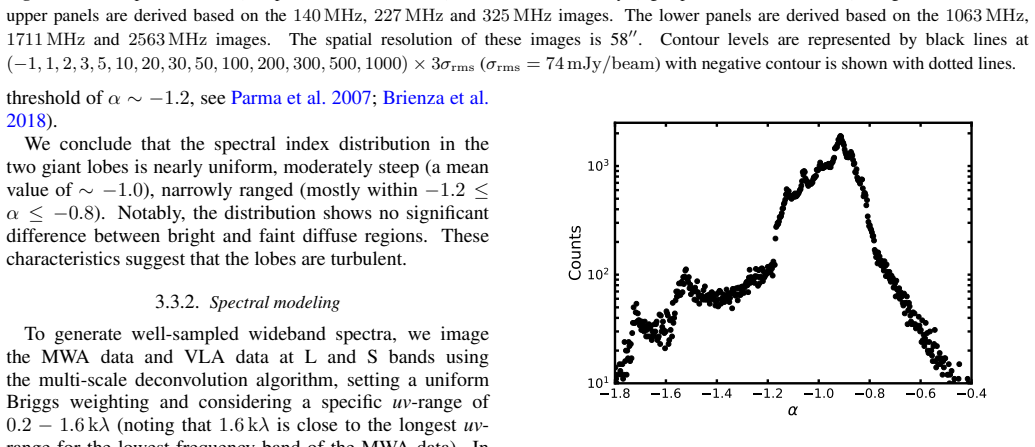
This study investigates the projected, quasi-symmetric $\sim\rm46\,kpc$-scale diffuse radio lobes surrounding the giant elliptical galaxy M\,87, utilizing well-sampled wideband ($\rm 60\,MHz-10.55\,GHz$) observations from MWA and VLA, supplemented by data from LOFAR and Effelsberg. The observed structures feature sharp edges and filaments, with nearly uniform and moderately steep spectral indices ($\alpha$, mostly within $-1.2\leq\alpha\leq-0.8$), indicating turbulence. Well-sampled radio spectra for the lobes' diffuse region are derived using the continuous injection (CI) model (with $\alpha_{\rm inj}\simeq-0.86$ and $\nu_{\rm b}\simeq1.72\rm\,GHz$), and for its three localized regions using the impulsive injection model (e.g., JP model). From energy equipartition analysis, we estimate the typical magnetic field strength in the lobes' diffuse region to be $B_{\rm eq}\simeq10\,\mu\rm G$. The age of the lobes is estimated as $\sim30-50\,\rm~Myr$, based on lifetimes derived from the CI and JP models and sound crossing time. Outflow powers of $\sim(0.2-2)\times10^{44}\,\rm erg\,s^{-1}$ for the lobes' diffuse components and $\sim(1-11)\times10^{44}\,\rm erg\,s^{-1}$ for the whole source are calculated. With this power assessment, we conclude that the galactic stellar wind has a negligible effect, the active galactic nucleus (AGN)-driven jet can provide the necessary energy for the whole system. Furthermore, we argue that while the wind driven by current AGN activity is unlikely to power the lobes' diffuse components, an average enhancement of AGN activity by a factor of $\sim 10^2$ over the past $\sim 30-50$ Myr remains plausible.
Figures


Figures from the paper (8 more)




Reference graph
Works this paper leans on
-
[2]
Avachat, S. S., Perlman, E. S., Adams, S. C., et al. 2016, ApJ, 832, 3, doi: 10.3847/0004-637X/832/1/3
-
[3]
Baars, J. W. M., Genzel, R., Pauliny-Toth, I. I. K., & Witzel, A. 1977, A&A, 61, 99
1977
-
[4]
P., Johnston-Hollitt, M., Trott, C
Beardsley, A. P., Johnston-Hollitt, M., Trott, C. M., et al. 2019, PASA, 36, e050, doi: 10.1017/pasa.2019.41
-
[5]
2005, Astronomische Nachrichten, 326, 414, doi: 10.1002/asna.200510366
Beck, R., & Krause, M. 2005, Astronomische Nachrichten, 326, 414, doi: 10.1002/asna.200510366
-
[6]
Bicknell, G. V ., & Begelman, M. C. 1996, ApJ, 467, 597, doi: 10.1086/177636 Bˆırzan, L., Rafferty, D. A., McNamara, B. R., Wise, M. W., &
-
[7]
Nulsen, P. E. J. 2004, ApJ, 607, 800, doi: 10.1086/383519
doi:10.1086/383519 2004
-
[8]
2022, MNRAS, 514, 5141, doi: 10.1093/mnras/stac1682
Blandford, R., & Globus, N. 2022, MNRAS, 514, 5141, doi: 10.1093/mnras/stac1682
-
[9]
2019, ARA&A, 57, 467, doi: 10.1146/annurev-astro-081817-051948
Blandford, R., Meier, D., & Readhead, A. 2019, ARA&A, 57, 467, doi: 10.1146/annurev-astro-081817-051948
Show all 139 references
-
[10]
D., & Rees, M
Blandford, R. D., & Rees, M. J. 1974, MNRAS, 169, 395, doi: 10.1093/mnras/169.3.395
1974 doi
-
[11]
D., Cairns, I., Kaplan, D
Bowman, J. D., Cairns, I., Kaplan, D. L., et al. 2013, PASA, 30, e031, doi: 10.1017/pas.2013.009
2013 doi
-
[12]
P., & Komissarov, S
Bowman, M., Leahy, J. P., & Komissarov, S. S. 1996, MNRAS, 279, 899, doi: 10.1093/mnras/279.3.899
1996 doi
-
[13]
2018, A&A, 618, A45, doi: 10.1051/0004-6361/201832846
Brienza, M., Morganti, R., Murgia, M., et al. 2018, A&A, 618, A45, doi: 10.1051/0004-6361/201832846
2018 doi
-
[14]
Briggs, D. S. 1995, in American Astronomical Society Meeting
1995
-
[15]
L., Perley, R
Carilli, C. L., Perley, R. A., Dreher, J. W., & Leahy, J. P. 1991, ApJ, 383, 554, doi: 10.1086/170813
1991 doi
-
[16]
2016, Nature, 533, 504, doi: 10.1038/nature18006
Cheung, E., Bundy, K., Cappellari, M., et al. 2016, Nature, 533, 504, doi: 10.1038/nature18006
2016 doi
-
[17]
Christensen, J. A. 1996, ApJ, 467, 551, doi: 10.1086/177633
1996 doi
-
[18]
Condon, J. J. 1992, ARA&A, 30, 575, doi: 10.1146/annurev.aa.30.090192.003043
1992
-
[19]
J., Cotton, W
Condon, J. J., Cotton, W. D., & Broderick, J. J. 2002, AJ, 124, 675, doi: 10.1086/341650
2002 doi
-
[20]
Cordey, R. A. 1987, MNRAS, 227, 695, doi: 10.1093/mnras/227.3.695
1987 doi
-
[21]
Cornwell, T. J. 2008, IEEE Journal of Selected Topics in Signal Processing, 2, 793, doi: 10.1109/JSTSP.2008.2006388
2008
-
[22]
M., & Aharonian, F
Crocker, R. M., & Aharonian, F. 2011, PhRvL, 106, 101102, doi: 10.1103/PhysRevLett.106.101102
2011 doi
-
[23]
M., Mizuno, Y ., et al
Cruz-Osorio, A., Fromm, C. M., Mizuno, Y ., et al. 2022, Nature Astronomy, 6, 103, doi: 10.1038/s41550-021-01506-w de Gasperin, F., Orr´u, E., Murgia, M., et al. 2012, A&A, 547, A56, doi: 10.1051/0004-6361/201220209 de Gasperin, F., Vink, J., McKean, J. P., et al. 2020, A&A, 6...
2022 doi
-
[24]
2019, MNRAS, 488, 1199, doi: 10.1093/mnras/stz1761
Devereux, N. 2019, MNRAS, 488, 1199, doi: 10.1093/mnras/stz1761
2019 doi
-
[25]
J., Lang, D., et al
Dey, A., Schlegel, D. J., Lang, D., et al. 2019, AJ, 157, 168, doi: 10.3847/1538-3881/ab089d Di Matteo, T., Allen, S. W., Fabian, A. C., Wilson, A. S., & Young, A. J. 2003, ApJ, 582, 133, doi: 10.1086/344504
2019 doi
-
[26]
W., & Feigelson, E
Dreher, J. W., & Feigelson, E. D. 1984, Nature, 308, 43, doi: 10.1038/308043a0
1984 doi
-
[27]
2020, ApJ, 896, 114, doi: 10.3847/1538-4357/ab93b3
Duan, X., & Guo, F. 2020, ApJ, 896, 114, doi: 10.3847/1538-4357/ab93b3
2020 doi
- [28]
-
[29]
Line, J. L. B. 2020, PASA, 37, e037, doi: 10.1017/pasa.2020.29 20 W U ET . AL
2020 doi
-
[30]
2018, MNRAS, 481, 2878, doi: 10.1093/mnras/sty2397
Ehlert, K., Weinberger, R., Pfrommer, C., Pakmor, R., & Springel, V . 2018, MNRAS, 481, 2878, doi: 10.1093/mnras/sty2397
2018 doi
-
[31]
2021, MNRAS, 503, 1327, doi: 10.1093/mnras/stab551 EHT MWL Science Working Group, Algaba, J
Ehlert, K., Weinberger, R., Pfrommer, C., & Springel, V . 2021, MNRAS, 503, 1327, doi: 10.1093/mnras/stab551 EHT MWL Science Working Group, Algaba, J. C., Anczarski, J., et al. 2021, ApJL, 911, L11, doi: 10.3847/2041-8213/abef71 Event Horizon Telescope Collaboration, Akiyama, ...
2021 doi
-
[32]
Fabian, A. C. 2012, ARA&A, 50, 455, doi: 10.1146/annurev-astro-081811-125521
2012 doi
-
[33]
C., Sanders, J
Fabian, A. C., Sanders, J. S., Ettori, S., et al. 2000, MNRAS, 318, L65, doi: 10.1046/j.1365-8711.2000.03904.x
2000
-
[34]
2018, ApJ, 861, 97, doi: 10.3847/1538-4357/aac959
Fan, X.-L., Wu, Q., & Liao, N.-H. 2018, ApJ, 861, 97, doi: 10.3847/1538-4357/aac959
2018 doi
-
[35]
2016, ApJ, 830, 6, doi: 10.3847/0004-637X/830/1/6
Feng, J., Wu, Q., & Lu, R.-S. 2016, ApJ, 830, 6, doi: 10.3847/0004-637X/830/1/6
2016 doi
-
[36]
2007, ApJ, 665, 1057, doi: 10.1086/519480
Forman, W., Jones, C., Churazov, E., et al. 2007, ApJ, 665, 1057, doi: 10.1086/519480
2007 doi
-
[37]
2011, ApJ, 729, 119, doi: 10.1088/0004-637X/729/2/119
Gebhardt, K., Adams, J., Richstone, D., et al. 2011, ApJ, 729, 119, doi: 10.1088/0004-637X/729/2/119
2011 doi
-
[38]
E., et al
Genzel, R., Weitzel, L., Tacconi-Garman, L. E., et al. 1995, ApJ, 444, 129, doi: 10.1086/175588
1995 doi
-
[39]
2019, A&A, 632, A26, doi: 10.1051/0004-6361/201936121
Gilli, R., Mignoli, M., Peca, A., et al. 2019, A&A, 632, A26, doi: 10.1051/0004-6361/201936121
2019 doi
-
[40]
Godfrey, L. E. H., & Shabala, S. S. 2013, ApJ, 767, 12, doi: 10.1088/0004-637X/767/1/12
2013 doi
-
[41]
Guo, F., & Mathews, W. G. 2010, ApJ, 717, 937, doi: 10.1088/0004-637X/717/2/937 —. 2012, ApJ, 756, 181, doi: 10.1088/0004-637X/756/2/181
2010 doi
-
[42]
G., Dobler, G., & Oh, S
Guo, F., Mathews, W. G., Dobler, G., & Oh, S. P. 2012, ApJ, 756, 182, doi: 10.1088/0004-637X/756/2/182
2012 doi
-
[43]
Guo, F., & Oh, S. P. 2008, MNRAS, 384, 251, doi: 10.1111/j.1365-2966.2007.12692.x
2008
-
[44]
M., Quataert, E., & Kim, C.-G
Guo, M., Stone, J. M., Quataert, E., & Kim, C.-G. 2024, ApJ, 973, 141, doi: 10.3847/1538-4357/ad5fe7
2024 doi
-
[45]
J., & Croston, J
Hardcastle, M. J., & Croston, J. H. 2020, NewAR, 88, 101539, doi: 10.1016/j.newar.2020.101539
2020
-
[46]
J., Vernstrom, T., & Stroe, A
Harwood, J. J., Vernstrom, T., & Stroe, A. 2020, MNRAS, 491, 803, doi: 10.1093/mnras/stz3069
2020 doi
-
[47]
M., Lehnert, M
Heckman, T. M., Lehnert, M. D., & Armus, L. 1993, in Astrophysics and Space Science Library, V ol. 188, The Environment and Evolution of Galaxies, ed. J. M. Shull & H. A. Thronson, 455, doi: 10.1007/978-94-011-1882-8 25
1993 doi
-
[48]
J., & Zakamska, N
Hill, M. J., & Zakamska, N. L. 2014, MNRAS, 439, 2701, doi: 10.1093/mnras/stu123
2014 doi
-
[49]
2016, PASA, 33, e020, doi: 10.1017/pasa.2016.19
Hindson, L., Johnston-Hollitt, M., Hurley-Walker, N., et al. 2016, PASA, 33, e020, doi: 10.1017/pasa.2016.19
2016 doi
-
[50]
C., Owen, F
Hines, D. C., Owen, F. N., & Eilek, J. A. 1989, ApJ, 347, 713, doi: 10.1086/168163
1989 doi
-
[51]
F., Squire, J., Su, K.-Y ., et al
Hopkins, P. F., Squire, J., Su, K.-Y ., et al. 2024, The Open Journal of Astrophysics, 7, 19, doi: 10.21105/astro.2310.04506
2024
-
[52]
R., Hancock, P
Hurley-Walker, N., Callingham, J. R., Hancock, P. J., et al. 2017, MNRAS, 464, 1146, doi: 10.1093/mnras/stw2337
2017 doi
-
[53]
J., & Perola, G
Jaffe, W. J., & Perola, G. C. 1973, A&A, 26, 423
1973
-
[54]
E., Perley, R
Kassim, N. E., Perley, R. A., Erickson, W. C., & Dwarakanath, K. S. 1993, AJ, 106, 2218, doi: 10.1086/116795
1993 doi
-
[55]
2014, MNRAS, 437, L41, doi: 10.1093/mnrasl/slt136
Kaviraj, S. 2014, MNRAS, 437, L41, doi: 10.1093/mnrasl/slt136
2014 doi
-
[56]
I., Pauliny-Toth, I
Kellermann, K. I., Pauliny-Toth, I. I. K., & Williams, P. J. S. 1969, ApJ, 157, 1, doi: 10.1086/150046
1969 doi
-
[57]
P., Baum, S
Kharb, P., O’Dea, C. P., Baum, S. A., Colbert, E. J. M., & Xu, C. 2006, ApJ, 652, 177, doi: 10.1086/507945
2006 doi
-
[58]
2023, ApJ, 952, 34, doi: 10.3847/1538-4357/accf17
Kim, J.-Y ., Savolainen, T., V oitsik, P., et al. 2023, ApJ, 952, 34, doi: 10.3847/1538-4357/accf17
2023 doi
-
[59]
S., & Gubanov, A
Komissarov, S. S., & Gubanov, A. G. 1994, A&A, 285, 27
1994
-
[60]
Y ., Asada, K., Rao, R., et al
Kuo, C. Y ., Asada, K., Rao, R., et al. 2014, ApJL, 783, L33, doi: 10.1088/2041-8205/783/2/L33 Ku´zmicz, A., Jamrozy, M., Kozieł-Wierzbowska, D., & We˙zgowiec, M. 2017, MNRAS, 471, 3806, doi: 10.1093/mnras/stx1830
2014 doi
-
[61]
L., Greene, J
Liu, G., Zakamska, N. L., Greene, J. E., Nesvadba, N. P. H., & Liu, X. 2013, MNRAS, 436, 2576, doi: 10.1093/mnras/stt1755
2013 doi
-
[62]
S., Ryle, M., & Scheuer, P
Longair, M. S., Ryle, M., & Scheuer, P. A. G. 1973, MNRAS, 164, 243, doi: 10.1093/mnras/164.3.243
1973 doi
-
[63]
P., et al
Lu, R.-S., Asada, K., Krichbaum, T. P., et al. 2023, Nature, 616, 686, doi: 10.1038/s41586-023-05843-w
2023 doi
-
[64]
N., Sabater, J., et al
Macfarlane, C., Best, P. N., Sabater, J., et al. 2021, MNRAS, 506, 5888, doi: 10.1093/mnras/stab1998
2021 doi
-
[65]
2022, A&A Rv, 30, 6, doi: 10.1007/s00159-022-00142-1
Magliocchetti, M. 2022, A&A Rv, 30, 6, doi: 10.1007/s00159-022-00142-1
2022 doi
-
[66]
H., Hardcastle, M
Mahatma, V . H., Hardcastle, M. J., Williams, W. L., et al. 2019, A&A, 622, A13, doi: 10.1051/0004-6361/201833973
2019 doi
-
[67]
1998, ApJ, 493, 650, doi: 10.1086/305150
Maiolino, R., Krabbe, A., Thatte, N., & Genzel, R. 1998, ApJ, 493, 650, doi: 10.1086/305150
1998 doi
-
[68]
Martin, C. L. 2005, ApJ, 621, 227, doi: 10.1086/427277
2005 doi
-
[69]
2002, A&A, 386, 77, doi: 10.1051/0004-6361:20020087
Matsushita, K., Belsole, E., Finoguenov, A., & B¨ohringer, H. 2002, A&A, 386, 77, doi: 10.1051/0004-6361:20020087
2002 doi
-
[70]
Reichardt, C. L. 2013, ApJL, 765, L37, doi: 10.1088/2041-8205/765/2/L37
2013 doi
-
[71]
A., et al
McDonald, M., Bayliss, M., Benson, B. A., et al. 2012, Nature, 488, 349, doi: 10.1038/nature11379
2012 doi
-
[72]
P., Waters, B., Schiebel, D., Young, W., & Golap, K
McMullin, J. P., Waters, B., Schiebel, D., Young, W., & Golap, K. 2007, in Astronomical Society of the Pacific Conference Series, V ol. 376, Astronomical Data Analysis Software and Systems XVI, ed. R. A. Shaw, F. Hill, & D. J. Bell, 127
2007
-
[73]
R., & Nulsen, P
McNamara, B. R., & Nulsen, P. E. J. 2012, New Journal of Physics, 14, 055023, doi: 10.1088/1367-2630/14/5/055023 DIFFUSE RADIO LOBES IN M 87 21
2012 doi
-
[74]
R., Wise, M., Nulsen, P
McNamara, B. R., Wise, M., Nulsen, P. E. J., et al. 2000, ApJL, 534, L135, doi: 10.1086/312662
2000 doi
-
[75]
P., Walker, R
Mertens, F., Lobanov, A. P., Walker, R. C., & Hardee, P. E. 2016, A&A, 595, A54, doi: 10.1051/0004-6361/201628829
2016 doi
-
[77]
A., Brienza, M., et al
Morganti, R., Oosterloo, T. A., Brienza, M., et al. 2021, A&A, 648, A9, doi: 10.1051/0004-6361/202039102
2021 doi
-
[78]
H., et al
Murgia, M., Parma, P., Mack, K. H., et al. 2011, A&A, 526, A148, doi: 10.1051/0004-6361/201015302 O’Dea, C. P. 1985, ApJ, 295, 80, doi: 10.1086/163351
2011 doi
-
[79]
Oei, M. S. S. L., Hardcastle, M. J., Timmerman, R., et al. 2024, Nature, 633, 537, doi: 10.1038/s41586-024-07879-y
2024 doi
-
[80]
R., & Smirnov, O
Offringa, A. R., & Smirnov, O. 2017, MNRAS, 471, 301, doi: 10.1093/mnras/stx1547
2017 doi
-
[81]
R., van de Gronde, J
Offringa, A. R., van de Gronde, J. J., & Roerdink, J. B. T. M. 2012, A&A, 539, A95, doi: 10.1051/0004-6361/201118497
2012 doi
-
[82]
R., McKinley, B., Hurley-Walker, N., et al
Offringa, A. R., McKinley, B., Hurley-Walker, N., et al. 2014, MNRAS, 444, 606, doi: 10.1093/mnras/stu1368
2014 doi
-
[83]
R., Wayth, R
Offringa, A. R., Wayth, R. B., Hurley-Walker, N., et al. 2015, PASA, 32, e008, doi: 10.1017/pasa.2015.7
2015 doi
-
[84]
R., Trott, C
Offringa, A. R., Trott, C. M., Hurley-Walker, N., et al. 2016, MNRAS, 458, 1057, doi: 10.1093/mnras/stw310
2016 doi
-
[85]
N., Eilek, J
Owen, F. N., Eilek, J. A., & Kassim, N. E. 2000, ApJ, 543, 611, doi: 10.1086/317151
2000 doi
-
[86]
Pacholczyk, A. G. 1970, Radio astrophysics. Nonthermal processes in galactic and extragalactic sources
1970
-
[87]
2019, ApJ, 871, 257, doi: 10.3847/1538-4357/aaf9a9
Park, J., Hada, K., Kino, M., et al. 2019, ApJ, 871, 257, doi: 10.3847/1538-4357/aaf9a9
2019 doi
-
[88]
R., et al
Parma, P., Murgia, M., de Ruiter, H. R., et al. 2007, A&A, 470, 875, doi: 10.1051/0004-6361:20077592
2007 doi
-
[89]
L., et al
Pasetto, A., Carrasco-Gonz´alez, C., G´omez, J. L., et al. 2021, ApJL, 923, L5, doi: 10.3847/2041-8213/ac3a88
2021 doi
-
[90]
A., & Butler, B
Perley, R. A., & Butler, B. J. 2013, ApJS, 204, 19, doi: 10.1088/0067-0049/204/2/19
2013 doi
-
[91]
A., Chandler, C
Perley, R. A., Chandler, C. J., Butler, B. J., & Wrobel, J. M. 2011, ApJL, 739, L1, doi: 10.1088/2041-8205/739/1/L1
2011 doi
-
[92]
2013, ApJ, 779, 10, doi: 10.1088/0004-637X/779/1/10
Pfrommer, C. 2013, ApJ, 779, 10, doi: 10.1088/0004-637X/779/1/10
2013 doi
-
[93]
R., Terrier, R., & Goldwurm, A
Ponti, G., Morris, M. R., Terrier, R., & Goldwurm, A. 2013, in Astrophysics and Space Science Proceedings, V ol. 34, Cosmic Rays in Star-Forming Environments, ed. D. F. Torres & O. Reimer, 331, doi: 10.1007/978-3-642-35410-6 26
2013 doi
-
[94]
A., Fern´andez-Ontiveros, J
Prieto, M. A., Fern´andez-Ontiveros, J. A., Markoff, S., Espada, D., & Gonz´alez-Mart´ın, O. 2016, MNRAS, 457, 3801, doi: 10.1093/mnras/stw166
2016 doi
-
[95]
J., Seymour, N., et al
Quici, B., Turner, R. J., Seymour, N., et al. 2022, MNRAS, doi: 10.1093/mnras/stac1328
2022 doi
-
[96]
A., McNamara, B
Rafferty, D. A., McNamara, B. R., Nulsen, P. E. J., & Wise, M. W. 2006, ApJ, 652, 216, doi: 10.1086/507672
2006 doi
-
[97]
2015, ApJL, 801, L29, doi: 10.1088/2041-8205/801/2/L29
Renzini, A., & Peng, Y .-j. 2015, ApJL, 801, L29, doi: 10.1088/2041-8205/801/2/L29
2015 doi
-
[98]
S., Fabian, A
Reynolds, C. S., Fabian, A. C., Celotti, A., & Rees, M. J. 1996, MNRAS, 283, 873, doi: 10.1093/mnras/283.3.873
1996 doi
-
[99]
S., Costain, C
Roger, R. S., Costain, C. H., & Bridle, A. H. 1973, AJ, 78, 1030, doi: 10.1086/111506
1973 doi
-
[100]
H., Klein, U., & Wielebinski, R
Rottmann, H., Mack, K. H., Klein, U., & Wielebinski, R. 1996, A&A, 309, L19
1996
-
[101]
S., Veilleux, S., & Sanders, D
Rupke, D. S., Veilleux, S., & Sanders, D. B. 2005, ApJS, 160, 115, doi: 10.1086/432889
2005 doi
-
[102]
R., Fabian, A
Russell, H. R., Fabian, A. C., McNamara, B. R., & Broderick, A. E. 2015, MNRAS, 451, 588, doi: 10.1093/mnras/stv954
2015 doi
-
[103]
M., Shields, J
Sabra, B. M., Shields, J. C., Ho, L. C., Barth, A. J., & Filippenko, A. V . 2003, ApJ, 584, 164, doi: 10.1086/345664
2003 doi
-
[104]
Scheuer, P. A. G. 1974, MNRAS, 166, 513, doi: 10.1093/mnras/166.3.513
1974 doi
-
[105]
P., Colbert, E
Sebastian, B., Kharb, P., O’Dea, C. P., Colbert, E. J. M., & Baum, S. A. 2019a, ApJ, 883, 189, doi: 10.3847/1538-4357/ab371a —. 2019b, ApJ, 883, 189, doi: 10.3847/1538-4357/ab371a
-
[106]
Sebokolodi, M. L. L., Perley, R., Eilek, J., et al. 2020, ApJ, 903, 36, doi: 10.3847/1538-4357/abb80e
2020 doi
- [107]
-
[108]
2021, Nature Astronomy, 5, 928, doi: 10.1038/s41550-021-01394-0
Shi, F., Li, Z., Yuan, F., & Zhu, B. 2021, Nature Astronomy, 5, 928, doi: 10.1038/s41550-021-01394-0
2021 doi
- [109]
-
[110]
M., et al
Silpa, S., Kharb, P., Harrison, C. M., et al. 2022, MNRAS, 513, 4208, doi: 10.1093/mnras/stac1044 —. 2021a, MNRAS, 507, 991, doi: 10.1093/mnras/stab1870
2022 doi
-
[111]
C., & Harrison, C
Silpa, S., Kharb, P., Ho, L. C., & Harrison, C. M. 2023, ApJ, 958, 47, doi: 10.3847/1538-4357/acf7c9
2023 doi
-
[112]
P., et al
Silpa, S., Kharb, P., O’Dea, C. P., et al. 2021b, MNRAS, 507, 2550, doi: 10.1093/mnras/stab2110
-
[113]
B., Roy, A
Slee, O. B., Roy, A. L., Murgia, M., Andernach, H., & Ehle, M. 2001, AJ, 122, 1172, doi: 10.1086/322105 Stawarz, Ł., Aharonian, F., Kataoka, J., et al. 2006, MNRAS, 370, 981, doi: 10.1111/j.1365-2966.2006.10525.x
2001
-
[114]
2025, ApJL, 981, L33, doi: 10.3847/2041-8213/adb7dd
Su, K.-Y ., Natarajan, P., Cho, H., et al. 2025, ApJL, 981, L33, doi: 10.3847/2041-8213/adb7dd
2025 doi
-
[115]
C., & Blackman, E
Tan, J. C., & Blackman, E. G. 2005, MNRAS, 362, 983, doi: 10.1111/j.1365-2966.2005.09364.x
2005
-
[116]
J., Goeke, R., Bowman, J
Tingay, S. J., Goeke, R., Bowman, J. D., et al. 2013, PASA, 30, e007, doi: 10.1017/pasa.2012.007
2013 doi
-
[117]
N., et al
Tombesi, F., Cappi, M., Reeves, J. N., et al. 2013, MNRAS, 430, 1102, doi: 10.1093/mnras/sts692
2013 doi
-
[118]
J., Rogers, J
Turner, R. J., Rogers, J. G., Shabala, S. S., & Krause, M. G. H. 2018a, MNRAS, 473, 4179, doi: 10.1093/mnras/stx2591 22 W U ET . AL
-
[119]
J., Shabala, S
Turner, R. J., Shabala, S. S., & Krause, M. G. H. 2018b, MNRAS, 474, 3361, doi: 10.1093/mnras/stx2947 —. 2018c, MNRAS, 474, 3361, doi: 10.1093/mnras/stx2947
-
[120]
D., Nowak, M
Wang, Q. D., Nowak, M. A., Markoff, S. B., et al. 2013, Science, 341, 981, doi: 10.1126/science.1240755
2013 doi
-
[121]
B., Tingay, S
Wayth, R. B., Tingay, S. J., Trott, C. M., et al. 2018, PASA, 35, e033, doi: 10.1017/pasa.2018.37
2018 doi
-
[122]
2017, MNRAS, 465, 3291, doi: 10.1093/mnras/stw2944
Weinberger, R., Springel, V ., Hernquist, L., et al. 2017, MNRAS, 465, 3291, doi: 10.1093/mnras/stw2944
2017 doi
-
[123]
T., et al
Werner, N., Simionescu, A., Million, E. T., et al. 2010, MNRAS, 407, 2063, doi: 10.1111/j.1365-2966.2010.16755.x
2010
-
[124]
2020, Research in Astronomy and Astrophysics, 20, 122, doi: 10.1088/1674-4527/20/8/122
Wu, L.-H., Wu, Q.-W., Feng, J.-C., Lu, R.-S., & Fan, X.-L. 2020, Research in Astronomy and Astrophysics, 20, 122, doi: 10.1088/1674-4527/20/8/122
2020 doi
-
[125]
C., & Wang, D.-X
Wu, Q., Cao, X., Ho, L. C., & Wang, D.-X. 2013, ApJ, 770, 31, doi: 10.1088/0004-637X/770/1/31
2013 doi
-
[126]
J., Karakas, A
Wykes, S., Hardcastle, M. J., Karakas, A. I., & Vink, J. S. 2015, MNRAS, 447, 1001, doi: 10.1093/mnras/stu2440
2015 doi
-
[127]
Wylezalek, D., & Zakamska, N. L. 2016, MNRAS, 461, 3724, doi: 10.1093/mnras/stw1557
2016 doi
-
[128]
2023, ApJ, 942, 20, doi: 10.3847/1538-4357/aca534
Xie, F.-G., Narayan, R., & Yuan, F. 2023, ApJ, 942, 20, doi: 10.3847/1538-4357/aca534
2023 doi
-
[129]
2012, MNRAS, 427, 1580, doi: 10.1111/j.1365-2966.2012.22030.x
Xie, F.-G., & Yuan, F. 2012, MNRAS, 427, 1580, doi: 10.1111/j.1365-2966.2012.22030.x
2012
-
[130]
Yang, H., Yuan, F., Yuan, Y .-F., & White, C. J. 2021, ApJ, 914, 131, doi: 10.3847/1538-4357/abfe63
2021 doi
-
[131]
2024, Science Advances, 10, eadn3544, doi: 10.1126/sciadv.adn3544
Yang, H., Yuan, F., Li, H., et al. 2024, Science Advances, 10, eadn3544, doi: 10.1126/sciadv.adn3544
2024 doi
-
[132]
2012a, ApJ, 761, 130, doi: 10.1088/0004-637X/761/2/130
Yuan, F., Bu, D., & Wu, M. 2012a, ApJ, 761, 130, doi: 10.1088/0004-637X/761/2/130
-
[133]
2015, ApJ, 804, 101, doi: 10.1088/0004-637X/804/2/101
Yuan, F., Gan, Z., Narayan, R., et al. 2015, ApJ, 804, 101, doi: 10.1088/0004-637X/804/2/101
2015 doi
-
[134]
2014, ARA&A, 52, 529, doi: 10.1146/annurev-astro-082812-141003
Yuan, F., & Narayan, R. 2014, ARA&A, 52, 529, doi: 10.1146/annurev-astro-082812-141003
2014 doi
-
[135]
2022a, ApJ, 924, 124, doi: 10.3847/1538-4357/ac4714 —
Yuan, F., Wang, H., & Yang, H. 2022a, ApJ, 924, 124, doi: 10.3847/1538-4357/ac4714 —. 2022b, ApJ, 924, 124, doi: 10.3847/1538-4357/ac4714
-
[136]
2012b, ApJ, 761, 129, doi: 10.1088/0004-637X/761/2/129
Yuan, F., Wu, M., & Bu, D. 2012b, ApJ, 761, 129, doi: 10.1088/0004-637X/761/2/129
-
[137]
2018, ApJ, 857, 121, doi: 10.3847/1538-4357/aab8f8
Yuan, F., Yoon, D., Li, Y .-P., et al. 2018, ApJ, 857, 121, doi: 10.3847/1538-4357/aab8f8
2018 doi
-
[138]
H., Duncan, K
Yue, B. H., Duncan, K. J., Best, P. N., et al. 2025, MNRAS, 537, 858, doi: 10.1093/mnras/staf077
2025 doi
- [139]
-
[140]
Zhu, B., Yuan, F., Ji, S., Peng, Y ., & Ho, L. C. 2023, MNRAS, 525, 4840, doi: 10.1093/mnras/stad2640
2023 doi
-
[141]
R., & Nayakshin, S
Zubovas, K., King, A. R., & Nayakshin, S. 2011, MNRAS, 415, L21, doi: 10.1111/j.1745-3933.2011.01070.x
2011
Reviewed August 7, 2026 · model on record in the stance chip above.
Discussion (0). Continue with ORCID to comment.