Particle swarm optimization fitting of long-range wake potentials for trapped-mode parameter characterization in the HALF storage ring
Pith reviewed 2026-06-27 20:36 UTC · model grok-4.3
The pith
Particle swarm optimization extracts trapped-mode parameters from partially decayed wake potentials with reduced computation.
A machine-rendered reading of the paper's core claim, the machinery that carries it, and where it could break.
Core claim
By constructing a multi-resonator fitting model and applying particle swarm optimization to partially decayed long-range wake potentials, the method recovers trapped-mode parameters that agree with the CST eigenmode solver and with differential evolution for both longitudinal and transverse wakes, while lowering computational cost.
What carries the argument
Multi-resonator fitting model of partially decayed long-range wake potentials, optimized by particle swarm optimization.
If this is right
- Trapped-mode parameters become available for any complex storage-ring component without requiring full eigenmode solution.
- Computational cost drops enough to allow repeated evaluations during design iterations.
- Both longitudinal and transverse cases are handled by the same fitting procedure.
- The extracted parameters can be inserted directly into coupled-bunch instability codes for the HALF ring.
Where Pith is reading between the lines
- The same fitting approach could be tested on wake data from other accelerator facilities to check transferability.
- If the model can be updated incrementally with new wake samples, it might support online monitoring of installed components.
- Combining the PSO fit with a coarse grid search might further reduce the risk of local minima without adding much cost.
Load-bearing premise
A multi-resonator model fitted to partially decayed wake potentials is enough to determine the trapped-mode parameters without large bias from missing decay or unmodeled effects.
What would settle it
Run the particle-swarm fit on the same pillbox-cavity wake data and obtain resonance frequencies or Q-values that differ from the CST eigenmode solver by more than the tolerance reported in the benchmark.
Figures
read the original abstract
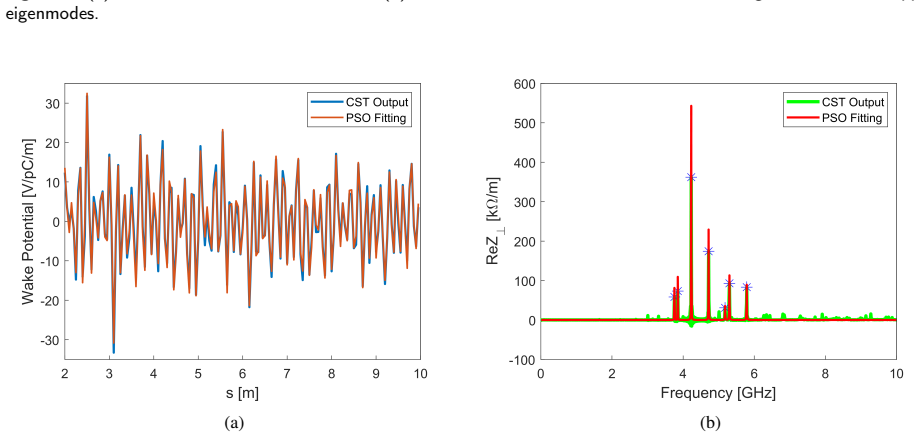
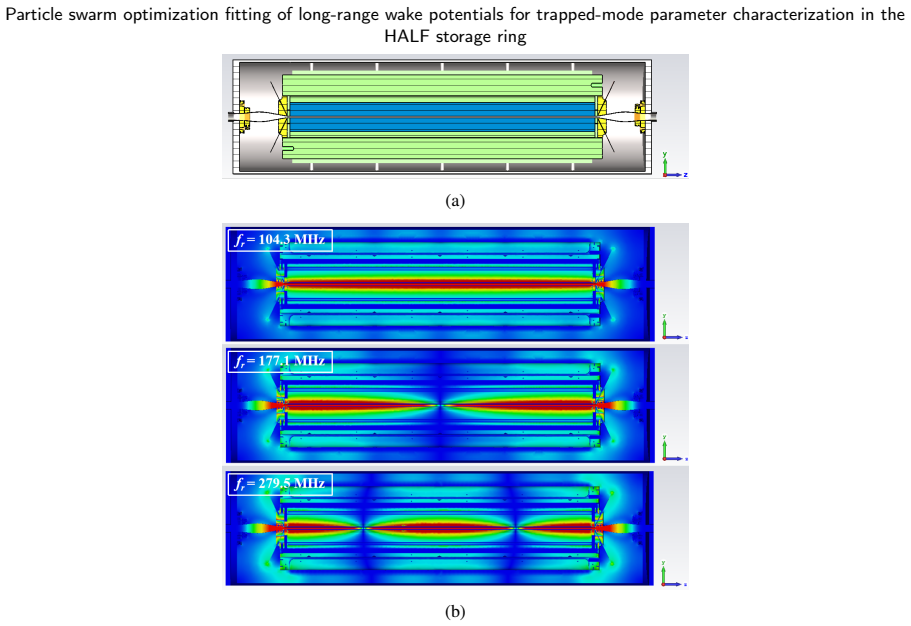
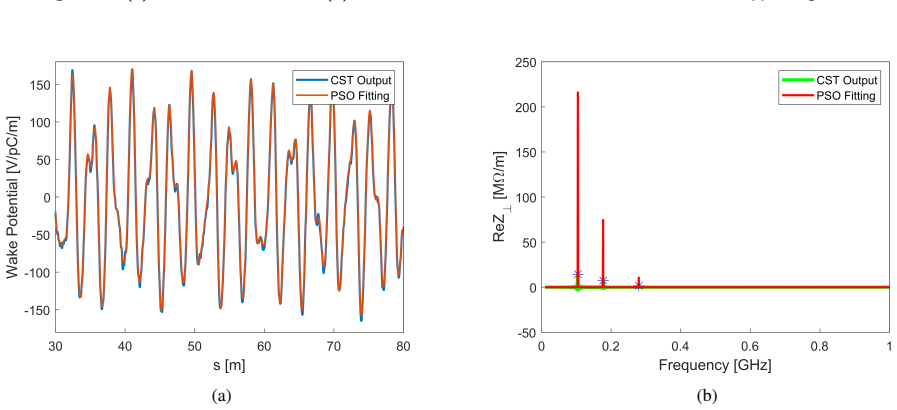
Accurate extraction of trapped-mode impedance parameters of complex storage ring components is essential for assessing their impact on coupled-bunch instabilities. This paper proposes a parameter extraction method based on particle swarm optimization. By constructing a multi-resonator fitting model, trapped-mode parameters are extracted from partially decayed long-range wake potentials. Benchmark validation using a cylindrical pillbox cavity demonstrates that the proposed method yields results consistent with those obtained from the CST eigenmode solver and the existing differential evolution method for both longitudinal and transverse cases, while significantly reducing the computational cost. The method is further applied to three critical components of the Hefei Advanced Light Facility storage ring, demonstrating its applicability to complex structures.
Editorial analysis
A structured set of objections, weighed in public.
Referee Report
Summary. The manuscript proposes a particle swarm optimization (PSO) method to extract trapped-mode impedance parameters (R/Q, Q, frequency) of storage-ring components by fitting a multi-resonator model to partially decayed long-range wake potentials. Benchmark validation on a cylindrical pillbox cavity shows results consistent with CST eigenmode solutions and an existing differential-evolution approach for both longitudinal and transverse cases, at substantially lower computational cost. The method is then applied to three critical components of the HALF storage ring to demonstrate applicability to realistic 3-D geometries.
Significance. If the central assumption holds—that a finite sum of resonators fitted to truncated wakes recovers the true trapped-mode parameters without systematic offset—the approach would supply a practical, lower-cost route to impedance characterization for coupled-bunch instability studies. The reported computational-cost reduction relative to differential evolution is a concrete strength; however, the absence of quantitative fit metrics (error bars, residual norms, or truncation-sensitivity tests) on even the benchmark case limits the strength of the claim.
major comments (3)
- [Benchmark validation] Benchmark validation section: the claim of consistency with CST eigenmode results is stated without any quantitative metrics (relative error, R², or residual wake power after the fitting window), so it is impossible to judge whether the PSO fit recovers the known pillbox parameters to within a stated tolerance or merely qualitatively.
- [HALF component application] Application to HALF components section: the multi-resonator model is fitted to wakes that are only partially decayed, yet no test is reported for sensitivity of the extracted R/Q and Q values to the truncation length, nor for the existence of multiple local minima in the PSO objective function. In geometries with dense spectra this truncation can alias unmodeled power into the fitted parameters.
- [PSO fitting procedure] Method description: the paper asserts that the PSO fit uniquely determines the trapped-mode parameters, but supplies no evidence (e.g., repeated runs with different random seeds, or comparison of the objective landscape) that the optimizer converges to the global minimum rather than a local one when the wake tail is incompletely decayed.
minor comments (2)
- Notation for the resonator parameters (R/Q, Q, f) should be defined explicitly at first use and kept consistent between the pillbox benchmark and the HALF examples.
- Figure captions for the wake-potential plots should state the fitting window length and the number of resonators retained in the model.
Simulated Author's Rebuttal
We thank the referee for the constructive comments on our manuscript. We address each major point below and have incorporated revisions to strengthen the quantitative validation and robustness analysis.
read point-by-point responses
-
Referee: [Benchmark validation] Benchmark validation section: the claim of consistency with CST eigenmode results is stated without any quantitative metrics (relative error, R², or residual wake power after the fitting window), so it is impossible to judge whether the PSO fit recovers the known pillbox parameters to within a stated tolerance or merely qualitatively.
Authors: We agree that explicit quantitative metrics were not provided in the original manuscript. In the revised version we have added a table of relative errors (R/Q, Q, frequency) versus CST eigenmode results together with the L2 residual norm of the fitted wake after the truncation window; these confirm agreement to within 2 % for the dominant parameters. revision: yes
-
Referee: [HALF component application] Application to HALF components section: the multi-resonator model is fitted to wakes that are only partially decayed, yet no test is reported for sensitivity of the extracted R/Q and Q values to the truncation length, nor for the existence of multiple local minima in the PSO objective function. In geometries with dense spectra this truncation can alias unmodeled power into the fitted parameters.
Authors: We acknowledge the absence of truncation-sensitivity tests. Additional simulations varying the wake length have been performed and are now reported; the extracted parameters vary by less than 5 % once the wake exceeds a threshold length. For the local-minima concern we have added results from repeated PSO runs on the HALF components, showing convergence to the same parameter set within the reported precision. revision: yes
-
Referee: [PSO fitting procedure] Method description: the paper asserts that the PSO fit uniquely determines the trapped-mode parameters, but supplies no evidence (e.g., repeated runs with different random seeds, or comparison of the objective landscape) that the optimizer converges to the global minimum rather than a local one when the wake tail is incompletely decayed.
Authors: The original text did not supply explicit convergence diagnostics. We have added a new subsection presenting ten independent PSO runs with distinct random seeds for the pillbox benchmark; all runs converge to the same parameters within 1 %, supporting reliable identification of the global minimum under the conditions studied. revision: yes
Circularity Check
No circularity: PSO fitting validated against independent CST eigenmode solver
full rationale
The paper describes a PSO-based multi-resonator fit to partially decayed wake potentials for extracting trapped-mode parameters. Benchmark validation on a pillbox cavity shows consistency with results from the external CST eigenmode solver and an existing differential evolution method. No equations, self-citations, or fitted quantities are presented that reduce predictions or uniqueness claims to the inputs by construction; the central procedure is an independent numerical optimization whose outputs are cross-checked externally rather than defined into the fit.
Axiom & Free-Parameter Ledger
axioms (1)
- domain assumption Wake potentials of trapped modes can be represented by a finite sum of resonator terms whose parameters are extractable from partially decayed time-domain data.
Reference graph
Works this paper leans on
-
[1]
E. Métral, Wake field, impedance and collective instability, JINST16 (2021) P10009, http://dx.doi.org/10.1088/1748-0221/16/10/P10009. arXiv:2108.11655
-
[2]
R. Nagaoka, K.L.F. Bane, Collective effects in a diffraction-limited storage ring, J. Synchrotron Radiat. 21 (2014) 937–960, http://dx.doi.org/10.1107/S1600577514015215
-
[3]
L. Palumbo, V.G. Vaccaro, M. Zobov, Wake fields and impedance, CERN Accelerator School: 5th Advanced Accelerator Physics Course, 1995, pp. 331–390, http://dx.doi.org/10.5170/CERN-1995-006.331
-
[4]
M.ElKhaldi,J.-N.Cayla,M.Diop,H.Monard,F.Ribeiro,Characterizationofhigher-order-modes(HOM)inTHOMXstorageringRFcavity, in: Proc. 13th International Particle Accelerator Conference (IPAC’22), Bangkok, Thailand, JACoW Publishing, Geneva, Switzerland, 2022, pp. 1513–1515, http://dx.doi.org/10.18429/JACoW-IPAC2022-TUPOMS040
-
[5]
K. Tian, J.J. Sebek, A.D. Ringwall, Z. Li, Damping trapped modes in an in-vacuum undulator at a synchrotron radiation light source, Phys. Rev. Accel. Beams22 (2019) 050702, http://dx.doi.org/10.1103/PhysRevAccelBeams.22.050702
-
[6]
M. Sangroula et al., Update on the beam-induced heating and thermal analysis for the EIC vacuum chamber components, in: Proc. 15th International Particle Accelerator Conference (IPAC’24), Nashville, TN, JACoW Publishing, Geneva, Switzerland, 2024, pp. 755–758, http://dx.doi.org/10.18429/JACoW-IPAC2024-MOPS21
-
[7]
Kononenko, B
O. Kononenko, B. Salvant, E. Métral, A. Grudiev, F. Caspers, Impedance studies for VMTSA module of LHC equipped with RF fingers, in: Proc. 4th International Particle Accelerator Conference (IPAC’13), Shanghai, China, 2013, pp. 1805–1807
2013
-
[8]
Dassault Systèmes, CST Studio Suite 2025, SIMULIA, Dassault Systèmes, Vélizy-Villacoublay, France, 2025, https://www.3ds.com/products/simulia/cst-studio-suite
2025
-
[9]
ANSYS, Inc., ANSYS HFSS 2025, ANSYS, Canonsburg, PA, USA, 2025, https://www.ansys.com/products/electronics/ansys-hfss
2025
-
[10]
B. Salvant, R. Jones, G. Rumolo, C. Boccard, M. Migliorati, C. Zannini, F. Roncarolo, R. Calaga, F. Caspers, D. Alesini, G. Arduini, A. Grudiev, B. Spataro, E. Métral, Coupling impedance of the CERN SPS beam position monitors, in: Proc. Particle Accelerator Conference (PAC’09), Vancouver, Canada, 2009, pp. 4646–4648, CERN-ATS-2009-046, https://cds.cern.ch...
arXiv 2009
-
[11]
E.J.Ericson,D.Bertwistle,M.J.Boland,M.CastilloSosa,D.Pelz,SimulationandanalysisofwakefieldsandtrappedRFmodesininsertion device vacuum chambers at the Canadian Light Source, in: Proc. 10th International Particle Accelerator Conference (IPAC’19), Melbourne, Australia, 19–24 May 2019, JACoW Publishing, Geneva, Switzerland, 2019, pp. 414–416, http://dx.doi.or...
-
[13]
D. Kim, S. Biedron, Z. Li, E.I. Simakov, Design study of HOM couplers for the C-band accelerating structure, in: Proc. 13th Interna- tional Particle Accelerator Conference (IPAC’22), Bangkok, Thailand, JACoW Publishing, Geneva, Switzerland, 2022, pp. 1561–1563, http://dx.doi.org/10.18429/JACoW-IPAC2022-TUPOMS057
-
[14]
Bruns, GdfidL: a finite difference program with reduced memory and CPU usage, in: Proc
W. Bruns, GdfidL: a finite difference program with reduced memory and CPU usage, in: Proc. 1997 Particle Accelerator Conference, Vancouver, Canada, 1997, pp. 2651–2653, http://dx.doi.org/10.1109/PAC.1997.751304
-
[15]
Marhauser, R.A
F. Marhauser, R.A. Rimmer, K. Tian, H. Wang, Enhanced method for cavity impedance calculations, in: Proc. 23rd Particle Accelerator Conference (PAC’09), Vancouver, Canada, 2009, pp. 4523–4525
2009
-
[16]
L.Faillaceetal.,WakefieldandHOMspreliminarycharacterizationofthefour-quadrantmulti-cellRFacceleratingstructurefortheASTERIX project, in: Proc. 16th International Particle Accelerator Conference (IPAC’25), Taipei, Taiwan, JACoW Publishing, Geneva, Switzerland, 2025, pp. 2402–2404, http://dx.doi.org/10.18429/JACoW-IPAC2025-WEPS088
-
[17]
A. Khan, V. Smaluk, Convergence study of wakefield simulations with GdfidL and ECHO3D, Nucl. Instrum. Methods Phys. Res. A 1082 (2026) 171073, http://dx.doi.org/10.1016/j.nima.2025.171073
-
[18]
N.C.Shipman,G.Burt,R.Calaga,J.A.Mitchell,Methodtocalculatethelongitudinalimpedancefromapartialwakefieldsimulation,in:Proc. International Particle Accelerator Conference (IPAC’17), Copenhagen, Denmark, 14–19 May 2017, JACoW, Geneva, Switzerland, 2017, pp. 3844–3846, http://dx.doi.org/10.18429/JACoW-IPAC2017-THPAB057
-
[19]
Joly, PS impedance model and related beam stability, Ph.D
S. Joly, PS impedance model and related beam stability, Ph.D. thesis, Università di Roma La Sapienza, Roma, Italy, 2024, http://dx.doi.org/10.13140/RG.2.2.34976.08964
-
[20]
Nielsen, Evolutionary algorithms for Wakefields, CERN-THESIS-2025-005, CERN, Geneva, Switzerland, 2025, https://repository.cern/records/dhvza-17385
M.R. Nielsen, Evolutionary algorithms for Wakefields, CERN-THESIS-2025-005, CERN, Geneva, Switzerland, 2025, https://repository.cern/records/dhvza-17385
2025
-
[21]
S. Joly, M. Raschke, B.A. Figueiredo, E. de la Fuente, IDDEFIX, GitHub repository, 2026, https://github.com/ImpedanCEI/IDDEFIX (accessed 18 April 2026)
2026
-
[22]
R. Poli, J. Kennedy, T. Blackwell, Particle swarm optimization, Swarm Intell.1(2007) 33–57, http://dx.doi.org/10.1007/s11721-007-0002-0
-
[23]
Hofmann, B
A. Hofmann, B. Zotter, Improved impedance models for high-energy accelerators and storage rings, 1988
1988
-
[24]
B.W. Zotter, S.A. Kheifets, Loss factors and effective impedances, in: Impedances and Wakes in High-Energy Particle Accelerators, World Scientific, Singapore, 1998, pp. 97–132, http://dx.doi.org/10.1142/3068
-
[25]
E.Métral,G.Rumolo,W.Herr,Impedanceandcollectiveeffects,in:ParticlePhysicsReferenceLibrary,Springer,Cham,2020,pp.105–181, http://dx.doi.org/10.1007/978-3-030-34245-6_4
-
[26]
T. He, Z. Bai, Graphics-processing-unit-accelerated simulation for longitudinal beam dynamics of arbitrary bunch trains in electron storage rings, Phys. Rev. Accel. Beams24(2021) 104401, http://dx.doi.org/10.1103/PhysRevAccelBeams.24.104401
-
[27]
Z.Baietal.,ProgressonthestorageringphysicsdesignofHefeiAdvancedLightFacility(HALF),in:Proc.14thInternationalParticleAcceler- atorConference(IPAC’23),Venice,Italy,JACoWPublishing,Geneva,Switzerland,2023,pp.1075–1078,http://dx.doi.org/10.18429/JACoW- IPAC2023-MOPM038
-
[28]
He et al., Beam coupling impedance modeling for the Hefei Advanced Light Facility, in: Proc
T. He et al., Beam coupling impedance modeling for the Hefei Advanced Light Facility, in: Proc. 17th International Particle Accelerator Conference (IPAC’26), Deauville, France, JACoW Publishing, Geneva, Switzerland, 2026, accepted for publication
2026
-
[29]
A.I. Drozhdin, B.C. Brown, D.E. Johnson, K. Koba, I. Kourbanis, N.V. Mokhov, I.L. Rakhno, V.I. Sidorov, Collimation system design for beam loss localization with slipstacking injection in the Fermilab Main Injector, in: Proc. 2007 IEEE Particle Accelerator Conference (PAC), Albuquerque, NM, USA, 2007, pp. 1688–1690, http://dx.doi.org/10.1109/PAC.2007.4440865
-
[30]
Redaelli, Beam cleaning and collimation systems, in: Proc
S. Redaelli, Beam cleaning and collimation systems, in: Proc. 2014 Joint International Accelerator School: Beam Loss and Accelerator Protection,NewportBeach,CA,USA,2014,CERN,Geneva,Switzerland,2016,pp.403–437,http://dx.doi.org/10.5170/CERN-2016-002.403
-
[31]
R.T. Dowd, W.J. Chi, D. Pelz, Investigation of options for damping trapped IVU resonances, in: Proc. 9th International Parti- cle Accelerator Conference (IPAC’18), Vancouver, BC, Canada, JACoW Publishing, Geneva, Switzerland, 2018, pp. 1296–1299, http://dx.doi.org/10.18429/JACoW-IPAC2018-TUPMF021
-
[32]
N. Wang, S. Yue, J. Li, S. Tian, L. Zhang, S. Sun, Y. Jiao, H. Lu, Y. Li, Impedance characterization and optimization of the High Energy Photon Source in-vacuum undulator, Phys. Rev. Accel. Beams28 (2025) 094401, http://dx.doi.org/10.1103/ztx5-848v
-
[33]
H. Yao et al., Modeling and optimization of transverse trapped-mode impedance for in-vacuum undulators of HALF, in: Proc. 15th Symposium on Accelerator Physics (SAP’25), Urumqi, China, JACoW Publishing, Geneva, Switzerland, 2025, pp. 58–60, http://dx.doi.org/10.18429/JACoW-SAP2025-THP21. First Author et al.:Preprint submitted to Elsevier Page 15 of 15
discussion (0)
Sign in with ORCID, Apple, or X to comment. Anyone can read and Pith papers without signing in.