REVIEW 1 major objections 1 cited by
Explicit bounds for Dickman's function
T0 review · 1 major / 0 minor · reviewed 2026-06-27 · grok-4.3
Pith's one-line read Dickman's function ρ(u) has explicit upper and lower bounds with relative error less than 0.005/u² for all u ≥ 5.
desk verdict Weingartner's paper supplies explicit upper and lower bounds on Dickman's rho(u) with relative error below 0.005/u squared for all u at least 5, derived from the delay equation via numerical means. read the letter →
The pith
A machine-rendered reading of the paper's core claim, the machinery that carries it, and where it could break.
The reading
What carries the argument
Explicit numerical upper and lower bounds on Dickman's function ρ(u) that sandwich the true value with relative error less than 0.005/u².
What would settle it
A single value of u ≥ 5 where the true ρ(u) lies strictly outside the stated upper and lower bounds would falsify the claim.
Extended reading notes
Core claim
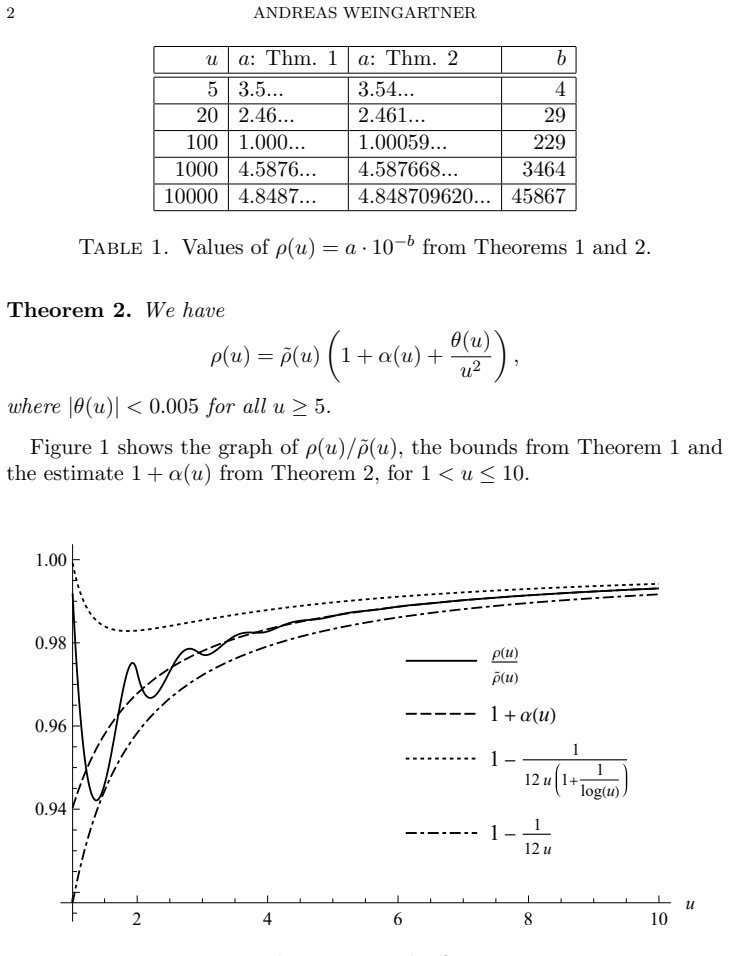
We establish numerically explicit upper and lower bounds for Dickman's function ρ(u), resulting in estimates with a relative error of less than 0.005/u² for all u≥5. This allows for an approximate evaluation of ρ(u) without the need to solve the delay differential equation numerically.
Load-bearing premise
The numerical verification establishing the bounds is rigorous, covers every real number u ≥ 5 without gaps, and contains no undetected computational or rounding errors.
Editorial extensions
If this is right
- Approximate values of ρ(u) for any u ≥ 5 follow directly from the bounds without repeated numerical integration.
- The guaranteed relative error shrinks as u increases, giving tighter control for large arguments.
- Applications that track the distribution of smooth numbers can substitute the bounds into existing formulas.
- The uniform coverage on [5, ∞) removes the need to switch between different approximation methods at different scales.
Reading between the lines
- The same style of rigorous interval-by-interval numerical checking could be applied to produce explicit bounds for other functions defined by delay equations.
- Analytic number theory results that currently invoke plots or tables of ρ(u) could be made fully rigorous by inserting these bounds.
- One could test whether combining the new bounds with known asymptotic expansions yields sharper error terms for the count of smooth integers.
Editorial analysis
A structured set of objections, weighed in public.
Referee Report
Summary. The manuscript claims to establish numerically explicit upper and lower bounds for Dickman's function ρ(u) such that the resulting estimates have relative error less than 0.005/u² for all real u ≥ 5. These bounds are said to be derived from the known delay differential equation satisfied by ρ(u) and to permit approximate evaluation of ρ(u) without numerically solving that equation.
Significance. If the claimed bounds are rigorously established with the stated error control holding continuously over u ≥ 5, the result would supply a practical, explicit approximation tool for applications in analytic number theory that involve the distribution of smooth numbers. The work would be strengthened by the provision of machine-checkable or interval-arithmetic verification that eliminates undetected rounding or truncation errors.
major comments (1)
- The central claim (explicit bounds with relative error < 0.005/u² for every real u ≥ 5) rests entirely on a numerical verification procedure whose method, step-size control, enclosure technique, and handling of rounding errors are not described. Without this information the claim cannot be checked.
Simulated Author's Rebuttal
We thank the referee for their report and for highlighting the need for greater transparency in our numerical verification. We agree that the current manuscript does not adequately describe the computational procedure and will revise it to include these details.
read point-by-point responses
-
Referee: The central claim (explicit bounds with relative error < 0.005/u² for every real u ≥ 5) rests entirely on a numerical verification procedure whose method, step-size control, enclosure technique, and handling of rounding errors are not described. Without this information the claim cannot be checked.
Authors: We acknowledge that the manuscript does not describe the numerical verification procedure, including step-size control, enclosure methods, or rounding-error handling. This omission prevents independent checking of the central claim. In the revised manuscript we will insert a dedicated section that specifies: (i) the integration scheme and adaptive step-size strategy used to propagate the delay-differential equation, (ii) the enclosure technique (interval arithmetic with directed rounding) employed to guarantee rigorous bounds at each step, and (iii) the a-posteriori error analysis that converts the computed enclosures into the stated relative-error guarantee of 0.005/u² for all real u ≥ 5. With these additions the verification becomes reproducible and the claim can be checked. revision: yes
Circularity Check
No significant circularity in derivation of explicit bounds for Dickman's function
full rationale
The paper derives explicit upper and lower bounds for ρ(u) directly from its standard delay differential equation definition via rigorous numerical verification that encloses the solution continuously for all u ≥ 5. No steps reduce by construction to fitted inputs, self-citations, or ansatzes; the central claim is an independent computational result with stated error control, not a renaming or self-referential definition. The derivation is self-contained against the DDE.
Assumptions & free parameters
Cite this review
Pith. "Pith review of Explicit bounds for Dickman's function." pith.science (2026). https://pith.science/paper/UPFUI6FA
@misc{pith2026260607785,
  author       = {Pith},
  title        = {Pith review of: Explicit bounds for Dickman's function},
  year         = {2026},
  howpublished = {\url{https://pith.science/paper/UPFUI6FA}},
  note         = {Machine review of arXiv:2606.07785}
}
abstract
We establish numerically explicit upper and lower bounds for Dickman's function $\rho(u)$, resulting in estimates with a relative error of less than $0.005/u^2$ for all $u\ge 5$. This allows for an approximate evaluation of $\rho(u)$ without the need to solve the delay differential equation numerically.
Figures
Forward citations
Cited by 1 Pith paper
-
Explicit bounds for Buchstab's function
Buchstab's function ω(u) is shown to equal 2|Φ_i(u)| cos(arg Φ_i(u)) plus an explicitly bounded error, yielding easy-to-evaluate two-sided bounds for u ≥ 3.
Reference graph
Works this paper leans on
-
[1]
Alladi, The Tur´ an-Kubilius inequality for integers without large prime factors,J
K. Alladi, The Tur´ an-Kubilius inequality for integers without large prime factors,J. Reine Angew. Math.335(1982), 180–196
1982
-
[2]
N. G. de Bruijn, The asymptotic behaviour of a function occurring in the theory of primes,J. Indian Math. Soc. (N.S.)15(1951), 25–32
1951
-
[3]
Dickman, On the frequency of numbers containing prime factors of a certain relative magnitude,Ark
K. Dickman, On the frequency of numbers containing prime factors of a certain relative magnitude,Ark. Mat. Astron. Fys.22(1930)
1930
-
[4]
Gorodetsky, Smooth numbers and the Dickmanρfunction,J
O. Gorodetsky, Smooth numbers and the Dickmanρfunction,J. Anal. Math.151 (2023), no. 1, 139–169
2023
-
[5]
Granville, Smooth numbers: computational number theory and beyond, in Algo- rithmic number theory: lattices, number fields, curves and cryptography, 267–323, Math
A. Granville, Smooth numbers: computational number theory and beyond, in Algo- rithmic number theory: lattices, number fields, curves and cryptography, 267–323, Math. Sci. Res. Inst. Publ. 44, Cambridge Univ. Press, Cambridge, 2008
2008
-
[6]
Marsaglia, A
G. Marsaglia, A. Zaman and J. C. W. Marsaglia, Numerical solution of some classical differential-difference equations.Math. Comp.53(1989), no. 187, 191–201
1989
-
[7]
Pinelis, Exact lower and upper bounds on the incomplete gamma function,Math
I. Pinelis, Exact lower and upper bounds on the incomplete gamma function,Math. Inequal. Appl.23(2020), no. 4, 1261–1278
2020
-
[8]
Smida, Sur les puissances de convolution de la fonction de Dickman,Acta Arith
H. Smida, Sur les puissances de convolution de la fonction de Dickman,Acta Arith. 59(1991), no. 2, 123–143
1991
Show all 11 references
-
[9]
Tenenbaum, Introduction to Analytic and Probabilistic Number Theory, Third Edition, Graduate Studies in Mathematics, Vol
G. Tenenbaum, Introduction to Analytic and Probabilistic Number Theory, Third Edition, Graduate Studies in Mathematics, Vol. 163, American Mathematical Society, 2015
2015
-
[10]
van de Lune and E
J. van de Lune and E. Wattel, On the numerical solution of a differential-difference equation arising in analytic number theory,Math. Comp.23(1969), 417–421
1969
-
[11]
T. Z. Xuan, On the asymptotic behavior of the Dickman-de Bruijn function,Math. Ann.297(1993), no. 3, 519–533. Department of Mathematics, Southern Utah University, 351 West Univer- sity Boulevard, Cedar City, Utah 84720, USA Email address:weingartner@suu.edu
1993
Reviewed June 27, 2026 · model on record in the stance chip above.
Discussion (0). Continue with ORCID to comment.