Kleene Theorems for Free Choice Nets Labelled with Distributed Alphabets
Pith reviewed 2026-05-25 10:54 UTC · model grok-4.3
The pith
Free choice nets labelled with distributed alphabets admit expressions corresponding to synchronous products and Zielonka automata after the product condition on final markings is dropped.
A machine-rendered reading of the paper's core claim, the machinery that carries it, and where it could break.
Core claim
Expressions exist for the languages of free choice nets labelled with distributed alphabets once the product condition on the set of final markings is removed; these expressions correspond exactly to free choice synchronous products and Zielonka automata. For the subclass possessing the distributed choice property an alternative characterization is given in terms of properties that are checkable in polynomial time.
What carries the argument
The syntactic expressions that generate the languages accepted by free choice synchronous products and Zielonka automata.
If this is right
- Languages of the enlarged class of free choice nets can be represented by the supplied expressions.
- Nets with the distributed choice property can be recognized by polynomially checkable conditions.
- The characterizations extend directly to Zielonka automata.
- Removal of the product condition produces a strictly larger class of representable nets.
Where Pith is reading between the lines
- The polynomial-time checks may support practical decision procedures for properties of distributed systems modeled by these nets.
- The expressions could serve as a bridge between net-based and automata-based verification techniques for concurrent processes.
- Further extensions might relate the expressions to other models of distributed computation that use synchronized actions.
Load-bearing premise
The nets are required to be 1-bounded and S-coverable with S-components that respect the given alphabet distribution.
What would settle it
A 1-bounded S-coverable free choice net labelled with a distributed alphabet whose accepted language lies outside the languages generated by the expressions supplied for free choice synchronous products would refute the claimed correspondence.
Figures
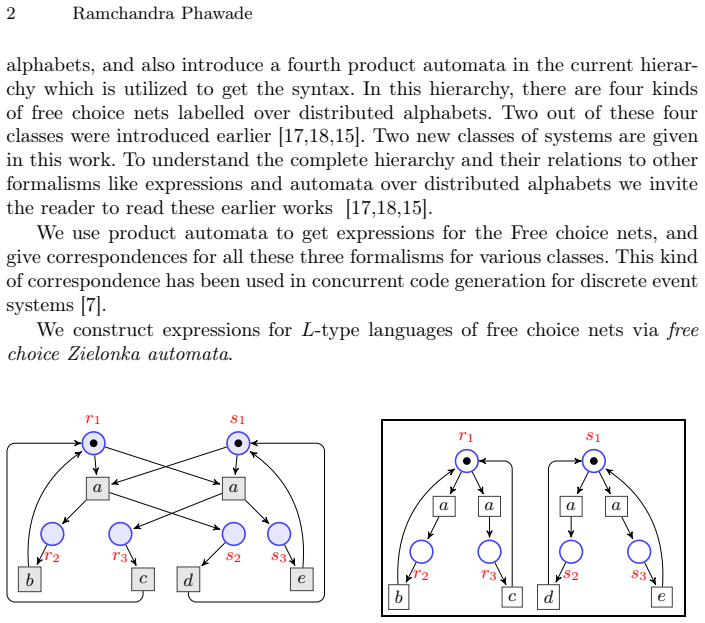
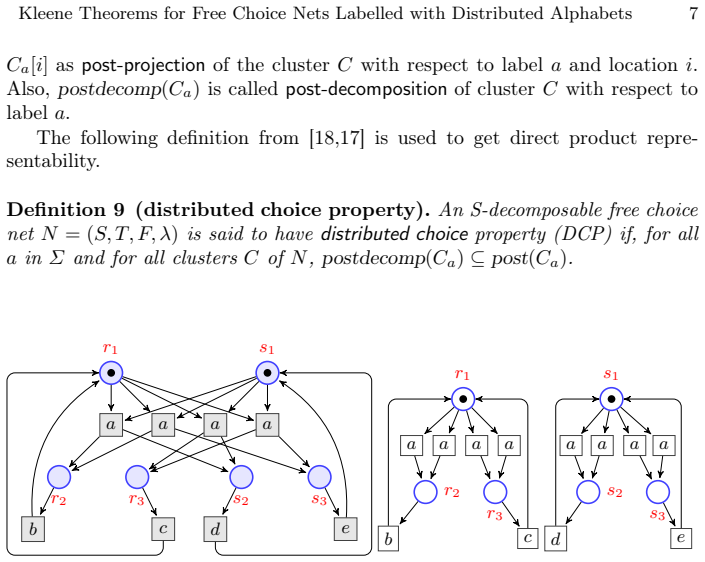
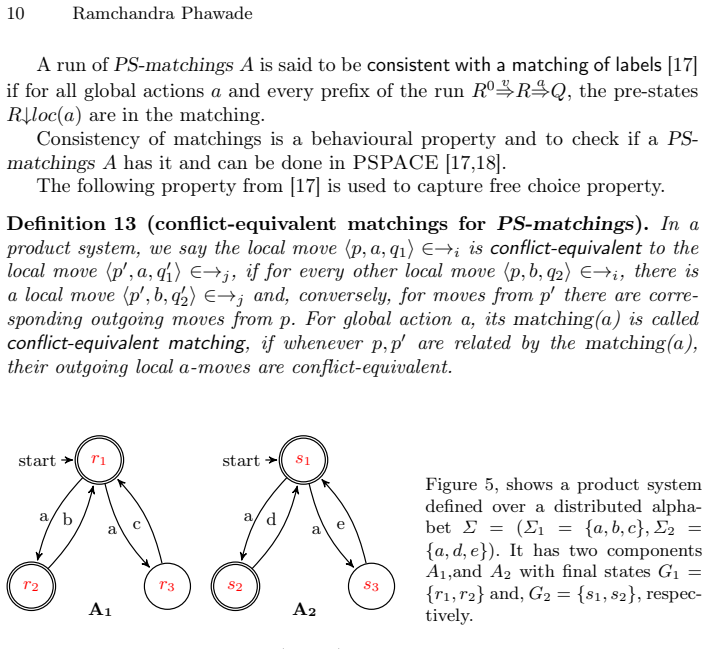
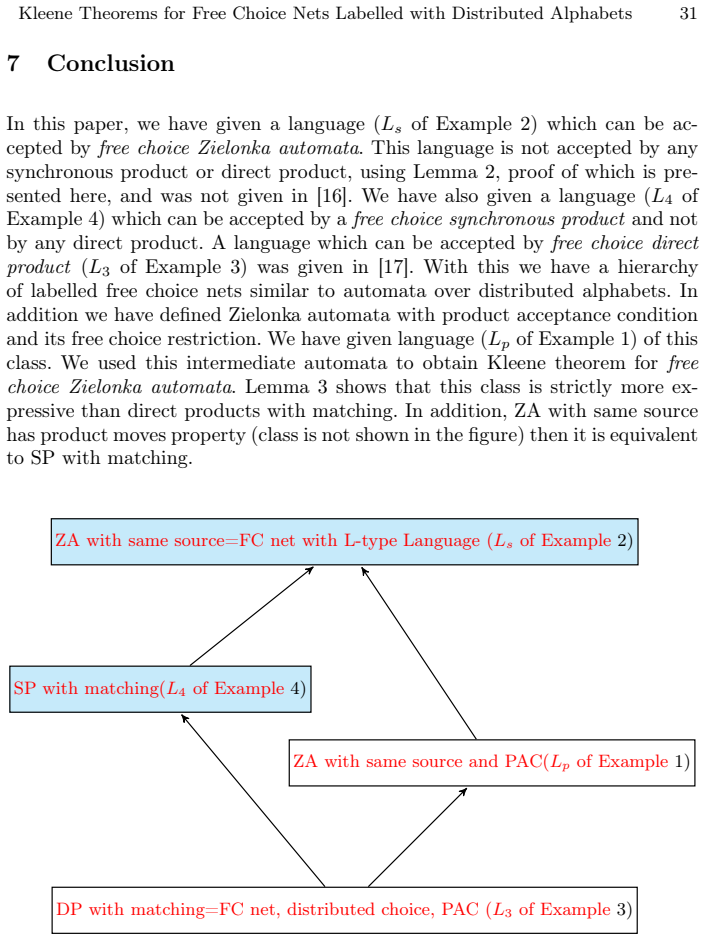
read the original abstract
We provided (PNSE'2014) expressions for free choice nets having "distributed choice property" which makes the nets "direct product" representable. In a recent work (PNSE'2016), we gave equivalent syntax for a larger class of free choice nets obtained by dropping distributed choice property. In both these works, the classes of free choice nets were restricted by a "product condition" on the set of final markings. In this paper we do away with this restriction and give expressions for the resultant classes of nets which correspond to "free choice synchronous products and Zielonka automata". For free choice nets with distributed choice property, we give an alternative characterization using properties checkable in polynomial time. Free choice nets we consider are 1-bounded, S-coverable, and are labelled with distributed alphabets, where S-components of the associated S-cover respect the given alphabet distribution.
Editorial analysis
A structured set of objections, weighed in public.
Referee Report
Summary. The paper extends the authors' prior PNSE'2014 and PNSE'2016 results on Kleene theorems for free choice nets by removing the product condition on final markings. For 1-bounded, S-coverable free choice nets labelled with distributed alphabets (where S-components respect the alphabet distribution), it supplies expressions corresponding to free choice synchronous products and Zielonka automata; for the distributed-choice-property subclass it supplies an alternative characterization whose properties are checkable in polynomial time.
Significance. If the claimed correspondences and constructions hold, the work enlarges the class of nets admitting syntactic characterizations without the prior product restriction and strengthens links to Zielonka automata; the polynomial-time check for the distributed-choice subclass is a concrete algorithmic contribution. The manuscript builds directly on the authors' earlier PNSE papers but does not reduce new quantities to fitted parameters from those works.
minor comments (2)
- Abstract, first sentence: the phrasing 'We provided (PNSE'2014) expressions' is grammatically awkward and should be revised for clarity (e.g., 'In PNSE 2014 we provided expressions...').
- Abstract, final sentence: the parenthetical qualifier on S-components could be moved earlier for readability when the scope of the nets is first introduced.
Simulated Author's Rebuttal
We thank the referee for the careful reading and the positive recommendation for minor revision. No specific major comments were raised in the report.
Circularity Check
No significant circularity in derivation chain
full rationale
The paper extends its own prior PNSE results by removing the product condition on final markings and supplies syntactic characterizations for the enlarged classes (free choice synchronous products, Zielonka automata) plus a polynomial-time check for the distributed-choice subclass. These steps rest on the stated restrictions (1-bounded, S-coverable nets with distributed alphabets whose S-components respect the labeling) rather than on any self-definitional loop, fitted parameter renamed as prediction, or load-bearing self-citation whose content is itself unverified. No equation or claim is shown to reduce to its own inputs by construction; the cited earlier works supply independent starting points that the present manuscript enlarges.
Axiom & Free-Parameter Ledger
axioms (1)
- domain assumption Free choice nets under consideration are 1-bounded and S-coverable with S-components respecting the alphabet distribution.
Reference graph
Works this paper leans on
-
[1]
Antimirov, V.: Partial derivatives of regular expressio ns and finite automaton con- structions. Theoret. Comp. Sci. 155(2), 291–319 (1996)
work page 1996
-
[2]
Brzozowski, J.A.: Derivatives of regular expressions. J . ACM 11(4), 481–494 (1964)
work page 1964
-
[3]
Cambridge University Press, New York, USA (1995)
Desel, J., Esparza, J.: Free choice Petri nets. Cambridge University Press, New York, USA (1995)
work page 1995
-
[4]
Garg, V.K., Ragunath, M.: Concurrent regular expression s and their relationship to petri nets. Theoret. Comp. Sci. 96(2), 285–304 (1992)
work page 1992
-
[5]
Grabowski, J.: On partial languages. Fundam. Inform. 4(2), 427–498 (1981)
work page 1981
-
[6]
Project Mac Report TR-94, MIT (1972)
Hack, M.H.T.: Analysis of production schemata by Petri ne ts. Project Mac Report TR-94, MIT (1972)
work page 1972
-
[7]
In: Proceedings Conference on Decision and Cont rol, CDC
Iordache, M.V., Antsaklis, P.J.: The ACTS software and it s supervisory control framework. In: Proceedings Conference on Decision and Cont rol, CDC. pp. 7238–
- [8]
- [9]
-
[10]
Lodaya, K., Mukund, M., Phawade, R.: Kleene theorems for product systems. In: DCFS, Proceedings. LNCS, vol. 6808. Springer (2011)
work page 2011
-
[11]
Mirkin, B.G.: An algorithm for constructing a base in a la nguage of regular ex- pressions. Engg. Cybern. 5, 110–116 (1966)
work page 1966
-
[12]
Mukund, M.: Automata on distributed alphabets. In: D’So uza, D., Shankar, P. (eds.) Modern Applications of Automata Theory. World Scien tific (2011)
work page 2011
-
[13]
Journal of C omputing and Systems Science 13(1), 1–24 (1976)
Petersen, J.L.: Computation sequence sets. Journal of C omputing and Systems Science 13(1), 1–24 (1976)
work page 1976
-
[14]
Phawade, R.: Labelled Free Choice Nets, finite Product Au tomata, and Expres- sions. Ph.D. thesis, Homi Bhabha National Institute (2015)
work page 2015
-
[15]
In: Cabac, L., Kristensen, L.M., Rölke, H
Phawade, R.: Kleene theorems for labelled free choice ne ts without distributed choice. In: Cabac, L., Kristensen, L.M., Rölke, H. (eds.) Pr oc. PNSE. CEUR Work- shop Proceedings, vol. 1591, pp. 132–152. CEUR-WS.org (201 6)
-
[16]
In: Daniel Moldt, E.K., Rölke, H
Phawade, R.: Kleene theorems free choice nets labelled w ith distributed alphabets. In: Daniel Moldt, E.K., Rölke, H. (eds.) Proc. PNSE. CEUR Wor kshop Proceed- ings, vol. 2138, pp. 77–98. CEUR-WS.org (2018)
work page 2018
-
[17]
Phawade, R., Lodaya, K.: Kleene theorems for labelled fr ee choice nets. In: Moldt, D., Rölke, H. (eds.) Proc. PNSE. CEUR Workshop Proceedings, vol. 1160, pp. 75–89. CEUR-WS.org (2014)
work page 2014
-
[18]
Transactions on Petri nets and other models of concurre ncy X, 84–108 (2015)
Phawade, R., Lodaya, K.: Kleene theorems for synchronou s products with match- ing. Transactions on Petri nets and other models of concurre ncy X, 84–108 (2015)
work page 2015
-
[19]
Zielonka, W.: Notes on finite asynchronous automata. Inf orm. Theor. Appl. 21(2), 99–135 (1987)
work page 1987
discussion (0)
Sign in with ORCID, Apple, or X to comment. Anyone can read and Pith papers without signing in.