REVIEW 3 major objections 5 minor 1 cited by
RainGaugeNet: CSI-Based Sub-6 GHz Rainfall Attenuation Measurement and Classification for ISAC Applications
T0 review · 3 major / 5 minor · reviewed 2026-08-10 · deepseek-v4-flash
Pith's one-line read Sub-6 GHz radio channels carry a measurable rainfall signature at 2.8 GHz.
desk verdict A genuinely new CSI-based rainfall sensing dataset and classifier, but the unaddressed wet-antenna confound makes the headline attenuation numbers unreliable. read the letter →
The pith
A machine-rendered reading of the paper's core claim, the machinery that carries it, and where it could break.
The reading
What carries the argument
The load-bearing object is the power delay profile (PDP), a 40-tap, 400-ns snapshot of how received power is distributed across propagation delays, obtained by inverse discrete Fourier transform of the channel frequency response. RainGaugeNet feeds a 40 x 20 matrix of PDP taps across 20 seconds into a dual-path ResNet1D network: one path extracts spatial multipath structure per snapshot, the other extracts temporal correlations across snapshots, and the final fully connected layers output the three-class rainfall label.
What would settle it
Re-run the 2.8 GHz, 7 m measurement with the horn and patch antennas kept dry, for example heated or shielded, while artificial rain falls only between them; if the 1.86 dB and 3.28 dB attenuation values and the fitted decay-factor shifts largely disappear, the rain-in-the-air attribution is disproved.
Extended reading notes
Core claim
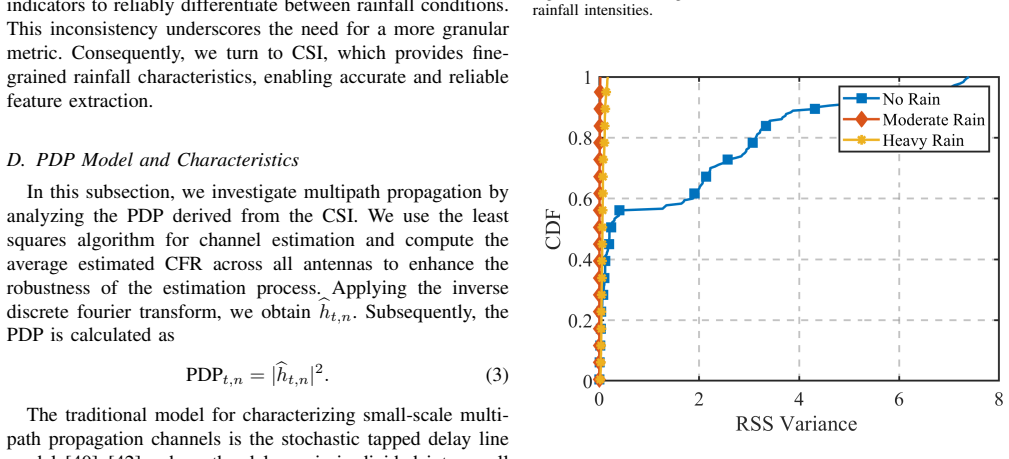
At 2.8 GHz over a 7 m link, rainfall attenuation is real but small and nonlinear: average received signal strength drops by 1.86 dB under moderate rain and 3.28 dB under heavy rain, whereas the ITU-R high-frequency power-law model predicts 0.0047 dB and 1.33 dB. The measured power delay profile follows a power-law decay model, with the fitted decay factor falling from 1.52 with no rain to 1.49 with moderate rain and 1.41 with heavy rain, and the RMS delay spread rises from 6.41 ns to 11.77 ns in moderate rain before easing to 10.70 ns in heavy rain. From these CSI-derived features, RainGaugeNet classifies three rainfall intensities with average accuracy above 90% in line-of-sight settings and above 85% in non-line-of-sight settings, using 20 consecutive 1-second CSI snapshots and outperforming RSS-only, single-snapshot, and plain CNN baselines.
Load-bearing premise
The paper attributes the measured received-power drops and power-delay-profile changes to attenuation by raindrops in the 7 m propagation path, and the load-bearing premise is that water films on the antennas and radomes do not contribute most of that signal; the paper identifies wet-antenna attenuation as a known hazard but reports no wet-antenna control.
Editorial extensions
If this is right
- If the effect is real, every sub-6 GHz base station that already records CSI could in principle act as a rain gauge without additional transmit power or dedicated hardware.
- Rainfall onset increases RMS delay spread, meaning rain is not only a loss effect; it changes the multipath structure that channel equalizers and beamformers must track.
- The reported decay-factor trend, with smaller fitted decay factors under heavier rain, gives a physical model-based feature for rainfall intensity beyond raw RSS.
- Twenty seconds of CSI is short enough for near-real-time network-level rainfall mapping in integrated sensing and communications systems.
Reading between the lines
- A controlled experiment with dry antennas or wet-antenna compensation would separate airborne rain attenuation from water films on radomes; until that control exists, the reported 1.86 dB and 3.28 dB values should be read as upper bounds on true atmospheric attenuation.
- The same CSI features could be extended from three-class classification to continuous rain-rate regression, using a rain gauge as ground truth over longer outdoor links.
- The non-monotonic delay spread, peaking at moderate rain, suggests rain-onset detection may be more reliable than intensity estimation, since onset and heavy rain produce different multipath signatures.
- Natural rainfall differs from artificial rainfall in drop-size distribution and wind, so validating on outdoor natural rain events is a direct next test of the classifier's generality.
Editorial analysis
A structured set of objections, weighed in public.
Referee Report
Summary. The paper presents RainGaugeNet, a CSI-based rainfall classification system operating at 2.8 GHz. The authors build a controlled artificial-rain testbed with a USRP transmitter and receiver, collect RSS and CSI under no rain, moderate rain (5 mm), and heavy rain (20 mm) in LoS and NLoS configurations at low and high wind speeds, and report three physical observations: RSS mean and variance shift with rainfall; the PDP follows a power-law decay whose exponent decreases with rainfall; and RMS delay spread increases with rainfall onset. They then train a ResNet-based neural network on 40x20 PDP matrices (400 ns x 20 s) to classify rainfall intensity, achieving average accuracies above 90% in LoS and above 85% in NLoS. The central claims are that this is the first CSI-based demonstration of measurable rainfall attenuation at sub-6 GHz and that CSI features support accurate rainfall classification.
Significance. If the central claims survive experimental scrutiny, the paper would be a valuable data point for ISAC-based weather sensing. Its strengths are the explicit hardware description, the use of a calibrated rain gauge, the temporal separation of training and test data, and the comparison against RSS-based and PDP-based baselines, which make the classification comparison meaningful. The paper also honestly reports challenges and does not oversell per-class performance. However, the physical interpretation of the attenuation measurements is currently undermined by an unaddressed wet-antenna confound; if that is resolved (or bounded), the CSI-based classification result would be the most transferable contribution.
major comments (3)
- [Sections I, II-B] The measurement setup exposes both the horn transmit antenna and the two patch receive antennas directly to artificial rainfall, yet no control experiment isolates the wet-antenna contribution. The introduction itself cites [33]-[35] to note that water films on radomes introduce additional attenuation and can cause overestimation of rainfall intensity. Over the 7 m path, the reported RSS drops (1.86 dB moderate, 3.28 dB heavy) are far larger than the free-space rain attenuation predicted by the ITU-R model at 2.8 GHz, so antenna wetting or near-field spray is a quantitatively plausible alternative explanation for the attenuation, the PDP decay changes, and the RMS delay spread increase. I request either a dry-versus-wet antenna control (e.g., wetting the antennas while keeping the propagation path dry), a protective radome with known wet-antenna loss, or a sensitivity analysis that bounds the wet-antenna contribution; without one of these, the central claim that the observed attenuation is due to rain in the propagation channel is not established.
- [Section II-D, Table II, Observation O3] The power-law decay factors in Table II (nPDP = 1.52, 1.49, 1.41) are presented as evidence that the decay factor decreases with rainfall intensity, but no confidence intervals or statistical test are reported. The RMSE values in the same table range up to 4.99 dB for the no-rain condition, which is of the same order as the differences among the fitted η0 values and among the mean RSS attenuation levels; the differences in nPDP are small relative to the fitting uncertainty. Please report per-realization distributions or bootstrap confidence intervals for nPDP and perform a significance test before asserting O3.
- [Section III-D, Table V] The headline claim of 'over 90% accuracy in LoS and over 85% in NLoS' is supported only as an average over wind conditions. Several per-condition results fall well below these thresholds: 80.14% for LoS low-wind heavy rain, 65.07% for NLoS low-wind no rain, and 58.10% for NLoS high-wind moderate rain. Because the robustness claim is central to the paper's ISAC positioning, the authors should report per-condition confidence intervals, discuss the failure modes, and qualify the abstract claim by stating that these are average accuracies.
minor comments (5)
- [Section II-B] Please specify what 'the system is reset' entails in Section II-B; currently it is too vague to determine whether antenna surfaces were dried between runs.
- [Section II-C] The units of RSS and of the attenuation values in Fig. 4 and the text should be stated consistently (dBm for RSS, dB for attenuation).
- [Section II-D, Eq. (5)] The notation XPDP is used both as the random variable and as the normal-distributed model error; distinguish the distribution parameter σ from the RMSE notation σRMSE for clarity.
- [Section III-C] In the description of RainGaugeNet-single, the sentence stating that it 'shares the same architecture as RainGaugeNet but uses data only from the first time snapshot' should clarify whether the remaining 19 time slots are zero-filled, as suggested by Fig. 11(a), since this affects the interpretation of its degenerate behavior.
- [References] Reference [21] contains a typo in its title ('arbrelation' should be 'a-b relation'); elsewhere, 'poisson' should be capitalized in Section I.
Circularity Check
No significant circularity: the measurements and trained classifier are self-contained; the wet-antenna concern is a validity threat, not a circular derivation.
full rationale
No load-bearing circular step reduces a claimed result to its own input. The RSS attenuation values (1.86 dB and 3.28 dB), the fitted PDP decay factors (Table II), the multipath power and RMS delay spread statistics (Table III), and the power-law decay observation O3 are all direct measurements or fits of measured data; none is presented as a prediction derived from those same fitted values. The classification accuracy of RainGaugeNet is obtained by training on one temporally distinct period and testing on another (Table IV and Section III.B), so it is an empirical performance result, not an identity or a self-fulfilling construction. The only self-citations are to [45] and [46] for a threshold-based multipath identification algorithm, but that algorithm is a standard detection procedure and is not used to define the rainfall labels or to force the classification outcome. The wet-antenna/water-film confound identified in the introduction is a legitimate external-validity and attribution concern, but it does not make any equation equivalent to another by construction and therefore does not constitute circularity under the stated criteria. The paper would be stronger with a wet-antenna control, but that issue belongs in correctness risk, not in the circularity score.
Assumptions & free parameters
free parameters (6)
- nPDP (power-law decay factor) =
1.52 (no rain), 1.49 (moderate), 1.41 (heavy)
- eta0 (log-scale power-law intercept) =
0.6, 0.94, 0.64
- gamma_P (relative power threshold) =
40 dB
- gamma_N (noise floor margin) =
10 dB
- Observation window NT =
40 taps (400 ns)
- Sliding window size for RSS statistics =
20
assumptions (4)
- domain assumption PDP decay follows a power-law model (Eq. 4-5) rather than exponential or other forms.
- domain assumption Artificial rainfall with two fixed intensities and a 7 m path is representative of real rainfall over cellular links.
- domain assumption Wet antenna effects are either absent or negligible in the 2.8 GHz measurements; no wet-radome correction is applied.
- domain assumption Temporally separated training and testing intervals within the same campaign provide independent evaluation.
Cite this review
Pith. "Pith review of RainGaugeNet: CSI-Based Sub-6 GHz Rainfall Attenuation Measurement and Classification for ISAC Applications." pith.science (2026). https://pith.science/paper/UQFRSEV2
@misc{pith2026250102175,
  author       = {Pith},
  title        = {Pith review of: RainGaugeNet: CSI-Based Sub-6 GHz Rainfall Attenuation Measurement and Classification for ISAC Applications},
  year         = {2026},
  howpublished = {\url{https://pith.science/paper/UQFRSEV2}},
  note         = {Machine review of arXiv:2501.02175}
}
read the original abstract
Rainfall impacts daily activities and can lead to severe hazards such as flooding. Traditional rainfall measurement systems often lack granularity or require extensive infrastructure. While the attenuation of electromagnetic waves due to rainfall is well-documented for frequencies above 10 GHz, sub-6 GHz bands are typically assumed to experience negligible effects. However, recent studies suggest measurable attenuation even at these lower frequencies. This study presents the first channel state information (CSI)-based measurement and analysis of rainfall attenuation at 2.8 GHz. The results confirm the presence of rain-induced attenuation at this frequency, although classification remains challenging. The attenuation follows a power-law decay model, with the rate of attenuation decreasing as rainfall intensity increases. Additionally, rainfall onset significantly increases the delay spread. Building on these insights, we propose RainGaugeNet, the first CSI-based rainfall classification model that leverages multipath and temporal features. Using only 20 seconds of CSI data, RainGaugeNet achieved over 90% classification accuracy in line-of-sight scenarios and over 85% in non-lineof-sight scenarios, significantly outperforming state-of-the-art methods.
Figures


Figures from the paper (8 more)




Forward citations
Cited by 1 Pith paper
-
Sovereign Cognitive Digital Twins: Fusing 6G ISAC, AI-RAN, and Zero-Trust Edge Grids for National Resilience in the Global South
A six-layer national digital twin architecture using 6G ISAC as a sensor, plus an uncalibrated but reproducible ray-tracing study of Barbados showing frequency-dependent coverage differences.
Reference graph
Works this paper leans on
-
[33]
Modeling of wet antenna attenuation for precipitation estimation from microwave links,
C. Moroder, U. Siart, C. Chwala, and H. Kunstmann, “Modeling of wet antenna attenuation for precipitation estimation from microwave links,” IEEE Geosci. Remote Sens. Lett. , vol. 17, no. 1, pp. 386–390, Jan 2020
work page 2020
-
[35]
H. Leijnse, R. Uijlenhoet, and J. N. M. Stricker, “Microwave link rainfall estimation: Effects of link length and frequency, temporal sampling, power resolution, and wet antenna attenuation,” Adv. Water Resour. , vol. 31, no. 11, pp. 1481–1493, Jul. 2008
work page 2008
-
[1]
Integrated sensing and communications: Toward dual-functional wire- less networks for 6G and beyond,
F. Liu, Y . Cui, C. Masouros, J. Xu, T. X. Han, Y . C. Eldar, and S. Buzzi, “Integrated sensing and communications: Toward dual-functional wire- less networks for 6G and beyond,” IEEE J. Select. Areas Commun. , vol. 40, no. 6, pp. 1728–1767, Jun. 2022
work page 2022
-
[2]
Integrated sensing and communication: 3GPP standardization progress,
H. Li, J. Xu, C. Sun, S. Wang, X. Wang, and H. Zhang, “Integrated sensing and communication: 3GPP standardization progress,” in Proc. 21st Int. Symp. Model. Optim. Mobile, Ad Hoc, Wireless Netw. (WiOpt) , 2023, pp. 1–7
work page 2023
-
[3]
V . Christofilakis, G. Tatsis, C. J. Lolis, S. K. Chronopoulos, P. Kostarakis, A. Bartzokas, and H. E. Nistazakis, “A rain estimation model based on microwave signal attenuation measurements in the city of ioannina, greece,” Meteorol. Appl., vol. 27, no. 4, p. e1932, Jul. 2020
work page 2020
-
[4]
Earth-to-earth microwave rain attenuation measurements: A survey on the recent literature,
V . Christofilakis, G. Tatsis, S. K. Chronopoulos, A. Sakkas, A. G. Skri- vanos, K. P. Peppas, H. E. Nistazakis, G. Baldoumas, and P. Kostarakis, “Earth-to-earth microwave rain attenuation measurements: A survey on the recent literature,” Symmetry, vol. 12, no. 9, p. 1440, Sep
-
[5]
R. Avanzato and F. Beritelli, “Hydrogeological risk management in smart cities: A new approach to rainfall classification based on LTE cell selection parameters,” IEEE Access , vol. 8, pp. 137 161–137 173, Jul. 2020
work page 2020
-
[6]
Rain rate estimation using measurements from commercial telecommunications links,
O. Goldshtein, H. Messer, and A. Zinevich, “Rain rate estimation using measurements from commercial telecommunications links,” IEEE Trans. Signal Process., vol. 57, no. 4, pp. 1616–1625, Apr. 2009
work page 2009
Show all 46 references
-
[7]
Uncertainty quan- tification of mean-areal radar-rainfall estimates,
E. N. Anagnostou, W. F. Krajewski, and J. Smith, “Uncertainty quan- tification of mean-areal radar-rainfall estimates,” J. Atmos. Oceanic Technol., vol. 16, pp. 206–215, 1999
1999
-
[8]
The hydrological cycle in three state- of-the-art reanalyses: Intercomparison and performance analysis,
C. Lorenz and H. Kunstmann, “The hydrological cycle in three state- of-the-art reanalyses: Intercomparison and performance analysis,” J. Hydrometeorol., vol. 13, no. 5, pp. 1397–1420, Oct. 2012
2012
-
[9]
Quality-based compositing of weather radar derived precipitation,
A. Jurczyk, J. Szturc, and K. O ´sródk, “Quality-based compositing of weather radar derived precipitation,” Meteorol. Appl., vol. 27, no. 1, p. e1812, May 2020
2020
-
[10]
Global precipitation measurement,
C. Kidd and G. Huffman, “Global precipitation measurement,” Meteorol. Appl., vol. 18, no. 3, pp. 334–353, Aug. 2011
2011
-
[11]
Environmental monitoring by wireless communication networks,
H. Messer, A. Zinevich, and P. Alpert, “Environmental monitoring by wireless communication networks,” Science, vol. 312, p. 713, May
-
[12]
Path-averaged rainfall estimation using mi- crowave links: Uncertainty due to spatial rainfall variability,
A. Berne and R. Uijlenhoet, “Path-averaged rainfall estimation using mi- crowave links: Uncertainty due to spatial rainfall variability,” Geophys. Res. Lett., vol. 34, no. 7, p. L07403, Apr. 2007
2007
-
[13]
Rain attenuation at 10-30 ghz along earth-space paths: Elevation angle, frequency, seasonal, and diurnal effects,
H. Arnold, D. Cox, and A. Rustako, “Rain attenuation at 10-30 ghz along earth-space paths: Elevation angle, frequency, seasonal, and diurnal effects,” IEEE Trans. Commun., vol. 29, no. 5, pp. 716–721, May 1981
1981
-
[14]
Hydrometeorological appli- cation of a microwave link: 2. precipitation,
H. Leijnse, R. Uijlenhoet, and J. Stricker, “Hydrometeorological appli- cation of a microwave link: 2. precipitation,” Water Resour. Res., vol. 43, no. 4, p. W02419, Apr. 2007
2007
-
[15]
Opportunistic remote sensing of rainfall using microwave links from cellular communication networks,
R. Uijlenhoet, A. Overeem, and H. Leijnse, “Opportunistic remote sensing of rainfall using microwave links from cellular communication networks,” WIREs Water, vol. 5, p. e1289, Apr. 2018
2018
-
[16]
Propagation data and prediction methods required for the design of terrestrial line-of-sight systems,
ITU-R, “Propagation data and prediction methods required for the design of terrestrial line-of-sight systems,” ITU-R Recommendation P.530-18, Tech. Rep., 2021
2021
-
[17]
Rain rate and rain attenuation prediction for satellite communication in ku and ka bands over nigeria,
J. Ojo and M. Ajewole, “Rain rate and rain attenuation prediction for satellite communication in ku and ka bands over nigeria,” Progress Electromagn. Res. B , vol. 5, pp. 207–223, Mar. 2008
2008
-
[18]
Diurnal and seasonal variations of rain rate attenuation in ku-band satellite systems in a tropical region: a synthetic storm technique approach,
J. Ojo and O. Rotimi, “Diurnal and seasonal variations of rain rate attenuation in ku-band satellite systems in a tropical region: a synthetic storm technique approach,” J. Inform. Commun., vol. 3, no. 4, pp. 1–10, Apr. 2015
2015
-
[19]
Wireless power transfer in mmwave massive MIMO systems with/without rain attenuation,
G. N. Kamga and S. Aïssa, “Wireless power transfer in mmwave massive MIMO systems with/without rain attenuation,” IEEE Trans. Commun. , vol. 67, no. 1, pp. 176–189, Jan. 2019
2019
-
[20]
Path- and area-integrated rainfall measurement by microwave attenuation in the 1–3 cm band,
D. Atlas and C. Ulbrich, “Path- and area-integrated rainfall measurement by microwave attenuation in the 1–3 cm band,” J. Appl. Meteorol. Climatol., vol. 16, pp. 1322–1331, Dec. 1977
1977
-
[21]
The arbrelation in the calculation of rain attenuation,
R. Olsen, D. Rogers, and D. Hodge, “The arbrelation in the calculation of rain attenuation,” IEEE Trans. Antennas Propag. , vol. 26, pp. 318– 329, Mar. 1978. 12
1978
-
[22]
The impact of weather condition on radio-based distance estimation: A case study in gsm networks with mobile measurements,
S.-H. Fang and Y .-H. S. Yang, “The impact of weather condition on radio-based distance estimation: A case study in gsm networks with mobile measurements,” IEEE Trans. Veh. Technol. , vol. 65, no. 8, pp. 6444–6453, Aug. 2016
2016
-
[23]
Rainfall estimation based on the intensity of the received signal in a lte/4g mobile terminal by using a probabilistic neural network,
F. Beritelli, G. Capizzi, G. Sciuto, C. Napoli, and F. Scaglione, “Rainfall estimation based on the intensity of the received signal in a lte/4g mobile terminal by using a probabilistic neural network,” IEEE Access, vol. 6, pp. 30 865–30 873, May 2018
2018
-
[24]
Harnessing the radio frequency power level of cellular terminals for weather parameter sensing,
A. Sakkas, V . Christofilakis, C. J. Lolis, S. K. Chronopoulos, and G. Tatsis, “Harnessing the radio frequency power level of cellular terminals for weather parameter sensing,” Electronics, vol. 13, no. 5, p. 840, Mar. 2024
2024
-
[25]
Measuring precipitation via microwave bands with a high- accuracy setup,
A. Sakkas, V . Christofilakis, C. J. Lolis, S. K. Chronopoulos, and K. P. Peppas, “Measuring precipitation via microwave bands with a high- accuracy setup,” Sensors, vol. 24, no. 24, p. 8056, Dec. 2024
2024
-
[26]
Statistical modeling of the climatic influence on a 5 ghz microwave link: A tropical weather case empirical study,
B. Ramos, T. Menéndez, and I. Nolivos, “Statistical modeling of the climatic influence on a 5 ghz microwave link: A tropical weather case empirical study,” IEEE Access, vol. 12, pp. 167 542–167 558, Dec. 2024
2024
-
[27]
Intelligent fingerprint-based localization scheme using csi images for internet of things,
X. Zhu, W. Qu, X. Zhou, L. Zhao, Z. Ning, and T. Qiu, “Intelligent fingerprint-based localization scheme using csi images for internet of things,” IEEE Trans. Netw. Sci. Eng., vol. 9, no. 4, pp. 2378–2391, Mar. 2022
2022
-
[28]
CSI fingerprinting localization with low human efforts,
X. Tong, Y . Wan, Q. Li, X. Tian, and X. Wang, “CSI fingerprinting localization with low human efforts,” IEEE/ACM Trans. Netw., vol. 29, no. 1, pp. 372–385, Feb. 2021
2021
-
[29]
Oparray: Exploiting array orientation for accurate indoor localization,
Y . Zheng, M. Sheng, J. Liu, and J. Li, “Oparray: Exploiting array orientation for accurate indoor localization,” IEEE Trans. Commun. , vol. 67, no. 1, pp. 847–858, Jan. 2019
2019
-
[30]
Pilot symbol parameter optimization based on imperfect channel state prediction for OFDM systems,
M. Karami, A. Olfat, and N. C. Beaulieu, “Pilot symbol parameter optimization based on imperfect channel state prediction for OFDM systems,” IEEE Trans. Commun. , vol. 61, no. 6, pp. 2557–2567, Jun. 2013
2013
-
[31]
Joint activity recognition and indoor localization with WiFi fingerprints,
F. Wang, J. Feng, Y . Zhao, X. Zhang, S. Zhang, and J. Han, “Joint activity recognition and indoor localization with WiFi fingerprints,” IEEE Access, vol. 7, pp. 80 058–80 068, Jun. 2019
2019
-
[32]
A survey on vital signs monitoring based on Wi-Fi CSI data,
J. C. H. Soto, I. Galdino, E. Caballero, V . Ferreira, D. Muchaluat-Saade, and C. Albuquerque, “A survey on vital signs monitoring based on Wi-Fi CSI data,” Comput. Commun., vol. 195, pp. 99–110, Mar. 2022
2022
-
[34]
Precipitation monitoring using commercial microwave links: Current status, challenges, and prospectives,
P. Zhang, X. Liu, and K. Pu, “Precipitation monitoring using commercial microwave links: Current status, challenges, and prospectives,” Remote Sens., vol. 15, p. 4821, Aug. 2023
2023
-
[36]
Prediction of rain attenuation and impact of rain in wave propagation at microwave frequency for tropical region (uttarakhand, india),
M. C. Kestwal, S. Joshi, and L. S. Garia, “Prediction of rain attenuation and impact of rain in wave propagation at microwave frequency for tropical region (uttarakhand, india),” Int. J. Microwave Sci. Technol. , no. 1, p. 958498, Jun. 2014
2014
-
[37]
A survey of rain attenuation prediction models for terrestrial links—current research challenges and state-of-the-art,
M. A. Samad, F. D. Diba, and D. Y . Choi, “A survey of rain attenuation prediction models for terrestrial links—current research challenges and state-of-the-art,” Sensors, vol. 21, p. 1207, Feb. 2021
2021
-
[38]
Unified method for the prediction of rain attenuation in satellite and terrestrial links,
L. D. Mello and M. S. Pontes, “Unified method for the prediction of rain attenuation in satellite and terrestrial links,” J. Microwaves, Optoelectronics Electromagn. Appl., vol. 11, pp. 1–14, Jun. 2012
2012
-
[39]
Modified lin’s empirical formula for calculating rain attenuation on a terrestrial path,
J. A. Garcia-Lopez and V . Casares-Giner, “Modified lin’s empirical formula for calculating rain attenuation on a terrestrial path,” Electronics Lett., vol. 17, pp. 34–36, Jan. 1981
1981
-
[40]
Impulse response modeling of indoor radio propagation channels,
H. Hashemi, “Impulse response modeling of indoor radio propagation channels,” IEEE J. Sel. Areas Commun. , vol. 11, no. 7, pp. 967–978, Aug. 1993
1993
-
[41]
The ultra-wide bandwidth indoor channel: from statistical model to simulations,
D. Cassioli, M. Z. Win, and A. F. Molisch, “The ultra-wide bandwidth indoor channel: from statistical model to simulations,”IEEE J. Sel. Areas Commun., vol. 20, no. 6, pp. 1247–1257, Nov. 2002
2002
-
[42]
UWB channel modeling in roadway and indoor parking environments,
J.-Y . Lee, “UWB channel modeling in roadway and indoor parking environments,” IEEE Trans. Veh. Technol. , vol. 59, no. 7, pp. 3171– 3180, Mar. 2010
2010
-
[43]
A measurement- based statistical model for industrial ultra-wideband channels,
J. Karedal, S. Wyne, P. Almers, and A. F. Molisch, “A measurement- based statistical model for industrial ultra-wideband channels,” IEEE Trans. Wireless Commun., vol. 6, no. 8, pp. 3065–3072, Aug. 2007
2007
-
[44]
Power delay profile analysis and modeling of industrial indoor channels,
Y . Ai, M. Cheffena, and Q. Li, “Power delay profile analysis and modeling of industrial indoor channels,” in Proc. IEEE EuCAP , Apr. 2015, pp. 1–5
2015
-
[45]
Time-domain channel measurements and small-scale fad- ing characterization for ris-assisted wireless communication systems,
Y . Ren et al., “Time-domain channel measurements and small-scale fad- ing characterization for ris-assisted wireless communication systems,” IEEE Trans. Veh. Technol. , vol. 73, no. 10, pp. 14 127–14 142, Oct. 2024
2024
-
[46]
Measurement-based small-scale channel model for sub-6 GHz RIS-assisted communications,
J. Sang et al., “Measurement-based small-scale channel model for sub-6 GHz RIS-assisted communications,” IEEE Trans. Veh. Technol., vol. 73, no. 8, pp. 12 178–12 183, Aug. 2024
2024
Reviewed August 10, 2026 · model on record in the stance chip above.
Discussion (0). Continue with ORCID to comment.