REVIEW 2 minor 45 references
Direct Informed Sampling on Riemannian Manifolds via Loewner Order Lower Bounds
T0 review · 0 major / 2 minor · reviewed 2026-06-28 · grok-4.3
Pith's one-line read A matrix-valued heuristic from the Loewner order on positive definite matrices enables direct, rejection-free informed sampling under Riemannian metrics.
desk verdict The paper's main contribution is a Loewner-order matrix lower bound on the metric tensor that keeps directional structure and reduces Riemannian informed-set sampling to standard Euclidean hyperspheroid routines. read the letter →
The pith
A machine-rendered reading of the paper's core claim, the machinery that carries it, and where it could break.
The reading
What carries the argument
The matrix-valued admissible heuristic derived from the Loewner order on symmetric positive definite matrices, whose Cholesky factorization supplies the linear map to isotropic Euclidean space.
What would settle it
A sampled point whose true Riemannian distance to the goal exceeds the current best solution cost, or a configuration where the proposed matrix bound exceeds the actual metric tensor.
Extended reading notes
Core claim
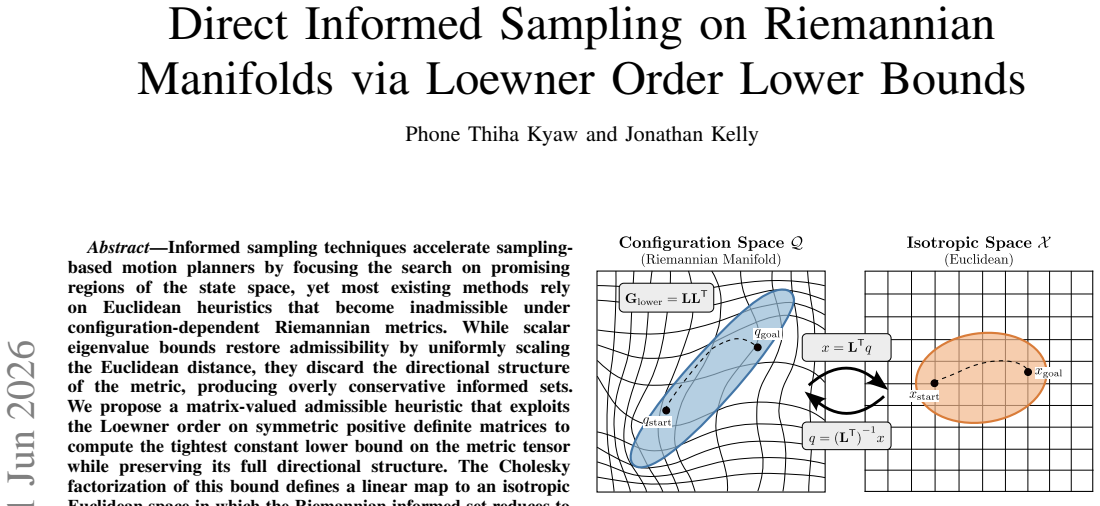
The Cholesky factorization of the tightest constant lower bound on the metric tensor, obtained via the Loewner order, defines a linear map to an isotropic Euclidean space in which the Riemannian informed set reduces to a standard prolate hyperspheroid, allowing direct use of existing Euclidean informed-sampling algorithms while remaining admissible.
Load-bearing premise
A single position-independent matrix lower bound obtained from the Loewner order stays admissible for the true Riemannian distance at every point and its Cholesky factor produces a linear map that correctly transforms the informed-set geometry.
Editorial extensions
If this is right
- Informed sets remain admissible yet are strictly smaller than those obtained from Euclidean distance or scalar eigenvalue bounds.
- Sampling inside the informed set requires no rejection step and reuses existing Euclidean algorithms.
- Convergence of asymptotically optimal planners improves on 6-DoF to 14-DoF manipulators under multiple Riemannian metrics.
- Directional structure of the metric is retained rather than collapsed to a scalar.
Reading between the lines
- The same Loewner-order construction could be applied to time-varying or learned metrics during online replanning.
- The linear-map reduction suggests that other manifold sampling tasks outside motion planning might benefit from analogous constant matrix bounds.
- Parallel sampling in the transformed Euclidean space becomes straightforward once the map is computed.
Signed reviews
Editorial analysis
A structured set of objections, weighed in public.
Referee Report
Summary. The paper claims to introduce a matrix-valued admissible heuristic for informed sampling on Riemannian manifolds by using the Loewner order on SPD matrices to compute the tightest constant lower bound on the metric tensor while preserving its directional structure. The Cholesky factorization of this bound induces a linear map to an isotropic Euclidean space, reducing the Riemannian informed set to a standard prolate hyperspheroid that permits direct, rejection-free sampling via existing Euclidean algorithms. Experiments on 6-DoF UR5, 7-DoF Franka, and 14-DoF PR2 manipulators under three Riemannian metrics demonstrate consistently tighter informed sets and accelerated convergence relative to Euclidean and scalar-eigenvalue baselines across multiple asymptotically optimal planners.
Significance. If the central derivation holds, the result supplies an admissible, direction-preserving heuristic that avoids the conservatism of scalar bounds while remaining parameter-free and directly compatible with existing sampling routines. This is a targeted improvement for sampling-based planning on configuration-dependent metrics, a setting common in robotics, and the approach rests on standard Loewner-order properties without introducing ad-hoc parameters or self-referential fitting.
minor comments (2)
- The abstract states that the bound is the 'tightest constant lower bound' but does not indicate in which section the explicit construction or optimization procedure for obtaining this bound from a given g(x) is presented; a short algorithmic outline or pseudocode would clarify reproducibility.
- The experimental section reports improvement on three robots and three metrics, yet the precise definitions of those metrics (e.g., the functional form of g(x)) are not referenced in the abstract; adding a brief table or equation pointer would strengthen the claim of generality.
Simulated Author's Rebuttal
We thank the referee for their positive assessment of the manuscript and for recommending minor revision. The referee summary accurately captures the central contribution regarding the Loewner-order heuristic and its reduction to prolate hyperspheroid sampling. No major comments appear in the report.
Circularity Check
No significant circularity detected
full rationale
The derivation relies on the standard mathematical property that any constant matrix M satisfying M ≼ g(x) for all x (in the Loewner order) produces an admissible heuristic d_M ≤ d_g for the Riemannian distance, which follows directly from the definition of path length and infimum over curves. The Cholesky factor of M then supplies an explicit linear isometry to Euclidean space, reducing the informed set to a prolate spheroid by algebraic construction without fitted parameters, self-citations, or ansatzes. No load-bearing step reduces to its own inputs or prior author work; the central claim is self-contained from first-principles properties of SPD matrices and the Loewner order.
Assumptions & free parameters
assumptions (1)
- standard math The Loewner order defines a partial order on symmetric positive definite matrices that admits a greatest lower bound for any set of such matrices.
invented entities (1)
-
Matrix-valued admissible heuristic via Loewner order
Cite this review
Pith. "Pith review of Direct Informed Sampling on Riemannian Manifolds via Loewner Order Lower Bounds." pith.science (2026). https://pith.science/paper/UQMTU6TD
@misc{pith2026260602879,
  author       = {Pith},
  title        = {Pith review of: Direct Informed Sampling on Riemannian Manifolds via Loewner Order Lower Bounds},
  year         = {2026},
  howpublished = {\url{https://pith.science/paper/UQMTU6TD}},
  note         = {Machine review of arXiv:2606.02879}
}
read the original abstract
Informed sampling techniques accelerate sampling-based motion planners by focusing the search on promising regions of the state space, yet most existing methods rely on Euclidean heuristics that become inadmissible under configuration-dependent Riemannian metrics. While scalar eigenvalue bounds restore admissibility by uniformly scaling the Euclidean distance, they discard the directional structure of the metric, producing overly conservative informed sets. We propose a matrix-valued admissible heuristic that exploits the Loewner order on symmetric positive definite matrices to compute the tightest constant lower bound on the metric tensor while preserving its full directional structure. The Cholesky factorization of this bound defines a linear map to an isotropic Euclidean space in which the Riemannian informed set reduces to a standard prolate hyperspheroid, enabling direct, rejection-free sampling using existing algorithms. Experiments on manipulation tasks with a 6-DoF UR5, 7-DoF Franka, and 14-DoF PR2 under three distinct Riemannian metrics show that our heuristic produces consistently tighter informed sets than both the Euclidean and scalar eigenvalue bounds, accelerating convergence across multiple state-of-the-art asymptotically optimal planners.
Figures


Figures from the paper (1 more)

Reference graph
Works this paper leans on
-
[1]
Randomized kinodynamic planning,
S. M. LaValle and J. J. Kuffner Jr, “Randomized kinodynamic planning,” Int. J. Robot. Res., vol. 20, no. 5, pp. 378–400, 2001
2001
-
[2]
Sampling-based algorithms for optimal motion planning,
S. Karaman and E. Frazzoli, “Sampling-based algorithms for optimal motion planning,”Int. J. Robot. Res., vol. 30, no. 7, pp. 846–894, 2011
2011
-
[3]
Batch Informed Trees (BIT*): Informed asymptotically optimal anytime search,
J. D. Gammell, T. D. Barfoot, and S. S. Srinivasa, “Batch Informed Trees (BIT*): Informed asymptotically optimal anytime search,”Int. J. Robot. Res., vol. 39, no. 5, pp. 543–567, 2020
2020
-
[4]
Informed sampling for asymptotically optimal path planning,
——, “Informed sampling for asymptotically optimal path planning,” IEEE Trans. Robot., vol. 34, no. 4, pp. 966–984, 2018
2018
-
[5]
Bullo and A
F. Bullo and A. D. Lewis,Geometric control of mechanical systems: modeling, analysis, and design for simple mechanical control systems. Springer, 2019, vol. 49
2019
-
[6]
Riemannian geometry as a unifying theory for robot motion learning and control,
N. Jaquier and T. Asfour, “Riemannian geometry as a unifying theory for robot motion learning and control,” inProc. Int. Symp. Robot. Res. (ISRR). Springer, 2022, pp. 395–403
2022
-
[7]
A Riemannian take on distance fields and geodesic flows in robotics,
Y . Li, J. Qiu, and S. Calinon, “A Riemannian take on distance fields and geodesic flows in robotics,”Int. J. Robot. Res., p. 02783649261420233, 2024
2024
-
[8]
Geometry-Aware Sampling-Based Motion Planning on Riemannian Manifolds
P. T. Kyaw and J. Kelly, “Geometry-aware sampling-based motion planning on Riemannian manifolds,”arXiv preprint arXiv:2602.00992, 2026
work page Pith review arXiv 2026
Show all 45 references
-
[9]
Geometry-aware manipulability learning, tracking, and transfer,
N. Jaquier, L. Rozo, D. G. Caldwell, and S. Calinon, “Geometry-aware manipulability learning, tracking, and transfer,”Int. J. Robot. Res., vol. 40, no. 2-3, pp. 624–650, 2021
2021
-
[10]
Learning stable robotic skills on Riemannian manifolds,
M. Saveriano, F. J. Abu-Dakka, and V . Kyrki, “Learning stable robotic skills on Riemannian manifolds,”Robot. Auton. Syst., vol. 169, p. 104510, 2023
2023
-
[11]
A Rie- mannian metric for geometry-aware singularity avoidance by articulated robots,
F. Mari´c, L. Petrovi ´c, M. Guberina, J. Kelly, and I. Petrovi ´c, “A Rie- mannian metric for geometry-aware singularity avoidance by articulated robots,”Robot. Auton. Syst., vol. 145, p. 103865, 2021
2021
-
[12]
Geodesic methods for shape and surface processing,
G. Peyr ´e and L. D. Cohen, “Geodesic methods for shape and surface processing,”Adv. Comput. Vis. Med. Image Process., pp. 29–56, 2009
2009
-
[13]
Adaptively Informed Trees (AIT*) and Effort Informed Trees (EIT*): Asymmetric bidirectional sampling-based path planning,
M. P. Strub and J. D. Gammell, “Adaptively Informed Trees (AIT*) and Effort Informed Trees (EIT*): Asymmetric bidirectional sampling-based path planning,”Int. J. Robot. Res., vol. 41, no. 4, pp. 390–417, 2022
2022
-
[14]
Greedy heuristics for sampling-based motion planning in high-dimensional state spaces,
P. T. Kyaw, A. V . Le, R. E. Mohan, and J. Kelly, “Greedy heuristics for sampling-based motion planning in high-dimensional state spaces,” arXiv preprint arXiv:2405.03411, 2024
2024
-
[15]
Off the beaten track: Laterally weighted motion planning for local obstacle avoidance,
J. Sehn, T. D. Barfoot, and J. Collier, “Off the beaten track: Laterally weighted motion planning for local obstacle avoidance,”IEEE Trans. Field Robot., vol. 1, pp. 249–275, 2024. Fig. 5: Anytime planning performance across all nine robot–metric scenarios over 100 trials. Row...
2024
-
[16]
Gener- alizing informed sampling for asymptotically-optimal sampling-based kinodynamic planning via markov chain monte carlo,
D. Yi, R. Thakker, C. Gulino, O. Salzman, and S. Srinivasa, “Gener- alizing informed sampling for asymptotically-optimal sampling-based kinodynamic planning via markov chain monte carlo,” inProc. IEEE Int. Conf. Robot. Autom. (ICRA), 2018, pp. 7063–7070
2018
-
[17]
Hierarchical rejection sampling for informed kinodynamic planning in high-dimensional spaces,
T. Kunz, A. Thomaz, and H. Christensen, “Hierarchical rejection sampling for informed kinodynamic planning in high-dimensional spaces,” inProc. IEEE Int. Conf. Robot. Autom. (ICRA), 2016, pp. 89–96
2016
-
[18]
Asymptotically optimal sampling-based motion planning methods,
J. D. Gammell and M. P. Strub, “Asymptotically optimal sampling-based motion planning methods,”Annu. Rev. Control Robot. Auton. Syst., vol. 4, no. 1, pp. 295–318, 2021
2021
-
[19]
Verification and synthesis of admissible heuristics for kinodynamic motion planning,
B. Paden, V . Varricchio, and E. Frazzoli, “Verification and synthesis of admissible heuristics for kinodynamic motion planning,”IEEE Robot. Autom. Lett., vol. 2, no. 2, pp. 648–655, 2017
2017
-
[20]
Asymptotically optimal A* for kinodynamic planning,
M. Przybylski, “Asymptotically optimal A* for kinodynamic planning,” IEEE Robot. Autom. Lett., vol. 9, no. 5, pp. 4353–4360, 2024
2024
-
[21]
An admissible heuristic to improve convergence in kinodynamic planners using motion primitives,
B. Sakcak, L. Bascetta, G. Ferretti, and M. Prandini, “An admissible heuristic to improve convergence in kinodynamic planners using motion primitives,”IEEE Control Syst. Lett., vol. 4, no. 1, pp. 175–180, 2019
2019
-
[22]
Search-based motion planning for aggressive flight in SE(3),
S. Liu, K. Mohta, N. Atanasov, and V . Kumar, “Search-based motion planning for aggressive flight in SE(3),”IEEE Robot. Autom. Lett., vol. 3, no. 3, pp. 2439–2446, 2018
2018
-
[23]
Fast exact and approximate geodesics on meshes,
V . Surazhsky, T. Surazhsky, D. Kirsanov, S. J. Gortler, and H. Hoppe, “Fast exact and approximate geodesics on meshes,”ACM Trans. Graph., vol. 24, no. 3, pp. 553–560, 2005
2005
-
[24]
Landmark-based geodesic computation for heuristically driven path planning,
G. Peyre and L. D. Cohen, “Landmark-based geodesic computation for heuristically driven path planning,” inProc. IEEE Conf. Comput. Vis. Pattern Recognit. (CVPR), vol. 2, 2006, pp. 2229–2236
2006
-
[25]
Landmark guided probabilistic roadmap queries,
B. Paden, Y . Nager, and E. Frazzoli, “Landmark guided probabilistic roadmap queries,” inProc. IEEE/RSJ Int. Conf. Intell. Robots Syst. (IROS), 2017, pp. 4828–4834
2017
-
[26]
Riemannian fast-marching on cartesian grids, using V oronoi’s first reduction of quadratic forms,
J.-M. Mirebeau, “Riemannian fast-marching on cartesian grids, using V oronoi’s first reduction of quadratic forms,”SIAM J. Numer. Anal., vol. 57, no. 6, pp. 2608–2655, 2019
2019
-
[27]
Non-Euclidean motion planning with graphs of geodesically convex sets,
T. Cohn, M. Petersen, M. Simchowitz, and R. Tedrake, “Non-Euclidean motion planning with graphs of geodesically convex sets,”Int. J. Robot. Res., vol. 44, no. 10-11, pp. 1840–1862, 2025
2025
-
[28]
Probabilistic motion planning for non-Euclidean and multi-vehicle problems,
A. Lukyanenko and D. Soudbakhsh, “Probabilistic motion planning for non-Euclidean and multi-vehicle problems,”Robot. Auton. Syst., vol. 168, p. 104487, 2023
2023
-
[29]
S. Boyd, L. El Ghaoui, E. Feron, and V . Balakrishnan,Linear matrix inequalities in system and control theory. SIAM, 1994
1994
-
[30]
Robust belief space planning under intermittent sensing via a maximum eigenvalue-based bound,
S. D. Bopardikar, B. Englot, A. Speranzon, and J. van den Berg, “Robust belief space planning under intermittent sensing via a maximum eigenvalue-based bound,”Int. J. Robot. Res., vol. 35, no. 13, pp. 1609– 1626, 2016
2016
-
[31]
Belief roadmap search: Advances in optimal and efficient planning under uncertainty,
T. Shan and B. Englot, “Belief roadmap search: Advances in optimal and efficient planning under uncertainty,” inProc. IEEE/RSJ Int. Conf. Intell. Robots Syst. (IROS), 2017, pp. 5318–5325
2017
-
[32]
Robust online motion planning via contraction theory and convex optimization,
S. Singh, A. Majumdar, J.-J. Slotine, and M. Pavone, “Robust online motion planning via contraction theory and convex optimization,” in Proc. IEEE Int. Conf. Robot. Autom. (ICRA), 2017, pp. 5883–5890
2017
-
[33]
STOMP: Stochastic trajectory optimization for motion planning,
M. Kalakrishnan, S. Chitta, E. Theodorou, P. Pastor, and S. Schaal, “STOMP: Stochastic trajectory optimization for motion planning,” in Proc. IEEE Int. Conf. Robot. Autom. (ICRA), 2011, pp. 4569–4574
2011
-
[34]
CHOMP: Covariant hamiltonian optimization for motion planning,
M. Zucker, N. Ratliff, A. D. Dragan, M. Pivtoraiko, M. Klingensmith, C. M. Dellin, J. A. Bagnell, and S. S. Srinivasa, “CHOMP: Covariant hamiltonian optimization for motion planning,”Int. J. Robot. Res., vol. 32, no. 9-10, pp. 1164–1193, 2013
2013
-
[35]
Computing large convex regions of obstacle- free space through semidefinite programming,
R. Deits and R. Tedrake, “Computing large convex regions of obstacle- free space through semidefinite programming,” inProc. Workshop Algorithmic Found. Robot. (WAFR). Springer, 2015, pp. 109–124
2015
-
[36]
On semidefinite relaxations for matrix-weighted state-estimation problems in robotics,
C. Holmes, F. D ¨umbgen, and T. Barfoot, “On semidefinite relaxations for matrix-weighted state-estimation problems in robotics,”IEEE Trans. Robot., vol. 40, pp. 4805–4824, 2024
2024
-
[37]
J. M. Lee,Introduction to Riemannian Manifolds. Springer, 2018, vol. 2
2018
-
[38]
Bhatia,Positive Definite Matrices
R. Bhatia,Positive Definite Matrices. Princeton University Press, 2007
2007
-
[39]
Order properties of bounded self-adjoint operators,
R. V . Kadison, “Order properties of bounded self-adjoint operators,”Proc. Amer. Math. Soc., vol. 2, no. 3, pp. 505–510, 1951
1951
-
[40]
MotionBenchMaker: A tool to generate and benchmark motion planning datasets,
C. Chamzas, C. Quintero-Pena, Z. Kingston, A. Orthey, D. Rakita, M. Gleicher, M. Toussaint, and L. E. Kavraki, “MotionBenchMaker: A tool to generate and benchmark motion planning datasets,”IEEE Robot. Autom. Lett., vol. 7, no. 2, pp. 882–889, 2022
2022
-
[41]
AORRTC: Almost-surely asymptotically optimal planning with RRT-Connect,
T. S. Wilson, W. Thomason, Z. Kingston, and J. D. Gammell, “AORRTC: Almost-surely asymptotically optimal planning with RRT-Connect,”IEEE Robot. Autom. Lett., 2025
2025
-
[42]
RRT*-Connect: Faster, asymptotically optimal motion planning,
S. Klemm, J. Oberl ¨ander, A. Hermann, A. Roennau, T. Schamm, J. M. Zollner, and R. Dillmann, “RRT*-Connect: Faster, asymptotically optimal motion planning,” inProc. IEEE Int. Conf. Robot. Biomimetics (ROBIO), 2015, pp. 1670–1677
2015
-
[43]
The open motion planning library,
I. A. Sucan, M. Moll, and L. E. Kavraki, “The open motion planning library,”IEEE Robot. Autom. Mag., vol. 19, no. 4, pp. 72–82, 2012
2012
-
[44]
Motions in microseconds via vectorized sampling-based planning,
W. Thomason, Z. Kingston, and L. E. Kavraki, “Motions in microseconds via vectorized sampling-based planning,” inProc. IEEE Int. Conf. Robot. Autom. (ICRA), 2024, pp. 8749–8756
2024
-
[45]
The Pinocchio C++ library: A fast and flexible implementation of rigid body dynamics algorithms and their analytical derivatives,
J. Carpentier, G. Saurel, G. Buondonno, J. Mirabel, F. Lamiraux, O. Stasse, and N. Mansard, “The Pinocchio C++ library: A fast and flexible implementation of rigid body dynamics algorithms and their analytical derivatives,” inProc. IEEE/SICE Int. Symp. Syst. Integr. (SII), 201...
2019
Reviewed June 28, 2026 · model on record in the stance chip above.
Discussion (0). Continue with ORCID to comment.