REVIEW 3 major objections 1 minor 36 references
Isochrones in primordial magnetic field evolution
T0 review · 3 major / 1 minor · reviewed 2026-06-27 · grok-4.3
Pith's one-line read For any initial primordial magnetic field, a proper time adjustment makes early and late isochrones parallel.
desk verdict A fitted proper-time offset from Alfvén time makes early and late isochrones parallel in 2D decaying MHD simulations for varied initial peaks, but the anastrophy conservation basis lacks reported verification. read the letter →
The pith
A machine-rendered reading of the paper's core claim, the machinery that carries it, and where it could break.
The reading
What carries the argument
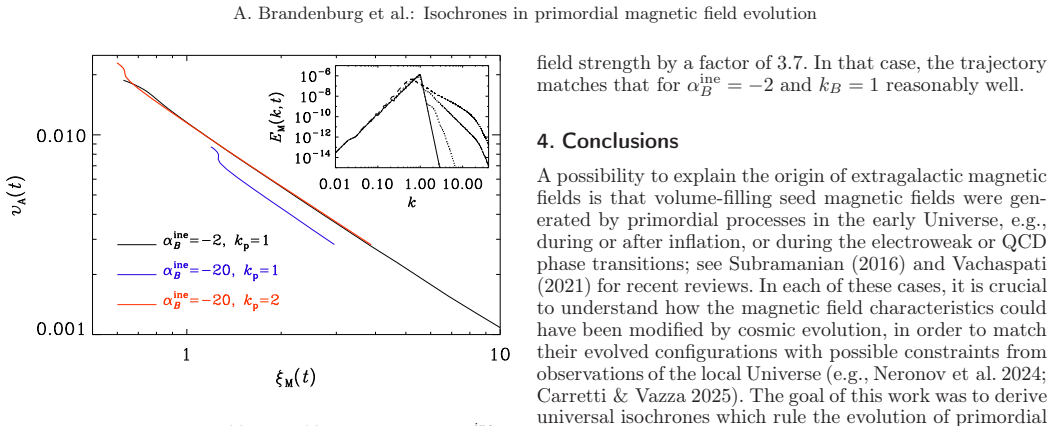
The isochrone: the track of the size of the largest processed eddy, which scales with the Alfvén speed and moves toward larger scales with increasing time.
What would settle it
A simulation in which anastrophy is not conserved would produce non-parallel isochrones even after the proper-time adjustment.
Extended reading notes
Core claim
The central claim is that for any initial field, a proper time can be determined such that the isochrones at early times are parallel to those at late times. The magnetic field parameters lie on universal isochrones even for early times. This is demonstrated in two-dimensional numerical simulations of decaying MHD turbulence by varying the initial position of the peak of the magnetic energy spectrum, where the evolution is governed by the conservation of anastrophy. A fit to the Alfvén time yields an accurate estimate of the factor by which the decay time is longer than the Alfvén time, while the offset provides an estimate of the proper time added to the nominal time since the beginning of
Load-bearing premise
The evolution in the simulations is governed by the conservation of anastrophy.
Editorial extensions
If this is right
- Varying the initial peak position of the magnetic energy spectrum still yields parallel isochrones after proper-time adjustment.
- The fit to the Alfvén time accurately estimates the factor by which decay time exceeds Alfvén time.
- The offset in that fit estimates the proper time to add to nominal simulation time.
- An initial velocity field of realistic strength produces a straighter evolutionary track.
Reading between the lines
- This unification could map magnetic field evolution from any generation mechanism onto one diagram independent of nominal start time.
- Extending the result to three-dimensional simulations would test whether universality survives without strict anastrophy conservation.
- The same proper-time construction might apply to other inverse-cascade systems in astrophysical fluids.
- Intergalactic magnetic field observations could be compared directly against these adjusted universal tracks.
Editorial analysis
A structured set of objections, weighed in public.
Referee Report
Summary. The paper claims that in the radiation-dominated era, primordial magnetic fields undergoing turbulent decay exhibit universal isochrones once a proper time offset (extracted from an Alfvén-time fit) is applied, making early-time isochrones parallel to late-time ones regardless of the initial peak position in the magnetic energy spectrum. This is demonstrated via 2D MHD simulations of decaying turbulence, attributed to anastrophy conservation, with an additional note that realistic initial velocity fields produce straighter tracks.
Significance. If substantiated, the result would allow different magnetogenesis scenarios to be mapped onto a single set of universal isochrones, simplifying theoretical predictions for the evolution of primordial fields and their observational consequences. The approach of varying initial spectral peaks in simulations is a positive step toward generality, though the current support rests on unverified assumptions about conserved quantities.
major comments (3)
- [abstract] Abstract: the assertion that 'the evolution is governed by the conservation of anastrophy' is invoked to explain the parallelism after proper-time adjustment, yet no supporting diagnostics (e.g., time series of anastrophy for different initial peaks or with added velocity fields) are referenced. Without this verification the physical basis for universality independent of initial peak location remains untested.
- [abstract] Abstract (paragraph on 2D simulations): the proper-time offset is obtained from a fit to the Alfvén time performed on the same simulation data subsequently claimed to lie on universal isochrones. This procedure risks circularity; an independent determination of the offset (theoretical or from a separate diagnostic) is needed to establish that the parallelism is not an artifact of the fitting choice.
- [abstract] Abstract: the claim that 'the magnetic field parameters lie on universal isochrones even for early times' is load-bearing for the central result, but the manuscript provides no quantitative measure (e.g., scatter or slope comparison before/after offset) of how well the early-time tracks align across the varied initial peaks once the offset is applied.
minor comments (1)
- [abstract] The abstract mentions varying the initial position of the peak but does not specify the range of peak wavenumbers or the number of runs performed; adding this detail would clarify the scope of the universality claim.
Simulated Author's Rebuttal
We thank the referee for the detailed and constructive report. We address each major comment below. The requested diagnostics and quantitative measures will be added to strengthen the manuscript.
read point-by-point responses
-
Referee: [abstract] Abstract: the assertion that 'the evolution is governed by the conservation of anastrophy' is invoked to explain the parallelism after proper-time adjustment, yet no supporting diagnostics (e.g., time series of anastrophy for different initial peaks or with added velocity fields) are referenced. Without this verification the physical basis for universality independent of initial peak location remains untested.
Authors: We agree that explicit verification is needed. In the revised manuscript we will add time-series plots of anastrophy (and its conservation) for the full set of runs with varied initial spectral peaks, including the cases with realistic initial velocity fields. revision: yes
-
Referee: [abstract] Abstract (paragraph on 2D simulations): the proper-time offset is obtained from a fit to the Alfvén time performed on the same simulation data subsequently claimed to lie on universal isochrones. This procedure risks circularity; an independent determination of the offset (theoretical or from a separate diagnostic) is needed to establish that the parallelism is not an artifact of the fitting choice.
Authors: The offset is extracted from the late-time asymptotic regime where the Alfvén-time scaling is already established and is then applied to test early-time behavior; this is not strictly circular. Nevertheless, to strengthen the result we will also provide an independent theoretical estimate of the offset derived from the initial anastrophy and Alfvén time and compare it with the fitted value. revision: partial
-
Referee: [abstract] Abstract: the claim that 'the magnetic field parameters lie on universal isochrones even for early times' is load-bearing for the central result, but the manuscript provides no quantitative measure (e.g., scatter or slope comparison before/after offset) of how well the early-time tracks align across the varied initial peaks once the offset is applied.
Authors: We will add quantitative diagnostics in the revised manuscript: root-mean-square scatter of the isochrone positions across initial-peak runs, and direct slope comparisons, both before and after the time offset is applied. revision: yes
Circularity Check
Proper-time offset fitted from simulation data then used to claim universal isochrones
-
fitted input called prediction
[abstract]
"A fit to the Alfvén time yields an accurate estimate of the factor by which the decay time is longer than the Alfvén time, while the offset in the fit provides an additional estimate of the proper time that needs to be added to the nominal time since the beginning of each simulation. [...] The magnetic field parameters lie on universal isochrones even for early times."
The offset that defines the proper time is extracted by fitting the Alfvén time directly to the simulation outputs for different initial peaks. Adding this fitted offset is then said to produce parallel (universal) isochrones on the same data, so the universality result is statistically forced by the choice of fit rather than predicted from first principles or external constraints.
full rationale
The paper determines the proper time offset via a fit performed on the 2D MHD simulation data (varying initial spectral peak), then adds that offset to assert that the same data lie on universal isochrones at early times. This adjustment is therefore a direct output of the fitting procedure applied to the data being analyzed, reducing the claimed universality to a consequence of the fit rather than an independent derivation. No self-citations, ansatzes, or other load-bearing reductions are exhibited in the provided text.
Assumptions & free parameters
free parameters (2)
- factor by which decay time exceeds Alfvén time
- proper-time offset
assumptions (1)
- domain assumption Conservation of anastrophy governs the decay of magnetic energy in two-dimensional MHD turbulence
Cite this review
Pith. "Pith review of Isochrones in primordial magnetic field evolution." pith.science (2026). https://pith.science/paper/UQPSPSNY
@misc{pith2026260610863,
  author       = {Pith},
  title        = {Pith review of: Isochrones in primordial magnetic field evolution},
  year         = {2026},
  howpublished = {\url{https://pith.science/paper/UQPSPSNY}},
  note         = {Machine review of arXiv:2606.10863}
}
read the original abstract
During the radiation-dominated era of the Universe, a primordial magnetic field undergoes a turbulent decay while its length scale increases due to an inverse cascade. At later times, the size of the largest processed eddy scales with the Alfv\'en speed and it describes an isochrone that moves toward larger scales with increasing time. Different magnetogenesis mechanisms produce different initial length scales and field strengths, independently of the nominal generation time. However, we show that for any initial field, a proper time can be determined such that the isochrones at early times are parallel to those at late times. We use two-dimensional numerical simulations of decaying MHD turbulence and vary the initial position of the peak of the magnetic energy spectrum. In this case, the evolution is governed by the conservation of anastrophy. A fit to the Alfv\'en time yields an accurate estimate of the factor by which the decay time is longer than the Alfv\'en time, while the offset in the fit provides an additional estimate of the proper time that needs to be added to the nominal time since the beginning of each simulation. We also find that the presence of an initial velocity field of realistic strength helps producing a more straight track. The magnetic field parameters lie on universal isochrones even for early times.
Figures


Figures from the paper (8 more)


Reference graph
Works this paper leans on
-
[1]
& Jedamzik, K
Banerjee, R. & Jedamzik, K. 2004, PhRvD, 70, 123003
2004
-
[2]
Bhat, P., Zhou, M., & Loureiro, N. F. 2021, MNRAS, 501, 3074
2021
-
[3]
2022, A& A, 660, A80
Bondarenko, K., Boyarsky, A., Korochkin, A., et al. 2022, A& A, 660, A80
2022
-
[4]
2020, ApJ, 901, 18
Brandenburg, A. 2020, ApJ, 901, 18
2020
-
[5]
1996, PhRvD, 54, 1 291
Brandenburg, A., Enqvist, K., & Olesen, P. 1996, PhRvD, 54, 1 291
1996
-
[6]
& Kahniashvili, T
Brandenburg, A. & Kahniashvili, T. 2017, PhRvL, 118, 055102
2017
-
[7]
2017, PhRvD, 96, 123528
Brandenburg, A., Kahniashvili, T., Mandal, S., et al. 2017, PhRvD, 96, 123528
2017
-
[8]
& Kumar, V
Brandenburg, A. & Kumar, V. 2026, JPlPh, to be submitted
2026
Show all 36 references
-
[9]
2024, A&A, 687, A18 6
Brandenburg, A., Neronov, A., & Vazza, F. 2024, A&A, 687, A18 6
2024
-
[10]
& Ntormousi, E
Brandenburg, A. & Ntormousi, E. 2025, ApJ, 990, 223
2025
-
[11]
2023, JPlPh, 8 9, 905890606
Brandenburg, A., Sharma, R., & Vachaspati, T. 2023, JPlPh, 8 9, 905890606
2023
-
[12]
2025, JPlPh, 91, E113
Brandenburg, A., Yi, L., & W u, X. 2025, JPlPh, 91, E113
2025
-
[13]
& Vazza, F
Carretti, E. & Vazza, F. 2025, Universe, 11, 164
2025
-
[14]
2001, Ph RvE, 64, 056405
Christensson, M., Hindmarsh, M., & Brandenburg, A. 2001, Ph RvE, 64, 056405
2001
-
[15]
Comisso, L., Grasso, D., & W aelbroeck, F. L. 2015, PhPl, 22, 0 42109 de Souza, R. S. & Opher, R. 2008, PhRvD, 77, 043529
2015
-
[16]
2010, MNRAS, 401, 47
Donnert, J., Dolag, K., Brunetti, G., Cassano, R., & Bonafed e, A. 2010, MNRAS, 401, 47
2010
-
[17]
& Caprini, C
Durrer, R. & Caprini, C. 2003, JCAP, 2003, 010
2003
-
[18]
1998, PhRvD, 58, 12 3004
Durrer, R., Kahniashvili, T., & Yates, A. 1998, PhRvD, 58, 12 3004
1998
-
[19]
& Neronov, A
Durrer, R. & Neronov, A. 2013, A&ARv, 21, 62
2013
-
[20]
& Montgomery, D
Fyfe, D. & Montgomery, D. 1976, JPlPh, 16, 181
1976
-
[21]
2026, PhRvD, 113, 023523
Ghosh, O., Brandenburg, A., Caprini, C., Neronov, A., & Vazz a, F. 2026, PhRvD, 113, 023523
2026
-
[22]
& Rubinstein, H
Grasso, D. & Rubinstein, H. R. 2001, Phys. Rep., 348, 163
2001
-
[23]
Hosking, D. N. & Schekochihin, A. A. 2021, PhRvX, 11, 041005
2021
-
[24]
Hosking, D. N. & Schekochihin, A. A. 2023, NatCo, 14, 7523
2023
-
[25]
G., Brandenburg, A., & Neron ov, A
Kahniashvili, T., Tevzadze, A. G., Brandenburg, A., & Neron ov, A. 2013, PhRvD, 87, 083007
2013
- [26]
-
[27]
2024 , arXiv e-prints, arXiv:2412.14825 Pencil Code Collaboration, Brandenburg, A., Johansen, A., et al
Neronov, A., Vazza, F., Mtchedlidze, S., & Carretti, E. 2024 , arXiv e-prints, arXiv:2412.14825 Pencil Code Collaboration, Brandenburg, A., Johansen, A., et al. 2021, JOSS, 6, 2807
2024
-
[28]
1993, Les Houches Session XL VII, 139
Pouquet, A. 1993, Les Houches Session XL VII, 139
1993
-
[29]
1976, JFM, 77, 321
Pouquet, A., Frisch, U., & Leorat, J. 1976, JFM, 77, 321
1976
-
[30]
& Banerjee, R
Reppin, J. & Banerjee, R. 2017, PhRvE, 96, 053105
2017
-
[31]
2016, Rep
Subramanian, K. 2016, Rep. Prog. Phys., 79, 076901
2016
-
[32]
2024, ApJ, 963, 135
Tjemsland, J., Meyer, M., & Vazza, F. 2024, ApJ, 963, 135
2024
-
[33]
2021, Rept
Vachaspati, T. 2021, Rept. Prog. Phys., 84, 074901
2021
-
[34]
2025, A&A, 696, A5 8
Vazza, F., Gheller, C., Zanetti, F., et al. 2025, A&A, 696, A5 8
2025
-
[35]
M., Ryu, D., Schleicher, D
Widrow, L. M., Ryu, D., Schleicher, D. R. G., et al. 2012, SSR, 166, 37
2012
-
[36]
2022, JPlPh., 88, 905 880602 Article number, page 11
Zhou, H., Sharma, R., & Brandenburg, A. 2022, JPlPh., 88, 905 880602 Article number, page 11
2022
Reviewed June 27, 2026 · model on record in the stance chip above.
Discussion (0). Continue with ORCID to comment.