Ultrafast chiral sensing with an ultraviolet vector beam
Pith reviewed 2026-06-27 05:57 UTC · model grok-4.3
The pith
An infrared vector beam drives high-order harmonics in randomly oriented chiral molecules, emitting an ultraviolet vector beam whose intensity profile distinguishes molecular handedness.
A machine-rendered reading of the paper's core claim, the machinery that carries it, and where it could break.
Core claim
An infrared vector beam generates high-order harmonics in a sample of randomly oriented chiral molecules, resulting in the emission of an ultraviolet vector beam whose intensity profile carries information about the handedness of the chiral molecules, thereby allowing spatial discrimination of enantiomers.
What carries the argument
The intensity profile of the ultraviolet vector beam produced via high-order harmonic generation from an infrared vector beam, which encodes the molecular handedness.
If this is right
- Spatial discrimination of molecular enantiomers becomes possible using the emitted beam's intensity profile.
- Ultrafast chirality studies can proceed without orienting the sample molecules.
- A robust and efficient setup combines vector beams with high-order harmonic generation for enantiomer distinction.
- The method opens a route for probing chirality on ultrafast timescales in randomly oriented samples.
Where Pith is reading between the lines
- This could extend to probing chiral dynamics during chemical reactions by capturing time-resolved profiles.
- The approach may link to other nonlinear optical effects where vector beam topology interacts with molecular asymmetry.
- Applications might include rapid screening of chiral purity in mixtures without physical separation.
Load-bearing premise
The intensity profile of the emitted ultraviolet vector beam uniquely encodes and allows discrimination of molecular handedness without confounding effects from molecular orientation, beam imperfections, or other sample properties.
What would settle it
Experiments measuring identical intensity profiles for both enantiomers under identical infrared vector beam conditions would show that the profile does not carry distinguishable handedness information.
Figures
read the original abstract
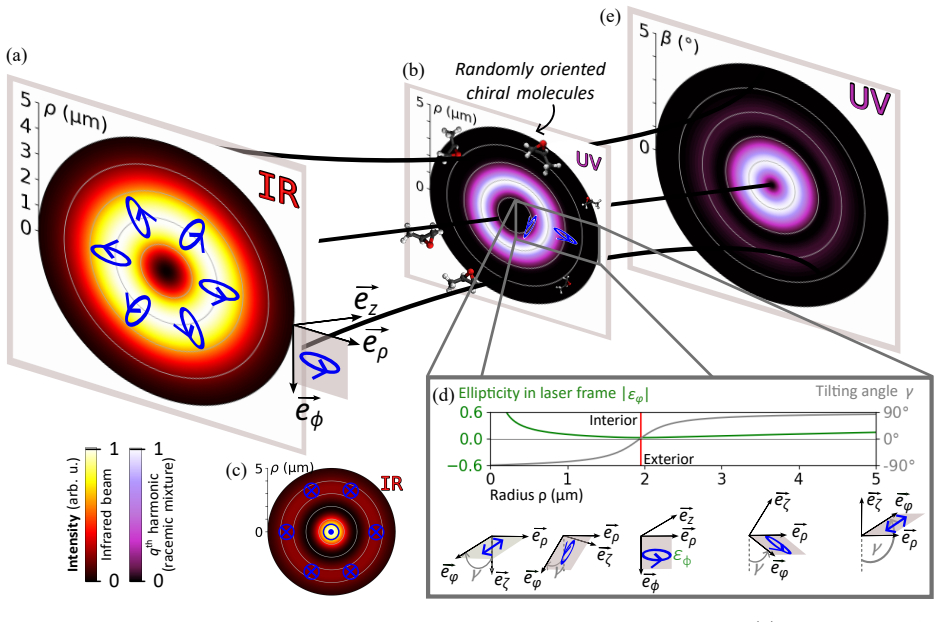
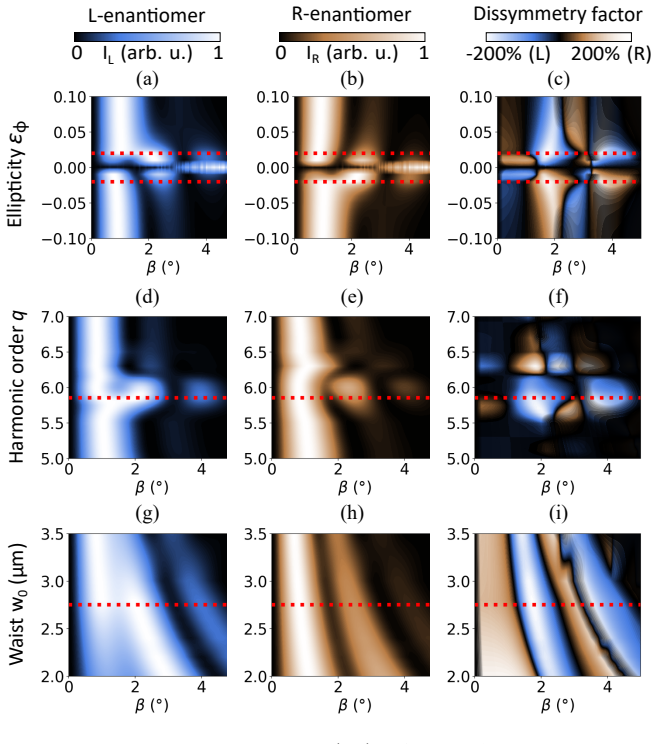
We present a robust, ultrafast and highly efficient setup for distinguishing molecular enantiomers by combining ultrafast techniques with vector beams, a type of topological light with azimuthally varying polarization. An infrared vector beam generates high-order harmonics in a sample of randomly oriented chiral molecules, resulting in the emission of an ultraviolet vector beam whose intensity profile carries information about the handedness of the chiral molecules. Our approach allows for spatial discrimination of molecular enantiomers, opening a new route for studying ultrafast chirality.
Editorial analysis
A structured set of objections, weighed in public.
Referee Report
Summary. The manuscript proposes using an infrared vector beam to drive high-order harmonic generation in a sample of randomly oriented chiral molecules, resulting in emission of an ultraviolet vector beam whose intensity profile encodes molecular handedness and enables spatial discrimination of enantiomers. The approach is presented as robust, ultrafast, and efficient for studying ultrafast chirality.
Significance. If validated, the proposal would introduce a new route for chiral sensing that leverages the azimuthal polarization structure of vector beams to achieve discrimination without requiring molecular alignment, potentially combining topological optics with nonlinear processes for spatial and temporal resolution.
major comments (2)
- [Abstract] Abstract: The central claim requires that the vector beam's polarization structure produces a chiral HHG response surviving random-orientation averaging and appearing in the emitted UV intensity profile (rather than phase or polarization). No selection-rule derivation, symmetry argument, or numerical demonstration of this mechanism is provided, leaving the load-bearing step for enantiomer discrimination unsupported.
- [Abstract] Abstract: No quantitative assessment or simulation addresses whether beam imperfections, residual alignment, or non-chiral contributions could produce indistinguishable intensity variations, which is required to establish that the profile uniquely encodes handedness.
minor comments (1)
- The abstract is concise but would benefit from at least one reference to prior vector-beam or chiral-HHG literature to situate the novelty.
Simulated Author's Rebuttal
We thank the referee for their careful reading and constructive feedback on our manuscript. We address the major comments point by point below.
read point-by-point responses
-
Referee: [Abstract] Abstract: The central claim requires that the vector beam's polarization structure produces a chiral HHG response surviving random-orientation averaging and appearing in the emitted UV intensity profile (rather than phase or polarization). No selection-rule derivation, symmetry argument, or numerical demonstration of this mechanism is provided, leaving the load-bearing step for enantiomer discrimination unsupported.
Authors: We agree that the manuscript does not currently provide a selection-rule derivation, symmetry argument, or numerical demonstration of the mechanism. This is a substantive gap in the presentation of the central claim. We will revise the manuscript to include a dedicated section with a symmetry argument based on the interaction of the azimuthally varying polarization with the chiral molecular response, showing explicitly how the effect survives random-orientation averaging and appears in the far-field intensity profile of the emitted UV vector beam rather than solely in phase or polarization. revision: yes
-
Referee: [Abstract] Abstract: No quantitative assessment or simulation addresses whether beam imperfections, residual alignment, or non-chiral contributions could produce indistinguishable intensity variations, which is required to establish that the profile uniquely encodes handedness.
Authors: We agree that establishing uniqueness requires quantitative checks against confounding effects. The submitted manuscript contains no such assessments or simulations. In revision we will add an analysis section with estimates or simulations of beam imperfections, possible residual alignment, and non-chiral background contributions to demonstrate that the enantiomer-specific intensity variations remain distinguishable under realistic conditions. revision: yes
Circularity Check
No circularity; physical claim presented without equations, fits, or self-referential derivations
full rationale
The provided abstract and description contain no equations, parameter fits, derivation chains, or self-citations. The central claim is a direct physical statement about high-order harmonic generation and resulting intensity profiles in chiral samples, without any reduction of a 'prediction' to fitted inputs or imported uniqueness theorems. No load-bearing steps exist that could be circular by construction. This matches the reader's assessment of score 0.0 and qualifies as a self-contained empirical proposal.
Axiom & Free-Parameter Ledger
Reference graph
Works this paper leans on
-
[1]
& Woerdman, J
Allen, L., Beijersbergen, M., Spreeuw, R. & Woerdman, J. Orbital angular momentum of light and the transformation of Laguerre-Gaussian laser modes.Phys. Rev. A45,8185 (11 1992)
1992
-
[2]
Cylindrical vector beams: From mathematical concepts to applications.Adv
Zhan, Q. Cylindrical vector beams: From mathematical concepts to applications.Adv. Opt. Photonics 1,1 (2009)
2009
-
[3]
& Forbes, A
Rosales-Guzm´ an, C., Ndagano, B. & Forbes, A. A review of complex vector light fields and their applications.Journal of Optics20,123001 (2018)
2018
-
[4]
Buono, W. T. & Forbes, A. Nonlinear optics with structured light.Opto-Electronic Advances5,210174- 1-210174–19.issn: 2096-4579 (2022)
2096
-
[5]
S., Pic´ on, A., Drevinskas, R., Cerkauskaite, A., Kazansky, P
Hern´ andez-Garc´ ıa, C., Turpin, A., Rom´ an, J. S., Pic´ on, A., Drevinskas, R., Cerkauskaite, A., Kazansky, P. G., Durfee, C. G. & Sola, ´I. J. Extreme ultraviolet vector beams driven by infrared lasers.Optica4, 520–526 (2017)
2017
-
[6]
K., Rom´ an, J
De las Heras, A., Pandey, A. K., Rom´ an, J. S., Serrano, J., Baynard, E., Dovillaire, G., Pittman, M., Durfee, C. G., Plaja, L., Kazamias, S., Guilbaud, O. & Hern´ andez-Garc´ ıa, C. Extreme-ultraviolet vector-vortex beams from high harmonic generation.Optica9,71–79 (2022)
2022
-
[7]
S., Plaja, L
Garc´ ıa-Cabrera, A., Boyero-Garc´ ıa, R., Zurr´ on-Cifuentes,´O., Serrano, J., Rom´ an, J. S., Plaja, L. & Hern´ andez-Garc´ ıa, C. Topological high-harmonic spectroscopy.Communications Physics7,28 (2024)
2024
-
[8]
& Oguri, K
Nagai, K., Okamoto, T., Shinohara, Y., Sanada, H. & Oguri, K. High-harmonic spin-orbit angular momentum generation in crystalline solids preserving multiscale dynamical symmetry.Science Advances 10,eado7315 (2024)
2024
-
[9]
& Ivanov, M
Krausz, F. & Ivanov, M. Attosecond physics.Reviews of Modern Physics(2009). 5
2009
-
[10]
M., Toma, E
Paul, P. M., Toma, E. S., Breger, P., Mullot, G., Aug´ e, F., Balcou, P., Muller, H. G. & Agostini, P. Observation of a train of attosecond pulses from high harmonic generation.Science292,1689–1692 (2001)
2001
-
[11]
F., Lompre, L
Ferray, M., L’Huillier, A., Li, X. F., Lompre, L. A., Mainfray, G. & Manus, C. Multiple-harmonic conversion of 1064 nm radiation in rare gases.Journal of Physics B: Atomic, Molecular and Optical Physics21,L31–L35 (1988)
1988
-
[12]
Y., L’Huillier, A
Lewenstein, M., Balcou, P., Ivanov, M. Y., L’Huillier, A. & Corkum, P. B. Theory of high-harmonic generation by low-frequency laser fields.Phys. Rev. A49,2117–2132 (3 1994)
1994
-
[13]
Kling, M. F. & Vrakking, M. J. Attosecond Electron Dynamics.Annual Review of Physical Chemistry 59,463–492.issn: 1545-1593 (2008)
2008
-
[14]
& Mart´ ın, F
Nisoli, M., Decleva, P., Calegari, F., Palacios, A. & Mart´ ın, F. Attosecond Electron Dynamics in Molecules.Chemical Reviews117,10760–10825.issn: 0009-2665 (2017)
2017
-
[15]
Corkum, P. B. & Krausz, F. Attosecond science.Nature Physics3,381–387 (2007)
2007
-
[16]
Barron, L. D. Chirality and Life.Space Science Reviews135,187–201.issn: 1572-9672 (2008)
2008
-
[17]
& Folkers, G.Chirality in drug research(Wiley- VCH Weinheim, 2006)
Francotte, E., Lindner, W., Mannhold, R., Kubinyi, H. & Folkers, G.Chirality in drug research(Wiley- VCH Weinheim, 2006)
2006
-
[18]
H., Guida, W
Brooks, W. H., Guida, W. C. & Daniel, K. G. The Significance of Chirality in Drug Design and Development.Current Topics in Medicinal Chemistry11,760–770.issn: 1873-4294 (2011)
2011
-
[19]
New opportunities for ultrafast and highly enantio-sensitive imaging of chiral nuclear dy- namics enabled by synthetic chiral light.Phys
Ayuso, D. New opportunities for ultrafast and highly enantio-sensitive imaging of chiral nuclear dy- namics enabled by synthetic chiral light.Phys. Chem. Chem. Phys.24,10193 (17 2022)
2022
-
[20]
F., Decleva, P., Lerner, G., Cohen, O., Ivanov, M
Ayuso, D., Neufeld, O., Ordonez, A. F., Decleva, P., Lerner, G., Cohen, O., Ivanov, M. & Smirnova, O. Synthetic chiral light for efficient control of chiral light–matter interaction.Nat. Photonics13,866 (12 2019)
2019
-
[21]
Y., Smirnova, O
Neufeld, O., Ayuso, D., Decleva, P., Ivanov, M. Y., Smirnova, O. & Cohen, O. Ultrasensitive Chiral Spectroscopy by Dynamical Symmetry Breaking in High Harmonic Generation.Phys. Rev. X9,031002 (3 2019)
2019
-
[22]
Ordonez, A. F. & Smirnova, O. Generalized perspective on chiral measurements without magnetic interactions.Phys. Rev. A98,063428 (6 2018)
2018
-
[23]
E., Alharbi, A
Cireasa, R., Suarez, J., Higuet, J., Schmidt, B. E., Alharbi, A. F., L´ egar´ e, F., Blanchet, V., Fabre, B., Patchkovskii, S., Smirnova, O., Mairesse, Y. & Bhardwaj, V. R. Probing molecular chirality on a sub-femtosecond timescale.Nat. Phys.11,654 (11 2015)
2015
-
[24]
& Patchkovskii, S
Smirnova, O., Mairesse, Y. & Patchkovskii, S. Opportunities for chiral discrimination using high har- monic generation in tailored laser fields.Journal of Physics B: Atomic, Molecular and Optical Physics 48,234005 (2015)
2015
-
[25]
& Sekikawa, T
Harada, Y., Haraguchi, E., Kaneshima, K. & Sekikawa, T. Circular dichroism in high-order harmonic generation from chiral molecules.Phys. Rev. A98,021401(R) (2 2018)
2018
-
[26]
F., Decleva, P., Ivanov, M
Ayuso, D., Ordonez, A. F., Decleva, P., Ivanov, M. & Smirnova, O. Strong chiral response in non- collinear high harmonic generation driven by purely electric-dipole interactions.Opt. Express30,4659– 4667 (2022)
2022
-
[27]
Lax, M., Louisell, W. H. & Mcknight, W. B. From Maxwell to paraxial wave optics.Phys. Rev. A11, 1365 (4 1975)
1975
-
[28]
& Ayuso, D
Rego, L., Smirnova, O. & Ayuso, D. Tilting light’s polarization plane to spatially separate the ultrafast nonlinear response of chiral molecules.Nanophotonics12,2873 (14 2023)
2023
-
[29]
A., Castro, A., Bertsch, G
Marques, M. A., Castro, A., Bertsch, G. F. & Rubio, A. octopus: a first-principles tool for excited electron-ion dynamics.Computer Physics Communications151,60–78 (2003)
2003
-
[30]
A., Andrade, X., Lorenzen, F., Marques, M
Castro, A., Appel, H., Oliveira, M., Rozzi, C. A., Andrade, X., Lorenzen, F., Marques, M. A. L., Gross, E. K. U. & Rubio, A. octopus: a tool for the application of time-dependent density functional theory. Phys. stat. sol. B243,2465–2488 (11 2006)
2006
-
[31]
D., Larsen, A
Andrade, X., Strubbe, D., Giovannini, U. D., Larsen, A. H., Oliveira, M. J. T., Alberdi-Rodriguez, J., Varas, A., Theophilou, I., Helbig, N., Verstraete, M. J., Stella, L., Nogueira, F., Aspuru-Guzik, A., Alberto Castro, j., Marques, M. A. L. & Rubiod, A. Real-space grids and the Octopus code as tools for the development of new simulation approaches for e...
2015
-
[32]
Tancogne-Dejean, N., Oliveira, M. J. T., Andrade, X., Appel, H., Borca, C. H., Breton, G. L., Buchholz, F., Castro, A., Corni, S., Correa, A. A., Giovannini, U. D., Delgado, A., Eich, F. G., Flick, J., Gil, G., Gomez, A., Helbig, N., H¨ ubener, H., Jest¨ adt, R., Jornet-Somoza, J., Larsen, A. H., Lebedeva, I. V., L¨ uders, M., Marques, M. A. L., Pipolo, S...
2020
-
[33]
& Smirnova, O
Mayer, N., Ayuso, D., Decleva, P., Khokhlova, M., Pisanty, E., Ivanov, M. & Smirnova, O. Chiral topological light for detection of robust enantiosensitive observables.Nat. Photonics18,1155 (2024)
2024
-
[34]
Dirac, P. A. M. Note on Exchange Phenomena in the Thomas Atom.Mathematical Proceedings of the Cambridge Philosophical Society26,376–385 (1930). 6
1930
-
[35]
Bemerkung zur Elektronentheorie des Ferromagnetismus und der elektrischen Leitf¨ ahigkeit
Bloch, F. Bemerkung zur Elektronentheorie des Ferromagnetismus und der elektrischen Leitf¨ ahigkeit. Zeitschrift f¨ ur Physik57,545–555.issn: 0044-3328 (1929)
1929
-
[36]
Perdew, J. P. & Zunger, A. Self-interaction correction to density-functional approximations for many- electron systems.Phys. Rev. B23,5048–5079 (10 1981)
1981
-
[37]
& Reinhard, P.-G
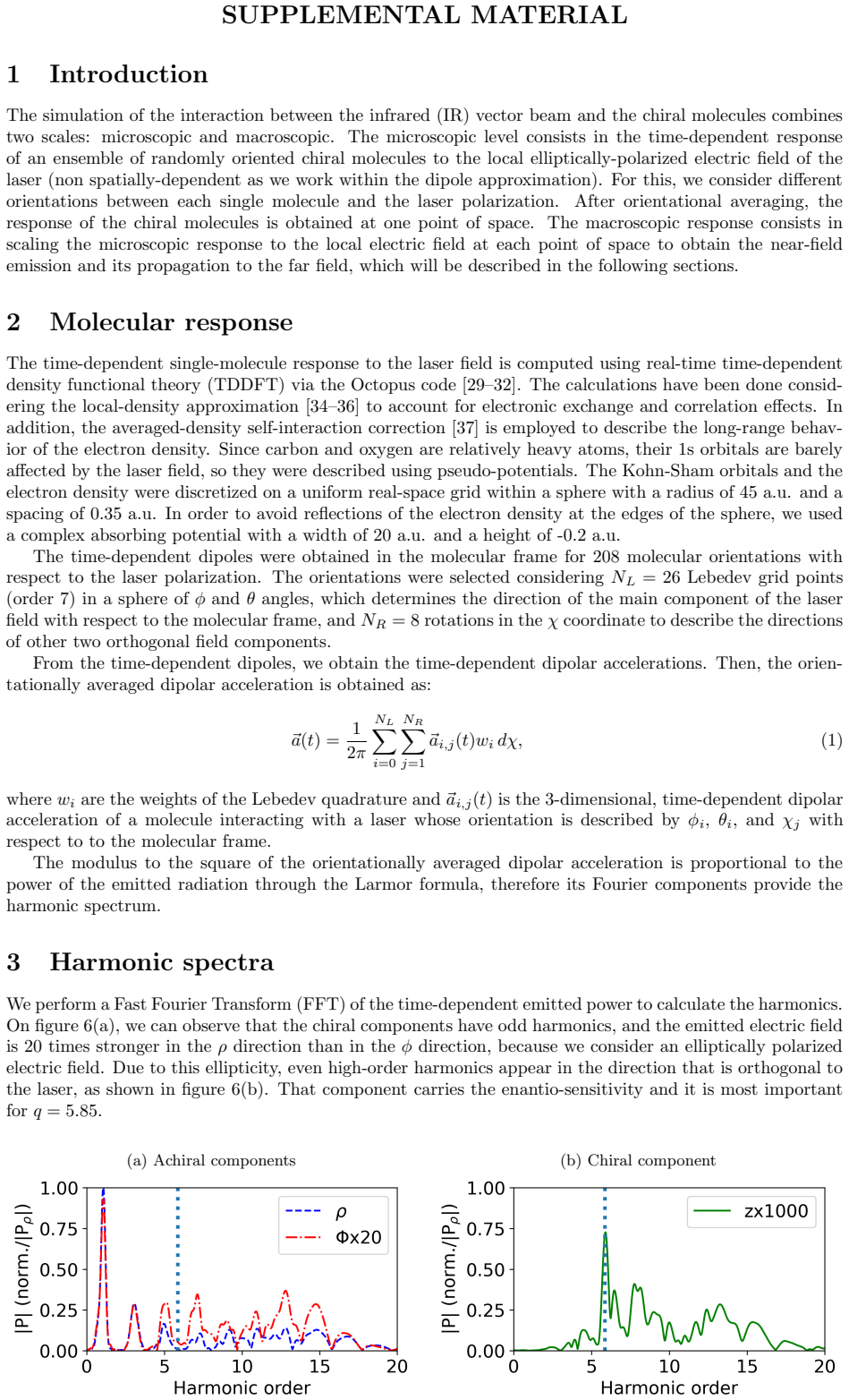
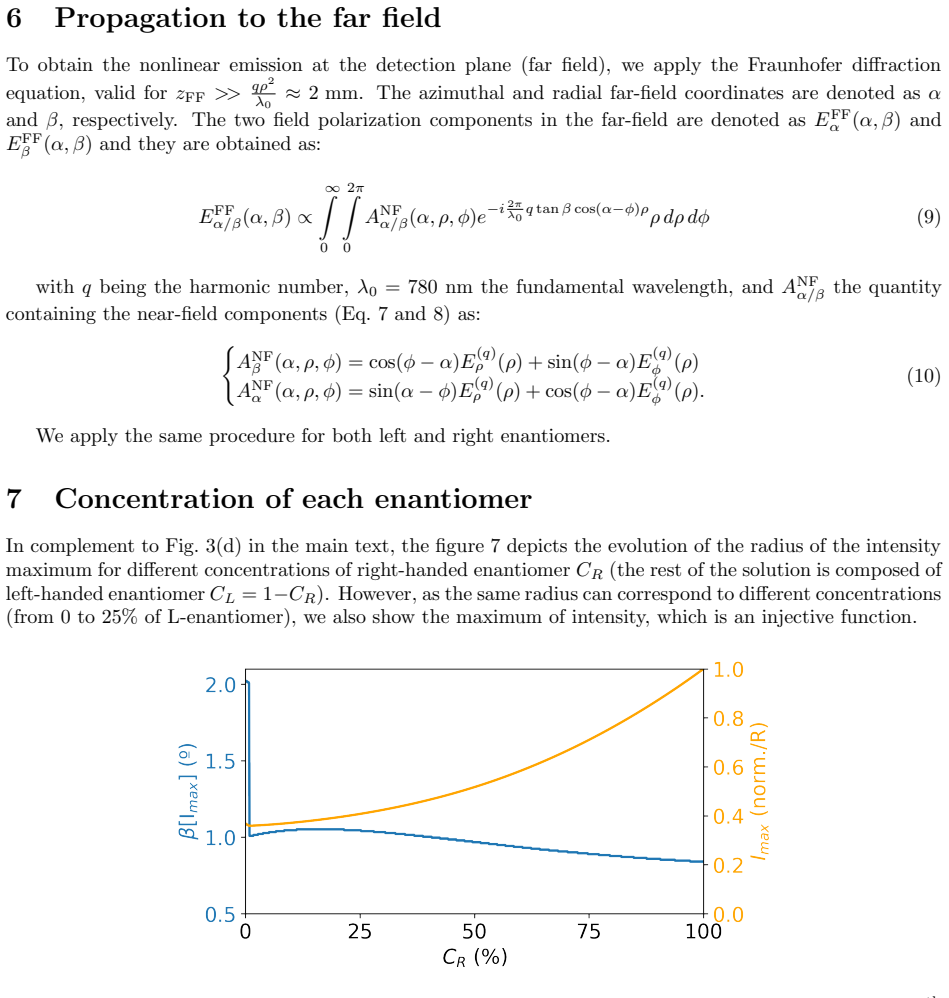
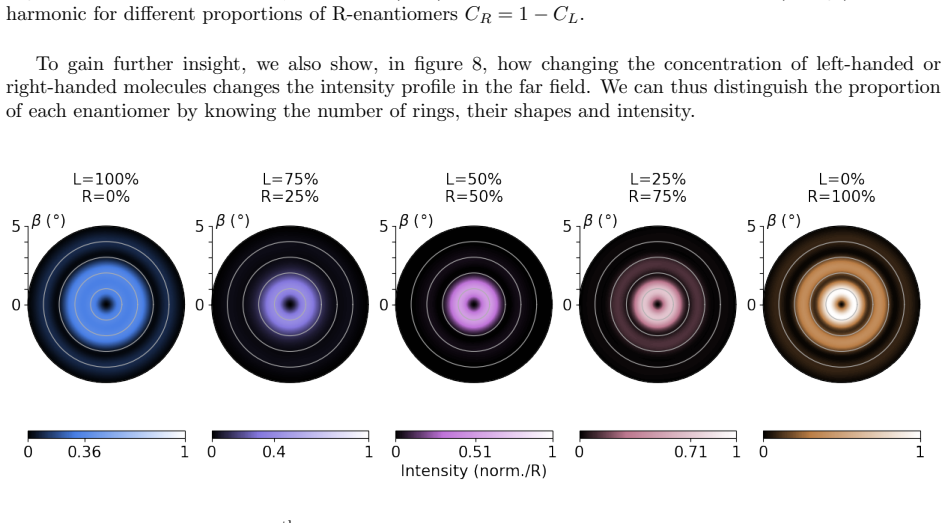
Legrand, C., Suraud, E. & Reinhard, P.-G. Comparison of self-interaction-corrections for metal clusters. Journal of Physics B: Atomic, Molecular and Optical Physics35,1115–1128 (2002). 7 SUPPLEMENTAL MATERIAL 1 Introduction The simulation of the interaction between the infrared (IR) vector beam and the chiral molecules combines two scales: microscopic and...
2002
discussion (0)
Sign in with ORCID, Apple, or X to comment. Anyone can read and Pith papers without signing in.