REVIEW 2 major objections 4 minor 10 references
On Antenna Array Out-of-Band Emissions
T0 review · 2 major / 4 minor · reviewed 2026-08-14 · deepseek-v4-flash
Pith's one-line read For multi-user arrays, power-amplifier distortion is beamformed toward the intended receivers, and is strongest there.
desk verdict Solid cubic-model derivation of beamformed OOB distortion toward intended users; the 'always strongest' claim outruns the proof for higher-order PA nonlinearities. read the letter →
The pith
A machine-rendered reading of the paper's core claim, the machinery that carries it, and where it could break.
The reading
What carries the argument
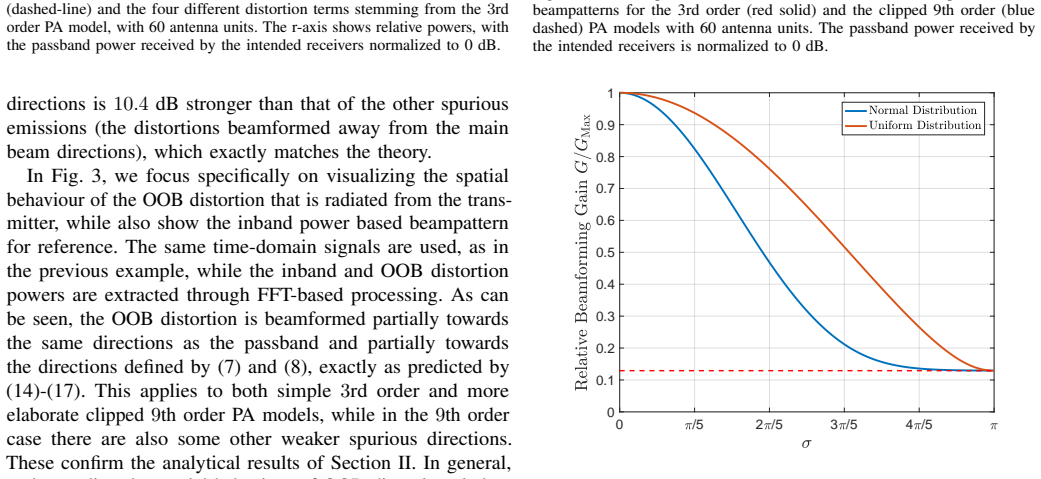
The load-bearing object is the memoryless third-order PA model $f(x)=x+\alpha x^3$ applied to a two-user narrowband I/Q signal. Expanding the cube yields four surviving in-band and out-of-band distortion terms: two containing the original beamforming phases, which therefore combine coherently at the intended receivers, and two containing the phase combinations $2\phi_2-\phi_1$ and $2\phi_1-\phi_2$, which produce spurious beams. Power evaluations rely on the complex-circular Gaussian statistics of the input, with the identities $E|s|^4=2P^2$ and $E|s|^6=6P^3$, and on modeling per-PA phase deviations $\psi_m$ as Gaussian or uniform, giving beamforming gains $M+(M^2-M)e^{-\sigma^2}$ and $M+(M^2-M)\operatorname{sinc}^2\sigma$. The ratio of the two coefficient sets, $99/8$ versus $9/8$, is what fixes the 10.4 dB gap between intended and spurious directions.
What would settle it
Feed a two-tone or OFDM signal through a measured power-amplifier polynomial whose fifth-order coefficient is comparable to or larger than the cubic coefficient, and compare the out-of-band power in the intended-user directions with the power in the spurious directions defined by the third-order phase combinations; if any spurious direction carries more out-of-band power than the intended-user directions, the paper's 'always strongest in the intended directions' claim fails.
Extended reading notes
Core claim
The central claim is that, under the truncated memoryless PA model, the out-of-band distortion produced by a multi-user precoded transmitter is always beamformed in the directions of the intended receivers and is always strongest there. The cubic nonlinearity creates four relevant distortion terms near the occupied band: two with phase arguments that match the users' data phases, and two with the spurious phase combinations $2\theta_2-\theta_1$ and $2\theta_1-\theta_2$. The first two are radiated with the exact precoding phases of the desired signals, hence coherent at the intended receivers; the latter two form beams in other directions. With equal-power users the coefficient ratio is $99/8$ against $9/8$, giving the 11-fold (10.4 dB) power advantage in the intended directions. The paper also claims that if the array's power amplifiers have mutually different random phase responses, the coherent gain of all distortion terms is reduced, approaching the noncoherent combining limit as the phase deviations grow.
Load-bearing premise
The load-bearing premise is that each power amplifier's nonlinearity is fully captured by the memoryless cubic term $f(x)=x+\alpha x^3$ and that all higher-order intermodulation products are negligible; if a real amplifier's fifth- or seventh-order terms become strong, the spurious beams they create could match or exceed the distortion sent toward the intended receivers.
Editorial extensions
If this is right
- Out-of-band distortion power at an intended receiver scales with the array's coherent gain, so it cannot be averaged away by increasing the number of antennas.
- Predicting a multi-user array's adjacent-channel leakage or spurious emission levels requires knowing the precoding directions, not just the single-antenna PA nonlinearity.
- Linearization methods for array transmitters must cancel distortion in the intended-user directions, since that is where the strongest out-of-band component lands.
- Introducing or tolerating random PA phase mismatches reduces the beamforming gain of the distortion, pushing it toward the noncoherent limit without, in this model, affecting the desired linear signal.
- A fixed spurious component remains in the directions defined by $2\phi_2-\phi_1$ and $2\phi_1-\phi_2$; with equal-power users it is 1/11 of the intended-direction distortion power.
Reading between the lines
- The exact 11:1 ratio comes from the cubic model; with a dominant fifth- or seventh-order odd coefficient, new intermodulation beams would appear with their own coefficients, so the 'always strongest' ordering would need to be re-checked rather than assumed.
- A direct test of the paper's reach is a two-tone experiment through a measured PA polynomial with strong fifth-order terms; comparing power at the intended-user and spurious directions would show whether the third-order picture survives in saturation.
- The phase randomization result suggests a deliberate design option the paper does not push: give each PA a small known phase offset to decorrelate the distortion beamforming, since the desired signal is unaffected by the PA's nonlinear phase while all cubic distortion terms share the factor $\sum e^{j\psi_m}$.
- For unequal-power users the simple ratio changes: the intended-direction terms contain cross-products of both user powers, while the spurious terms contain only one user's power, so the ordering could differ under strong power imbalance.
Signed reviews
Editorial analysis
A structured set of objections, weighed in public.
Referee Report
Summary. This letter analyzes the spatial distribution of power-amplifier-induced distortion in multi-user precoded antenna arrays. It first uses a two-tone signal to show that, contrary to a recent claim, inband distortion terms share the beamforming phases of the desired users. It then considers a narrowband I/Q-modulated two-user signal through a memoryless cubic polynomial PA model, identifies four in-band/OOB distortion components (Eqs. (18)-(21)), and computes their powers under Gaussian signal assumptions. For equal-power users, the distortion power in the intended-user directions is 11 times (about 10.4 dB) larger than that in each spurious direction (Eqs. (32)-(38)). The paper also analyzes the impact of random per-antenna PA phase deviations on the beamforming gain of the distortion, giving closed forms for Gaussian and uniform phase deviations, and validates the predictions with simulations using third-order and measured clipped ninth-order PA models.
Significance. If the main claim were established in full generality, the result would correct the existing literature's assertion that PA-induced OOB emissions are beamformed away from the intended users, and would have direct implications for interference analysis and digital predistortion in large arrays. The paper's strengths are the explicit signal model, the parameter-free derivation of the 11:1 power ratio, the closed-form beamforming-gain expressions for phase deviations, and the numerical validation with a clipped ninth-order model fitted to measured PAs. The analytical core for the cubic model is internally consistent, and the simulations match the derived total-power ratio.
major comments (2)
- [Abstract; Section II.B; Section III.B] The abstract's statement that OOB emissions are 'always strongest' in the intended-receiver directions is not established by the analysis. Section III.B explicitly computes total powers of the four third-order distortion components (Eqs. (27)-(36)), not OOB-filtered powers; the spectral shapes of z1 (which contains both A1^3 and A1 A2^2 terms) and u1 (which contains only A1 A2^2) differ, so the OOB-only power ratio can differ from the total-power ratio of 11. Figure 3 shows OOB beampatterns but does not provide a quantitative comparison to the 10.4 dB figure, and no OOB-specific analytic bound is given. The 'always strongest' claim should therefore be restricted to total distortion power, or supported by an OOB-spectrum analysis.
- [Abstract; Section II.A; Section IV] The unqualified 'always' claim exceeds the proven statement. The derivation is based on the truncated memoryless third-order model f(x)=x+alpha x^3 (Eq. (2)) and on the four terms in Eqs. (18)-(21). For a general PA with fifth- or higher-order odd terms, intermodulation products with baseband phases such as 4theta1-3theta2 or 3theta2-2theta1 create additional spurious beams; their powers scale as P1^4 P2^3 or P2^3 P1^2 and can, with unequal user powers or strong higher-order PA coefficients, exceed the intended-direction distortion power. Section IV's clipped ninth-order simulation shows 'some other weaker spurious directions' but does not bound their power. Either the claim must be qualified to the third-order model (and the equal-power case used in the 10.4 dB derivation), or an analytic bound for higher-order intermodulation beams must be provided.
minor comments (4)
- [Section III.B, Eq. (30)] The Gaussian exponent in Eq. (30) is typeset as e^{- -psi^2/(2sigma^2)}; this should be e^{-psi^2/(2sigma^2)}.
- [Section III.B, Eqs. (31), (33), (38)] The notation 'sinc2sigma' is ambiguous and appears to be a typo for sinc^2 sigma (the squared sinc function); the stray period in Eqs. (33) and (38) before 'sinc2sigma' should also be removed.
- [Section II.B] The notation omega1(t) is introduced as a shorthand but is easily confused with the product omega1 t; please define the shorthand consistently, for instance by writing omega_l(t) = omega_l t + theta_l(t) before first use.
- [References] Several entries in the reference list have corrupted author ordering (e.g., [2] and [3] list editor-style names before the actual authors); these should be corrected.
Circularity Check
No significant circularity: the central beamforming-of-distortion result is derived parameter-free from a stated PA model, with no fitted constant or self-citation chain carrying the load.
full rationale
The paper's central claim is that with multi-user precoding, PA-induced OOB emissions are beamformed toward the intended receivers and are strongest there. This is derived analytically in Sections II and III starting from the explicitly stated memoryless 3rd-order PA model f(x)=x+αx^3 (Eq. 2). The distortion terms (18)-(21) follow by direct expansion of the polynomial, the observed powers (22)-(38) follow from standard Gaussian moment identities E[|s|^4]=2P^2 and E[|s|^6]=6P^3, and the 11:1 (10.4 dB) ratio between intended-receiver and spurious-direction distortion power is a parameter-free algebraic consequence of comparing Eqs. (28) and (36). No constant is fitted to the target result, and no prior work is invoked to establish the central derivation. The cited works [1]-[6] are used to frame prior claims and to support that nonlinear distortion follows the same spatial response as the in-band signal, but the present proof does not depend on those citations; it is self-contained. The measured PA coefficients enter only in the numerical simulations (Section IV), not in the analytical prediction, so this is not a fitted-input-called-prediction pattern. The limitation concerning higher-order odd intermodulation products, which are simulated for a clipped 9th-order model but not analytically bounded, is a correctness/scope risk for the unqualified 'always strongest' wording, not a circularity: the derivation legitimately proves the stated result for the stated model. Thus no circular step is exhibited, and the honest score is 0.
Assumptions & free parameters
assumptions (4)
- domain assumption Memoryless odd-order polynomial PA model f(x)=x+alpha x^3 (Eq. 2), with far-out intermodulation products omitted.
- domain assumption Narrowband assumption: beamforming phases apply over the full bandwidth of the signals (Section II-B, citing [7]).
- domain assumption Baseband signals s1(t) and s2(t) are independent, zero-mean complex-circular Gaussian (Section III-B, citing [8]).
- domain assumption PA phase deviations psi_m are zero-mean i.i.d. Gaussian or uniform and independent of the signals (Section III).
Cite this review
Pith. "Pith review of On Antenna Array Out-of-Band Emissions." pith.science (2026). https://pith.science/paper/USATZ2Y7
@misc{pith2026190802982,
  author       = {Pith},
  title        = {Pith review of: On Antenna Array Out-of-Band Emissions},
  year         = {2026},
  howpublished = {\url{https://pith.science/paper/USATZ2Y7}},
  note         = {Machine review of arXiv:1908.02982}
}
read the original abstract
We substantiate and extend recent research on the behavior of the out-of-band emissions in antenna array transmitters. Specifically, with multi-user precoding, we show that the emissions are always beamformed in the directions of the intended receivers, contrary to some claims in the recent literature. Moreover, while also other spurious directions exist, we show that the emissions are always strongest in the directions of the intended receivers. We also show that power amplifiers with mutually different nonlinear phase characteristics will reduce the beamforming gain of the unwanted emissions, with the gain approaching the noncoherent combining limit as the phase deviations are increased.
Figures


Reference graph
Works this paper leans on
-
[1]
E. G. Larsson and L. Van der Perre, ``Out-of-band radiation from antenna arrays clarified,'' IEEE Wireless Commun. Lett. , vol. 7, pp. 610--613, Aug. 2018
work page 2018
-
[2]
T. Eriksson C. Moll\' e n, U. Gustavsson and E. G. Larsson, ``Spatial characteristics of distortion radiated from antenna arrays with transceiver nonlinearities,'' IEEE Trans. Wireless Commun. , vol. 17, pp. 6663--6679, Oct. 2018
work page 2018
- [3]
-
[4]
A. Bourdoux L. Van der Perre S. Blandino, C. Desset and S. Pollin, ``Analysis of out-of-band interference from saturated power amplifiers in massive mimo,'' 2017 European Conference on Networks and Communications (EuCNC) , June 2016
work page 2017
-
[5]
M. Abdelaziz A. Brihuega, L. Anttila and M. Valkama, ``Digital predistortion in large-array digital beamforming transmitters,'' 2018 52nd Asilomar Conference on Signals, Systems, and Computers , Oct. 2018
work page 2018
-
[6]
A. Brihuega F. Tufvesson M. Abdelaziz, L. Anttila and M. Valkama, ``Digital predistortion for hybrid mimo transmitters,'' IEEE J. Sel. Topics in Signal Process. , vol. 12, no. 3, pp. 445--454, June 2018
work page 2018
-
[7]
Mailloux, ``Phased array theory and technology,'' Proc
R.J. Mailloux, ``Phased array theory and technology,'' Proc. IEEE , vol. 70, pp. 246--291, Mar. 1982
work page 1982
-
[8]
Picinbono, Random Signals and Systems , Englewood Cliffs, NJ, USA: Prentice Hall, 1993
B. Picinbono, Random Signals and Systems , Englewood Cliffs, NJ, USA: Prentice Hall, 1993
work page 1993
Show all 10 references
-
[9]
I. S. Gradshteyn and I. M Ryzhik, Table of Integrals, Series, and Products , Academic Press, 1980
1980
-
[10]
" id="W5M0MpCehiHzreSzNTczkc9d
11em plus .33em minus .07em 4000 4000 100 4000 4000 500 `\.=1000 = #1 \@IEEEnotcompsoconly \@IEEEcompsoconly #1 * [1] 0pt [0pt][0pt] #1 * [1] 0pt [0pt][0pt] #1 * \| ** #1 \@IEEEauthorblockNstyle \@IEEEcompsocnotconfonly \@IEEEcompsocconfonly \@IEEEauthorblockAstyle \@IEEEcomps...
1999
Reviewed August 14, 2026 · model on record in the stance chip above.
Discussion (0). Continue with ORCID to comment.