REVIEW 3 major objections 5 minor 147 references
The shapes of spiral arms in the S$^4$G survey and their connection with stellar bars
T0 review · 3 major / 5 minor · reviewed 2026-08-14 · deepseek-v4-flash
Pith's one-line read In 391 nearby spiral galaxies, the tightness of spiral arms shows no dependence on stellar bar strength, black-hole mass, or shear, while spiral amplitude does grow with bar strength.
desk verdict A careful, large-sample null result on bar-driven spiral structure, but the central 'no correlation' claim outruns the measurement error budget without a power analysis. read the letter →
The pith
A machine-rendered reading of the paper's core claim, the machinery that carries it, and where it could break.
The reading
What carries the argument
The load-bearing object is the pitch angle $\phi$ of a logarithmic spiral arm, defined as the angle between the tangent to the arm and the tangent to a circle at the same radius, with the arm shape written $r(\theta) = R e^{\theta \tan \phi}$. The paper turns many per-segment fits into a global pitch angle by a mean, a median, the mean of the innermost segments, and an arc-length-weighted mean, where each segment's arc length is approximated by $s_i \approx |r_i' - r_i|\sqrt{1+\tan^2 |\phi_i|}/\tan |\phi_i|$. On the bar side, strength is quantified by the tangential-to-radial force ratio $Q_T$ and by the normalized $m=2$ Fourier amplitude $A_2$, computed both in the bar region and over the radial ranges of the fitted spiral segments. These proxies allow the two central tests: whether pitch angle tracks bar torque as the invariant-manifold picture of arm formation (arms as orbit tubes emerging from the unstable points at the bar ends) predicts, and whether spiral amplitude tracks bar strength. Every claimed correlation is assessed with Spearman rank statistics, so the machinery is not a model but a systematic comparison of these measured shapes and force ratios.
What would settle it
Measure pitch angles with an automated Fourier or machine-vision method on the full 391-galaxy sample, propagating per-galaxy uncertainties, and re-test the Spearman correlation between pitch angle and bar torque at the bar end; a bar-driven trend at the level predicted by manifold simulations should then appear as a clear positive correlation, and its continued absence would confirm the paper's null result.
Extended reading notes
Core claim
The central claim is that observational data do not support the idea that stellar bars are the main drivers of spiral arms. Using 391 S4G galaxies spanning grand-design, multi-armed, and flocculent spirals, the paper finds that the global pitch angle, defined as the mean or arc-length-weighted mean of individually fitted logarithmic spiral segments, is essentially independent of bar strength measured by tangential-to-radial force ratios and by m=2 Fourier amplitudes, whether evaluated at the bar radius or after halo correction. The same null result holds for Fourier-based pitch angles and for the innermost segments closest to the bar. Meanwhile, the amplitude of the spiral pattern does increase with bar strength and bar length, including when only the outermost spiral segments are considered, which the authors interpret as evidence that discs prone to forming strong bars are also reactive to forming prominent spirals. The paper also reports that pitch angle is barely correlated with supermassive black-hole mass inferred from velocity dispersion, with central stellar mass concentration, or with shear, challenging several published scaling relations.
Load-bearing premise
The whole comparison rests on per-galaxy pitch angles that are simple averages of visually fitted spiral segments, so if human fitting scatter is as large as the reported roughly 10-degree internal dispersion, the null correlations could be false negatives rather than real absences of a trend.
Editorial extensions
If this is right
- If spiral arms were predominantly bar-driven, pitch angle should rise strongly with bar torque; the observed correlation is far too weak to support that picture, so bar-driving cannot be the primary formation mechanism for most local spirals.
- Because the bar-spiral amplitude coupling appears even in flocculent galaxies and in the outermost segments of multi-armed galaxies, it is better read as shared disc responsiveness than as evidence that bars excite arms.
- The near-zero correlation between pitch angle and inferred black-hole mass implies that pitch-angle-based black-hole mass estimators will not work at current measurement precision.
- The roughly 10-degree internal scatter in pitch angle within a single galaxy means a single global number cannot characterise arm winding on its own; radial and segment-by-segment information is needed.
- More than 90% of late-type spirals with T>5 are barred, so models of late-type disc evolution must treat bars as a near-universal feature of these galaxies.
Reading between the lines
- Editorial inference: if shared disc reactivity is the real driver, then simulations that vary disc responsiveness while holding bar strength fixed should still produce correlated bar and spiral amplitudes; this is a controlled test the paper does not run.
- Editorial inference: the null bar-strength/pitch-angle result used global per-galaxy pitch angles; re-running the correlations on a full-sample catalogue of Fourier pitch angles with per-measurement errors could either confirm the null or reveal a weak trend that segment averaging washed out.
- Editorial inference: the failure of the black-hole-mass/pitch relation in 391 galaxies, if confirmed with direct black-hole masses, would imply that earlier tight relations were artefacts of small samples or inhomogeneous pitch-angle methods.
- Editorial inference: if bars do not set the winding angle, then kinematic measurements of bar and spiral pattern speeds in the same galaxies should frequently find them decoupled; existing data could test this directly.
Signed reviews
Editorial analysis
A structured set of objections, weighed in public.
Referee Report
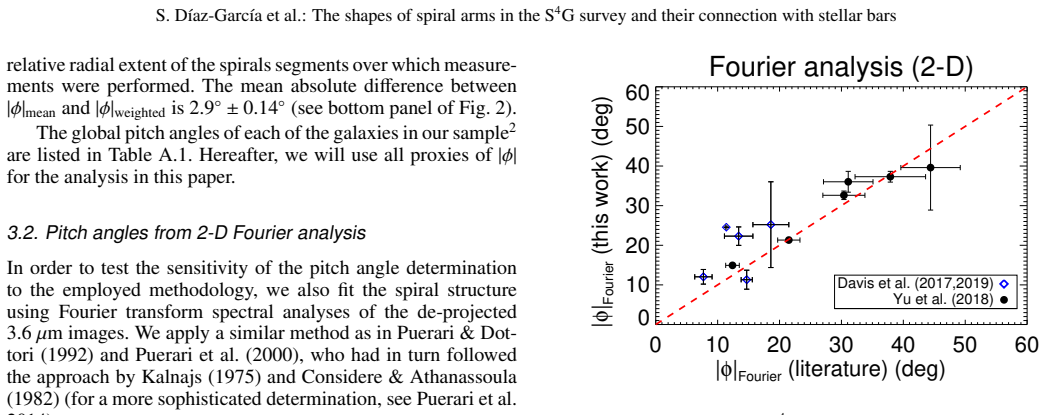
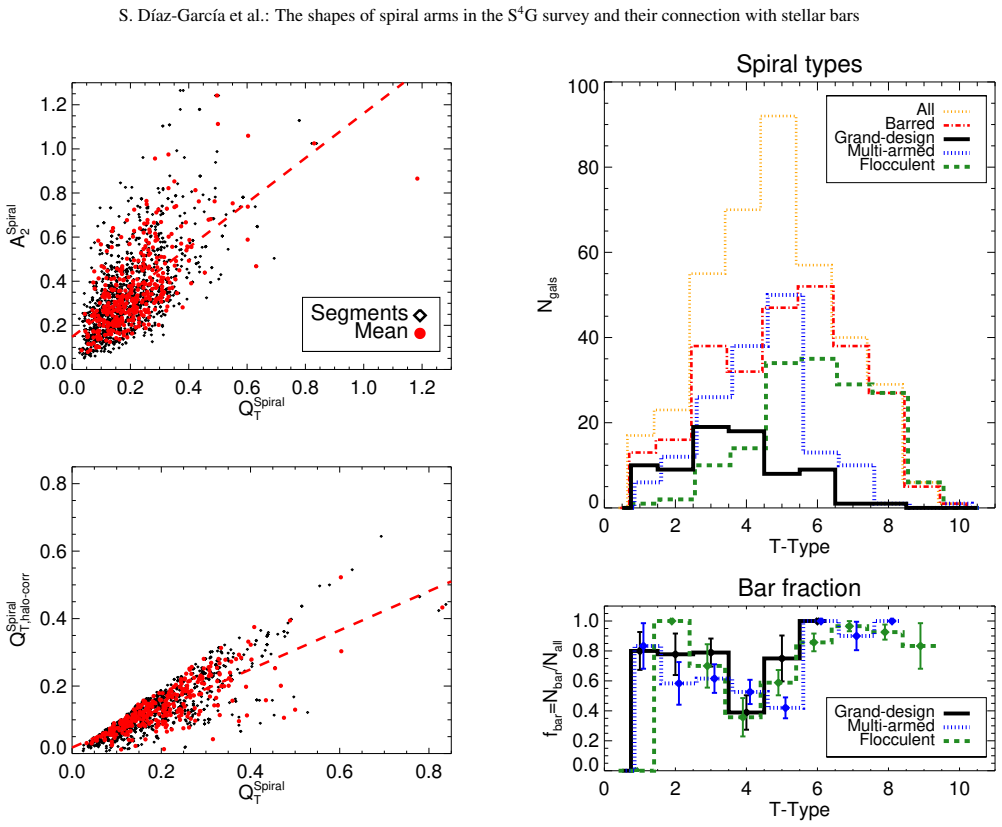
Summary. The paper uses 391 nearby S4G spiral galaxies with inclinations below 65 degrees to characterize spiral arm pitch angles and amplitudes, using the visual segment measurements of Herrera-Endoqui et al. (2015) plus a 32-galaxy Fourier subsample. It defines several global pitch-angle proxies (mean, median, inner-segment mean, and arc-length-weighted mean) and combines them with bar and spiral strength measures from Díaz-García et al. (2016b) and with velocity-dispersion-based black hole mass estimates. The main reported results are: a large within-galaxy scatter of about 9.5 degrees in pitch angle; similar pitch angle versus Hubble-type distributions for barred and non-barred galaxies; only weak correlations between pitch angle and bar strength; a clear correlation between spiral amplitude and bar strength; and essentially no correlation between pitch angle and black hole mass or central concentration. The authors conclude that there is no observational evidence that spiral arms are driven by stellar bars or by invariant manifolds, and favor an interpretation in which bar-prone disks are also reactive to spiral formation.
Significance. If the null results hold after a proper treatment of measurement uncertainty, the paper would be an important, large-sample challenge to manifold-theory predictions and to previously claimed pitch-angle scaling relations, especially the MBH-pitch relation. The paper provides a valuable public catalog in Table A.1, cross-checks the segment-based pitch angles with Fourier methods, and honestly reports weak correlations as null results. The positive correlation between spiral amplitude and bar strength is supported across multiple proxies, radial ranges, and a bar-only torque measure, strengthening the interpretation that bar-prone disks are also spiral-reactive. The main limitation is that the dominant pitch-angle measurement error is not propagated into the correlation tests, so the strength of the null claims is currently underexploited.
major comments (3)
- [Sect. 7.1 and Figs. 11/13] The central null result ('the pitch angle is not correlated with bar strength') is not quantitatively supported because the dominant measurement uncertainty in |phi| is not propagated into the correlation tests. The paper itself reports a mean within-galaxy scatter of sigma_|phi| ~ 9.5 degrees (Sect. 5.2) and mean absolute differences of 6.8 +/- 1.0 degrees between |phi|mean and |phi|Fourier, and 10.0 +/- 2.2 degrees for |phi|inner (Sect. 3.3). The Spearman coefficients rho = 0.18-0.20 quoted in Sect. 7.1 are computed on these noisy estimates without accounting for that error. With measurement noise of this order, an underlying monotonic trend between |phi| and QT(rbar) would be attenuated toward the observed small rho, so the statement 'we hardly find any dependence' is not yet distinguishable from 'the test could not detect the predicted trend.' I request that the authors propagate the measurement uncertainties into the rank-correlation analysis, for example by Monte Carlo resampling of the segment-level pitch angles, and report the minimum detectable |rho| or slope at the sample size N ~ 391.
- [Sect. 7.1] The comparison with the manifold-theory prediction is too qualitative to support the conclusion that the theory is ruled out. The expected relation from Athanassoula et al. (2009a) is overlaid as a rough trace taken by eye from their Fig. 5, and it is evaluated at rbar rather than at the L1 point, as the authors acknowledge. The statement that the binned averages are 'consistent with those in the simulations' while the correlation is nearly absent conflates agreement in normalization with a test of the predicted slope. Please specify the predicted (|phi|, QT(L1)) relation quantitatively, fit or compare it to the data with a stated statistic, and discuss how the rbar-to-L1 offset affects the comparison; without this, the rejection of the manifold prediction is not a quantitative inference.
- [Sect. 8.1 and Fig. 19] The MBH null result is presented as questioning the Davis et al. (2017) scaling relation, but the analysis is not yet sensitive enough for that claim. MBH is estimated only indirectly from central velocity dispersions via Eq. (12), with no propagation of the scatter in that calibration, and the result depends strongly on which pitch proxy is used: rho = -0.24 (p = 0.008) for |phi|mean, rho = -0.10 (p = 0.27) for |phi|inner, and rho = -0.03 (p = 0.78) for |phi|weighted. The manuscript itself states that the lack of correlation may be due to uncertainty in |phi| or to indirect MBH estimates. Please either add a sensitivity analysis, for example using only galaxies with direct MBH measurements or varying the adopted sigma-MBH relation, and report the detectable effect size, or soften the conclusion to a cautionary null consistent with the acknowledged large uncertainties.
minor comments (5)
- [Table 1] Several entries list a zero error (e.g., NGC2710, NGC3310, NGC3893) while one entry has +/- 16.8 degrees; the text says uncertainties come from reducing the radial fit range by 20%, so please explain why some fits produce exactly zero uncertainty and whether those galaxies should be treated differently.
- [Fig. B.1] The lower-right panel prints the p-value as '0.00 . 10-4', which is not a valid number; use e.g. p < 10^-4.
- [Sect. 3.1, Eq. (2)] The symbol R is introduced as the starting radius and then used again later (R25.5); please use a distinct symbol or explicitly state the notation to avoid confusion.
- [Footnote 8] The phrase 'we do not sample galaxies hosting rings of type R2 exclusively' is ambiguous; please rephrase to clarify that the sample contains no R2-only ring galaxies.
- [Fig. 13, lower panel] The Fourier-based |phi| measurements are shown but no Spearman coefficient is given for this subsample; adding the rho and p for the combined literature plus this-work points would make the methodology cross-check quantitative.
Circularity Check
No circularity: the null correlations are comparisons among independently measured pitch angles, force amplitudes, and externally calibrated MBH estimates; the paper's own caveats are sensitivity limitations, not input-output identity.
full rationale
The paper's load-bearing results are statistical comparisons of independently determined quantities. Pitch angles come from visual logarithmic-segment fits of Herrera-Endoqui et al. (2015) and from 2-D Fourier fits made here, cross-calibrated against Yu et al. (2018) and Davis et al. (2017) (Sect. 3.3, Figs. 4-6). Bar and spiral strengths are taken from the NIR-QB force and Fourier decompositions of Diaz-Garcia et al. (2016b); no pitch angle enters those decompositions, and the bar-only torque Qbar-only is explicitly used to suppress spiral contamination (Sect. 7.2, Fig. 15). MBH is estimated from central velocity dispersions via the external Gültekin et al. (2009) calibration, Eq. (12), and compared with direct measurements in Fig. 18; no pitch-angle-dependent fit is used to generate MBH. The Athanassoula et al. (2009a) curve is an external theoretical prediction overlaid as 'roughly traced from their Fig. 5' at rbar rather than L1; the paper does not fit it to the data. The main caveats the paper itself states, including internal segment-to-segment scatter sigma_|phi| ~ 9.5 deg, evaluation at rbar instead of L1, and 'the lack of clear correlation can be due to the uncertainty in |phi| or to the use of indirect estimates of MBH,' are detection-power and measurement-robustness concerns, not circularity. None of the paper's equations defines a predicted quantity in terms of its inputs, no fitted parameter is renamed as a prediction, and no load-bearing claim rests on a self-cited uniqueness theorem. The central null results could be false negatives, but that is a correctness risk, not circular reasoning.
Assumptions & free parameters
assumptions (6)
- standard math Spiral arms can be modeled as logarithmic spirals r(theta)=R e^(theta tan phi) (Eq. 1).
- domain assumption 3.6 micrometer emission traces the old stellar backbone of spiral arms.
- domain assumption The deprojected orientation parameters (inclination, position angle) and Hubble classifications from S4G catalogs are correct.
- domain assumption All measured spiral segments are trailing, so pitch angles are taken positive.
- domain assumption The MBH-sigma relation of Gültekin et al. (2009) applies to these galaxies (Eq. 12).
- domain assumption Bar strength proxies (A2 max, Qb) from Diaz-Garcia et al. (2016b) measure bar gravitational forcing independently of spiral arms.
Cite this review
Pith. "Pith review of The shapes of spiral arms in the S$^4$G survey and their connection with stellar bars." pith.science (2026). https://pith.science/paper/USE62G24
@misc{pith2026190804246,
  author       = {Pith},
  title        = {Pith review of: The shapes of spiral arms in the S$^4$G survey and their connection with stellar bars},
  year         = {2026},
  howpublished = {\url{https://pith.science/paper/USE62G24}},
  note         = {Machine review of arXiv:1908.04246}
}
abstract
Spiral galaxies are common in the local Universe, but their formation, evolution, and interplay with bars remain poorly understood. We use a sample of 391 nearby galaxies from the S$^4$G survey to characterise the winding angle and amplitude of spiral arms as a function of disc properties, such as bar strength, in all kinds of spirals (grand-design, multi-armed, and flocculent). We derive global pitch angles in 3.6 $\mu$m de-projected images from i) average measurements of individual logarithmic spiral segments, and ii) for a subsample of 32 galaxies, from 2-D Fourier analyses. The strength of spirals is quantified from the tangential-to-radial force ratio and from the normalised $m=2$ Fourier density amplitudes. In galaxies with more than one measured logarithmic segment, the spiral pitch angle varies on average by $\sim 10^{\circ}$ between segments, but by up to $\gtrsim 15-20^{\circ}$. The distribution of the global pitch angle versus Hubble type ($T$) is very similar for barred and non-barred galaxies when $1 \lesssim T \lesssim 5$. Most spiral galaxies ($>90\%$) are barred for $T>5$. The pitch angle is not correlated with bar strength, and only weakly with spiral strength. The amplitude of spirals is correlated with bar strength (and less tightly, with bar length) for all types of spirals. The mean pitch angle is hardly correlated with the mass of the supermassive black hole (estimated from central stellar velocity dispersion), with central stellar mass concentration, or with shear, questioning previous results in the literature using smaller samples. We do not find observational evidence that spiral arms are driven by stellar bars or by invariant manifolds. Most likely, disks that are prone to the development of strong bars are also reactive to the formation of prominent spirals, explaining the observed coupling between bar and spiral amplitudes (Abridged).
Figures


Figures from the paper (16 more)




Reference graph
Works this paper leans on
-
[1]
, " * write output.state after.block = add.period write newline
ENTRY address archiveprefix author booktitle chapter edition editor howpublished institution eprint journal key month note number organization pages publisher school series title type volume year label extra.label sort.label short.list INTEGERS output.state before.all mid.sentence after.sentence after.block FUNCTION init.state.consts #0 'before.all := #1 ...
-
[2]
write newline
" write newline "" before.all 'output.state := FUNCTION n.dashify 't := "" t empty not t #1 #1 substring "-" = t #1 #2 substring "--" = not "--" * t #2 global.max substring 't := t #1 #1 substring "-" = "-" * t #2 global.max substring 't := while if t #1 #1 substring * t #2 global.max substring 't := if while FUNCTION word.in bbl.in " " * FUNCTION format....
-
[3]
2003, , 341, 1179
Athanassoula , E. 2003, , 341, 1179
2003
-
[4]
2012, , 426, L46
Athanassoula , E. 2012, , 426, L46
2012
-
[5]
Athanassoula , E., Machado , R. E. G., & Rodionov , S. A. 2013, , 429, 1949
2013
-
[6]
& Misiriotis , A
Athanassoula , E. & Misiriotis , A. 2002, , 330, 35
2002
-
[7]
Athanassoula , E., Romero-G \'o mez , M., Bosma , A., & Masdemont , J. J. 2009 a , , 400, 1706
2009
-
[8]
Athanassoula , E., Romero-G \'o mez , M., & Masdemont , J. J. 2009 b , , 394, 67
2009
Show all 147 references
-
[9]
C., Davis , B
Berrier , J. C., Davis , B. L., Kennefick , D., et al. 2013, , 769, 132
2013
-
[10]
& Tremaine , S
Binney , J. & Tremaine , S. 1987, Galactic dynamics
1987
-
[11]
A., Elmegreen , B
Bittner , A., Gadotti , D. A., Elmegreen , B. G., et al. 2017, , 471, 1070
2017
-
[12]
L., Bertin , G., Stockton , A., et al
Block , D. L., Bertin , G., Stockton , A., et al. 1994, , 288, 365
1994
-
[13]
L., Buta , R., Knapen , J
Block , D. L., Buta , R., Knapen , J. H., et al. 2004, , 128, 183
2004
-
[14]
L., Puerari , I., Knapen , J
Block , D. L., Puerari , I., Knapen , J. H., et al. 2001, , 375, 761
2001
-
[15]
& Combes , F
Bournaud , F. & Combes , F. 2002, , 392, 83
2002
-
[16]
& Block , D
Buta , R. & Block , D. L. 2001, , 550, 243
2001
-
[17]
L., & Knapen , J
Buta , R., Block , D. L., & Knapen , J. H. 2003, , 126, 1148
2003
-
[18]
2004, , 127, 279
Buta , R., Laurikainen , E., & Salo , H. 2004, , 127, 279
2004
-
[19]
2005, , 130, 506
Buta , R., Vasylyev , S., Salo , H., & Laurikainen , E. 2005, , 130, 506
2005
-
[20]
J., Knapen , J
Buta , R. J., Knapen , J. H., Elmegreen , B. G., et al. 2009, , 137, 4487
2009
-
[21]
J., Sheth , K., Athanassoula , E., et al
Buta , R. J., Sheth , K., Athanassoula , E., et al. 2015, , 217, 32
2015
-
[22]
A., Knapen , J
Cisternas , M., Gadotti , D. A., Knapen , J. H., et al. 2013, , 776, 50
2013
-
[23]
& Sanders , R
Combes , F. & Sanders , R. H. 1981, , 96, 164
1981
-
[24]
& Athanassoula , E
Considere , S. & Athanassoula , E. 1982, , 111, 28
1982
-
[25]
& Athanassoula , E
Considere , S. & Athanassoula , E. 1988, , 76, 365
1988
-
[26]
L., Berrier , J
Davis , B. L., Berrier , J. C., Shields , D. W., et al. 2012, , 199, 33
2012
-
[27]
L., Berrier , J
Davis , B. L., Berrier , J. C., Shields , D. W., et al. 2016, 2DFFT: Measuring Galactic Spiral Arm Pitch Angle , Astrophysics Source Code Library
2016
-
[28]
L., Graham , A
Davis , B. L., Graham , A. W., & Cameron , E. 2019, , 873, 85
2019
-
[29]
L., Graham , A
Davis , B. L., Graham , A. W., & Seigar , M. S. 2017, , 471, 2187
2017
-
[30]
L., Kennefick , D., Kennefick , J., et al
Davis , B. L., Kennefick , D., Kennefick , J., et al. 2015, , 802, L13
2015
-
[31]
Davis , D. R. & Hayes , W. B. 2014, , 790, 87
2014
-
[32]
1959, Handbuch der Physik, 53, 275
de Vaucouleurs , G. 1959, Handbuch der Physik, 53, 275
1959
-
[33]
2016, PhD thesis, University of Oulu
D \' az-Garc \' a , S. 2016, PhD thesis, University of Oulu
2016
-
[34]
H., & Salo , H
D \' az-Garc \' a , S., D \' az-Su \'a rez , S., Knapen , J. H., & Salo , H. 2019, , 625, A146
2019
-
[35]
2016 a , , 596, A84
D \' az-Garc \' a , S., Salo , H., & Laurikainen , E. 2016 a , , 596, A84
2016
-
[36]
2016 b , , 587, A160
D \' az-Garc \' a , S., Salo , H., Laurikainen , E., & Herrera-Endoqui , M. 2016 b , , 587, A160
2016
-
[37]
2016 c , ArXiv e-prints [ [arXiv] 1611.01844 ]
D \' az-Garc \' a , S., Salo , H., Laurikainen , E., & Leaman , R. 2016 c , ArXiv e-prints [ [arXiv] 1611.01844 ]
2016 arXiv
-
[38]
2015, , 808, L8
D'Onghia , E. 2015, , 808, L8
2015
-
[39]
2013, , 766, 34
D'Onghia , E., Vogelsberger , M., & Hernquist , L. 2013, , 766, 34
2013
-
[40]
W., & Verdes-Montenegro , L
Durbala , A., Buta , R., Sulentic , J. W., & Verdes-Montenegro , L. 2009, , 397, 1756
2009
-
[41]
Elmegreen , B. G. 1990, Annals of the New York Academy of Sciences, 596, 40
1990
-
[42]
Elmegreen , B. G. & Elmegreen , D. M. 1985, , 288, 438
1985
-
[43]
Elmegreen , B. G. & Elmegreen , D. M. 1989, , 342, 677
1989
-
[44]
G., Elmegreen , D
Elmegreen , B. G., Elmegreen , D. M., & Montenegro , L. 1992, , 79, 37
1992
-
[45]
Elmegreen , D. M. 1981, , 47, 229
1981
-
[46]
Elmegreen , D. M. & Elmegreen , B. G. 1982, , 201, 1021
1982
-
[47]
Elmegreen , D. M. & Elmegreen , B. G. 1984, , 54, 127
1984
-
[48]
Elmegreen , D. M. & Elmegreen , B. G. 1987, , 314, 3
1987
-
[49]
M., Elmegreen , B
Elmegreen , D. M., Elmegreen , B. G., Yau , A., et al. 2011, , 737, 32
2011
-
[50]
H., Leaman , R., et al
Erroz-Ferrer , S., Knapen , J. H., Leaman , R., et al. 2016, , 458, 1199
2016
-
[51]
2018, , 474, 5372
Erwin , P. 2018, , 474, 5372
2018
-
[52]
B., Frogel , J
Eskridge , P. B., Frogel , J. A., Pogge , R. W., et al. 2002, , 143, 73
2002
-
[53]
2019, , 875, L1
Event Horizon Telescope Collaboration , Akiyama , K., Alberdi , A., et al. 2019, , 875, L1
2019
-
[54]
G., Hora , J
Fazio , G. G., Hora , J. L., Allen , L. E., et al. 2004, , 154, 10
2004
-
[55]
E., James , P
Font , J., Beckman , J. E., James , P. A., & Patsis , P. A. 2019, , 482, 5362
2019
-
[56]
S., B \'e dorf , J., Baba , J., & Portegies Zwart , S
Fujii , M. S., B \'e dorf , J., Baba , J., & Portegies Zwart , S. 2018, , 477, 1451
2018
-
[57]
A., Seidel , M
Gadotti , D. A., Seidel , M. K., S \'a nchez-Bl \'a zquez , P., et al. 2015, , 584, A90
2015
-
[58]
& Athanassoula , E
García Gómez , C. & Athanassoula , E. 1993, , 100, 431
1993
-
[59]
2009, , 692, 1075
Gillessen , S., Eisenhauer , F., Trippe , S., et al. 2009, , 692, 1075
2009
-
[60]
& Haynes , M
Giovanelli , R. & Haynes , M. P. 1988, Extragalactic neutral hydrogen. , ed. K. I. Kellermann & G. L. Verschuur , 522--562
1988
-
[61]
& Lynden-Bell , D
Goldreich , P. & Lynden-Bell , D. 1965 a , , 130, 97
1965
-
[62]
& Lynden-Bell , D
Goldreich , P. & Lynden-Bell , D. 1965 b , , 130, 125
1965
-
[63]
Graham , A. W. & Scott , N. 2013, , 764, 151
2013
-
[64]
W., Soria , R., & Davis , B
Graham , A. W., Soria , R., & Davis , B. L. 2019, , 484, 814
2019
-
[65]
Grand , R. J. J., Kawata , D., & Cropper , M. 2013, , 553, A77
2013
-
[66]
O., Gebhardt , K., et al
G \"u ltekin , K., Richstone , D. O., Gebhardt , K., et al. 2009, , 698, 198
2009
-
[67]
E., Bamford , S
Hart , R. E., Bamford , S. P., Willett , K. W., et al. 2016, , 461, 3663
2016
-
[68]
B., Davis , D., & Silva , P
Hayes , W. B., Davis , D., & Silva , P. 2017, , 466, 3928
2017
-
[69]
2015, , 582, A86
Herrera-Endoqui , M., D \' az-Garc \' a , S., Laurikainen , E., & Salo , H. 2015, , 582, A86
2015
-
[70]
C., Li , Z.-Y., Barth , A
Ho , L. C., Li , Z.-Y., Barth , A. J., Seigar , M. S., & Peng , C. Y. 2011, , 197, 21
2011
-
[71]
Julian , W. H. & Toomre , A. 1966, , 146, 810
1966
-
[72]
Kalnajs , A. J. 1975, in La Dynamique des galaxies spirales, ed. L. Weliachew , Vol. 241, 103
1975
-
[73]
C., & Clarke , C
Kendall , S., Kennicutt , R. C., & Clarke , C. 2011, , 414, 538
2011
-
[74]
& Hodge , P
Kennicutt , Jr., R. & Hodge , P. 1982, , 253, 101
1982
-
[75]
Kennicutt , Jr., R. C. 1981, , 86, 1847
1981
-
[76]
Knapen , J. H. & Beckman , J. E. 1996, , 283, 251
1996
-
[77]
& Kennicutt , Jr., R
Kormendy , J. & Kennicutt , Jr., R. C. 2004, , 42, 603
2004
-
[78]
& Norman , C
Kormendy , J. & Norman , C. A. 1979, , 233, 539
1979
-
[79]
& Richstone , D
Kormendy , J. & Richstone , D. 1995, , 33, 581
1995
-
[80]
2016, , 596, A25
Laine , J., Laurikainen , E., & Salo , H. 2016, , 596, A25
2016
-
[81]
2014, , 441, 1992
Laine , J., Laurikainen , E., Salo , H., et al. 2014, , 441, 1992
2014
-
[82]
& Salo , H
Laurikainen , E. & Salo , H. 2002, , 337, 1118
2002
-
[83]
2004, , 607, 103
Laurikainen , E., Salo , H., & Buta , R. 2004, , 607, 103
2004
-
[84]
2002, , 331, 880
Laurikainen , E., Salo , H., & Rautiainen , P. 2002, , 331, 880
2002
-
[85]
2013, , 433, L30
Lelli , F., Fraternali , F., & Verheijen , M. 2013, , 433, L30
2013
-
[86]
S., & Schombert , J
Lelli , F., McGaugh , S. S., & Schombert , J. M. 2016, , 152, 157
2016
-
[87]
Lin , C. C. & Shu , F. H. 1964, , 140, 646
1964
-
[88]
Lin , C. C. & Shu , F. H. 1966, Proceedings of the National Academy of Science, 55, 229
1966
-
[89]
2011, , 410, 166
Lintott , C., Schawinski , K., Bamford , S., et al. 2011, , 410, 166
2011
-
[90]
& Rees , M
Lynden-Bell , D. & Rees , M. J. 1971, , 152, 461
1971
-
[91]
E., Puerari , I., Rosales-Ortega , F
Mart \' nez-Garc \' a , E. E., Puerari , I., Rosales-Ortega , F. F., et al. 2014, , 793, L19
2014
-
[92]
L., Lintott , C
Masters , K. L., Lintott , C. J., Hart , R. E., et al. 2019, [ [arXiv] 1904.11436 ]
2019 arXiv
-
[93]
2011, , 527, A147
Minchev , I., Famaey , B., Combes , F., et al. 2011, , 527, A147
2011
-
[94]
P., Somerville , R
Moster , B. P., Somerville , R. S., Maulbetsch , C., et al. 2010, , 710, 903
2010
-
[95]
C., Sheth , K., Regan , M., et al
Mu \ n oz-Mateos , J. C., Sheth , K., Regan , M., et al. 2015, , 219, 3
2015
-
[96]
Patsis , P. A. 2006, , 369, L56
2006
-
[97]
2016, , 827, L2
Pour-Imani , H., Kennefick , D., Kennefick , J., et al. 2016, , 827, L2
2016
-
[98]
L., Elmegreen , B
Puerari , I., Block , D. L., Elmegreen , B. G., Frogel , J. A., & Eskridge , P. B. 2000, , 359, 932
2000
-
[99]
& Dottori , H
Puerari , I. & Dottori , H. A. 1992, , 93, 469
1992
-
[100]
G., & Block , D
Puerari , I., Elmegreen , B. G., & Block , D. L. 2014, , 148, 133
2014
-
[101]
W., Roberts , M
Roberts , Jr., W. W., Roberts , M. S., & Shu , F. H. 1975, , 196, 381
1975
-
[102]
J., & Garc \' a-G \'o mez , C
Romero-G \'o mez , M., Athanassoula , E., Masdemont , J. J., & Garc \' a-G \'o mez , C. 2007, , 472, 63
2007
-
[103]
J., Athanassoula , E., & Garc \' a-G \'o mez , C
Romero-G \'o mez , M., Masdemont , J. J., Athanassoula , E., & Garc \' a-G \'o mez , C. 2006, , 453, 39
2006
-
[104]
Rosse , T. E. O. 1850, Philosophical Transactions of the Royal Society of London Series I, 140, 499
-
[105]
W., & Davis , B
Sahu , N., Graham , A. W., & Davis , B. L. 2019, arXiv e-prints [ [arXiv] 1903.04738 ]
2019 arXiv
-
[106]
& Laurikainen , E
Salo , H. & Laurikainen , E. 2000 a , , 319, 377
2000
-
[107]
& Laurikainen , E
Salo , H. & Laurikainen , E. 2000 b , , 319, 393
2000
-
[108]
& Laurikainen , E
Salo , H. & Laurikainen , E. 2017, , 835, 252
2017
-
[109]
Salo , H., Laurikainen , E., Buta , R., & Knapen , J. H. 2010, , 715, L56
2010
-
[110]
2015, , 219, 4
Salo , H., Laurikainen , E., Laine , J., et al. 2015, , 219, 4
2015
-
[111]
Salo , H., Ohtsuki , K., & Lewis , M. C. 2018, in Planetary Ring Systems , ed. M. S. Tiscareno & C. D. Murray , 434--493
2018
-
[112]
1999, , 117, 792
Salo , H., Rautiainen , P., Buta , R., et al. 1999, , 117, 792
1999
-
[113]
F., Kennicutt , R
S \'a nchez , S. F., Kennicutt , R. C., Gil de Paz , A., et al. 2012, , 538, A8
2012
-
[114]
K., P \'e rez , I., & Peletier , R
S \'a nchez-Bl \'a zquez , P., Ocvirk , P., Gibson , B. K., P \'e rez , I., & Peletier , R. F. 2011, , 415, 709
2011
-
[115]
& Gadotti , D
S \'a nchez-Janssen , R. & Gadotti , D. A. 2013, , 432, L56
2013
-
[116]
F., P \'e rez , I., et al
S \'a nchez-Menguiano , L., S \'a nchez , S. F., P \'e rez , I., et al. 2017, , 603, A113
2017
-
[117]
Sanders , R. H. & Huntley , J. M. 1976, , 209, 53
1976
-
[118]
Savchenko , S. S. & Reshetnikov , V. P. 2013, , 436, 1074
2013
-
[119]
2002, Nature, 419, 694
Sch \"o del , R., Ott , T., Genzel , R., et al. 2002, Nature, 419, 694
2002
-
[120]
1976, , 31, 313
Schweizer , F. 1976, , 31, 313
1976
-
[121]
K., Falc \'o n-Barroso , J., Mart \' nez-Valpuesta , I., et al
Seidel , M. K., Falc \'o n-Barroso , J., Mart \' nez-Valpuesta , I., et al. 2015, , 451, 936
2015
-
[122]
Seiden , P. E. & Gerola , H. 1979, , 233, 56
1979
-
[123]
S., Block , D
Seigar , M. S., Block , D. L., Puerari , I., Chorney , N. E., & James , P. A. 2005, , 359, 1065
2005
-
[124]
S., Bullock , J
Seigar , M. S., Bullock , J. S., Barth , A. J., & Ho , L. C. 2006, , 645, 1012
2006
-
[125]
S., Chorney , N
Seigar , M. S., Chorney , N. E., & James , P. A. 2003, , 342, 1
2003
-
[126]
S., Davis , B
Seigar , M. S., Davis , B. L., Berrier , J., & Kennefick , D. 2014, , 795, 90
2014
-
[127]
Seigar , M. S. & James , P. A. 1998 a , , 299, 672
1998
-
[128]
Seigar , M. S. & James , P. A. 1998 b , , 299, 685
1998
-
[129]
S., Kennefick , D., Kennefick , J., & Lacy , C
Seigar , M. S., Kennefick , D., Kennefick , J., & Lacy , C. H. S. 2008, , 678, L93
2008
-
[130]
Sellwood , J. A. 2011, , 410, 1637
2011
-
[131]
Sellwood , J. A. & Kahn , F. D. 1991, , 250, 278
1991
-
[132]
Sellwood , J. A. & Sparke , L. S. 1988, , 231, 25P
1988
-
[133]
& Sellwood , J
Shen , J. & Sellwood , J. A. 2004, , 604, 614
2004
-
[134]
L., et al
Sheth , K., Regan , M., Hinz , J. L., et al. 2010, , 122, 1397
2010
-
[135]
W., Boe , B., Pfountz , C., et al
Shields , D. W., Boe , B., Pfountz , C., et al. 2015 a , ArXiv e-prints [ [arXiv] 1511.06365 ]
2015 arXiv
-
[136]
W., Boe , B., Pfountz , C., et al
Shields , D. W., Boe , B., Pfountz , C., et al. 2015 b , Spirality: Spiral arm pitch angle measurement , Astrophysics Source Code Library
2015
-
[137]
1981, in Structure and Evolution of Normal Galaxies, ed
Toomre , A. 1981, in Structure and Evolution of Normal Galaxies, ed. S. M. Fall & D. Lynden-Bell , 111--136
1981
-
[138]
2010, , 719, 1470
Villa-Vargas , J., Shlosman , I., & Heller , C. 2010, , 719, 1470
2010
-
[139]
2006, , 373, 280
Voglis , N., Tsoutsis , P., & Efthymiopoulos , C. 2006, , 373, 280
2006
-
[140]
E., Mihos , J
Watkins , A. E., Mihos , J. C., & Harding , P. 2015, , 800, L3
2015
-
[141]
W., Roellig , T
Werner , M. W., Roellig , T. L., Low , F. J., et al. 2004, , 154, 1
2004
-
[142]
W., Lintott , C
Willett , K. W., Lintott , C. J., Bamford , S. P., et al. 2013, , 435, 2835
2013
-
[143]
& Wakamatsu , K
Yoshizawa , M. & Wakamatsu , K. 1975, , 44, 363
1975
-
[144]
& Ho , L
Yu , S.-Y. & Ho , L. C. 2018, , 869, 29
2018
-
[145]
& Ho , L
Yu , S.-Y. & Ho , L. C. 2019, , 871, 194
2019
-
[146]
C., Barth , A
Yu , S.-Y., Ho , L. C., Barth , A. J., & Li , Z.-Y. 2018, , 862, 13
2018
-
[147]
1963, The Advanced Geometry of Plane Curves and Their Applications , ed
Zwikker , C. 1963, The Advanced Geometry of Plane Curves and Their Applications , ed. Dover Phoenix Editions
1963
Reviewed August 14, 2026 · model on record in the stance chip above.
Discussion (0). Continue with ORCID to comment.