Adaptive Artificial Anti-Diffusion Methods for Hyperbolic Systems of Conservation Laws
Pith reviewed 2026-05-19 22:25 UTC · model grok-4.3
The pith
Adaptive anti-diffusion added only to linearly degenerate fields sharpens contact waves without oscillations.
A machine-rendered reading of the paper's core claim, the machinery that carries it, and where it could break.
Core claim
The authors establish that the AAAD methods, realized with second-order central-upwind fluxes or fifth-order A-WENO extensions, improve resolution of contact waves by applying the anti-diffusion term only in linearly degenerate fields, with coefficients chosen proportional to mesh size near contacts and near zero elsewhere, without introducing oscillations or lowering formal accuracy in smooth parts of the solution.
What carries the argument
The adaptive artificial anti-diffusion (AAAD) term that acts solely in linearly degenerate fields, with coefficients scaled to mesh size near contacts.
If this is right
- Contact discontinuities become noticeably sharper in one- and two-dimensional gas-dynamics computations.
- Formal order of accuracy remains high in smooth regions because coefficients stay small there.
- No new oscillations appear because the term is withheld from nonlinear fields.
- The same construction works for both second-order central-upwind schemes and their fifth-order A-WENO versions.
- Robust results are obtained across a range of standard Euler-equation benchmarks.
Where Pith is reading between the lines
- The same selective anti-diffusion idea could be tried on other hyperbolic systems such as shallow-water or MHD equations.
- Automatic mesh-adaptive refinement might become less necessary near contacts if the AAAD term already supplies the missing sharpness.
- The method's built-in detection of linearly degenerate fields could be reused to locate and treat other weak discontinuities.
- Extending the adaptation rule to time-dependent mesh sizes might further improve long-time accuracy on moving contacts.
Load-bearing premise
That applying anti-diffusion only in linearly degenerate fields with adaptive mesh-proportional coefficients will sharpen contacts without creating oscillations or losing accuracy.
What would settle it
If the AAAD schemes produce visible oscillations near contacts or visibly lower accuracy in smooth regions on the Sod shock tube or a standard two-dimensional Riemann problem, the central claim would be falsified.
Figures






read the original abstract
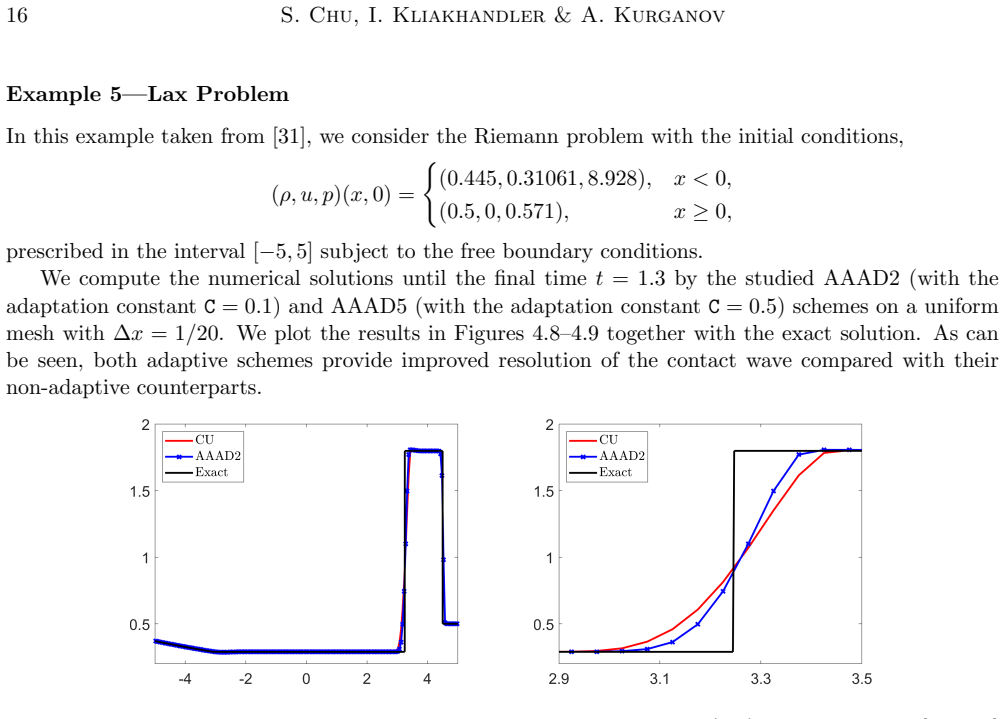
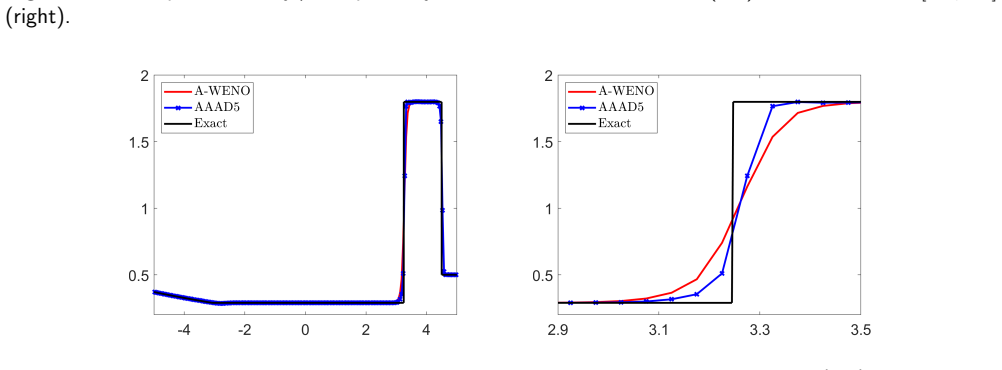
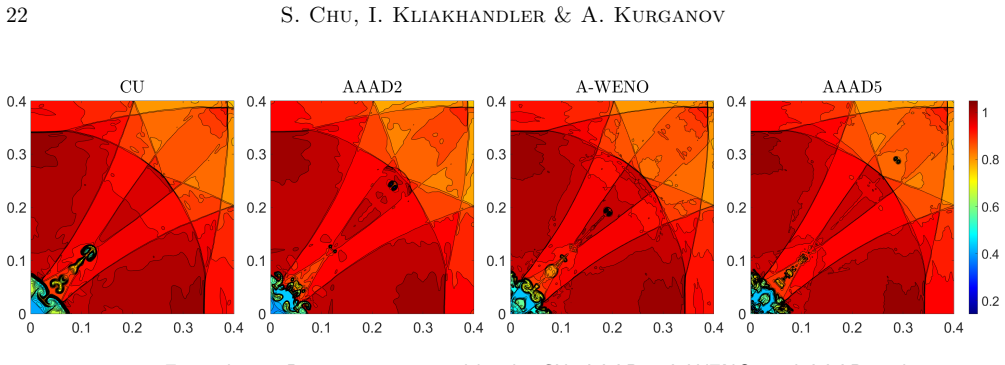
We introduce new adaptive artificial anti-diffusion (AAAD) methods for one- and two-dimensional hyperbolic systems of conservation laws. The key idea is to reduce the amount of numerical dissipation present in a given numerical method by adding an anti-diffusion (AD) term acting in linearly degenerate fields only. This way, the resolution of contact waves can be improved without risking oscillations, which may be caused if the AD acts in nonlinear fields as well. The AD coefficients are selected adaptively: they are supposed to be proportional to the mesh size near the contact waves to enhance the resolution and to be very small in the smooth parts of the computed solution to ensure a sufficiently high (formal) order of accuracy there. The proposed AAAD methods are realized using either the second-order central-upwind numerical fluxes or their fifth-order extensions implemented within the alternative weighted essentially non-oscillatory (A-WENO) framework. We test the proposed schemes on a series of benchmarks for the one- and two-dimensional Euler equations of gas dynamics and the obtained results demonstrate the robustness and high resolution of the new AAAD methods.
Editorial analysis
A structured set of objections, weighed in public.
Referee Report
Summary. The manuscript introduces adaptive artificial anti-diffusion (AAAD) methods for one- and two-dimensional hyperbolic systems of conservation laws. The key construction adds an anti-diffusion term exclusively in linearly degenerate fields (to sharpen contacts without risking oscillations in nonlinear waves), with coefficients chosen adaptively: proportional to mesh size near detected contacts and very small in smooth regions to preserve formal accuracy. The methods are realized on second-order central-upwind fluxes and their fifth-order A-WENO extensions; numerical tests on the Euler equations are said to demonstrate robustness and high resolution.
Significance. If the adaptive coefficient selection indeed preserves the formal order of the underlying schemes while improving contact resolution, the AAAD framework would constitute a useful, low-risk enhancement to existing central-upwind and WENO-type methods for gas-dynamics simulations. The restriction of anti-diffusion to linearly degenerate fields is a prudent design choice that addresses a known source of instability.
major comments (2)
- [Abstract] Abstract: the central claim that the anti-diffusion coefficients are made 'very small in the smooth parts of the computed solution to ensure a sufficiently high (formal) order of accuracy' lacks any supporting truncation-error analysis, modified-equation study, or explicit bound showing that the coefficient is o(Δx^{p-1}) for scheme order p when the contact sensor does not trigger. Without such analysis, it remains possible that even modest misclassification of smooth cells leaves an O(Δx) term that degrades the observed convergence rate; this assumption is load-bearing for the reported 'high resolution' results.
- [Numerical experiments] Numerical experiments section: the abstract asserts that the proposed schemes demonstrate 'robustness and high resolution' on Euler benchmarks, yet no quantitative L1 or L2 error norms, observed convergence rates, or direct comparisons against the baseline central-upwind and A-WENO schemes are referenced. Such metrics are required to substantiate that the adaptive anti-diffusion improves resolution without compromising accuracy.
minor comments (1)
- [Method description] The precise definition of the contact sensor, the explicit formula for the adaptive coefficient (including the value of the proportionality factor), and the exact implementation within the A-WENO framework should be stated with numbered equations to ensure reproducibility.
Simulated Author's Rebuttal
We thank the referee for the careful reading of the manuscript and the constructive comments. We address each major point below and indicate the revisions planned for the next version.
read point-by-point responses
-
Referee: [Abstract] Abstract: the central claim that the anti-diffusion coefficients are made 'very small in the smooth parts of the computed solution to ensure a sufficiently high (formal) order of accuracy' lacks any supporting truncation-error analysis, modified-equation study, or explicit bound showing that the coefficient is o(Δx^{p-1}) for scheme order p when the contact sensor does not trigger. Without such analysis, it remains possible that even modest misclassification of smooth cells leaves an O(Δx) term that degrades the observed convergence rate; this assumption is load-bearing for the reported 'high resolution' results.
Authors: We agree that the current manuscript does not contain a truncation-error or modified-equation analysis that rigorously bounds the adaptive coefficient in smooth regions. The coefficient is constructed to be proportional to a contact indicator that is designed to be negligible away from discontinuities, but this scaling is justified only heuristically and by numerical observation. In the revised manuscript we will add a short discussion (or appendix) that provides a scaling argument for the sensor in smooth flow and, where feasible, a numerical check of the observed order on a smooth test problem to support the claim that formal accuracy is retained. revision: yes
-
Referee: [Numerical experiments] Numerical experiments section: the abstract asserts that the proposed schemes demonstrate 'robustness and high resolution' on Euler benchmarks, yet no quantitative L1 or L2 error norms, observed convergence rates, or direct comparisons against the baseline central-upwind and A-WENO schemes are referenced. Such metrics are required to substantiate that the adaptive anti-diffusion improves resolution without compromising accuracy.
Authors: The numerical section of the original manuscript emphasizes visual and qualitative evidence of improved contact resolution. We acknowledge that quantitative error tables, convergence rates, and direct comparisons with the underlying schemes are absent. In the revision we will insert tables reporting L1 and L2 errors for representative one- and two-dimensional Euler tests, include observed convergence rates on both smooth and discontinuous problems, and add side-by-side comparisons against the baseline central-upwind and A-WENO schemes without the AAAD term. revision: yes
Circularity Check
No significant circularity; method construction and benchmarks are independent
full rationale
The paper presents a new construction for adaptive artificial anti-diffusion (AAAD) terms restricted to linearly degenerate fields, with coefficient selection described as a design choice (proportional to mesh size near contacts, very small elsewhere) layered on top of existing central-upwind and A-WENO fluxes. No derivation step reduces by construction to fitted inputs or prior self-citations; the central claim of robustness and high resolution rests on explicit numerical tests for the Euler equations rather than any self-referential equivalence. The adaptive rule is stated as an ansatz for resolution improvement without any claim that it is derived from or equivalent to the benchmark outcomes themselves. This is the typical non-circular case for a numerical-method proposal with empirical validation.
Axiom & Free-Parameter Ledger
free parameters (1)
- anti-diffusion proportionality factor
axioms (1)
- domain assumption Anti-diffusion applied only in linearly degenerate fields avoids oscillations that would occur in nonlinear fields.
Reference graph
Works this paper leans on
- [1]
-
[2]
Boscheri, W. and Dumbser, M. , TITLE =. Commun. Comput. Phys. , VOLUME =. 2013 , NUMBER =
work page 2013
-
[3]
Sod, G. A. , Journal =. A survey of several finite difference methods for systems of nonlinear hyperbolic conservation laws , Volume =
- [4]
-
[5]
Chu, S. and Feng, P. and Kolotilov, V. A. and Kurganov, A. and Ostapenko, V. V. , Title =
-
[6]
Chu, S. and Kurganov, A. and Xin, R. , title =. J. Sci. Comput. , VOLUME =. 2025 , NUMBER =
work page 2025
-
[7]
Kolotilov, V. A. and Kurganov, A. A. and Ostapenko, V. V. and Khandeeva, N. A. and Chu, S. , TITLE =. Comput. Math. Math. Phys. , VOLUME =. 2023 , NUMBER =
work page 2023
- [8]
-
[9]
Chu, S. and Kurganov, A. , TITLE =. Finite volumes for complex applications
-
[10]
Chu, S. and Kurganov, A. and Xin, R. , journal =. Low-dissipation central-upwind schemes for compressible multifluids , year =
-
[11]
Chu, S. and Herty, M. and Kurganov, A. , journal =. Novel local characteristic decomposition based path-conservative central-upwind schemes , year =
-
[12]
Toro, E. F. , Edition =. Riemann solvers and numerical methods for fluid dynamics:
-
[13]
Gande, N. and Rathod, Y. and Rathan, S. , TITLE =. Internat. J. Numer. Methods Fluids , VOLUME =. 2017 , NUMBER =
work page 2017
-
[14]
Gande, N. and Rathod, Y. and Rathan, S. , TITLE =. Internat. J. Numer. Methods Fluids , VOLUME =. 2018 , NUMBER =
work page 2018
-
[15]
Chu, S. and Feng, P. and Kolotilov, V. A. and Kurganov, A. and Ostapenko, V. V. , title =
-
[16]
Chu, S. and Herty, M. and Toro, E. F. , title =. Comput. & Fluids , VOLUME =. 2025 , NOTE =
work page 2025
-
[17]
Titarev, V. A. and Toro, E. F. , TITLE =. Comput. & Fluids , VOLUME =. 2005 , NUMBER =
work page 2005
-
[18]
Hu, C. and Shu, C.-W. , TITLE =. J. Comput. Phys. , VOLUME =. 1999 , NUMBER =
work page 1999
-
[19]
Titarev, V. A. and Toro, E. F. , TITLE =. J. Comput. Phys. , VOLUME =. 2005 , NUMBER =
work page 2005
-
[20]
Toro, E. F. and Titarev, V. A. , TITLE =. J. Sci. Comput. , VOLUME =. 2005 , NUMBER =
work page 2005
-
[21]
Chertock, A. and Chu, S. and Herty, M. and Kurganov, A. and Luk\'a. J. Comput. Phys. , title =. 2023 , note =
work page 2023
-
[22]
Chu, S. and Kurganov, A. and Na, M. , TITLE =. J. Comput. Phys. , VOLUME =. 2022 , NOTE =
work page 2022
- [23]
-
[24]
Shu, C.-W. and Osher, S. , Journal =. Efficient implementation of essentially nonoscillatory shock-capturing schemes
-
[25]
Kurganov, A. and Xin, R. , TITLE =. J. Sci. Comput. , VOLUME =. 2023 , NOTE =
work page 2023
-
[26]
Chu, S. and Kurganov, A. and Xin, R. , title =. J. Sci. Comput. , Volume =. 2025 , NOTE =
work page 2025
- [27]
- [28]
- [29]
-
[30]
Arminjon, P. and St-Cyr, A. and Madrane, A. , TITLE =. Appl. Numer. Math. , VOLUME =. 2002 , NUMBER =
work page 2002
-
[31]
Arminjon, P. and Viallon, M.-C. and Madrane, A. , TITLE =. Int. J. Comput. Fluid Dyn. , VOLUME =. 1997 , NUMBER =
work page 1997
-
[32]
Bianco, F. and Puppo, G. and Russo, G. , TITLE =. SIAM J. Sci. Comput. , VOLUME =. 1999 , NUMBER =
work page 1999
-
[33]
Liou, M. S. , Journal =. A new flux splitting scheme , Volume =
-
[34]
Liou, M. S. , Journal =. A sequel to
- [35]
-
[36]
Liou, M. S. , Journal =. A Sequel to
-
[37]
Constantin, L. A. and Kurganov, A. , TITLE =. Hyperbolic problems: theory, numerics and applications
-
[38]
Chang, C. H. and Liou, M. S. , Journal =. A robust and accurate approach to computing compressible multiphase flow: stratified flow model and AUSM+ up scheme , Volume =
-
[39]
Paillere, H. and Corre, C. and Garcia-Cascales, J. R. , Journal =. On the extension of the AUSM+ scheme to compressible two-fluid models , Volume =
-
[40]
Zha, G.-C. and Bilgen, E. , Journal =. Numerical solution of Euler equations by a new flux vector splitting scheme , Volume =
-
[41]
Dumbser, M. and Toro, E. F. , Journal =. On universal Osher-type schemes for general nonlinear hyperbolic conservation laws , Volume =
-
[42]
Toro, E. F. and Spruce, M. and Speares, W. , Journal =. Restoration of the contact surface in the HLL-Riemann solver , Volume =
-
[43]
Harten, A. and Lax, P. D. and van Leer, B. , TITLE =. SIAM Rev. , VOLUME =. 1983 , NUMBER =
work page 1983
-
[44]
Tokareva, S. and Toro, E. F. , TITLE =. Finite volumes for complex applications
-
[45]
Luo, H. and Luo, L. Q. and Nourgaliev, R. , Journal =. A reconstructed discontinuous Galerkin method for the Euler equations on arbitrary grids , Volume =
-
[46]
Gressier, J. and Villedieu, P. and Moschetta, J. M. , Journal =. Positivity of flux vector splitting schemes , Volume =
-
[47]
Kitamura, K. and Shima, E. and Fujimoto, K. and Wang, Z. J. , Journal =. Performance of low-dissipation Euler fluxes and preconditioned LU-SGS at low speeds , Volume =
-
[48]
Toro, E. F. and V\'azquez-Cend\'on, M. E. , Journal =. Flux splitting schemes for the
-
[49]
Toro, E. F. and Castro, C. E. and Lee, B. J. , TITLE =. J. Comput. Phys. , VOLUME =. 2015 , PAGES =
work page 2015
-
[50]
Balsara, D. S. and Montecinos, G. I. and Toro, E. F. , TITLE =. J. Comput. Phys. , VOLUME =. 2016 , PAGES =
work page 2016
-
[51]
Dumbser, M. and Balsara, D. S. and Tavelli, M. and Fambri, F. , TITLE =. Internat. J. Numer. Methods Fluids , VOLUME =. 2019 , NUMBER =
work page 2019
-
[52]
Toro, E. F. and Castro, C. E. and Vanzo, D. and Siviglia, A. , TITLE =. Internat. J. Numer. Methods Fluids , VOLUME =. 2022 , NUMBER =
work page 2022
-
[53]
Liou, M. S. , BOOKTITLE =. Recent progress and applications of
-
[54]
Kurganov, A. and Liu, Y. and Zeitlin, V. , journal =. Numerical dissipation switch for two-dimensional central-upwind schemes , year =
- [55]
-
[56]
Burstein, S. Z. and Mirin, A. A. , Journal =. Third order difference methods for hyperbolic equations , Volume =
-
[57]
Castro, M. J. and Morales de Luna, T. and Par\'. Well-balanced schemes and path-conservative numerical methods , Year =. Handbook of numerical methods for hyperbolic problems , Publisher =
-
[58]
Chen, Y. L. and Kurganov, A. and Lei, M. L. and Liu, Y. , Booktitle =. An adaptive artificial viscosity method for the
-
[59]
Don, W. S. and Li, D.-M. and Gao, Z. and Wang, B.-S. , TITLE =. J. Sci. Comput. , VOLUME =. 2020 , NUMBER =
work page 2020
-
[60]
Chu, S. and Kurganov, A. and Menshov, I. , TITLE =. Appl. Numer. Math. , FJOURNAL =. 2025 , PAGES =
work page 2025
-
[61]
Wang, B.-S. and Garg, N. K. , TITLE =. Comput. & Fluids , VOLUME =. 2024 , PAGES =
work page 2024
-
[62]
Li, X. G. and Xia, T. and Deng, Y. X. and Yang, S. Q. and Ge, Y. B. , TITLE =. Int. J. Comput. Fluid Dyn. , VOLUME =. 2022 , NUMBER =
work page 2022
-
[63]
Gao, Z. and Fang, L.-L. and Wang, B.-S. and Wang, Y. and Don, W. S. , TITLE =. Comput. & Fluids , VOLUME =. 2020 , NUMBER =
work page 2020
- [64]
- [65]
- [66]
-
[67]
Fjordholm, U. S. and Mishra, S. and Tadmor, E. , Journal =. On the computation of measure-valued solutions , Volume =
-
[68]
Friedrichs, K. O. , Fjournal =. Symmetric hyperbolic linear differential equations , Volume =. Comm. Pure Appl. Math. , Pages =
-
[69]
Garg, N. K. and Kurganov, A. and Liu, Y. , Journal =. Semi-discrete central-upwind. 2021 , NOTE =
work page 2021
- [70]
-
[71]
Godunov, S. K. , Journal =. A difference method for numerical calculation of discontinuous solutions of the equations of hydrodynamics , Volume =
-
[72]
Gottlieb, S. and Ketcheson, D. and Shu, C.-W. , TITLE =. 2011 , PAGES =
work page 2011
-
[73]
Hesthaven, J. S. , TITLE =
-
[74]
Gottlieb, S. and Shu, C.- W. and Tadmor, E. , Journal =. Strong stability-preserving high-order time discretization methods , Volume =
-
[75]
Jiang, Y. and Shu, C.- W. and Zhang, M. P. , Journal =. An alternative formulation of finite difference weighted
-
[76]
Jiang, G. S. and Tadmor, E. , Journal =. Nonoscillatory central schemes for multidimensional hyperbolic conservation laws , Volume =
-
[77]
Godlewski, E. and Raviart, P.-A. , Edition =. Numerical approximation of hyperbolic systems of conservation laws , Year =
-
[78]
Ketcheson, D. I. and LeVeque, R. J. and del Razo, M. J. , TITLE =. 2020 , PAGES =
work page 2020
-
[79]
Numerical schemes for conservation laws , SERIES =
Kr\". Numerical schemes for conservation laws , SERIES =
-
[80]
Kurganov, A. and Tadmor, E. , Journal =. New high-resolution semi-discrete central schemes for
discussion (0)
Sign in with ORCID, Apple, or X to comment. Anyone can read and Pith papers without signing in.