REVIEW 2 major objections 4 minor 78 references
Almost everywhere convergence of Bochner-Riesz means on Heisenberg-type groups
T0 review · 2 major / 4 minor · reviewed 2026-08-14 · deepseek-v4-flash
Pith's one-line read Bochner–Riesz means converge almost everywhere on Heisenberg-type groups in a trapezoidal range.
desk verdict Genuinely new trapezoidal-range a.e. convergence theorem for H-type groups, with a detailed proof that has one correctable uniformity gap in the second-layer trace lemma. read the letter →
The pith
A machine-rendered reading of the paper's core claim, the machinery that carries it, and where it could break.
The reading
What carries the argument
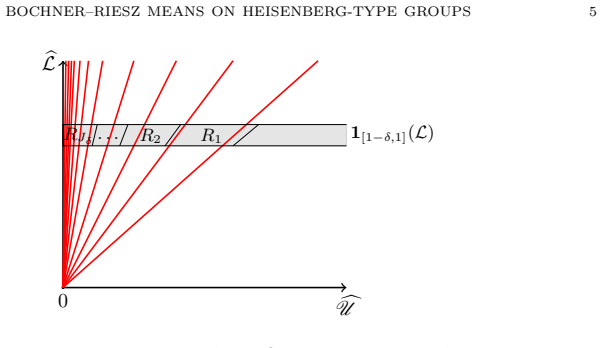
The proof is carried by two reduction steps. First, Lemma 3.1 and the estimates around (1.19) control the local maximal Bochner–Riesz operator pointwise by a product of two non-maximal operators, so the weighted $L^2$ estimate for the maximal operator is equivalent to uniform estimates for $m_\delta(sL)$; the reduction is valid for sum-of-squares polynomial weights, and a separate interpolation step in Section 5 extends it to the fractional weights $(1+|\cdot|)^a$ and $(1+\rho)^b$. Second, those non-maximal estimates are recast as dual Sobolev trace lemmas, Theorems 7.1 and 7.2, which are weighted $L^2$ bounds for the spectral cut-offs $M^\gamma_{\delta,j}$ playing the role of a Sobolev trace inequality in frequency space. The trace lemmas are proved on the group-Fourier side: the kernel for fractional integration with respect to the second-layer weight $|u|$ is explicit in terms of Jacobi polynomials, and the decisive input is the refined Jacobi-polynomial estimate Theorem 8.4, whose transition point $x_{\mathrm{tr}}=1-\alpha^2/(2u^2)$ governs the two bounds in (8.8).
What would settle it
A concrete way to test the theorem is to evaluate the trace-lemma estimate (7.21) on a Heisenberg-type group with centre dimension $n>1$, in the middle-frequency range $\frac34J_\delta<j<J_\delta$, using the explicit kernel formula (2.44) for the second-layer weight; if for a sequence $\delta\to0$ some test function violates the claimed bound with exponent $\frac23$, the trace lemma is false and the theorem collapses. A more local check is to compute the two sides of (8.8) numerically for Jacobi parameters $\alpha\approx c(1+n)$ with $x$ near the transition point $x_{\mathrm{tr}}$; any systematic violation would pinpoint the failing step.
Extended reading notes
Core claim
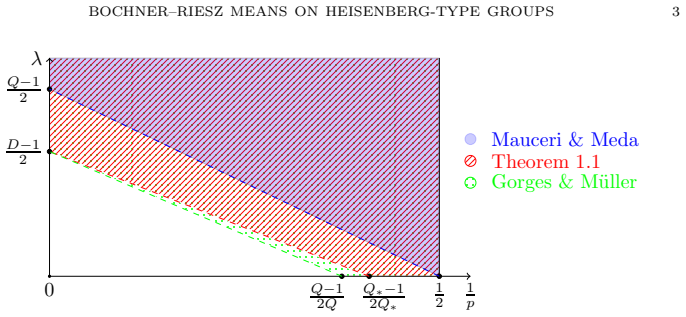
The central claim is Theorem 1.1: if $G$ is an H-type group with homogeneous dimension $Q$, topological dimension $D$, and $Q^*=2Q-D$, then for every $\lambda>0$ and every $2\le p\le\infty$ satisfying $\frac{Q^*-1}{Q^*}(\frac12-\frac{\lambda}{D-1})<\frac1p\le\frac12$, the Bochner–Riesz means $T^\lambda_r$ converge almost everywhere to $f$ as $r\to0^+$ for all $f\in L^p(G)$. Because the left inequality admits positive solutions $\frac1p$ for all small $\lambda$, the admissible region is genuinely trapezoidal, so almost-everywhere convergence holds for some $p>2$ at arbitrarily small orders. The theorem covers all H-type groups, not only the Heisenberg groups for which an analogous result was already known.
Load-bearing premise
The whole theorem rests on the refined Jacobi-polynomial estimate in Theorem 8.4, namely the two bounds in (8.8) with uniform constants in the parameter range that actually occurs in the proof; if that approximation fails at its transition point or in a corner of its stated range, the second dual trace lemma loses its power and the estimate (1.13) at the trapezoid's vertex collapses.
Editorial extensions
If this is right
- The theorem gives almost-everywhere convergence for every H-type group, extending the known Heisenberg-group result to centres of any dimension $n\ge1$.
- For every sufficiently small $\lambda>0$ the admissible region contains exponents $p>2$, so convergence holds at arbitrarily small smoothing orders on these groups.
- The explicit maximal-to-nonmaximal reduction (1.19) is a quantitative statement that does not appear in the Euclidean or Heisenberg-group precedents and can be applied to other maximal operators built from sub-Laplacians.
- The dual trace lemmas supply the vertex estimate (1.13) at $\frac1p=\frac{Q^*-1}{2Q^*}$ and $\lambda=0$, which is the endpoint needed for interpolation across the whole trapezoid.
- Theorem 1.2 improves the general stratified-group maximal bound whenever the sub-Laplacian's spectral threshold $\varsigma_+(L)$ is smaller than $Q/2$.
Reading between the lines
- If the missing trace estimate with exponent $a=1$ for the middle frequencies $\frac34J_\delta<j<J_\delta$ could be established, the convergence range would match the known Heisenberg-group range; the natural route would be a weight mixing the $z$ and $u$ variables.
- The same scheme may transfer to other 2-step stratified groups: the only group-specific ingredient is the Fourier-side kernel of the chosen weight, so finding a weight whose kernel obeys a suitable special-function estimate is a template for further results.
- The appearance of $Q^*=2Q-D$ shows that the gain over the general stratified-group bound shrinks as the centre dimension grows; testing whether the trapezoid can be stated with $Q$ replaced by $D$ would distinguish a genuine geometric obstruction from an artifact of the trace-lemma method.
Signed reviews
Editorial analysis
A structured set of objections, weighed in public.
Referee Report
Summary. The paper proves an almost everywhere convergence result for Bochner–Riesz means of arbitrarily small order on Heisenberg-type groups, extending to H-type groups the range obtained by Gorges and Müller for Heisenberg groups. The proof has three main parts: a reduction of the maximal Bochner–Riesz operator to nonmaximal operators on certain weighted L2 spaces (Sections 4–6), a reduction of the relevant weighted estimates to dual Sobolev trace lemmas (Section 7), and the proof of those trace lemmas via refined estimates for Jacobi polynomials (Sections 7–8). The main theorem is stated as Theorem 1.1.
Significance. If the proof is completed, this is a substantial advance: it gives, on all H-type groups, a nontrivial range of p>2 for which almost everywhere convergence holds for every λ>0, with a sharp-looking trapezoidal range involving the parameter Q^*=2Q-D. The paper also introduces a clean maximal-to-nonmaximal reduction (inequality (1.19)/(4.10)) that is likely to be useful beyond this setting, and it develops explicit kernel formulas for fractional integration on the Fourier dual of H-type groups. The overall architecture is original and the debt to Gorges–Müller, Mauceri–Meda, and the Jacobi-polynomial literature is clearly acknowledged. However, the central technical lemma (Lemma 7.10) contains a gap: a uniformity claim in the imaginary part of the interpolation parameter is false as stated, and the proof as written does not establish the hypothesis (7.3) needed by Proposition 7.3. This gap is load-bearing for the main endpoint estimate (1.13).
major comments (2)
- [§7.3, Lemma 7.10 and Proposition 7.3] Lemma 7.10 claims the uniform bound (7.21) for ∂_{ψ^{-a/2}}\hat{K}_{γ,δ,j}, with no factor e^{-θ²}. For this to feed into Proposition 7.3, the bound is needed with a replaced by a-2iθ, since (7.3) involves ∂_{ω^{-a/2+iθ}}. In the proof, after formula (7.22), the constant is |C_{n,a}| = π^{(Re(a)-n)/2}|Γ(n/2-a/4)/Γ(a/4)|, and the text asserts that this is ≲_{Re(a)} 1 and that the quantity only depends on a through its real part. This is false: for a = α-2iθ (α = Re(a)), DLMF 5.11.12 gives |Γ(n/2-a/4)/Γ(a/4)| ≃ (1+|θ|)^{(n-α)/2}, which is unbounded in θ for 0<α<min{2,n}. Consequently the undamped quantity in (7.21) is not uniformly bounded in θ, and the stated lemma is incorrect. The gap is repairable in principle, because the e^{-θ²} factor in (7.3) decays faster than any polynomial and can compensate the growth; but the repair must be written. As it stands, the proof of (7.3) is missing, and Corollary 7.11, Theorem 7.1, and the endpoint estimate (1.13) all rely on it.
- [§8, Theorem 8.4] The proof of Theorem 8.4 invokes the asymptotic approximation of [21, eq. (3.49)] with the error bound from [6], displayed as (8.14). The text argues uniformity of the error by saying that ζ remains in a bounded interval, but the estimate must also be uniform in α,n in the regime 1≤α≤c(1+n), including the transition region where |ζ-α̃²| is comparable to α^{4/3}/u². This uniformity is used through the first estimate in (8.8) in the K1 and K3 estimates of Lemma 7.10, so the proof of the main trace lemma depends on it. The paper should either provide a detailed verification that the O(u^{-1}) error term in (8.14) is uniform in all parameters in the stated range, or cite a precise theorem covering exactly that range.
minor comments (4)
- [Throughout] The notation "B(x,r)" is used for both the open and closed ball in Section 2.1, which is confusing; please distinguish the two.
- [§1 and §3] The spelling "Mihlin–Hörmander threshold" should be "Mikhlin–Hörmander" to match standard transliteration.
- [§7.3, proof of Lemma 7.10] In the paragraph following (7.22), the paper states "we may assume that a is real" after asserting that the quantity depends only on Re a. This step requires the missing θ-dependence analysis described in the first major comment; as written it is not justified.
- [§8] In the proof of Theorem 8.4, the term "E^{-1}_α M_α" is used without defining the functions E_α and M_α in the manuscript; a brief definition or a precise pointer to [6] would improve readability.
Circularity Check
No significant circularity: Theorem 1.1 rests on external Jacobi-polynomial asymptotics and independent spectral multiplier results; the sole self-citation supplies technical estimates, not the target claim.
full rationale
The proof of Theorem 1.1 is self-contained against external benchmarks. The main endpoint estimate (1.13) is reduced to the dual trace lemmas (Theorems 7.1 and 7.2), which are proved via the conditional result Proposition 7.3 and kernel estimates for fractional powers on the Fourier dual. The load-bearing technical estimates for Jacobi polynomials in Theorem 8.4 are derived from the independent asymptotic works of Dunster [21] and Boyd-Dunster [6], together with published Jacobi polynomial bounds [33, 40, 41]. The only direct self-citation, [13] by Casarino, Ciatti and Martini, is used for a summation estimate in Lemma 7.7 and as methodological inspiration for Theorem 8.4; it does not assert the target theorem or introduce a fitted parameter, and the proof of Theorem 8.4 does not depend on [13] for its validity. The case m = 1 is deferred to Gorges-Muller [30], which is an independent published result. No step in the derivation defines a quantity in terms of the conclusion, fits a parameter to data and then calls it a prediction, or invokes the authors' own prior work as the sole justification for a forbidden alternative. The skeptical concern about the uniformity of the estimate in Lemma 7.10 is a potential mathematical gap in the proof, not a circularity: it concerns correctness of an intermediate bound, not reduction of the conclusion to its inputs.
Assumptions & free parameters
assumptions (6)
- domain assumption Finite propagation speed of cos(t sqrt(L)) on stratified groups (Lemma 2.4).
- domain assumption Mihlin-Hoermander spectral multiplier threshold: sigma_+(L) = D/2 for H-type groups.
- domain assumption Gorges-Mueller almost everywhere convergence theorem for Heisenberg groups [30].
- standard math Jacobi polynomial estimates from [40,33,41] (Theorem 8.2) and the asymptotic approximation of [21,6] used in Theorem 8.4.
- standard math Sobolev embeddings for sub-Laplacians [26] and the standard three-epsilon argument.
- domain assumption Weighted Littlewood-Paley decomposition on A2 weights (Lemma 2.6), from [42,70].
Cite this review
Pith. "Pith review of Almost everywhere convergence of Bochner-Riesz means on Heisenberg-type groups." pith.science (2026). https://pith.science/paper/USN65FYF
@misc{pith2026190804049,
  author       = {Pith},
  title        = {Pith review of: Almost everywhere convergence of Bochner-Riesz means on Heisenberg-type groups},
  year         = {2026},
  howpublished = {\url{https://pith.science/paper/USN65FYF}},
  note         = {Machine review of arXiv:1908.04049}
}
abstract
We prove an almost everywhere convergence result for Bochner-Riesz means of $L^p$ functions on Heisenberg-type groups, yielding the existence of a $p>2$ for which convergence holds for means of arbitrarily small order. The proof hinges on a reduction of weighted $L^2$ estimates for the maximal Bochner-Riesz operator to corresponding estimates for the non-maximal operator, and a `dual Sobolev trace lemma', whose proof is based on refined estimates for Jacobi polynomials.
Figures
Reference graph
Works this paper leans on
-
[13]
V. Casarino, P. Ciatti and A. Martini, ‘From refined estimates for spherical harmonics to a sharp multiplier theorem on the Grushin sphere’ , Adv. Math. 350 (2019), 816–859
work page 2019
-
[6]
W.G.C. Boyd and T.M. Dunster, ‘Uniform asymptotic solutions of a class of second-order linear differential equations having a turning point and a re gular singularity, with an appli- cation to Legendre functions’ , SIAM J. Math. Anal. 17 (1986), 422–450
work page 1986
-
[1]
D. Albrecht, X.T. Duong and A. McIntosh, ‘Operator theory and harmonic analysis’ , In- structional W orkshop on Analysis and Geometry, Part III (Ca nberra, 1995), Proc. Centre Math. Appl. Austral. Nat. Univ., 34, Austral. Nat. Univ., Ca nberra, 1996, 77–136
work page 1995
-
[2]
M. Annoni, ‘Almost everywhere convergence for modified Bochner–Riesz means at the critical index for p ≥ 2’, Pacific J. Math. 286 (2017), 257–275
work page 2017
-
[3]
F. Astengo, M. Cowling, B. Di Blasio and M. Sundari, ‘Hardy’s uncertainty principle on certain Lie groups’, J. Lond. Math. Soc. (2) 62 (2000), 461–472
work page 2000
-
[4]
C. Bennett and R. Sharpley, ‘Interpolation of Operators’ , Academic Press, Inc, Orlando, Florida, 1988
work page 1988
-
[5]
J. Bourgain and L. Guth, ‘Bounds on oscillatory integral operators based on multili near estimates’, Geom. Funct. Anal. 21 (2011), 1239–1295
work page 2011
-
[7]
A.P. Calder´ on and A. Zygmund, ‘A note on the interpolation of sublinear operations’ , Amer. J. Math. 78(2) (1956), 282–288
work page 1956
Show all 78 references
-
[8]
Carbery, ‘The boundedness of the maximal Bochner–Riesz operator on L4(R2)’, Duke Math
A. Carbery, ‘The boundedness of the maximal Bochner–Riesz operator on L4(R2)’, Duke Math. J. 50 (1983), 409–416
1983
-
[9]
Carbery, J.L
A. Carbery, J.L. Rubio de Francia and L. Vega, ‘Almost everywhere summability of Fourier integrals’, J. Lond. Math. Soc. (2) 38 (1988), 513–524
1988
-
[10]
Carbery and F
A. Carbery and F. Soria, ‘Almost everywhere convergence of Fourier integrals for fu nctions in Sobolev spaces, and an L2-localisation principle’, Rev. Mat. Iberoam. 4 (1988), 319–337
1988
-
[11]
Carleson and P
L. Carleson and P. Sj¨ olin, ‘Oscillatory integrals and a multiplier problem for the dis c’, Studia Math. 44 (1972), 287–299
1972
-
[12]
Casarino and P
V. Casarino and P. Ciatti, ‘A restriction theorem for M´ etivier groups’, Adv. Math. 245 (2013) 52–77,
2013
-
[14]
P. Chen, S. Lee, A. Sikora and L. Yan, ‘Bounds on the maximal Bochner–Riesz means for elliptic operators’, Trans. Amer. Math. Soc. 373 (2020), 3793–3828
2020
-
[15]
Christ, ‘Lp bounds for spectral multipliers on nilpotent Lie groups’ , Trans
M. Christ, ‘Lp bounds for spectral multipliers on nilpotent Lie groups’ , Trans. Amer. Math. Soc. 328 (1991), 73–81
1991
-
[16]
Christ, ‘On almost everywhere convergence for Bochner–Riesz means in higher dimen- sions’, Proc
M. Christ, ‘On almost everywhere convergence for Bochner–Riesz means in higher dimen- sions’, Proc. Amer. Math. Soc. 95 (1985), 155–167
1985
-
[17]
Cowling, A
M.G. Cowling, A. Dooley, A. Koranyi and F. Ricci, ‘H-type groups and Iwasawa decomposi- tions’, Adv. Math. 87 (1991), 1–41
1991
-
[18]
Damek and F
E. Damek and F. Ricci, ‘Harmonic analysis on solvable extensions of H-type groups’, J. Geom. Anal. 2 (1992), 213–248
1992
-
[19]
Davis and Y
K. Davis and Y. Chang, ‘Lectures on Bochner–Riesz Means’, London Mathematical Society Lecture Notes, Vol. 114, Cambridge University Press, 1987
1987
-
[20]
De Michele and G
L. De Michele and G. Mauceri, ‘Lp multipliers on the Heisenberg group’ , Michigan Math. J. 26(3) (1979), 361–371
1979
-
[21]
Dunster, ‘Asymptotic approximations for the Jacobi and ultraspheri cal polynomials, and related functions’, Methods Appl
T.M. Dunster, ‘Asymptotic approximations for the Jacobi and ultraspheri cal polynomials, and related functions’, Methods Appl. Anal. 6(3) (1999), 281–316
1999
-
[22]
Erd´ elyi, W
A. Erd´ elyi, W. Magnus, F. Oberhettinger and F.G. Trico mi, ‘Tables of Integral Transforms, Volume I’, McGraw-Hill, New York, 1954
1954
-
[23]
Fischer and M
V. Fischer and M. Ruzhansky, ‘Quantization on Nilpotent Lie Groups’ , Birkh¨ auser, Cham 2016
2016
-
[24]
Folland, ‘A Course in Abstract Harmonic Analysis, Second Edition ’ , CRC Press, 2016
G.B. Folland, ‘A Course in Abstract Harmonic Analysis, Second Edition ’ , CRC Press, 2016. 48 ADAM D. HOR WICH AND ALESSIO MARTINI
2016
-
[25]
Folland, ‘Harmonic Analysis in Phase Space’ , Annals of Mathematics Studies 122, Princeton University Press, Princeton, NJ, 1989
G.B. Folland, ‘Harmonic Analysis in Phase Space’ , Annals of Mathematics Studies 122, Princeton University Press, Princeton, NJ, 1989
1989
-
[26]
Folland, ‘Subelliptic estimates and function spaces on nilpotent Li e groups’, Ark
G.B. Folland, ‘Subelliptic estimates and function spaces on nilpotent Li e groups’, Ark. Mat. 13 (1975), 161–207
1975
-
[27]
Folland and E.M
G.B. Folland and E.M. Stein, ‘Hardy Spaces on Homogeneous Groups’, Princeton University Press, Princeton, NJ, 1982
1982
-
[28]
Garg and K
R. Garg and K. Jotsaroop, ‘Localisation of Bochner–Riesz means corresponding to the sub- Laplacian on the Heisenberg group’ , arXiv:1804.02837
-
[29]
Goodman, ‘Nilpotent Lie Groups: Structure and Applications to Analy sis’, Lecture Notes in Mathematics 562, Springer-Verlag, Berlin, 1976
R.W. Goodman, ‘Nilpotent Lie Groups: Structure and Applications to Analy sis’, Lecture Notes in Mathematics 562, Springer-Verlag, Berlin, 1976
1976
-
[30]
Gorges and D
D. Gorges and D. M¨ uller, ‘Almost everywhere convergence of Bochner–Riesz means on t he Heisenberg group and fractional integration on the dual’ , Proc. Lond. Math. Soc. 85 (2002), 139–167
2002
-
[31]
Grafakos, ‘Modern Fourier Analysis’, Graduate Texts in Mathematics 250, Springer, New York, 2009
L. Grafakos, ‘Modern Fourier Analysis’, Graduate Texts in Mathematics 250, Springer, New York, 2009
2009
-
[32]
L. Guth, J. Hickman and M. Iliopoulou, ‘Sharp estimates for oscillatory integral operators via polynomial partitioning’, Acta Math. 223 (2019), 251–376
2019
-
[33]
Haagerup and H
U. Haagerup and H. Schlichtkrull, ‘Inequalities for Jacobi polynomials’ , Ramanujan J. 33 (2014), 227–246
2014
-
[34]
Hebisch, ‘Multiplier theorem on generalized Heisenberg groups’, Colloq
W. Hebisch, ‘Multiplier theorem on generalized Heisenberg groups’, Colloq. Math. 65 (1993), 231–239
1993
-
[35]
Herz, ‘On the mean inversion of Fourier and Hankel transforms’ , Proc
C. Herz, ‘On the mean inversion of Fourier and Hankel transforms’ , Proc. Nat. Acad. Sci. U.S.A. 40 (1954), 996–999
1954
-
[36]
Hulanicki, ‘A functional calculus for Rockland operators’ , Studia Math
A. Hulanicki, ‘A functional calculus for Rockland operators’ , Studia Math. 78 (1984), 253– 266
1984
-
[37]
Hulanicki and J.W
A. Hulanicki and J.W. Jenkins, ‘Almost everywhere summability on nilmanifolds’ , Trans. Amer. Math. Soc. 278 (1983), 703–715
1983
-
[38]
Kaplan, ‘Fundamental solutions for a class of hypoelliptic PDE gene rated by composition of quadratic forms’ , Trans
A. Kaplan, ‘Fundamental solutions for a class of hypoelliptic PDE gene rated by composition of quadratic forms’ , Trans. Amer. Math. Soc. 258 (1980), 147–153
1980
-
[39]
Kaplan and F
A. Kaplan and F. Ricci, ‘Harmonic analysis on groups of Heisenberg type’, Harmonic analysis (Cortona, 1982), Lecture Notes in Mathematics 992, Springe r-Verlag, Berlin, 1983, 416–435
1982
-
[40]
Koornwinder, A
T. Koornwinder, A. Kostenko and G. Teschl, ‘Jacobi polynomials, Bernstein-type inequaliities and dispersion estimates for the discrete Laguerre operato r’, Adv. Math. 333 (2018), 796–821
2018
-
[41]
Krasikov, ‘An upper bound on Jacobi polynomials’, J
I. Krasikov, ‘An upper bound on Jacobi polynomials’, J. Approx. Theory 149 (2007), 116–130
2007
-
[42]
Kriegler and L
C. Kriegler and L. W eis, ‘Paley–Littlewood decomposition for sectorial operators and inter- polation spaces’, Math. Nachr. 289 (2016), 1488–1525
2016
-
[43]
Landau, ‘Bessel functions: monotonicity and bounds’ , J
L.J. Landau, ‘Bessel functions: monotonicity and bounds’ , J. Lond. Math. Soc. (2) 61 (2000), 197–215
2000
-
[44]
Lebedev, ‘Special Functions and Their Applications’ , Dover, New York, 1972
N.N. Lebedev, ‘Special Functions and Their Applications’ , Dover, New York, 1972
1972
-
[45]
Lee, ‘Improved bounds for Bochner–Riesz and maximal Bochner–Ri esz operators’, Duke Math
S. Lee, ‘Improved bounds for Bochner–Riesz and maximal Bochner–Ri esz operators’, Duke Math. J. 122 (2004), 205–232
2004
-
[46]
Lee, ‘Square function estimates for the Bochner–Riesz means’ , Anal
S. Lee, ‘Square function estimates for the Bochner–Riesz means’ , Anal. PDE 11 (2018) 1535– 1586
2018
-
[47]
Lee and A
S. Lee and A. Seeger, ‘On radial Fourier multipliers and almost everywhere conve rgence’, J. Lond. Math. Soc. 91 (2015), 105–126
2015
-
[48]
Lu and D
S. Lu and D. Yan, ‘Bochner–Riesz Means on Euclidean Space’ , W orld Scientific Publishing Co., Hackensack, NJ, 2013
2013
-
[49]
Martini, ‘Analysis of joint spectral multipliers on Lie groups of pol ynomial growth’, Ann
A. Martini, ‘Analysis of joint spectral multipliers on Lie groups of pol ynomial growth’, Ann. Inst. Fourier (Grenoble) 62 (2012), 1215–1263
2012
-
[50]
Martini, ‘Spectral multipliers on Heisenberg–Reiter and related gr oups’, Ann
A. Martini, ‘Spectral multipliers on Heisenberg–Reiter and related gr oups’, Ann. Mat. Pura Appl. (4) 194 (2015), 1135–1155
2015
-
[51]
Martini and D
A. Martini and D. M¨ uller, ‘Spectral multiplier theorems of Euclidean type on new clas ses of 2-step stratified groups’ , Proc. Lond. Math. Soc. (3) 109 (2014), 1229–1263
2014
-
[52]
Martini and D
A. Martini and D. M¨ uller, ‘Spectral multipliers on 2-step groups: topological versu s homoge- neous dimension ’, Geom. Funct. Anal. 26 (2016), 680–702
2016
-
[53]
Martini and D
A. Martini and D. M¨ uller, ‘Lp spectral multipliers on the free group N3, 2’, Studia Math. 217(1) (2013), 41–55
2013
-
[54]
Martini, D
A. Martini, D. M¨ uller and S. Nicolussi Golo, ‘Spectral multipliers and wave equation for sub-Laplacians: lower regularity bounds of Euclidean type ’, arXiv:1812.02671
-
[55]
Mateu, J
J. Mateu, J. Orobitg, and J. Verdera, ‘Estimates for the maximal singular integral in terms of the singular integral: the case of even kernels’ , Ann. Math. (2) 174 (2011), 1429–1483
2011
-
[56]
Mauceri, ‘Riesz means for the eigenfunction expansions for a class of hypoelliptic differ- ential operators’, Ann
G. Mauceri, ‘Riesz means for the eigenfunction expansions for a class of hypoelliptic differ- ential operators’, Ann. Inst. Fourier (Grenoble) 31 (1981), 115–140. BOCHNER–RIESZ MEANS ON HEISENBERG-TYPE GROUPS 49
1981
-
[57]
Mauceri, ‘Maximal operators and Riesz means on stratified groups’ , Symposia Mathemat- ica, Vol
G. Mauceri, ‘Maximal operators and Riesz means on stratified groups’ , Symposia Mathemat- ica, Vol. XXIX (Cortona, 1984), Academic Press, New York, 19 87, 47–62
1984
-
[58]
Mauceri and S
G. Mauceri and S. Meda, ‘Vector-valued multipliers on stratified groups’, Rev. Mat. Iberoam. 6 (1990), 141–154
1990
-
[59]
R. Melrose, ‘Propagation for the wave group of a positive subelliptic se cord-order differential operator’, Hyperbolic equations and related topics, Proceedings of t he Taniguchi International Symposium, Katata ad Kyoto, 1984 (Academic Press, Boston 19 86), 181–192
1984
-
[60]
M¨ uller, ‘A restriction theorem for the Heisenberg group’ , Ann
D. M¨ uller, ‘A restriction theorem for the Heisenberg group’ , Ann. Math. (2) 131 (1990), 567–587
1990
-
[61]
M¨ uller, ‘On Riesz means of eigenfunction expansions for the Kohn Lap lacian ’, J
D. M¨ uller, ‘On Riesz means of eigenfunction expansions for the Kohn Lap lacian ’, J. reine Angew. Math. 401 (1989), 113–121
1989
-
[62]
M¨ uller, F
D. M¨ uller, F. Ricci and E.M. Stein, ‘Marcinkiewicz multipliers and multi-parameter structure on Heisenberg (-type) groups, II’ , Math. Z. 221 (1996), 267–291
1996
-
[63]
M¨ uller and E.M
D. M¨ uller and E.M. Stein, ‘On spectral multipliers for Heisenberg and related groups ’, J. Math. Pures Appl. (9) 73 (1994), 413–440
1994
-
[64]
Olver, ‘Asymptotics and Special Functions’, Academic Press, New York, 1974
F.W.J. Olver, ‘Asymptotics and Special Functions’, Academic Press, New York, 1974
1974
-
[65]
Olver, D.W
F.W.J. Olver, D.W. Lozier, R.F. Boisvert and C.W. Clark (eds.), ‘NIST Handbook of Math- ematical Functions’, NIST, W ashington, DC, and Cambridge University Press, Cam bridge,
-
[66]
Ricci, ‘Fourier and Spectral Multipliers in Rn and in the Heisenberg Group’ , lecture notes, http://homepage.sns.it/fricci/papers/multipliers.pdf
F. Ricci, ‘Fourier and Spectral Multipliers in Rn and in the Heisenberg Group’ , lecture notes, http://homepage.sns.it/fricci/papers/multipliers.pdf
-
[67]
Sikora, ‘Riesz transform, Gaussian bounds and the method of wave equ ation ’, Math
A. Sikora, ‘Riesz transform, Gaussian bounds and the method of wave equ ation ’, Math. Z. 247 (2004), 643–662
2004
-
[68]
Stein, ‘Harmonic Analysis: Real-Variable Methods, Orthogonalit y and Oscillatory In- tegrals’, Princeton University Press, Princeton, NJ, 1993
E.M. Stein, ‘Harmonic Analysis: Real-Variable Methods, Orthogonalit y and Oscillatory In- tegrals’, Princeton University Press, Princeton, NJ, 1993
1993
-
[69]
Stein, ‘Singular Integrals and Differentiability Properties of Fu nctions’, Princeton Uni- versity Press, Princeton, NJ, 1970
E.M. Stein, ‘Singular Integrals and Differentiability Properties of Fu nctions’, Princeton Uni- versity Press, Princeton, NJ, 1970
1970
-
[70]
Stempak, ‘A weighted multiplier theorem for Rockland operators’ , Coll
K. Stempak, ‘A weighted multiplier theorem for Rockland operators’ , Coll. Math. 51 (1987), 335–344
1987
-
[71]
Str¨ omberg and A
J.-O. Str¨ omberg and A. Torchinsky, ‘Weighted Hardy Spaces’, Lecture Notes in Mathematics 1381, Springer-Verlag, Berlin, 1989
1989
-
[72]
Tao, ‘Recent progress on the restriction conjecture’ , Fourier Analysis and Convexity, Birkh¨ auser, Boston, MA, 2004, 217–243
T. Tao, ‘Recent progress on the restriction conjecture’ , Fourier Analysis and Convexity, Birkh¨ auser, Boston, MA, 2004, 217–243
2004
-
[73]
Tao, ‘On the maximal Bochner-Riesz conjecture in the plane for p < 2’, Trans
T. Tao, ‘On the maximal Bochner-Riesz conjecture in the plane for p < 2’, Trans. Amer. Math. Soc. 354 (2002), 1947–1959
2002
-
[74]
Thangavelu, ‘Harmonic analysis on the Heisenberg group’ , Progress in Mathematics 159, Birk¨ auser, Boston, MA, 1998
S. Thangavelu, ‘Harmonic analysis on the Heisenberg group’ , Progress in Mathematics 159, Birk¨ auser, Boston, MA, 1998
1998
-
[75]
Thangavelu, ‘Lectures on Hermite and Laguerre Expansions’ , Princeton University Press, Princeton, NJ, 1993
S. Thangavelu, ‘Lectures on Hermite and Laguerre Expansions’ , Princeton University Press, Princeton, NJ, 1993
1993
-
[76]
Varopoulos, L
N.T. Varopoulos, L. Saloff-Coste and T. Coulhon, ‘Analysis and Geometry on Groups’, Cam- bridge University Press, Cambridge, 1992
1992
-
[77]
Whitney, ‘Differentiable even functions’ , Duke Math
H. Whitney, ‘Differentiable even functions’ , Duke Math. J. 10 (1943), 159–160. (A.D. Horwich) School of Mathematics, University of Birmingham, Edgbaston , Birm- ingham, B15 2TT, United Kingdom Email address : adh192@alumni.bham.ac.uk (A. Martini) School of Mathematics, Univers...
1943
-
[2010]
http://dlmf.nist.gov/
Reviewed August 14, 2026 · model on record in the stance chip above.
Discussion (0). Continue with ORCID to comment.