WaveDM.jl: An Adaptable Simulation Framework for Dynamics of Baryonic and Wave Dark Matter on Galaxy Scales
Pith reviewed 2026-06-25 23:34 UTC · model grok-4.3
The pith
WaveDM.jl solves the Schrödinger-Poisson equation with a pseudo-spectral Fourier method and couples it to N-body solvers to evolve wave dark matter and baryons together on galaxy scales.
A machine-rendered reading of the paper's core claim, the machinery that carries it, and where it could break.
Core claim
The central claim is that a pseudo-spectral Fourier solver for the Schrödinger-Poisson equation can be tightly coupled to N-body gravitational solvers inside a multi-level parallel Julia framework, allowing the same code to evolve wave dark matter and baryonic matter simultaneously on galaxy scales while scaling across different hardware and supporting cross-disciplinary use through its modular nonlinear Schrödinger architecture.
What carries the argument
The pseudo-spectral Fourier method for the Schrödinger-Poisson equation, tightly integrated with N-body gravitational force solvers.
If this is right
- The same computational workflow can scale from single-node to multi-node environments without major code changes.
- A dedicated toolbox supplies flexible initial condition generators, trajectory lookback, tidal force calculations, and real-time visualization for galaxy-scale runs.
- The modular nonlinear Schrödinger framework supports applications outside astrophysics such as nonlinear optics and cold-atom physics.
- Simultaneous evolution of wave dark matter and baryonic components becomes possible inside one simulation.
Where Pith is reading between the lines
- If the coupling is stable, the code could enable direct tests of wave dark matter soliton or interference effects against observed galactic density profiles using a single integrated solver.
- The open-source Julia structure may allow astronomers to add new physics modules for specific galaxy problems with relatively low effort.
- Scalability across hardware types suggests the framework could support larger simulation volumes than previous single-component wave dark matter codes.
- Cross-disciplinary reuse could let laboratory physicists adapt the same spectral-plus-N-body coupling to model interacting Bose-Einstein condensates.
Load-bearing premise
The pseudo-spectral Fourier discretization combined with N-body coupling remains numerically stable and accurate for galaxy-scale problems without requiring problem-specific fixes or validation against analytic solutions.
What would settle it
A direct numerical comparison of the code output against an exact analytic soliton solution of the Schrödinger-Poisson equation, or against a well-tested N-body result for a simple self-gravitating system, that shows deviations larger than expected truncation error would falsify the stability and accuracy claim.
Figures
read the original abstract
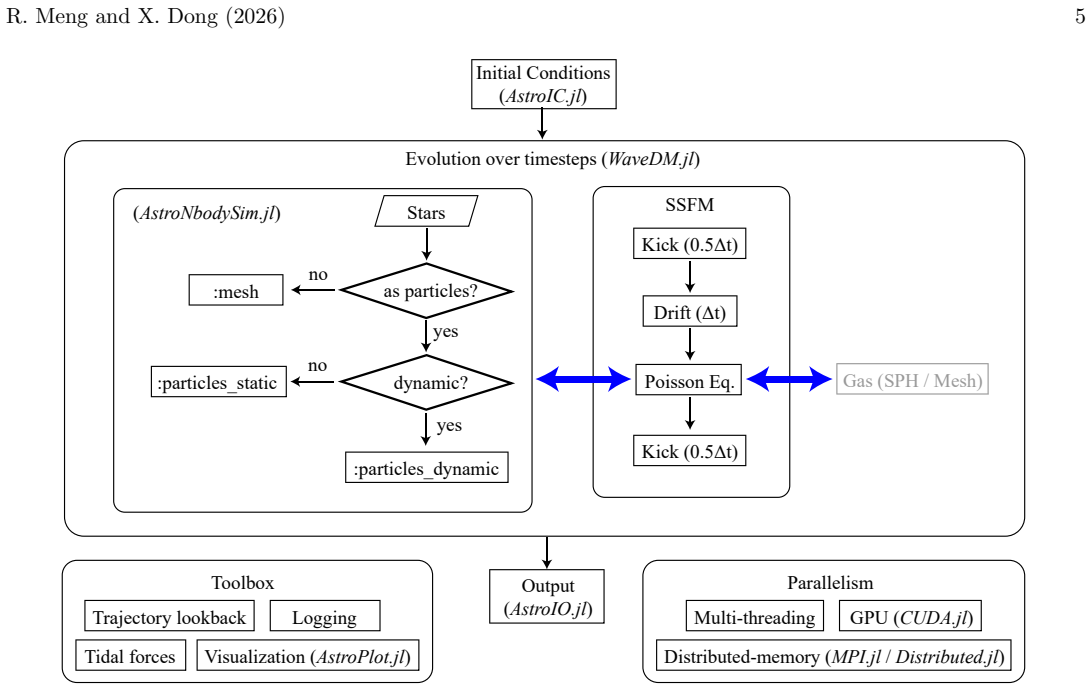
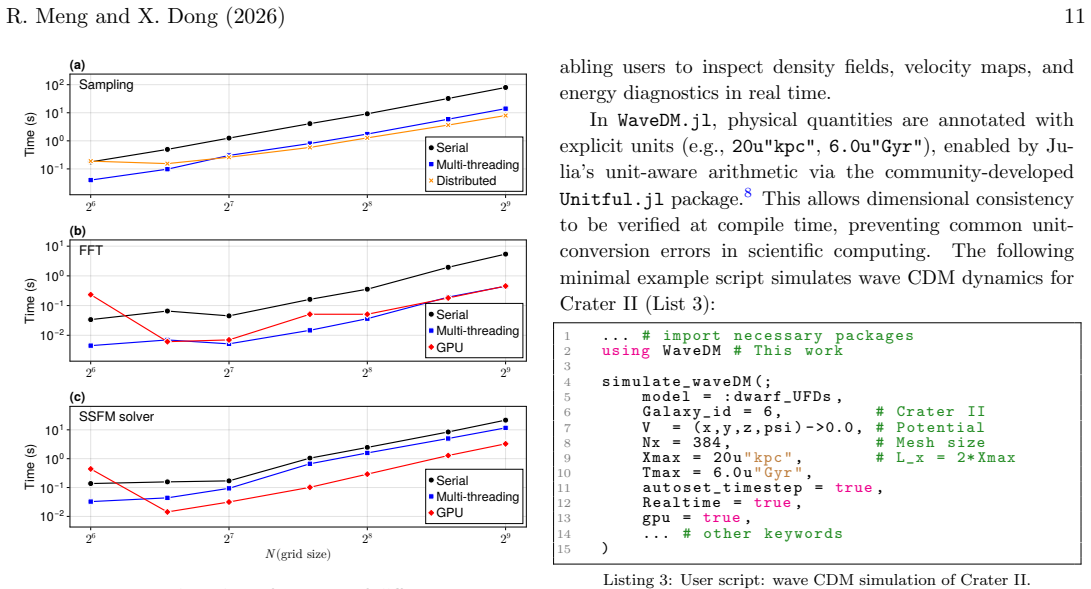
We present WaveDM.jl, an open-source Julia package for high-performance simulations of wave dark matter dynamics on galaxy scales, with a design philosophy centered on extensibility and adaptability. The code solves the time-dependent Schrodinger--Poisson equation (SPE) using a pseudo-spectral Fourier method. The spectral solver is tightly integrated with N-body gravitational force solvers, enabling simultaneous evolution of wave dark matter and baryonic components in galaxy-scale simulations. WaveDM.jl unifies shared-memory, distributed-memory, and GPU execution within a multi-level parallelization framework, enabling the same computational workflow to scale from single-node to multi-node computing environments without requiring major code changes. To further facilitate user-friendly galaxy-scale simulations, the package provides a dedicated toolbox that integrates flexible initial condition generators, trajectory lookback, tidal force calculations, and real-time visualization. Beyond astrophysical applications, the code's modular architecture and general nonlinear Schrodinger framework enable cross-disciplinary studies such as nonlinear optics and cold-atom physics. The code is open source and available on https://github.com/JuliaAstroSim/WaveDM.jl.
Editorial analysis
A structured set of objections, weighed in public.
Referee Report
Summary. The manuscript presents WaveDM.jl, an open-source Julia package for high-performance simulations of wave dark matter and baryonic matter on galaxy scales. It solves the time-dependent Schrödinger--Poisson equation via a pseudo-spectral Fourier method tightly coupled to N-body gravitational solvers, enabling joint evolution of wave DM and baryons. The code supports multi-level parallelization (shared-memory, distributed, GPU) without major workflow changes, and supplies a toolbox for initial conditions, trajectory lookback, tidal forces, and visualization. The modular nonlinear Schrödinger framework is positioned for cross-disciplinary use beyond astrophysics.
Significance. If the coupled spectral--particle solver is shown to be stable and accurate, the package could serve as a practical, extensible tool for galaxy-scale wave-DM studies, with the open-source release, unified parallelization, and general framework as clear strengths for reproducibility and community adoption.
major comments (1)
- [Abstract] The central claim that the pseudo-spectral Fourier discretization of the SPE, when coupled to N-body forces, remains stable and accurate for galaxy-scale evolution lacks any supporting evidence: no L2 or L∞ error norms against analytic solitons, no resolution or timestep convergence studies, and no tests of operator splitting or force interpolation are reported anywhere in the manuscript.
Simulated Author's Rebuttal
We thank the referee for their careful reading and for highlighting the need for explicit numerical validation. We agree that the current manuscript does not contain the requested convergence tests or error norms, and we will incorporate these in a revised version.
read point-by-point responses
-
Referee: [Abstract] The central claim that the pseudo-spectral Fourier discretization of the SPE, when coupled to N-body forces, remains stable and accurate for galaxy-scale evolution lacks any supporting evidence: no L2 or L∞ error norms against analytic solitons, no resolution or timestep convergence studies, and no tests of operator splitting or force interpolation are reported anywhere in the manuscript.
Authors: We acknowledge the absence of these quantitative validation tests in the submitted manuscript. The paper's primary focus is the software architecture, parallelization strategy, and integration of the spectral solver with N-body methods. In the revised manuscript we will add a new section (or subsection) presenting (i) L2 and L∞ error norms for isolated soliton solutions, (ii) resolution and timestep convergence studies, and (iii) explicit tests of the Strang splitting and force-interpolation scheme. These additions will directly support the stability and accuracy claims. revision: yes
Circularity Check
No circularity: code-release paper with no derivation chain or predictions
full rationale
The manuscript describes an open-source Julia package implementing a pseudo-spectral solver for the Schrödinger–Poisson equation coupled to N-body gravity. No first-principles derivations, analytic predictions, fitted parameters, or uniqueness theorems are presented; the text consists of implementation details, parallelization features, and usage tools. None of the enumerated circularity patterns apply because there are no load-bearing steps that reduce a claimed result to its own inputs by construction. The paper is self-contained as a software description and requires no external validation of a mathematical claim within its own text.
Axiom & Free-Parameter Ledger
axioms (2)
- standard math Pseudo-spectral Fourier method accurately discretizes the time-dependent Schrödinger-Poisson equation on periodic domains
- domain assumption N-body gravitational force calculation can be directly coupled to the spectral wave solver without order-of-magnitude accuracy loss
Reference graph
Works this paper leans on
-
[1]
Fuzzy Cold Dark Matter: The Wave Properties of Ultralight Particles.Phys- ical Review Letters, 85(6):1158–1161, August 2000
Wayne Hu, Rennan Barkana, and Andrei Gruzinov. Fuzzy Cold Dark Matter: The Wave Properties of Ultralight Particles.Phys- ical Review Letters, 85(6):1158–1161, August 2000
2000
-
[2]
Wave dark matter.arXiv preprint arXiv:2101.11735, 2021
Lam Hui. Wave dark matter.arXiv preprint arXiv:2101.11735, 2021
arXiv 2021
-
[3]
Xinyu Li, Lam Hui, and Greg L. Bryan. Numerical and pertur- bative computations of the fuzzy dark matter model.Physical Review D, 99(6):063509, 2019
2019
-
[4]
Fuzzy dark matter simulations.Living Reviews in Computational Astrophysics, 12(1):1, April 2026
Hsi-Yu Schive. Fuzzy dark matter simulations.Living Reviews in Computational Astrophysics, 12(1):1, April 2026
2026
-
[5]
PyUltraLight: A pseudo-spectral solver for ultralight dark matter dynamics.Journal of Cosmology and Astroparticle Physics, 2018(10):27, October 2018
Faber Edwards, Emily Kendall, Shaun Hotchkiss, and Richard Easther. PyUltraLight: A pseudo-spectral solver for ultralight dark matter dynamics.Journal of Cosmology and Astroparticle Physics, 2018(10):27, October 2018
2018
-
[6]
UltraDark.jl: A julia package for simulation of cosmological scalar fields.Journal of Open Source Software, 9(96):6035, April 2024
Nathan Musoke. UltraDark.jl: A julia package for simulation of cosmological scalar fields.Journal of Open Source Software, 9(96):6035, April 2024
2024
-
[7]
Cosmic structure as the quantum interference of a coherent dark wave
Hsi-Yu Schive, Tzihong Chiueh, and Tom Broadhurst. Cosmic structure as the quantum interference of a coherent dark wave. Nature Physics, 10(7):496–499, July 2014
2014
-
[8]
Alexander Kunkel, Hei Yin Jowett Chan, Hsi-Yu Schive, Hsinhao Huang, and Pin-Yu Liao. A hybrid scheme for fuzzy dark mat- ter simulations combining the schr¨ odinger and Hamilton–jacobi– madelung equations.The Astrophysical Journal Supplement Se- ries, 279(2):39, July 2025
2025
-
[9]
MIT Press, 1999
William Gropp, Ewing Lusk, and Anthony Skjellum.Using MPI: Portable Parallel Programming with the Message-passing Inter- face. MIT Press, 1999
1999
-
[10]
Warm and fuzzy dark matter: Free streaming of wave dark matter.Physical Review D, 111(2):023535, January 2025
Rayne Liu, Wayne Hu, and Huangyu Xiao. Warm and fuzzy dark matter: Free streaming of wave dark matter.Physical Review D, 111(2):023535, January 2025
2025
-
[11]
Predictive model of BEC dark matter ha- los with a solitonic core and an isothermal atmosphere.Physical Review D, 100(8):083022, 2019
Pierre-Henri Chavanis. Predictive model of BEC dark matter ha- los with a solitonic core and an isothermal atmosphere.Physical Review D, 100(8):083022, 2019
2019
-
[12]
Xiaobo Dong, Yongda Zhu, Marcia Rieke, George Rieke, Xinyu Li, Peter Behroozi, Haixia Ma, Runyu Meng, Zhiying Mao, and Zhe Sun. A promise for the JWST era: Massive black holes directly collapsed from wave dark matter haloes, and star forma- tion in and around their accretion flows.http://arxiv.org/abs/ 2508.09258, August 2025
arXiv 2025
-
[13]
Oxford University Press, January 2016
Lev Pitaevskii and Sandro Stringari.Bose-Einstein Condensa- tion and Superfluidity. Oxford University Press, January 2016
2016
-
[14]
Yu. Kagan. Evolution of Correlation Properties and Appearance of Broken Symmetry in the Process of Bose-Einstein Condensa- tion.Physical Review Letters, 79(18):3331–3334, 1997
1997
-
[15]
Modifying PyUl- traLight to model scalar dark matter with self-interactions.Phys- ical Review D, 104(8):083532, October 2021
Noah Glennon and Chanda Prescod-Weinstein. Modifying PyUl- traLight to model scalar dark matter with self-interactions.Phys- ical Review D, 104(8):083532, October 2021. R. Meng and X. Dong (2026) 19
2021
-
[16]
Ostriker, Scott Tremaine, and Edward Witten
Lam Hui, Jeremiah P. Ostriker, Scott Tremaine, and Edward Witten. Ultralight scalars as cosmological dark matter.Physical Review D, 95(4):043541, 2017
2017
-
[17]
Robles, Jes´ us Zavala, Michael Boylan-Kolchin, Anastasia Fialkov, and Lars Hernquist
Philip Mocz, Mark Vogelsberger, Victor H. Robles, Jes´ us Zavala, Michael Boylan-Kolchin, Anastasia Fialkov, and Lars Hernquist. Galaxy formation with BECDM – I. Turbulence and relaxation of idealized haloes.Monthly Notices of the Royal Astronomical Society, 471(4):4559–4570, November 2017
2017
-
[18]
Deciphering the soliton-halo relation in fuzzy dark matter.Physical Review Letters, 135(6), 2025
Pin-Yu Liao. Deciphering the soliton-halo relation in fuzzy dark matter.Physical Review Letters, 135(6), 2025
2025
-
[19]
van den Bosch, Victor H
Dhruba Dutta Chowdhury, Frank C. van den Bosch, Victor H. Robles, Pieter van Dokkum, Hsi-Yu Schive, Tzihong Chiueh, and Tom Broadhurst. On the Random Motion of Nuclear Objects in a Fuzzy Dark Matter Halo.The Astrophysical Journal, 916(1):27, July 2021
2021
-
[20]
The solution of poisson’s equation for isolated source distributions.Journal of Computational Physics, 25(2):71–93, October 1977
R.A James. The solution of poisson’s equation for isolated source distributions.Journal of Computational Physics, 25(2):71–93, October 1977
1977
-
[21]
GADGET: A code for collisionless and gasdy- namical cosmological simulations.New Astronomy, 6(2):79–117, April 2001
Volker Springel. GADGET: A code for collisionless and gasdy- namical cosmological simulations.New Astronomy, 6(2):79–117, April 2001
2001
-
[22]
The cosmological simulation code GADGET-2
Volker Springel. The cosmological simulation code GADGET-2. Monthly Notices of the Royal Astronomical Society, 364(4):1105– 1134, 2005
2005
-
[23]
Galaxy formation with BECDM – II
Philip Mocz, Anastasia Fialkov, Mark Vogelsberger, Fernando Becerra, Xuejian Shen, Victor H Robles, Mustafa A Amin, Jes´ us Zavala, Michael Boylan-Kolchin, Sownak Bose, Federico Mari- nacci, Pierre-Henri Chavanis, Lachlan Lancaster, and Lars Hern- quist. Galaxy formation with BECDM – II. Cosmic filaments and first galaxies.Monthly Notices of the Royal Ast...
2027
-
[24]
Simon May and Volker Springel. Structure formation in large- volume cosmological simulations of fuzzy dark matter: Impact of the non-linear dynamics.Monthly Notices of the Royal Astro- nomical Society, 506(2):2603–2618, July 2021
2021
-
[25]
The halo mass function and fil- aments in full cosmological simulations with fuzzy dark matter
Simon May and Volker Springel. The halo mass function and fil- aments in full cosmological simulations with fuzzy dark matter. Monthly Notices of the Royal Astronomical Society, 524(3):4256– 4274, September 2023
2023
-
[26]
Niemeyer, and Jan F
Bodo Schwabe, Jens C. Niemeyer, and Jan F. Engels. Simula- tions of solitonic core mergers in ultralight axion dark matter cosmologies.Physical Review D, 94(4):043513, August 2016
2016
-
[27]
Barry T. Chiang. Soliton oscillations and revised constraints from eridanus II of fuzzy dark matter.Physical Review D, 103(10), 2021
2021
-
[28]
STATISTICAL MECHANICS OF VIOLENT RELAXATION IN STELLAR SYSTEMS.Monthly Notices of the Royal Astronomical Society, 136(1):101–121, 1967
D Lynden-Bell. STATISTICAL MECHANICS OF VIOLENT RELAXATION IN STELLAR SYSTEMS.Monthly Notices of the Royal Astronomical Society, 136(1):101–121, 1967
1967
-
[29]
Fernanda P. C. Benetti, Ana C. Ribeiro-Teixeira, Renato Pak- ter, and Yan Levin. Nonequilibrium stationary states of 3D self- gravitating systems.Physical Review Letters, 113(10):100602, September 2014
2014
-
[30]
Klessen, Fabian Heitsch, and Mordecai-Mark Mac Low
Ralf S. Klessen, Fabian Heitsch, and Mordecai-Mark Mac Low. Gravitational collapse in turbulent molecular clouds. I. Gasdy- namical turbulence.The Astrophysical Journal, 535:887–906, June 2000
2000
-
[31]
O. L. Berman, R. Ya. Kezerashvili, G. V. Kolmakov, and Yu. E. Lozovik. Turbulence in a bose-einstein condensate of dipolar ex- citons in coupled quantum wells.Physical Review B, 86(4):45108, July 2012
2012
-
[32]
Ostriker
Sanghyuk Moon and Eve C. Ostriker. Theory of turbulent equi- librium spheres with power-law linewidth–size relation.The As- trophysical Journal, 975(2):295, November 2024
2024
-
[33]
Chandrasekhar and E
S. Chandrasekhar and E. Fermi. Problems of gravitational stabil- ity in the presence of a magnetic field.The Astrophysical Journal, 118:116, July 1953
1953
-
[34]
HIGH-RESOLUTION SIMULATION ON STRUCTURE FORMATION WITH EX- TREMELY LIGHT BOSONIC DARK MATTER.The Astro- physical Journal, 697(1):850–861, May 2009
Tak-Pong Woo and Tzihong Chiueh. HIGH-RESOLUTION SIMULATION ON STRUCTURE FORMATION WITH EX- TREMELY LIGHT BOSONIC DARK MATTER.The Astro- physical Journal, 697(1):850–861, May 2009
2009
-
[35]
Wilcox, and Valentin Churavy
Simon Byrne, Lucas C. Wilcox, and Valentin Churavy. MPI.jl: Julia bindings for the Message Passing Interface.Proceedings of the JuliaCon Conferences, 1(1):68, July 2021
2021
-
[36]
Effective ex- tensible programming: Unleashing julia on GPUs.IEEE Trans- actions on Parallel and Distributed Systems, 30(4):827–841, April 2019
Tim Besard, Christophe Foket, and Bjorn De Sutter. Effective ex- tensible programming: Unleashing julia on GPUs.IEEE Trans- actions on Parallel and Distributed Systems, 30(4):827–841, April 2019
2019
-
[37]
How close dark matter haloes and MOND are to each other: Three-dimensional tests based on Gaia DR2.Monthly No- tices of the Royal Astronomical Society, 519(3):4479–4498, March 2023
Yongda Zhu, Hai-Xia Ma, Xiao-Bo Dong, Yang Huang, Tobias Mistele, Bo Peng, Qian Long, Tianqi Wang, Liang Chang, and Xi Jin. How close dark matter haloes and MOND are to each other: Three-dimensional tests based on Gaia DR2.Monthly No- tices of the Royal Astronomical Society, 519(3):4479–4498, March 2023
2023
-
[38]
Battaglia, S
G. Battaglia, S. Taibi, G. F. Thomas, and T. K. Fritz. Gaia early DR3 systemic motions of local group dwarf galaxies and orbital properties with a massive large magellanic cloud.Astronomy and Astrophysics, 657:A54, January 2022
2022
-
[39]
Makie.jl: Flexible high- performance data visualization for Julia.Journal of Open Source Software, 6(65):3349, September 2021
Simon Danisch and Julius Krumbiegel. Makie.jl: Flexible high- performance data visualization for Julia.Journal of Open Source Software, 6(65):3349, September 2021
2021
-
[40]
Kohei Hayashi, Yutaka Hirai, Masashi Chiba, and Tomoaki Ishiyama. Dark matter halo properties of the galactic dwarf satel- lites: Implication for chemo-dynamical evolution of the satellites and a challenge to lambda cold dark matter.Astrophysical Jour- nal, 953(2):185, August 2023
2023
-
[41]
Ren´ ee Hlozek, Daniel Grin, David J. E. Marsh, and Pedro G. Fer- reira. A search for ultralight axions using precision cosmological data.Physical Review D, 91(10):103512, May 2015
2015
-
[42]
Numerical solution of the nonlin- ear Schr¨ odinger equation using smoothed-particle hydrodynam- ics.Physical Review E, 91(5):053304, May 2015
Philip Mocz and Sauro Succi. Numerical solution of the nonlin- ear Schr¨ odinger equation using smoothed-particle hydrodynam- ics.Physical Review E, 91(5):053304, May 2015
2015
-
[43]
Niemeyer
Jan Veltmaat and Jens C. Niemeyer. Cosmological particle-in-cell simulations with ultralight axion dark matter.Physical Review D, 94(12):123523, December 2016
2016
-
[44]
Niemeyer, and Bodo Schwabe
Jan Veltmaat, Jens C. Niemeyer, and Bodo Schwabe. Formation and structure of ultralight bosonic dark matter halos.Physical Review D, 98(4):043509, August 2018
2018
-
[45]
AX-GADGET: A new code for cos- mological simulations of Fuzzy Dark Matter and Axion models
Matteo Nori and Marco Baldi. AX-GADGET: A new code for cos- mological simulations of Fuzzy Dark Matter and Axion models. Monthly Notices of the Royal Astronomical Society, 478(3):3935– 3951, 2018
2018
-
[46]
Ultralight Axion Dark Matter and Its Impact on Dark Halo Structure inN-body Simulations.The Astrophysical Journal, 853(1):51, January 2018
Jiajun Zhang, Yue-Lin Sming Tsai, Jui-Lin Kuo, Kingman Che- ung, and Ming-Chung Chu. Ultralight Axion Dark Matter and Its Impact on Dark Halo Structure inN-body Simulations.The Astrophysical Journal, 853(1):51, January 2018
2018
-
[47]
A stable finite-volume method for scalar field dark matter.Monthly Notices of the Royal Astronomical Society, 489(2):2367–2376, October 2019
Philip F Hopkins. A stable finite-volume method for scalar field dark matter.Monthly Notices of the Royal Astronomical Society, 489(2):2367–2376, October 2019
2019
-
[48]
Niemeyer, and Richard Easther
Bodo Schwabe, Mateja Gosenca, Christoph Behrens, Jens C. Niemeyer, and Richard Easther. Simulating mixed fuzzy and cold dark matter.Physical Review D, 102(8):083518, October 2020
2020
-
[49]
Mota, and Hans A
Mattia Mina, David F. Mota, and Hans A. Winther. SCALAR: An AMR code to simulate axion-like dark matter models.As- tronomy & Astrophysics, 641:A107, September 2020
2020
-
[50]
Richard Bond, Ren´ ee Hloˇ zek, David J
Alex Lagu¨ e, J. Richard Bond, Ren´ ee Hloˇ zek, David J. E. Marsh, and Laurin S¨ oding. Evolving Ultralight Scalars into Non- Linearity with Lagrangian Perturbation Theory.Monthly Notices of the Royal Astronomical Society, 504(2):2391–2404, April 2021. R. Meng and X. Dong (2026) 20
2021
-
[51]
Niemeyer
Bodo Schwabe and Jens C. Niemeyer. Deep zoom-in simulation of a fuzzy dark matter galactic halo.Physical Review Letters, 128(18):181301, May 2022
2022
-
[52]
Jaxion.https://github.com/JaxionProject/ jaxion, October 2025
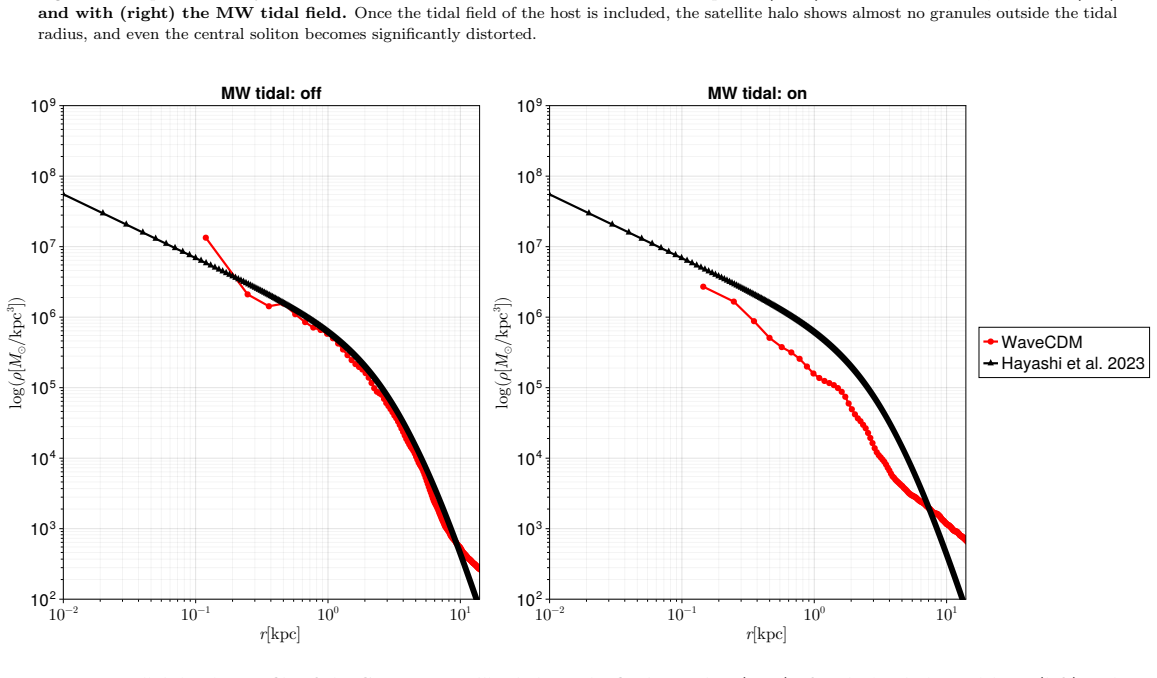
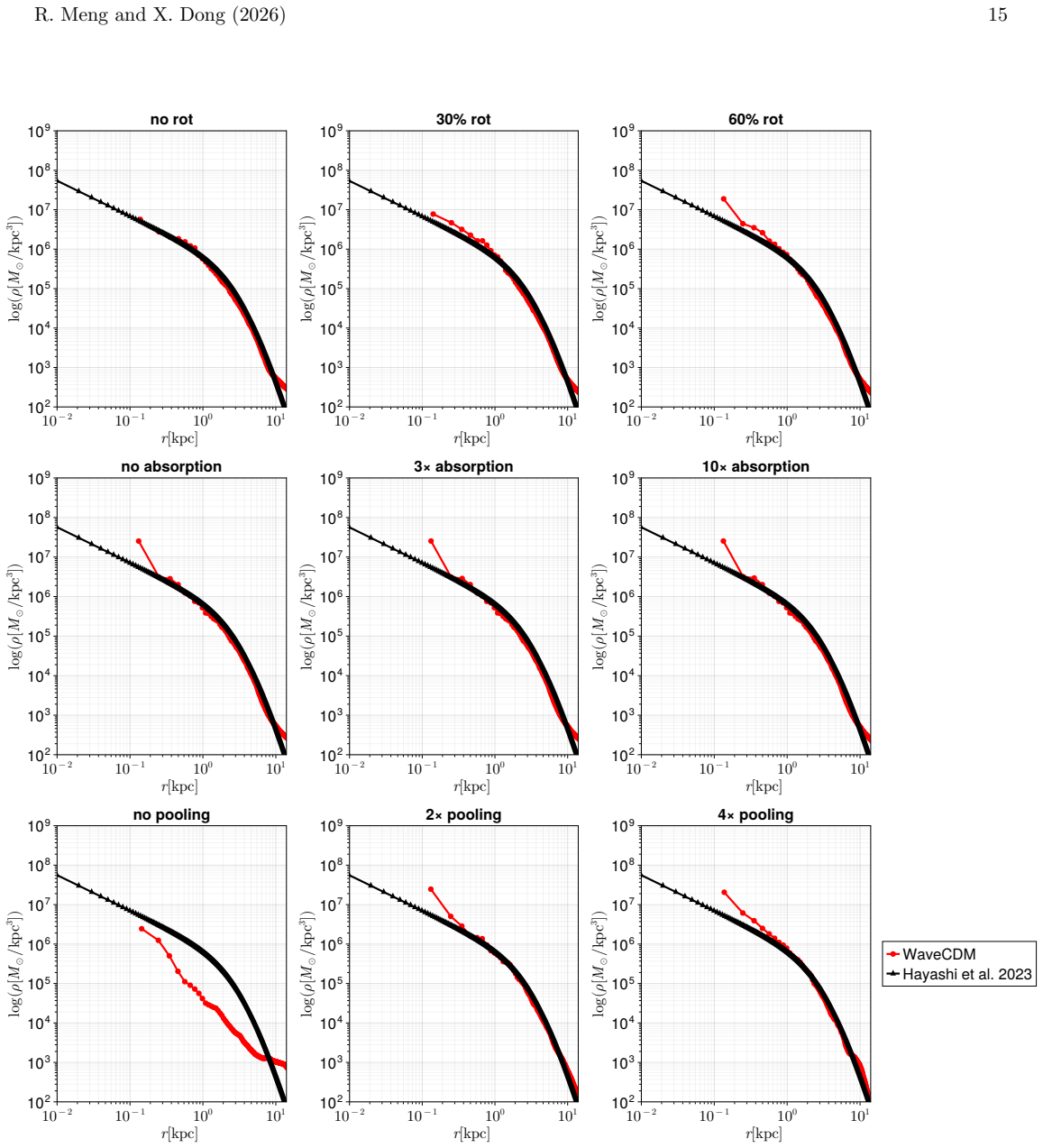
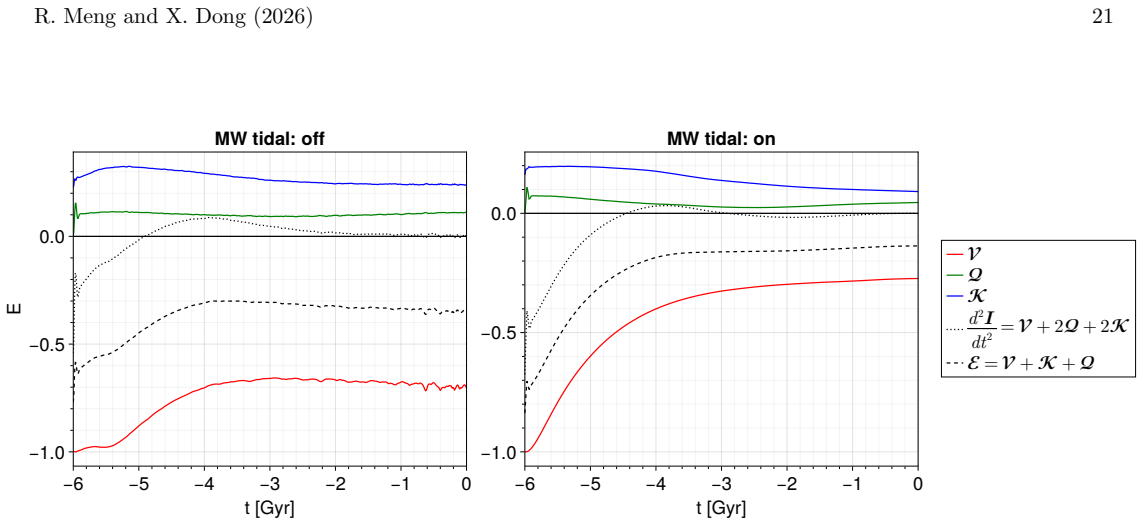
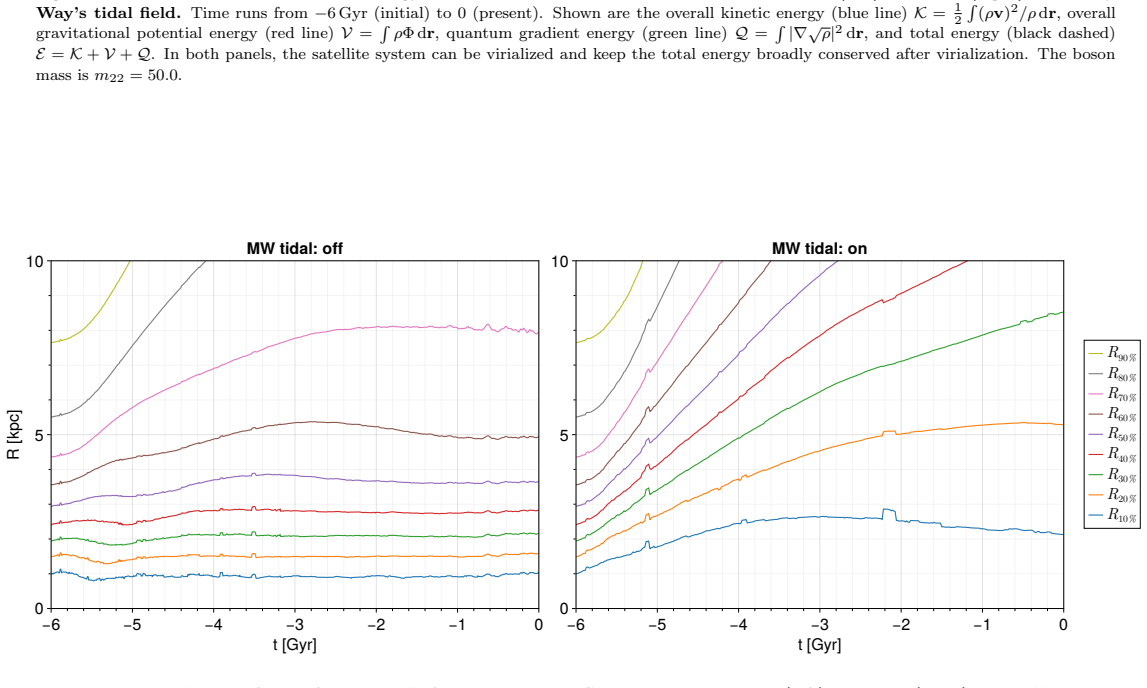
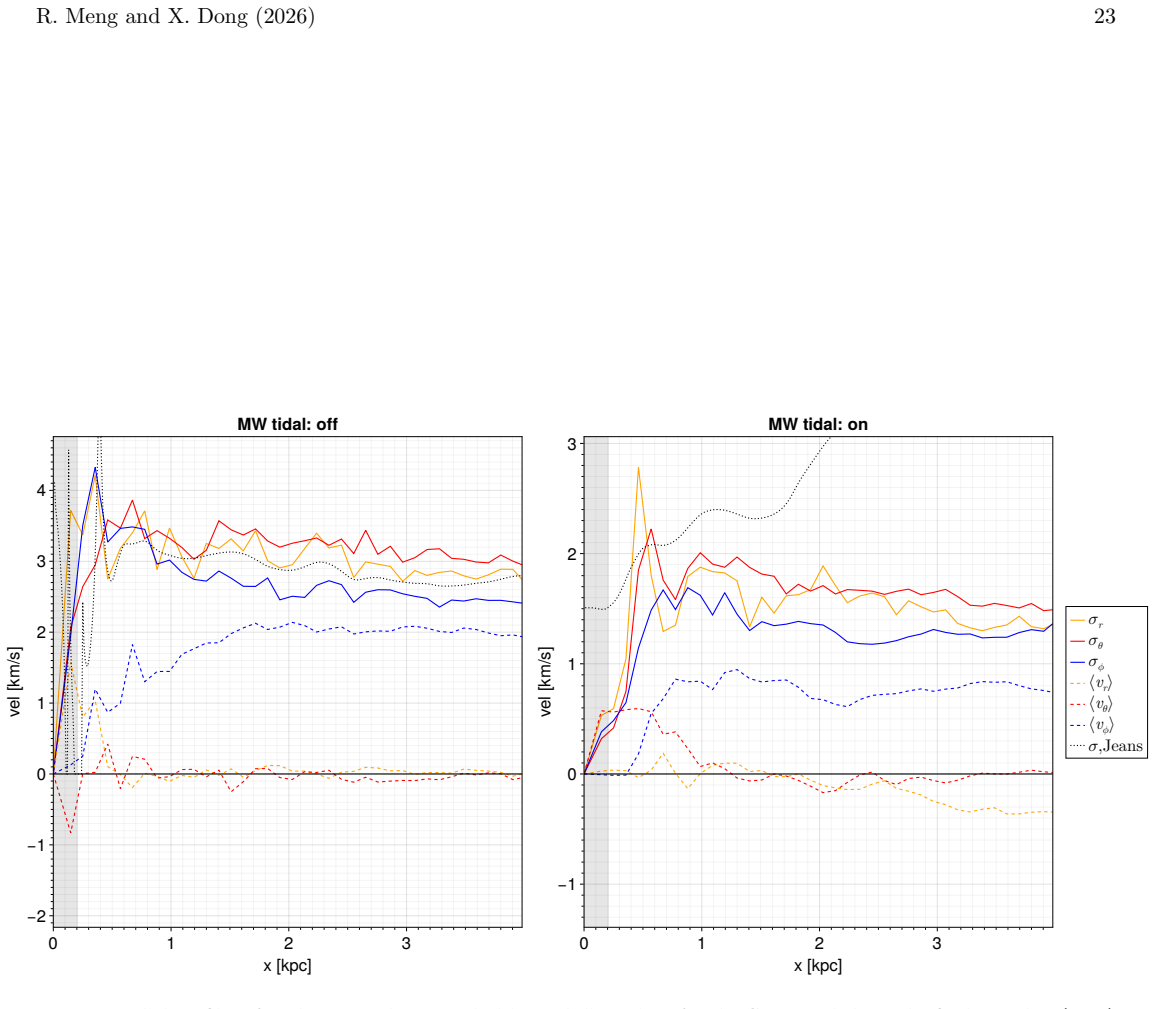
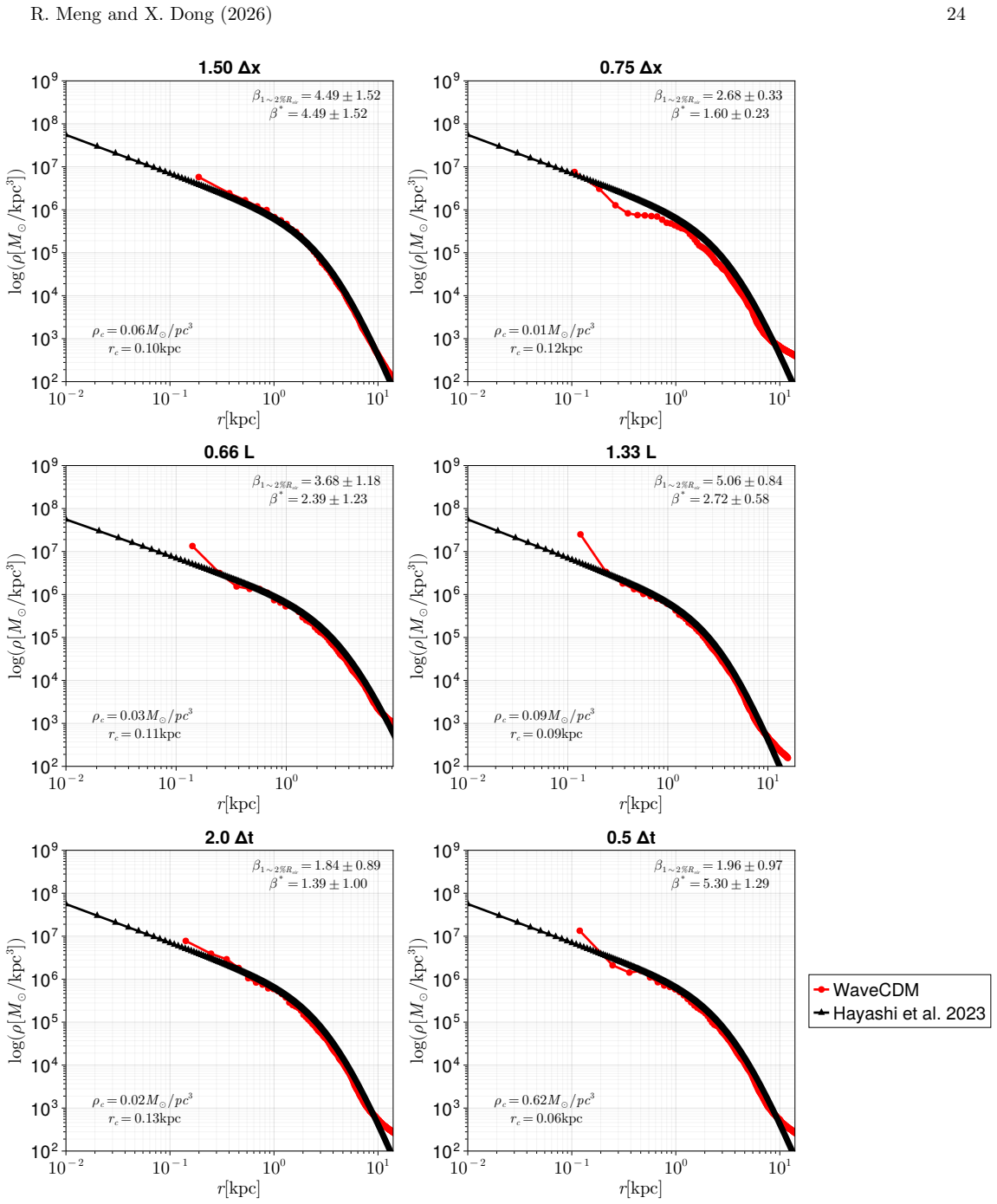
Philip Mocz. Jaxion.https://github.com/JaxionProject/ jaxion, October 2025. A A.1 Detailed analysis of Crater II simulation This appendix section provides some further analyses of the Crater II simulation (see section 4), mainly for the purpose of illustrating the functionalities of theWaveDM.jlpackage, particularly the different diagnostic powers of the ...
2025
discussion (0)
Sign in with ORCID, Apple, or X to comment. Anyone can read and Pith papers without signing in.