REVIEW 3 major objections 5 minor 1 cited by
Measuring the magnetic field of young stars using iSHELL observations: BP Tau and V347 Aur
T0 review · 3 major / 5 minor · reviewed 2026-08-14 · deepseek-v4-flash
Pith's one-line read Fitting high-resolution near-infrared spectra with a magnetized radiative-transfer model recovers stellar parameters to within 91 K and measures the first magnetic field of the protostar V347 Aur at 1.36 kG.
desk verdict The first magnetic field measurement of the class I protostar V347 Aur is a real result, but the quoted error bars understate the systematic floor and the solar-calibrated line list needs an independent check at cool, low-gravity parameters. read the letter →
The pith
A machine-rendered reading of the paper's core claim, the machinery that carries it, and where it could break.
The reading
What carries the argument
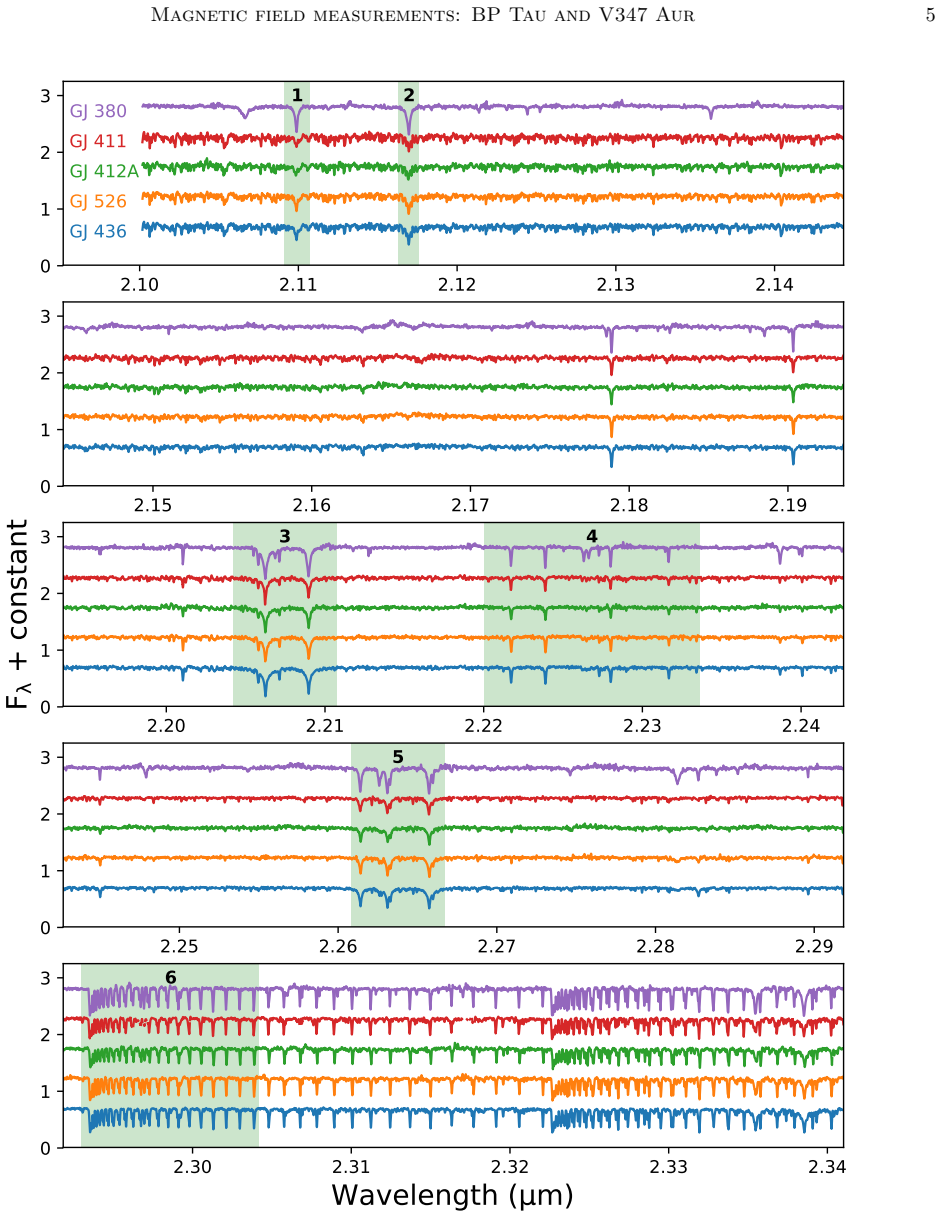
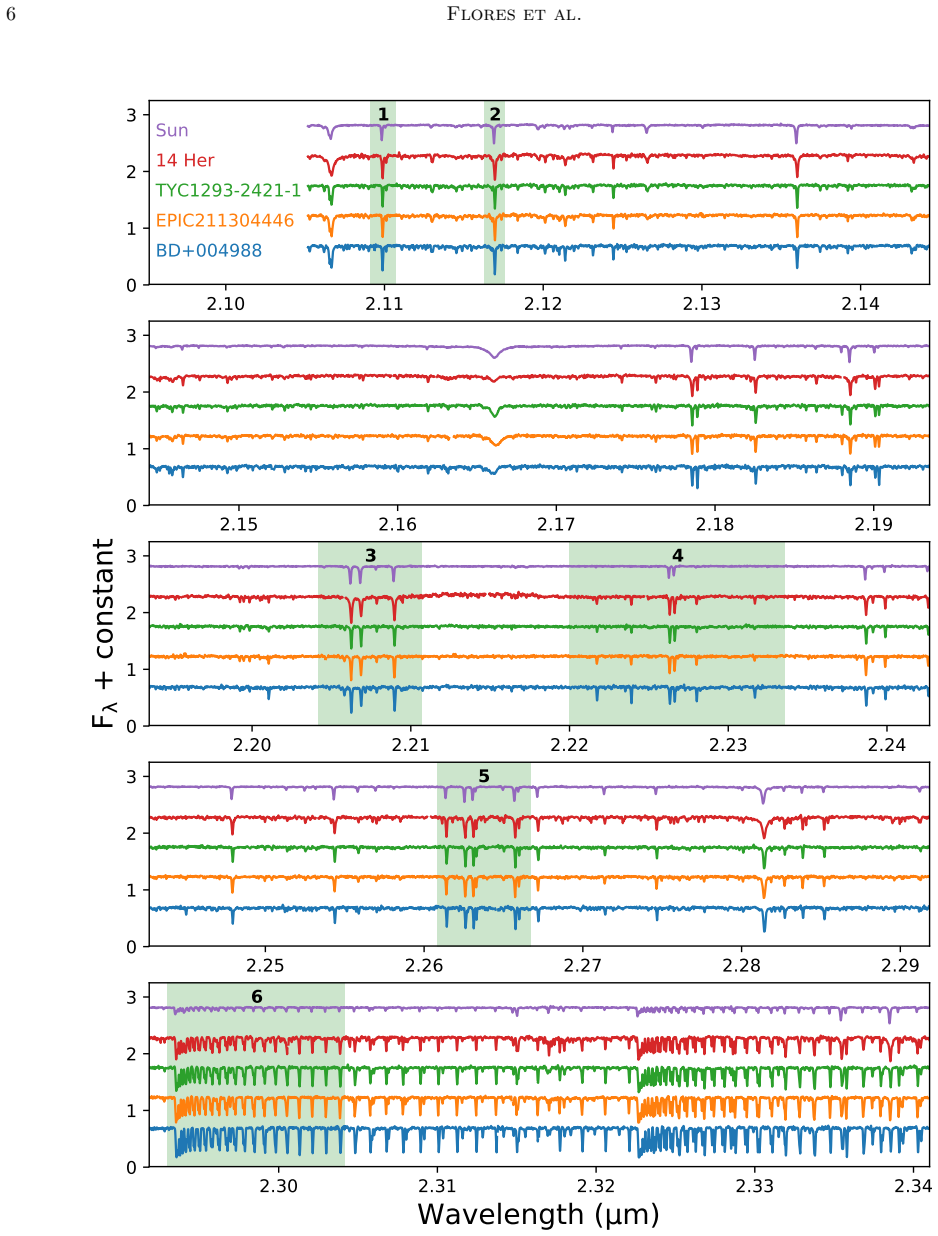
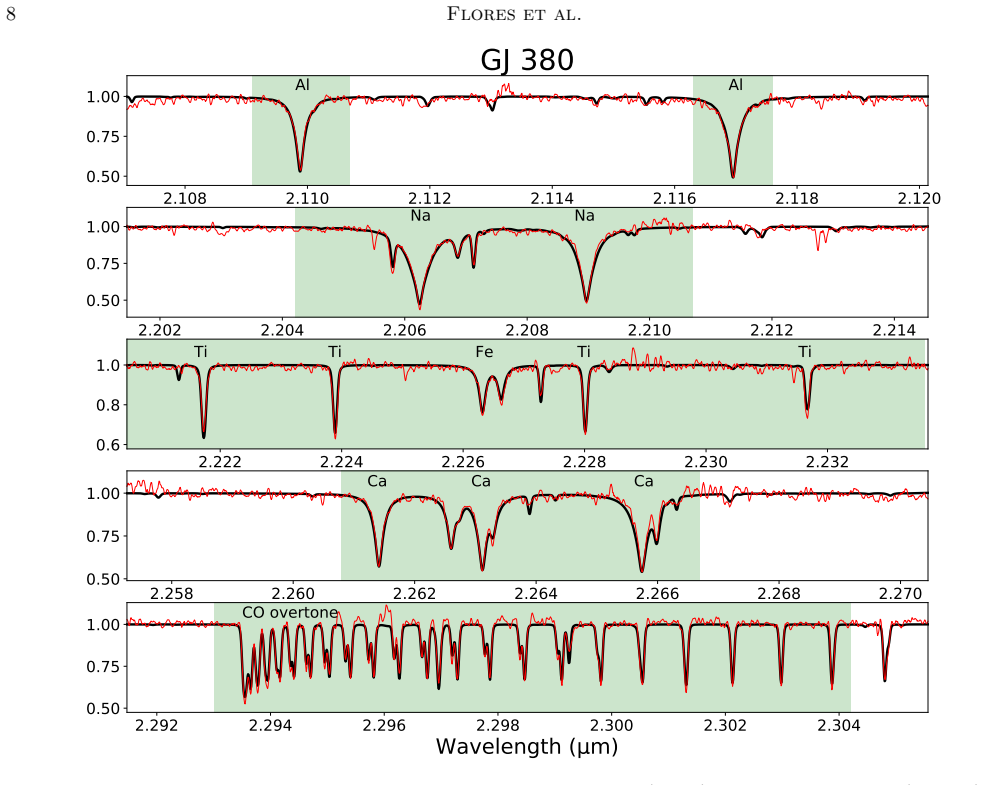
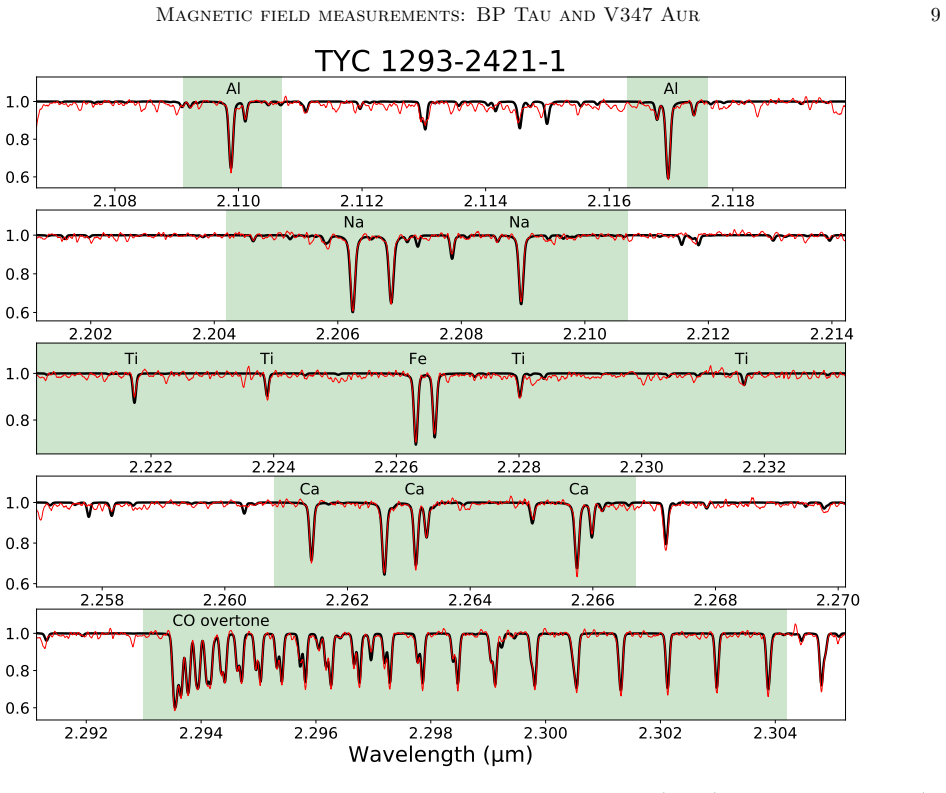
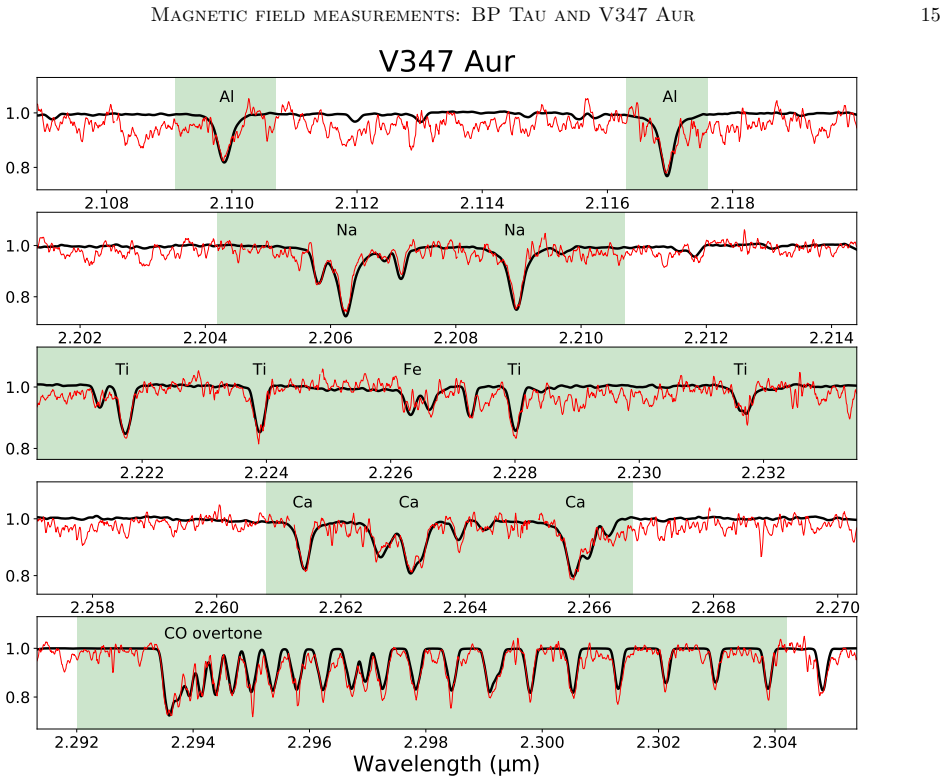
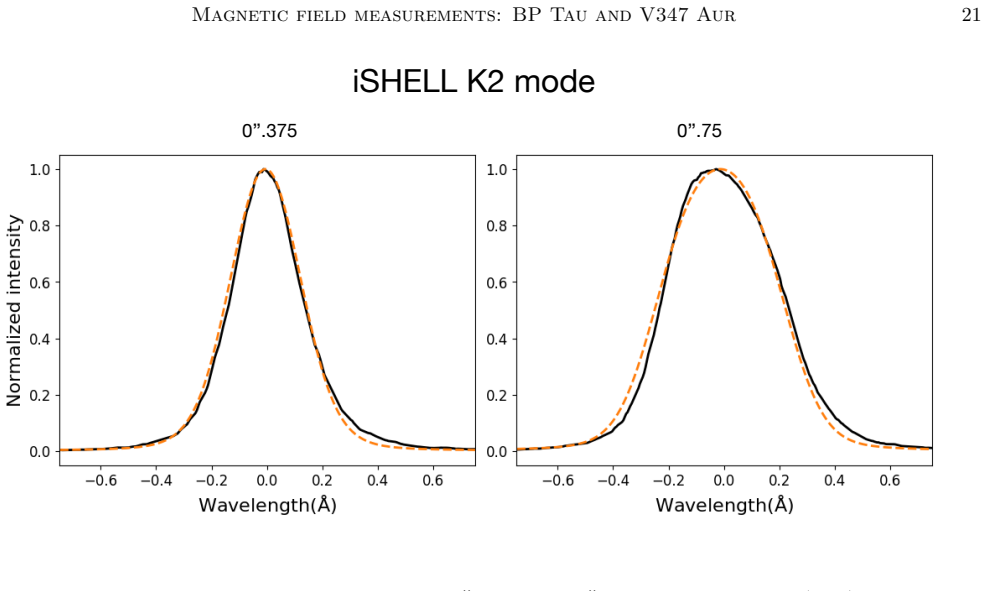
The Zeeman effect is the load-bearing mechanism: in a magnetic field, a spectral line's components separate by an amount proportional to lambda squared times the Lande factor times the field strength, so line widths carry the magnetic signal. Six selected K-band windows include lines with high magnetic sensitivity, such as Ti lines, and lines with low sensitivity, such as CO rovibrational transitions, and all six are fitted simultaneously. The fitting chain combines a plane-parallel LTE magnetic synthesis code, model atmospheres, an empirically measured instrument profile, and a Markov chain Monte Carlo parameter search to recover temperature, gravity, field strength, rotation, microturbulence, veiling, and CO abundance together.
What would settle it
Fit the V347 Aur spectrum with a different atmospheric model grid or with line parameters that were not solar-calibrated; if the recovered field drops to the 0.31 kG detection limit, the 1.36 kG detection was an artifact of the calibration assumptions. Alternatively, obtain an independent spectropolarimetric or optical Zeeman measurement of V347 Aur; disagreement beyond the quoted uncertainties would falsify the transferability of the method.
Extended reading notes
Core claim
The paper claims that the broad wavelength coverage of a high-resolution K-band spectrograph, combined with a magnetic radiative-transfer code that includes Zeeman broadening, is sufficient to determine the fundamental parameters of young stars in one consistent fit. Validated against nine main- and post-main-sequence stars and the Sun, the method returns effective temperatures with a scatter of 91 K and surface gravities with a scatter of 0.14 dex, and it sets a detection limit of 0.31 kG. Applied to the class II star BP Tau, it recovers a surface magnetic field of 2.5 kG, consistent with earlier optical Zeeman studies, but a temperature about 400 K cooler, which the authors attribute to starspot emission dominating the K band. Applied to the class I protostar V347 Aur, it yields the first measurement of that object's field, 1.36 kG, together with log g = 3.25, and it argues that dropping the magnetic term from the fit inflates rotation and turbulence estimates while degrading the fit.
Load-bearing premise
The solar-calibrated changes to 26 atomic line parameters are physically real and carry over to the cooler, lower-gravity photosphere of V347 Aur, rather than absorbing errors in the atmospheric models, radiative transfer, or instrument profile.
Editorial extensions
If this is right
- Magnetic field measurements can be extended to class I protostars, the youngest pre-main-sequence phase, with a uniform parameter fit rather than assumed temperatures and gravities.
- Because Zeeman broadening scales as wavelength squared, the near-infrared approach can detect weaker fields than optical studies, making it a route to a larger protostellar magnetic-field sample.
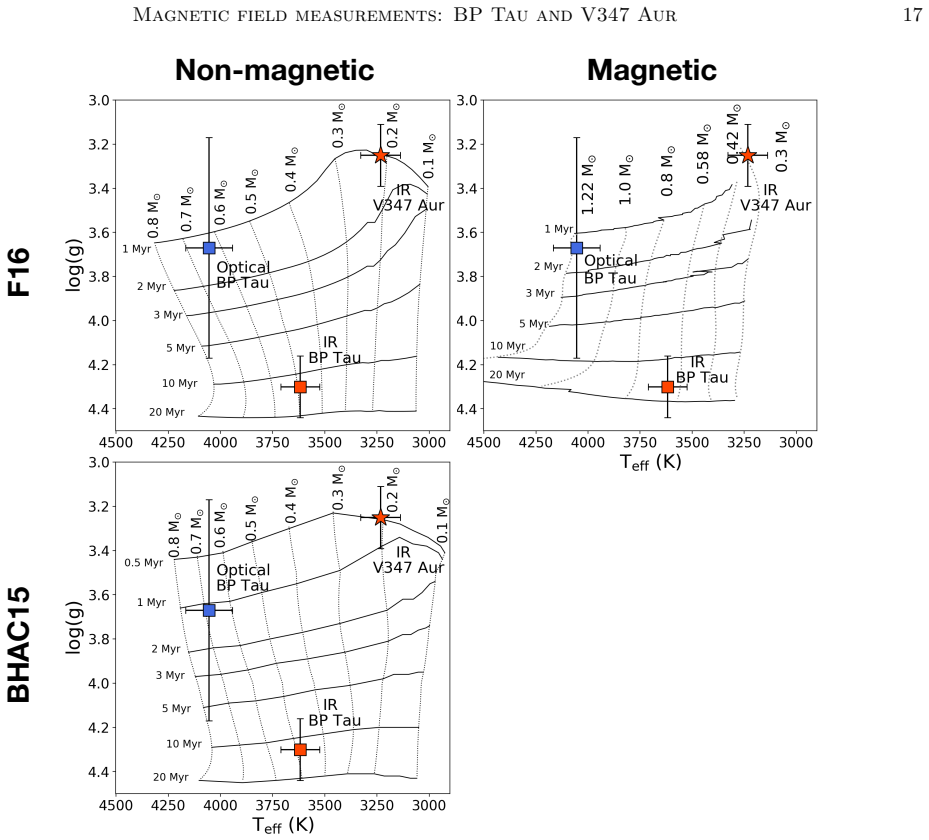
- The 400 K difference between optical and infrared temperatures of BP Tau means single-temperature masses and ages of spotted young stars are uncertain by up to roughly a factor of two, depending on the evolutionary model.
- Nonmagnetic fits to strongly magnetic young stars overestimate projected rotation and microturbulence, so magnetic terms cannot be ignored when measuring rotation in such objects.
Reading between the lines
- If starspots systematically depress infrared temperatures, then masses derived from infrared-only fits to heavily spotted young stars are biased low unless spot filling factors are modeled explicitly.
- The method's detection limit suggests that a survey of class I protostars using the same six spectral windows could map the distribution of fields at the earliest ages and test whether V347 Aur's relatively weak 1.36 kG field is typical.
- A direct extension would be to fit the same spectra with two-temperature spotted models; the difference between the single-temperature and two-temperature recovered fields would indicate how much of the Zeeman broadening is masked by spot contrasts.
Signed reviews
Editorial analysis
A structured set of objections, weighed in public.
Referee Report
Summary. The paper presents a method for deriving stellar parameters and surface magnetic fields of young stars by fitting iSHELL K-band spectra with the MoogStokes Zeeman-broadening code. The method is validated on nine main- and post-main-sequence stars plus the Sun, giving a temperature scatter of 91 K and a gravity scatter of 0.14 dex, and a null-field detection floor of 0.31 kG. Applied to BP Tau, the method recovers B = 2.5 kG, consistent with previous literature. For the class I source V347 Aur, the paper reports the first magnetic field measurement (B = 1.36 kG), along with Teff = 3233 K and log g = 3.25, and shows in a nonmagnetic control test that excluding B degrades the fit to the magnetically sensitive lines while increasing v sin(i) and microturbulence. The paper also discusses the influence of starspots on masses and ages derived from pre-main-sequence evolutionary tracks.
Significance. If the calibration concerns are resolved, this is a valuable contribution: it extends Zeeman-broadening measurements to the K band with broad wavelength coverage, provides an externally consistent BP Tau benchmark, and delivers a new class I magnetic field measurement for V347 Aur. The empirical instrumental profile, the tabulated line-list modifications, the standard-star validation, and the nonmagnetic control test are explicit and reproducible steps that give the method a solid empirical base. The main risk is systematic rather than statistical: the solar-calibrated line parameters and the 0.31 kG null-field floor must be shown to transfer to V347 Aur's cool, low-gravity parameters before the reported 1.36 kG can be taken at face value.
major comments (3)
- [Section 4.5 and Table 5] The quoted uncertainties for V347 Aur's magnetic field (B = 1.36+0.06-0.05 kG in Table 5) are posterior percentiles only and do not include the 0.31 kG null-field floor established in Section 4.5. Because that floor is the strongest field recovered on stars where a null field was expected, it should be added in quadrature as a systematic uncertainty, or the authors should demonstrate that it does not apply at V347 Aur's Teff = 3233 K and log g = 3.25. Even after adding the floor the detection remains significant, but the reported precision would be materially different and the paper should present the combined error budget.
- [Appendix B, Table 8] The V347 Aur detection relies on the Zeeman broadening of Ti I and Ca I lines whose log(gf) and van der Waals constants were adjusted on the Sun (Table 8). Some VdW changes are large, up to about 1.2 dex (e.g., Ti I 22627.394 Å), and because van der Waals broadening is stronger in a cool, low-gravity atmosphere, an error absorbed into these constants at solar conditions could mimic or cancel the Zeeman width at V347 Aur's parameters. The authors themselves caution in Appendix B that the adjustments 'could be hiding defects associated with the stellar atmospheric models, the radiative transfer code, or even the measured instrument spectral profile.' I ask for a concrete external check: fit a standard star near V347 Aur's Teff and log g that was not used in the solar calibration, or explicitly propagate a plausible range of VdW errors into the B measurement, to quantify the resulting systematic uncertainty.
- [Section 5.2 with Section 4] The statement that V347 Aur's parameters 'are contained within the range of stellar parameters we investigated in Section 4' is inaccurate for temperature: the coolest standard star in Table 4 is GJ 436 at 3401 K, while V347 Aur is 3233 K, and no standard star combines Teff below about 3400 K with log g around 3.2. The null-field floor of 0.31 kG in Section 4.5 was measured on warmer giants and on the Sun. The transfer of both the adjusted line list and the detection limit to V347 Aur is therefore an extrapolation and should be identified as such, or supported by additional anchor points.
minor comments (5)
- [Section 3.1] The text says 'we adopted, for simplicity, a solar composition in all our models,' but Section 3.3 and Table 4 treat [M/H] as a free parameter; please clarify that 'solar composition' refers to element abundance ratios rather than a fixed metallicity.
- [Equation (1) and surrounding text] There is a missing space before 'λ' in the sentence below Equation (1), and the wavelength unit is given as microns there while other parts of the paper use Ångströms; please harmonize the notation.
- [Table 8] Please state the units and sign convention for the 'Waals' column and provide the origin of the default values, so that the modifications are fully reproducible.
- [Section 6.1] The sentence 'if the covering factor ... iw known' contains a typo; it should read 'is known.'
- [Table 4 note] The note says that actual errors are significantly larger than the tabulated formal uncertainties, but the paper does not state the final combined uncertainty for each standard star; consider adding a column or equation showing how sigma_Teff = 91 K, sigma_logg = 0.14, and the 0.31 kG magnetic floor combine with the MCMC errors.
Circularity Check
No circular derivation: the magnetic fields are free parameters in MoogStokes, validated against external standard-star benchmarks; the V347 Aur result is not forced by any fitted input.
full rationale
The derivation chain is self-contained. The magnetic field is a free parameter in the MoogStokes radiative transfer code (Section 3.1: 'MoogStokes assumes a radial and uniform magnetic field in the radiative transfer computation'), and the method is validated on nine main- and post-main-sequence stars with independent Teff and log(g) determinations plus the Sun before being applied to BP Tau and V347 Aur. BP Tau (B = 2.5 kG) is an external benchmark checked against Johns-Krull et al. (1999, 2007), not an input. The V347 Aur detection (B = 1.36 kG) is judged against the empirically defined null-field floor Blimit = 0.31 kG (Section 4.5), so the detection is not forced by a prior. The only internal calibration is the adjustment of 26 VALD3 line parameters against solar spectra (Appendix B); the authors explicitly caution that this 'could be hiding defects associated with the stellar atmospheric models, the radiative transfer code, or even the measured instrument spectral profile.' That is a transferability risk rather than circularity, because the Sun is an external calibrator and the YSO spectra are not part of that fit. Self-citations (e.g., Connelley & Greene 2010; Reipurth 2008) provide spectral classification and distance context and are not load-bearing for the magnetic field measurement. No equation reduces to its own input, and no fitted parameter is renamed as a prediction.
Assumptions & free parameters
free parameters (3)
- Modified line transition parameters (26 K-band lines) =
See Table 8
- CO abundance scaling =
Fit, not listed in Table 5
- IR K-band veiling r_K =
BP Tau 1.08, V347 Aur 0.97
assumptions (4)
- standard math The Zeeman effect with effective Landé g factors from the adopted line lists describes the magnetic broadening in Stokes I (Eq. 1)
- domain assumption MARCS 1D hydrostatic LTE model atmospheres with solar composition represent the photospheres of the YSOs
- domain assumption MoogStokes' assumption of a radial, uniform magnetic field is sufficient to recover the average surface field strength
- ad hoc to paper The solar-calibrated modified line list is valid for cool, low-gravity stars such as V347 Aur
Cite this review
Pith. "Pith review of Measuring the magnetic field of young stars using iSHELL observations: BP Tau and V347 Aur." pith.science (2026). https://pith.science/paper/UU4RAGQW
@misc{pith2026190808583,
  author       = {Pith},
  title        = {Pith review of: Measuring the magnetic field of young stars using iSHELL observations: BP Tau and V347 Aur},
  year         = {2026},
  howpublished = {\url{https://pith.science/paper/UU4RAGQW}},
  note         = {Machine review of arXiv:1908.08583}
}
abstract
While it has been suggested that there is a connection between the magnetic properties and the internal structure of young stars, there have not been enough magnetic measurements to firmly establish such a correlation at the earliest ages. Here, we contribute to this endeavor by presenting stellar parameters and magnetic field strength measurements of BP Tau and V347 Aur, both stars observed with the near-infrared spectrograph iSHELL. We first test the accuracy of our method by fitting synthetic stellar spectra to a sample of nine main and post-main-sequence stars. We report uncertainties of $\sigma_{\rm Teff}$ = 91 K in temperature and $\sigma_{\rm log(g)}$ = 0.14 in gravity. We then apply the modeling technique to BP Tau and measure a surface magnetic field strength of $\langle \rm B \rangle $ = 2.5$^{+0.15}_{-0.16}$ kG, confirming literature results. For this star, however, we obtain a much lower temperature value than previous optical studies ($\Delta \rm T \sim 400$ K) and interpret this significant temperature difference as due to the relatively higher impact of starspots at near-infrared wavelengths than at optical wavelengths. We further apply this technique to the class I protostellar source V347 Aur and measure for the first time its magnetic field strength $\langle \rm B \rangle = $ 1.36$^{+0.06}_{-0.05}$ kG and its surface gravity log(g) = 3.25$^{+0.14}_{-0.14}$. Lastly, we combine our measurements with pre-main-sequence stellar evolutionary models and illustrate the effects produced by starspots on the retrieved masses and ages of young stars.
Figures
Figures from the paper (10 more)





Forward citations
Cited by 1 Pith paper
-
Unstable magnetospheric accretion on the T Tauri star TW Hya
TW Hya’s large-scale field is a ~0.83 kG tilted dipole that varies yearly; accretion is unstable (rmag/rcor ≈ 0.33–0.40) and no close-in planet is detected above ~0.3–1 Mjup.
Reference graph
Works this paper leans on
-
[1]
, " * write output.state after.block = add.period write newline
ENTRY address archivePrefix author booktitle chapter doi edition editor eprint howpublished institution journal key month note number organization pages publisher school series title misctitle type volume year version url label extra.label sort.label short.list INTEGERS output.state before.all mid.sentence after.sentence after.block FUNCTION init.state.co...
-
[2]
write newline
" write newline "" before.all 'output.state := FUNCTION format.doi doi empty "" "doi:" doi * if FUNCTION format.url url empty "" new.block "" url * "" * if FUNCTION format.eprint eprint empty "" archivePrefix empty "" archivePrefix ":" * if eprint field.or.null * if FUNCTION format.pid eprint empty format.doi format.eprint if FUNCTION n.dashify 't := "" t...
-
[3]
̀5Yz< < 1 ڵ+ ) hH!͐ 9xOȂQ K&VCΝ 튱`6 Jq A b Ԝݽ ܹs X ,D Dܸq1L 8 j˒'n#NN -Vp - ]H? C2`d ɯ i ϟ? ͚5C&
thebibliography [1] 20pt to REFERENCES 6pt =0pt 10pt plus 3pt =0pt =0pt =1pt plus 1pt =0pt =0pt -12pt =13pt plus 1pt =20pt =13pt plus 1pt \@M =10000 =-1.0em =0pt =0pt 0pt =0pt =1.0em @enumiv\@empty 10000 10000 `\.\@m \@noitemerr \@latex@warning Empty `thebibliography' environment \@ifnextchar \@reference \@latexerr Missing key on reference command Each re...
2017
-
[4]
Anderson, E., & Francis, C.\ 2011, VizieR Online Data Catalog, 5137, 0
2011
-
[5]
Andrae, R., Schulze-Hartung, T., & Melchior, P.\ 2010, arXiv:1012.3754
arXiv 2010
-
[6]
T., Sousa, S
Andreasen, D. T., Sousa, S. G., Delgado Mena, E., et al.\ 2016, , 585, A143
2016
-
[7]
M., Sip o cz, B
Astropy Collaboration, Price-Whelan, A. M., Sip o cz, B. M., et al.\ 2018, , 156, 123
2018
-
[8]
Baraffe, I., Homeier, D., Allard, F., & Chabrier, G.\ 2015, , 577, A42 [BHAC15]
2015
Show all 100 references
-
[9]
W., & Valenti, J
Basri, G., Marcy, G. W., & Valenti, J. A.\ 1992, , 390, 622
1992
-
[10]
G., Boffin, H
Beccari, G., Petr-Gotzens, M. G., Boffin, H. M. J., et al.\ 2017, , 604, A22
2017
-
[11]
Bouvier, J., Alencar, S. H. P., Harries, T. J., Johns-Krull, C. M., & Romanova, M. M.\ 2007, Protostars and Planets V, B. Reipurth, D. Jewitt, and K. Keil (eds.), University of Arizona Press, Tucson, p.479-494
2007
-
[12]
P., Mohanty, S., et al.\ 2014, Protostars and Planets VI, Henrik Beuther, Ralf S
Bouvier, J., Matt, S. P., Mohanty, S., et al.\ 2014, Protostars and Planets VI, Henrik Beuther, Ralf S. Klessen, Cornelis P. Dullemond, and Thomas Henning (eds.), University of Arizona Press, Tucson, p.433-450
2014
-
[13]
S., von Braun, K., van Belle, G., et al.\ 2012, , 757, 112
Boyajian, T. S., von Braun, K., van Belle, G., et al.\ 2012, , 757, 112
2012
-
[14]
K., Majewski, S
Carlberg, J. K., Majewski, S. R., Patterson, R. J., et al.\ 2011, , 732, 39
2011
-
[15]
A., Kessler-Silacci, J
Cieza, L. A., Kessler-Silacci, J. E., Jaffe, D. T., et al.\ 2005, , 635, 422
2005
-
[16]
S., & Greene, T
Connelley, M. S., & Greene, T. P.\ 2010, , 140, 1214
2010
-
[17]
R., Greene, T
Covey, K. R., Greene, T. P., Doppmann, G. W., & Lada, C. J.\ 2005, , 129, 2765
2005
-
[18]
C., Vacca, W
Cushing, M. C., Vacca, W. D., & Rayner, J. T.\ 2004, , 116, 362
2004
-
[19]
C., Rayner, J
Cushing, M. C., Rayner, J. T., & Vacca, W. D.\ 2005, , 623, 1115
2005
-
[20]
D'Antona, F., & Mazzitelli, I.\ 1994, , 90, 467
1994
-
[21]
J., Hillenbrand, L
David, T. J., Hillenbrand, L. A., Cody, A. M., Carpenter, J. M., & Howard, A. W.\ 2016, , 816, 21
2016
-
[22]
H., Jang-Condell, H., Weinberger, A
Debes, J. H., Jang-Condell, H., Weinberger, A. J., Roberge, A., & Schneider, G.\ 2013, , 771, 45
2013
-
[23]
P.\ 2013, , 146, 51
Deen, C. P.\ 2013, , 146, 51
2013
-
[24]
D.\ 2009, ARAA, 47, 333
Donati, J.-F., & Landstreet, J. D.\ 2009, ARAA, 47, 333
2009
-
[25]
M., Gregory, S
Donati, J.-F., Jardine, M. M., Gregory, S. G., et al.\ 2008, , 386, 1234
2008
-
[26]
Donati, J.-F., Yu, L., Moutou, C., et al.\ 2017, , 465, 3343
2017
-
[27]
W., & Jaffe, D
Doppmann, G. W., & Jaffe, D. T.\ 2003, , 126, 3030
2003
-
[28]
W., Greene, T
Doppmann, G. W., Greene, T. P., Covey, K. R., & Lada, C. J.\ 2005, , 130, 1145
2005
-
[29]
A.\ 2016, , 593, A99 [F16]
Feiden, G. A.\ 2016, , 593, A99 [F16]
2016
-
[30]
W., Lang, D., & Goodman, J.\ 2013, , 125, 306
Foreman-Mackey, D., Hogg, D. W., Lang, D., & Goodman, J.\ 2013, , 125, 306
2013
-
[31]
Gaia Collaboration, Prusti, T., de Bruijne, J. H. J., et al.\ 2016, , 595, A1
2016
-
[32]
Gaia Collaboration, Brown, A. G. A., Vallenari, A., et al.\ 2018, , 616, A1
2018
-
[33]
V., Feigelson, E
Getman, K. V., Feigelson, E. D., Kuhn, M. A., et al.\ 2018, , 476, 1213
2018
-
[34]
H.\ 1999, , 511, L111
Gonzalez, G., Wallerstein, G., & Saar, S. H.\ 1999, , 511, L111
1999
-
[35]
N.\ 2016, Astronomy Letters, 42, 314
Grankin, K. N.\ 2016, Astronomy Letters, 42, 314
2016
-
[36]
P., Tokunaga, A
Greene, T. P., Tokunaga, A. T., Toomey, D. W., & Carr, J. B.\ 1993, , 1946, 313
1993
-
[37]
G., Matt, S
Gregory, S. G., Matt, S. P., Donati, J.-F., et al.\ 2008, , 389, 1839
2008
-
[38]
W., Lehmann, H., Emerson, J
Guenther, E. W., Lehmann, H., Emerson, J. P., & Staude, J.\ 1999, , 341, 768
1999
-
[39]
Gullbring, E., Hartmann, L., Brice \ n o, C., & Calvet, N.\ 1998, , 492, 323
1998
-
[40]
A., Herczeg, G
Gully-Santiago, M. A., Herczeg, G. J., Czekala, I., et al.\ 2017, , 836, 200
2017
-
[41]
J.\ 2018, , 868, 143
Guo, Z., Gully-Santiago, M., & Herczeg, G. J.\ 2018, , 868, 143
2018
-
[42]
Gustafsson, B., Edvardsson, B., Eriksson, K., et al.\ 2008, , 486, 951
2008
-
[43]
Hartigan, P., Edwards, S., & Ghandour, L.\ 1995, , 452, 736
1995
-
[44]
H., Blum, R
Hinkle, K. H., Blum, R. D., Joyce, R. R., et al.\ 2003, , 4834, 353
2003
-
[45]
J., & Hillenbrand, L
Herczeg, G. J., & Hillenbrand, L. A.\ 2014, , 786, 97
2014
-
[46]
Hestroffer, D., & Magnan, C.\ 1998, , 333, 338
1998
-
[47]
R.\ 2010, , 407, 1657
Houdebine, E. R.\ 2010, , 407, 1657
2010
-
[48]
Hu \'e lamo, N., de Gregorio-Monsalvo, I., Macias, E., et al.\ 2015, , 575, L5
2015
-
[49]
T., Haas, M
Huber, D., Bryson, S. T., Haas, M. R., et al.\ 2016, , 224, 2
2016
-
[50]
Hussain, G. A. J.\ 2012, Astronomische Nachrichten, 333, 4
2012
-
[51]
S., Ramsey, L
Jenkins, J. S., Ramsey, L. W., Jones, H. R. A., et al.\ 2009, , 704, 975
2009
-
[52]
M., Valenti, J
Johns-Krull, C. M., Valenti, J. A., & Koresko, C.\ 1999, , 516, 900
1999
-
[53]
M.\ 2007, , 664, 975
Johns-Krull, C. M.\ 2007, , 664, 975
2007
-
[54]
M., Greene, T
Johns-Krull, C. M., Greene, T. P., Doppmann, G. W., & Covey, K. R.\ 2009, , 700, 1440
2009
-
[55]
G., et al.\ 2017, Astronomische Nachrichten, 338, 428
Kochukhov, O., Petit, P., Strassmeier, K. G., et al.\ 2017, Astronomische Nachrichten, 338, 428
2017
-
[56]
K\"onigl, A.\ 1991, , 370, L39
1991
-
[57]
J., & Wilking, B
Lada, C. J., & Wilking, B. A.\ 1984, , 287, 610
1984
-
[58]
Lavail, A., Kochukhov, O., Hussain, G. A. J., et al.\ 2017, , 608, A77
2017
-
[59]
Moutou, C., Boisse, I., H \'e brard, G., et al.\ 2015, in SF2A-2015: Proceedings of the Annual meeting of the French Society of Astronomy and Astrophysics. Eds.: F. Martins, S. Boissier, V. Buat, L. Cambr \'e sy, P. Petit, pp.205-212
2015
-
[60]
M., Morin, J., et al.\ 2017, , 472, 4563
Moutou, C., H \'e brard, E. M., Morin, J., et al.\ 2017, , 472, 4563
2017
-
[61]
D.\ 1988, , 326, 967
Landstreet, J. D.\ 1988, , 326, 967
1988
-
[62]
D., & Stift, M
Leone, F., Vacca, W. D., & Stift, M. J.\ 2003, , 409, 1055
2003
-
[63]
L., & Sch \"o ller, M.\ 2015, , 191, 27
Linsky, J. L., & Sch \"o ller, M.\ 2015, , 191, 27
2015
-
[64]
T., Yuk, I.-S., et al.\ 2014, , 9147, 91471D
Park, C., Jaffe, D. T., Yuk, I.-S., et al.\ 2014, , 9147, 91471D
2014
-
[65]
1999, Polarization, 243, 515
Piskunov, N. 1999, Polarization, 243, 515
1999
-
[66]
Rayner, J., Tokunaga, A., Jaffe, D., et al.\ 2016, , 9908, 990884
2016
-
[67]
Reipurth, B.\ 2008, Handbook of Star Forming Regions, Volume II: The Southern Sky ASP Monograph Publications, Vol. 5. Edited by Bo Reipurth, p.847
2008
-
[68]
C., Ireland, M
Rizzuto, A. C., Ireland, M. J., Dupuy, T. J., et al.\ 2016, , 817, 164
2016
-
[69]
R., Muirhead, P
Rojas-Ayala, B., Covey, K. R., Muirhead, P. S., & Lloyd, J. P.\ 2012, , 748, 93
2012
-
[70]
S., Gordon, I
Rothman, L. S., Gordon, I. E., Barber, R. J., et al.\ 2010, , 111, 2139
2010
-
[71]
L., et al.\ 2015, , 90, 054005
Ryabchikova, T., Piskunov, N., Kurucz, R. L., et al.\ 2015, , 90, 054005
2015
-
[72]
M., & Owocki, S
Romanova, M. M., & Owocki, S. P.\ 2015, , 191, 339
2015
-
[73]
Schatzman, E.\ 1962, Annales d'Astrophysique, 25, 18
1962
-
[74]
P., Batalha, C., & Barbuy, B.\ 1995, , 301, 840
Schiavon, R. P., Batalha, C., & Barbuy, B.\ 1995, , 301, 840
1995
-
[75]
Shulyak, D., Reiners, A., Engeln, A., et al.\ 2017, NatAs, 1, 0184
2017
-
[76]
Siess, L., Dufour, E., & Forestini, M.\ 2000, , 358, 593
2000
-
[77]
Simon, M., Guilloteau, S., Di Folco, E., et al.\ 2017, , 844, 158
2017
-
[78]
E., et al.\ 2015, , 221, 24
Shetrone, M., Bizyaev, D., Lawler, J. E., et al.\ 2015, , 221, 24
2015
-
[79]
Shu, F., Najita, J., Ostriker, E., et al.\ 1994, , 429, 781
1994
-
[80]
R., Hillenbrand, L
Soderblom, D. R., Hillenbrand, L. A., Jeffries, R. D., Mamajek, E. E., & Naylor, T.\ 2014, Protostars and Planets VI, Henrik Beuther, Ralf S. Klessen, Cornelis P. Dullemond, and Thomas Henning (eds.), University of Arizona Press, Tucson, p.219-241
2014
-
[81]
R., Deen, C
Sokal, K. R., Deen, C. P., Mace, G. N., et al.\ 2018, , 853, 120
2018
-
[82]
A.\ 1973, Ph.D
Sneden, C. A.\ 1973, Ph.D. Thesis, , The University of Texas at Austin
1973
-
[83]
G., Feiden, G
Stassun, K. G., Feiden, G. A., & Torres, G.\ 2014, , 60, 1
2014
-
[84]
Steffen, M., Caffau, E., & Ludwig, H.-G.\ 2013, Memorie della Societa Astronomica Italiana Supplementi, 24, 37
2013
-
[85]
J., Leone, F., & Cowley, C
Stift, M. J., Leone, F., & Cowley, C. R.\ 2012, , 419, 2912
2012
-
[86]
Takeda, Y., & UeNo, S.\ 2017, , 69, 46
2017
-
[87]
T.\ 2000, Allen's Astrophysical Quantities, ed
Tokunaga, A. T.\ 2000, Allen's Astrophysical Quantities, ed. A. N. Cox. (4th ed.; New York: AIP; Springer), 143
2000
-
[88]
T., Toomey, D
Tokunaga, A. T., Toomey, D. W., Carr, J., Hall, D. N. B., & Epps, H. W.\ 1990, , 1235, 131
1990
-
[89]
Springer, |c1968, 2
Unsoeld, A.\ 1968, Heidelberger Taschenbuecher, Berlin: J. Springer, |c1968, 2. Auflage,
1968
-
[90]
D., Cushing, M
Vacca, W. D., Cushing, M. C., & Rayner, J. T.\ 2003, , 115, 389
2003
-
[91]
A., Marcy, G
Valenti, J. A., Marcy, G. W., & Basri, G.\ 1995, , 439, 939
1995
-
[92]
A., & Piskunov, N.\ 1996, , 118, 595
Valenti, J. A., & Piskunov, N.\ 1996, , 118, 595
1996
-
[93]
A., Gregory, S
Vidotto, A. A., Gregory, S. G., Jardine, M., et al.\ 2014, , 441, 2361
2014
-
[94]
S., Kane, S
von Braun, K., Boyajian, T. S., Kane, S. R., et al.\ 2012, , 753, 171
2012
-
[95]
J., Greene, T
White, R. J., Greene, T. P., Doppmann, G. W., Covey, K. R., & Hillenbrand, L. A.\ 2007, Protostars and Planets V, B. Reipurth, D. Jewitt, and K. Keil (eds.), University of Arizona Press, Tucson, 2007., p.117-132
2007
-
[96]
M., & Valenti, J
Yang, H., Johns-Krull, C. M., & Valenti, J. A.\ 2005, , 635, 466
2005
-
[97]
M., & Valenti, J
Yang, H., Johns-Krull, C. M., & Valenti, J. A.\ 2008, , 136, 2286
2008
-
[98]
M.\ 2011, , 729, 83
Yang, H., & Johns-Krull, C. M.\ 2011, , 729, 83
2011
-
[99]
Zeeman, P.\ 1897, , 5, 332
-
[100]
S.\ 2004, , 613, L65
Zuckerman, B., Song, I., & Bessell, M. S.\ 2004, , 613, L65
2004
Reviewed August 14, 2026 · model on record in the stance chip above.
Discussion (0). Continue with ORCID to comment.