A canonical realization of the alt ν-associahedron
Pith reviewed 2026-05-24 04:20 UTC · model grok-4.3
The pith
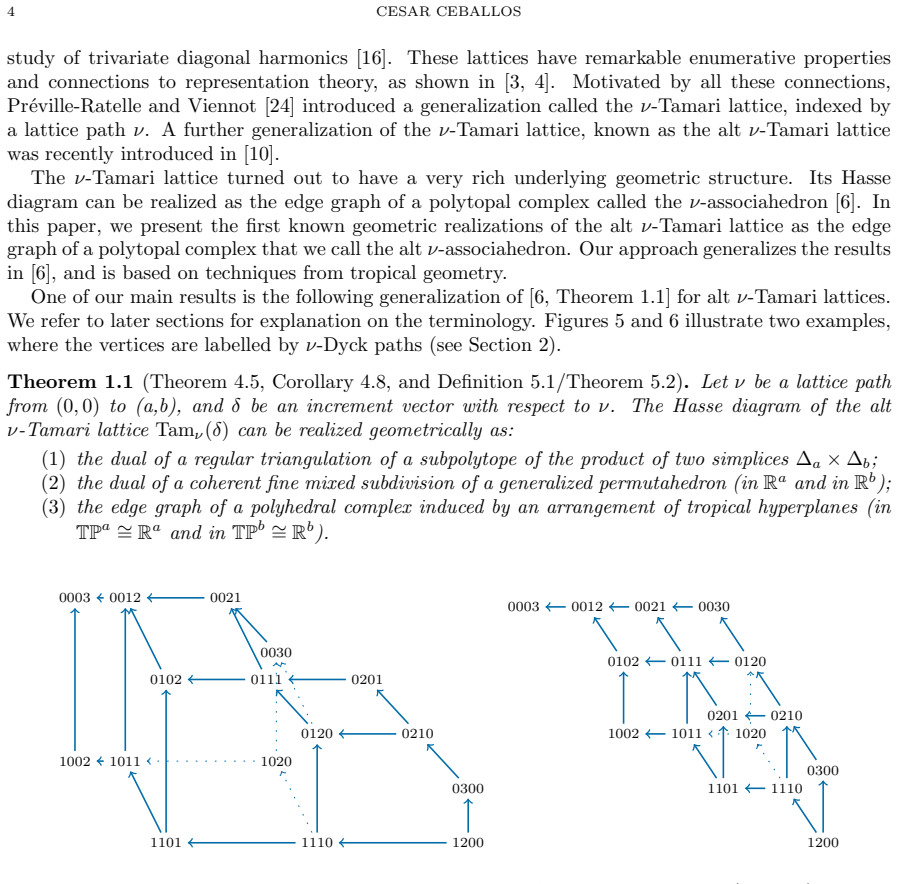
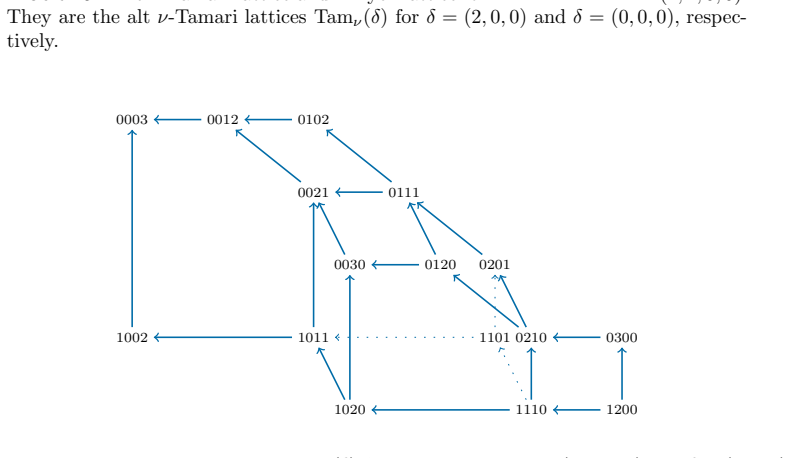
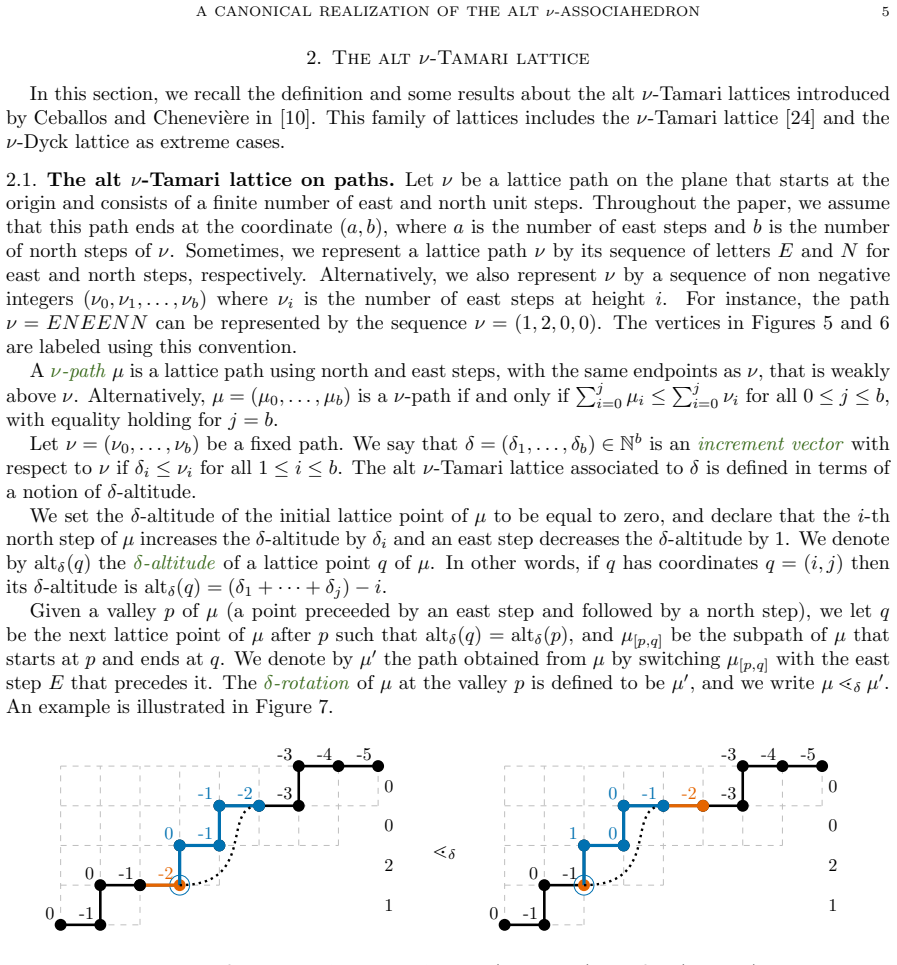
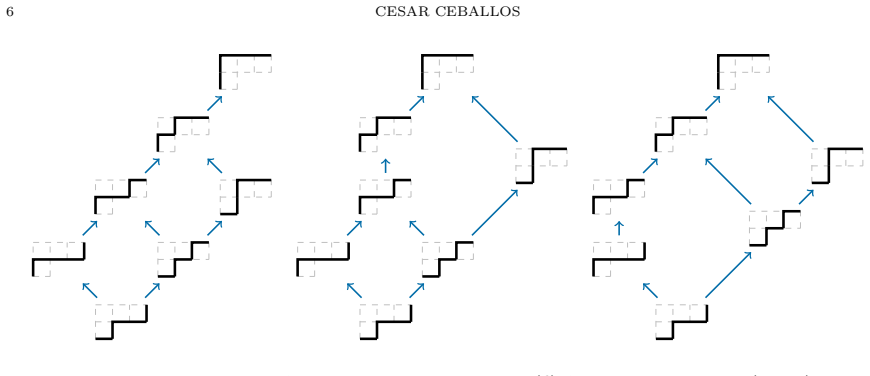
The alt ν-Tamari lattice has its Hasse diagram as the 1-skeleton of a polytopal complex induced by a tropical hyperplane arrangement.
A machine-rendered reading of the paper's core claim, the machinery that carries it, and where it could break.
Core claim
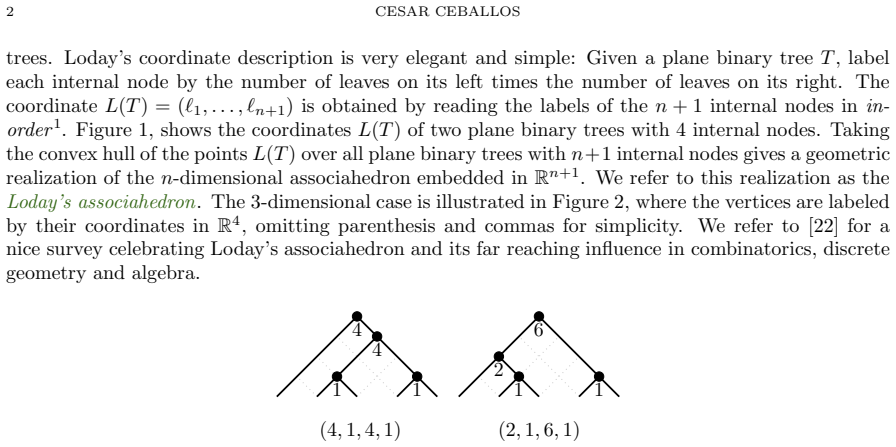
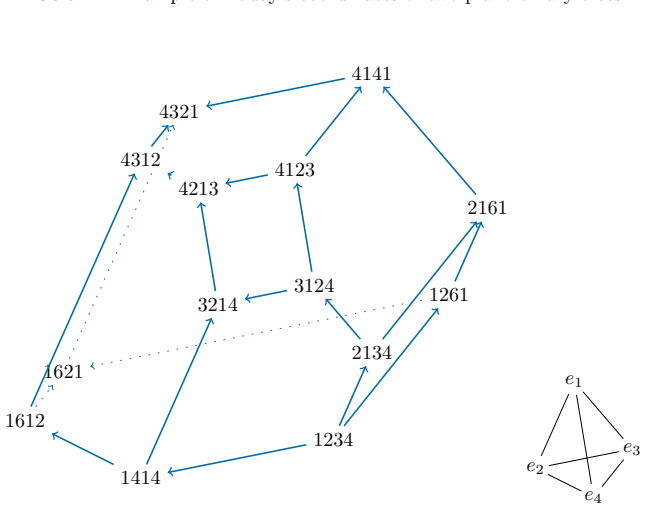
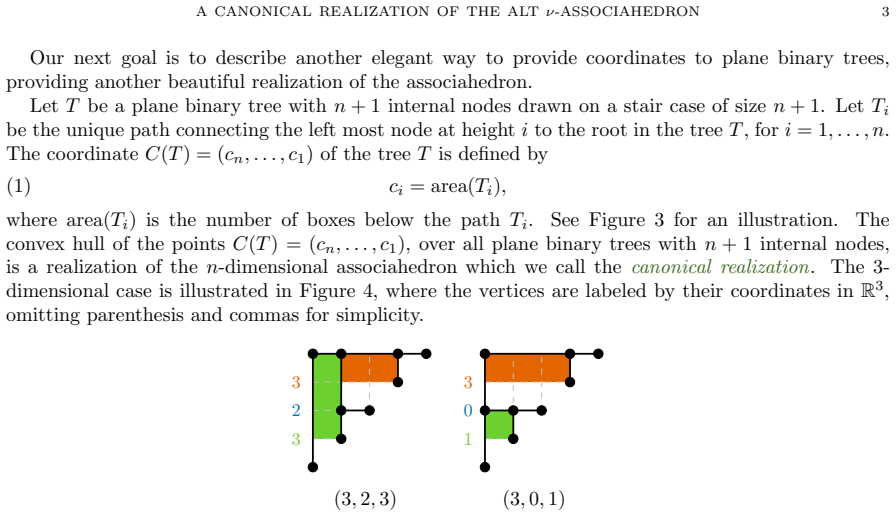
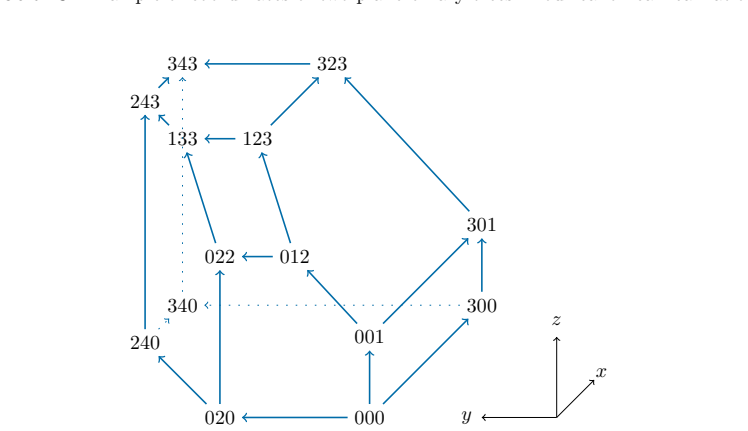
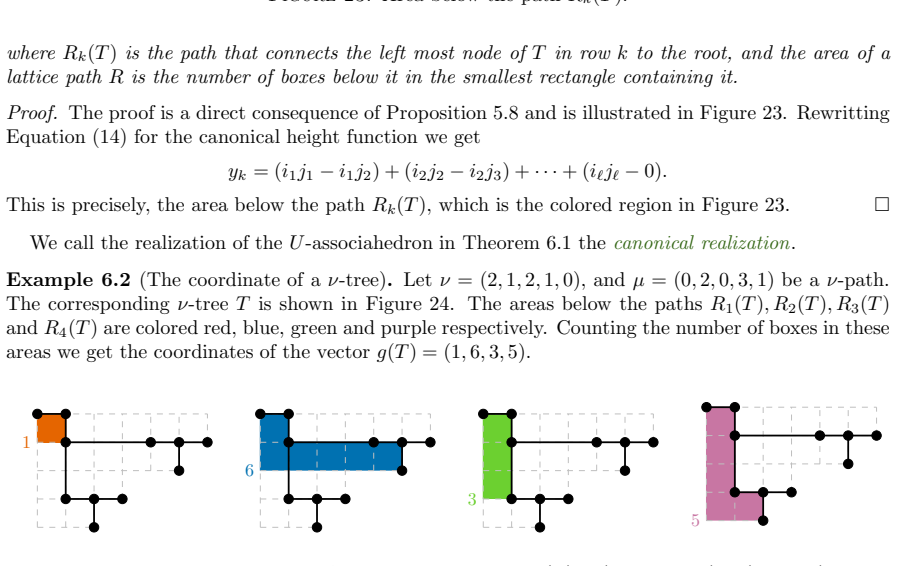
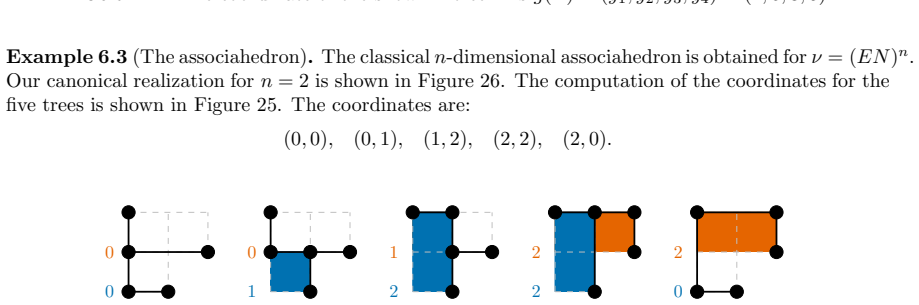
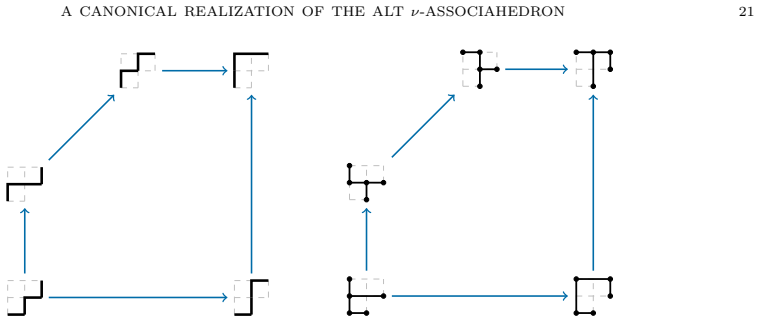
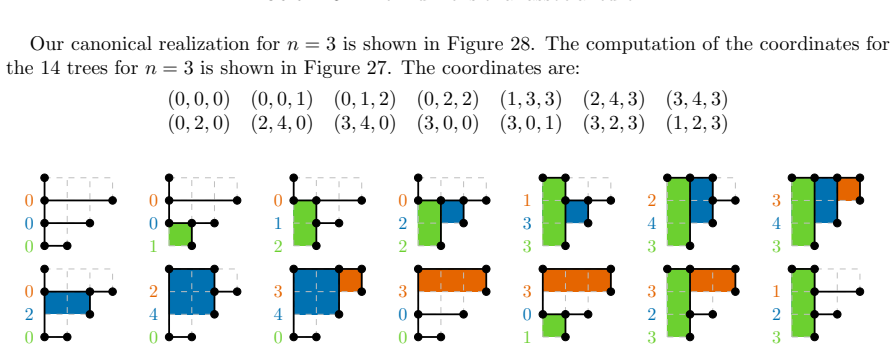
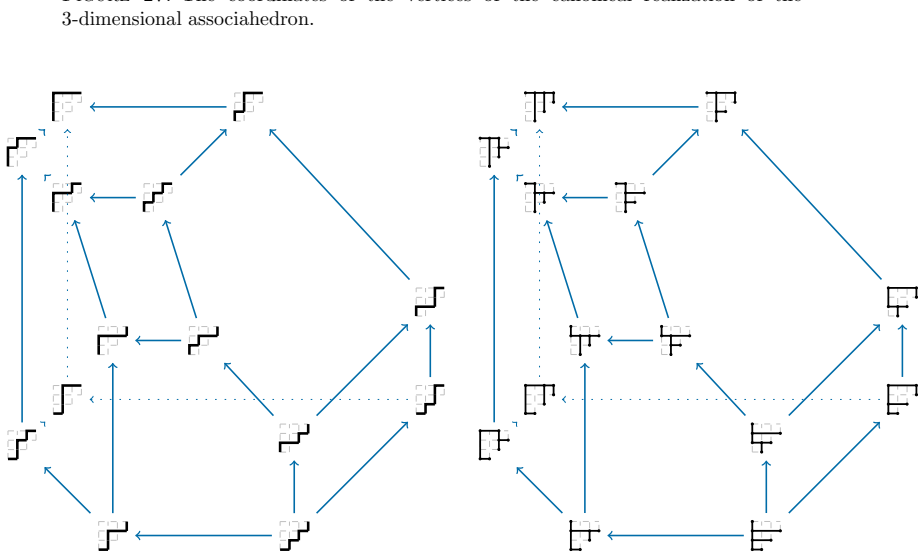
The Hasse diagram of the alt ν-Tamari lattice coincides with the edge graph of the polytopal complex induced by a suitable tropical hyperplane arrangement; this complex is the alt ν-associahedron. Its vertices are the lattice paths above ν, and its canonical realization assigns to each path the vector of areas it subtends with the axes and with ν. When ν is the diagonal path the construction is affinely equivalent to Loday's classic realization of the associahedron.
What carries the argument
The alt ν-associahedron, the polytopal complex whose 1-skeleton is the Hasse diagram of the alt ν-Tamari lattice and whose facets arise from a tropical hyperplane arrangement.
If this is right
- The same tropical arrangement supplies a geometric realization for every alt ν-Tamari lattice and for its special cases including the ν-Tamari and ν-Dyck lattices.
- The canonical area-based coordinates give an explicit embedding that specializes to Loday's coordinates on the classical associahedron.
- Combinatorial properties such as the number of facets or the diameter of the poset can be read from the geometry of the tropical arrangement.
- The construction supplies a uniform polytopal model for a family of posets previously studied only combinatorially.
Where Pith is reading between the lines
- The area-based coordinates may extend to give realizations for other Tamari-like orders defined by different path constraints.
- Because the construction recovers Loday's realization, it offers a bridge between tropical and classical combinatorial realizations of the associahedron.
- One could test whether the same tropical hyperplanes produce higher associahedra or multi-associahedra when the path ν is replaced by a higher-dimensional analog.
Load-bearing premise
The covering relations of the alt ν-Tamari lattice exactly match the edges of the 1-skeleton coming from the tropical hyperplane arrangement.
What would settle it
A single pair of lattice paths above ν whose covering relation in the Tamari order does not correspond to an edge in the tropical complex, or vice versa.
Figures
read the original abstract
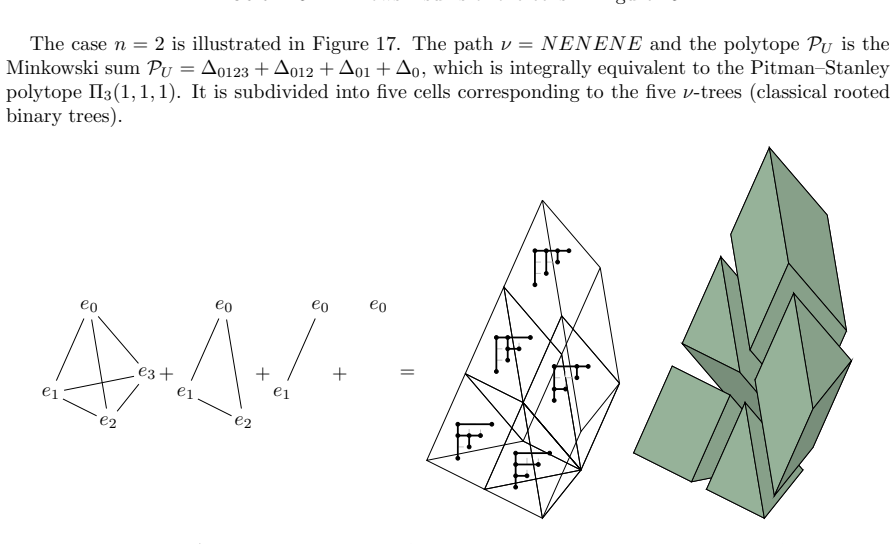
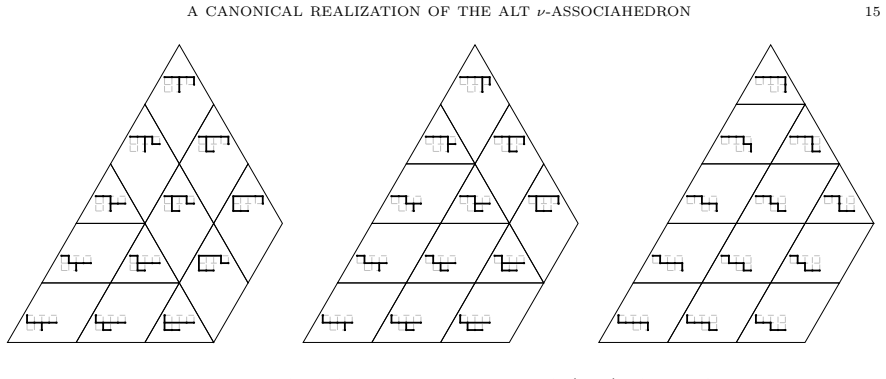
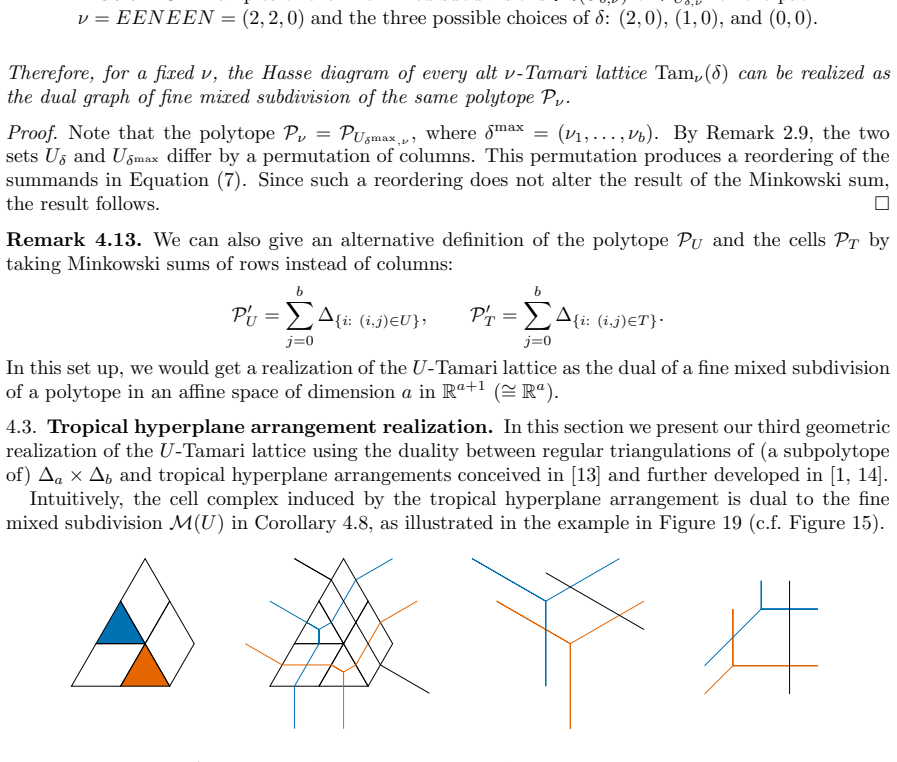
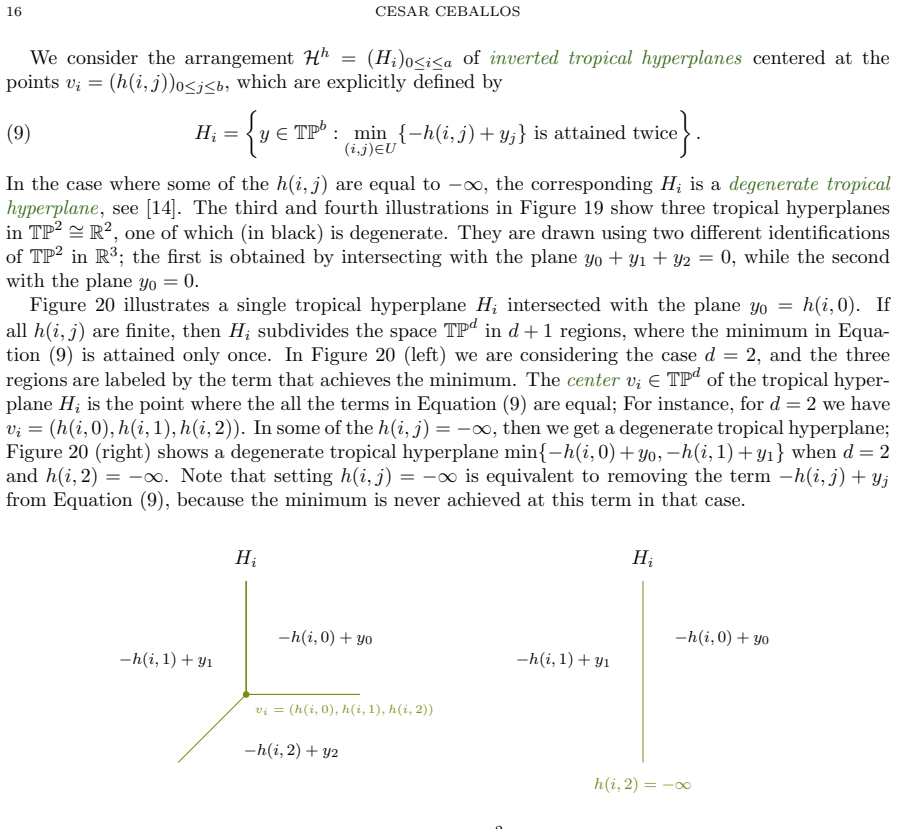
Given a lattice path $\nu$, the alt $\nu$-Tamari lattice is a partial order recently introduced by Ceballos and Chenevi\`ere, which generalizes the $\nu$-Tamari lattice and the $\nu$-Dyck lattice. All these posets are defined on the set of lattice paths that lie weakly above $\nu$, and posses a rich combinatorial structure. In this paper, we study the geometric structure of these posets. We show that their Hasse diagram is the edge graph of a polytopal complex induced by a tropical hyperplane arrangement, which we call the alt $\nu$-associahedron. This generalizes the realization of $\nu$-associahedra by Ceballos, Padrol and Sarmiento. Our approach leads to an elegant construction, in terms of areas below lattice paths, which we call the canonical realization. Surprisingly, in the case of the classical associahedron, our canonical realization magically recovers Loday's ubiquitous realization, via a simple affine transformation.
Editorial analysis
A structured set of objections, weighed in public.
Referee Report
Summary. The paper constructs a canonical realization of the alt ν-associahedron as the polytopal complex induced by a tropical hyperplane arrangement whose coordinates are the areas below lattice paths lying weakly above a fixed path ν. It claims that the 1-skeleton of this complex is exactly the Hasse diagram of the alt ν-Tamari lattice (generalizing the ν-associahedra of Ceballos–Padrol–Sarmiento) and that, for the classical case, the realization is affinely equivalent to Loday’s associahedron.
Significance. If the geometric identification holds, the construction supplies an explicit, area-based tropical model for a family of generalized Tamari posets. The parameter-free character of the area coordinates and the recovery of Loday’s realization are concrete strengths that would make the result useful for further combinatorial and geometric study.
major comments (1)
- [§3] §3 (main theorem on the 1-skeleton): the proof that the edges of the tropical complex coincide exactly with the covering relations of the alt ν-Tamari poset proceeds by showing that each combinatorial cover corresponds to a facet crossing, but does not contain an independent argument that the arrangement introduces no extraneous edges for arbitrary ν; the identification therefore inherits the poset structure from Ceballos–Chenevière rather than re-deriving it from the geometry of the hyperplanes.
minor comments (2)
- Notation for the area coordinates (e.g., the vector a(π)) is introduced without an explicit formula relating it to the standard height or inversion table; a displayed equation would improve readability.
- Figure 2 (classical case) would benefit from an explicit matrix or coordinate list showing the affine map to Loday’s realization.
Simulated Author's Rebuttal
We thank the referee for their careful reading and constructive feedback. We address the single major comment below and will revise the manuscript to strengthen the proof.
read point-by-point responses
-
Referee: [§3] §3 (main theorem on the 1-skeleton): the proof that the edges of the tropical complex coincide exactly with the covering relations of the alt ν-Tamari poset proceeds by showing that each combinatorial cover corresponds to a facet crossing, but does not contain an independent argument that the arrangement introduces no extraneous edges for arbitrary ν; the identification therefore inherits the poset structure from Ceballos–Chenevière rather than re-deriving it from the geometry of the hyperplanes.
Authors: We acknowledge that the argument in Section 3 establishes one direction: every covering relation of the alt ν-Tamari poset corresponds to an edge by crossing exactly one facet. The converse—that the tropical arrangement introduces no extraneous edges—is not given an independent geometric proof and instead relies on the covering relations already established by Ceballos–Chenevière. We agree this is a substantive point. In the revised version we will add a self-contained argument showing that any two vertices joined by an edge in the arrangement differ by a covering relation; this will proceed by examining the area coordinates and proving that a non-covering difference forces the points to be separated by at least two hyperplanes. revision: yes
Circularity Check
No significant circularity; geometric realization is independent of prior combinatorial definitions
full rationale
The paper defines a new geometric model (tropical hyperplane arrangement with canonical area-below-path realization) and claims to show that its 1-skeleton matches the Hasse diagram of the alt ν-Tamari poset. This identification is presented as a derived result rather than an input or self-referential definition. Self-citations to Ceballos-Chenevière (poset) and Ceballos-Padrol-Sarmiento (prior realizations) supply the combinatorial starting point and context for generalization, but do not reduce the current construction or its claimed edge correspondence to a fit, renaming, or unverified self-citation chain. The recovery of Loday's realization via affine transform is an independent verification step. No equations or steps reduce the output to the input by construction.
Axiom & Free-Parameter Ledger
axioms (1)
- domain assumption The alt ν-Tamari lattice is a partial order on the set of lattice paths lying weakly above ν.
Lean theorems connected to this paper
-
IndisputableMonolith/Foundation/RealityFromDistinction.leanreality_from_one_distinction unclear?
unclearRelation between the paper passage and the cited Recognition theorem.
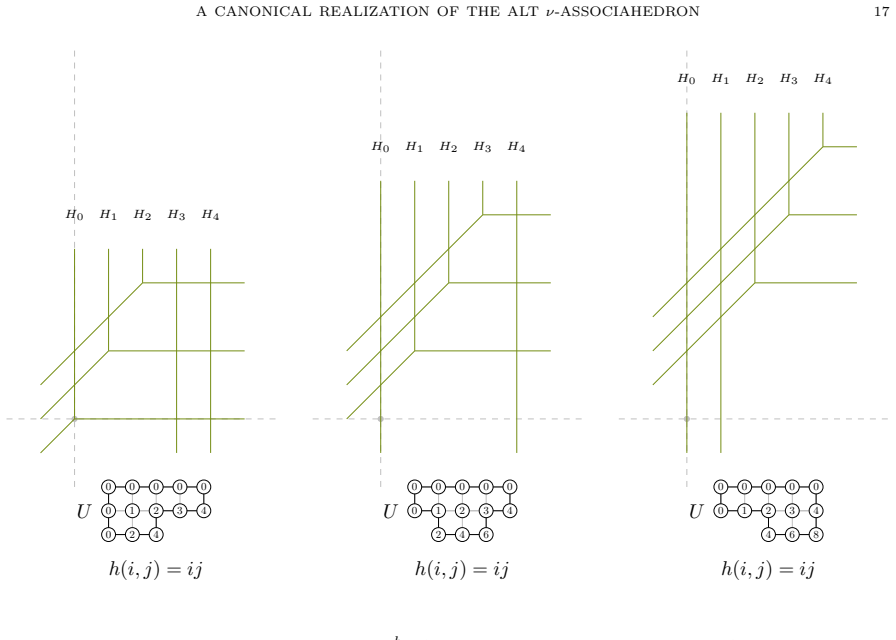
We show that their Hasse diagram is the edge graph of a polytopal complex induced by a tropical hyperplane arrangement... canonical realization... h(i,j)=ij
-
IndisputableMonolith/Cost/FunctionalEquation.leanwashburn_uniqueness_aczel unclear?
unclearRelation between the paper passage and the cited Recognition theorem.
The coordinate C(T)=(cn,...,c1) ... ci=area(Ti)
What do these tags mean?
- matches
- The paper's claim is directly supported by a theorem in the formal canon.
- supports
- The theorem supports part of the paper's argument, but the paper may add assumptions or extra steps.
- extends
- The paper goes beyond the formal theorem; the theorem is a base layer rather than the whole result.
- uses
- The paper appears to rely on the theorem as machinery.
- contradicts
- The paper's claim conflicts with a theorem or certificate in the canon.
- unclear
- Pith found a possible connection, but the passage is too broad, indirect, or ambiguous to say the theorem truly supports the claim.
Forward citations
Cited by 1 Pith paper
-
A combinatorial model for the canonical join complex of alt $\nu$-Tamari lattices
A combinatorial model for the canonical join complex of alt ν-Tamari lattices proves vertex decomposability, shellability, and computes the homology.
Reference graph
Works this paper leans on
-
[1]
Tropical hyperplane a rrangements and oriented matroids
Federico Ardila and Mike Develin. Tropical hyperplane a rrangements and oriented matroids. Math. Z. , 262(4):795– 816, 2009
work page 2009
-
[2]
Higher trivariate diagonal harmonics via generalize d Tamari posets
Fran¸ cois Bergeron and Louis-Fran¸ cois Pr´ eville-Ratelle. Higher trivariate diagonal harmonics via generalize d Tamari posets. J. Comb. , 3(3):317–341, 2012
work page 2012
-
[3]
The representation of the sym- metric group on m-Tamari intervals
Mireille Bousquet-M´ elou, Guillaume Chapuy, and Louis -Fran¸ cois Pr´ eville-Ratelle. The representation of the sym- metric group on m-Tamari intervals. Adv. Math. , 247:309–342, 2013
work page 2013
-
[4]
The number of intervals in the m-Tamari lattices
Mireille Bousquet-M´ elou, ´Eric Fusy, and Louis-Fran¸ cois Pr´ eville-Ratelle. The number of intervals in the m-Tamari lattices. Electron. J. Combin. , 18(2):Paper 31, 26, 2011
work page 2011
-
[5]
Burkard, Bettina Klinz, and R¨ udiger Rudolf
Rainer E. Burkard, Bettina Klinz, and R¨ udiger Rudolf. P erspectives of Monge properties in optimization. Discrete Appl. Math. , 70(2):95–161, 1996
work page 1996
-
[6]
Geo metry of ν-Tamari lattices in types A and B
Cesar Ceballos, Arnau Padrol, and Camilo Sarmiento. Geo metry of ν-Tamari lattices in types A and B. Trans. Amer. Math. Soc. , 371(4):2575–2622, 2019
work page 2019
-
[7]
The ν-Tamari lattice via ν-trees, ν-bracket vectors, and subword complexes
Cesar Ceballos, Arnau Padrol, and Camilo Sarmiento. The ν-Tamari lattice via ν-trees, ν-bracket vectors, and subword complexes. Electron. J. Combin. , 27(1):Paper No. 1.14, 31, 2020
work page 2020
-
[8]
The s-weak order and s-permutahedra
Cesar Ceballos and Viviane Pons. The s-weak order and s-permutahedra. S´ em. Lothar. Combin., 82B:Art. 76, 12, 2020
work page 2020
- [9]
-
[10]
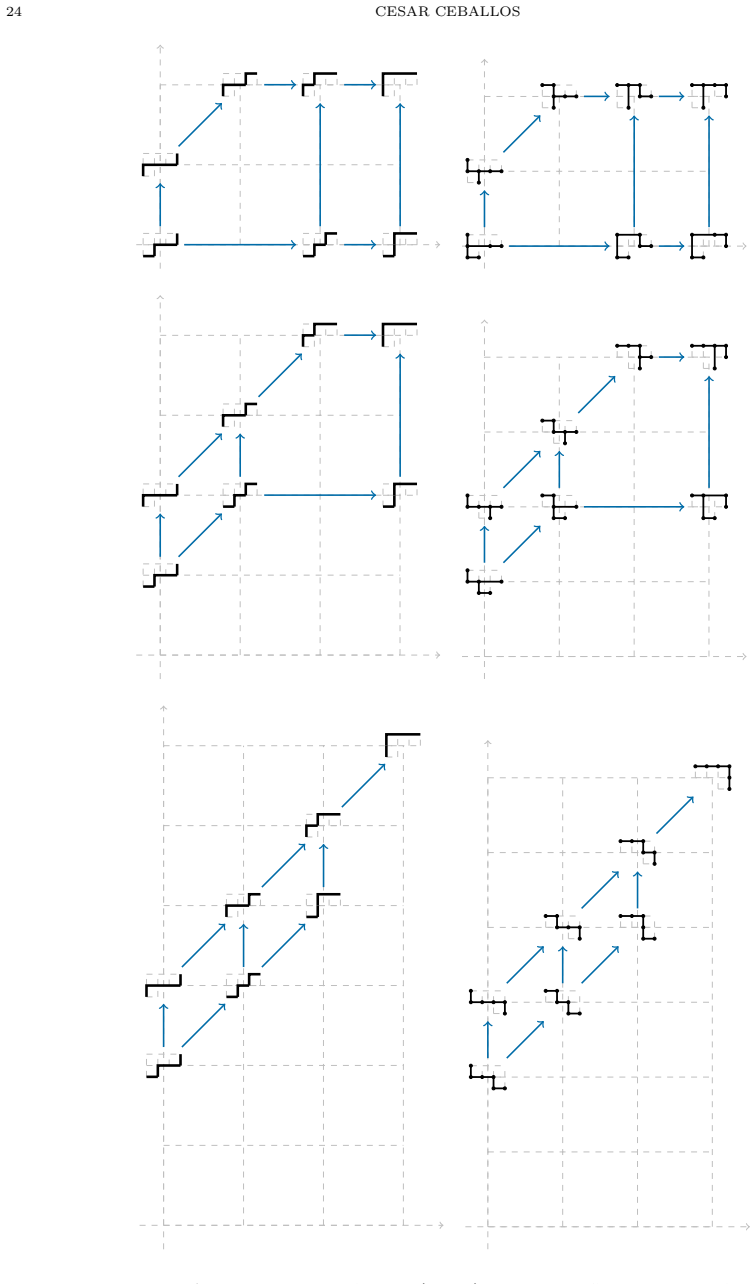
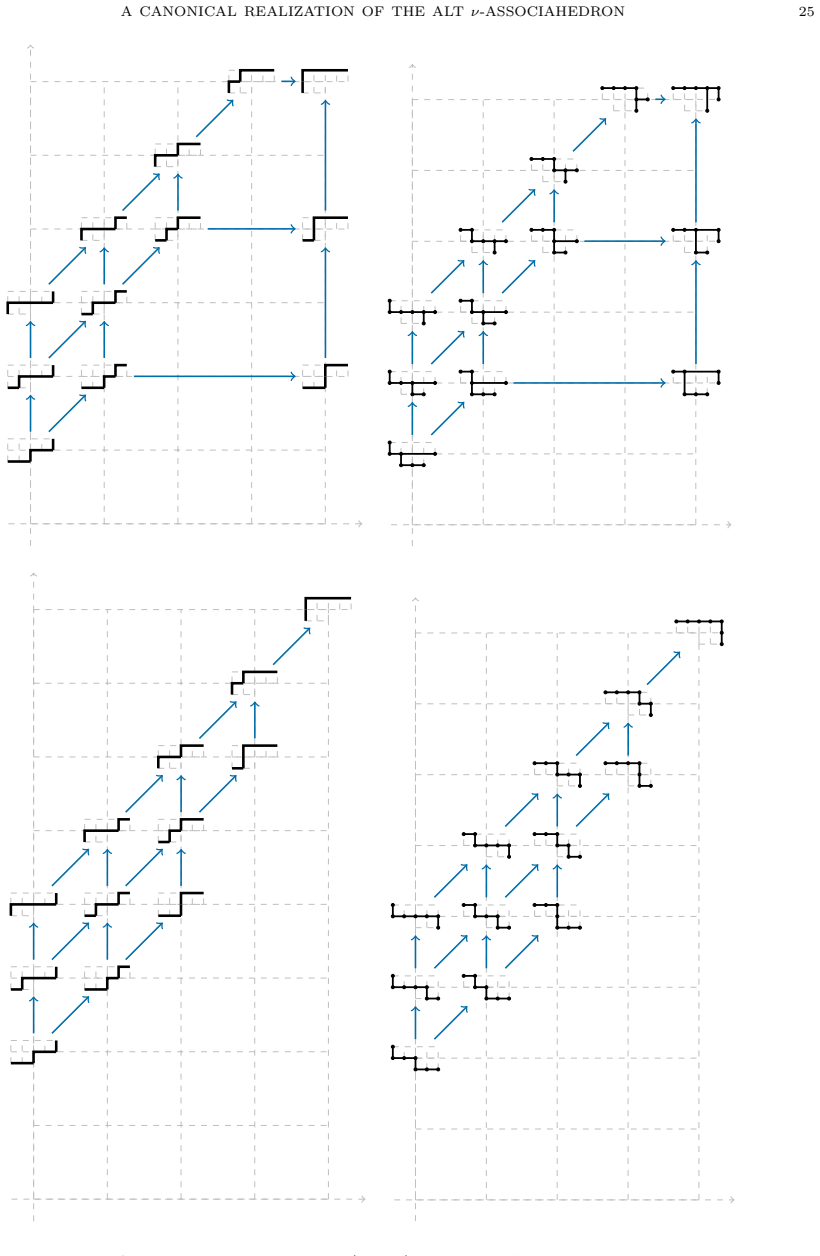
Ceballos. Cesar and Cl´ ement Chenevi` ere. On linear in tervals in the alt ν-tamari lattices. Preprint available at arXiv:2209.00418, May 2023. 24 CESAR CEBALLOS Figure 32. Alt ν associahedra for ν = (1, 2, 0) and three different choices of increment vector δ. The top is δ = (2, 0), the middle is δ = (1, 0), and the bottom is δ = (0, 0). A CANONICAL REALI...
- [11]
-
[12]
Jes´ us A. De Loera, J¨ org Rambau, and Francisco Santos.Triangulations, volume 25 of Algorithms and Computation in Mathematics . Springer-Verlag, Berlin, 2010. Structures for algorithm s and applications
work page 2010
-
[13]
Mike Develin and Bernd Sturmfels. Tropical convexity. Doc. Math. , 9:1–27, 2004
work page 2004
-
[14]
Stiefel tropical linear s paces
Alex Fink and Felipe Rinc´ on. Stiefel tropical linear s paces. J. Combin. Theory Ser. A , 135:291–331, 2015
work page 2015
-
[15]
Constructing the associahedron
Mark Haiman. Constructing the associahedron. Unpubli shed manuscript, MIT 1984, 11 pages, http://math.berkeley.edu/∼haiman/ftp/assoc/manuscript.pdf
work page 1984
-
[16]
Mark D. Haiman. Conjectures on the quotient ring by diag onal invariants. J. Algebraic Combin. , 3(1):17–76, 1994
work page 1994
-
[17]
The Cayley trick, lifting subdivisions and the Bohne-Dress theorem on zonotopal tilings
Birkett Huber, J¨ org Rambau, and Francisco Santos. The Cayley trick, lifting subdivisions and the Bohne-Dress theorem on zonotopal tilings. J. Eur. Math. Soc. (JEMS) , 2(2):179–198, 2000
work page 2000
-
[18]
Generalized triangulations and diagon al-free subsets of stack polyominoes
Jakob Jonsson. Generalized triangulations and diagon al-free subsets of stack polyominoes. J. Combin. Theory Ser. A, 112(1):117–142, 2005
work page 2005
-
[19]
Carl W. Lee. The associahedron and triangulations of th e n-gon. European J. Combin. , 10(6):551–560, 1989
work page 1989
-
[20]
Realization of the Stasheff polytope
Jean-Louis Loday. Realization of the Stasheff polytope . Arch. Math. (Basel) , 83(3):267–278, 2004
work page 2004
-
[21]
Associahedra, Tamari lattices and related structures, volume 299 of Progress in Mathematics
Folkert M¨ uller-Hoissen, Jean Marcel Pallo, and Jim St asheff, editors. Associahedra, Tamari lattices and related structures, volume 299 of Progress in Mathematics . Birkh¨ auser/Springer, Basel, 2012. Tamari memorial Festschrift
work page 2012
- [22]
-
[23]
Permutohedra, associahedra, an d beyond
Alexander Postnikov. Permutohedra, associahedra, an d beyond. Int. Math. Res. Not. IMRN , (6):1026–1106, 2009
work page 2009
-
[24]
The enumeration of generalized Tamari intervals
Louis-Fran¸ cois Pr´ eville-Ratelle and Xavier Viennot. The enumeration of generalized Tamari intervals. Trans. Amer. Math. Soc. , 369(7):5219–5239, 2017
work page 2017
-
[25]
The Cayley trick and triangulations of products of simplices
Francisco Santos. The Cayley trick and triangulations of products of simplices. In Integer points in polyhedra— geometry, number theory, algebra, optimization , volume 374 of Contemp. Math. , pages 151–177. Amer. Math. Soc., Providence, RI, 2005
work page 2005
-
[26]
Quantum groups , volume II of Graduate Texts in Mathematical Physics
Steven Shnider and Shlomo Sternberg. Quantum groups , volume II of Graduate Texts in Mathematical Physics . International Press, Cambridge, MA, 1993. From coalgebras to Drinfel’d algebras, A guided tour
work page 1993
-
[27]
Richard P. Stanley and Jim Pitman. A polytope related to empirical distributions, plane trees, parking functions, and the associahedron. Discrete Comput. Geom. , 27(4):603–634, 2002. TU Graz, Institut f ¨ur Geometrie, Kopernikusgasse 24, 8010 Graz, Austria. Email address : cesar.ceballos@tugraz.at
work page 2002
discussion (0)
Sign in with ORCID, Apple, or X to comment. Anyone can read and Pith papers without signing in.