The PICNN-Assisted Physics-Preserving Scheme for Thermodynamically Consistent Two-Phase Flow in Porous Media
Pith reviewed 2026-07-02 05:24 UTC · model grok-4.3
The pith
A PICNN trained on finite-volume residuals with TPFA replaces the traditional prediction solver while preserving energy stability, mass conservation, and bounds in two-phase porous-media flow.
A machine-rendered reading of the paper's core claim, the machinery that carries it, and where it could break.
Core claim
A PICNN trained solely on finite-volume residuals with TPFA produces predictions whose post-processed outputs remain energy-stable, mass-conservative, and bounds-preserving for the target thermodynamically consistent model, allowing the network to replace the traditional prediction solver within the physics-preserving prediction-correction scheme.
What carries the argument
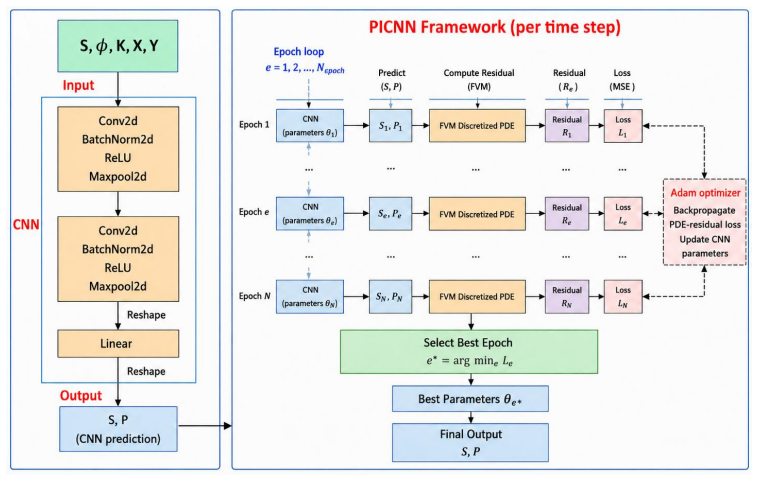
PICNN trained on finite-volume residuals with TPFA interfacial fluxes, followed by post-processing correction to enforce physical constraints.
If this is right
- The PICNN captures local spatial interactions between each control volume and its neighbors more directly than conventional PINNs.
- The finite-volume residual training accommodates discontinuous permeability fields and enforces interfacial flux continuity.
- The overall scheme maintains the thermodynamic consistency of the underlying two-phase model after the correction step.
- Numerical results confirm that the network can substitute for the conventional prediction solver without loss of the preserved properties.
Where Pith is reading between the lines
- The approach may reduce computational cost for repeated solves over similar geometries once the network is trained.
- It could be tested on time-dependent problems or heterogeneous media with sharp contrasts to check robustness beyond the reported cases.
- The same residual-based training idea might transfer to other finite-volume based multiphase models that already use prediction-correction structures.
Load-bearing premise
Training the PICNN only on finite-volume residuals computed with TPFA is enough to guarantee that post-processed predictions stay energy-stable, mass-conservative, and bounds-preserving for the target model on the permeability fields examined.
What would settle it
Run the trained PICNN on a permeability field or boundary condition outside the training distribution and check whether any post-processed solution violates energy stability or mass conservation.
Figures
read the original abstract
In this paper, we develop a physics-informed convolutional neural network (PICNN) assisted physics-preserving method for a thermodynamically consistent model of incompressible and immiscible two-phase flow in porous media. Following the physics-preserving prediction-correction scheme of Li et al. \cite{li2025class}, the prediction step is performed by a PICNN trained with finite-volume residuals, where the interfacial fluxes are evaluated by the two-point flux approximation (TPFA) using two-point difference quotients of neighboring cell-centered unknowns to approximate interfacial normal gradients. The PICNN output is further corrected by a post-processing procedure to obtain energy-stable, mass-conservative, and bounds-preserving solutions. Numerical results show that the finite-volume residuals trained PICNN can replace the traditional prediction solver within the physics-preserving framework. Compared with conventional physics-informed neural networks (PINNs), the PICNN better captures local spatial interactions between each control volume and its neighboring cells, while the finite-volume residuals accommodate discontinuous permeability fields and interfacial flux continuity.
Editorial analysis
A structured set of objections, weighed in public.
Referee Report
Summary. The manuscript develops a physics-informed convolutional neural network (PICNN) assisted physics-preserving prediction-correction scheme for a thermodynamically consistent model of incompressible immiscible two-phase flow in porous media. Following Li et al., the prediction step uses a PICNN trained solely on finite-volume residuals with TPFA two-point quotients; the output is then corrected by post-processing to enforce energy stability, mass conservation, and bounds preservation. The central claim is that numerical results demonstrate the PICNN can replace the traditional prediction solver, with advantages in capturing local cell interactions and handling discontinuous permeability.
Significance. If the replacement claim is substantiated with quantitative evidence, the work could enable faster, structure-preserving simulations of two-phase porous-media flows by combining convolutional architectures with an existing physics-preserving framework. The explicit use of TPFA residuals to accommodate discontinuous coefficients is a constructive choice relative to standard PINNs.
major comments (2)
- [Abstract] Abstract: the load-bearing claim that 'Numerical results show that the finite-volume residuals trained PICNN can replace the traditional prediction solver' is unsupported by any reported quantitative metrics (error norms, mass-conservation residuals, bound-violation frequencies, mesh sizes, or direct comparisons against the traditional solver), leaving the success of post-processing across permeability fields unverified.
- [Methods (PICNN architecture and loss)] PICNN training description: the loss is defined exclusively by matching finite-volume residuals (TPFA two-point quotients) without embedding thermodynamic consistency or bound constraints; consequently the assertion that raw PICNN outputs remain sufficiently close to the admissible set for post-processing to succeed without material alteration (the weakest assumption in the replacement claim) requires explicit verification, e.g., statistics on correction magnitudes or failure rates over the tested fields.
minor comments (1)
- [Abstract] The reference to Li et al. (2025) should be expanded to a full bibliographic entry.
Simulated Author's Rebuttal
We thank the referee for the careful reading and constructive comments on our manuscript. We agree that the replacement claim requires stronger quantitative support and will revise the manuscript to include the requested metrics and statistics. Point-by-point responses follow.
read point-by-point responses
-
Referee: [Abstract] Abstract: the load-bearing claim that 'Numerical results show that the finite-volume residuals trained PICNN can replace the traditional prediction solver' is unsupported by any reported quantitative metrics (error norms, mass-conservation residuals, bound-violation frequencies, mesh sizes, or direct comparisons against the traditional solver), leaving the success of post-processing across permeability fields unverified.
Authors: We agree that explicit quantitative metrics are needed to substantiate the claim. In the revised manuscript we will add a new table (and corresponding discussion in Section 4) reporting L2 error norms relative to the traditional solver, mass-conservation residuals, bound-violation frequencies before and after correction, mesh sizes used, and direct side-by-side comparisons across the tested permeability fields. These additions will verify the success of the post-processing step. revision: yes
-
Referee: [Methods (PICNN architecture and loss)] PICNN training description: the loss is defined exclusively by matching finite-volume residuals (TPFA two-point quotients) without embedding thermodynamic consistency or bound constraints; consequently the assertion that raw PICNN outputs remain sufficiently close to the admissible set for post-processing to succeed without material alteration (the weakest assumption in the replacement claim) requires explicit verification, e.g., statistics on correction magnitudes or failure rates over the tested fields.
Authors: The training loss is deliberately restricted to finite-volume residuals so that the PICNN learns the local TPFA flux structure; thermodynamic consistency and bounds are enforced exclusively by the subsequent post-processing step of Li et al. To address the concern we will include, in the revised Section 3.3 and a new supplementary table, statistics on the magnitude of the corrections (e.g., maximum and mean changes in saturation and pressure) and any failure rates of the post-processing step across all tested permeability realizations. These data will quantify how close the raw PICNN outputs remain to the admissible set. revision: yes
Circularity Check
No significant circularity; empirical surrogate claim is self-contained
full rationale
The paper proposes training a PICNN on finite-volume residuals (using TPFA) to serve as a surrogate for the prediction step inside the existing Li et al. physics-preserving prediction-correction framework, followed by post-processing to enforce stability, conservation, and bounds. The central assertion is an empirical one: numerical experiments demonstrate that this replacement is feasible. No derivation chain is presented that reduces a claimed result to its own fitted inputs by construction, nor are there self-definitional equations, load-bearing self-citations from the same authors, uniqueness theorems imported from prior work, or ansatzes smuggled via citation. The training objective (residual matching) and the post-processing correction are distinct steps; the former approximates the discrete system while the latter supplies the thermodynamic constraints. This is standard surrogate modeling and does not meet the criteria for circularity.
Axiom & Free-Parameter Ledger
free parameters (1)
- PICNN network weights and hyperparameters
axioms (2)
- domain assumption The prediction-correction scheme of Li et al. 2025 produces energy-stable, mass-conservative, bounds-preserving solutions when the predictor is sufficiently accurate.
- domain assumption Two-point flux approximation using neighboring cell-centered unknowns adequately approximates interfacial normal gradients for the target model.
Reference graph
Works this paper leans on
-
[1]
and Hassanizadeh, S
Joekar-Niasar, V. and Hassanizadeh, S. M. , title =. Critical Reviews in Environmental Science and Technology , volume =
-
[2]
Advances in Water Resources , volume =
Reichenberger, Volker and Jakobs, Hartmut and Bastian, Peter and Helmig, Rainer , title =. Advances in Water Resources , volume =
-
[3]
Journal of Computational Physics , volume =
Tomin, Pavel and Lunati, Ivan , title =. Journal of Computational Physics , volume =
-
[4]
and Pruess, Karsten and Lippmann, Marcelo J
O'Sullivan, Michael J. and Pruess, Karsten and Lippmann, Marcelo J. , title =. Geothermics , volume =. 2001 , doi =
2001
-
[5]
and Nordbotten, Jan M
Class, Holger and Ebigbo, Anozie and Helmig, Rainer and Dahle, Helge K. and Nordbotten, Jan M. and Celia, Michael A. and Audigane, Pascal and Darcis, Melanie and Ennis-King, Jonathan and Fan, Yaqing and Flemisch, Bernd and Gasda, Sarah E. and Jin, Maoxin and Krug, Stefanie and Labregere, Diane and Naderi Beni, Ali and Pawar, Rajesh J. and Sbai, Adil and T...
2009
-
[6]
Computer Methods in Applied Mechanics and Engineering , volume =
Chen, Huangxin and Kou, Jisheng and Sun, Shuyu and Zhang, Tao , title =. Computer Methods in Applied Mechanics and Engineering , volume =
-
[7]
Journal of Computational and Applied Mathematics , volume =
Chen, Huangxin and Sun, Shuyu , title =. Journal of Computational and Applied Mathematics , volume =
-
[8]
Journal of Scientific Computing , volume =
Wang, Yiran and Chung, Eric and Sun, Shuyu , title =. Journal of Scientific Computing , volume =
-
[9]
Oil & Gas Science and Technology -- Revue d'IFP Energies nouvelles , volume =
Gao, Huicai and Kou, Jisheng and Sun, Shuyu and Wang, Xiuhua , title =. Oil & Gas Science and Technology -- Revue d'IFP Energies nouvelles , volume =
-
[10]
Mathematical Models and Methods in Applied Sciences , volume =
Yang, Xiaofeng and Zhao, Jie and Wang, Qi and Shen, Jie , title =. Mathematical Models and Methods in Applied Sciences , volume =
-
[11]
Journal of Computational Physics , volume =
Kou, Jisheng and Wang, Xiuhua and Du, Shigui and Sun, Shuyu , title =. Journal of Computational Physics , volume =
-
[12]
International Journal for Numerical Methods in Engineering , volume =
Kou, Jisheng and Wang, Xiuhua and Chen, Huangxin and Sun, Shuyu , title =. International Journal for Numerical Methods in Engineering , volume =
-
[13]
Journal of Computational Physics , volume =
Shen, Jie and Xu, Jie and Yang, Jiang , title =. Journal of Computational Physics , volume =
-
[14]
SIAM Journal on Scientific Computing , volume =
Huang, Fukeng and Shen, Jie and Yang, Zhiguo , title =. SIAM Journal on Scientific Computing , volume =
-
[15]
Journal of Computational and Applied Mathematics , volume =
Cheng, Qing and Liu, Chun and Shen, Jie , title =. Journal of Computational and Applied Mathematics , volume =
-
[16]
Journal of Computational Physics , volume =
Li, Xiaoli and Yan, Yujing and Chen, Huangxin , title =. Journal of Computational Physics , volume =
-
[17]
Journal of Computational Physics , volume =
Zhang, Xiangxiong and Shu, Chi-Wang , title =. Journal of Computational Physics , volume =
-
[18]
SIAM Journal on Numerical Analysis , volume =
Cheng, Qing and Shen, Jie , title =. SIAM Journal on Numerical Analysis , volume =
-
[19]
Nature , volume =
LeCun, Yann and Bengio, Yoshua and Hinton, Geoffrey , title =. Nature , volume =
-
[20]
Goodfellow, Ian and Bengio, Yoshua and Courville, Aaron , title =
-
[21]
Journal of Computational Physics , volume =
Sirignano, Justin and Spiliopoulos, Konstantinos , title =. Journal of Computational Physics , volume =
-
[22]
Communications in Mathematics and Statistics , volume =
E, Weinan and Han, Jiequn and Jentzen, Arnulf , title =. Communications in Mathematics and Statistics , volume =
-
[23]
Journal of Computational Physics , volume =
Raissi, Maziar and Perdikaris, Paris and Karniadakis, George Em , title =. Journal of Computational Physics , volume =
-
[24]
and Lu, Lu and Perdikaris, Paris and Wang, Sifan and Yang, Liu , title =
Karniadakis, George Em and Kevrekidis, Ioannis G. and Lu, Lu and Perdikaris, Paris and Wang, Sifan and Yang, Liu , title =. Nature Reviews Physics , volume =
-
[25]
Journal of Computational Physics , volume =
Zhu, Yinhao and Zabaras, Nicholas , title =. Journal of Computational Physics , volume =
-
[26]
Water Resources Research , volume =
Mo, Shaoxing and Zabaras, Nicholas and Shi, Xiaoqing and Wu, Jichun , title =. Water Resources Research , volume =
-
[27]
and Anandkumar, Anima , title =
Li, Zongyi and Kovachki, Nikola and Azizzadenesheli, Kamyar and Liu, Burigede and Bhattacharya, Kaushik and Stuart, Andrew M. and Anandkumar, Anima , title =. International Conference on Learning Representations , year =
-
[28]
, title =
Chen, Jungang and Gildin, Eduardo and Killough, John E. , title =. Mathematics , volume =
-
[29]
Journal of Computational Physics , volume =
Zhang, Zhao and Yan, Xia and Liu, Piyang and Zhang, Kai and Han, Renmin and Wang, Sheng , title =. Journal of Computational Physics , volume =
-
[30]
Neural Networks , volume =
Guo, Yuan and Fu, Zhuojia and Min, Jian and Lin, Shiyu and Liu, Xiaoting and Zhuang, Xiaoying , title =. Neural Networks , volume =. 2025 , doi =
2025
-
[31]
Acta Numerica , volume =
De Ryck, Tim and Lanthaler, Samuel and Mishra, Siddhartha , title =. Acta Numerica , volume =. 2024 , doi =
2024
-
[32]
Computer Methods in Applied Mechanics and Engineering , volume =
Luo, Kai and others , title =. Computer Methods in Applied Mechanics and Engineering , volume =. 2025 , doi =
2025
-
[33]
Chen, X. X. and Zhang, P. and Yin, Z. Y. , title =. Georisk: Assessment and Management of Risk for Engineered Systems and Geohazards , volume =. 2024 , doi =
2024
-
[34]
Transport in Porous Media , volume =
ML-LBM: predicting and accelerating steady state flow simulation in porous media with convolutional neural networks , author =. Transport in Porous Media , volume =. 2021 , doi =
2021
-
[35]
1997 , doi =
Helmig, Rainer , title =. 1997 , doi =
1997
-
[36]
2006 , doi =
Chen, Zhangxin and Huan, Guanren and Ma, Yuanle , title =. 2006 , doi =
2006
-
[37]
Handbook of Numerical Analysis , volume =
Eymard, Robert and Gallouet, Thierry and Herbin, Raphaele , title =. Handbook of Numerical Analysis , volume =. 2000 , doi =
2000
-
[38]
Mathematical Models and Methods in Applied Sciences , volume =
Abels, Helmut and Garcke, Harald and Grun, Gunther , title =. Mathematical Models and Methods in Applied Sciences , volume =. 2012 , doi =
2012
-
[39]
and Kalliadasis, Serafim and Perez, Sergio P
Bailo, Rafael and Carrillo, Jose A. and Kalliadasis, Serafim and Perez, Sergio P. , title =. Communications in Computational Physics , volume =. 2023 , doi =
2023
-
[40]
and Ba, Jimmy , title =
Kingma, Diederik P. and Ba, Jimmy , title =. International Conference on Learning Representations , year =
discussion (0)
Sign in with ORCID, Apple, or X to comment. Anyone can read and Pith papers without signing in.