REVIEW 4 major objections 6 minor 15 references
Organic liquid scintillator neutrino detector experiment, theoretical modeling, and computational simulation
T0 review · 4 major / 6 minor · reviewed 2026-08-11 · deepseek-v4-flash
Pith's one-line read The paper claims that a FLUKA simulation chain reproduces the LSND liquid-scintillator detector's neutrino and neutron-capture response, and that this validates the experiment's sensitivity and limitations.
desk verdict A review-style compilation with a validation claim that is asserted rather than demonstrated; no quantitative comparison to LSND data appears anywhere. read the letter →
The pith
A machine-rendered reading of the paper's core claim, the machinery that carries it, and where it could break.
The reading
What carries the argument
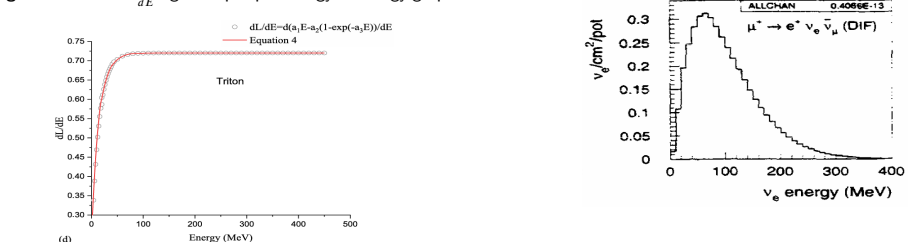
The load-bearing object is the FLUKA Monte Carlo simulation of particle transport in the scintillator, driven by three interlocking inputs: the neutrino flux from pion and muon decay at rest and in flight, the pion-production cross-section parameterization fitted to 585 and 730 MeV proton data and interpolated to the 800 MeV beam, and the Birks'-law light-yield relation $\frac{dL}{dE}=S\left(1+K B\,\frac{dE}{dx}+C\left(\frac{dE}{dx}\right)^2\right)^{-1}$ implemented through the TCQUENCH card. The EVENTBIN card scores energy deposited by electrons and positrons, and the output is expressed as a detector response function in counts per MeVee per unit neutron fluence, with the 2.2 MeV hydrogen-capture gamma serving as the delayed tag.
What would settle it
Compare the simulated positron energy spectrum and the delayed 2.2 MeV neutron-capture coincidence rate against the published LSND beam-on/beam-off data set; a mismatch beyond the quoted uncertainties would falsify the claimed validation. Independently, measure pion-production double-differential cross sections for 800 MeV protons on the inconel/water target and test them against the linearly interpolated parameterization.
Extended reading notes
Core claim
On its own terms, the paper claims that a FLUKA-based simulation chain reproduces the LSND detector's response to the reactions $\overline{\nu}_e + p \to e^+ + n$, $\nu_e + p \to e^- + n$, and the subsequent capture $n + p \to d + \gamma$. The chain maps each deposited energy to a predicted light output through the Birks quenching law, uses the EVENTBIN and TCQUENCH cards to score $e^\pm$ energy deposition and scintillation light, and normalizes the result as a response function in counts per MeVee per unit neutron fluence. From the simulated light-yield curves and flux calculations, the authors conclude that the framework validated the experimental observations and supplied insight into the detector's sensitivity and limitations, reinforcing the LSND hint of oscillation and sterile-neutrino physics.
Load-bearing premise
The whole simulation depends on the assumed numbers for how many pions an 800 MeV proton beam makes when it hits the inconel-and-water target; those numbers come from fitting data at 585 and 730 MeV and stretching the fit up to 800 MeV, and the paper notes the fit misses the data at some angles.
Editorial extensions
If this is right
- Future organic liquid scintillator detectors can use the same FLUKA chain to predict their electron-equivalent energy scale, positron detection efficiency, and neutron-capture tagging rate before construction.
- The separation of decay-at-rest and decay-in-flight fluxes gives a quantitative handle on the energy window in which a muon-to-electron antineutrino oscillation signal would appear above conventional backgrounds.
- The simulated response function, normalized per unit neutron fluence, allows the sensitivity of different scintillators to be compared independently of beam intensity.
- Modeling the delayed 2.2 MeV gamma from $n+p\to d+\gamma$ provides a template for coincidence-tagging backgrounds in short-baseline neutrino experiments.
- The parameterized pion-production cross sections can be reused as a source term for other beam-stop neutrino flux calculations at proton energies up to 800 MeV.
Reading between the lines
- The validation claim is asserted qualitatively; the text does not overlay simulated and measured spectra, so a quantitative comparison to the LSND data would be the natural next test.
- The framework models hydrogen capture as the delayed tag; replacing it with the multi-gamma cascade from gadolinium capture would extend the same chain to the metal-loaded detectors the paper motivates.
- The pion-production interpolation could be checked against direct measurements at 800 MeV, which would test the neutrino-flux normalization independently of any oscillation result.
Editorial analysis
A structured set of objections, weighed in public.
Referee Report
Summary. The paper presents a review-style account of the liquid scintillator neutrino detector (LSND) experiment and claims to develop a FLUKA-based theoretical modeling and simulation framework for it. The stated goal is to validate LSND's experimental observations by simulating inverse beta decay, neutron capture, scintillation light output with Birks' law quenching, decay-at-rest and decay-in-flight neutrino fluxes, and pion production cross-sections. The abstract and conclusion assert that this framework validated the experimental results and provided insights into the detector's sensitivity and limitations. No quantitative comparison between any simulation output and LSND data is shown anywhere in the manuscript.
Significance. If the claims were substantiated, a validated FLUKA model of the LSND detector response could be a useful reference for organic liquid scintillator simulations. The paper, however, contains no reproducible simulation results, no error analysis, and no comparison to measured data. The theoretical sections (PMNS matrix, weak interactions, Birks' law, scintillation chemistry) are standard textbook material, and the only apparently original quantitative content, the pion production parameterization, is directly adapted from the cited work of Burman and Smith. Because the central validation claim is asserted rather than demonstrated, the manuscript does not meet the standard for an original research contribution in detector physics.
major comments (4)
- [Abstract; Sec. 6] The central claim that the theoretical modeling and simulation framework "validated the experimental observations" is unsupported. The text provides no quantitative comparison between any FLUKA output (positron/electron light-yield spectra, neutron capture time distribution, or detector response function) and published LSND data. Fig. 12 shows a simulated response function without experimental overlays or residuals, and Sec. 5.1 describes the response function only qualitatively. Without such a comparison, the paper's headline conclusion in Sec. 6 cannot be evaluated, let alone accepted.
- [Sec. 5.2, Eq. for dL/dE] The light-yield equations are internally inconsistent and dimensionally wrong. Birks' law is correctly written as dL/dx = S (dE/dx)/(1 + KB dE/dx). The subsequent expression dL/dE = S [1 + KB (dE/dx) + C (dE/dx)^2]^{-1} does not follow from the first: dividing by dE/dx would give dL/dE = S/(1 + KB dE/dx). The extra quadratic quenching term C, the missing dE/dx factor, and the later exponential variant in the same section make the formula not implementable as written. Since scintillation light output is the core simulated observable, this is a load-bearing technical error.
- [Sec. 5.4] The pion production parameterization is used outside its validated range without evidence. The fits are made at T_p = 585 and 730 MeV and linearly interpolated to the LAMPF energy of 800 MeV via the expressions for T_A(Z,T_p) and sigma_A(Z,T_p). The text itself admits "underestimation at T_p = 585 MeV and scattering angles around 50°, and overestimation at T_p = 730 MeV and 20°," yet concludes that the parameterization "effectively predicts" pion production cross sections below 800 MeV. No validation at 800 MeV is shown, and the admitted discrepancies at the fit energies are not quantified. Since the source neutrino flux is derived from this parameterization, the reliability of any downstream detector-response simulation cannot be established.
- [Secs. 3 and 5.1] The manuscript conflates neutrinos and antineutrinos in the inverse beta decay reactions. It writes nu_e + p -> e^- + n and nu_e + p -> e^+ + n as equivalent channels, and similarly nu_e + 12C -> e^- + 12B and nu_e + 12C -> e^+ + 12B. The physical LSND signal is bar-nu_e + p -> e^+ + n; the bet minus channel is a charged-current neutrino interaction, not an IBD signal. This error appears in the abstract, Sec. 3, and Sec. 5.1, where the simulated reactions are listed. Because the simulation's event definitions are based on these reactions, the physics content of the modeling is compromised.
minor comments (6)
- [Sec. 5.2] The symbol for the Birks coefficient appears as KB and kB in adjacent sentences; unify the notation and specify units consistently (g MeV^{-1} cm^{-2} or mm/MeV).
- [Sec. 5.4] In the differential cross-section formula, the quantities a, T_F, and B are used but never defined, and the parentheses in the exponential and Fermi-factor terms are ambiguous. Please define all symbols and clarify the expression.
- [Sec. 5.3] The neutrino flux plots (Figs. 18-22) are described only qualitatively ("increase to a peak and then decrease"); no equations for the DAR or DIF energy spectra are given, making the flux calculation non-reproducible.
- [Sec. 4.2] The description of the beam and target ("went through a water target") would benefit from a reference to a source for the LAMPF beam parameters, and the figures in Sec. 4 (Figs. 10, 11) are not referenced in the text.
- [Sec. 5.5] This section consists largely of textbook material (Bethe-Bloch, FRET, MO theory) that is not connected to any simulation result; consider condensing it to the items actually used in the modeling.
- [Sec. 2] The PMNS parametrization places e^{-i delta_CP} in the (1,3) entry; the standard PDG convention uses it in the (1,3) element with a different sign convention. Please state the convention explicitly or cite it.
Circularity Check
No circularity: the simulation imports external parameterizations and does not fit any parameter to LSND data; the unsupported 'validation' claim is an evidence gap, not a by-construction reduction.
full rationale
The paper's derivation chain is expository and imports its load-bearing physical inputs from external prior work: FLUKA (ref [10]), Birks' law (ref [11]), and the Burman-Smith pion production parameterization (refs [12], [15]). No parameter in the manuscript is defined in terms of the LSND observations it claims to validate, and no LSND data are used to fit a quantity that is later presented as a prediction. Section 5.4 describes a pion-production parameterization based on data at Tp=585 and 730 MeV, interpolated to LAMPF energies; this is an external, independently published parameterization, and the text claims agreement with independent measurements at higher energies, so even the interpolation is not a fitted input relabeled as a prediction. The abstract and Section 6 state that the framework 'validated the experimental observations,' but the text contains no quantitative comparison of FLUKA output to LSND data. That makes the validation claim unsupported, but it is not circular: nothing in the simulation chain reduces by construction to the target result.
Assumptions & free parameters
free parameters (5)
- Amp(θ) spline coefficients a1-a5 =
a1 = min(27-4((730-Tp)/(730-585))^2, 27), a2=18.2, a3=8, a4=13+(Z-12)/10, a5=9+(Z-12)/10-(Tp-685)/20
- Norm(Z) coefficients c0-c3 =
c0=0.8851, c1=-0.1015, c2=0.1459, c3=-0.0265
- T_A(Z,Tp) and sigma_A(Z,Tp) =
Linear interpolation between values at 585 and 730 MeV
- Quenching parameter C in dL/dE =
not specified
- Birks coefficient kB for BC501A =
not stated; literature values quoted (0.126 mm/MeV for polystyrene; 1.26-2.07e-2 g MeV^-1 cm^-2 for PVT)
assumptions (5)
- domain assumption PMNS mixing angles and mass-squared differences as quoted in Sec. 2 are correct.
- domain assumption FLUKA accurately simulates neutron and hadron transport from thermal energies to 20 TeV in organic scintillators.
- domain assumption Birks' law, with the added C term, describes quenching for all secondary particles in BC501A.
- domain assumption The Burman-Smith pion production parameterization is valid for the LAMPF 800 MeV proton beam and water/inconel target.
- domain assumption Inverse beta decay (nu_e + p -> e+ + n) is the dominant signal channel, and n + p -> d + gamma provides the delayed tag.
Cite this review
Pith. "Pith review of Organic liquid scintillator neutrino detector experiment, theoretical modeling, and computational simulation." pith.science (2026). https://pith.science/paper/UV62EL3R
@misc{pith2026260803359,
  author       = {Pith},
  title        = {Pith review of: Organic liquid scintillator neutrino detector experiment, theoretical modeling, and computational simulation},
  year         = {2026},
  howpublished = {\url{https://pith.science/paper/UV62EL3R}},
  note         = {Machine review of arXiv:2608.03359}
}
abstract
The Liquid Scintillator Neutrino Detector (LSND) experiment aimed at investigating neutrino oscillations, particularly the transformation of muon-type antineutrinos (\(\overline{\nu}_\mu\)) into electron-type antineutrinos (\(\overline{\nu}_e\)). This phenomenon challenges the Standard Model's assumption of massless neutrinos. The LSND employed a large organic liquid scintillator (LS) to detect low-energy neutrino interactions, enhanced by the addition of metal ions such as gadolinium (Gd) for improved signal sensitivity and noise suppression. Theoretical modeling and simulations are used in this paper to accurately interpret experimental results. The FLUKA Monte Carlo code was employed to simulate particle interactions and transport in the detector. Key processes modeled included neutrino interactions (\(\overline{\nu}_e + p \to e^+ + n\)), neutron capture (\(n + p \to d + \gamma\)), and the corresponding light output in the scintillator. The simulations accounted for quenching effects using Birks' law, enabling precise predictions of light yield and detector response to secondary particles. Neutrino fluxes from decay-at-rest (DAR) and decay-in-flight (DIF) processes were calculated, capturing the energy spectra of neutrinos generated by pion and muon decays. Pion production cross-sections and light output efficiency for various particles were also modeled to understand detector performance comprehensively. The theoretical modeling and simulation framework validated the experimental observations and provided insights into the detector's sensitivity and limitations. The LSND results hinted at deviations from the Standard Model, stimulating further investigations into neutrino oscillations and the potential existence of sterile neutrinos.
Figures


Figures from the paper (5 more)



Reference graph
Works this paper leans on
-
[10]
A. Ghavami, M. Tajik, Validation of the fluka code to simulate response functions of organic liquid scintillator for high- energy neutrons, Nuclear Engineering and Technology (2024). doi:https://doi.org/10.1016/j.net.2024.09.001. URLhttps://www.sciencedirect.com/science/article/pii/ S1738573324004479
-
[12]
R. Burman, M. Potter, E. Smith, Monte carlo simulation of neutrino production by medium-energy protons in a beam stop, Nuclear Instruments and Methods in Physics Research Section A: Accelerators, Spectrometers, Detectors and Associated Equipment (1990).doi:https://doi.org/10.1016/0168-9002(90)90012-U. URLhttps://www.sciencedirect.com/science/article/pii/ ...
-
[14]
F. Maddalena, L. Tjahjana, A. Xie, Arramel, S. Zeng, H. Wang, P.Coquet,W.Drozdowski,C.Dujardin,C.Dang,M.D.Birowosuto, Inorganic, organic, and perovskite halides with nanotechnology for high-light yield x- and𝛾-ray scintillators, Crystals (2019).doi: 10.3390/cryst9020088. URLhttps://www.mdpi.com/2073-4352/9/2/88
-
[1]
C. Athanassopoulos, The liquid scintillator neutrino detector and lampf neutrino source, Nuclear Instruments and Methods in Physics Research Section A: Accelerators, Spectrometers, Detectors and Associated Equipment 388 (1) (1997) 149–172. doi:https://doi.org/10.1016/S0168-9002(96)01155-2. URLhttps://www.sciencedirect.com/science/article/pii/ S0168900296011552
-
[2]
C. Buck, M. Yeh, Metal-loaded organic scintillators for neutrino physics, Journal of Physics G: Nuclear and Particle Physics 43 (9) (2016) 093001.doi:10.1088/0954-3899/43/9/093001. URLhttps://dx.doi.org/10.1088/0954-3899/43/9/093001
-
[3]
J. Y. Choi, K. K. Joo, H.-G. Lee, S. Y. Kim, Organic liquid scintillation detectors for reactor neutrino experiments: Toward precision neutrino physics, Current Applied Physics 59 (2024) 182–196.doi:https://doi.org/10.1016/j.cap.2023.10.020. URLhttps://www.sciencedirect.com/science/article/pii/ S1567173923002444
-
[4]
doi:https://doi.org/10.1016/j.nima.2007.10.045
H.Back,M.Balatal,Studyofphenylxylylethane(pxe)asscintillator for low energy neutrino experiments, Nuclear Instruments and Methods in Physics Research Section A: Accelerators, Spectrometers, Detectors and Associated Equipment (2008). doi:https://doi.org/10.1016/j.nima.2007.10.045. URLhttps://www.sciencedirect.com/science/article/pii/ S0168900207022607
-
[5]
S. Ait-Boubker, M. Avenier, G. Bagieu, J. Cavaignac, J. Collot, J. Favier, E. Kajfasz, D. Koang, A. Stutz, B. Vignon, Thermal neutron detection and identification in a large volume with a new lithium-6 loaded liquid scintillator, Nuclear Instruments and Methods in Physics Research Section A: Accelerators, Spectrometers, Detectors and Associated Equipment ...
Show all 15 references
-
[6]
Fukumi, Neutrino spectroscopy with atoms and molecules, Progress of Theoretical and Experimental Physics 2012 (1) (2012) 04D002.doi:10.1093/ptep/pts066
A. Fukumi, Neutrino spectroscopy with atoms and molecules, Progress of Theoretical and Experimental Physics 2012 (1) (2012) 04D002.doi:10.1093/ptep/pts066. URLhttps://doi.org/10.1093/ptep/pts066
2012 doi
-
[7]
Z. Xie, J. Cao, Y. Ding, M. Liu, X. Sun, W. Wang, Y. Xie, A liquid scintillator for a neutrino detector working at - 50 degree, Nuclear Instruments and Methods in Physics Research Section A: Accelerators, Spectrometers, Detectors and Associated Equipment 1009 (2021) 165459.doi...
2021
-
[8]
Aberle, C
C. Aberle, C. Buck, B. Gramlich, F. X. Hartmann, M. Lindner, S. Schönert, U. Schwan, S. Wagner, H. Watanabe, Large scale gd-beta-diketonate based organic liquid scintillator production for antineutrino detection, Journal of Instrumentation (2012).doi: 10.1088/1748-0221/7/06/P0...
2012 doi
-
[9]
Jánský, J
J. Jánský, J. Janda, V. Mazánková, F. Cvachovec, Optimization of composition of liquid organic scintillators for fast neutron spectrometry, Nuclear Instruments and Methods in Physics Research Section A: Accelerators, Spectrometers, Detectors and Associated Equipment 1010 (2021...
2021
-
[11]
J. B. Birks, Scintillations from organic crystals: Specific fluores- cence and relative response to different radiations, Proceedings of the Physical Society. Section A (1951).doi:10.1088/0370-1298/64/ 10/303. URLhttps://dx.doi.org/10.1088/0370-1298/64/10/303
1951 doi
-
[13]
Brown, S
B. Brown, S. Brice, E. Hawker, S. Maza, H.-O. Meyer, A. Pla- Dalmau, R. Tayloe, H. Tanaka, D. Toptygin, Study of scintillation, fluorescenceandscatteringinmineraloilfortheminibooneneutrino detector (2004).doi:10.1109/NSSMIC.2004.1462277
2004 arXiv
-
[15]
R. L. Burman, E. S. Smith, Parameterization of pion production and reaction cross sections at lampf energies (1989).doi:10.2172/ 6167579. URLhttps://www.osti.gov/biblio/6167579 Xi Liu𝑎, Wenxi Fang𝑏:Preprint submitted to ElsevierPage 14 of 14
1989
Reviewed August 11, 2026 · model on record in the stance chip above.
Discussion (0). Continue with ORCID to comment.