REVIEW 1 major objections 4 minor 32 references
Existence and asymptotics of nonlinear Helmholtz eigenfunctions
T0 review · 1 major / 4 minor · reviewed 2026-08-14 · deepseek-v4-flash
Pith's one-line read Small incoming radiation patterns at infinity determine nonlinear Helmholtz eigenfunctions with a two-wave asymptotic expansion, on Euclidean space and asymptotically conic manifolds.
desk verdict New range of cases and a serious microlocal framework, but the asymptotic expansion rests on an unproven angular regularity gain. read the letter →
The pith
A machine-rendered reading of the paper's core claim, the machinery that carries it, and where it could break.
The reading
What carries the argument
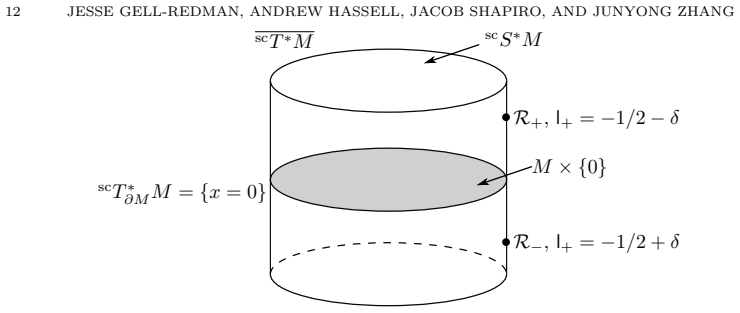
The load-bearing object is a family of anisotropic Sobolev spaces $H^{s,\ell;\kappa,k}_+$ with module regularity: on top of $s$ ordinary derivatives and $\ell$ orders of spatial decay, functions have $\kappa$ derivatives with respect to a module $\mathcal M_+$ of operators that annihilate the outgoing oscillation $e^{i\lambda r}$, and $k$ angular derivatives from a module $\mathcal N$ of tangential operators. The Helmholtz operator $P=\Delta_g+V-\lambda^2$ is shown to be an isomorphism $P:X^{s,\ell;\kappa,k}_+\to H^{s-2,\ell+1;\kappa,k}_+$, where $X^{s,\ell;\kappa,k}_+$ consists of functions in $H^{s,\ell;\kappa,k}_+$ whose image under $P$ has the stated regularity; the proof combines elliptic estimates, propagation of regularity along bicharacteristics, and radial-point estimates at the incoming and outgoing radial sets $R_\pm$. An algebra property for these spaces, requiring $\kappa\ge1$ and $k\ge(n-1)/2$, turns the nonlinear term into an element of the correct weighted space and provides the one-order decay gain encoded in $(p-1)(n-1)/2>2$.
What would settle it
Take the fixed point $w$ built in Section 4.2 for a concrete nonlinearity, such as $N[u]=|u|^{p-1}u$ on $\mathbb R^n$ with admissible $n,p$, and test whether $w\in H^{2,\ell;1,k+2}_+$ rather than only $H^{2,\ell;1,k}_+$. If an admissible small $f$ yields a fixed point whose angular regularity stops at $k$, then Lemma 4.2 cannot be applied and the stated $O(r^{-\epsilon'})$ expansion with $g\in H^k$ does not follow. Conversely, an estimate showing that the outgoing resolvent $R(\lambda+i0)$ gains two angular derivatives on these module spaces would close the gap and make the expansion unconditional.
Extended reading notes
Core claim
On the paper's own terms, the discovery is that the linear parametrization of Helmholtz eigenfunctions by their data on the sphere at infinity survives small nonlinear perturbations. Fix a nonlinearity $N$ that is a sum of monomials of degree at least $p$ in $u$, $\bar u$, and derivatives up to order two, assume $(p-1)(n-1)/2>2$, and take $k>(n-1)/2$. Then each sufficiently small incoming pattern $f\in H^{k+2}(\mathbb S^{n-1})$ is the incoming coefficient of a solution $u$ of $(\Delta-\lambda^2)u=N[u]$ with $u(r,\omega)=r^{-(n-1)/2}(e^{-i\lambda r}f(\omega)+e^{+i\lambda r}g(\omega)+O(r^{-\epsilon'}))$ for some outgoing coefficient $g\in H^k(\mathbb S^{n-1})$. The same statement holds on asymptotically conic manifolds, with the sphere replaced by the boundary of the radial compactification. The proof produces the solution as a fixed point of a contraction on a space with module regularity, and uniqueness is shown among small solutions with the same leading incoming term.
Load-bearing premise
The contraction mapping produces a fixed point with only $k$ orders of angular regularity, while the lemma that yields the outgoing coefficient $g$ assumes $k+2$ orders; the paper does not prove that the fixed point has those extra two angular derivatives.
Editorial extensions
If this is right
- Small nonlinear Helmholtz eigenfunctions are parametrized by incoming radiation patterns just as linear ones are, with the outgoing pattern determined by the incoming one.
- For phase-equivariant nonlinearities such as $\alpha|u|^{2q}u$, each such eigenfunction produces a global time-periodic standing wave of the nonlinear Schrodinger equation, despite the wave having no spatial decay.
- The same existence and asymptotic expansion is valid on asymptotically conic manifolds, so the phenomenon is geometric and does not rely on Euclidean translation symmetry.
- Prescribing small incoming data selects exactly one small nonlinear eigenfunction in the relevant weighted Sobolev space.
Reading between the lines
- The map $f\mapsto g$ would constitute a nonlinear scattering matrix between Sobolev spaces on the sphere at infinity; composing it with the linear scattering relation could describe nonlinear reflection off metric or potential perturbations.
- The gap between the fixed point in $H^{2,\ell;1,k}_+$ and the $H^{2,\ell;1,k+2}_+$ assumption of the expansion lemma is testable: a two-derivative angular smoothing estimate for the outgoing resolvent would remove the gap, while a counterexample fixed point with angular regularity exactly $k$ would invalidate the stated form of the expansion.
- The threshold $(p-1)(n-1)/2>2$ is tied to the choice $\kappa=1$; higher module regularity would change the decay bookkeeping and might reach the low-dimensional cases $n=3,4$ with $p=3$ that fall outside this paper's range.
Signed reviews
Editorial analysis
A structured set of objections, weighed in public.
Referee Report
Summary. The paper proves existence and asymptotic expansion of small solutions to nonlinear Helmholtz equations (Δ−λ²)u = N[u] on R^n and on asymptotically conic manifolds. Under the condition (p−1)(n−1)/2 > 2 and k > (n−1)/2, the authors claim that for every incoming datum f ∈ H^{k+2}(S^{n−1}) of sufficiently small norm there exists a solution u with asymptotic expansion u(r,ω) = r^{−(n−1)/2}(e^{−iλr}f(ω) + e^{iλr}g(ω) + O(r^{−ε′})) for some g ∈ H^k(S^{n−1}). The proof develops anisotropic Sobolev spaces with module regularity, establishes the invertibility of P = Δ−λ² between such spaces (Theorem 2.6), proves multiplicative (algebra) properties, and then runs a contraction mapping argument on X^{2,ℓ;1,k}_+ for w = u − u_−, where u_− carries the prescribed incoming wave. The asymptotics of the fixed point are then extracted via Lemma 4.2 in Proposition 4.1.
Significance. If the main theorem holds, the paper provides a substantial generalization of Gutierrez's nonlinear Helmholtz eigenfunctions to broad nonlinearities, including derivative nonlinearities, and to the general setting of asymptotically conic manifolds. The microlocal framework, especially the module-regularity spaces and the detailed proof of the resolvent mapping properties in Theorem 2.6, is a valuable technical contribution. The paper also gives a clear parametrization of small nonlinear eigenfunctions by their incoming radiation pattern, with uniqueness in a natural space. These strengths make the central claim worth pursuing. However, as written, the proof of the asymptotic expansion has a significant gap that affects the main theorems.
major comments (1)
- [§4.3, Proposition 4.1 and Lemma 4.2] The proof of the asymptotic expansion (4.11) applies Lemma 4.2 to the fixed point w, but Lemma 4.2 assumes w ∈ H^{2,ℓ;1,k+2}_+, while the contraction argument in §4.2 produces only w ∈ X^{2,ℓ;1,k}_+, i.e., w ∈ H^{2,ℓ;1,k}_+ with Pw ∈ H^{0,ℓ+1;1,k}_+. The proof of Lemma 4.2 explicitly requires the N-module regularity of order at least 2 for the tangential derivatives (see the sentence after (4.18)), so the k+2 hypothesis is not superfluous. The right-hand side N[u_−+w] is only shown to lie in H^{0,3/4;1,k}_+ (discussion below (4.7)), and no elliptic or propagation estimate in the paper upgrades w to H^{2,ℓ;1,k+2}_+. Consequently, the existence of the outgoing coefficient b ∈ H^k and the O(r^{−ε′}) remainder in (4.11) is not established by the written proof. Since (4.11) is exactly the asymptotic statement in Theorems 1.1 and 1.4, this gap is load-bearing.
minor comments (4)
- [§2.3, Eq. (2.44)] In the displayed mapping property (2.44), the domain of the resolvent should be H^{s−2,ℓ+1;κ,k}_±, not H^{2−s,ℓ+1;κ,k}_±; as written the indices are inconsistent with (2.43).
- [§4.2, Eq. (4.9)] In the contraction estimate, the norm on the left is said to be taken in X^{2,ℓ;1,k}_+ while the difference w1−w2 is measured in H^{2,ℓ;1,k}_+; this is acceptable since the X norm controls the H norm, but the wording should be made explicit to avoid confusion.
- [Title and abstract] The title contains an unintended space in 'HELMHOL TZ', and a similar spacing issue appears in the abstract; these should be corrected in revision.
- [§4.3, Lemma 4.2] The asymmetry between the regularity assumptions on w (H^{2,ℓ;1,k+2}_+) and on F (H^{0,1/2+ε;1,k}_+) is surprising and should be discussed; if the lemma is to be retained in this form, the authors should explain why k+2 is natural rather than merely sufficient for the proof.
Circularity Check
No circularity: the scattering parametrization is derived from a contraction argument, not assumed; cited prior microlocal theorems are independent, though Proposition 4.1 has a non-circular regularity gap.
full rationale
I find no circularity in the paper's derivation. The main theorem prescribes the incoming data f, constructs a linear solution u0, splits off the non-module-regular part u-, solves for w in X^{2,l;1,k}_+ by contraction, and then proves the outgoing coefficient b exists via Lemma 4.2 from Pw = F. The outgoing data g is therefore an output of the proof, not an input or a fitted parameter, and the asymptotic expansion (4.11) is not assumed in the definition of the spaces. The reliance on prior work—Vasy's anisotropic Sobolev invertibility, Melrose's boundary-pairing and asymptotic expansion results, and the test-module framework of Hassell-Melrose-Vasy—is citation of independent published theorems with stated hypotheses that do not include the target nonlinear result. Even though Hassell is a co-author of [12] and the paper uses [12]'s positive commutator framework in Proposition 3.11, that is a legitimate use of an established microlocal tool, and the paper supplies substantial proof details in Section 3 rather than merely renaming a prior result. I do flag, as an omitted proof rather than as circularity, the regularity mismatch noted in the skeptic's analysis: Proposition 4.1 applies Lemma 4.2, which assumes w in H^{2,l;1,k+2}_+, while the contraction argument only yields w in X^{2,l;1,k}_+. No argument is given for the missing two orders of angular regularity, so the assertion b in H^k and the O(r^{-epsilon'}) remainder are not fully established as written. This is a correctness gap in the proof, not a circular reduction: the missing step would supply additional regularity, it would not identify the conclusion with the hypotheses. Overall, the central claim has independent content and does not reduce by construction to its inputs.
Assumptions & free parameters
assumptions (5)
- domain assumption The scattering pseudodifferential calculus and Fredholm framework of Vasy [32] provides the invertibility of Δ-λ² between variable-order anisotropic Sobolev spaces (Theorem 3.1).
- standard math The boundary pairing lemma of Melrose [23, Prop. 13] is valid for the operator P on asymptotically conic manifolds.
- standard math Hörmander's unique continuation theorem [17, Theorem 17.2.8] applies to the operator P to conclude u ≡ 0.
- standard math The test module algebra result of Hintz-Vasy [13, Lemma 4.4] (Y^{κ,k}_{d} is an algebra) holds.
- domain assumption The radial point estimates of Melrose [23, Section 9] as extended in [32, Prop. 5.27] are valid in the stated form.
Cite this review
Pith. "Pith review of Existence and asymptotics of nonlinear Helmholtz eigenfunctions." pith.science (2026). https://pith.science/paper/UVN6LS6Q
@misc{pith2026190804890,
  author       = {Pith},
  title        = {Pith review of: Existence and asymptotics of nonlinear Helmholtz eigenfunctions},
  year         = {2026},
  howpublished = {\url{https://pith.science/paper/UVN6LS6Q}},
  note         = {Machine review of arXiv:1908.04890}
}
abstract
We prove the existence and asymptotic expansion of a large class of solutions to nonlinear Helmholtz equations of the form \begin{equation*} (\Delta - \lambda^2) u = N[u], \end{equation*} where $\Delta = -\sum_j \partial^2_j$ is the Laplacian on $\mathbb{R}^n$ with sign convention that it is positive as an operator, $\lambda$ is a positive real number, and $N[u]$ is a nonlinear operator that is a sum of monomials of degree $\geq p$ in $u$, $\overline{u}$ and their derivatives of order up to two, for some $p \geq 2$. Nonlinear Helmholtz eigenfunctions with $N[u]= \pm |u|^{p-1} u$ were first considered by Guti\'errez. Such equations are of interest in part because, for certain nonlinearities $N[u]$, they furnish standing waves for nonlinear evolution equations, that is, solutions that are time-harmonic. We show that, under the condition $(p-1)(n-1)/2 > 2$ and $k > (n-1)/2$, for every $f \in H^{k+2}(\mathbb{S}^{n-1})$ of sufficiently small norm, there is a nonlinear Helmholtz function taking the form \begin{equation*} u(r, \omega) = r^{-(n-1)/2} \Big( e^{-i\lambda r} f(\omega) + e^{+i\lambda r} g(\omega) + O(r^{-\epsilon}) \Big), \text{ as } r \to \infty, \quad \epsilon > 0, \end{equation*} for some $g \in H^{k}(\mathbb{S}^{n-1})$. Moreover, we prove the result in the general setting of asymptotically conic manifolds.
Figures

Reference graph
Works this paper leans on
-
[1]
H. Berestycki and P.-L. Lions. Nonlinear scalar field equations. I. Existence of a ground state. Arch. Rational Mech. Anal., 82(4):313–345, 1983. 6
work page 1983
-
[2]
H. Berestycki and P.-L. Lions. Nonlinear scalar field equations. II. Existence of infinitely many solutions. Arch. Rational Mech. Anal., 82(4):347–375, 1983. 6
work page 1983
- [3]
-
[4]
H. Christianson and J. Marzuola. Existence and stability of solitons for the nonlinear schr¨ odinger equation on hyperbolic space. Nonlinearity, 23:89–106, 2010. 6
work page 2010
-
[5]
Bounded solutions to the Allen-Cahn equation with level sets of any compact topology
Alberto Enciso and Daniel Peralta-Salas. Bounded solutions to the Allen-Cahn equation with level sets of any compact topology. Anal. PDE, 9(6):1433–1446, 2016. 6 EXISTENCE AND ASYMPTOTICS OF NONLINEAR HELMHOLTZ EIGENFUNCTIONS 35
work page 2016
-
[6]
Dual variational methods and nonvanishing for the nonlinear Helmholtz equation
Gilles Evequoz and Tobias Weth. Dual variational methods and nonvanishing for the nonlinear Helmholtz equation. Adv. Math., 280:690–728, 2015. 6
work page 2015
-
[7]
On the ab- sence of positive eigenvalues for one-body Schr¨ odinger operators.J
Richard Froese, Ira Herbst, Maria Hoffmann-Ostenhof, and Thomas Hoffmann-Ostenhof. On the ab- sence of positive eigenvalues for one-body Schr¨ odinger operators.J. Analyse Math. , 41:272–284, 1982. 23
work page 1982
-
[8]
The Feynman propagator on perturbations of Minkowski space
Jesse Gell-Redman, Nick Haber, and Andr´ as Vasy. The Feynman propagator on perturbations of Minkowski space. Comm. Math. Phys. , 342(1):333–384, 2016. 5, 6
work page 2016
Show all 32 references
-
[9]
Guillarmou and A
C. Guillarmou and A. Hassell. Uniform sobolev estimates for non-trapping metrics. Journal of Inst. Math. Jussieu, 13:599–632, 2014. 6
2014
-
[10]
Non trivialLq solutions to the Ginzburg-Landau equation
Susana Guti´ errez. Non trivialLq solutions to the Ginzburg-Landau equation. Math. Ann., 328(1-2):1– 25, 2004. 1, 4, 6
2004
-
[11]
Haber and A
N. Haber and A. Vasy. Propagation of singularities around a Lagrangian submanifold of radial points. Bulletin de la SMF, arXiv:1110.1419 , To appear. 15
-
[12]
Spectral and scattering theory for symbolic po- tentials of order zero
Andrew Hassell, Richard Melrose, and Andr´ as Vasy. Spectral and scattering theory for symbolic po- tentials of order zero. Adv. Math., 181(1):1–87, 2004. 5, 14, 25, 26, 27
2004
-
[13]
Semilinear wave equations on asymptotically de Sitter, Kerr–de Sitter and Minkowski spacetimes
Peter Hintz and Andr´ as Vasy. Semilinear wave equations on asymptotically de Sitter, Kerr–de Sitter and Minkowski spacetimes. Anal. PDE, 8(8):1807–1890, 2015. 6, 18, 19
2015
-
[14]
Global analysis of quasilinear wave equations on asymptotically Kerr–de Sitter spaces
Peter Hintz and Andr´ as Vasy. Global analysis of quasilinear wave equations on asymptotically Kerr–de Sitter spaces. Int. Math. Res. Not. IMRN , (17):5355–5426, 2016. 7
2016
-
[15]
The global non-linear stability of the Kerr–de Sitter family of black holes
Peter Hintz and Andr´ as Vasy. The global non-linear stability of the Kerr–de Sitter family of black holes. Acta Math., 220(1):1–206, 2018. 7
2018
-
[16]
On the existence and the regularity of solutions of linear pseudo-differential equations
Lars H¨ ormander. On the existence and the regularity of solutions of linear pseudo-differential equations. Enseignement Math. (2) , 17:99–163, 1971. 20
1971
-
[17]
Springer, Berlin, 1985
Lars H¨ ormander.The analysis of linear partial differential operators III . Springer, Berlin, 1985. 7, 23
1985
-
[18]
Linear stability of slowly rotating Kerr black holes
Dietrich Hfner, Peter Hintz, and Andrs Vasy. Linear stability of slowly rotating Kerr black holes. Preprint, arXiv:1906.00860, 2019. 7
1906 arXiv
-
[19]
C. E. Kenig, A. Ruiz, and C. D. Sogge. Uniform Sobolev inequalities and unique continuation for second order constant coefficient differential operators. Duke Math. J. , 55(2):329–347, 1987. 4
1987
-
[20]
On the Helmholtz equation and Dancer’s-type entire solutions for nonlinear elliptic equations
Yong Liu and Juncheng Wei. On the Helmholtz equation and Dancer’s-type entire solutions for nonlinear elliptic equations. Proc. Amer. Math. Soc. , 147(3):1135–1148, 2019. 6
2019
-
[21]
Oscillating solutions for nonlinear Helmholtz equations
Rainer Mandel, Eugenio Montefusco, and Benedetta Pellacci. Oscillating solutions for nonlinear Helmholtz equations. Z. Angew. Math. Phys. , 68(6):Art. 121, 19, 2017. 6
2017
-
[22]
Marzuola and E.M
J. Marzuola and E.M. Taylor. Higher dimensional vortex standing waves for nonlinear schr¨ odinger equations,. Commu. PDE, 41:398–446, 2016. 6
2016
-
[23]
Richard B. Melrose. Spectral and scattering theory for the Laplacian on asymptotically Euclidian spaces. In Spectral and scattering theory (Sanda, 1992), volume 161 of Lecture Notes in Pure and Appl. Math., pages 85–130. Dekker, New York, 1994. 5, 6, 7, 12, 21, 23, 30
1992
-
[24]
Absence of singular spectrum for certain self-adjoint operators
D Mourre. Absence of singular spectrum for certain self-adjoint operators. Comm. Math. Phys. , 78(1):391–400, 1981. 21
1981
-
[25]
On a nonlinear differential equation arising in nuclear physics
Zeev Nehari. On a nonlinear differential equation arising in nuclear physics. Proc. Roy. Irish Acad. Sect. A, 62:117–135 (1963), 1963. 6
1963
-
[26]
Operatori pseudo-differenziali in Rn e applicazioni
Cesare Parenti. Operatori pseudo-differenziali in Rn e applicazioni. Ann. Mat. Pura Appl. (4) , 93:359– 389, 1972. 6
1972
-
[27]
Peter A. Tomas. A restriction theorem for the Fourier transform. Bull. Amer. Math. Soc. , 81:477–478,
-
[28]
A. Vasy. Resolvent near zero energy on Riemannian scattering (asymptotically conic) spaces, a La- grangian approach. Preprint, arXiv:1905.12809, 2019. 7
1905 arXiv
-
[29]
Limiting absorption principle on riemannian scattering (asymptotically conic) spaces, a lagrangian approach
Andras Vasy. Limiting absorption principle on riemannian scattering (asymptotically conic) spaces, a lagrangian approach. Preprint, arXiv:1905.12587. 7, 23
1905 arXiv
-
[30]
Resolvent near zero energy on riemannian scattering (asymptotically conic) spaces
Andras Vasy. Resolvent near zero energy on riemannian scattering (asymptotically conic) spaces. Preprint, arXiv:1808.06123. 7
-
[31]
Microlocal analysis of asymptotically hyperbolic and Kerr-de Sitter spaces (with an ap- pendix by Semyon Dyatlov)
Andr´ as Vasy. Microlocal analysis of asymptotically hyperbolic and Kerr-de Sitter spaces (with an ap- pendix by Semyon Dyatlov). Invent. Math., 194(2):381–513, 2013. 4, 6
2013
-
[32]
A minicourse on microlocal analysis for wave propagation
Andr´ as Vasy. A minicourse on microlocal analysis for wave propagation. In Asymptotic analysis in general relativity, volume 443 of London Math. Soc. Lecture Note Ser. , pages 219–374. Cambridge Univ. Press, Cambridge, 2018. 1, 5, 6, 7, 19, 20, 21, 22, 28 36 JESSE GELL-REDMAN...
2018
Reviewed August 14, 2026 · model on record in the stance chip above.
Discussion (0). Continue with ORCID to comment.