REVIEW 3 major objections 5 minor 26 references
A geometric model for the non-$\tau$-rigid modules of type $\widetilde{D}_n$
T0 review · 3 major / 5 minor · reviewed 2026-08-06 · deepseek-v4-flash
Pith's one-line read For affine type D-tilde-n, every indecomposable module is represented by a colored curve in a twice-punctured disk, and the intersection number of two curves equals the two-way dimension of the extension spaces between the modules.
desk verdict A plausible and genuinely new geometric model for non-tau-rigid modules of type ~D_n, but the central quiver isomorphism is asserted, not proven. read the letter →
The pith
A machine-rendered reading of the paper's core claim, the machinery that carries it, and where it could break.
The reading
What carries the argument
The machinery is the category $\mathcal E(T)$ of colored admissible tagged edges in the twice-punctured disk, together with the tagged rotation $\rho$ and the six classes of elementary moves that generate the arrows of the quiver $\Gamma(\mathcal E(T))$. An admissible tagged edge is a curve that is properly embedded, not null-homotopic, not homotopic to a boundary segment, and not allowed to cut out a once-punctured monogon; the color $\lambda\in \mathbb P^1\cup\{-\infty\}$ records which stable tube a regular module belongs to, and edges of distinct non-$-\infty$ colors are declared to have intersection number zero. The tagged rotation $\rho$ is the geometric analogue of the Auslander-Reiten translation, and the elementary moves are the geometric analogues of the middle terms of almost split sequences. The quiver isomorphism $\varphi$ is defined on the mouth vertices of stable tubes by matching a module's dimension vector to the intersection numbers of its curve with the triangulation, then extended recursively along arrows; the mesh relations in $\mathcal E(T)$ play the role of the Auslander-Reiten mesh relations.
What would settle it
Fix an acyclic triangulation $T$ of the twice-punctured disk with $(n-2)$ boundary marked points. For each indecomposable module $M$ in a stable tube, compute the vector $(\operatorname{Int}((\gamma,\kappa,\lambda), i))_{i\in T}$ for the curve the paper assigns to $M$ and compare it with $\dim M$. If any module's dimension vector is not realized by an admissible edge, or if two non-isomorphic modules are assigned the same curve, then the quiver isomorphism $\varphi$ fails and the intersection-dimension formula of Theorem A does not hold for those modules.
Extended reading notes
Core claim
The central claim is Theorem A. For a triangulation $T$ of a twice-punctured disk with $(n-2)$ boundary marked points whose quiver $Q_T$ is an acyclic orientation of type $\widetilde D_n$, every indecomposable finite-dimensional module over $kQ_T$ is represented by a colored admissible tagged edge $(\gamma,\kappa,\lambda)$, and for any two such edges, $\operatorname{Int}((\gamma_1,\kappa_1,\lambda_1),(\gamma_2,\kappa_2,\lambda_2))=\dim_k\operatorname{Ext}^1(M_1,M_2)+\dim_k\operatorname{Ext}^1(M_2,M_1)$. The paper further claims that the correspondence $\varphi\colon \Gamma(\operatorname{mod} kQ_T)\to \Gamma(\mathcal E(T))$ is an isomorphism of quivers that sends the Auslander-Reiten translation $\tau$ to the tagged rotation $\rho$, so the entire combinatorial skeleton of the module category, including the infinitely many homogeneous stable tubes of the regular component, is mirrored in the disk.
Load-bearing premise
The result rests on the claim that every indecomposable module is matched to exactly one curve, with the curve's intersection counts against the fixed triangulation equal to the module's dimension vector at every position in the Auslander-Reiten quiver, not only at the mouths of the stable tubes; if that matching ever identifies two different modules or loses a module, Theorem A stops being a statement about modules.
Editorial extensions
If this is right
- For any two modules, the number $\dim_k\operatorname{Ext}^1(M_1,M_2)+\dim_k\operatorname{Ext}^1(M_2,M_1)$ can be computed by drawing two curves and counting intersections; no extension calculation is needed.
- The Auslander-Reiten quiver of $kQ_T$ is isomorphic, as a quiver, to the quiver of admissible edges, so the irreducible-morphism combinatorics of the module category is displayed directly in the disk.
- Modules in different stable tubes have zero intersection and zero extension dimensions, because their curves carry different colors and are declared non-intersecting.
- The regular modules, which are not $\tau$-rigid and are invisible to tilting theory, are included in the model, so homological questions about the entire module category of type $\widetilde D_n$ become geometric questions.
- Because intersection numbers are invariant under the tagged rotation, computations for non-projective modules can be moved along the Auslander-Reiten quiver to simpler representatives, matching the $\tau$-invariance of $\mathrm{Ext}^1$.
Reading between the lines
- An implication the paper leaves implicit is that if the recursive definition of $\varphi$ can be made fully explicit, the same 'dimension vector equals intersection vector' check would give a direct bijective proof of the quiver isomorphism for the whole Auslander-Reiten quiver, not just for the tube mouths.
- The coloring idea should transfer to other affine types whose regular components split into infinitely many disjoint tubes: assign each tube a distinct point of $\mathbb P^1$ and declare different colors non-intersecting, and the same intersection-dimension formula would hold whenever a surface model exists.
- A testable extension is to use the model as a combinatorial filter for $\tau$-rigidity: since $\mathrm{Ext}^1$ dimensions are intersection counts, a module is $\tau$-rigid exactly when its curve has controlled self- and mutual intersections, so one could read off the support $\tau$-tilting data of the regular component from the disk.
- The paper leaves open whether the quiver isomorphism can be upgraded to an equivalence of additive categories, with elementary moves and mesh relations matching irreducible morphisms and Auslander-Reiten sequences; such a categorification would make the geometric model a full replacement for the module category rather than only its quiver.
Editorial analysis
A structured set of objections, weighed in public.
Referee Report
Summary. The paper proposes a geometric model for the indecomposable modules, in particular the non-τ-rigid regular modules, over path algebras of acyclic quivers of type \widetilde{D}_n. The model consists of colored admissible tagged edges in a twice-punctured disk with (n−2) boundary marked points, together with a quiver Γ(E(T)) of such edges. The central result, Theorem A (Corollary 7.3), claims an intersection-dimension formula: for two colored admissible edges (γ1,κ1,λ1) and (γ2,κ2,λ2), the intersection number Int((γ1,κ1,λ1),(γ2,κ2,λ2)) equals dim_k Ext^1(M1,M2)+dim_k Ext^1(M2,M1), where M_i are the modules corresponding under a quiver isomorphism φ: Γ(mod kQ_T) → Γ(E(T)) defined in Section 6. The proof of Theorem A is split into Lemma 7.1 (preprojective versus arbitrary modules) and Lemma 7.2 (regular-regular modules), with the remaining cases handled by duality and known vanishing statements.
Significance. If established, the model would fill a genuine gap in the geometric modeling of module categories over Euclidean quivers: previous work covered types A_n, D_n, \widetilde{A}_n, and the τ-rigid modules of type \widetilde{D}_n, but not the non-τ-rigid regular modules. The idea of adding a color λ to admissible edges in order to separate infinitely many stable tubes is natural and is the right kind of move for the problem. However, the main theorem is not proven as written: the quiver isomorphism φ of Definition 6.1 is asserted rather than proved, and the regular-regular case in Lemma 7.2 relies on 'visual inspection'. Both points are load-bearing for the claimed correspondence between geometry and homological algebra, so the paper needs substantial revision before the central claim can be accepted.
major comments (3)
- [Definition 6.1] The quiver isomorphism φ is load-bearing but is not proved. The recursive definition assumes that for each arrow [M]→[N] there is a unique admissible edge (γ,κ,λ) such that dim[N] equals (Int((γ,κ,λ),i))_{i∈T} and such that the required arrow from φ([M]) exists. No argument is given for existence, uniqueness, or bijectivity; the text says only 'It should be clear from the constructions' and then asserts that φ 'must define an isomorphism of quivers'. The injectivity concern is concrete: by Definition 4.7, all triangulation edges have color −∞ and intersections with them are independent of the color λ, so the condition dim[M]=(Int(...)) cannot by itself distinguish among infinitely many colorings of the same underlying tagged edge. The recursion carries λ along geometric arrows, but no proof rules out different paths assigning different colored edges to the same module [M]. Since Lemmas 7.1 and 7.2 use φ^{-1} and Theorem A is stated in terms of 'corresponding modules', this gap undermines the central claim.
- [Lemma 7.2] The same-tube case is not proved. After correctly noting that distinct colors give zero on both sides, the proof says that since modules in a stable tube are uniserial, dim_k Ext^1 can be calculated combinatorially, and then 'by construction (and visual inspection)' the intersection number between two admissible edges follows exactly the same pattern. This is not a proof of the claimed equality. What is needed is an explicit verification that the intersection numbers of admissible edges in each of the three types of regular tubes (rank 2, rank n−2, and rank 1) reproduce the extension dimensions dictated by the uniserial composition series; such a verification should include the exceptional tubes T_0, T_1, T_∞ and the homogeneous tubes. As written, the regular-regular case of Theorem A is left to inspection rather than demonstrated.
- [Lemma 7.1] The proof of the preprojective case has an unhandled subcase. The argument applies τ^{n+1} to both modules and asserts that if τ^{n+1}M2≠0 then the chain of equalities follows. If M2 is preinjective, τ^{n+1}M2 may be 0, and the proof does not explain why the equality Int(ρ^{n+1}(γ1),ρ^{n+1}(γ2)) = dim_k Hom(P(j),τ^{n+1}M2) is still valid when the right-hand side is interpreted with τ^{n+1}M2=0. In addition, the claim that 'by our assumption that M1 is to the left of M2, Ext^1(M1,M2)=0' needs a justification in terms of the Auslander-Reiten structure of the preprojective component; this is plausible but not automatic for arbitrary preprojective pairs. These steps are part of the proof of Theorem A and should be completed.
minor comments (5)
- [Lemma 7.1] In the final line of the proof, 'the last inequality follows from the Auslander-Reiten formulas' should read 'the last equality follows from the Auslander-Reiten formulas'.
- [Definition 5.4] In case (6), the condition 'ρ^1(γ)=γ' is better written as 'ρ(γ)=γ' for consistency with the notation introduced in Definition 4.14.
- [Remark 4.13] The sentence 'ϑγϑ is homotopic to γ' mixes the left and right poliwhirl notations without a definition of their composition; please clarify whether this is intended to be (ϑγ)ϑ or γϑ and spell out the homotopy.
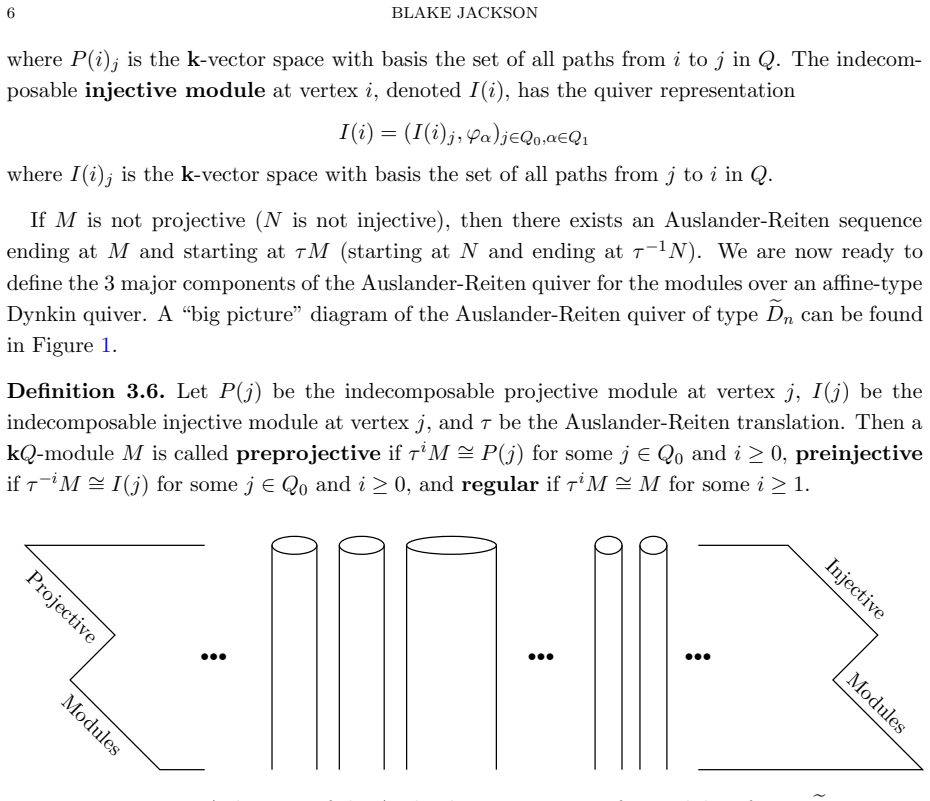
- [Figure 1] Figure 1 is a schematic diagram of the Auslander-Reiten quiver but is not labeled with the components P(T), Q(T), and R(T); adding such labels would help the reader connect the figure to Definitions 3.7 and 5.2.
- [Theorem 5.1] The citation 'Proposition 2.10 of [9]' should be checked against the published version of Fomin-Shapiro-Thurston, since the numbering of propositions differs between the preprint and the journal version.
Circularity Check
Definition 6.1 stipulates the module–curve bijection, distinct-tube zero is fitted to known Ext vanishing, and the same-tube equality in Lemma 7.2 is asserted “by construction” rather than derived.
-
self definitional
[Definition 6.1, Section 6 (used in Lemmas 7.1–7.2 and Corollary 7.3)]
"Define φ([M]) = (γ, κ, λ) where dim[M] = (Int((γ, κ, λ), i))_{i∈T} and (γ, κ, λ) also sits at the mouth of a stable tube. … We define φ on the remaining vertices of the Auslander-Reiten quiver recursively: if there is an arrow [M]→[N] in Γ(mod kQ_T), an arrow φ([M])→(γ, κ, λ) in Γ(E(T)), and dim [N] = (Int((γ, κ, λ), i))_{i∈T}, then define φ([N]) = (γ, κ, λ). … It should be clear from the constructions in the previous sections and the definition that φ is an isomorphism of quivers."
The quiver isomorphism φ is not proved; it is stipulated by requiring dimension vectors to equal intersection vectors and by recursively assigning edges only when such an edge already exists. No proof is given that a matching edge exists for every module, that the matching edge is unique, or that different recursive paths cannot assign two different edges to the same module. Corollary 7.3 then invokes “the correspondence φ^{-1}” as if this equivalence had been established. Thus the central module-to-curve matching is an input to the construction, and any formula “for the corresponding modules” inherits that stipulated matching rather than deriving it.
-
fitted input called prediction
[Section 4.1 and Definition 4.7 (used in Lemma 7.2, first case)]
"It is known that there are no nonzero homomorphisms between regular modules in distinct tubes. However, the geometric model we have laid out so far will not be able to pick up on this subtle detail. To account for this, we add another decoration to our admissible tagged edges so that edges in distinct stable tubes will not intersect. … Otherwise, if −∞ ≠ λ1 ≠ λ2 ≠ −∞, we set Int((γ1, κ1, λ1),(γ2, κ2, λ2)) = 0."
The vanishing of the intersection number for curves of distinct colors is not computed from the geometry; it is put into Definition 4.7 because the module theory already says Ext vanishes between distinct tubes. The abstract and Section 4.1 state this motivation explicitly: the coloring is added “to prevent intersections” for that reason. Lemma 7.2 then “proves” the distinct-tube case by quoting both the stipulated geometric zero and the known homological zero. In that case the intersection-dimension formula is a restatement of the chosen convention together with an external module-theoretic fact, not an independent prediction of the model.
1 more flagged steps
-
other
[Lemma 7.2, Section 7 (same-tube case)]
"Also, by construction (and visual inspection), the intersection number between two admissible edges in the same stable tube follows exactly the same pattern as their corresponding modules."
This is the same-tube regular-regular case, which is the paper's novel non-τ-rigid content. The proof states the desired equality in words: the geometric intersection pattern is said to match the module Ext pattern “by construction (and visual inspection)”. The preceding sentences show that Ext in a stable tube can be computed combinatorially from uniserial structure, but they do not compute the intersection number. Asserting that the two patterns coincide is exactly the content of Theorem A for this case, so the conclusion is treated as an axiom of the model rather than derived from the geometric and homological definitions.
full rationale
The paper is not entirely circular: Lemma 7.1 contains a real homological chain using the Auslander-Reiten formulas and Hom(P(j), M) ≅ M_j, and the preprojective half of the formula has independent content. Also, no load-bearing self-citation or imported uniqueness theorem drives the argument. However, the central module–curve correspondence in Definition 6.1 is defined by the very dimension-vector/intersection-vector matching that the later lemmas reuse, with only an assertion that the resulting φ is an isomorphism. The distinct-color zero in Definition 4.7 is explicitly fitted to the known vanishing of Ext between different tubes, so that part of Lemma 7.2 reduces to a convention plus a citation. Most importantly, the same-tube regular-regular case—the paper's advertised contribution for non-τ-rigid modules—is concluded “by construction (and visual inspection)” rather than proved. These are partial construction-level reductions of the claimed intersection-dimension predictions, so the paper gets a 6 rather than a clean 0–2. The score is not raised by citation issues, which are absent here; it is raised because one or more of the promised predictions reduce to the model's own stipulations.
Assumptions & free parameters
assumptions (5)
- domain assumption Classification of regular modules of \tilde{D}_n: the regular component is a disjoint union of infinitely many stable tubes indexed by λ ∈ P^1(k), with ranks 1, 1, 2, 2, and n-2.
- domain assumption Hom-vanishing between components: Hom(Q(kQ), P(kQ)) = Hom(R(kQ), P(kQ)) = Hom(Q(kQ), R(kQ)) = 0.
- standard math Auslander-Reiten formulas and the invariance of Ext^1 under the AR translation for non-projective modules (Corollary 3.12).
- domain assumption Fomin-Shapiro-Thurston correspondence between triangulations of marked surfaces and quiver mutations, including the fact that an acyclic triangulation of the twice-punctured (n-2)-gon gives a quiver of type \tilde{D}_n.
- domain assumption Acyclicity of the triangulation T, so that Q_T is an acyclic quiver.
invented entities (2)
-
Color λ on admissible edges
independent evidence
-
Poliwhirl operation (variants ϑγ, γϑ, ϑ^2γ)
Cite this review
Pith. "Pith review of A geometric model for the non-$\tau$-rigid modules of type $\widetilde{D}_n$." pith.science (2026). https://pith.science/paper/UWXR5CZR
@misc{pith2026250702218,
  author       = {Pith},
  title        = {Pith review of: A geometric model for the non-$\tau$-rigid modules of type $\widetildeD_n$},
  year         = {2026},
  howpublished = {\url{https://pith.science/paper/UWXR5CZR}},
  note         = {Machine review of arXiv:2507.02218}
}
abstract
We give a geometric model for the non-$\tau$-rigid modules over acyclic path algebras of type $\widetilde{D}_n$. Similar models have been provided for module categories over path algebras of types $A_n, D_n,$ and $\widetilde{A}_n$ as well as the $\tau$-rigid modules of type $\widetilde{D}_n$. A major draw of these geometric models is the "intersection-dimension formulas" they often come with. These formulas give an equality between the intersection number of the curves representing the modules in the geometric model and the dimension of the extension spaces between the two modules. This formula allows us to calculate the homological data between two modules combinatorially. Since there are infinitely many distinct homogeneous stable tubes in the regular component of the Auslander-Reiten quiver of type $\widetilde{D}_n$, all of which are disjoint, our geometric data requires an extra decoration on the admissible edges in our geometric model to prevent intersections between curves corresponding to modules in distinct stable tubes of the Auslander-Reiten quiver.
Figures


Figures from the paper (6 more)


Reference graph
Works this paper leans on
-
[1]
1, Cambridge University Press, Cambridge, 2006
Ibrahim Assem, Andrzej Skowronski, and Daniel Simson,Elements of the Representation Theory of Asso- ciative Algebras: Techniques of Representation Theory, London Mathematical Society Student Texts, vol. 1, Cambridge University Press, Cambridge, 2006
work page 2006
-
[2]
Maurice Auslander, Idun Reiten, and Sverre O. Smalø,Representation Theory of Artin Algebras, Cambridge Studies in Advanced Mathematics, Cambridge University Press, Cambridge, 1995
work page 1995
-
[3]
Karin Baur and Hermund Andr´ e Torkildsen,A geometric realization of tame categories, February 2015, arXiv:1502.06489 [math]
work page Pith review arXiv 2015
-
[4]
Aslak Bakke Buan, Bethany Marsh, and Idun Reiten,Cluster-tilted algebras, Transactions of the American Mathematical Society359(2007), no. 1, 323–332 (en)
work page 2007
-
[5]
Aslak Bakke Buan, Bethany R. Marsh, and Idun Reiten,Cluster mutation via quiver representations, Com- mentarii Mathematici Helvetici83(2008), no. 1, 143–177 (en)
work page 2008
-
[6]
2, 572–618, Publisher: Elsevier
Aslak Bakke Buan, Robert Marsh, Markus Reineke, Idun Reiten, and Gordana Todorov,Tilting theory and cluster combinatorics, Advances in mathematics204(2006), no. 2, 572–618, Publisher: Elsevier
work page 2006
-
[7]
3, 1347–1364, Publisher: American Mathematical Society
Philippe Caldero, Fr´ ed´ eric Chapton, and Ralf Schiffler,Quivers with Relations Arising from Clusters (An Case), Transactions of the American Mathematical Society358(2006), no. 3, 1347–1364, Publisher: American Mathematical Society
work page 2006
-
[8]
2, 457–469, Publisher: Editorial Committee of Tsukuba Journal of Mathematics
Peter Dr¨ axler and Jos´ e Antonio de la Pe˜ na,On the Existence of Postprojective Components in the Auslander- Reiten Quiver of an Algebra, Tsukuba Journal of Mathematics20(1996), no. 2, 457–469, Publisher: Editorial Committee of Tsukuba Journal of Mathematics
work page 1996
Show all 26 references
-
[9]
Part I: Cluster complexes, Acta Mathematica201(2008), no
Sergey Fomin, Michael Shapiro, and Dylan Thurston,Cluster algebras and triangulated surfaces. Part I: Cluster complexes, Acta Mathematica201(2008), no. 1, 83–146, Publisher: Institut Mittag-Leffler
2008
-
[10]
2, 497–529
Sergey Fomin and Andrei Zelevinsky,Cluster algebras I: foundations, Journal of the American Mathematical Society15(2002), no. 2, 497–529
2002
-
[11]
1, 63–121, arXiv:math/0208229
,Cluster algebras II: Finite type classification, Inventiones mathematicae154(2003), no. 1, 63–121, arXiv:math/0208229
2003 arXiv
-
[12]
1, 71–103 (de)
Peter Gabriel,Unzerlegbare Darstellungen I, manuscripta mathematica6(1972), no. 1, 71–103 (de). 24 BLAKE JACKSON
1972
-
[13]
73, Springer, 1997 (en)
Peter Gabriel and Andrei Roiter,Representations of Finite-Dimensional Algebras, Encyclopaedia of Mathe- matical Sciences, vol. 73, Springer, 1997 (en)
1997
-
[14]
3, 589–632, Publisher: Springer
Christof Geiß, Bernard Leclerc, and Jan Schr¨ oer,Rigid modules over preprojective algebras, Inventiones math- ematicae165(2006), no. 3, 589–632, Publisher: Springer
2006
-
[15]
,Rigid modules over preprojective algebras II: The Kac-Moody case, arXiv preprint math/0703039 (2007)
2007 arXiv
-
[16]
Ping He, Yu Zhou, and Bin Zhu,Mutation graph of support tau-tilting modules over a skew-gentle algebra, December 2022, arXiv:2212.10880 [math]
2022 arXiv
-
[17]
,A geometric model for the module category of a skew-gentle algebra, April 2023, arXiv:2004.11136 [math]
2023 arXiv
-
[18]
Lucie Jacquet-Malo,A Geometric Realization of the m-cluster Categories of Type$${\tilde D} {n}$$, Frontiers of Mathematics (2025) (en)
2025
-
[19]
4, 1023–1054 (en)
Lisa Lamberti,Combinatorial model for the cluster categories of type E, Journal of Algebraic Combinatorics 41(2015), no. 4, 1023–1054 (en)
2015
-
[20]
1099, Springer, Berlin, Heidelberg, 1984
Claus Michael Ringel,Tame Algebras and Integral Quadratic Forms, Lecture Notes in Mathematics, vol. 1099, Springer, Berlin, Heidelberg, 1984
1984
-
[21]
1, 1–21, Publisher: Springer
Ralf Schiffler,A geometric model for cluster categories of type Dn, Journal of Algebraic Combinatorics27 (2008), no. 1, 1–21, Publisher: Springer
2008
-
[22]
1, Springer, 2014
,Quiver Representations, CMS Books in Mathematics, vol. 1, Springer, 2014
2014
-
[23]
2, Cambridge University Press, Cambridge, 2007
Daniel Simson and Andrzej Skowro´ nski,Elements of the Representation Theory of Associative Algebras: Vol- ume 2: Tubes and Concealed Algebras of Euclidean type, London Mathematical Society Student Texts, vol. 2, Cambridge University Press, Cambridge, 2007
2007
-
[24]
3, Cambridge University Press, Cambridge, 2007
,Elements of the Representation Theory of Associative Algebras: Volume 3: Representation-infinite Tilted Algebras, London Mathematical Society Student Texts, vol. 3, Cambridge University Press, Cambridge, 2007
2007
-
[25]
6, 2541–2567, Publisher: Taylor & Francis eprint: https://doi.org/10.1080/00927872.2014.903403
Hermund Andr´ e Torkildsen,A Geometric Realization of the m-cluster Category of Affine Type A, Communications in Algebra43(2015), no. 6, 2541–2567, Publisher: Taylor & Francis eprint: https://doi.org/10.1080/00927872.2014.903403
2015
-
[26]
10, 2898–2915
Yu Zhou and Bin Zhu,Cluster combinatorics of d-cluster categories, Journal of Algebra321(2009), no. 10, 2898–2915. Department of Mathematics, University of Connecticut, Storrs, CT 06269, U.S.A. Email address:blake.jackson@uconn.edu
2009
Reviewed August 6, 2026 · model on record in the stance chip above.
Discussion (0). Continue with ORCID to comment.