When bars and spirals conspire: recurrent build-up of the nuclear regions of disc galaxies
Pith reviewed 2026-06-26 08:29 UTC · model grok-4.3
The pith
Bar-spiral reconnections drive repeated gas inflows that build nuclear stellar clusters and discs after bar formation.
A machine-rendered reading of the paper's core claim, the machinery that carries it, and where it could break.
Core claim
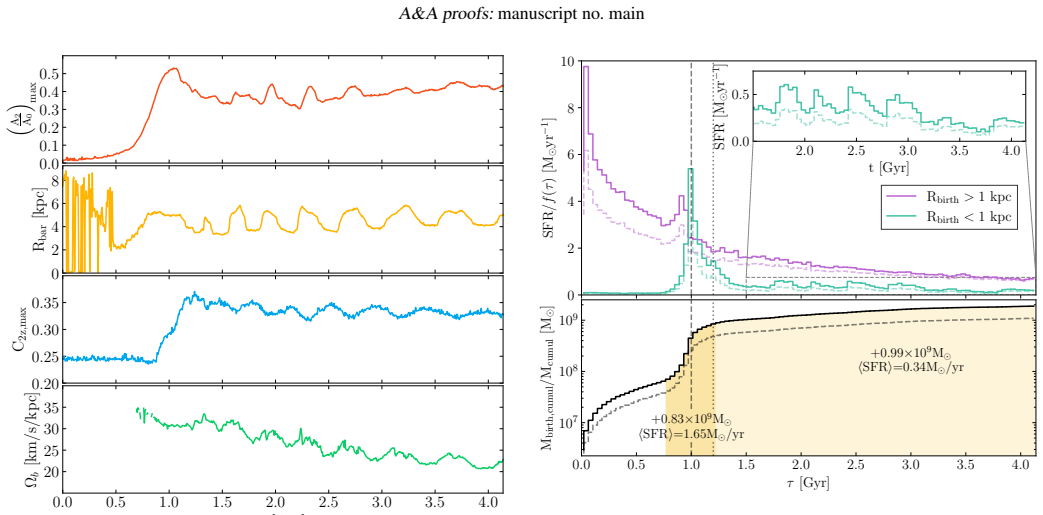
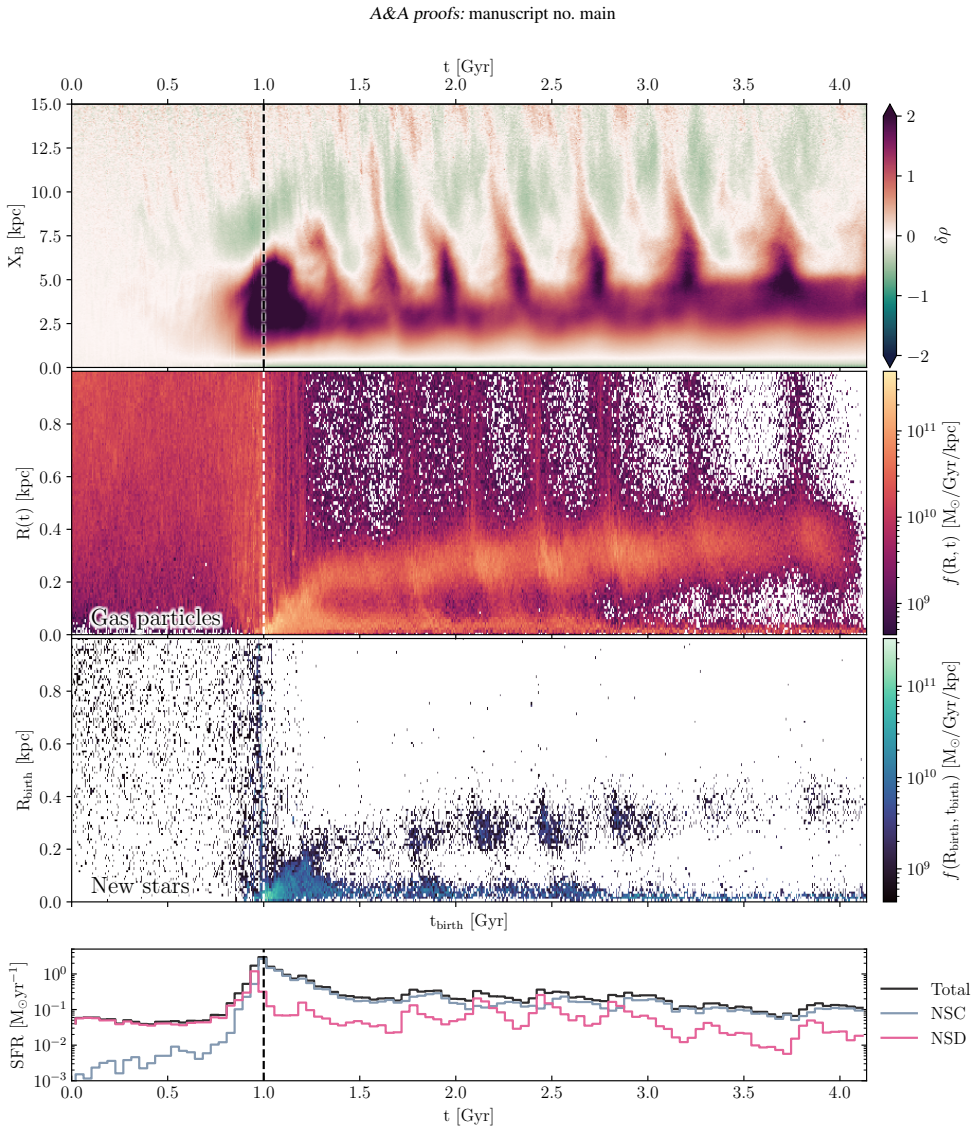
In the simulation the star-formation history of the nuclear stellar disc and nuclear stellar cluster exhibits a primary burst at the epoch of bar formation driven by bar-induced gas inflows, followed by secondary periodic bursts that are absent from the main disc; these secondary bursts coincide with times when the bar and spiral arms, rotating at different pattern speeds, reconnect and thereby trigger renewed bar-driven gas infall events.
What carries the argument
Bar-spiral reconnection events, in which the bar and spiral arms periodically align despite differing pattern speeds and thereby amplify non-axisymmetric torques that sustain gas inflow after the bar has already formed.
If this is right
- The star-formation histories of nuclear stellar clusters and discs record episodic bursts tied to bar-spiral reconnection times.
- Bar-driven gas infall into the nuclear regions continues after bar formation because of ongoing spiral-arm interactions.
- Non-axisymmetric features in the disc are strengthened during each bar-spiral reconnection, sustaining central gas supply.
- The assembly of nuclear structures occurs in recurrent episodes rather than in a single early event.
Where Pith is reading between the lines
- Similar reconnection-driven bursts may appear in the nuclear star-formation histories of other barred galaxies once high-resolution age dating becomes available.
- The frequency of bursts could be used to infer the relative pattern speeds of bars and spirals in external galaxies.
- Changing the gas fraction or feedback strength in future runs would test whether the reconnection mechanism remains dominant.
Load-bearing premise
The secondary periodic bursts seen in the nuclear regions are produced specifically by bar-spiral reconnections rather than by other dynamical processes, resolution limits, or the particular initial conditions and feedback implementation.
What would settle it
A measurement of the star-formation history in the nuclear regions of a barred galaxy whose spiral arms have been removed or whose bar and spiral pattern speeds have been shown to preclude reconnection, yet which still exhibits the same secondary bursts, would falsify the claimed causal link.
Figures
read the original abstract
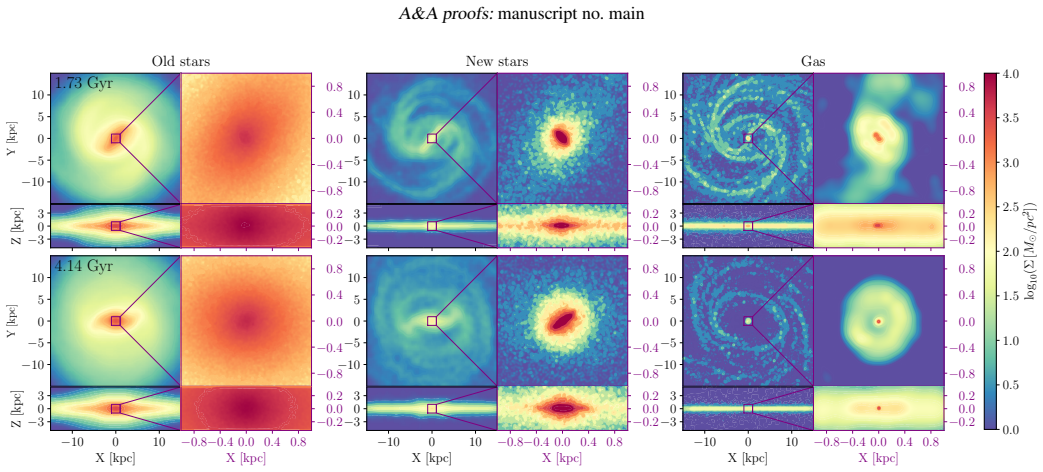
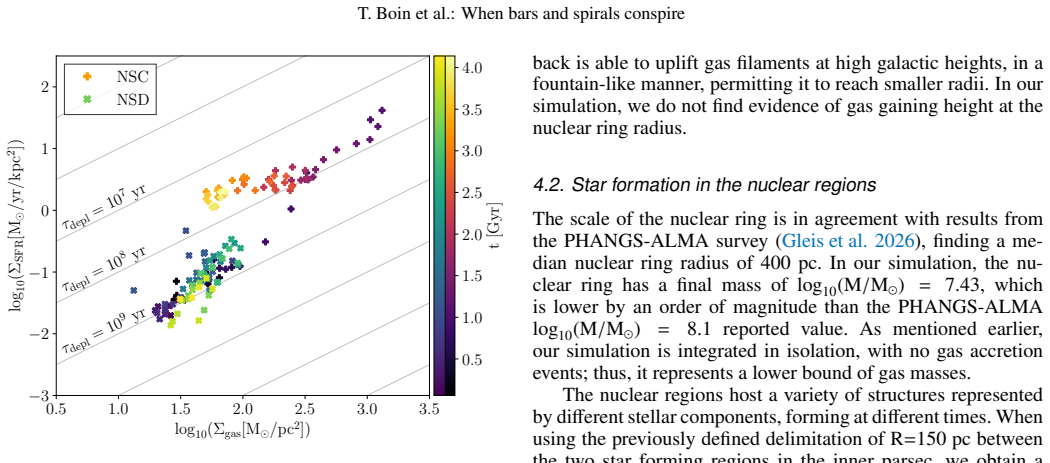
The assembly history of the central regions of disc galaxies is regulated by dynamical processes that trigger gas infall events, leading to active star formation in nuclear stellar discs (NSD) and in nuclear stellar clusters (NSC). In the Milky Way, recent studies of its nuclear regions have revealed a complex star formation history (SFH), with an initial burst associated to the formation of the Galactic bar, followed by a non-constant star formation rate. In this work, we aim to study the formation and evolution of nuclear structures and their link with the formation of large-scale structures. Our goal is to investigate the effects of the bar and spiral arms on the gas dynamics and, as a result on the SFH of NSDs and NSCs. We run a simulation of an isolated Milky Way-like galaxy with the SWIFT N-Body+hydro simulation code, including star formation and stellar feedback from SNIa & SNII. We start from a live DM halo and a pre-existing stellar & gaseous disc with 20% gas fraction, which form a bar, a boxy/peanut bulge, spiral arms and nuclear structures. We study the SFH of these regions and how they relate to variations in the bar length, strength and pattern speed. We investigate the role of spiral arms and their interaction with the bar. We find that the SFH of the nuclear regions display a main burst at bar formation time, due to bar-driven gas inflows. After bar formation, we find secondary periodic formation bursts, that do not appear in the disc SFH. These bursts occur when the spiral arms and the bar, rotating at different pattern speeds, reconnect, triggering secondary gas inflow events. The interaction of spiral arms and the galactic bar can enhance non-axisymmetric features in the disc, triggering bar-driven gas infall even after the bar has formed. These bar-spiral reconnection events are imprinted into the SFH of the NSCs and NSDs as episodic star formation bursts.
Editorial analysis
A structured set of objections, weighed in public.
Referee Report
Summary. The paper presents a hydrodynamical simulation of an isolated Milky Way-like galaxy using the SWIFT N-body+hydro code with star formation and SN feedback. Starting from a live DM halo and a pre-existing stellar/gaseous disc (20% gas fraction), the run forms a bar, boxy/peanut bulge, spiral arms, and nuclear structures. The SFH of nuclear stellar clusters (NSCs) and nuclear stellar discs (NSDs) shows a primary burst at bar formation due to bar-driven inflows, followed by secondary periodic bursts after bar formation. These are attributed to reconnections between the bar and spiral arms (differing pattern speeds) that trigger additional gas inflows, imprinting episodic bursts in the nuclear SFH but not the disc-wide SFH.
Significance. If the causal attribution of secondary nuclear SF bursts to bar-spiral reconnections holds, the result would supply a concrete dynamical channel for recurrent nuclear gas infall and star formation in barred disc galaxies after the initial bar-driven episode. This offers a potential explanation for the non-constant post-bar SFH inferred for the Milky Way's NSD/NSC and links large-scale non-axisymmetric features directly to nuclear assembly. The forward simulation with live components and explicit timing correlations is a positive feature, though the absence of quantitative causal diagnostics limits the strength of the interpretation.
major comments (3)
- [Abstract / SFH analysis] Abstract and results on SFH: the central claim that secondary periodic bursts are specifically triggered by bar-spiral reconnections rests on temporal coincidence alone. No time-resolved metrics (e.g., gas inflow rates, torque integrals, or phase-angle statistics at reconnection epochs) or control experiments (e.g., runs suppressing spirals or fixing pattern speeds) are reported to establish causality over alternatives such as bar buckling, feedback cycles, or resolution-dependent effects.
- [Simulation Setup] Simulation setup: the single run with fixed 20% initial gas fraction and SWIFT subgrid physics is presented without resolution convergence tests or parameter variations. This directly bears on the weakest assumption that the observed bursts are not numerical artifacts or tied to the particular initial conditions, undermining the generality of the reconnection mechanism.
- [Results / SFH] Nuclear region definition and periodicity: the distinction between nuclear SFH bursts and the disc SFH is noted, but without explicit radial boundaries for NSC/NSD, error estimates on burst timings, or quantitative periodicity analysis (e.g., Fourier or autocorrelation measures), the claim of recurrent reconnection-driven episodes cannot be rigorously evaluated.
minor comments (2)
- [Abstract] The abstract references recent Milky Way nuclear SFH studies but does not cite specific works; adding 1-2 key references would clarify the observational motivation.
- [Results] Notation for pattern speeds and reconnection events could be defined more explicitly when first introduced to aid readability.
Simulated Author's Rebuttal
We thank the referee for their constructive comments on our manuscript. We provide detailed responses to each major comment below, indicating where revisions will be made to address the concerns.
read point-by-point responses
-
Referee: [Abstract / SFH analysis] Abstract and results on SFH: the central claim that secondary periodic bursts are specifically triggered by bar-spiral reconnections rests on temporal coincidence alone. No time-resolved metrics (e.g., gas inflow rates, torque integrals, or phase-angle statistics at reconnection epochs) or control experiments (e.g., runs suppressing spirals or fixing pattern speeds) are reported to establish causality over alternatives such as bar buckling, feedback cycles, or resolution-dependent effects.
Authors: The interpretation in the manuscript is based on the precise timing of the reconnection events with the observed bursts, combined with the distinct pattern speeds of the bar and spirals, and the fact that these bursts are absent from the disc-wide SFH. We agree that this is correlative and that additional metrics would be valuable. In the revised version, we will incorporate time-resolved gas inflow rate calculations and bar/spiral torque integrals evaluated at the reconnection times to provide more direct evidence of the causal connection. Control experiments are not included as they would require a suite of additional simulations, which is beyond the current scope; we will note this limitation. revision: partial
-
Referee: [Simulation Setup] Simulation setup: the single run with fixed 20% initial gas fraction and SWIFT subgrid physics is presented without resolution convergence tests or parameter variations. This directly bears on the weakest assumption that the observed bursts are not numerical artifacts or tied to the particular initial conditions, undermining the generality of the reconnection mechanism.
Authors: We recognize that a single simulation limits the ability to test robustness against numerical effects or different initial conditions. The presented run uses standard parameters for a Milky Way-like galaxy and the SWIFT code's subgrid model. In revision, we will expand the discussion section to address potential numerical artifacts and the specificity to the chosen gas fraction and feedback implementation. Full convergence tests and parameter explorations are planned for follow-up studies but cannot be added to this work without substantial additional computational effort. revision: partial
-
Referee: [Results / SFH] Nuclear region definition and periodicity: the distinction between nuclear SFH bursts and the disc SFH is noted, but without explicit radial boundaries for NSC/NSD, error estimates on burst timings, or quantitative periodicity analysis (e.g., Fourier or autocorrelation measures), the claim of recurrent reconnection-driven episodes cannot be rigorously evaluated.
Authors: We will update the manuscript to provide explicit definitions of the radial extents for the NSC and NSD regions used in the SFH analysis. Additionally, we will include error estimates derived from the simulation time resolution and perform a quantitative periodicity analysis using autocorrelation functions on the nuclear SFH time series to support the recurrent nature of the bursts. revision: yes
Circularity Check
Forward simulation with emergent outputs; no reduction to fitted inputs or self-citations
full rationale
The paper reports results from a single forward N-body+hydro simulation (SWIFT code) initialized with a live DM halo plus a pre-existing stellar/gaseous disc (20% gas fraction). Bar formation, spiral arms, nuclear structures, and the SFH (main burst at bar formation plus secondary periodic bursts) are direct numerical outputs. The attribution of secondary bursts to bar-spiral reconnections is an interpretive claim based on timing in the run, not a mathematical derivation, fitted parameter, or self-referential definition. No equations, uniqueness theorems, or ansatzes are invoked; no self-citations appear in the provided text as load-bearing. The result is therefore self-contained against external benchmarks and receives the default non-circularity finding.
Axiom & Free-Parameter Ledger
free parameters (1)
- initial gas fraction
axioms (1)
- domain assumption The SWIFT N-body+hydro code with SNIa and SNII feedback accurately captures the gas dynamics and star formation relevant to bar and spiral structures.
Reference graph
Works this paper leans on
-
[1]
AGAMA: Action-based galaxy modelling architecture
AGAMA: action-based galaxy modelling architecture. , keywords =. doi:10.1093/mnras/sty2672 , archivePrefix =. 1802.08239 , primaryClass =
work page internal anchor Pith review Pith/arXiv arXiv doi:10.1093/mnras/sty2672
-
[2]
SWIFT: A modern highly-parallel gravity and smoothed particle hydrodynamics solver for astrophysical and cosmological applications. , keywords =. doi:10.1093/mnras/stae922 , archivePrefix =. 2305.13380 , primaryClass =
-
[3]
The EAGLE project: Simulating the evolution and assembly of galaxies and their environments
The EAGLE project: simulating the evolution and assembly of galaxies and their environments. , keywords =. doi:10.1093/mnras/stu2058 , archivePrefix =. 1407.7040 , primaryClass =
work page internal anchor Pith review Pith/arXiv arXiv doi:10.1093/mnras/stu2058
-
[4]
The EAGLE simulations of galaxy formation: calibration of subgrid physics and model variations
The EAGLE simulations of galaxy formation: calibration of subgrid physics and model variations. , keywords =. doi:10.1093/mnras/stv725 , archivePrefix =. 1501.01311 , primaryClass =
work page internal anchor Pith review Pith/arXiv arXiv doi:10.1093/mnras/stv725
-
[5]
Boxy/Peanut bulges, vertical buckling and galactic bars
Boxy/peanut bulges, vertical buckling and galactic bars. Formation and Evolution of Galaxy Bulges , year = 2008, editor =. doi:10.1017/S1743921308017390 , archivePrefix =. 0710.4054 , primaryClass =
work page internal anchor Pith review Pith/arXiv arXiv doi:10.1017/s1743921308017390 2008
-
[6]
What the Milky Way bulge reveals about the initial metallicity gradients in the disc
What the Milky Way bulge reveals about the initial metallicity gradients in the disc. , keywords =. doi:10.1051/0004-6361/201731597 , archivePrefix =. 1710.06864 , primaryClass =
work page internal anchor Pith review Pith/arXiv arXiv doi:10.1051/0004-6361/201731597
-
[7]
The disc origin of the Milky Way bulge. Dissecting the chemo-morphological relations using N-body simulations and APOGEE. , keywords =. doi:10.1051/0004-6361/201732509 , archivePrefix =. 1802.00453 , primaryClass =
work page internal anchor Pith review Pith/arXiv arXiv doi:10.1051/0004-6361/201732509
-
[8]
On the ridges, undulations, and streams in Gaia DR2: linking the topography of phase space to the orbital structure of an N-body bar. , keywords =. doi:10.1093/mnras/stz1875 , archivePrefix =. 1901.07568 , primaryClass =
work page internal anchor Pith review Pith/arXiv arXiv doi:10.1093/mnras/stz1875 1901
-
[9]
The echo of the bar buckling: phase-space spirals in Gaia DR2
The echo of the bar buckling: Phase-space spirals in Gaia Data Release 2. , keywords =. doi:10.1051/0004-6361/201834707 , archivePrefix =. 1811.09205 , primaryClass =
work page internal anchor Pith review Pith/arXiv arXiv doi:10.1051/0004-6361/201834707
-
[10]
Presence of low-eccentricity metal-rich stars at the solar vicinity
Escapees from the bar resonances. Presence of low-eccentricity metal-rich stars at the solar vicinity. , keywords =. doi:10.1051/0004-6361/201937188 , archivePrefix =. 1911.12424 , primaryClass =
-
[11]
The disc origin of the Milky Way bulge: The high velocity dispersion of metal-rich stars at low latitudes. , keywords =. doi:10.1051/0004-6361/202451486 , archivePrefix =. 2407.09799 , primaryClass =
-
[12]
Early formation and recent starburst activity in the nuclear disk of the Milky Way. Nature Astronomy , keywords =. doi:10.1038/s41550-019-0967-9 , archivePrefix =. 1910.06968 , primaryClass =
-
[13]
Fluctuations in galactic bar parameters due to bar-spiral interaction. , keywords =. doi:10.1093/mnras/staa1934 , archivePrefix =. 2003.05457 , primaryClass =
-
[14]
Age dating the Galactic bar with the nuclear stellar disc. , keywords =. doi:10.1093/mnras/staa140 , archivePrefix =. 1909.07548 , primaryClass =
-
[15]
The epoch of the Milky Way's bar formation: dynamical modelling of Mira variables in the nuclear stellar disc. , keywords =. doi:10.1093/mnras/stae711 , archivePrefix =. 2311.00035 , primaryClass =
-
[16]
MUSE tells the story of NGC 4371: The dawning of secular evolution
MUSE tells the story of NGC 4371: The dawning of secular evolution. , keywords =. doi:10.1051/0004-6361/201526677 , archivePrefix =. 1509.00032 , primaryClass =
work page internal anchor Pith review Pith/arXiv arXiv doi:10.1051/0004-6361/201526677
-
[17]
The TIMER view on NGC1433's old bar and the inside-out growth of its nuclear disc
A new method for age-dating the formation of bars in disc galaxies. The TIMER view on NGC1433's old bar and the inside-out growth of its nuclear disc. , keywords =. doi:10.1051/0004-6361/202244667 , archivePrefix =. 2211.07670 , primaryClass =
-
[18]
Time Inference with MUSE in Extragalactic Rings (TIMER): properties of the survey and high-level data products. , keywords =. doi:10.1093/mnras/sty2666 , archivePrefix =. 1810.01425 , primaryClass =
work page internal anchor Pith review Pith/arXiv arXiv doi:10.1093/mnras/sty2666
-
[19]
Molecular gas and star formation in central rings across nearby galaxies. , keywords =. doi:10.1051/0004-6361/202557430 , archivePrefix =. 2601.11127 , primaryClass =
-
[20]
, keywords =
Spiral structure of molecular clouds in response to bar forcing: a particle simulation. , keywords =
-
[21]
The existence and shapes of dust lanes in galactic bars. , keywords =. doi:10.1093/mnras/259.2.345 , adsurl =
-
[22]
Gas dynamics in barred spirals: gaseous density waves and galactic shocks. , keywords =. doi:10.1086/157367 , adsurl =
-
[24]
, year = 1993, month = apr, volume =
Bars in early- and late-type galaxies. , year = 1993, month = apr, volume =
1993
-
[25]
Effects of Gas on Formation and Evolution of Stellar Bars and Nuclear Rings in Disk Galaxies
Effects of Gas on Formation and Evolution of Stellar Bars and Nuclear Rings in Disk Galaxies. , keywords =. doi:10.3847/1538-4357/aafc5f , archivePrefix =. 1901.02021 , primaryClass =
work page internal anchor Pith review Pith/arXiv arXiv doi:10.3847/1538-4357/aafc5f 1901
-
[26]
Bar-formation as driver of gas inflows in isolated disc galaxies
Bar formation as driver of gas inflows in isolated disc galaxies. , keywords =. doi:10.1093/mnras/stv2247 , archivePrefix =. 1509.08474 , primaryClass =
work page internal anchor Pith review Pith/arXiv arXiv doi:10.1093/mnras/stv2247
-
[27]
Bar-spiral interaction induces radial migration and star formation bursts. , keywords =. doi:10.1051/0004-6361/202554020 , archivePrefix =. 2502.02651 , primaryClass =
-
[28]
Nuclear stellar discs. , keywords =. doi:10.1007/s00159-025-00163-6 , archivePrefix =. 2509.04562 , primaryClass =
-
[29]
Evolution of Galactic Discs: Multiple Patterns, Radial Migration and Disc Outskirts
Evolution of galactic discs: multiple patterns, radial migration, and disc outskirts. , keywords =. doi:10.1051/0004-6361/201219198 , archivePrefix =. 1203.2621 , primaryClass =
work page internal anchor Pith review Pith/arXiv arXiv doi:10.1051/0004-6361/201219198
-
[30]
A New Mechanism for Radial Migration in Galactic Disks: Spiral-Bar Resonance Overlap
A New Mechanism for Radial Migration in Galactic Disks: Spiral-Bar Resonance Overlap. , keywords =. doi:10.1088/0004-637X/722/1/112 , archivePrefix =. 0911.1794 , primaryClass =
work page internal anchor Pith review Pith/arXiv arXiv doi:10.1088/0004-637x/722/1/112
-
[31]
Thirty systems with space-based light curves
Structure in phase space associated with spiral and bar density waves in an N-body hybrid galactic disc. , keywords =. doi:10.1111/j.1365-2966.2011.19349.x , archivePrefix =. 1010.5745 , primaryClass =
-
[32]
Nonlinear Coupling of Galactic Spiral Modes. , keywords =. doi:10.1086/184934 , adsurl =
-
[33]
Non-linear coupling of spiral waves in disk galaxies: a numerical study
Non-linear coupling of spiral waves in disk galaxies: a numerical study. , keywords =. doi:10.48550/arXiv.astro-ph/9902125 , archivePrefix =. astro-ph/9902125 , primaryClass =
work page internal anchor Pith review Pith/arXiv arXiv doi:10.48550/arxiv.astro-ph/9902125
-
[34]
Pattern speeds in barred spiral galaxies. , keywords =. doi:10.1093/mnras/231.1.25P , adsurl =
-
[35]
Constraints on the history of Galactic spiral arms revealed by Gaia GSP-Spec -elements. , keywords =. doi:10.1051/0004-6361/202450868 , archivePrefix =. 2411.10007 , primaryClass =
-
[36]
Young stars as tracers of a barred-spiral Milky Way. , keywords =. doi:10.1093/mnras/stz3155 , archivePrefix =. 1911.04030 , primaryClass =
-
[37]
Smooth kinematic and metallicity gradients reveal that the Milky Way's nuclear star cluster and disc might be part of the same structure. , keywords =. doi:10.1051/0004-6361/202347421 , archivePrefix =. 2309.07219 , primaryClass =
-
[38]
Evidence of an age gradient along the line of sight in the nuclear stellar disc of the Milky Way. , keywords =. doi:10.1051/0004-6361/202345941 , archivePrefix =. 2302.02890 , primaryClass =
-
[39]
Metallicity-dependent kinematics and orbits in the Milky Way's nuclear stellar disc. , keywords =. doi:10.1051/0004-6361/202450946 , archivePrefix =. 2409.15279 , primaryClass =
-
[40]
Hundreds of thousands of solar masses of young stars in the Sagittarius C region
Hunting young stars in the Galactic centre. Hundreds of thousands of solar masses of young stars in the Sagittarius C region. , keywords =. doi:10.1051/0004-6361/202348712 , archivePrefix =. 2401.07900 , primaryClass =
-
[41]
The LEGARE Project. I. Chemical evolution model of the Nuclear Stellar Disc in a Bayesian framework. arXiv e-prints , keywords =. doi:10.48550/arXiv.2601.21032 , archivePrefix =. 2601.21032 , primaryClass =
-
[42]
An Analytical Model for Spherical Galaxies and Bulges. , keywords =. doi:10.1086/168845 , adsurl =
-
[44]
Measuring bar pattern speeds from single simulation snapshots. , keywords =. doi:10.1093/mnras/stac3184 , archivePrefix =. 2211.00674 , primaryClass =
-
[45]
GALACTICNUCLEUS: A high angular resolution JHK _ s imaging survey of the Galactic centre. I. Methodology, performance, and near-infrared extinction towards the Galactic centre. , keywords =. doi:10.1051/0004-6361/201732002 , archivePrefix =. 1709.09094 , primaryClass =
-
[46]
A kinematic method for measuring the pattern speed of barred galaxies. , keywords =. doi:10.1086/184292 , adsurl =
-
[47]
Monthly Notices of the Royal Astronomical Society , volume =
Sormani, Mattia C and Sanders, Jason L and Fritz, Tobias K and Smith, Leigh C and Gerhard, Ortwin and Schödel, Rainer and Magorrian, John and Neumayer, Nadine and Nogueras-Lara, Francisco and Feldmeier-Krause, Anja and Mastrobuono-Battisti, Alessandra and Schultheis, Mathias and Shahzamanian, Banafsheh and Vasiliev, Eugene and Klessen, Ralf S and Lucas, P...
-
[48]
A proper motion catalogue for the Milky Way's nuclear stellar disc. , keywords =. doi:10.1051/0004-6361/202142687 , archivePrefix =. 2108.11847 , primaryClass =
-
[49]
Nuclear star clusters. , keywords =. doi:10.1007/s00159-020-00125-0 , archivePrefix =. 2001.03626 , primaryClass =
-
[50]
Structure and star formation history from deep imaging
The Milky Way's nuclear star cluster: Old, metal-rich, and cuspy. Structure and star formation history from deep imaging. , keywords =. doi:10.1051/0004-6361/201936688 , archivePrefix =. 2007.15950 , primaryClass =
-
[51]
Detection of an excess of young stars in the Galactic Centre Sagittarius B1 region , journal=
Nogueras-Lara, Francisco and Sch. Detection of an excess of young stars in the Galactic Centre Sagittarius B1 region , journal=. 2022 , month=. doi:10.1038/s41550-022-01755-3 , url=
-
[52]
The star formation history of the Milky Way's Nuclear Star Cluster
The Star Formation History of the Milky Way's Nuclear Star Cluster. , keywords =. doi:10.1088/0004-637X/741/2/108 , archivePrefix =. 1110.1633 , primaryClass =
work page internal anchor Pith review Pith/arXiv arXiv doi:10.1088/0004-637x/741/2/108
-
[53]
Really Cool Stars and the Star Formation History at the Galactic Center
Really Cool Stars and the Star Formation History at the Galactic Center. , keywords =. doi:10.1086/378380 , archivePrefix =. astro-ph/0307291 , primaryClass =
work page internal anchor Pith review Pith/arXiv arXiv doi:10.1086/378380
-
[54]
The inner two degrees of the Milky Way. Evidence of a chemical difference between the Galactic Center and the surrounding inner bulge stellar populations. , keywords =. doi:10.1051/0004-6361/201935772 , archivePrefix =. 1906.07985 , primaryClass =
work page internal anchor Pith review Pith/arXiv arXiv doi:10.1051/0004-6361/201935772 1906
-
[55]
MOONS: The New Multi-Object Spectrograph for the VLT. The Messenger , keywords =. doi:10.18727/0722-6691/5195 , archivePrefix =. 2009.00628 , primaryClass =
-
[56]
2D chemical evolution models. II. Effects of multiple spiral arm patterns on O, Eu, Fe, and Ba abundance gradients. , keywords =. doi:10.1051/0004-6361/202347325 , archivePrefix =. 2310.11504 , primaryClass =
-
[57]
The Frequency of Barred Spiral Galaxies in the Near-Infrared. , keywords =. doi:10.1086/301203 , adsurl =
-
[58]
A Near-Infrared Study of 2MASS Bars in Local Galaxies. , keywords =. doi:10.1086/511025 , adsurl =
-
[59]
Evolution of the Bar Fraction in COSMOS: Quantifying the Assembly of the Hubble Sequence. , keywords =. doi:10.1086/524980 , adsurl =
-
[60]
Bars in Disk-dominated and Bulge-dominated Galaxies at z 0: New Insights from 3600 SDSS Galaxies. , keywords =. doi:10.1086/526510 , adsurl =
-
[61]
Galaxy Zoo: bars in disc galaxies. , keywords =. doi:10.1111/j.1365-2966.2010.17834.x , adsurl =
-
[62]
Bars in early- and late-type discs in COSMOS. , year = 2010, month = nov, volume =. doi:10.1111/j.1365-2966.2010.17314.x , adsurl =
-
[63]
, year = 2014, month = mar, volume =
Galaxy Zoo: an independent look at the evolution of the bar fraction over the last eight billion years from HST-COSMOS. , year = 2014, month = mar, volume =. doi:10.1093/mnras/stt2397 , adsurl =
-
[64]
Observed Properties of Boxy/Peanut/Barlens Bulges. Galactic Bulges , editor =. doi:10.1007/978-3-319-19378-6_4 , adsurl =
-
[65]
The frequency and stellar-mass dependence of boxy/peanut-shaped bulges in barred galaxies. , keywords =. doi:10.1093/mnras/stx620 , adsurl =
-
[66]
A Vertical Resonance Heating Model for X- or Peanut-Shaped Galactic Bulges
A vertical resonance heating model for X- or peanut-shaped galactic bulges. , keywords =. doi:10.1093/mnras/stt1972 , archivePrefix =. 1307.8441 , primaryClass =
work page internal anchor Pith review Pith/arXiv arXiv doi:10.1093/mnras/stt1972
-
[67]
Direct Evidence for a Bar at the Galactic Center. , keywords =. doi:10.1086/170535 , adsurl =
-
[68]
, year = 2005, month = sep, volume =
First GLIMPSE Results on the Stellar Structure of the Galaxy. , year = 2005, month = sep, volume =. doi:10.1086/491785 , adsurl =
-
[69]
A first glimpse at the line-of-sight structure of the Milky Way's nuclear stellar disc. , keywords =. doi:10.1051/0004-6361/202244934 , archivePrefix =. 2212.00047 , primaryClass =
-
[70]
The structure of the Milky Way's bar outside the bulge. , keywords =. doi:10.1093/mnras/stv745 , adsurl =
-
[71]
Two Red Clumps and the X-shaped Milky Way Bulge. , keywords =. doi:10.1088/0004-637X/724/2/1491 , adsurl =
-
[72]
The Split Red Clump of the Galactic Bulge from OGLE-III. , keywords =. doi:10.1088/2041-8205/721/1/L28 , adsurl =
-
[73]
Mapping the three-dimensional density of the Galactic bulge with VVV red clump stars. , keywords =. doi:10.1093/mnras/stt1376 , adsurl =
-
[74]
The X-shaped Bulge of the Milky Way Revealed by WISE. , keywords =. doi:10.3847/0004-6256/152/1/14 , adsurl =
-
[75]
Three mechanisms for bar thickening. , keywords =. doi:10.1093/mnras/staa1336 , archivePrefix =. 2005.05184 , primaryClass =
-
[76]
The Galaxy in Context: Structural, Kinematic and Integrated Properties
The Galaxy in Context: Structural, Kinematic, and Integrated Properties. , keywords =. doi:10.1146/annurev-astro-081915-023441 , archivePrefix =. 1602.07702 , primaryClass =
work page internal anchor Pith review Pith/arXiv arXiv doi:10.1146/annurev-astro-081915-023441
-
[77]
A Hubble Space Telescope Census of Nuclear Star Clusters in Late-Type Spiral Galaxies. I. Observations and Image Analysis. , keywords =. doi:10.1086/339025 , adsurl =
-
[78]
The ACS Virgo Cluster Survey. VIII. The Nuclei of Early-Type Galaxies. , keywords =. doi:10.1086/504042 , adsurl =
-
[79]
, keywords =
Nuclear Stellar Disks in Spiral Galaxies. , keywords =
-
[80]
A census of nuclear stellar discs in early-type galaxies. , keywords =. doi:10.1111/j.1365-2966.2010.16990.x , adsurl =
-
[81]
Kinematic signatures of nuclear discs and bar-driven secular evolution in nearby galaxies of the MUSE TIMER project. , keywords =. doi:10.1051/0004-6361/202038448 , adsurl =
-
[82]
, year = 2014, month = jun, volume =
Surface brightness profile of the Milky Way's nuclear star cluster. , year = 2014, month = jun, volume =. doi:10.1051/0004-6361/201423481 , adsurl =
discussion (0)
Sign in with ORCID, Apple, or X to comment. Anyone can read and Pith papers without signing in.