REVIEW 2 major objections 2 minor 1 cited by
New galaxy cluster in the Zone of Avoidance SRGe CL0512.7+3712. Discovery and multi-wavelength characterization
T0 review · 2 major / 2 minor · reviewed 2026-06-30 · grok-4.3
Pith's one-line read A new massive galaxy cluster at z=0.0745 has been discovered in the Zone of Avoidance with eROSITA X-ray data.
desk verdict A routine discovery paper that adds one cluster to the local census with standard methods. read the letter →
The pith
A machine-rendered reading of the paper's core claim, the machinery that carries it, and where it could break.
The reading
What carries the argument
Cross-identification of an eROSITA X-ray source with a red-sequence galaxy overdensity and spectroscopic redshift to confirm a single bound physical cluster.
What would settle it
Deeper spectroscopy revealing that the candidate member galaxies span a broad redshift range inconsistent with a single system at z=0.0745, or high-resolution X-ray imaging showing no extended emission matching the reported temperature and mass.
Extended reading notes
Core claim
The newly found object is a massive (M_{500c}=(4-5)·10^{14}M_⊙, kT≈5 keV) galaxy cluster at redshift z=0.0745 with possible indications of unrelaxed dynamical state.
Load-bearing premise
The detected X-ray source, galaxy overdensity, and redshift measurement all trace the same single gravitationally bound cluster instead of unrelated objects projected along the line of sight.
Editorial extensions
If this is right
- This cluster fills a gap in the local census of massive systems that are otherwise missed due to Galactic plane obscuration.
- Its location and elongation are consistent with an extended overdensity of clusters in the Galactic Anticenter direction at this redshift.
- The multi-wavelength approach used here can be applied to other eROSITA sources in the Zone of Avoidance.
- Similar targeted examination of X-ray, radio, and infrared data is expected to reveal around 10 additional clusters at z approximately 0.07.
Reading between the lines
- Completeness of the local massive cluster population may be lower than currently assumed, affecting studies of structure growth and cosmology.
- The cluster could serve as a test case for how dynamical state influences X-ray and optical observables in recently formed systems.
- Extending the search to other predicted overdensities might map previously unknown filaments crossing the Galactic plane.
Editorial analysis
A structured set of objections, weighed in public.
Referee Report
Summary. The manuscript reports the discovery of galaxy cluster SRGe CL0512.7+3712 in the Zone of Avoidance from SRG/eROSITA all-sky survey data. Multi-wavelength analysis (radio, optical, infrared) identifies a red-sequence overdensity and candidate BCG; follow-up observations are stated to confirm a massive cluster with M_500c = (4-5)×10^14 M_⊙, kT ≈ 5 keV at z = 0.0745, showing possible unrelaxed dynamics and alignment with large-scale structure at this redshift, with the suggestion that ~10 similar systems may exist in the Galactic Anticenter direction.
Significance. If the multi-wavelength signals are shown to trace a single bound halo, the result adds one object to the local massive-cluster census in a region where detection is difficult and illustrates the utility of eROSITA for ZoA searches. The suggestion of an extended overdensity is potentially interesting but remains qualitative.
major comments (2)
- [Abstract] Abstract: the assertion that follow-up X-ray, optical, and radio data “confirm” the cluster does not supply quantitative tests that the X-ray centroid, red-sequence overdensity, candidate BCG, and z = 0.0745 spectroscopic members are physically associated rather than a line-of-sight superposition. No centroid offset, velocity dispersion from ≥10 members, or hardness-ratio map peaked on the optical center is reported; this association is load-bearing for the quoted M_500c and kT values.
- [Abstract] Abstract: the mass and temperature are given without error bars, without the fitting method or selection criteria used to derive them, and without any stated overdensity significance statistic; these omissions prevent assessment of whether the reported values are robust.
minor comments (2)
- [Abstract] The mass interval (4-5)·10^{14} M_⊙ is stated without a central value or uncertainty; a single best-fit value with 1σ errors would be clearer.
- [Abstract] The phrase “unrelaxed dynamical scale” appears to be a typographical error for “state.”
Simulated Author's Rebuttal
We thank the referee for the detailed and constructive report. We address the two major comments point by point below.
read point-by-point responses
-
Referee: [Abstract] Abstract: the assertion that follow-up X-ray, optical, and radio data “confirm” the cluster does not supply quantitative tests that the X-ray centroid, red-sequence overdensity, candidate BCG, and z = 0.0745 spectroscopic members are physically associated rather than a line-of-sight superposition. No centroid offset, velocity dispersion from ≥10 members, or hardness-ratio map peaked on the optical center is reported; this association is load-bearing for the quoted M_500c and kT values.
Authors: The manuscript body shows spatial coincidence of the eROSITA X-ray centroid with the optical red-sequence overdensity and candidate BCG, plus spectroscopic redshifts for a small number of galaxies at z=0.0745. We agree the abstract uses “confirm” too strongly without these quantitative details. We will revise the abstract to describe the evidence more precisely, report any measured centroid offset, note the limited spectroscopic sample size (precluding a velocity dispersion), and add a hardness-ratio map if the data permit. revision_made = yes. revision: yes
-
Referee: [Abstract] Abstract: the mass and temperature are given without error bars, without the fitting method or selection criteria used to derive them, and without any stated overdensity significance statistic; these omissions prevent assessment of whether the reported values are robust.
Authors: The quoted M_500c and kT are derived from the X-ray analysis in the main text using standard scaling relations and spectral fitting on the eROSITA data; the optical overdensity significance is quantified in the corresponding section. We agree the abstract omits these details. We will revise it to include approximate uncertainties, a brief statement of the method, and a reference to the overdensity statistic. revision_made = yes. revision: yes
Circularity Check
No circularity: purely observational discovery and characterization
full rationale
The paper reports an observational discovery of a galaxy cluster using eROSITA X-ray data combined with optical/IR/radio surveys and follow-up observations. The central claims (redshift z=0.0745, M_500c=(4-5)·10^14 M_⊙, kT≈5 keV) are presented as direct measurements from the data rather than derived predictions. No equations, fitted parameters renamed as predictions, self-citations as load-bearing uniqueness theorems, or ansatzes appear in the provided text. The derivation chain is self-contained against external benchmarks (survey catalogs and spectroscopic redshifts) with no reduction of outputs to inputs by construction.
Assumptions & free parameters
assumptions (1)
- domain assumption X-ray emission traces hot intracluster gas and red-sequence galaxies trace cluster members at the same redshift
Cite this review
Pith. "Pith review of New galaxy cluster in the Zone of Avoidance SRGe CL0512.7+3712. Discovery and multi-wavelength characterization." pith.science (2026). https://pith.science/paper/UXB7G7RA
@misc{pith2026260524648,
  author       = {Pith},
  title        = {Pith review of: New galaxy cluster in the Zone of Avoidance SRGe CL0512.7+3712. Discovery and multi-wavelength characterization},
  year         = {2026},
  howpublished = {\url{https://pith.science/paper/UXB7G7RA}},
  note         = {Machine review of arXiv:2605.24648}
}
abstract
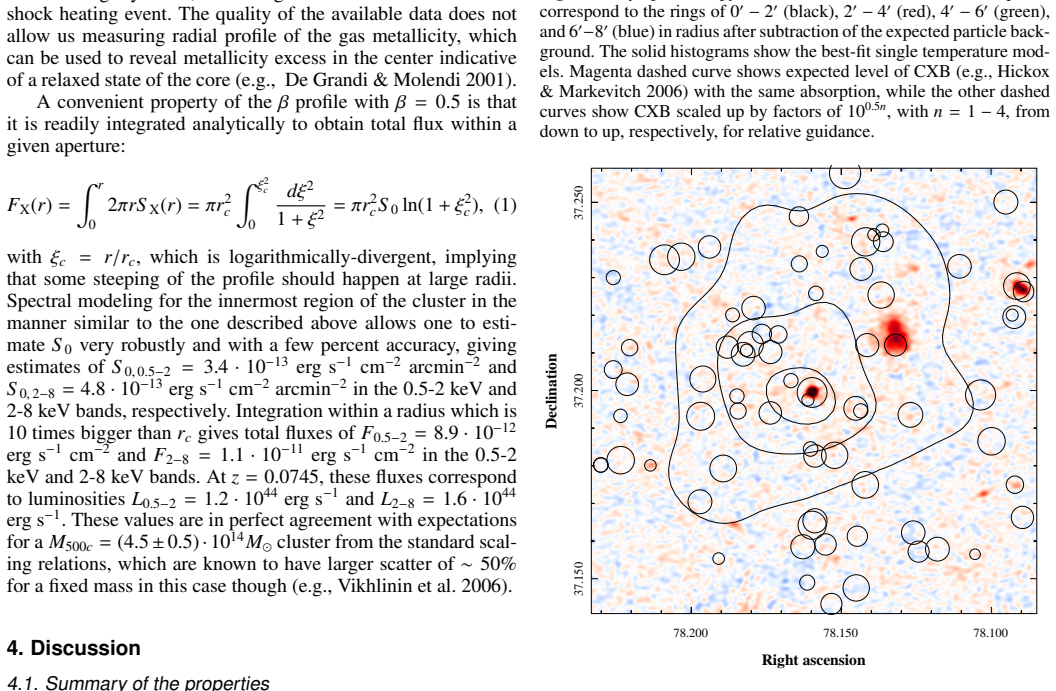
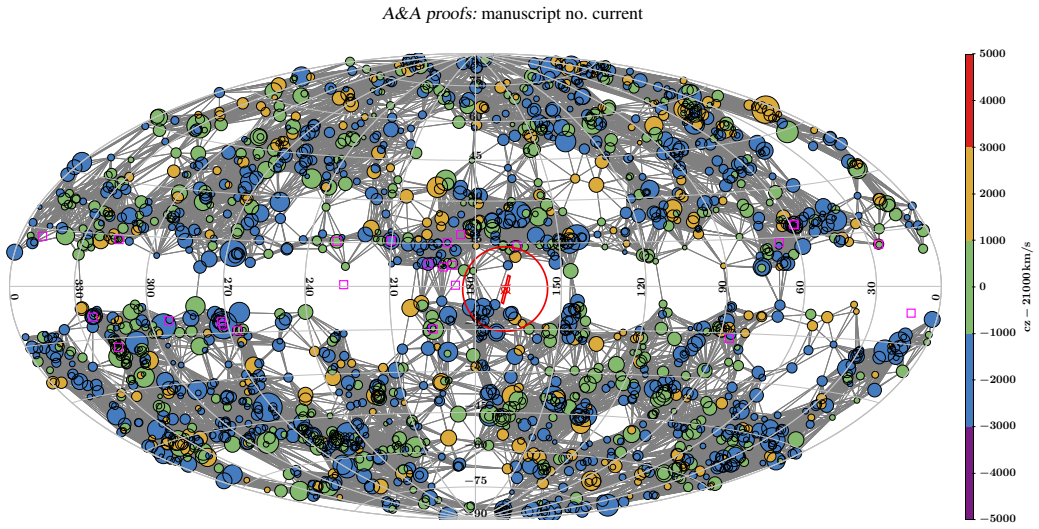
The census of massive clusters of galaxies in the local Universe is almost complete, thanks to their prominent observational signatures at X-ray, optical, and sub-mm wavelengths. Nevertheless, a number of such systems are likely to be missing and hidden behind the plane of our Galaxy, where high interstellar absorption as well as strong contamination by foreground stellar and diffuse sources prevent detection of even the brightest and the most massive ones. Here we report the discovery and multiwavelength characterization of such a cluster in the zone of avoidance (ZoA) SRGe CL0512.7+3712 in the data of SRG/eROSITA all-sky survey. Combining the data of radio, optical, and infrared surveys, we identify overdensity of possible red sequence galaxies, as well as the candidate brightest cluster galaxy. Follow-up optical and X-ray observations confirm that the newly found object is a massive ($M_{500c}=(4-5)\cdot 10^{14}M_{\odot}$, $kT\approx 5 $ keV) galaxy cluster at redshift $z=0.0745$ with possible indications of unrelaxed dynamical scale. Location and elongation of this cluster is consistent with an expectation from the large-scale structure at this redshift, and it might be a part of an extended overdensity of such objects in the Galactic Anticenter direction. Examination of X-ray, radio, and infrared data in the locations of ZoA, where similar objects are expected to be found based on the large-scale structure properties, might reveal another $\sim10$ clusters at this redshift in future.
Figures


Figures from the paper (7 more)



Forward citations
Cited by 1 Pith paper
-
The Treble Clef radio phoenix and its old nonthermal filaments
VLSS J0318.9+5755 (the Treble Clef) is a radio phoenix with ultra-steep spectrum in a massive merging cluster at z≈0.117 in the Zone of Avoidance, shaped by ICM gas motions that may also power a candidate radio halo.
Reference graph
Works this paper leans on
-
[1]
2021), launched in 2019 which started to perform the all-sky survey mission in December 2019
on board theSRGmission (Sunyaev et al. 2021), launched in 2019 which started to perform the all-sky survey mission in December 2019. We use the data accumulated over four consec- utive scans, with the total effective exposure amounting to≈850 seconds per point. Initial reduction and processing of the data were performed using standard routines of theeSASS...
work page 2021
-
[2]
has proven to be extremely efficient in detecting mas- sive galaxy clusters, the very high level of foreground Galactic emission at mm and sub-mm wavelengths makes blind detec- tions nearly impossible in the ZoA. Here, being guided by X-ray, NIR, and optical observations, we perform a check for possible traces of the thermal SZ signal in the direction of ...
work page 2023
Reviewed June 30, 2026 · model on record in the stance chip above.
Discussion (0). Continue with ORCID to comment.