REVIEW 3 major objections 5 minor 41 references
FSL-HDnn: A 40 nm Few-shot On-Device Learning Accelerator with Integrated Feature Extraction and Hyperdimensional Computing
T0 review · 3 major / 5 minor · reviewed 2026-08-03 · deepseek-v4-flash
Pith's one-line read A fabricated 40 nm chip with a frozen, weight-clustered CNN feature extractor and an HDC classifier measures 6 mJ per-image training energy, aiming to show that few-shot on-device learning can be gradient-free and single-pass.
desk verdict A fabricated 40nm FSL chip with credible measured energy (6 mJ/image) and throughput (28 images/s), but the abstract's 2–20.9x speedup claim mislabels Table I (latency 5.3–229.1x vs energy 2.0–20.9x) and depends on undocumented estimates. read the letter →
The pith
A machine-rendered reading of the paper's core claim, the machinery that carries it, and where it could break.
The reading
What carries the argument
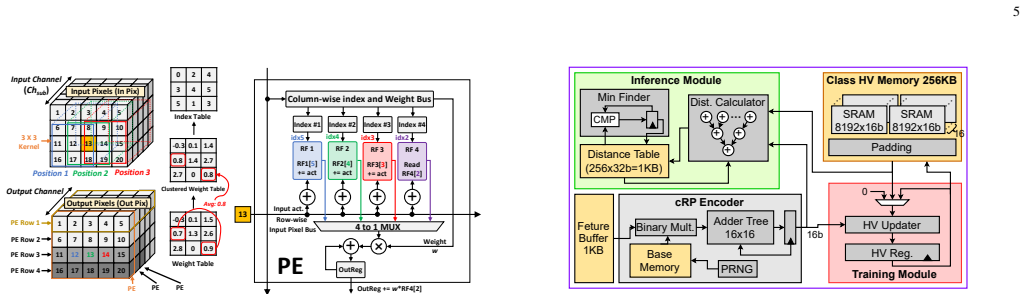
The load-bearing mechanism is the HDC classifier built on cyclic random projection (cRP) encoding. Conventional HDC encoding multiplies each feature vector by a large random matrix; cRP instead stores one 16×16 random block, generated by linear-feedback shift registers, and reconstructs the projection on the fly, cutting encoder matrix memory from O(F×D) to O(B). Training is then pure vector addition: the k encoded support samples of a class are summed into a class hypervector, and inference is a minimum-distance match. On the feature-extraction side, weight clustering groups similar filter weights into a codebook and reuses partial sums for equal indices, reducing per-convolution operations
What would settle it
Measure the same 10-way 5-shot FSL task with the same frozen pretrained CNN features and the same quantization on a prior ODL chip, on the same board, and compare per-image training energy and latency. If any prior chip measures below 6 mJ/image or below 35 ms/image under identical conditions, the claimed advantage collapses. Independently, reconcile the abstract's latency range with Table I: if 2x and 20.9x are energy ratios, state so; if they are meant as latency ratios, the table's labels are wrong.
Extended reading notes
Core claim
The paper's central claim is that the two expensive parts of on-device learning—feature extraction and classifier training—can both be made gradient-free and single-pass. A pretrained CNN is frozen after its weights are clustered into a small codebook of shared centroids, which cuts MAC operations and memory; the extracted features are encoded into high-dimensional hypervectors by a cyclic random projection encoder that generates its random matrix on the fly, and class hypervectors are learned by simply summing the hypervectors of the k support samples per class. Inference is a distance search against stored class hypervectors. The fabricated 40 nm chip measures 6 mJ/image training energy an
Load-bearing premise
The headline efficiency comparison depends on Table I's baseline numbers being fair estimates (scaled to 40 nm, 224×224 ResNet-18, five training epochs for prior chips) and on the abstract's '2–20.9x latency' wording matching Table I's energy column; if those estimates or labels are off, the relative advantage over prior ODL chips shrinks even though the absolute 6 mJ/image measurement may still be correct.
Editorial extensions
If this is right
- Few-shot adaptation on-device becomes a single forward pass plus one vector accumulation per class, eliminating backpropagation, weight transposition, and multi-epoch iteration from the training loop.
- Training energy of 6 mJ/image and roughly 1.7 s end-to-end for a 10-way 5-shot task put model personalization within reach of battery-powered edge devices, if the measurement conditions hold.
- cRP encoding reduces the HDC encoder's memory footprint by orders of magnitude, making the classifier practical in on-chip SRAM.
- Early exit and batched training compound the savings: batched training cuts per-image latency and energy by 18–32%, and early exit (starting block 2, 2 confirmations) skips 20–25% of CONV layers with less than 1% accuracy loss.
- FSL-HDnn matches fine-tuning accuracy on some datasets (Flower102: 94.1% vs 94.5%) and beats kNN by 4.9% on average, suggesting gradient-free learning does not necessarily trade away accuracy.
Reading between the lines
- The same frozen-backbone-plus-HDC recipe should transfer to other pretrained features (for example, from transformer backbones or self-supervised embeddings) and to non-image modalities, because HDC training only needs feature vectors; the paper does not test this.
- The claimed speedup over prior chips depends on Table I's estimated and scaled baselines (40 nm scaling, 224×224 ResNet-18, five epochs for prior chips); a direct measured head-to-head on identical hardware and tasks would be the cleaner test.
- The abstract's '2–20.9x latency' figure appears inconsistent with Table I, where 2x and 20.9x label the energy row and the listed latency ratios are 5.3x–229.1x; one of the two presentations is mislabeled.
- Early exit with branch class hypervectors implies a memory/accuracy tradeoff that the paper quantifies only for ResNet-18; on deeper or wider networks the 256 KB class-hypervector memory may become the binding constraint for many-way tasks.
Editorial analysis
A structured set of objections, weighed in public.
Referee Report
Summary. FSL-HDnn presents a 40 nm CMOS accelerator for end-to-end few-shot on-device learning. It combines a frozen ResNet-18 feature extractor whose weights are clustered to reduce MAC complexity, with a hyperdimensional computing (HDC) classifier that is trained in a single pass by class-HV aggregation, eliminating backpropagation. The paper also proposes a cyclic random-projection encoder to reduce HDC memory, an early-exit mechanism based on branch features, and batched single-pass training to improve PE utilization. Measured on a 10-way 5-shot task, the chip reports 6 mJ/image training energy, 28 images/s end-to-end training throughput, 1.4–2.9 TOPS/W, and FSL accuracy competitive with fine-tuning baselines on CIFAR100, Flower102, and Traffic-sign. The paper claims a 2–20.9× speedup over prior ODL chips.
Significance. If the comparative claims are properly supported, this is a significant result: a fully measured silicon implementation of a complete few-shot learning pipeline (feature extraction plus classifier) that avoids gradient-based iteration entirely, with strong energy efficiency at the edge. The absolute measured numbers—6 mJ/image training energy, 35 ms/image latency, and 28 images/s throughput—are valuable even independently of the comparison to prior chips. The architecture contributions (weight-clustered feature extractor, cRP encoder, batched single-pass training) are concrete and described in sufficient detail to be useful to the community. The main weakness is that the headline comparative advantage over SOTA ODL chips rests on undocumented estimates and on a metric mismatch between the abstract and Table I.
major comments (3)
- [Abstract, §I contribution 4, §VII; Table I] The abstract, introduction, and conclusion state a '2–20.9×' reduction in end-to-end training latency. Table I contradicts this: the 'FSL Training Latency' ratios are 8.9×, 5.3×, 23.0×, 20.4×, 5.8×, and 229.1×, while the 2.0–20.9× range appears only in the 'FSL Training Energy' column. This is not a wording issue; it changes the claim from an energy advantage to a latency advantage. Please correct the metric consistently in the abstract, introduction, conclusion, and all summary statements, or reconcile Table I with the stated claim.
- [Table I, footnote f; Fig. 19] The prior-chip FSL training latency/energy numbers are 'estimated using 10-way 5-shot task and 224×224 image @ ResNet-18; five training epochs are used for other baselines.' No estimation protocol is given: the original measured per-chip training costs, the scaling methodology from each chip's native workload to ResNet-18/224×224, dataflow/utilization assumptions, and the treatment of batch size and DRAM traffic are all absent. Since these estimates are the basis for the 2–20.9× energy claim and the visual comparison in Fig. 19, the central comparative claim is not independently checkable. Provide a reproducible derivation with source numbers, equations, and a sensitivity analysis, or restrict claims to directly measured quantities and clearly label all estimates.
- [§VI-C1, Fig. 15 and Fig. 17] The FSL accuracy comparisons are reported without error bars or the number of FSL episodes/tasks. Few-shot accuracy is known to have high variance across episodes; the claimed parity with FT (e.g., 94.1% vs 94.5% on Flower102) and the '<1% accuracy loss' of the (Es=2, Ec=2) early-exit configuration may not be statistically meaningful. Report means with standard deviations or confidence intervals, and state the episode count for each condition.
minor comments (5)
- [§VI-C2, Fig. 16] The exact measurement condition for the headline 6 mJ/image and 28 images/s is not stated. Specify the dataset, voltage/frequency, batch size, and whether this is with or without the batched-training optimization.
- [§III-B, Fig. 3(b)] The claimed '21× reduction in computing operations relative to FT' is presented only as a normalized complexity plot. Define the complexity measure and the baseline operation count in the text so the reader can reproduce the number.
- [§III-A, Fig. 5] Define Ch_sub and the 'FE error' metric precisely before using them to justify the design point. The text refers to 'Chsub' and 'Csub' interchangeably, and the error definition (e.g., distance to INT8 feature maps) is not stated.
- [Reference [24]] Reference [24] is a prior ESSERC paper with the same title. Clarify the relationship between that chip and the one reported here (same silicon vs. a new fabrication), and state what new material this manuscript adds.
- [Fig. 10] The text says '512 - 4096 × weight memory' but the figure axis is 'Memory (Norm.)'. Explain the range and the normalization baseline.
Circularity Check
No circularity: the headline measured numbers are independent silicon measurements; the main caveat is an under-specified comparison protocol, not a circular derivation.
full rationale
FSL-HDnn is an empirical chip paper. Its headline absolute numbers (6 mJ/image, 28 images/s, 35 ms/image training latency) are measured on a fabricated 40 nm chip (Section VI-A/B, Figs. 13-16), not produced by fitting or by deriving the target claim from cited HDC/weight-clustering work. The HDC encoding/training rules (Eqs. 3-5) and the weight-clustering operation reduction (Fig. 4) are presented as explicit design constructions, and Eq. (6) is a complexity model, not a prediction of measured energy. The paper does cite author-overlapping prior work — [23] for RP encoding, [28] for weight clustering, and [24] for the prior FSL-HDnn chip — but these citations are not load-bearing for the measured claims: no uniqueness theorem is imported, no alternative is excluded by self-citation, and the central contributions (cRP encoder, batched single-pass training, early exit, silicon measurements) are evaluated directly on the fabricated chip. The only substantive weakness is Table I's footnote f, which says prior-chip FSL latency/energy are 'Estimated using 10-way 5-shot task and 224×224 image @ ResNet-18. Five training epochs are used for other baselines' without giving the estimation method; this makes the comparative 2-20.9x claim hard to verify, and the abstract's phrasing conflicts with Table I (the 2-20.9x range is the energy ratio, while the latency ratios are 5.3-229.1x). That is a correctness/interpretation issue, not circularity: the baseline comparison numbers are estimates, not quantities obtained by fitting the target claim. Hence no circular step is exhibited.
Assumptions & free parameters
free parameters (5)
- Feature-extractor channel subgroup size Ch_sub =
64
- Weight-clustering centroid count N =
not stated
- HDC dimension D =
4096 (default)
- Feature quantization width =
4-bit
- Early-exit parameters (E_s, E_c) =
e.g., (2,2) for optimal balance; (1,3) and (1,2) explored
assumptions (5)
- domain assumption A frozen ImageNet-pretrained ResNet-18 provides transferable features for CIFAR-100, Flower102, and Traffic-sign few-shot tasks.
- domain assumption K-means weight clustering with shared codebooks preserves feature quality sufficient for classification.
- domain assumption Binary random-projection HDC encoding, including the cyclic PRNG-generated variant, preserves enough similarity information for few-shot classification.
- ad hoc to paper Prediction consistency across E_c consecutive CONV blocks is a valid confidence signal for early exit.
- domain assumption The power/energy measurements and the technology-scaling estimates for prior chips are accurate.
Cite this review
Pith. "Pith review of FSL-HDnn: A 40 nm Few-shot On-Device Learning Accelerator with Integrated Feature Extraction and Hyperdimensional Computing." pith.science (2026). https://pith.science/paper/UXCF52SL
@misc{pith2026251211826,
  author       = {Pith},
  title        = {Pith review of: FSL-HDnn: A 40 nm Few-shot On-Device Learning Accelerator with Integrated Feature Extraction and Hyperdimensional Computing},
  year         = {2026},
  howpublished = {\url{https://pith.science/paper/UXCF52SL}},
  note         = {Machine review of arXiv:2512.11826}
}
read the original abstract
This paper introduces FSL-HDnn, an energy-efficient accelerator that implements the end-to-end pipeline of feature extraction and on-device few-shot learning (FSL). The accelerator addresses fundamental challenges of on-device learning (ODL) for resource-constrained edge applications through two synergistic modules: a parameter-efficient feature extractor employing weight clustering and an FSL classifier based on hyperdimensional computing (HDC). The feature extractor exploits the weight clustering mechanism to reduce computational complexity, while the HDC-based FSL classifier eliminates gradient-based back propagation operations, enabling single-pass training with substantially reduced latency. Additionally, FSL-HDnn enables low-latency ODL and inference via two proposed optimization strategies, including an early-exit mechanism with branch feature extraction and batched single-pass training that improves hardware utilization. Measurement results demonstrate that our chip fabricated in a 40 nm CMOS process delivers superior training energy efficiency of 6 mJ/image and end-to-end training throughput of 28 images/s on a 10-way 5-shot FSL task. The end-to-end training latency is also reduced by 2x to 20.9x compared to state-of-the-art ODL chips.
Figures


Figures from the paper (10 more)







Reference graph
Works this paper leans on
-
[24]
Fsl-hdnn: A 5.7 tops/w end-to- end few-shot learning classifier accelerator with feature extraction and hyperdimensional computing,
H. Yang, C. E. Song, W. Xu, B. Khaleghi, U. Mallappa, M. Shah, K. Fan, M. Kang, and T. Rosing, “Fsl-hdnn: A 5.7 tops/w end-to- end few-shot learning classifier accelerator with feature extraction and hyperdimensional computing,” inIEEE European Solid-State Electronics Research Conference (ESSERC), pp. 33–36, 2024
2024
-
[1]
A survey of on-device machine learning: An algorithms and learning theory perspective,
S. Dhar, J. Guo, J. Liu, S. Tripathi, U. Kurup, and M. Shah, “A survey of on-device machine learning: An algorithms and learning theory perspective,”ACM Transactions on Internet of Things, vol. 2, no. 3, pp. 1–49, 2021
2021
-
[2]
Df-lnpu: A pipelined direct feedback alignment-based deep neural network learning processor for fast online learning,
D. Han, J. Lee, and H.-J. Yoo, “Df-lnpu: A pipelined direct feedback alignment-based deep neural network learning processor for fast online learning,”IEEE Journal of Solid-State Circuits, vol. 56, no. 5, pp. 1630– 1640, 2021
2021
-
[3]
A neural network training processor with 8-bit shared exponent bias floating point and multiple-way fused multiply-add trees,
J. Park, S. Lee, and D. Jeon, “A neural network training processor with 8-bit shared exponent bias floating point and multiple-way fused multiply-add trees,”IEEE Journal of Solid-State Circuits, vol. 57, no. 3, pp. 965–977, 2021
2021
-
[4]
CHIMERA: A 0.92-TOPS, 2.2-TOPS/W edge AI accelerator with 2-MByte on-chip foundry resistive RAM for efficient training and inference,
K. Prabhu, A. Gural, Z. F. Khan, R. M. Radway, M. Giordano, K. Koul, R. Doshi, J. W. Kustin, T. Liu, G. B. Lopes, V . Turbiner, W.-S. Khwa, Y .-D. Chih, M.-F. Chang, G. Lallement, B. Murmann, S. Mitra, and P. Raina, “CHIMERA: A 0.92-TOPS, 2.2-TOPS/W edge AI accelerator with 2-MByte on-chip foundry resistive RAM for efficient training and inference,”IEEE J...
2022
-
[5]
Trainer: An energy-efficient edge-device training processor supporting dynamic weight pruning,
Y . Wang, Y . Qin, D. Deng, J. Wei, T. Chen, X. Lin, L. Liu, S. Wei, and S. Yin, “Trainer: An energy-efficient edge-device training processor supporting dynamic weight pruning,”IEEE Journal of Solid-State Circuits, vol. 57, no. 10, pp. 3164–3178, 2022
2022
-
[6]
A 28-nm 8-bit floating- point tensor core-based programmable cnn training processor with dynamic structured sparsity,
S. K. Venkataramanaiah, J. Meng, H.-S. Suh, I. Yeo, J. Saikia, S. K. Cherupally, Y . Zhang, Z. Zhang, and J.-S. Seo, “A 28-nm 8-bit floating- point tensor core-based programmable cnn training processor with dynamic structured sparsity,”IEEE Journal of Solid-State Circuits, vol. 58, no. 7, pp. 1885–1897, 2023
2023
-
[7]
A 4.69-TOPS/W Training, 2.34-µJ/Image Inference On-Chip Training Accelerator With Inference- Compatible Backpropagation and Design Space Exploration in 28-nm CMOS,
J. Qian, H. Ge, Y . Lu, and W. Shan, “A 4.69-TOPS/W Training, 2.34-µJ/Image Inference On-Chip Training Accelerator With Inference- Compatible Backpropagation and Design Space Exploration in 28-nm CMOS,”IEEE Journal of Solid-State Circuits, vol. 60, no. 1, pp. 298–307, 2025
2025
Show all 41 references
-
[8]
An overview of energy-efficient hardware accelerators for on-device deep-neural-network training,
J. Lee and H.-J. Yoo, “An overview of energy-efficient hardware accelerators for on-device deep-neural-network training,”IEEE Open Journal of the Solid-State Circuits Society, vol. 1, pp. 115–128, 2021
2021
-
[9]
Sp-pim: A super- pipelined processing-in-memory accelerator with local error prediction for area/energy-efficient on-device learning,
J. Heo, J.-H. Kim, W. Han, J. Kim, and J.-Y . Kim, “Sp-pim: A super- pipelined processing-in-memory accelerator with local error prediction for area/energy-efficient on-device learning,”IEEE Journal of Solid-State Circuits, vol. 59, no. 8, pp. 2671–2683, 2024
2024
-
[10]
Tinytl: Reduce memory, not parameters for efficient on-device learning,
H. Cai, C. Gan, L. Zhu, and S. Han, “Tinytl: Reduce memory, not parameters for efficient on-device learning,”Advances in Neural Information Processing Systems, vol. 33, pp. 11285–11297, 2020
2020
-
[11]
T-pim: An energy- efficient processing-in-memory accelerator for end-to-end on-device training,
J. Heo, J. Kim, S. Lim, W. Han, and J.-Y . Kim, “T-pim: An energy- efficient processing-in-memory accelerator for end-to-end on-device training,”IEEE Journal of Solid-State Circuits, vol. 58, no. 3, pp. 600– 613, 2022
2022
-
[12]
Scicnn: A 0-shot-retraining patient-independent epilepsy-tracking soc,
C.-W. Tsai, R. Jiang, L. Zhang, M. Zhang, L. Wu, J. Guo, Z. Yan, and J. Yoo, “Scicnn: A 0-shot-retraining patient-independent epilepsy-tracking soc,” inIEEE International Solid-State Circuits Conference (ISSCC), pp. 488–490, 2023
2023
-
[13]
A high accuracy and ultra-energy-efficient zero- shot-retraining seizure detection processor,
J. Liu, X. Liu, X. Wang, Z. Xie, C. Guo, Z. Zhong, J. Fan, H. Qiu, Y . Xu, H. Qin, Y . Long, Y . Zhou, Z. Shen, L. Zhou, L. Chang, S. Liu, S. Lin, C. Wang, and J. Zhou, “A high accuracy and ultra-energy-efficient zero- shot-retraining seizure detection processor,”IEEE Journal ...
2024
-
[14]
Energy-efficient reconfigurable xgboost inference accelerator with modular unit trees via selective node execution and data movement,
C. E. Song, Y . Li, A. Ramnani, P. Agrawal, P. Agrawal, S.-J. Jang, S.-S. Lee, T. Rosing, and M. Kang, “Energy-efficient reconfigurable xgboost inference accelerator with modular unit trees via selective node execution and data movement,”IEEE Journal of Solid-State Circuits, p...
2025
-
[15]
Hybrid slc-mlc rram mixed-signal processing-in-memory architecture for transformer acceleration via gradient redistribution,
C. E. Song, P. Bhatnagar, Z. Xia, N. S. Kim, T. S. Rosing, and M. Kang, “Hybrid slc-mlc rram mixed-signal processing-in-memory architecture for transformer acceleration via gradient redistribution,” inProceedings of the 52nd Annual International Symposium on Computer Architect...
2025
-
[16]
On- device learning systems for edge intelligence: A software and hardware synergy perspective,
Q. Zhou, Z. Qu, S. Guo, B. Luo, J. Guo, Z. Xu, and R. Akerkar, “On- device learning systems for edge intelligence: A software and hardware synergy perspective,”IEEE Internet of Things Journal, vol. 8, no. 15, pp. 11916–11934, 2021
2021
-
[17]
Experimentally validated memristive memory augmented neural network with efficient hashing and similarity search,
R. Mao, B. Wen, A. Kazemi, Y . Zhao, A. F. Laguna, R. Lin, N. Wong, M. Niemier, X. S. Hu, X. Sheng, C. E. Graves, J. P. Strachan, and C. Li, “Experimentally validated memristive memory augmented neural network with efficient hashing and similarity search,”Nature Communications...
2022
-
[18]
Sapiens: A 64-kb rram-based non-volatile associative memory for one-shot learning and inference at the edge,
H. Li, W.-C. Chen, A. Levy, C.-H. Wang, H. Wang, P.-H. Chen, W. Wan, W.-S. Khwa, H. Chuang, Y .-D. Chih, M.-F. Chang, H.-S. P. Wong, and P. Raina, “Sapiens: A 64-kb rram-based non-volatile associative memory for one-shot learning and inference at the edge,”IEEE Transactions on...
2021
-
[19]
In-memory realization of in-situ few-shot continual learning with a dynamically evolving explicit memory,
G. Karunaratne, M. Hersche, J. Langeneager, G. Cherubini, M. L. Gallo, U. Egger, K. Brew, S. Choi, I. Ok, C. Silvestre, N. Li, N. Saulnier, V . Chan, I. Ahsan, V . Narayanan, L. Benini, A. Sebastian, and A. Rahimi, “In-memory realization of in-situ few-shot continual learning ...
2022
-
[20]
Understanding of object detection based on cnn family and yolo,
J. Du, “Understanding of object detection based on cnn family and yolo,” inJournal of Physics: Conference Series, vol. 1004, p. 012029, IOP Publishing, 2018
2018
-
[21]
Optimization as a model for few-shot learning,
S. Ravi and H. Larochelle, “Optimization as a model for few-shot learning,” inInternational Conference on Learning Representations, 2017
2017
-
[22]
Hyperdimensional computing: An introduction to computing in distributed representation with high-dimensional random vectors,
P. Kanerva, “Hyperdimensional computing: An introduction to computing in distributed representation with high-dimensional random vectors,” Cognitive Computation, vol. 1, no. 2, pp. 139–159, 2009
2009
-
[23]
A theoretical perspective on hyperdimensional computing,
A. Thomas, S. Dasgupta, and T. Rosing, “A theoretical perspective on hyperdimensional computing,”Journal of Artificial Intelligence Research, vol. 72, pp. 215–249, 2021
2021
-
[25]
Meta-transfer learning for few-shot learning,
Q. Sun, Y . Liu, T.-S. Chua, and B. Schiele, “Meta-transfer learning for few-shot learning,” inIEEE/CVF Conference on Computer Vision and Pattern Recognition, pp. 403–412, 2019
2019
-
[26]
Rethinking few-shot image classification: A good embedding is all you need?,
Y . Tian, Y . Wang, D. Krishnan, J. B. Tenenbaum, and P. Isola, “Rethinking few-shot image classification: A good embedding is all you need?,” in European Conference on Computer Vision, pp. 266–282, 2020
2020
-
[27]
Few-shot image classification: Just use a library of pre-trained feature extractors and a simple classifier,
A. Chowdhury, M. Jiang, S. Chaudhuri, and C. Jermaine, “Few-shot image classification: Just use a library of pre-trained feature extractors and a simple classifier,” inProceedings of the IEEE/CVF International Conference on Computer Vision, pp. 9445–9454, 2021
2021
-
[28]
Patternet: explore and exploit filter patterns for efficient deep neural networks,
B. Khaleghi, U. Mallappa, D. Yaldiz, H. Yang, M. Shah, J. Kang, and T. Rosing, “Patternet: explore and exploit filter patterns for efficient deep neural networks,” inACM/IEEE Design Automation Conference, pp. 223–228, 2022
2022
-
[29]
Deep residual learning for image recognition,
K. He, X. Zhang, S. Ren, and J. Sun, “Deep residual learning for image recognition,” inIEEE Conference on Computer Vision and Pattern Recognition, pp. 770–778, 2016
2016
-
[30]
Learning multiple layers of features from tiny images,
A. Krizhevsky and G. Hinton, “Learning multiple layers of features from tiny images,” 2009
2009
-
[31]
Locality-based encoder and model quantization for efficient hyper- dimensional computing,
J. Morris, R. Fernando, Y . Hao, M. Imani, B. Aksanli, and T. Rosing, “Locality-based encoder and model quantization for efficient hyper- dimensional computing,”IEEE Transactions on Computer-Aided Design of Integrated Circuits and Systems, vol. 41, no. 4, pp. 897–907, 2021
2021
-
[32]
Study and analysis of various lfsr architectures,
R. Oommen, M. K. George, and S. Joseph, “Study and analysis of various lfsr architectures,” inInternational Conference on Circuits and Systems in Digital Enterprise Technology (ICCSDET), pp. 1–6, 2018
2018
-
[33]
Branchynet: Fast inference via early exiting from deep neural networks,
S. Teerapittayanon, B. McDanel, and H.-T. Kung, “Branchynet: Fast inference via early exiting from deep neural networks,” inInternational Conference on Pattern Recognition (ICPR), pp. 2464–2469, 2016
2016
-
[34]
Locoexnet: Low-cost early exit network for energy efficient cnn accelerator design,
J. Jo, G. Kim, S. Kim, and J. Park, “Locoexnet: Low-cost early exit network for energy efficient cnn accelerator design,”IEEE Transactions on Computer-Aided Design of Integrated Circuits and Systems, vol. 42, no. 12, pp. 4909–4921, 2023
2023
-
[35]
Early-exit deep neural network-a comprehensive survey,
H. Rahmath P, V . Srivastava, K. Chaurasia, R. G. Pacheco, and R. S. Couto, “Early-exit deep neural network-a comprehensive survey,”ACM Computing Surveys, vol. 57, no. 3, pp. 1–37, 2024
2024
-
[36]
Adaptive deep neural network inference optimization with eenet,
F. Ilhan, K.-H. Chow, S. Hu, T. Huang, S. Tekin, W. Wei, Y . Wu, M. Lee, R. Kompella, H. Latapie, G. Liu, and L. Liu, “Adaptive deep neural network inference optimization with eenet,” inIEEE/CVF Winter Conference on Applications of Computer Vision, pp. 1373–1382, 2024
2024
-
[37]
Tadam: Task dependent adaptive metric for improved few-shot learning,
B. Oreshkin, P. Rodr ´ıguez L ´opez, and A. Lacoste, “Tadam: Task dependent adaptive metric for improved few-shot learning,”Advances in Neural Information Processing Systems, vol. 31, 2018
2018
-
[38]
Automated flower classification over a large number of classes,
M.-E. Nilsback and A. Zisserman, “Automated flower classification over a large number of classes,” inSixth Indian Conference on Computer Vision, Graphics & Image Processing, pp. 722–729, 2008
2008
-
[39]
Detection of traffic signs in real-world images: The german traffic sign detection 10 benchmark,
S. Houben, J. Stallkamp, J. Salmen, M. Schlipsing, and C. Igel, “Detection of traffic signs in real-world images: The german traffic sign detection 10 benchmark,” inInternational Joint Conference on Neural Networks (IJCNN), pp. 1–8, 2013
2013
-
[40]
Imagenet: A large-scale hierarchical image database,
J. Deng, W. Dong, R. Socher, L.-J. Li, K. Li, and L. Fei-Fei, “Imagenet: A large-scale hierarchical image database,” inIEEE Conference on Computer Vision and Pattern Recognition, pp. 248–255, 2009
2009
-
[41]
Deepscaletool: A tool for the accurate estimation of technology scaling in the deep-submicron era,
S. Sarangi and B. Baas, “Deepscaletool: A tool for the accurate estimation of technology scaling in the deep-submicron era,” inInternational Symposium on Circuits and Systems (ISCAS), pp. 1–5, 2021
2021
Reviewed August 3, 2026 · model on record in the stance chip above.
Discussion (0). Sign in to comment.