REVIEW 5 major objections 4 minor 41 references
AgentX: Towards Orchestrating Robust Agentic Workflow Patterns with FaaS-hosted MCP Services
T0 review · 5 major / 4 minor · reviewed 2026-08-04 · deepseek-v4-flash
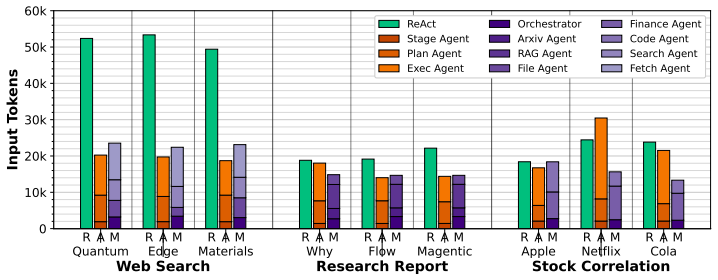
Pith's one-line read AgentX, a stage-based workflow of stage-designer, planner, and executor agents, matches or beats ReAct and Magentic-One on three tool-using applications while using 62.1% fewer input tokens on web search.
desk verdict A useful FaaS-MCP deployment recipe and a stage-based agent pattern whose engineering value is real, but the "competitive or better" headline outruns the evidence: self-graded accuracy, a weakened ReAct baseline, and no error bars. read the letter →
The pith
A machine-rendered reading of the paper's core claim, the machinery that carries it, and where it could break.
The reading
What carries the argument
The load-bearing mechanism is the three-agent stage hierarchy: Stage Generation Agent → Planner Agent → Executor Agent, with structured outputs (schemas declaring fields like sub_tasks and execution results) grounding each agent's response in parseable form. Two design choices carry the gains. Tool filtering: the Planner exposes only the tools needed for the current stage, shrinking the prompt each inference sees and reducing the chance the executor drifts to irrelevant tools. Context consolidation: after each stage the Executor summarizes only what later stages need, instead of passing raw tool output forward — the mechanism behind the input-token savings. On the deployment side, the distri
What would settle it
Have human raters and a second judge model (different from the model that generated the outputs) score the final artifacts from all three patterns with the paper's attribute weights, and rerun the comparison with the canonical ReAct pattern that includes its thought step. If canonical ReAct out-scores AgentX on accuracy, or if the judge model reverses the pattern ranking, the central 'competitive or better' claim fails. A second, cheaper check: with the same three applications, expose ten times as many tools — if AgentX's per-stage tool filtering does not widen its token-cost advantage as tool
Extended reading notes
Core claim
The paper's central claim, stated on its own terms, is that a hierarchical stage-based workflow — a Stage Generation agent that splits the user prompt into stages, a Planner agent that writes a detailed per-stage plan naming the exact tools and parameters and exposes only those tools to execution, and an Executor agent that runs the plan, reflects on tool outputs, and summarizes the essential context for the next stage — is competitive or better than the ReAct and Magentic-One patterns. On LLM-judged accuracy the pattern scores 86.7 versus 86.1 (ReAct) and 89.1 (Magentic-One) for web search, and 89.0 versus 83.9 and 87.9 for research reports, while clearly outperforming Magentic-One on stock
Load-bearing premise
The comparison rests on the evaluation protocol: outputs are scored by the same small language model that produced them, using attribute weights the authors chose (50 accuracy, 30 relevance, 10 depth, 10 breadth) with no human ground-truth check, and the ReAct baseline is a modified variant that drops the original pattern's thought step. If the judge favors one output style, or the thought-free ReAct is weaker than canonical ReAct, the headline 'competitive or better' claim d
Editorial extensions
If this is right
- Multi-step tool use can be made cheaper and more reliable by decomposing a task into stages and letting a planner pre-select tools per stage, rather than giving the executor the full toolset and conversation history.
- Context bloat in long-horizon agent tasks can be controlled by summarizing stage outputs, which keeps input token counts and therefore cost down without sacrificing output quality.
- MCP servers can be operated as serverless functions rather than long-running local processes, with state persisted externally and only relevant tools exposed per deployment; the measured cloud cost is negligible relative to LLM calls.
- Pattern-level trade-offs are quantified: ReAct is simplest with the highest success rate (100% in these experiments) but the highest token consumption on web search, while the orchestrator-style baseline is slower and, on stock correlation, prone to silently truncating or fabricating data.
- Accuracy scores stay comparable across patterns for summary-style tasks, so the practical differentiator among patterns on these workloads is cost and reliability rather than raw output quality.
Reading between the lines
- Tool filtering suggests a scaling prediction: as the number of available tools grows, AgentX's token-cost and hallucination advantage should widen, since single-context agents pay for every tool description on every inference. Measuring accuracy degradation as tool count increases (e.g., 5 vs 50 tools) would test this.
- The success-rate data hint that the stage pattern's main weakness is the absence of a recovery loop — AgentX failures come from missing context, dummy parameter values, and retrying invalid code. Adding a bounded retry/reflection mechanism, which the authors list as future work, would likely close much of the gap with the 100%-success baseline.
- The LLM-judged evaluation invites a direct robustness check: re-scoring the same outputs with a different judge model, or with human raters, would tell whether the 'competitive or better' claim is an artifact of the same model family grading its own outputs with the authors' attribute weights.
- Because the FaaS experiments changed tool descriptions alongside the hosting platform, the local-vs-FaaS comparison is cleanest read as evidence of operational feasibility, not performance parity; a controlled A/B test with identical tool descriptions on both platforms would isolate the serverless overhead (observed here as slower code execution and 13-35% slower remote tools).
Editorial analysis
A structured set of objections, weighed in public.
Referee Report
Summary. The paper proposes AgentX, a hierarchical agentic workflow pattern consisting of a Stage Generation agent, a Planner agent, and an Execution agent, together with a serverless deployment of MCP servers on AWS Lambda (distributed FaaS model with DynamoDB-backed session state). The authors evaluate AgentX against ReAct and Magentic-One on three applications—web exploration, stock-correlation plotting, and research-report generation—using local and FaaS-hosted MCP servers. They report accuracy, success rate, end-to-end latency, input/output token counts, and LLM/FaaS costs, and argue that AgentX is competitive or better than the baselines, reduces input-token consumption, and offers a viable FaaS deployment model for MCP servers.
Significance. If the empirical claims held, the paper would make two contributions: a new agentic workflow pattern that combines stage decomposition, tool filtering, and context summarization to reduce cost and context bloat, and a concrete architectural pattern for hosting MCP servers on serverless functions with session persistence. The paper is also honest in cataloguing anomalies and failure modes. However, the central 'competitive or better' claim rests on an evaluation protocol that is not yet convincing: accuracy is scored by the same LLM family that produced the outputs, the ReAct baseline omits its defining thought step, success rates actually favor ReAct, and the FaaS/local comparison is confounded by different tool descriptions and tool subsets. The systems contribution is real and worth developing, but the evidence as presented does not support the headline claim.
major comments (5)
- [Section 5.4.1, Fig. 4] Accuracy is assessed by gpt-4o-mini, the same model family that generates the outputs, using author-chosen weights (Accuracy 50, Relevance 30, Depth 10, Breadth 10) with no human ground truth, no inter-rater agreement, and no sensitivity analysis. The reported deltas are small (Web Search: 86.7 vs 86.1 vs 89.1; Research Report: 89.0 vs 83.9 vs 87.9), and no confidence intervals or significance tests are given. The LLM judge may systematically prefer one pattern's output style, so the 'competitive or better' claim is not established. Please add a human-validated or independently judged accuracy evaluation, a weight-sensitivity analysis, and statistical comparisons.
- [Section 5.1] The ReAct baseline is described as 'a divergence from the original ReAct pattern' that 'consists only of the action and observation components, omitting the thought component.' This is because LangGraph's classic ReAct implementation is limited to single-parameter tools. Since the original ReAct pattern is defined by its interleaved thought-action-observation loop, comparing against a thought-free variant confounds any 'better than ReAct' conclusion. Please use a faithful ReAct implementation that supports multi-parameter tools, or clearly scope the claim to this modified variant.
- [Section 5.4.2, Fig. 8] The reported success rates contradict the paper's framing. Locally, ReAct achieves 100% success for all applications, while AgentX achieves 80% (Web Search) and 66% (Stock Correlation) and Magentic-One 75% and 42%. This directly contradicts the §3.1 statement that AgentX shows 'higher success rate of completion, as we show in §5.4.2.' Since 'robust' is a central claim, the paper must either address why AgentX has lower completion rates, add a recovery mechanism, or substantially reframe the claim.
- [Sections 5.2 and 5.4.3] The FaaS and Local MCP setups differ not only in deployment location but also in tool descriptions and tool subsets: tool-description hints were added only to Local experiments, and FaaS MCP servers expose only a subset of tools. The paper acknowledges in §5.4.3 that the direct comparison 'is not necessarily fair' for Web Search and that the lower FaaS input-token counts are 'not a fair comparison.' These differences confound the FaaS latency, cost, and token analyses, and weaken the deployment-viability conclusions. Please run matched tool descriptions/subsets or explicitly restrict the claims to the configurations actually compared.
- [Section 5.4.2, Figs. 5–6] With approximately five runs per instance and documented outliers that move the means (e.g., Document Retriever latency 0.77–795s; AgentX 'Flow' outlier of 133s; Magentic-One 'Netflix' framework outlier of 613s; Magentic-One 'Magentic' outlier of 553s), the reported averages are highly unstable. No confidence intervals, medians, or per-run distributions are provided. Please report robust statistics and perform basic significance testing, or the latency/cost comparisons cannot be reliably interpreted.
minor comments (4)
- [Figure 2] The Figure 2 caption appears to contain duplicated or misplaced subcaptions ('Local MCP Exec.' repeated, and overlapping labels for (a), (b), (c)). Please clean up the caption to match the actual panels.
- [Throughout] There are several typos and inconsistent naming, e.g., 'Anthrophic' for Anthropic in the Introduction, and inconsistent use of 'React' vs 'ReAct'. A careful proofread is needed.
- [Section 4] The paper proposes both monolithic and distributed FaaS deployments but evaluates only the distributed one. This is stated in the text, but the abstract and Section 4 could mislead readers into thinking both were experimentally compared. Consider making the scope explicit earlier.
- [Availability] No code, prompts, or data availability statement is provided. Given the non-determinism of LLM-based experiments and the importance of exact prompts/tool descriptions, a public artifact would substantially improve reproducibility.
Circularity Check
No significant circularity: AgentX's design and empirical comparison are presented as an independent construction and external benchmark; the noted same-model grading and modified ReAct baseline are validity concerns, not derivation-circularity.
full rationale
The paper's central claims—AgentX as a stage/planner/executor pattern and the viability of FaaS-hosted MCP servers—are not derived from the measured outcomes. AgentX is specified as a new architectural pattern in Section 3, with system prompts, structured outputs, and execution flow defined independently of the results. The comparison against ReAct and Magentic-One is an external benchmark reported in Section 5, not a fitted quantity. The only self-reference is the prior workshop paper [29], mentioned as 'Preliminary ideas for the AgentX pattern' (Section 2.2) and as a pointer for future multi-LLM evaluation (Section 7); it is not load-bearing for the current experiments. The accuracy protocol (Section 5.4.1) uses gpt-4o-mini to grade outputs produced by the same model family, and the ReAct baseline omits the thought component (Section 5.1). These are real threats to external validity and could bias the comparison, but they do not make any claimed prediction equivalent to its inputs by construction; no equation or fitted parameter is renamed as a result. The paper itself acknowledges the single-LLM limitation: 'Our current study evaluates the agentic patterns only using the OpenAI GPT 4o mini LLM model. But the workflow's latency, accuracy and cost are fundamentally linked to the LLM's capabilities.' Under the specified circularity criteria, no load-bearing step reduces to its own input, so the score is low.
Assumptions & free parameters
free parameters (3)
- Accuracy attribute weights =
Accuracy 50, Relevance 30, Depth 10, Breadth 10; stock plots: Data Accuracy 50, Query Adherence 30, Plot Quality 10, Dat
- Tool-description augmentations (hints) =
'Use this tool after using the Google Search tool, when you need more detailed information from a specific web page.' ap
- Success-rate stopping rule =
Run each instance until 5 successful runs; success rate = 15 / (total runs per application)
assumptions (4)
- domain assumption The gpt-4o-mini judge produces valid quality scores without calibration against human ratings
- domain assumption A thought-free ReAct variant adequately represents the ReAct SOTA pattern
- domain assumption Per-stage executor summaries preserve enough context for later stages
- domain assumption The three templated applications generalize to practical agentic workloads
invented entities (2)
-
AgentX roles: Stage Generation Agent, Planner Agent, Execution Agent
-
Stateful FaaS-hosted MCP server using session_id persisted in DynamoDB
Cite this review
Pith. "Pith review of AgentX: Towards Orchestrating Robust Agentic Workflow Patterns with FaaS-hosted MCP Services." pith.science (2026). https://pith.science/paper/UY2LFFAX
@misc{pith2026250907595,
  author       = {Pith},
  title        = {Pith review of: AgentX: Towards Orchestrating Robust Agentic Workflow Patterns with FaaS-hosted MCP Services},
  year         = {2026},
  howpublished = {\url{https://pith.science/paper/UY2LFFAX}},
  note         = {Machine review of arXiv:2509.07595}
}
read the original abstract
Generative Artificial Intelligence (GenAI) has rapidly transformed various fields including code generation, text summarization, image generation and so on. Agentic AI is a recent evolution that further advances this by coupling the decision making and generative capabilities of LLMs with actions that can be performed using tools. While seemingly powerful, Agentic systems often struggle when faced with numerous tools, complex multi-step tasks,and long-context management to track history and avoid hallucinations. Workflow patterns such as Chain-of-Thought (CoT) and ReAct help address this. Here, we define a novel agentic workflow pattern, AgentX, composed of stage designer, planner, and executor agents that is competitive or better than the state-of-the-art agentic patterns. We also leverage Model Context Protocol (MCP) tools, and propose two alternative approaches for deploying MCP servers as cloud Functions as a Service (FaaS). We empirically evaluate the success rate, latency and cost for AgentX and two contemporary agentic patterns, ReAct and Magentic One, using these the FaaS and local MCP server alternatives for three practical applications. This highlights the opportunities and challenges of designing and deploying agentic workflows.
Figures


Figures from the paper (16 more)




Reference graph
Works this paper leans on
-
[1]
Adebowale Jeremy Adetayo, Mariam Oyinda Aborisade, and Basheer Abiodun Sanni. Mi- crosoft copilot and anthropic claude ai in education and library service.Library Hi Tech News, 2024.doi:10.1108/LHTN-01-2024-0002
-
[2]
Agent2Agent(A2A)Protocol.https://a2a-protocol.org/latest/, 2025. Accessed: 2025-07-22
work page 2025
-
[3]
Agentops: Observability platform for ai agents.https://www.agentops
AgentOps AI. Agentops: Observability platform for ai agents.https://www.agentops. ai/, 2025. Accessed: 2025-08-18
work page 2025
-
[4]
Aws lambda pricing.https://aws.amazon.com/lambda/ pricing/, 2025
Amazon Web Services, Inc. Aws lambda pricing.https://aws.amazon.com/lambda/ pricing/, 2025. Accessed: 2025-08-18
work page 2025
-
[5]
Anthropic. MCP Github, 2025. URL:https://github.com/ modelcontextprotocol/servers
work page 2025
-
[6]
MCP Lambda Handler.https://github.com/awslabs/mcp/tree/ main/src/mcp-lambda-handler, 2025
AWS Labs. MCP Lambda Handler.https://github.com/awslabs/mcp/tree/ main/src/mcp-lambda-handler, 2025. Accessed: 2025-08-18
work page 2025
-
[7]
A Survey on Prompting Techniques in LLMs
Prabin Bhandari. A survey on prompting techniques in llms.arXiv, (2312.03740), 2023. doi:10.48550/arXiv.2312.03740
work page Pith review arXiv doi:10.48550/arxiv.2312.03740 2023
-
[8]
A survey on rag meeting llms: Towards retrieval-augmented large lan- guage models
Wenqi Fan, Yujuan Ding, Liangbo Ning, Shijie Wang, Hengyun Li, Dawei Yin, Tat-Seng Chua, and Qing Li. A survey on rag meeting llms: Towards retrieval-augmented large lan- guage models. InProceedings of the 30th ACM SIGKDD conference on knowledge discovery and data mining, 2024
work page 2024
Show all 41 references
- [9]
-
[10]
Pal: Program-aided language models, 2023
Luyu Gao, Aman Madaan, Shuyan Zhou, Uri Alon, Pengfei Liu, Yiming Yang, Jamie Callan, and Graham Neubig. Pal: Program-aided language models, 2023. URL:https://arxiv. org/abs/2211.10435,arXiv:2211.10435
2023 arXiv
-
[11]
A survey on hallucination in large language models: Principles, taxonomy, challenges, and open questions.ACM Trans- actions on Information Systems, 43(2):1–55, 2025
Lei Huang, Weijiang Yu, Weitao Ma, Weihong Zhong, Zhangyin Feng, Haotian Wang, Qian- glong Chen, Weihua Peng, Xiaocheng Feng, Bing Qin, et al. A survey on hallucination in large language models: Principles, taxonomy, challenges, and open questions.ACM Trans- actions on Informa...
2025
-
[12]
Next-generation agentic ai for transforming healthcare.Informatics and Health, 2025.doi:10.1016/j.infoh.2025.03.001
Nalan Karunanayake. Next-generation agentic ai for transforming healthcare.Informatics and Health, 2025.doi:10.1016/j.infoh.2025.03.001
2025 doi
-
[13]
Xfaas: Cross- platform orchestration of faas workflows on hybrid clouds
Aakash Khochare, Tuhin Khare, Varad Kulkarni, and Yogesh Simmhan. Xfaas: Cross- platform orchestration of faas workflows on hybrid clouds. In2023 IEEE/ACM 23rd Inter- national Symposium on Cluster, Cloud and Internet Computing (CCGrid), pages 498–512, 2023.doi:10.1109/CCGrid57...
2023
-
[14]
Langgraph: Agent orchestration framework.https://langchain-ai
LangChain Inc. Langgraph: Agent orchestration framework.https://langchain-ai. github.io/langgraph/, 2025. Accessed: 2025-08-18
2025
-
[15]
Camel: communicative agents for "mind" exploration of large language model society
Guohao Li, Hasan Abed Al Kader Hammoud, Hani Itani, Dmitrii Khizbullin, and Bernard Ghanem. Camel: communicative agents for "mind" exploration of large language model society. InProceedings of the 37th International Conference on Neural Information Pro- cessing Systems, NIPS ’...
2023
-
[16]
Llava-plus: Learning to use tools for creating multimodal agents
Shilong Liu, Hao Cheng, Haotian Liu, Hao Zhang, Feng Li, Tianhe Ren, Xueyan Zou, Jianwei Yang, Hang Su, Jun Zhu, et al. Llava-plus: Learning to use tools for creating multimodal agents. InEuropean conference on computer vision. Springer, 2024. URL: https://openreview.net/forum...
2024
-
[17]
Self-refine: Iterative refinement with self-feedback, 2023.doi:10.48550/ arXiv.2303.17651
Aman Madaan, Niket Tandon, Prakhar Gupta, Skyler Hallinan, Luyu Gao, Sarah Wiegr- effe, Uri Alon, Nouha Dziri, Shrimai Prabhumoye, Yiming Yang, Shashank Gupta, Bod- hisattwa Prasad Majumder, Katherine Hermann, Sean Welleck, Amir Yazdanbakhsh, and Peter Clark. Self-refine: Iter...
- [18]
-
[19]
The landscape of emerging ai agent architectures for reasoning, planning, and tool calling: A survey.arXiv, (2404.11584), 2024.doi:10.48550/arXiv.2404.11584
Tula Masterman, Sandi Besen, Mason Sawtell, and Alex Chao. The landscape of emerging ai agent architectures for reasoning, planning, and tool calling: A survey.arXiv, (2404.11584), 2024.doi:10.48550/arXiv.2404.11584
-
[20]
Autogen: A framework for building ai agents and applications.https:// microsoft.github.io/autogen/stable/index.html, 2025
Microsoft. Autogen: A framework for building ai agents and applications.https:// microsoft.github.io/autogen/stable/index.html, 2025. Accessed: 2025-08-18
2025
-
[21]
Fiona Fui-Hoon Nah, Ruilin Zheng, Jingyuan Cai, Keng Siau, and Langtao Chen. Gen- erative ai and chatgpt: Applications, challenges, and ai-human collaboration.Journal of Information Technology Case and Application Research, 25(3):277–304, 2023.doi: 10.1080/15228053.2023.2233814
2023
-
[22]
Asurveyonmodelcontextprotocol: Architecture, state-of-the-art, chal- lenges and future directions.TechRxiv, 2025.doi:10.36227/techrxiv.174495492
ParthaPratimRay. Asurveyonmodelcontextprotocol: Architecture, state-of-the-art, chal- lenges and future directions.TechRxiv, 2025.doi:10.36227/techrxiv.174495492. 22752319
2025 doi
-
[23]
Chatgpt and open-ai models: A pre- liminary review.Future Internet, May 2023.doi:10.3390/fi15060192
Konstantinos I Roumeliotis and Nikolaos D Tselikas. Chatgpt and open-ai models: A pre- liminary review.Future Internet, May 2023.doi:10.3390/fi15060192
2023 doi
-
[24]
Enhancing trust in llm-based ai automation agents: New considerations and future challenges.arXiv preprint arXiv:2308.05391, 2023
Sivan Schwartz, Avi Yaeli, and Segev Shlomov. Enhancing trust in llm-based ai automation agents: New considerations and future challenges.arXiv preprint arXiv:2308.05391, 2023
2023 arXiv
-
[25]
Reflexion: Language agents with verbal reinforcement learning, 2023
Noah Shinn, Federico Cassano, Edward Berman, Ashwin Gopinath, Karthik Narasimhan, and Shunyu Yao. Reflexion: Language agents with verbal reinforcement learning, 2023. URL:https://arxiv.org/abs/2303.11366,arXiv:2303.11366
2023 arXiv
-
[26]
Agentic ai: A whitepaper, December 2024
Allan Smeyatsky. Agentic ai: A whitepaper, December 2024. URL:https://www. linkedin.com/pulse/agentic-ai-whitepaper-allan-smeyatsky-fpgff/
2024
-
[27]
What chatgpt and generative ai mean for science.Nature, 614, February 2023
Chris Stokel-Walker and Richard Van Noorden. What chatgpt and generative ai mean for science.Nature, 614, February 2023. URL:https://www.nature.com/articles/ d41586-023-00340-6
2023
-
[28]
Building better ai agents: A provocation on the utilisation of persona in llm-based conversational agents
Guangzhi Sun, Xiao Zhan, and Jose Such. Building better ai agents: A provocation on the utilisation of persona in llm-based conversational agents. In6th ACM Conference on Conversational User Interfaces, 2024.doi:10.1145/3640794.366588
2024
-
[29]
Towards orchestrating agentic applications as faas workflows
Shiva Sai Krishna Anand Tokal, Vaibhav Jha, Anand Eswaran, Praveen Jayachandran, and Yogesh Simmhan. Towards orchestrating agentic applications as faas workflows. In2025 IEEE International Parallel and Distributed Processing Symposium Workshops (IPDPSW), pages 1003–1010, 2025....
2025
-
[30]
Creating large language model applications utilizing langchain: A primer on developing llm apps fast
Oguzhan Topsakal and Tahir Cetin Akinci. Creating large language model applications utilizing langchain: A primer on developing llm apps fast. InInternational conference on applied engineering and natural sciences, 2023.doi:10.59287/icaens.1127
2023 doi
-
[31]
Llama: Open and efficient foundation language models.arXiv, (2302.13971), 2023
Hugo Touvron, Thibaut Lavril, Gautier Izacard, Xavier Martinet, Marie-Anne Lachaux, Timothée Lacroix, Baptiste Rozière, Naman Goyal, Eric Hambro, Faisal Azhar, et al. Llama: Open and efficient foundation language models.arXiv, (2302.13971), 2023. doi:10.48550/arXiv.2302.13971
-
[32]
Attention is all you need
AshishVaswani, NoamShazeer, NikiParmar, JakobUszkoreit, LlionJones, AidanNGomez, Ł ukasz Kaiser, and Illia Polosukhin. Attention is all you need. InAdvances in Neural In- formation Processing Systems, 2017. URL:https://papers.nips.cc/paper_files/ paper/2017/hash/3f5ee243547dee...
2017
-
[33]
Coco matrix: Taxonomy of cognitive contributions in co-writing with intelligent agents
Ruyuan Wan, Simret Araya Gebreegziabher, Toby Jia-Jun Li, and Karla Badillo-Urquiola. Coco matrix: Taxonomy of cognitive contributions in co-writing with intelligent agents. InProceedings of the 16th Conference on Creativity & Cognition, pages 504–511, 2024. doi:10.1145/3635636.366426
2024
-
[34]
A review on code generation with llms: Application and evaluation
Jianxun Wang and Yixiang Chen. A review on code generation with llms: Application and evaluation. In2023 IEEE International Conference on Medical Artificial Intelligence (MedAI), pages 284–289. IEEE, 2023.doi:10.1109/MedAI59581.2023.00044
2023
-
[35]
Plan-and-solve prompting: Improving zero-shot chain-of-thought reasoning by large language models.arxiv, (2305.04091), 2023.doi:10.48550/arXiv.2305.04091
Lei Wang, Wanyu Xu, Yihuai Lan, Zhiqiang Hu, Yunshi Lan, Roy Ka-Wei Lee, and Ee-Peng Lim. Plan-and-solve prompting: Improving zero-shot chain-of-thought reasoning by large language models.arxiv, (2305.04091), 2023.doi:10.48550/arXiv.2305.04091
-
[36]
Prompt engineering in consistency and reliability with the evidence-based guideline for llms.NPJ digital medicine, 7(41), 2024.doi:0.1038/s41746-024-01029-4
Li Wang, Xi Chen, XiangWen Deng, Hao Wen, MingKe You, WeiZhi Liu, Qi Li, and Jian Li. Prompt engineering in consistency and reliability with the evidence-based guideline for llms.NPJ digital medicine, 7(41), 2024.doi:0.1038/s41746-024-01029-4
2024
-
[37]
Chi, Quoc V
Jason Wei, Xuezhi Wang, Dale Schuurmans, Maarten Bosma, Brian Ichter, Fei Xia, Ed H. Chi, Quoc V. Le, and Denny Zhou. Chain-of-thought prompting elicits reasoning in large language models. InProceedings of the 36th International Conference on Neural Information Processing Syst...
2022
-
[38]
White, Doug Burger, and Chi Wang
QingyunWu, GaganBansal, JieyuZhang, YiranWu, BeibinLi, Erkang(Eric)Zhu, LiJiang, Xiaoyun Zhang, Shaokun Zhang, Ahmed Awadallah, Ryen W. White, Doug Burger, and Chi Wang. Autogen: Enabling next-gen llm applications via multi-agent conversation. InCOLM 2024, August 2024. URL:htt...
2024
- [39]
-
[40]
Alignment for efficient tool calling of large language models.arXiv, (2503.06708), 2025
Hongshen Xu, Zihan Wang, Zichen Zhu, Lei Pan, Xingyu Chen, Lu Chen, and Kai Yu. Alignment for efficient tool calling of large language models.arXiv, (2503.06708), 2025. doi:10.48550/arXiv.2503.06708
-
[41]
React: Synergizing reasoning and acting in language models
Shunyu Yao, Jeffrey Zhao, Dian Yu, Nan Du, Izhak Shafran, Karthik Narasimhan, and Yuan Cao. React: Synergizing reasoning and acting in language models. InInternational Conference on Learning Representations (ICLR), 2023.doi:10.48550/arXiv.2210. 03629. 34
2023 doi
Reviewed August 4, 2026 · model on record in the stance chip above.
Discussion (0). Sign in to comment.