REVIEW 3 major objections 5 minor 34 references
Cone-jet Stokes solutions in strong viscous flows: the vanishing flow rate limit
T0 review · 3 major / 5 minor · reviewed 2026-08-07 · deepseek-v4-flash
Pith's one-line read The paper establishes local conical Stokes-flow solutions for steady tip streaming in the vanishing flow rate limit, with cone angle scaling as the square root of the viscosity ratio.
desk verdict A real analytical step forward on the local Stokes cone-jet problem, but the universal prefactor k is a conjecture the authors themselves flag; it deserves a serious referee even though the strong-flow selection mechanism is not closed. read the letter →
The pith
A machine-rendered reading of the paper's core claim, the machinery that carries it, and where it could break.
The reading
What carries the argument
The load-bearing object is the separable Stokes stream function in spherical coordinates, Ψ = R^(3/2+β) f(cos θ), whose angular part is a combination of associated Legendre functions. For a conical interface the authors keep two similarity parts: an $R^{2}$ part (the 'stress solution') carrying the outer viscous stress, and an $R^{0}$ part (the 'flux solution') carrying the emitted flow rate q. The slender-body route reduces the cone-jet structure to a single first-order ODE for the scaled radius H(ξ), with the local capillary number Ca as the only parameter; the relation α = (1 − $\sqrt$(1 − (8Ca)^2))/(4Ca) λ^(1/2) connects the two descriptions. This machinery makes the cone angle a function of the outer flow strength rather than a free geometric parameter.
What would settle it
A direct numerical Stokes simulation with fixed viscosity ratio (say λ = 0.025) and a strong extensional flow, following the cone-jet shape as Q is reduced, would falsify the claim if the local cone angle does not approach α = 2 λ^(1/2) or if no conical intermediate region appears before the jet vanishes.
Extended reading notes
Core claim
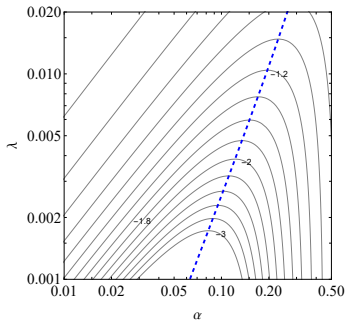
The central claim is that steady tip streaming in the vanishing flow rate limit possesses local conical Stokes solutions, giving an intermediate asymptotically self-similar cone from which a vanishingly thin cylindrical jet is emitted. Concretely, the paper derives a conical stream function as a superposition of an $R^{2}$ stress term and an $R^{0}$ flux term in spherical coordinates, evaluating boundary conditions at the conical interface; then a regularized cone-jet variant is matched at an intermediate angle χ. A parallel slender-body route produces a similarity solution H(ξ) governed by a first-order ordinary differential equation with a single parameter, the local capillary number Ca = u0(z0) μ0 λ^(1/2)/γ. This solution exists only for Ca ≤ 1/8, and the critical value Ca = 1/8 gives the cone angle α = 2 λ^(1/2); for Ca > 1/8 the profile becomes exponentially widening rather than conical. Full numerical simulations of the cone-jet transition, with the analytical solution imposed as the far-field boundary condition, agree with the slender-body theory as the flow rate Q approaches zero.
Load-bearing premise
The load-bearing premise is that the outer flow can select the local capillary number Ca and, for strong flows, tunes it exactly to the critical value 1/8; if that selection fails, strong outer flows produce cusp-like tips instead of cones and the universal prefactor k is not fixed by the local theory.
Editorial extensions
If this is right
- Flow focusing and tip-streaming devices can in principle tune the emitted jet diameter continuously toward zero while the cone angle remains finite and depends on the viscosity ratio.
- The maximum cone angle for a given liquid pair is α_max = 2 λ^(1/2), so the viscosity ratio sets a purely geometric bound on conical tips.
- Above the critical local capillary number Ca = 1/8, conical solutions cease to exist; strong outer flows should drive the system toward the critical conical state rather than toward sharper conical shapes.
- When the viscosity ratio is small, the slender-body similarity solution gives a universal cone-jet profile, so results from different macroscopic geometries collapse onto one curve after rescaling.
Reading between the lines
- If the conjectured selection mechanism holds, where the outer flow tunes the local capillary number exactly to Ca = 1/8, then the prefactor k in α = k λ^(1/2) is pinned at 2 for any sufficiently strong macroscopic flow, making the cone angle a purely local prediction testable without knowing the far-field geometry.
- The parameter-free slender-body structure suggests a direct experimental test: measure the cone slope and jet radius in a microfluidic flow-focusing device and compare the full H(ξ) profile with the predicted similarity curve.
- An analogous local conical solution may exist for other interface-pinching problems driven by electric or inertial stresses, with the critical capillary number replaced by the corresponding dimensionless stress-balance parameter.
Editorial analysis
A structured set of objections, weighed in public.
Referee Report
Summary. The paper studies steady tip streaming of a low-viscosity inner liquid into a viscous outer flow in the limit of vanishing emitted flow rate. It constructs local conical Stokes-flow solutions by three routes: (i) an exact separable conical solution of the biharmonic equation with an internal recirculating flow, which has a logarithmic singularity on the outer axis; (ii) an approximate "cone-jet" solution in which the exact cone solution is matched to a regular cylindrical jet solution by minimizing a matching error; and (iii) a slender-body lubrication similarity solution that reduces the cone-jet transition to a single ODE with a local capillary number Ca. The slender-body analysis yields the scaling α = (1 - sqrt(1-(8Ca)^2))/(4Ca) λ^(1/2), with a critical value Ca = 1/8 corresponding to the maximum cone angle α = 2λ^(1/2). The paper conjectures that strong outer flows tune Ca to 1/8 and supports this with numerical solutions of an extensional flow.
Significance. The main conceptual contribution is to provide a slender-body framework in which the cone angle in the vanishing flow-rate limit is controlled by a single local capillary number, with no fitted parameters in the similarity reduction; this is a valuable step toward a theoretical basis for tip streaming, analogous to Taylor's cone. The critical value Ca = 1/8 and the resulting α ∝ λ^(1/2) scaling for the cone angle are clean analytical results that are consistent with the first approach's asymptotic Eq. (19). If the selection of Ca by the outer flow could be established, the prefactor k would be determined. The paper is also honest in stating that the selection mechanism and the matching accuracy are not yet rigorously resolved.
major comments (3)
- [4.2 / 5.2] The claim that strong macroscopic flows tune the local capillary number to Cacr = 1/8 is a conjecture, as the authors explicitly state after Eq. (52) ("More detailed analysis is required to determine this"). The numerical evidence in Figure 12 does not confirm it: the extrapolated values of Ca2 are 0.113 (C = 0.09), 0.116 (C = 0.11), and 0.118 (C = 0.3), all below 0.125, and the convergence of Ca2 - Ca becomes slower as C increases. Consequently, the prefactor k in α = k λ^(1/2) is not fixed by the present theory; the λ^(1/2) scaling is supported, but the asymptotic value k = 2 for strong flows remains undetermined and should not be stated as a result without qualification.
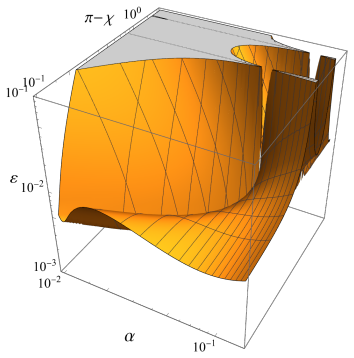
- [3.2 / Appendix A] The cone-jet solution is not an exact matched solution. The text states that the matching system (32) has no nontrivial exact solution because the transversality conditions of Morse-Sard's theorem fail, and the matching angle χ is instead chosen by minimizing the error norm (58), with the resulting χ(α;λ) fitted by the seven-parameter expression (59). This is an approximate procedure whose error is not controlled by a small parameter. As a result, the comparison in Section 5.1 is between the slender-body ODE and an approximate construct, not an independent validation of the full cone-jet structure.
- [3.1 / 3.2] The exact conical solution (11)-(14) has a logarithmic singularity on the outer axis (θ = π), as acknowledged in the text ("does not completely solve our problem"). The regularization in Section 3.2 removes this singularity only through the approximate matching procedure just described. Thus the "exact" solution cannot by itself support the claimed conical intermediate structure; the physical content rests on the regularized approximate solution, and the abstract's wording "approximate local conical solutions" should be carried through the introduction and conclusions with the same emphasis.
minor comments (5)
- [3.3] In Eq. (35) the subscripts i and j are used inconsistently in the far-field boundary condition; please correct the index notation.
- [3.2.1] The list of 11 unknowns is not immediately clear from the bullet enumeration: the eight coefficients G_{2,i}, G_{3,i}, A_{3,1}, A_{3,2} plus RJ, α, and χ should be counted explicitly.
- [5.2 / Figure 10] The definition of Ca2 is given in the caption as using the interface velocity u(z0), while the text says it is defined at the same axial location z = z0 as Ca; please state explicitly which velocity is used and why convergence of Ca2 to Ca is expected, since Ca2 is not identical to the slender-body Ca.
- [Various] There are several typographical errors: "margenta" for "magenta" in Section 3.3, "the the Spanish" in the Funding statement, and "algabraic" in Section 3.2.1.
- [References] Reference [18] cites a website rather than a peer-reviewed source for the JAM method; a proper citation should be provided if available.
Circularity Check
No significant circularity: the α ∝ λ^(1/2) scaling is derived from the exact Stokes solution and the independent slender-body ODE, with the Ca = 1/8 selection explicitly left as a conjecture.
full rationale
The paper's central scaling claim is supported by two independent routes. Route 1: the exact conical Stokes solution (11)-(14) is obtained by imposing the stress balances and boundary conditions on a biharmonic streamfunction; the maximizing-angle formula (18)-(19) is a purely algebraic consequence, yielding α_m = 2λ^(1/2) + O(λ^(3/2)). Route 2: the slender-body lubrication reduction (45)-(46) is derived from the Stokes equations and boundary balances; the similarity ansatz (47) is a distinguished limit in which Ca = O(1), h ~ λ^(1/4), and the resulting ODE (48) is solved without reference to Route 1. The linear asymptotes (50) give s± and hence (53), α = s− λ^(1/2); the prefactor s− is not imposed but follows from the ODE, and the fact that its maximum at Ca = 1/8 equals 2, matching (19), is a cross-check, not an input. The Ca = 1/8 selection for strong outer flows is explicitly conjectural ('More detailed analysis is required to determine this'), so it is not claimed as a derived result. The numerical comparisons in Sec. 5.2 fit Ca from full simulations to compare profiles; this is validation of the similarity structure, not a fitted parameter renamed as a prediction. Self-citations [13] and [24] supply background and an external numerical benchmark; the benchmark data are independent of the present derivation and do not carry the load of the scaling argument. No step reduces by construction to its input, and no load-bearing uniqueness claim is imported from self-citation.
Assumptions & free parameters
free parameters (4)
- Ca (local capillary number) =
Not fitted; it is matched to the outer flow, with example values 0.113, 0.116 and 0.118 in Fig 11.
- α (cone angle) in the cone-jet analytical solution =
Free parameter; example values used include 0.05, 0.077 and 0.173.
- χ (matching angle) fitting parameters {A, x1, x2, φ1, φ2, δ1, δ2} =
{0.71, 1.32, 1.58, 1.05, 3.0, 13.0, 14.0}.
- z0 (transition point) =
Not specified; it is determined implicitly by matching.
assumptions (6)
- domain assumption The flow is steady, incompressible, and inertia-less (Stokes) in both fluids.
- domain assumption There exists an intermediate scale l with l0 ≪ l ≪ lµ where the meniscus is locally conical.
- domain assumption The disturbance of the jet on the outer flow is a line distribution of two-dimensional point sources along the axis, u' = (0, A(z)/r).
- domain assumption The inner jet flow is a parabolic lubrication profile (42).
- ad hoc to paper The similarity ansatz (47) with h ~ λ^(1/4) H(ξ) and ξ ~ λ^(1/4)(z - z0).
- ad hoc to paper For strong macroscopic flows, the local capillary number is tuned to its critical value Ca = 1/8.
invented entities (1)
-
Axial line of stokeslets ('drawing line')
Cite this review
Pith. "Pith review of Cone-jet Stokes solutions in strong viscous flows: the vanishing flow rate limit." pith.science (2026). https://pith.science/paper/UYKG5TQM
@misc{pith2026250524741,
  author       = {Pith},
  title        = {Pith review of: Cone-jet Stokes solutions in strong viscous flows: the vanishing flow rate limit},
  year         = {2026},
  howpublished = {\url{https://pith.science/paper/UYKG5TQM}},
  note         = {Machine review of arXiv:2505.24741}
}
abstract
Steady tip streaming in the vanishing flow rate limit has been evidenced both experimentally and numerically in the literature. However, local conical Stokes flow solutions supporting these results at vanishing small scales around the emitting tip have remained elusive. This work presents approximate local conical solutions in liquid-liquid flow focusing and tip streaming, in general, as the limit of a macroscopic vanishing issued flow rate. This provides mathematical foundations for the existence of an asymptotically vanishing scale at the tip of an intermediate conical flow geometry with angle $\alpha$. For a sufficiently small inner-to-outer liquid viscosity ratio $\lambda$, these solutions exhibit a universal power-law relationship between this ratio and the cone angle as $\alpha=k \lambda^{1/2}$, where the prefactor $k$, of the order of unity, depends on the geometric details of the macroscopic flow. This confirms the existing proposals that anticipate the use of flow focusing and tip streaming technologies for tight control of microscopic scales, down to those where diffuse liquid-liquid interfaces become manifested.
Figures


Figures from the paper (12 more)




Reference graph
Works this paper leans on
-
[1]
S. L. Anna, N. Bontoux, and H. A. Stone. Formation of dispersions using flow focusing in microchannels. Appl. Phys. Lett., 82:364–366, 2003
work page 2003
-
[2]
J. D. Buckmaster. Pointed bubbles in slow viscous flow. J. Fluid Mech., 55:385–400, 1972
work page 1972
-
[3]
E. Castro-Hern´ andez, F. Campo-Cort´ es, and J. M. Gordillo. Slender-body theory for the generation of micrometre-sized emulsions through tip stream- ing. J. Fluid Mech., 698:423–445, 2012
work page 2012
-
[4]
M. Cloupeau and B. Prunet-Foch. Electrostatic spraying of liquids in cone- jet mode. J. Electrostatics, 22:135–159, 1989
work page 1989
-
[5]
S. Courrech du Pont and J. Eggers. Sink flow deforms the interface between a viscous liquid and air into a tip singularity. Phys. Rev. Lett., 96:034501, 2006
work page 2006
-
[6]
S. Courrech du Pont and J. Eggers. Fluid interfaces with very sharp tips in viscous flow. Proc. Natl. Acad. Sci., 117:32238–32243, 2020
work page 2020
-
[7]
J. Dong, M. Meissner, M.A. Faers, J. Eggers, A.M. Seddon, and C.P. Royall. Opposed flow focusing: Evidence of a second order jetting transition. Soft Matter, 14(41):8344–8351, 2018
work page 2018
-
[8]
J. Eggers. Theory of bubble tips in strong viscous flows. Phys. Rev. Fluids, 6:044005, 2021
work page 2021
Show all 34 references
-
[9]
Eggers and S
J. Eggers and S. Courrech du Pont. Numerical analysis of tips in viscous flow. Phys. Rev. E, 79:066311, 2009
2009
-
[10]
J. B. Fenn, M. Mann, C. K. Meng, S. F. Wong, and C. M. Whitehouse. Elec- trospray ionization for mass spectrometry of large biomolecules. Science, 246:64–71, 1989
1989
-
[11]
Fern´ andez de la Mora
J. Fern´ andez de la Mora. The fluid dynamics of Taylor cones. Annu. Rev. Fluid Mech., 39:217–243, 2007
2007
-
[12]
A. M. Ga˜ n´ an-Calvo. Generation of steady liquid microthreads and micron- sized monodisperse sprays in gas streams. Phys. Rev. Lett., 80:285–288, 1998. 36
1998
-
[13]
A. M. Ga˜ n´ an-Calvo, R. Gonz´ alez-Prieto, P. Riesco-Chueca, M. A. Herrada, and M. Flores-Mosquera. Focusing capillary jets close to the continuum limit. Nat. Phys., 3:737–742, 2007
2007
-
[14]
A. M. Ga˜ n´ an-Calvo and J. M. Gordillo. Perfectly monodisperse microbub- bling by capillary flow focusing. Phys. Rev. Lett., 87:274501, 2001
2001
-
[15]
A. M. Ga˜ n´ an-Calvo, J. M. L´ opez-Herrera, M. A. Herrada, A. Ramos, and J. M. Montanero. Review on the physics of electrospray: from electrokinet- ics to the operating conditions of single and coaxial Taylor cone-jets, and AC electrospray. J. Aerosol Sci., 125:32–56, 2018
2018
-
[16]
Ga˜ n´ an-Calvo and J.M
A.M. Ga˜ n´ an-Calvo and J.M. Montanero. Self-similar electrohydrodynamic solutions in multiple coaxial taylor cones. J. Fluid Mech., 915:R1, 2021
2021
-
[17]
Happel and H
J. Happel and H. Brenner. Low Reynolds number hydrodynamics. Kluwer Academic Publishers, Dordrecht, 1973
1973
-
[18]
M. A. Herrada. This method has recently been termed JAM (Ja- cobian Analytical Method). Examples of JAM codes can be found at https://github.com/miguelherrada/JAM., 2023
2023
-
[19]
A Herrada and J
M. A Herrada and J. M. Montanero. A numerical method to study the dynamics of capillary fluid systems. J. Comput. Phys., 306:137–147, 2016
2016
-
[20]
C. H. Liu and Daniel D. Joseph. Stokes flow in conical trenches. SIAM J. Appl. Math., 34(2):286–296, 1978
1978
-
[21]
J. M. Montanero and A. M. Ga˜ n´ an-Calvo. Dripping, jetting and tip stream- ing. Rep. Prog. Phys., 83:097001, 2020
2020
-
[22]
A.P. Morse. The behaviour of a function on its critical set. Annals Math., 40:62–70, 1939
1939
-
[23]
Ramos and A
A. Ramos and A. Castellanos. Conical points in liquid-liquid interfaces subjected to electric fields. Phys. Lett. A, 184:268–272, 1994
1994
-
[24]
Rubio, J.M.Montanero, J
M. Rubio, J.M.Montanero, J. Eggers, and M.A. Herrada. Stable production of fluid jets with vanishing diameters via tip streaming. J. Fluid Mech., 983:A4, 2024
2024
-
[25]
F. D. Rumscheidt and S. G. Mason. Particle motions in sheared suspensions XII. Deformation and burst of fluid drops in shear and hyperbolic flows. J. Colloid Sci., 16:238–261, 1961
1961
-
[26]
A. Sard. The measure of the critical values of differentiable maps. Bull. Am. Math. Soc., 48:883–890, 1942
1942
-
[27]
H . A. Stone and L. G . Leal. Relaxation and breakup of an initially extended drop in an otherwise quiescent fluid. J. Fluid Mech, 198:399–427, 1989. 37
1989
-
[28]
H. A. Stone. Dynamics of drop deformation and breakup in viscous fluids. Ann. Rev. Fluid Mech., 26:65–102, 1994
1994
-
[29]
Suryo and O
R. Suryo and O. A. Basaran. Tip streaming from a liquid drop forming from a tube in a co-flowing outer fluid. Phys. Fluids, 18:082102, 2006
2006
-
[30]
G. Taylor. Disintegration of water drops in electric field. Proc. R. Soc. Lond. A, 280:383–397, 1964
1964
-
[31]
G. I. Taylor. The formation of emulsions in definable fields of flow. Proc. R. Soc. London, Ser. A, 146:501–523, 1934
1934
-
[32]
G. I. Taylor. Conical free surfaces and fluid interfaces, volume Applied Mechanics, pages 790–796. Springer-Verlag Berlin Heidelberg, 1966
1966
-
[33]
J. Zeleny. Instability of electrified liquid surfaces. Phys. Rev., 10:1–6, 1917
1917
-
[34]
W. Zhang. Viscous entrainment from a nozzle: Singular liquid spouts. Phys. Rev. Lett., 93:184502, 2004. 38
2004
Reviewed August 7, 2026 · model on record in the stance chip above.
Discussion (0). Sign in to comment.