Two-Dimensional Locally Adaptive Non-Hydrostatic Extension of Shallow Water Equations
Pith reviewed 2026-06-29 00:38 UTC · model grok-4.3
The pith
Locally applying non-hydrostatic corrections to shallow water equations reduces computational cost by about 40% in tsunami-like scenarios without loss of accuracy.
A machine-rendered reading of the paper's core claim, the machinery that carries it, and where it could break.
Core claim
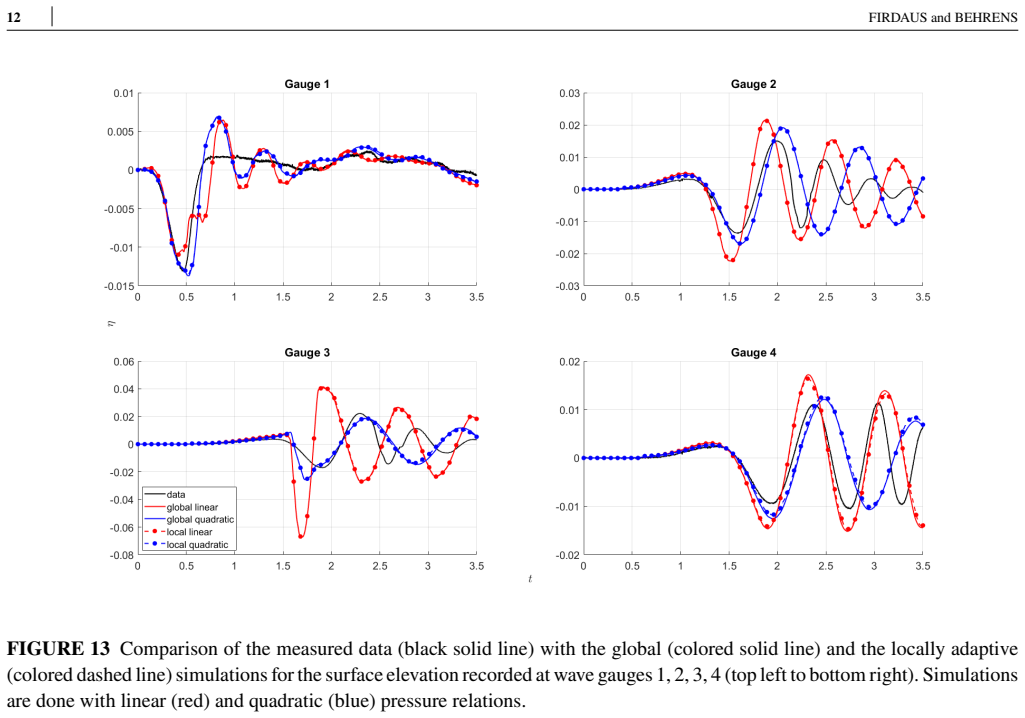
The model applies a non-hydrostatic correction to the shallow water equations in a predictor-corrector scheme, but only locally in areas identified by the ratio of total water depth to surface elevation and by horizontal velocity norms. This selective application reduces the computational effort by approximately 40% compared to uniform application while maintaining accuracy in standard test cases including wave trains over a semi-circular shoal and static and moving bottom tsunami-like wave propagation.
What carries the argument
The local adaptation mechanism that selects regions for non-hydrostatic correction based on depth-elevation ratio and velocity norms within a predictor-corrector framework.
If this is right
- Tsunami propagation models can handle larger domains at the same computational expense.
- The elliptic solver for corrections runs only on subsets of the grid, lowering overall runtime.
- Accuracy in dispersive wave effects is preserved in critical areas like shoals.
- Interface between hydrostatic and non-hydrostatic regions does not introduce significant errors in the tested scenarios.
Where Pith is reading between the lines
- Similar local adaptation could apply to three-dimensional or other physics extensions in fluid models.
- Combining this with mesh refinement might yield even greater efficiency gains in variable-resolution setups.
- Further tests on highly nonlinear or breaking waves would clarify the limits of the indicators.
Load-bearing premise
The chosen indicators reliably identify all regions where non-hydrostatic effects matter without missing critical areas or introducing interface errors.
What would settle it
A new wave scenario in which the indicators fail to flag a dispersion-critical zone, producing wave heights or phases that deviate from a full non-hydrostatic reference solution.
Figures
read the original abstract
We introduce a two-dimensional non-hydrostatic model for shallow water wave dispersion. The model is based on a locally adapted application of a non-hydrostatic correction to the hydrostatic shallow water equations (SWE) in a predictor-corrector scheme. Applying the non-hydrostatic correction uniformly to the entire domain demands a high computational cost, since an elliptic system of equations needs to be solved for the correction terms. We demonstrate that by determining the area where the non-hydrostatic effects are significant, and applying the correction only locally, the computational effort can be reduced by approximately 40\% without sacrificing accuracy in tsunami-like scenarios. As indicators for the non-hydrostatic effect, we use the ratio between total water depth and surface elevation, as well as horizontal velocity norms. Results are shown for several well-known test cases, including wave trains over a semi-circular shoal, static, and moving bottom tsunami-like wave propagation.
Editorial analysis
A structured set of objections, weighed in public.
Referee Report
Summary. The manuscript introduces a two-dimensional non-hydrostatic extension of the shallow water equations based on a predictor-corrector scheme with locally adaptive application of the elliptic correction. Regions for the non-hydrostatic correction are identified using two heuristic indicators (ratio of total water depth to surface elevation, and horizontal velocity norms), yielding an empirical reduction in computational cost of approximately 40% with no reported loss of accuracy on tsunami-like test cases including wave trains over a semi-circular shoal and static/moving-bottom tsunami generation.
Significance. If the local indicators prove robust, the approach would provide a practical efficiency gain for dispersive shallow-water models in large-domain applications such as tsunami forecasting, where full-domain elliptic solves dominate cost. The work demonstrates the savings empirically on standard benchmarks and credits the underlying non-hydrostatic formulation, offering a concrete step toward scalable non-hydrostatic modeling without requiring new theoretical derivations.
major comments (3)
- [Methodology on locally adaptive scheme] Section describing the indicator thresholds: the two indicators are controlled by free thresholds whose values are chosen per test case; no sensitivity study is presented showing that the reported 40% savings and accuracy hold under modest threshold perturbations, which directly bears on whether the local scheme reliably generalizes beyond the presented suite.
- [Shoal test case results] Results section on the semi-circular shoal test: the claim of maintained accuracy rests on visual comparison of surface elevation snapshots; quantitative L2 or L-infinity error norms between the locally adaptive solution and the full non-hydrostatic reference solution are not reported, leaving the 'without sacrificing accuracy' assertion unsupported by the data shown.
- [Predictor-corrector scheme] Section on the predictor-corrector implementation: no analysis or numerical test addresses continuity of the non-hydrostatic pressure correction or velocity at the dynamic interfaces between hydrostatic and non-hydrostatic cells; abrupt switching could introduce local artifacts not captured by the chosen tsunami-like benchmarks.
minor comments (2)
- The abstract and introduction would benefit from an explicit statement of the precise error metric (e.g., relative L2 norm) used to assert 'maintained accuracy'.
- Figure captions for the tsunami tests could include the specific threshold values employed for each indicator to aid reproducibility.
Simulated Author's Rebuttal
We thank the referee for the constructive comments. We address each major point below and indicate the revisions that will be incorporated.
read point-by-point responses
-
Referee: Section describing the indicator thresholds: the two indicators are controlled by free thresholds whose values are chosen per test case; no sensitivity study is presented showing that the reported 40% savings and accuracy hold under modest threshold perturbations, which directly bears on whether the local scheme reliably generalizes beyond the presented suite.
Authors: The thresholds are selected empirically according to the physical interpretation of the indicators to identify regions of significant dispersion in tsunami-like flows. They are not arbitrary but tuned to the wave characteristics of each benchmark while remaining consistent across the test suite. To strengthen the generalization claim, we will add a sensitivity analysis in the revised manuscript by varying each threshold by ±10% and ±20% on the semi-circular shoal case and reporting the resulting changes in both computational cost and solution fidelity. revision: yes
-
Referee: Results section on the semi-circular shoal test: the claim of maintained accuracy rests on visual comparison of surface elevation snapshots; quantitative L2 or L-infinity error norms between the locally adaptive solution and the full non-hydrostatic reference solution are not reported, leaving the 'without sacrificing accuracy' assertion unsupported by the data shown.
Authors: We agree that quantitative norms provide stronger evidence than visual inspection alone. Although the snapshots already indicate close agreement with the full non-hydrostatic reference, we will compute and tabulate L2 and L-infinity norms of surface elevation against the reference solution at representative times in the revised results section. revision: yes
-
Referee: Section on the predictor-corrector implementation: no analysis or numerical test addresses continuity of the non-hydrostatic pressure correction or velocity at the dynamic interfaces between hydrostatic and non-hydrostatic cells; abrupt switching could introduce local artifacts not captured by the chosen tsunami-like benchmarks.
Authors: The non-hydrostatic pressure correction is solved only inside the locally marked region and is identically zero outside it; the velocity update is performed uniformly, so the correction field is continuous by construction at the moving interfaces. No spurious artifacts appeared in any of the presented benchmarks. We will add a concise paragraph in the methodology section explaining this interface treatment and its continuity properties. revision: partial
Circularity Check
No circularity; local adaptation and savings are empirical outcomes of chosen indicators on test cases
full rationale
The paper introduces a predictor-corrector non-hydrostatic extension to SWE and selects two explicit local indicators (depth-to-elevation ratio and velocity norms) to decide where the elliptic correction is applied. The 40% cost reduction is reported as a measured outcome on standard tsunami and shoal benchmarks after applying those fixed thresholds; no parameter is fitted to the target accuracy metric, no result is renamed as a prediction, and no load-bearing premise rests on self-citation. The central claim therefore remains an independent numerical demonstration rather than a definitional or self-referential reduction.
Axiom & Free-Parameter Ledger
free parameters (1)
- thresholds for indicators
axioms (1)
- domain assumption Standard assumptions of shallow water equations hold in the hydrostatic part.
Reference graph
Works this paper leans on
-
[1]
Kirby JT, Grilli ST, Horrillo J, et al. Validation and inter-comparison of models for landslide tsunami generation.Ocean Modelling2022; 170: 101943. doi: https://doi.org/10.1016/j.ocemod.2021.101943 14 FIRDAUS and BEHRENS
-
[2]
Glimsdal S, Pedersen GK, Harbitz CB, Løvholt F. Dispersion of tsunamis: does it really matter?.Natural Hazards and Earth System Sciences2013; 13(6): 1507–1526. doi: 10.5194/nhess-13-1507-2013
-
[3]
Abadie S, Morichon D, Grilli S, Glockner S. Numerical simulation of waves generated by landslides using a multiple-fluid Navier–Stokes model.Coastal Engineering2010; 57(9): 779-794. doi: https://doi.org/10.1016/j.coastaleng.2010.03.003
-
[4]
doi: https://doi.org/10.1016/j.apm.2021.02.014
AiC,MaY,YuanC,XieZ,DongG.Athree-dimensionalnon-hydrostaticmodelfortsunamiwavesgeneratedbysubmarine landslides.Applied Mathematical Modelling2021; 96: 1-19. doi: https://doi.org/10.1016/j.apm.2021.02.014
-
[5]
Yuk D, Yim S, Liu PF. Numerical modeling of submarine mass-movement generated waves using RANS model.Com- puters & Geosciences2006; 32(7): 927-935. Computer Simulation of natural phenomena for Hazard Assessmentdoi: https://doi.org/10.1016/j.cageo.2005.10.028
-
[6]
Higher–order Boussinesq–type equations for surface gravity waves: derivation and analysis
Madsen PA, Schäffer HA. Higher–order Boussinesq–type equations for surface gravity waves: derivation and analysis. Philosophical Transactions of the Royal Society of London. Series A: Mathematical, Physical and Engineering Sciences 1998; 356(1749): 3123-3181. doi: 10.1098/rsta.1998.0309
-
[7]
Madsen PA, Bingham HB, Schäffer HA. Boussinesq-type formulations for fully nonlinear and extremely dispersive water waves: derivation and analysis.Proceedings of the Royal Society of London. Series A: Mathematical, Physical and Engineering Sciences2003; 459(2033): 1075-1104. doi: 10.1098/rspa.2002.1067
-
[8]
doi: https://doi.org/10.1016/j.coastaleng.2005.11.002
MadsenPA,FuhrmanDR,WangB.ABoussinesq-typemethodforfullynonlinearwavesinteractingwitharapidlyvarying bathymetry.Coastal Engineering2006; 53(5): 487-504. doi: https://doi.org/10.1016/j.coastaleng.2005.11.002
-
[9]
Fuhrman DR, Madsen PA. Tsunami generation, propagation, and run-up with a high-order Boussinesq model.Coastal Engineering2009; 56(7): 747-758. doi: 10.1016/j.coastaleng.2009.02.004
-
[10]
Fang K, Liu Z, Sun J, Xie Z, Zheng Z. Development and validation of a two-layer Boussinesq model for simulating free surface waves generated by bottom motion.Applied Ocean Research2020; 94: 101977. doi: https://doi.org/10.1016/j.apor.2019.101977
-
[11]
Dutykh D, Kalisch H. Boussinesq modeling of surface waves due to underwater landslides.Nonlinear Processes in Geophysics2013; 20(3): 267–285. doi: 10.5194/npg-20-267-2013
-
[12]
Stelling G, Zijlema M. An accurate and efficient finite-difference algorithm for non-hydrostatic free-surface flow with application to wave propagation.International Journal for Numerical Methods in Fluids2003; 43(1): 1-23. doi: 10.1002/fld.595
-
[13]
doi: https://doi.org/10.1002/fld.1019
WaltersRA.Asemi-implicitfiniteelementmodelfornon-hydrostatic(dispersive)surfacewaves.International Journal for Numerical Methods in Fluids2005; 49(7): 721-737. doi: https://doi.org/10.1002/fld.1019
-
[14]
YamazakiY,KowalikZ,CheungKF.Depth-integrated,non-hydrostaticmodelforwavebreakingandrun-up.International Journal for Numerical Methods in Fluids2009; 61(5): 473-497. doi: 10.1002/fld.1952
-
[15]
Jeschke A, Pedersen GK, Vater S, Behrens J. Depth-averaged non-hydrostatic extension for shallow water equations with quadraticverticalpressureprofile:equivalencetoBoussinesq-typeequations.International Journal for Numerical Methods in Fluids2017; 84(10): 569-583. doi: 10.1002/fld.4361
-
[16]
Wang W, Martin T, Kamath A, Bihs H. An improved depth-averaged nonhydrostatic shallow water model with quadratic pressure approximation.International Journal for Numerical Methods in Fluids2020; 92(8): 803-824. doi: 10.1002/fld.4807
-
[17]
Dempwolff LC, Windt C, Bihs H, Melling G, Holzwarth I, Goseberg N. Hydrodynamic coupling of multi-fidelity solvers in REEF3D with application to ship-induced wave modelling.Coastal Engineering2024; 188: 104452. doi: 10.1016/j.coastaleng.2023.104452
-
[18]
Green AE, Naghdi PM. A derivation of equations for wave propagation in water of variable depth.Journal of Fluid Mechanics1976; 78(2): 237–246. doi: 10.1017/S0022112076002425 FIRDAUS and BEHRENS 15
-
[19]
Locally Adaptive Non-Hydrostatic Shallow Water Extension for Moving Bottom-Generated Waves
Firdaus K, Behrens J. Locally Adaptive Non-Hydrostatic Shallow Water Extension for Moving Bottom-Generated Waves. International Journal for Numerical Methods in Fluids2026; 98(2): 159-173. doi: https://doi.org/10.1002/fld.70021
-
[20]
Firdaus K, Behrens J. Non-Hydrostatic Model for Simulating Moving Bottom-Generated Waves: A Shallow Water Exten- sion With Quadratic Vertical Pressure Profile.International Journal for Numerical Methods in Fluids2025; 97(8): 1093-1103. doi: https://doi.org/10.1002/fld.5393
-
[21]
Optimal dispersion with minimized Poisson equations for non-hydrostatic free surface flows
Cui H, Pietrzak J, Stelling G. Optimal dispersion with minimized Poisson equations for non-hydrostatic free surface flows. Ocean Modelling2014; 81: 1-12. doi: https://doi.org/10.1016/j.ocemod.2014.06.004
-
[22]
Popinet S. A vertically-Lagrangian, non-hydrostatic, multilayer model for multiscale free-surface flows.Journal of Computational Physics2020; 418: 109609. doi: https://doi.org/10.1016/j.jcp.2020.109609
-
[23]
An Efficient Two-Layer Non-Hydrostatic Model for Investigating Wave Run-Up Phenomena
Magdalena I, Erwina N. An Efficient Two-Layer Non-Hydrostatic Model for Investigating Wave Run-Up Phenomena. Computation2020; 8(1). doi: 10.3390/computation8010001
-
[24]
doi: https://doi.org/10.1002/fld.4762
VaterS,BeisiegelN,BehrensJ.Alimiter-basedwell-balanceddiscontinuousGalerkinmethodforshallow-waterflowswith wetting and drying: Triangular grids.International Journal for Numerical Methods in Fluids2019; 91(8): 395-418. doi: https://doi.org/10.1002/fld.4762
-
[25]
Rusanov V. The calculation of the interaction of non-stationary shock waves and obstacles.USSR Computational Mathematics and Mathematical Physics1962; 1(2): 304-320. doi: https://doi.org/10.1016/0041-5553(62)90062-9
-
[26]
Giraldo FX, Warburton T. A high-order triangular discontinuous Galerkin oceanic shallow water model.International Journal for Numerical Methods in Fluids2008; 56(7): 899-925. doi: 10.1002/fld.1562
-
[27]
Texts in Applied MathematicsSpringer New York, NY
Hesthaven JS, Warburton T.Nodal Discontinuous Galerkin Methods: Algorithms, Analysis, and Applications. Texts in Applied MathematicsSpringer New York, NY. 1 ed. 2008
2008
-
[28]
Schlottke-Lakemper M, Winters AR, Ranocha H, Gassner GJ. A purely hyperbolic discontinuous Galerkin approach for self-gravitating gas dynamics.Journal of Computational Physics2021; 442: 110467. doi: https://doi.org/10.1016/j.jcp.2021.110467
-
[29]
Texts in Computational Science and Engineering (TCSE, Volume 24)Springer Cham
Giraldo FX.An Introduction to Element-Based Galerkin Methods on Tensor-Product Bases: Analysis, Algorithms, and Applications. Texts in Computational Science and Engineering (TCSE, Volume 24)Springer Cham . 2020
2020
-
[30]
The Limit of Applicability of Linear Wave Refraction Theory in a Convergence Zone
Whalin RW. The Limit of Applicability of Linear Wave Refraction Theory in a Convergence Zone. research report h-71-3, U.S. Army Corps of Engineers, Waterways Experiment Station; Vicksburg, MS, USA: 1971. Hydraulics Laboratory
1971
-
[31]
doi:https://doi.org/10.1016/0378-3839(92)90019- Q
MadsenPA,SørensenOR.AnewformoftheBoussinesqequationswithimprovedlineardispersioncharacteristics.Part2.A slowly-varyingbathymetry.Coastal Engineering1992;18(3):183-204. doi:https://doi.org/10.1016/0378-3839(92)90019- Q
-
[32]
doi: https://doi.org/10.1016/j.coastaleng.2012.05.008
KazoleaM,DelisA,NikolosI,SynolakisC.Anunstructuredfinitevolumenumericalschemeforextended2DBoussinesq- type equations.Coastal Engineering2012; 69: 42-66. doi: https://doi.org/10.1016/j.coastaleng.2012.05.008
-
[33]
Lannes D, Marche F. A new class of fully nonlinear and weakly dispersive Green–Naghdi models for efficient 2D simulations.Journal of Computational Physics2015; 282: 238-268. doi: https://doi.org/10.1016/j.jcp.2014.11.016
-
[34]
BriggsMJ,SynolakisCE,HarkinsGS,GreenDR.Laboratoryexperimentsoftsunamirunuponacircularisland.Pure and Applied Geophysics1995; 144(3): 569–593. doi: 10.1007/BF00874384
-
[35]
Runup of solitary waves on a circular Island.Journal of Fluid Mechanics1995; 302: 259–285
Liu PLF, Cho YS, Briggs MJ, Kanoglu U, Synolakis CE. Runup of solitary waves on a circular Island.Journal of Fluid Mechanics1995; 302: 259–285. doi: 10.1017/S0022112095004095
-
[36]
Experimental Study of Tsunami Generation by Three-Dimensional Rigid Underwater Landslides
Enet F, Grilli ST. Experimental Study of Tsunami Generation by Three-Dimensional Rigid Underwater Landslides. Journal of Waterway, Port, Coastal, and Ocean Engineering2007; 133(6): 442-454. doi: 10.1061/(ASCE)0733- 950X(2007)133:6(442) 16 FIRDAUS and BEHRENS
-
[37]
Macías J, Escalante C, Castro MJ. Multilayer-HySEA model validation for landslide-generated tsunamis – Part 1: Rigid slides.Natural Hazards and Earth System Sciences2021; 21(2): 775–789. doi: 10.5194/nhess-21-775-2021
-
[38]
Tarwidi D, Pudjaprasetya SR, Adytia D, Subasita N. An efficient two-dimensional non-hydrostatic model for simulating submarine landslide-generated tsunamis.Ocean Engineering2024; 310: 118750. doi: https://doi.org/10.1016/j.oceaneng.2024.118750
-
[39]
The NTHMP Landslide Tsunami Benchmark Workshop, Galveston, Texas, USA, 9–11 January 2017
Kirby J, Grilli S, Zhang C, Horrillo J, Nicolsky D, Liu PLF. The NTHMP Landslide Tsunami Benchmark Workshop, Galveston, Texas, USA, 9–11 January 2017. tech. rep., Research Report CACR-18-01; Newark, Delaware, USA: 2018. Tech. Rep
2017
discussion (0)
Sign in with ORCID, Apple, or X to comment. Anyone can read and Pith papers without signing in.