REVIEW 3 major objections 4 minor 34 references
Infinite induced-saturated graphs
T0 review · 3 major / 4 minor · reviewed 2026-08-07 · deepseek-v4-flash
Pith's one-line read Nontrivial H gets an infinite graph that turns any local edit into H
desk verdict A complete countable characterization for induced-saturation, with a strong local-perturbation theorem; the only real soft spot is the two computer-assisted exhaustive checks that carry the load for small and borderline cases. read the letter →
The pith
A machine-rendered reading of the paper's core claim, the machinery that carries it, and where it could break.
The reading
What carries the argument
The central mechanism is a fixing operation relative to a class of H-free graphs: given an H-free graph G and an unfixed pair xy, the operation glues a designed graph onto G so that the result stays in the class and any locally finite perturbation that touches xy forces an induced copy of H. The operation is driven by gatekeepers — an edge or non-edge uv of H whose removal leaves a glued copy that cannot create H — and by taking cores, iteratively peeling low-degree or twin vertices so that a construction for a smaller core extends to all graphs with that core. A scheduling lemma repeatedly applies these operations to a growing countable graph, ensuring every pair is eventually fixed while H never appears.
What would settle it
Run an independent exhaustive check: verify that every graph on 11 or fewer vertices (or its complement) falls into one of the listed cases, and independently search all bipartite graphs with |A|+|B|=12, |A| at least 5, |B| at least 3 for a 3-connected subgraph on at least 5 vertices. A single counterexample to either check would leave an exceptional H outside the proof of Theorem 1.
Extended reading notes
Core claim
On its own terms, the paper establishes Theorem 1: for every finite graph H that is not a clique or an independent set, there exists a countably infinite H-free graph G_H such that every locally finite perturbation of G_H contains an induced copy of H. The construction is not a single universal graph but a family of explicitly built graphs, each tailored to H through a sequence of fixing operations that take an unfixed pair of vertices and add a gadget — often an infinite blow-up — ensuring that any locally finite perturbation touching that pair creates a copy of H. The proof organizes all possible H into finitely many structural cases: 3-connected cores, K_{2,p} or K_{1,1,p} cores, forests with a unique maximum-degree vertex, and small exceptional graphs, with the small cases settled by an exhaustive computer-assisted check together with a scheduling lemma that upgrades fixing operations to the strong locally finite statement.
Load-bearing premise
The load-bearing assumption is that the exhaustive computer-assisted checks are error-free: the classification of every graph on at most 11 vertices (or its complement) into the proved cases, and the search showing every bipartite graph with |A|+|B|=12, |A| at least 5, |B| at least 3 contains a 3-connected subgraph on at least 5 vertices.
Editorial extensions
If this is right
- For every finite H that is not a clique or independent set, a countably infinite H-induced-saturated graph exists (Corollary 2), including for graphs like P_4 where no finite example exists.
- The space of countable H-free graphs, understood with locally finite edits as the notion of closeness, has points isolated in a very strong sense, so this space is very poorly connected.
- The construction is complement-invariant: the complement of a strongly H-induced-saturated graph is strongly H-complement-induced-saturated.
- The proof supplies explicit infinite graphs — the up-and-right graph, the torero graph, the rational geometric graph, and a blown-up lattice — that are strongly saturating for whole families of forbidden graphs at once.
- The excluded classes are exactly cliques and independent sets, so the dichotomy is sharp and cannot be relaxed.
Reading between the lines
- The fixing-operation and scheduling method suggests a general recipe: any hereditary graph class that stays closed under carefully chosen gluings can yield infinite graphs that are fragile under all locally finite edits, potentially transferring to tournaments, k-uniform hypergraphs, and edge-coloured complete graphs as the paper conjectures.
- The up-and-right graph is strongly saturating precisely for graphs one edit away from a permutation graph, hinting at a broader principle: infinite strongly saturating graphs can be engineered from hereditary classes that are almost closed under single edge edits.
- An independent brute-force verification of the small cases would make the theorem logically self-contained without relying on the correctness of the attached computer search, and would also pinpoint which exceptional graphs require the bespoke constructions of Sections 7.4 and 7.5.
Editorial analysis
A structured set of objections, weighed in public.
Referee Report
Summary. The paper proves Theorem 1: for every finite graph H that is neither a clique nor an independent set, there exists a countably infinite H-free graph G_H such that every locally finite perturbation of G_H contains an induced copy of H. This implies Corollary 2, the existence of countably infinite H-induced-saturated graphs for all such H. The proof introduces fixing operations relative to graph classes, gatekeepers, and several core notions (Section 4), and reduces the problem to four families of graphs via the structure theorem Theorem 10 for |V(H)| ≥ 12 (Section 5), with explicit constructions for forests with a unique maximum degree and for K2,p and K1,1,p 2-cores (Section 6). For |V(H)| ≤ 11, a computer-assisted classification identifies which of seven sufficient conditions hold for H or its complement, leaving eight exceptional graphs handled by ad hoc constructions (Section 7). A scheduling lemma (Lemma 17) converts fixing operations into strongly saturated graphs.
Significance. If the two computer-assisted steps are correct, Theorem 1 is a definitive and very strong answer to the existence question for infinite induced-saturated graphs: it isolates points in the space of H-free graphs under locally finite edit distance for every non-trivial H. The paper's structural toolkit (gatekeepers, cores, fixing operations) is elegant and reusable, and the explicit infinite graphs constructed (the up-and-right graph, the torero graph, the rational geometric graph) are interesting in their own right. The human-verifiable lemmas are written in detail. The main residual risk is that the two computer-assisted exhaustive checks—the bipartite claim inside the proof of Theorem 10 and the classification for graphs on at most 11 vertices in Section 7.3—are load-bearing and are not replaced by human-readable proofs; the second is backed by attached code, but the first is only asserted. If those checks are correct, the main result follows.
major comments (3)
- [Section 5, proof of Theorem 10] The sentence "This means that H contains a (not necessarily induced) bipartite subgraph H' = (A, B, E) with |A| + |B| = 12" is not justified as written, since A = V(H0) and B = V(H)\V(H0) have total size n ≥ 12, with equality only when n = 12. As written, the computer-search assertion that follows covers only the n = 12 case and Theorem 10 is not established for n > 12. Please supply the missing reduction: because |A| ≥ 5, |B| ≥ 3 and |A| + |B| ≥ 12, one can choose subsets A' ⊆ A and B' ⊆ B with |A'| + |B'| = 12, |A'| ≥ 5 and |B'| ≥ 3, and then delete edges inside the bipartite graph so that every b ∈ B' has exactly |A'| - 2 neighbours in A'; the search condition then applies to the resulting subgraph, and any 3-connected subgraph found there is also a subgraph of the original bipartite graph.
- [Section 5, proof of Theorem 10] The claim "A computer search shows that there is indeed a 3-connected subgraph on at least 5 vertices in every such bipartite graph" is load-bearing for Theorem 10 and hence for Theorem 1, yet it is stated with no description of the algorithm, no specification of the search space or the exact predicates checked, and no certificate or explicit pointer to code in this section. The text should either (a) give a complete, reproducible description of the finite check (code, canonical labelling method, and verifiable output), or (b) replace this step with a human-readable proof. As it stands, a reader cannot independently verify the key reduction for large graphs.
- [Section 7.3 and proof of Theorem 1] The exhaustive classification of graphs on at most 11 vertices is load-bearing for Theorem 1 in the small case, but the paper only sketches the gatekeeper check and refers to attached code. Please specify precisely which conditions are tested (the seven bullets in Section 7 plus their complements), how subgraph isomorphism with coloured vertices is decided, and how the completeness of the enumeration is guaranteed. In addition, the statement in the proof of Theorem 1 that "There are 8 graphs (E?qw, F?S|w, F?q|w and F?q w , and their complements)" uses names that are garbled in the text; a table with adjacency lists or readable names for these eight graphs would make the final cases checkable.
minor comments (4)
- [Section 2.4] The outline says "graphs H on at most 7 vertices in Section 7", but Section 7 actually handles graphs on at most 11 vertices; please correct the bound.
- [Section 5, proof of Lemma 12] The claims that H[A2 ∪ B1 ∪ B2] contains K4,2,2 and that H[A3 ∪ B1 ∪ B2 ∪ B3] contains K2,1,1,1 appear to hold in the complement of H rather than in H, since by construction there are no edges between A2 and B2 in H; if an overline was lost in the text, please correct the notation for these two subgraphs.
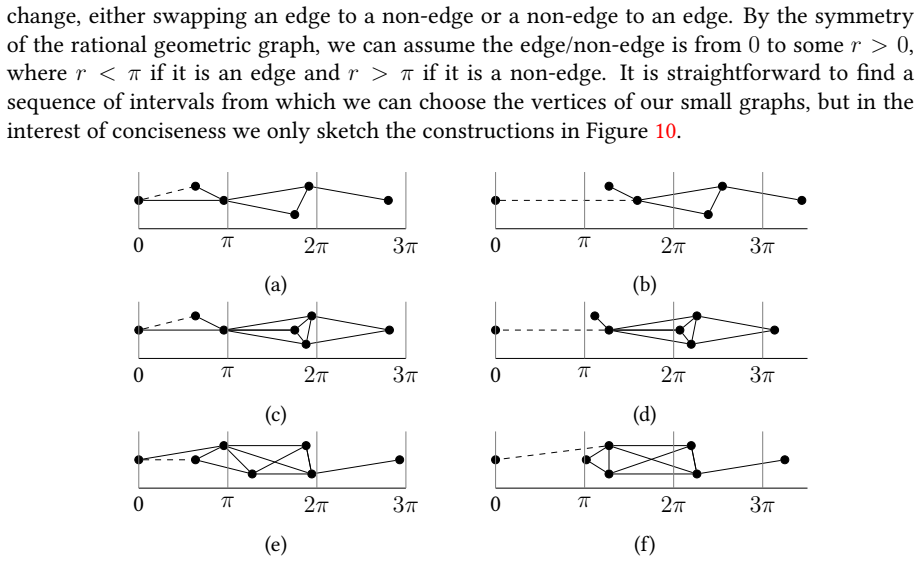
- [Section 7.4] The verification for the three graphs handled by the rational geometric graph is deferred to Figure 10 with the remark "we only sketch the constructions"; for a formal proof, a table of explicit rational coordinates for each of the three graphs would be preferable.
- [Section 7.1, proof of Theorem 19] The proof uses the phrase "the up and right graph is vertex transitive"; this is true for translations by rationals, but a one-sentence justification or a reference would help the reader.
Circularity Check
No circularity: the proof is self-contained and the only self-citation is motivational.
full rationale
No circularity found. The paper's target property, strong H-induced-saturation, is not assumed or fitted: fixing operations, gatekeepers, and cores are introduced as general definitions, and the paper proves their existence for each class of H via explicit gluing constructions and scheduling arguments (e.g., Lemmas 3, 7-9, 14-17) rather than importing the conclusion. The one self-citation, reference [3], is used only as motivational history for the P5 case and is not invoked in the proof of Theorem 1 or in any lemma; it is therefore not load-bearing. The computer-assisted checks in Section 7.3 and in the proof of Theorem 10 are finite exhaustive verifications that reduce the theorem to the proved cases; they involve no fitted parameters and the eight residual graphs are handled by separate explicit constructions (Sections 7.4-7.5), so any computational error would be a verifiability or correctness risk rather than a circularity. Theorem 19's characterization is proved from the definition of permutation graphs, and Lemma 17 is a genuine scheduling proof, not a definitional restatement of strong saturation. The derivation chain is therefore self-contained apart from external computational trust.
Assumptions & free parameters
assumptions (2)
- standard math Standard ZFC set theory and the standard definitions of graphs, subgraphs, and induced subgraphs as presented in Section 3.
- domain assumption The computer-assisted searches (for graphs up to 11 vertices and for the bipartite subgraph claim in Theorem 10) are correct and exhaustive.
Cite this review
Pith. "Pith review of Infinite induced-saturated graphs." pith.science (2026). https://pith.science/paper/UZTN6BEY
@misc{pith2026250608810,
  author       = {Pith},
  title        = {Pith review of: Infinite induced-saturated graphs},
  year         = {2026},
  howpublished = {\url{https://pith.science/paper/UZTN6BEY}},
  note         = {Machine review of arXiv:2506.08810}
}
abstract
A graph $G$ is $H$-induced-saturated if $G$ is $H$-free but deleting any edge or adding any edge creates an induced copy of $H$. There are non-trivial graphs $H$, such as $P_4$, for which no finite $H$-induced-saturated graph $G$ exists. We show that for every finite graph $H$ that is not a clique or an independent set, there always exists a countable $H$-induced-saturated graph. In fact, we show that a far stronger property can be achieved: there is a countably infinite $H$-free graph $G$ such that any graph $G'\ne G$ obtained by making a locally finite set of changes to $G$ contains a copy of $H$.
Figures


Figures from the paper (10 more)




Reference graph
Works this paper leans on
-
[1]
M. Axenovich and M. Csik ´os. Induced saturation of graphs. Discrete Mathematics , 342(4):1195–1212, 2019
work page 2019
-
[2]
S. Behrens, C. Erbes, M. Santana, D. Yager and E. Yeager. Graphs with induced saturation number zero. Electronic Journal of Combinatorics, 23(1):#P1.54, 2016
work page 2016
- [3]
-
[4]
P. J. Cameron and J. Neˇsetˇril. Homomorphism-homogeneous relational structures. Com- binatorics, Probability and Computing, 15(1-2):91–103, 2006
work page 2006
-
[5]
G. Cherlin and S. Shelah. Universal graphs with a forbidden subtree. J. Comb. Theory Ser. B, 97(3):293–333, 2007
work page 2007
-
[6]
G. Cherlin and S. Shelah. Universal graphs with a forbidden subgraph: Block path solidity. Combinatorica, 36(3):249–264, 2016
work page 2016
-
[7]
G. Cherlin and L. Tallgren. Universal graphs with a forbidden near-path or 2-bouquet. Journal of Graph Theory, 56(1):41–63, 2007
work page 2007
-
[8]
G. L. Cherlin. The Classification of Countable Homogeneous Directed Graphs and Countable Homogeneous n-tournaments, volume 621. American Mathematical Soc., 1998
work page 1998
Show all 34 references
-
[9]
E.-K. Cho, I. Choi and B. Park. On induced saturation for paths. European Journal of Combinatorics, 91:103204, 2021
2021
-
[10]
B. L. Currie, J. R. Faudree, R. J. Faudree and J. R. Schmitt. A survey of minimum saturated graphs. Electronic Journal of Combinatorics, DS19:36, 2021
2021
-
[11]
R. Diestel. Graph Decompositions—A Study in Infinite Graph Theory . Oxford University Press, 1990
1990
-
[12]
R. Diestel. Infinite Graphs, pages 209–281. Springer Berlin Heidelberg, Berlin, Heidelberg, 2017. 27
2017
-
[13]
Diestel, R
R. Diestel, R. Hahn and W. Vogler. Some remarks on universal graphs. Combinatorica, 5:283–293, 1985
1985
-
[14]
Diestel and D
R. Diestel and D. K ¨uhn. A universal planar graph under the minor relation. Journal of Graph Theory, 32(2):191–206, 1999
1999
-
[15]
Dvo ˇr´ak
V. Dvo ˇr´ak. Pn-induced-saturated graphs exist for all n ≥ 6. Electronic Journal of Combi- natorics, 27(4):#P4.43, 2020
2020
-
[16]
Erd ˝os, A
P. Erd ˝os, A. Hajnal and J. W. Moon. A problem in graph theory. American Mathematical Monthly, 71:1107–1110, 1964
1964
-
[17]
X. Fan, S. Hajebi, S. Hajebi and S. Spirkl. Halfway to induced saturation for even cycles. arXiv preprint arXiv:2505.24100, 2025
2025 arXiv
-
[18]
F ¨uredi and P
Z. F ¨uredi and P. Komj´ath. Nonexistence of universal graphs without some trees. Combi- natorica, 17(2), 1997
1997
-
[19]
F ¨uredi and P
Z. F ¨uredi and P. Komj ´ath. On the existence of countable universal graphs. Journal of Graph Theory, 25(1):53–58, 1997
1997
-
[20]
M. Hamann. Connected-homogeneous digraphs. Habilitationsschrift, University of Ham- burg, 2014
2014
-
[21]
M. Hamann. The classification of finite and locally finite connected-homogeneous di- graphs. Combinatorica, 37:183–222, 2017
2017
-
[22]
C. W. Henson. A family of countable homogeneous graphs. Pacific J. Math., 38(1):69–83, 1971
1971
-
[23]
Komj ´ath, A
P. Komj ´ath, A. H. Mekler and J. Pach. Some universal graphs. Israel Journal of Mathe- matics, 64(2):158–168, 1988
1988
-
[24]
Komj ´ath
P. Komj ´ath. The chromatic number of infinite graphs—a survey. Discrete Mathematics, 311(15):1448–1450, 2011
2011
-
[25]
Komj ´ath and J
P. Komj ´ath and J. Pach. Universal graphs without large bipartite subgraphs.Mathematika, 31(2):282–290, 1984
1984
-
[26]
A. H. Lachlan and R. E. Woodrow. Countable ultrahomogeneous undirected graphs. Transactions of the American Mathematical Society, 262(1):51–94, 1980
1980
-
[27]
R. R. Martin and J. J. Smith. Induced saturation number. Discrete Mathematics , 312(21):3096–3106, 2012
2012
-
[28]
J. Pach. A problem of Ulam on planar graphs. European Journal of Combinatorics , 2(4):357–361, 1981
1981
-
[29]
R. Rado. Universal graphs and universal functions. Acta Arithmetica, 9:331–340, 1964
1964
-
[30]
E. R ¨aty. Induced saturation of P6. Discrete Mathematics, 343(1):111641, 2020
2020
-
[31]
J. H. Schmerl. Countable homogeneous partially ordered sets. Algebra universalis , 9(1):317–321, 1979. 28
1979
-
[32]
M. Stein. Extremal infinite graph theory. Discrete Mathematics, 311(15):1472–1496, 2011
2011
-
[33]
C. M. Tennenhouse. Induced subgraph saturated graphs. Theory and Applications of Graphs, 3(2), 2016
2016
-
[34]
Thomassen
C. Thomassen. Duality of infinite graphs. Journal of Combinatorial Theory, Series B , 33(2):137–160, 1982. 29
1982
Reviewed August 7, 2026 · model on record in the stance chip above.
Discussion (0). Sign in to comment.