REVIEW 3 major objections 4 minor 152 references
$R_{\rm e}$. II. Understanding the IC 3475 galaxy type, including ultra-diffuse galaxy, structural scaling relations
T0 review · 3 major / 4 minor · reviewed 2026-08-16 · deepseek-v4-flash
Pith's one-line read Ultra-diffuse galaxies are the faint tail of the early-type galaxy sequence, not a separate class.
desk verdict Graham makes a real contribution by quantifying the Sersic-based case that UDGs are faint ETGs, but the main 'expectation' curve is partly calibrated on the UDGs it claims to explain. read the letter →
The pith
A machine-rendered reading of the paper's core claim, the machinery that carries it, and where it could break.
The reading
What carries the argument
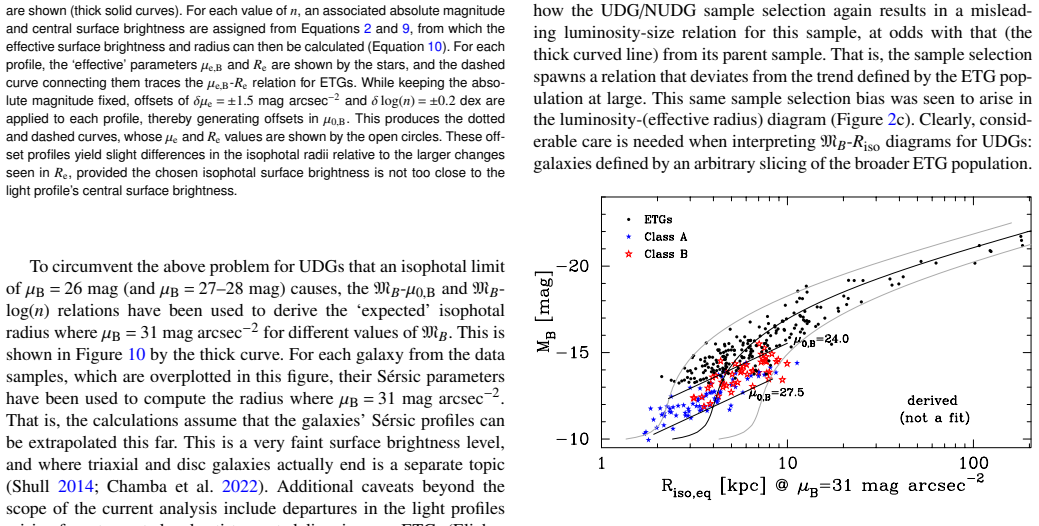
The central machinery is the Sérsic $R^{1/n}$ light-profile model, used as a bridge between three pieces: the empirical magnitude–central surface brightness relation, the empirical magnitude–Sérsic-index relation, and the analytic identity $\langle\mu\rangle_e = \mu_0 + 2.5b/\ln 10 - 2.5\log f(n)$, with $f(n)=ne^b\Gamma(2n)/b^{2n}$ and $b(n)$ fixed by enclosing half the light. Feeding the empirical relations into the magnitude–size equation yields a derived curve, Equation (10), that is not a fit: $\log R_{e,\rm eq} = 0.139M_B - 0.5\log[f(n)] + 0.217b + 1.812$, with $n = 10^{-(14.0+M_B)/10}$ from the magnitude–index relation. The same equations convert offsets in $n$ and $\mu_e$ at fixed magnitude into offsets in $\mu_0$ and hence into changes in $R_e$, which is the mechanism that explains the scatter and the apparent UDG subclasses.
What would settle it
Take a sample of faint dwarf galaxies selected purely by luminosity, with no cut on surface brightness or size, and measure their Sérsic parameters. If the $M_B$\u2013$\log n$ or $M_B$\u2013$\mu_0$ relations turn over or steepen fainter than about $M_B = -16$ mag, then the derived $R_e(M_B)$ curve is not the correct baseline and the claim that UDGs have expected sizes loses its footing. Alternatively, a single UDG whose measured $n$ and $\mu_0$ cannot reproduce its observed $R_e$ through the derived relation would falsify the reduction.
Extended reading notes
Core claim
The paper claims that relatively gas-poor ultra-diffuse galaxies are not a distinct class with unexpectedly large sizes. They are the faint extension of the same early-type-galaxy sequence: given the empirical relations between absolute magnitude and central surface brightness, and between absolute magnitude and Sérsic index, the Sérsic $R^{1/n}$ model predicts the observed large effective radii without any additional formation mechanism. The paper further claims that the scatter about the magnitude–size relation is the mapped consequence of the scatter in $\mu_0$ at fixed magnitude, driven by offsets in both $n$ and effective surface brightness $\mu_e$, and that the proposed split of gas-poor UDGs into two classes reflects this scatter rather than two genuinely different origins. It also attributes the reduced scatter in magnitude–isophotal-radius diagrams to the insensitivity of faint isophotal radii to exactly those perturbations in $n$ and $\mu_e$ that move $R_e$.
Load-bearing premise
The load-bearing premise is that the linear magnitude–surface-brightness and magnitude–Sérsic-index relations, anchored on brighter early-type galaxies, continue unchanged into the ultra-diffuse regime; because the index relation was refit after adding the UDG data, the predicted size curve is not fully independent of the galaxies it is used to validate.
Editorial extensions
If this is right
- If UDGs are the faint end of the ETG sequence, then the UDG designation thresholds (for example, $R_e \gtrsim 1.5$ kpc and $\mu_0 \gtrsim 24$ mag arcsec$^{-2}$) mark a portion of one continuous distribution rather than a physically new class.
- The size–magnitude trend seen within surface-brightness-selected UDG samples is produced by the selection slice and can run roughly orthogonal to the true ETG relation, so it should not be read as evidence for a distinct scaling law.
- The larger scatter in dynamical mass indicators such as $\sigma^2 R_e / G$ at faint magnitudes, and correlations with globular-cluster richness, trace the same $\mu_0$ scatter; arbitrary sample divisions can create apparent mass-dependent trends.
- Isophotal radii measured at a sufficiently faint surface brightness level scatter less than effective radii at fixed magnitude, making them a stabler size indicator for faint ETGs and UDGs.
Reading between the lines
- A testable consequence of the continuity claim is that a large census of dwarf galaxies selected by luminosity alone should reproduce the same linear $M_B$\u2013$\log n$ and $M_B$\u2013$\mu_0$ relations at $M_B \gtrsim -15$ mag, with no break or second sequence.
- If the explanation of UDG size via low $n$ and faint $\mu_0$ is correct, gas-rich UDGs with ongoing star formation may follow the same structural relations but shifted in $\mu_0$ because young stellar populations or disc structure alter the central light profile; the paper only gestures at this through its H I-bearing UDG comparison.
- The scatter-decomposition method could be applied to the mass–size plane at fixed stellar mass rather than luminosity, which would separate the role of mass-to-light ratio variations from structural scatter.
- Forward-modelling the $\mu_0$\u2013$R_e$ selection cuts could turn the paper's qualitative selection-bias argument into a quantitative completeness correction for deep surveys.
Signed reviews
Editorial analysis
A structured set of objections, weighed in public.
Referee Report
Summary. The paper argues that gas-poor ultra-diffuse galaxies (UDGs) are not a distinct class with unexpectedly large sizes, but rather the low-luminosity continuation of the early-type galaxy (ETG) sequence. Using the Sersic R^1/n model together with empirical M_B-mu0,B and M_B-log n relations, the author derives a curved M_B-R_e relation (Equations 10 and 13) and claims that UDGs and NUDGs lie on this curve. The paper further explains the scatter about the M_B-R_e relation through scatter in n and mu_e, explains the smaller scatter in M_B-R_iso diagrams, and argues that the two UDG classes defined by Buzzo et al. (2025) are an artifact of slicing the intrinsic scatter about the M_B-mu0 relation. The work is presented as a follow-up to the author's Paper I framework.
Significance. If the claims hold, the paper provides a useful unification: UDGs would not require separate formation channels, and their large effective radii would follow from Sersic profiles plus the empirical M_B-mu0 and M_B-log n relations. The algebraic derivation from Equations 3 to 10 is internally consistent and is a genuine strength, and the discussion of sample-selection effects in the M_B-R_e diagram (Figure 2c versus 1c) is a valuable cautionary contribution. The central weakness is that the derived 'expected' curve is partly calibrated on the UDG/NUDG sample that it is then used to validate; the paper's abstract describes the baseline as defined by brighter early-type galaxies, which is not strictly what the analysis does.
major comments (3)
- [Section 3, Equations (9) and (10); Figure 2c] The central 'expected' size-luminosity curve is not independent of the UDG/NUDG sample it is used to validate. Equation 9 is introduced as a slightly revised version of Equation 1 that 'better matches the fuller ensemble' after the UDG and NUDG data are added, and Equation 10 is then derived from Equation 9. The abstract's phrasing that UDG sizes are 'in line with expectations from ... brighter early-type galaxies' is therefore only partially supported: the brighter-ETG baseline has been recalibrated with the very objects whose consistency is the conclusion. At a central surface brightness typical of UDGs (mu0,B around 26 mag arcsec^-2), Equation 9 gives M_B about 0.4 mag fainter than Equation 1, moving log R_e by roughly 0.06 dex through the 0.139 M_B term in Equation 10; the shift is small but is set by the same sample. Please recompute the curve using only the ETG sample (e.g., Equation 1 or a refit with UDG/NUDG points excluded), extrapolate to the faint regime, and report the residuals of the UDG/NUDG points about that curve. If the revised relation is retained, quantify how much of the apparent agreement is due to the refit.
- [Section 3, Equations (1), (2), (9)-(10)] The derivation assumes that the M_B-mu0,B and M_B-log n relations are linear and universal across the full magnitude range, including the faint UDG regime. This assumption is load-bearing and is not tested. Because the UDG selection cuts (R_e,maj >= 1.5 kpc and mu0,g >= 24 mag arcsec^-2) slice the parameter space at faint magnitudes, a curvature or a change of slope in either relation at the faint end could be absorbed into Equation 9 and propagated into the derived curve. Please test for such bending by fitting the relations to the brighter ETG sample alone and extrapolating, and by reporting binned residuals in the UDG regime. If a bend is present, the continuity conclusion would need to be revised.
- [Figure 2c and Section 4.1] The claim that there is no distinct separation between IC 3475-type galaxies, UDGs, and dwarf/ordinary ETGs is currently supported by visual inspection and by the placement of the derived curve. A quantitative statement is needed: report the RMS scatter of the UDG/NUDG points about the derived M_B-R_e curve, and also about the ETG-only extrapolation, ideally compared with the scatter of the brighter ETGs at the same magnitudes. The rebuttal of the two UDG classes would also be strengthened by showing that the residuals of Class A and Class B objects about Equations (9) and (2) are statistically indistinguishable.
minor comments (4)
- [Section 2, paragraph introducing the UDG/NUDG designation] The sentence beginning 'Galaxies from from Buzzo et al. (2024, 2025)' contains a duplicated 'from' and an unmatched parenthesis; please correct this.
- [Throughout, especially Section 4] There are several typographical errors, including 'propogate', 'dynamical massses', and 'Triangal i'; these should be fixed during proofreading.
- [Figures 2 and 3, panel labels] The label 'derived (not a fit)' is technically true of the Sersic algebra, but because the input M_B-mu0 relation is refit to the full sample in Equation 9, the label may mislead readers. Consider using 'derived from fits to other relations' or explicitly listing Equations 9 and 2 as the inputs.
- [Equations (3) and (4)] The (1+z)^4 surface-brightness correction is mentioned but then disappears from the subsequent equations; please state explicitly that the cosmological correction is negligible for the nearby sample or carry the term through the derivation for clarity.
Circularity Check
Expected Re curve is not independent of the UDGs: Eq. 9 is refit after adding UDG/NUDG data, then used to derive Eq. 10.
-
fitted input called prediction
[Section 3, paragraph introducing Equations 9 and 10]
"The following slightly revised version of Equation 1 better matches the fuller ensemble of data shown in Figure 2a: MB = 0.59µ0,B,obs− 28.1,σ = 0.8mag. (9) By feeding this empirical relation into Equations 4 and 6, one derives the following relation shown by the black curve in Figure 2c. log Re,eq(kpc) = 0.139MB− 0.5 log[f (n)] + 0.217b + 1.812, (10) with n = 10−(14.0+MB)/10.0 coming from Equation 2."
Equation 10, the curve used to show that UDG sizes are 'in line with expectations', is obtained by substituting Equation 9 into the Sersic equations. Equation 9 is not the bright-ETG relation (Equation 1) but a 'slightly revised version' that 'better matches the fuller ensemble', i.e., it is refit after the UDG/NUDG data are added. Thus the 'expected' Re(M) is a transform of a fit that already includes the target galaxies; any systematic offset of UDGs in the M-mu0 plane is absorbed into the baseline and then announced as agreement. The bright-only Equation 1 would shift MB by about -0.36 mag at mu0 ~ 24 (log Re by ~0.07 dex), but this independent test is not shown. The prediction is therefore partially forced by construction.
full rationale
The paper's central quantitative step is the derivation of the size-luminosity curve from the Sersic model plus empirical M-mu0 and M-log n relations. Equation 10 is not a fit to Re, which is good; however, Equation 9 is explicitly revised to 'better match the fuller ensemble' of Figure 2a, which includes the UDG/NUDG sample. Feeding that revised relation into the Sersic equations means the 'expected' Re curve is partly calibrated with the same galaxies whose consistency with the curve is the conclusion. The unrevised Equation 1 differs from Equation 9 by about 0.36 mag in MB at mu0 ~ 24, moving log Re by about 0.07 dex toward the UDGs, so the effect is modest and the qualitative continuity claim would likely survive; but the paper never presents the bright-only extrapolation test. There is also no evidence that Equation 2 (M-log n) was refit after adding UDGs, so the n-relation and Sersic geometry provide independent content. Therefore the circularity is partial: the quantitative prediction is partly forced, not fully tautological. No other load-bearing self-citations or uniqueness imports were found; the self-citations to Paper I and Graham et al. (2006) are used for context and previous derivation, not to forbid alternatives. Score 5 reflects partial construction-based prediction, not a fully circular derivation.
Assumptions & free parameters
free parameters (3)
- Slope and intercept of the MB-mu0,B,obs relation =
0.59 and -28.1 (Equation 9); earlier 0.63 and -28.7 (Equation 1)
- Slope and intercept of the MB-log(n) relation =
-10.0 and -14.0 (Equation 2)
- Scatter sigma about the MB-mu0 relation =
0.8 mag
assumptions (4)
- domain assumption The Sersic R1/n model (Equation 5) describes the light profiles of all ETGs and UDGs, with Equations 6 to 8 connecting mu0, mu_e, n, and Re.
- domain assumption The empirical MB-mu0 and MB-log(n) relations (Equations 2 and 9) are linear and universal across the full magnitude range, including the faint UDG regime.
- domain assumption Photometric conversions from g-band AB to B-band Vega (B_AB = g_AB + 0.35 and B_Vega = B_AB + 0.12) apply to all UDGs and NUDGes.
- domain assumption The 'triangular cutout' in Figure 2a is a selection artifact rather than a real population gap in the MB-mu0 plane.
Cite this review
Pith. "Pith review of $R_{\rm e}$. II. Understanding the IC 3475 galaxy type, including ultra-diffuse galaxy, structural scaling relations." pith.science (2026). https://pith.science/paper/UZVFTLRR
@misc{pith2026250416593,
  author       = {Pith},
  title        = {Pith review of: $R_\rm e$. II. Understanding the IC 3475 galaxy type, including ultra-diffuse galaxy, structural scaling relations},
  year         = {2026},
  howpublished = {\url{https://pith.science/paper/UZVFTLRR}},
  note         = {Machine review of arXiv:2504.16593}
}
abstract
It is explained why relatively gas-poor ultra-diffuse galaxies (UDGs), a subset of IC 3475 galaxy types, do not have unexpectedly large sizes but large sizes that are in line with expectations from the curved size-luminosity relation defined by brighter early-type galaxies (ETGs). These UDGs extend the faint end of the (absolute magnitude, $\mathfrak{M}$)-log(S\'ersic index, $n$) and $\mathfrak{M}$-(central surface brightness, $\mu_{\rm 0}$) relations defined by all ETGs, leading to the large effective half-light radii, $R_{\rm e}$, in these UDGs. It is detailed how the scatter in $\mu_{\rm 0}$, at a given $\mathfrak{M}$, relates to variations in the galaxies' values of $n$ and effective surface brightness, $\mu_{\rm e}$. These variations map into changes in $R_{\rm e}$ and produce the scatter about the $\mathfrak{M}$-$R_{\rm e}$ relation at fixed $\mathfrak{M}$. Similarly, the scatter in $\mathfrak{M}$, at fixed $\mu_{\rm 0}$ and $n$, can be mapped into changes in $R_{\rm e}$. The suggestion that there may be two types of relatively gas-poor UDGs appears ill-founded, arising from the scatter about the $\mathfrak{M}$-$\mu_{\rm 0}$ relation. The increased scatter about the faint end of the $\mathfrak{M}$-$R_{\rm e}$ relation and the smaller scatter about $\mathfrak{M}$-(isophotal radii, $R_{\rm iso}$) relations are explained. Artificial and potentially misleading size-luminosity relations for UDGs are also addressed. Finally, expected trends with dynamical mass, and evolutionary pathways towards relatively gas-rich galaxies, are briefly discussed. Hopefully, the understanding presented here will prove helpful for interpreting the many low surface brightness galaxies that the Large Synoptic Survey Telescope will detect.
Figures


Figures from the paper (8 more)




Reference graph
Works this paper leans on
-
[1]
write newline
" write newline "" before.all 'output.state := FUNCTION fin.entry write newline FUNCTION new.block output.state before.all = 'skip after.block 'output.state := if FUNCTION new.sentence output.state after.block = 'skip output.state before.all = 'skip after.sentence 'output.state := if if FUNCTION not #0 #1 if FUNCTION and 'skip pop #0 if FUNCTION or pop #1...
-
[2]
Akeson R., et al., 2019, @doi [arXiv e-prints] 10.48550/arXiv.1902.05569 , https://ui.adsabs.harvard.edu/abs/2019arXiv190205569A p. arXiv:1902.05569
-
[3]
Amorisco N. C., Loeb A., 2016, @doi [ ] 10.1093/mnrasl/slw055 , https://ui.adsabs.harvard.edu/abs/2016MNRAS.459L..51A 459, L51
-
[4]
C., Monachesi A., Agnello A., White S
Amorisco N. C., Monachesi A., Agnello A., White S. D. M., 2018, @doi [ ] 10.1093/mnras/sty116 , https://ui.adsabs.harvard.edu/abs/2018MNRAS.475.4235A 475, 4235
-
[5]
Barazza F. D., Binggeli B., Jerjen H., 2002, @doi [ ] 10.1051/0004-6361:20020875 , https://ui.adsabs.harvard.edu/abs/2002A&A...391..823B 391, 823
-
[6]
Begelman M. C., Blandford R. D., Rees M. J., 1980, @doi [ ] 10.1038/287307a0 , https://ui.adsabs.harvard.edu/abs/1980Natur.287..307B 287, 307
doi:10.1038/287307a0 1980
-
[7]
Bekki K., Couch W. J., Drinkwater M. J., Gregg M. D., 2001, @doi [ ] 10.1086/323075 , https://ui.adsabs.harvard.edu/abs/2001ApJ...557L..39B 557, L39
doi:10.1086/323075 2001
-
[8]
Bell E. F., de Jong R. S., 2001, @doi [ ] 10.1086/319728 , https://ui.adsabs.harvard.edu/abs/2001ApJ...550..212B 550, 212
doi:10.1086/319728 2001
Show all 152 references
-
[9]
M., 1991, , https://ui.adsabs.harvard.edu/abs/1991A&A...252...27B 252, 27
Binggeli B., Cameron L. M., 1991, , https://ui.adsabs.harvard.edu/abs/1991A&A...252...27B 252, 27
1991
-
[10]
M., 1993, , https://ui.adsabs.harvard.edu/abs/1993A&AS...98..297B 98, 297
Binggeli B., Cameron L. M., 1993, , https://ui.adsabs.harvard.edu/abs/1993A&AS...98..297B 98, 297
1993
- [11]
-
[12]
C., 1995, , https://ui.adsabs.harvard.edu/abs/1995A&A...298...63B 298, 63
Binggeli B., Popescu C. C., 1995, , https://ui.adsabs.harvard.edu/abs/1995A&A...298...63B 298, 63
1995
-
[13]
A., 1985, @doi [ ] 10.1086/113874 , https://ui.adsabs.harvard.edu/abs/1985AJ.....90.1681B 90, 1681
Binggeli B., Sandage A., Tammann G. A., 1985, @doi [ ] 10.1086/113874 , https://ui.adsabs.harvard.edu/abs/1985AJ.....90.1681B 90, 1681
1985 doi
-
[14]
T., Graham A
Bonfini P., Dullo B. T., Graham A. W., 2015, @doi [ ] 10.1088/0004-637X/807/2/136 , https://ui.adsabs.harvard.edu/abs/2015ApJ...807..136B 807, 136
2015 doi
-
[15]
D., Impey C
Bothun G. D., Impey C. D., Malin D. F., Mould J. R., 1987, @doi [ ] 10.1086/114443 , https://ui.adsabs.harvard.edu/abs/1987AJ.....94...23B 94, 23
1987 doi
-
[16]
Buttitta C., et al., 2025, @doi [ ] 10.1051/0004-6361/202452915 , https://ui.adsabs.harvard.edu/abs/2025A&A...694A.276B 694, A276
2025 doi
-
[17]
L., et al., 2022, @doi [ ] 10.1093/mnras/stac2442 , https://ui.adsabs.harvard.edu/abs/2022MNRAS.517.2231B 517, 2231
Buzzo M. L., et al., 2022, @doi [ ] 10.1093/mnras/stac2442 , https://ui.adsabs.harvard.edu/abs/2022MNRAS.517.2231B 517, 2231
2022 doi
-
[18]
L., et al., 2024, @doi [ ] 10.1093/mnras/stae564 , https://ui.adsabs.harvard.edu/abs/2024MNRAS.529.3210B 529, 3210
Buzzo M. L., et al., 2024, @doi [ ] 10.1093/mnras/stae564 , https://ui.adsabs.harvard.edu/abs/2024MNRAS.529.3210B 529, 3210
2024 doi
-
[19]
L., et al., 2025, @doi [ ] 10.1093/mnras/stae2700 , https://ui.adsabs.harvard.edu/abs/2025MNRAS.536.2536B 536, 2536
Buzzo M. L., et al., 2025, @doi [ ] 10.1093/mnras/stae2700 , https://ui.adsabs.harvard.edu/abs/2025MNRAS.536.2536B 536, 2536
2025 doi
-
[20]
Caon N., Capaccioli M., D'Onofrio M., 1993, @doi [ ] 10.1093/mnras/265.4.1013 , https://ui.adsabs.harvard.edu/abs/1993MNRAS.265.1013C 265, 1013
1993 doi
-
[21]
Capaccioli M., 1989, in Corwin Jr. H. G., Bottinelli L., eds, World of Galaxies (Le Monde des Galaxies). pp 208--227
1989
-
[22]
J., Terndrup D
Capaccioli M., 1990, in Jarvis B. J., Terndrup D. M., eds, European Southern Observatory Conference and Workshop Proceedings Vol. 35, European Southern Observatory Conference and Workshop Proceedings. p. 231
1990
-
[23]
Carleton T., Errani R., Cooper M., Kaplinghat M., Pe \ n arrubia J., Guo Y., 2019, @doi [ ] 10.1093/mnras/stz383 , https://ui.adsabs.harvard.edu/abs/2019MNRAS.485..382C 485, 382
2019 doi
-
[24]
A., Forte J
Cellone S. A., Forte J. C., Geisler D., 1994, @doi [ ] 10.1086/192059 , https://ui.adsabs.harvard.edu/abs/1994ApJS...93..397C 93, 397
1994 doi
-
[25]
H., 2020, @doi [ ] 10.1051/0004-6361/201936821 , https://ui.adsabs.harvard.edu/abs/2020A&A...633L...3C 633, L3
Chamba N., Trujillo I., Knapen J. H., 2020, @doi [ ] 10.1051/0004-6361/201936821 , https://ui.adsabs.harvard.edu/abs/2020A&A...633L...3C 633, L3
2020 doi
-
[26]
H., 2022, @doi [ ] 10.1051/0004-6361/202243612 , https://ui.adsabs.harvard.edu/abs/2022A&A...667A..87C 667, A87
Chamba N., Trujillo I., Knapen J. H., 2022, @doi [ ] 10.1051/0004-6361/202243612 , https://ui.adsabs.harvard.edu/abs/2022A&A...667A..87C 667, A87
2022 doi
-
[27]
M., Saintonge A., Borlaff A
Chamba N., Marcum P. M., Saintonge A., Borlaff A. S., Hayes M. J., Le Gouellec V. J. M., Chojnowski S. D., Fanelli M. N., 2024, @doi [ ] 10.3847/1538-4357/ad7377 , https://ui.adsabs.harvard.edu/abs/2024ApJ...974..247C 974, 247
2024 doi
-
[29]
Ciotti L., 1991, , https://ui.adsabs.harvard.edu/abs/1991A&A...249...99C 249, 99
1991
-
[30]
J., 2018, @doi [Research Notes of the American Astronomical Society] 10.3847/2515-5172/aab7f6 , https://ui.adsabs.harvard.edu/abs/2018RNAAS...2...43C 2, 43
Conselice C. J., 2018, @doi [Research Notes of the American Astronomical Society] 10.3847/2515-5172/aab7f6 , https://ui.adsabs.harvard.edu/abs/2018RNAAS...2...43C 2, 43
2018 doi
-
[31]
D'Onofrio M., Capaccioli M., Caon N., 1994, @doi [ ] 10.1093/mnras/271.3.523 , https://ui.adsabs.harvard.edu/abs/1994MNRAS.271..523D 271, 523
1994 doi
-
[32]
L., Efstathiou G., Fall S
Davies R. L., Efstathiou G., Fall S. M., Illingworth G., Schechter P. L., 1983, @doi [ ] 10.1086/160757 , https://ui.adsabs.harvard.edu/abs/1983ApJ...266...41D 266, 41
1983 doi
-
[34]
Dekel A., Silk J., 1986, @doi [ ] 10.1086/164050 , https://ui.adsabs.harvard.edu/abs/1986ApJ...303...39D 303, 39
1986 doi
-
[35]
B., Dutton A
Di Cintio A., Brook C. B., Dutton A. A., Macci \`o A. V., Obreja A., Dekel A., 2017, @doi [ ] 10.1093/mnrasl/slw210 , https://ui.adsabs.harvard.edu/abs/2017MNRAS.466L...1D 466, L1
2017 doi
-
[36]
C., Borlaff A., Beckman J
Eliche-Moral M. C., Borlaff A., Beckman J. E., Guti \'e rrez L., 2015, @doi [ ] 10.1051/0004-6361/201424692 , https://ui.adsabs.harvard.edu/abs/2015A&A...580A..33E 580, A33
2015 doi
-
[37]
Emsellem E., et al., 2011, @doi [ ] 10.1111/j.1365-2966.2011.18496.x , https://ui.adsabs.harvard.edu/abs/2011MNRAS.414..888E 414, 888
2011
-
[38]
Errani R., Penarrubia J., Tormen G., 2015, @doi [ ] 10.1093/mnrasl/slv012 , https://ui.adsabs.harvard.edu/abs/2015MNRAS.449L..46E 449, L46
2015 doi
-
[39]
M., et al., 1997, @doi [ ] 10.1086/118606 , https://ui.adsabs.harvard.edu/abs/1997AJ....114.1771F 114, 1771
Faber S. M., et al., 1997, @doi [ ] 10.1086/118606 , https://ui.adsabs.harvard.edu/abs/1997AJ....114.1771F 114, 1771
1997 doi
-
[40]
M., Efstathiou G., 1980, @doi [ ] 10.1093/mnras/193.2.189 , https://ui.adsabs.harvard.edu/abs/1980MNRAS.193..189F 193, 189
Fall S. M., Efstathiou G., 1980, @doi [ ] 10.1093/mnras/193.2.189 , https://ui.adsabs.harvard.edu/abs/1980MNRAS.193..189F 193, 189
1980 doi
-
[41]
R., Tully R
Fisher J. R., Tully R. B., 1975, , https://ui.adsabs.harvard.edu/abs/1975A&A....44..151F 44, 151
1975
-
[42]
A., Gannon J., 2024, @doi [ ] 10.1093/mnras/stad4004 , https://ui.adsabs.harvard.edu/abs/2024MNRAS.528..608F 528, 608
Forbes D. A., Gannon J., 2024, @doi [ ] 10.1093/mnras/stad4004 , https://ui.adsabs.harvard.edu/abs/2024MNRAS.528..608F 528, 608
2024 doi
-
[44]
A., Read J
Forbes D. A., Read J. I., Gieles M., Collins M. L. M., 2018, @doi [ ] 10.1093/mnras/sty2584 , https://ui.adsabs.harvard.edu/abs/2018MNRAS.481.5592F 481, 5592
2018 doi
-
[45]
C., 1970, @doi [ ] 10.1086/150474 , https://ui.adsabs.harvard.edu/abs/1970ApJ...160..811F 160, 811
Freeman K. C., 1970, @doi [ ] 10.1086/150474 , https://ui.adsabs.harvard.edu/abs/1970ApJ...160..811F 160, 811
1970 doi
-
[46]
E., Doi M., Shimasaku K., Schneider D
Fukugita M., Ichikawa T., Gunn J. E., Doi M., Shimasaku K., Schneider D. P., 1996, @doi [ ] 10.1086/117915 , https://ui.adsabs.harvard.edu/abs/1996AJ....111.1748F 111, 1748
1996 doi
-
[47]
P., 2003, @doi [ ] 10.1086/377624 , https://ui.adsabs.harvard.edu/abs/2003AJ....126.1794G 126, 1794
Geha M., Guhathakurta P., van der Marel R. P., 2003, @doi [ ] 10.1086/377624 , https://ui.adsabs.harvard.edu/abs/2003AJ....126.1794G 126, 1794
2003 doi
-
[48]
E., Schulman L
Gerola H., Seiden P. E., Schulman L. S., 1980, @doi [ ] 10.1086/158485 , https://ui.adsabs.harvard.edu/abs/1980ApJ...242..517G 242, 517
1980 doi
-
[49]
I., Stadel J., 2010, @doi [ ] 10.1088/0004-637X/725/2/1707 , https://ui.adsabs.harvard.edu/abs/2010ApJ...725.1707G 725, 1707
Goerdt T., Moore B., Read J. I., Stadel J., 2010, @doi [ ] 10.1088/0004-637X/725/2/1707 , https://ui.adsabs.harvard.edu/abs/2010ApJ...725.1707G 725, 1707
2010 doi
-
[51]
W., 2002, @doi [ ] 10.1086/340274 , https://ui.adsabs.harvard.edu/abs/2002ApJ...568L..13G 568, L13
Graham A. W., 2002, @doi [ ] 10.1086/340274 , https://ui.adsabs.harvard.edu/abs/2002ApJ...568L..13G 568, L13
2002 doi
-
[52]
W., 2013, in Oswalt T
Graham A. W., 2013, in Oswalt T. D., Keel W. C., eds, , Vol. 6, Planets, Stars and Stellar Systems. Volume 6: Extragalactic Astronomy and Cosmology. Springer Science+Business Media, Dordrecht, pp 91--140, @doi 10.1007/978-94-007-5609-0_2
2013 doi
-
[53]
W., 2019, @doi [ ] 10.1017/pasa.2019.23 , https://ui.adsabs.harvard.edu/abs/2019PASA...36...35G 36, e035 (Paper I)
Graham A. W., 2019, @doi [ ] 10.1017/pasa.2019.23 , https://ui.adsabs.harvard.edu/abs/2019PASA...36...35G 36, e035 (Paper I)
2019 doi
-
[54]
W., 2023, @doi [ ] 10.1093/mnras/stad1124 , https://ui.adsabs.harvard.edu/abs/2023MNRAS.522.3588G 522, 3588
Graham A. W., 2023, @doi [ ] 10.1093/mnras/stad1124 , https://ui.adsabs.harvard.edu/abs/2023MNRAS.522.3588G 522, 3588
2023 doi
-
[55]
W., 2024a, @doi [ ] 10.1093/mnras/stae1193 , https://ui.adsabs.harvard.edu/abs/2024MNRAS.531..230G 531, 230
Graham A. W., 2024a, @doi [ ] 10.1093/mnras/stae1193 , https://ui.adsabs.harvard.edu/abs/2024MNRAS.531..230G 531, 230
-
[56]
W., 2024b, @doi [ ] 10.1093/mnras/stae2324 , https://ui.adsabs.harvard.edu/abs/2024MNRAS.535..299G 535, 299
Graham A. W., 2024b, @doi [ ] 10.1093/mnras/stae2324 , https://ui.adsabs.harvard.edu/abs/2024MNRAS.535..299G 535, 299
-
[57]
W., Driver S
Graham A. W., Driver S. P., 2005, @doi [ ] 10.1071/AS05001 , https://ui.adsabs.harvard.edu/abs/2005PASA...22..118G 22, 118
2005 doi
-
[58]
W., Guzm \'a n R., 2003, @doi [ ] 10.1086/374992 , https://ui.adsabs.harvard.edu/abs/2003AJ....125.2936G 125, 2936
Graham A. W., Guzm \'a n R., 2003, @doi [ ] 10.1086/374992 , https://ui.adsabs.harvard.edu/abs/2003AJ....125.2936G 125, 2936
2003 doi
-
[59]
W., Sahu N., 2023, @doi [ ] 10.1093/mnras/stad087 , https://ui.adsabs.harvard.edu/abs/2023MNRAS.520.1975G 520, 1975
Graham A. W., Sahu N., 2023, @doi [ ] 10.1093/mnras/stad087 , https://ui.adsabs.harvard.edu/abs/2023MNRAS.520.1975G 520, 1975
2023 doi
-
[60]
W., Worley C
Graham A. W., Worley C. C., 2008, @doi [ ] 10.1111/j.1365-2966.2008.13506.x , https://ui.adsabs.harvard.edu/abs/2008MNRAS.388.1708G 388, 1708
2008
-
[61]
W., de Blok W
Graham A. W., de Blok W. J. G., 2001, @doi [ ] 10.1086/321566 , https://ui.adsabs.harvard.edu/abs/2001ApJ...556..177G 556, 177
2001 doi
-
[62]
W., Colless M
Graham A. W., Colless M. M., Busarello G., Zaggia S., Longo G., 1998, @doi [ ] 10.1051/aas:1998325 , https://ui.adsabs.harvard.edu/abs/1998A&AS..133..325G 133, 325
1998 doi
-
[63]
W., Trujillo I., Caon N., 2001, @doi [ ] 10.1086/323090 , https://ui.adsabs.harvard.edu/abs/2001AJ....122.1707G 122, 1707
Graham A. W., Trujillo I., Caon N., 2001, @doi [ ] 10.1086/323090 , https://ui.adsabs.harvard.edu/abs/2001AJ....122.1707G 122, 1707
2001 doi
-
[64]
W., Erwin P., Trujillo I., Asensio Ramos A., 2003a, @doi [ ] 10.1086/375320 , https://ui.adsabs.harvard.edu/abs/2003AJ....125.2951G 125, 2951
Graham A. W., Erwin P., Trujillo I., Asensio Ramos A., 2003a, @doi [ ] 10.1086/375320 , https://ui.adsabs.harvard.edu/abs/2003AJ....125.2951G 125, 2951
-
[65]
W., Jerjen H., Guzm \'a n R., 2003b, @doi [ ] 10.1086/378166 , https://ui.adsabs.harvard.edu/abs/2003AJ....126.1787G 126, 1787
Graham A. W., Jerjen H., Guzm \'a n R., 2003b, @doi [ ] 10.1086/378166 , https://ui.adsabs.harvard.edu/abs/2003AJ....126.1787G 126, 1787
-
[66]
W., Merritt D., Moore B., Diemand J., Terzi \'c B., 2006, @doi [ ] 10.1086/508992 , https://ui.adsabs.harvard.edu/abs/2006AJ....132.2711G 132, 2711
Graham A. W., Merritt D., Moore B., Diemand J., Terzi \'c B., 2006, @doi [ ] 10.1086/508992 , https://ui.adsabs.harvard.edu/abs/2006AJ....132.2711G 132, 2711
2006 doi
-
[67]
W., Jarrett T
Graham A. W., Jarrett T. H., Cluver M. E., 2024, @doi [ ] 10.1093/mnras/stad3795 , https://ui.adsabs.harvard.edu/abs/2024MNRAS.52710059G 527, 10059
2024 doi
-
[68]
Grossi M., et al., 2009, @doi [ ] 10.1051/0004-6361/200810823 , https://ui.adsabs.harvard.edu/abs/2009A&A...498..407G 498, 407
2009 doi
-
[69]
E., Gott III J
Gunn J. E., Gott III J. R., 1972, @doi [ ] 10.1086/151605 , https://ui.adsabs.harvard.edu/abs/1972ApJ...176....1G 176, 1
1972 doi
-
[70]
Guzman R., et al., 2022, in EAS2022, European Astronomical Society Annual Meeting. p. 1507
2022
-
[71]
H \"a u ler B., et al., 2013, @doi [ ] 10.1093/mnras/sts633 , https://ui.adsabs.harvard.edu/abs/2013MNRAS.430..330H 430, 330
2013 doi
-
[72]
Heidmann J., 1967, C.R.Acad.Sci., Paris, 265, 866
1967
-
[73]
Heidmann J., 1969, , https://ui.adsabs.harvard.edu/abs/1969ApL.....3...19H 3, 19
1969
-
[74]
Hon D. S. H., Graham A. W., Sahu N., 2023, @doi [ ] 10.1093/mnras/stac3704 , https://ui.adsabs.harvard.edu/abs/2023MNRAS.519.4651H 519, 4651
2023 doi
-
[75]
P., 1936, Realm of the Nebulae
Hubble E. P., 1936, Realm of the Nebulae. New Haven: Yale University Press
1936
-
[76]
K., Richter O
Huchtmeier W. K., Richter O. G., 1989, , https://ui.adsabs.harvard.edu/abs/1989A&A...210....1H 210, 1
1989
-
[77]
Ivezi \'c Z ., et al., 2019, @doi [ ] 10.3847/1538-4357/ab042c , https://ui.adsabs.harvard.edu/abs/2019ApJ...873..111I 873, 111
2019 doi
-
[78]
C., Harding P., Feldmeier J
Janowiecki S., Mihos J. C., Harding P., Feldmeier J. J., Rudick C., Morrison H., 2010, @doi [ ] 10.1088/0004-637X/715/2/972 , https://ui.adsabs.harvard.edu/abs/2010ApJ...715..972J 715, 972
2010 doi
-
[79]
J., Graham A
Janz J., Penny S. J., Graham A. W., Forbes D. A., Davies R. L., 2017, @doi [ ] 10.1093/mnras/stx634 , https://ui.adsabs.harvard.edu/abs/2017MNRAS.468.2850J 468, 2850
2017 doi
-
[80]
H., 1928, Astronomy and cosmogony
Jeans J. H., 1928, Astronomy and cosmogony . Cambridge: Cambridge University Press
1928
- [81]
-
[82]
Jester S., et al., 2005, @doi [ ] 10.1086/432466 , https://ui.adsabs.harvard.edu/abs/2005AJ....130..873J 130, 873
2005 doi
-
[83]
K., Ammon K., 2006, @doi [ ] 10.1051/0004-6361:20066082 , https://ui.adsabs.harvard.edu/abs/2006A&A...460..339J 460, 339
Jordi K., Grebel E. K., Ammon K., 2006, @doi [ ] 10.1051/0004-6361:20066082 , https://ui.adsabs.harvard.edu/abs/2006A&A...460..339J 460, 339
2006 doi
-
[84]
E., Huang S., Goulding A., 2022, @doi [ ] 10.3847/1538-4357/ac9964 , https://ui.adsabs.harvard.edu/abs/2022ApJ...941...11K 941, 11
Kado-Fong E., Greene J. E., Huang S., Goulding A., 2022, @doi [ ] 10.3847/1538-4357/ac9964 , https://ui.adsabs.harvard.edu/abs/2022ApJ...941...11K 941, 11
2022 doi
-
[85]
L., Dey A., 2024, @doi [ ] 10.3847/1538-4357/ad77cf , https://ui.adsabs.harvard.edu/abs/2024ApJ...975...91K 975, 91
Karunakaran A., Motiwala K., Spekkens K., Zaritsky D., Donnerstein R. L., Dey A., 2024, @doi [ ] 10.3847/1538-4357/ad77cf , https://ui.adsabs.harvard.edu/abs/2024ApJ...975...91K 975, 91
2024 doi
-
[86]
S., et al., 2012, @doi [ ] 10.1111/j.1365-2966.2012.20355.x , https://ui.adsabs.harvard.edu/abs/2012MNRAS.421.1007K 421, 1007
Kelvin L. S., et al., 2012, @doi [ ] 10.1111/j.1365-2966.2012.20355.x , https://ui.adsabs.harvard.edu/abs/2012MNRAS.421.1007K 421, 1007
2012
-
[87]
Kennedy R., et al., 2016a, @doi [ ] 10.1093/mnras/stw1176 , https://ui.adsabs.harvard.edu/abs/2016MNRAS.460.3458K 460, 3458
-
[88]
P., H \"a u ler B., Brough S., Holwerda B., Hopkins A
Kennedy R., Bamford S. P., H \"a u ler B., Brough S., Holwerda B., Hopkins A. M., Vika M., Vulcani B., 2016b, @doi [ ] 10.1051/0004-6361/201628715 , https://ui.adsabs.harvard.edu/abs/2016A&A...593A..84K 593, A84
-
[89]
N., Cohen J
Kirby E. N., Cohen J. G., Guhathakurta P., Cheng L., Bullock J. S., Gallazzi A., 2013, @doi [ ] 10.1088/0004-637X/779/2/102 , https://ui.adsabs.harvard.edu/abs/2013ApJ...779..102K 779, 102
2013 doi
-
[90]
M., Sembach K
Knezek P. M., Sembach K. R., Gallagher III J. S., 1999, @doi [ ] 10.1086/306921 , https://ui.adsabs.harvard.edu/abs/1999ApJ...514..119K 514, 119
1999 doi
-
[91]
Koda J., Yagi M., Yamanoi H., Komiyama Y., 2015, @doi [ ] 10.1088/2041-8205/807/1/L2 , https://ui.adsabs.harvard.edu/abs/2015ApJ...807L...2K 807, L2
2015 doi
-
[92]
W., Michielsen D., 2009, @doi [ ] 10.1111/j.1365-2966.2009.14820.x , https://ui.adsabs.harvard.edu/abs/2009MNRAS.396.2133K 396, 2133
Koleva M., de Rijcke S., Prugniel P., Zeilinger W. W., Michielsen D., 2009, @doi [ ] 10.1111/j.1365-2966.2009.14820.x , https://ui.adsabs.harvard.edu/abs/2009MNRAS.396.2133K 396, 2133
2009
-
[93]
Kormendy J., 1985, @doi [ ] 10.1086/163350 , https://ui.adsabs.harvard.edu/abs/1985ApJ...295...73K 295, 73
1985 doi
-
[94]
Krajnovi \'c D., et al., 2013, @doi [ ] 10.1093/mnras/sts315 , https://ui.adsabs.harvard.edu/abs/2013MNRAS.432.1768K 432, 1768
2013 doi
-
[95]
B., 1974, @doi [ ] 10.1093/mnras/169.2.229 , https://ui.adsabs.harvard.edu/abs/1974MNRAS.169..229L 169, 229
Larson R. B., 1974, @doi [ ] 10.1093/mnras/169.2.229 , https://ui.adsabs.harvard.edu/abs/1974MNRAS.169..229L 169, 229
1974 doi
-
[96]
A., Venn K
Leaman R., Cole A. A., Venn K. A., Tolstoy E., Irwin M. J., Szeifert T., Skillman E. D., McConnachie A. W., 2009, @doi [ ] 10.1088/0004-637X/699/1/1 , https://ui.adsabs.harvard.edu/abs/2009ApJ...699....1L 699, 1
2009 doi
-
[97]
Leisman L., et al., 2017, @doi [ ] 10.3847/1538-4357/aa7575 , https://ui.adsabs.harvard.edu/abs/2017ApJ...842..133L 842, 133
2017 doi
-
[98]
Li J., et al., 2023, @doi [ ] 10.3847/1538-4357/ace829 , https://ui.adsabs.harvard.edu/abs/2023ApJ...955....1L 955, 1
2023 doi
-
[99]
Lim S., et al., 2020, @doi [ ] 10.3847/1538-4357/aba433 , https://ui.adsabs.harvard.edu/abs/2020ApJ...899...69L 899, 69
2020 doi
-
[100]
E., Aguerri J
Mancera Pi \ n a P. E., Aguerri J. A. L., Peletier R. F., Venhola A., Trager S., Choque Challapa N., 2019a, @doi [ ] 10.1093/mnras/stz238 , https://ui.adsabs.harvard.edu/abs/2019MNRAS.485.1036M 485, 1036
-
[101]
E., et al., 2019b, @doi [ ] 10.3847/2041-8213/ab40c7 , https://ui.adsabs.harvard.edu/abs/2019ApJ...883L..33M 883, L33
Mancera Pi \ n a P. E., et al., 2019b, @doi [ ] 10.3847/2041-8213/ab40c7 , https://ui.adsabs.harvard.edu/abs/2019ApJ...883L..33M 883, L33
-
[102]
E., et al., 2020, @doi [ ] 10.1093/mnras/staa1256 , https://ui.adsabs.harvard.edu/abs/2020MNRAS.495.3636M 495, 3636
Mancera Pi \ n a P. E., et al., 2020, @doi [ ] 10.1093/mnras/staa1256 , https://ui.adsabs.harvard.edu/abs/2020MNRAS.495.3636M 495, 3636
2020 doi
-
[103]
R., et al., 2021, @doi [ ] 10.1051/0004-6361/202141432 , https://ui.adsabs.harvard.edu/abs/2021A&A...654A.105M 654, A105
Marleau F. R., et al., 2021, @doi [ ] 10.1051/0004-6361/202141432 , https://ui.adsabs.harvard.edu/abs/2021A&A...654A.105M 654, A105
2021 doi
-
[104]
R., et al., 2024, @doi [ ] 10.1051/0004-6361/202449617 , https://ui.adsabs.harvard.edu/abs/2024A&A...690A.339M 690, A339
Marleau F. R., et al., 2024, @doi [ ] 10.1051/0004-6361/202449617 , https://ui.adsabs.harvard.edu/abs/2024A&A...690A.339M 690, A339
2024 doi
-
[105]
F., de Jong J
Martin N. F., de Jong J. T. A., Rix H.-W., 2008, @doi [ ] 10.1086/590336 , https://ui.adsabs.harvard.edu/abs/2008ApJ...684.1075M 684, 1075
2008 doi
-
[106]
L., 1998, @doi [ ] 10.1146/annurev.astro.36.1.435 , https://ui.adsabs.harvard.edu/abs/1998ARA&A..36..435M 36, 435
Mateo M. L., 1998, @doi [ ] 10.1146/annurev.astro.36.1.435 , https://ui.adsabs.harvard.edu/abs/1998ARA&A..36..435M 36, 435
1998 doi
-
[107]
Mayer L., Governato F., Colpi M., Moore B., Quinn T., Wadsley J., Stadel J., Lake G., 2001, @doi [ ] 10.1086/318898 , https://ui.adsabs.harvard.edu/abs/2001ApJ...547L.123M 547, L123
2001 doi
-
[108]
Mayer L., Mastropietro C., Wadsley J., Stadel J., Moore B., 2006, @doi [ ] 10.1111/j.1365-2966.2006.10403.x , https://ui.adsabs.harvard.edu/abs/2006MNRAS.369.1021M 369, 1021
2006
-
[109]
Mir \'o -Carretero J., et al., 2024, @doi [ ] 10.1051/0004-6361/202451685 , https://ui.adsabs.harvard.edu/abs/2024A&A...691A.196M 691, A196
2024 doi
-
[110]
Moore B., Katz N., Lake G., Dressler A., Oemler A., 1996, @doi [ ] 10.1038/379613a0 , https://ui.adsabs.harvard.edu/abs/1996Natur.379..613M 379, 613
1996 doi
-
[111]
Oosterloo T., et al., 2010, @doi [ ] 10.1111/j.1365-2966.2010.17351.x , https://ui.adsabs.harvard.edu/abs/2010MNRAS.409..500O 409, 500
2010
-
[112]
Padovani P., Cirasuolo M., 2023, @doi [Contemporary Physics] 10.1080/00107514.2023.2266921 , https://ui.adsabs.harvard.edu/abs/2023ConPh..64...47P 64, 47
2023
-
[113]
Pedraz S., Gorgas J., Cardiel N., S \'a nchez-Bl \'a zquez P., Guzm \'a n R., 2002, @doi [ ] 10.1046/j.1365-8711.2002.05565.x , https://ui.adsabs.harvard.edu/abs/2002MNRAS.332L..59P 332, L59
2002
-
[114]
D., Zhang Y
Pierini D., Zibetti S., Braglia F., B \"o hringer H., Finoguenov A., Lynam P. D., Zhang Y. Y., 2008, @doi [ ] 10.1051/0004-6361:200809400 , https://ui.adsabs.harvard.edu/abs/2008A&A...483..727P 483, 727
2008 doi
-
[115]
Poulain M., et al., 2021, @doi [ ] 10.1093/mnras/stab2092 , https://ui.adsabs.harvard.edu/abs/2021MNRAS.506.5494P 506, 5494
2021 doi
-
[116]
J., et al., 2019, @doi [ ] 10.1093/mnras/stz326 , https://ui.adsabs.harvard.edu/abs/2019MNRAS.484.4865P 484, 4865
Prole D. J., et al., 2019, @doi [ ] 10.1093/mnras/stz326 , https://ui.adsabs.harvard.edu/abs/2019MNRAS.484.4865P 484, 4865
2019 doi
-
[117]
Reaves G., 1956, @doi [ ] 10.1086/107292 , https://ui.adsabs.harvard.edu/abs/1956AJ.....61...69R 61, 69
1956 doi
-
[118]
Reaves G., 1983, @doi [ ] 10.1086/190895 , https://ui.adsabs.harvard.edu/abs/1983ApJS...53..375R 53, 375
1983 doi
-
[119]
Rix H.-W., White S. D. M., 1990, @doi [ ] 10.1086/169242 , https://ui.adsabs.harvard.edu/abs/1990ApJ...362...52R 362, 52
1990 doi
-
[120]
Rom \'a n J., Trujillo I., 2017, @doi [ ] 10.1093/mnras/stx694 , https://ui.adsabs.harvard.edu/abs/2017MNRAS.468.4039R 468, 4039
2017 doi
-
[121]
Rong Y., et al., 2020, @doi [ ] 10.3847/1538-4357/aba74a , https://ui.adsabs.harvard.edu/abs/2020ApJ...899...78R 899, 78
2020 doi
-
[122]
S., Terndrup D
Ryden B. S., Terndrup D. M., 1994, @doi [ ] 10.1086/173960 , https://ui.adsabs.harvard.edu/abs/1994ApJ...425...43R 425, 43
1994 doi
-
[123]
Saito M., 1979, , https://ui.adsabs.harvard.edu/abs/1979PASJ...31..193S 31, 193
1979
-
[124]
Sandage A., Binggeli B., 1984, @doi [ ] 10.1086/113588 , https://ui.adsabs.harvard.edu/abs/1984AJ.....89..919S 89, 919
1984 doi
-
[125]
Year Book - Carnegie Institution of Washington Vol
Sandage A., Shaw R., 1980, Year Book 79 . Year Book - Carnegie Institution of Washington Vol. 79, Washington, D.C., Carnegie Institution of Washington, https://archive.org/details/yearbookcarne79197980carn/page/2/mode/2up
1980
-
[126]
A., 1985, in Richter O
Sandage A., Binggeli B., Tammann G. A., 1985, in Richter O. G., Binggeli B., eds, European Southern Observatory Conference and Workshop Proceedings Vol. 20, ESO Workshop on the Virgo Cluster of Galaxies. pp 239--293
1985
-
[127]
M., McGaugh S., 2014, @doi [ ] 10.1017/pasa.2014.2 , https://ui.adsabs.harvard.edu/abs/2014PASA...31...11S 31, e011
Schombert J. M., McGaugh S., 2014, @doi [ ] 10.1017/pasa.2014.2 , https://ui.adsabs.harvard.edu/abs/2014PASA...31...11S 31, e011
2014 doi
-
[128]
S., Graham A
Seigar M. S., Graham A. W., Jerjen H., 2007, @doi [ ] 10.1111/j.1365-2966.2007.11899.x , https://ui.adsabs.harvard.edu/abs/2007MNRAS.378.1575S 378, 1575
2007
-
[129]
B., 2023, @doi [ ] 10.1093/mnras/stad425 , https://ui.adsabs.harvard.edu/abs/2023MNRAS.520.5521S 520, 5521
Seo M., Ann H. B., 2023, @doi [ ] 10.1093/mnras/stad425 , https://ui.adsabs.harvard.edu/abs/2023MNRAS.520.5521S 520, 5521
2023 doi
-
[130]
L., 1968a, Atlas de Galaxias Australes
Sersic J. L., 1968a, Atlas de Galaxias Australes . Observatorio Astronomico, Cordoba, Argentina
-
[131]
L., 1968b, Bulletin of the Astronomical Institutes of Czechoslovakia, https://ui.adsabs.harvard.edu/abs/1968BAICz..19..105S 19, 105
S \'e rsic J. L., 1968b, Bulletin of the Astronomical Institutes of Czechoslovakia, https://ui.adsabs.harvard.edu/abs/1968BAICz..19..105S 19, 105
-
[132]
D., et al., 2017, @doi [ ] 10.3847/1538-4357/aa8327 , https://ui.adsabs.harvard.edu/abs/2017ApJ...846...26S 846, 26
Shi D. D., et al., 2017, @doi [ ] 10.3847/1538-4357/aa8327 , https://ui.adsabs.harvard.edu/abs/2017ApJ...846...26S 846, 26
2017 doi
-
[133]
M., 2014, @doi [ ] 10.1088/0004-637X/784/2/142 , https://ui.adsabs.harvard.edu/abs/2014ApJ...784..142S 784, 142
Shull J. M., 2014, @doi [ ] 10.1088/0004-637X/784/2/142 , https://ui.adsabs.harvard.edu/abs/2014ApJ...784..142S 784, 142
2014 doi
- [134]
-
[135]
R., Forbes D
Spitler L. R., Forbes D. A., 2009, @doi [ ] 10.1111/j.1745-3933.2008.00567.x , https://ui.adsabs.harvard.edu/abs/2009MNRAS.392L...1S 392, L1
2009
-
[136]
W., Ferguson H
Stiavelli M., Miller B. W., Ferguson H. C., Mack J., Whitmore B. C., Lotz J. M., 2001, @doi [ ] 10.1086/319425 , https://ui.adsabs.harvard.edu/abs/2001AJ....121.1385S 121, 1385
2001 doi
-
[137]
S., Patterson R
Sung E.-C., Han C., Ryden B. S., Patterson R. J., Chun M.-S., Kim H.-I., Lee W.-B., Kim D.-J., 1998, @doi [ ] 10.1086/306166 , https://ui.adsabs.harvard.edu/abs/1998ApJ...505..199S 505, 199
1998 doi
-
[138]
W., 2005, @doi [ ] 10.1111/j.1365-2966.2005.09269.x , https://ui.adsabs.harvard.edu/abs/2005MNRAS.362..197T 362, 197
Terzi \'c B., Graham A. W., 2005, @doi [ ] 10.1111/j.1365-2966.2005.09269.x , https://ui.adsabs.harvard.edu/abs/2005MNRAS.362..197T 362, 197
2005
-
[139]
Toloba E., et al., 2009, @doi [ ] 10.1088/0004-637X/707/1/L17 , https://ui.adsabs.harvard.edu/abs/2009ApJ...707L..17T 707, L17
2009 doi
-
[140]
Toloba E., et al., 2014, @doi [ ] 10.1088/0067-0049/215/2/17 , https://ui.adsabs.harvard.edu/abs/2014ApJS..215...17T 215, 17
2014 doi
-
[141]
W., Caon N., 2001, @doi [ ] 10.1046/j.1365-8711.2001.04471.x , https://ui.adsabs.harvard.edu/abs/2001MNRAS.326..869T 326, 869
Trujillo I., Graham A. W., Caon N., 2001, @doi [ ] 10.1046/j.1365-8711.2001.04471.x , https://ui.adsabs.harvard.edu/abs/2001MNRAS.326..869T 326, 869
2001
-
[142]
H., 2020, @doi [ ] 10.1093/mnras/staa236 , https://ui.adsabs.harvard.edu/abs/2020MNRAS.493...87T 493, 87
Trujillo I., Chamba N., Knapen J. H., 2020, @doi [ ] 10.1093/mnras/staa236 , https://ui.adsabs.harvard.edu/abs/2020MNRAS.493...87T 493, 87
2020 doi
-
[143]
P., 1986, @doi [ ] 10.1086/164281 , https://ui.adsabs.harvard.edu/abs/1986ApJ...305..669V 305, 669
Vader J. P., 1986, @doi [ ] 10.1086/164281 , https://ui.adsabs.harvard.edu/abs/1986ApJ...305..669V 305, 669
1986 doi
-
[144]
D., Munshi F., Wright A
Van Nest J. D., Munshi F., Wright A. C., Tremmel M., Brooks A. M., Nagai D., Quinn T., 2022, @doi [ ] 10.3847/1538-4357/ac43b7 , https://ui.adsabs.harvard.edu/abs/2022ApJ...926...92V 926, 92
2022 doi
-
[145]
Venhola A., et al., 2022, @doi [ ] 10.1051/0004-6361/202141756 , https://ui.adsabs.harvard.edu/abs/2022A&A...662A..43V 662, A43
2022 doi
-
[146]
X., Vader J
Vigroux L., Thuan T. X., Vader J. P., Lachieze-Rey M., 1986, @doi [ ] 10.1086/113981 , https://ui.adsabs.harvard.edu/abs/1986AJ.....91...70V 91, 70
1986 doi
-
[147]
White S. D. M., Rees M. J., 1978, @doi [ ] 10.1093/mnras/183.3.341 , https://ui.adsabs.harvard.edu/abs/1978MNRAS.183..341W 183, 341
1978 doi
-
[148]
Yagi M., Koda J., Komiyama Y., Yamanoi H., 2016, @doi [ ] 10.3847/0067-0049/225/1/11 , https://ui.adsabs.harvard.edu/abs/2016ApJS..225...11Y 225, 11
2016 doi
-
[149]
Yozin C., Bekki K., 2015, @doi [ ] 10.1093/mnras/stv1073 , https://ui.adsabs.harvard.edu/abs/2015MNRAS.452..937Y 452, 937
2015 doi
-
[150]
de Vaucouleurs G., de Vaucouleurs A., 1972, , https://ui.adsabs.harvard.edu/abs/1972MmRAS..77....1D 77, 1
1972
-
[151]
J., Buta R
de Vaucouleurs G., de Vaucouleurs A., Corwin Herold G. J., Buta R. J., Paturel G., Fouque P., 1991, Third Reference Catalogue of Bright Galaxies . Springer, New York
1991
-
[152]
G., 2005, @doi [ ] 10.1086/497593 , https://ui.adsabs.harvard.edu/abs/2005AJ....130.2647V 130, 2647
van Dokkum P. G., 2005, @doi [ ] 10.1086/497593 , https://ui.adsabs.harvard.edu/abs/2005AJ....130.2647V 130, 2647
2005 doi
-
[153]
G., Abraham R., Merritt A., Zhang J., Geha M., Conroy C., 2015, @doi [ ] 10.1088/2041-8205/798/2/L45 , https://ui.adsabs.harvard.edu/abs/2015ApJ...798L..45V 798, L45
van Dokkum P. G., Abraham R., Merritt A., Zhang J., Geha M., Conroy C., 2015, @doi [ ] 10.1088/2041-8205/798/2/L45 , https://ui.adsabs.harvard.edu/abs/2015ApJ...798L..45V 798, L45
2015 doi
-
[154]
van Dokkum P., et al., 2017, @doi [ ] 10.3847/2041-8213/aa7ca2 , https://ui.adsabs.harvard.edu/abs/2017ApJ...844L..11V 844, L11
2017 doi
-
[155]
van den Bergh S., 1976, @doi [ ] 10.1086/154452 , https://ui.adsabs.harvard.edu/abs/1976ApJ...206..883V 206, 883
1976 doi
-
[156]
van den Bergh S., 1990, @doi [ ] 10.1086/168213 , https://ui.adsabs.harvard.edu/abs/1990ApJ...348...57V 348, 57
1990 doi
Reviewed August 16, 2026 · model on record in the stance chip above.
Discussion (0). Continue with ORCID to comment.