REVIEW 4 major objections 5 minor 15 references
FineGrasp: Towards Robust Grasping for Delicate Objects
T0 review · 4 major / 5 minor · reviewed 2026-08-06 · deepseek-v4-flash
Pith's one-line read FineGrasp claims that renormalizing graspness labels per object, adding multi-range attention and surface-normal priors, and mixing in a simulated dataset with depth noise lets a 6-DoF grasp detector handle small/delicate objects that…
desk verdict The core method improvements are real and the benchmark gains are solid, but the SimGraspNet contribution is contradicted by the paper's own ablation table, so the central claim about mixed training does not hold. read the letter →
The pith
A machine-rendered reading of the paper's core claim, the machinery that carries it, and where it could break.
The reading
What carries the argument
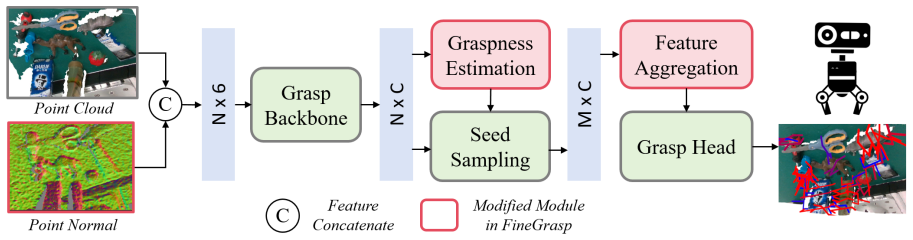
The load-bearing mechanisms are: (1) Instance-Norm Graspness, a two-step label normalization (per object category, then scene-level) so small objects are not suppressed; (2) Multi-Range Attention, which encodes multi-radius cylinder-group features with a Transformer and learns adaptive fusion weights; (3) a surface-normal prior fed as an input feature alongside point positions; and (4) SimGraspNet, a simulated dataset with Gaussian depth shift used for mixed training. Together they address point proposal, feature aggregation, orientation regression, and depth-noise robustness.
What would settle it
Measure the depth noise statistics of the real camera (e.g., a RealSense D435i) on the same 40 objects over many frames; if the Gaussian shift applied in SimGraspNet differs substantially from the measured noise magnitude and spatial correlation, and if removing the shift does not change Small AP on the RealSense split, then the sim-to-real transfer claim is not supported. Alternatively, train FineGrasp on GraspNet-1B alone and on GraspNet-1B plus a SimGraspNet whose objects have been held out; if Small AP no longer improves, the gain comes from memorizing the object set rather than from the simulated depth-noise pattern.
Extended reading notes
Core claim
The central discovery is that existing grasp detectors' failure on fine objects is not a fundamental resolution limit but a training-signal bias, and that the bias can be removed without extra inference overhead. By renormalizing graspness labels within each object instance (instance-norm graspness), the point-proposal stage learns to propose seeds on small objects even when their absolute grasp scores are low. The Multi-Range Attention module lets the network combine evidence from several cylinder-grouping radii with learned per-range weights, and the normal prior adds surface orientation as a geometric feature that correlates with high-quality approach directions. Because small objects are also overwhelmed by depth noise, the authors add SimGraspNet, a simulated dataset of roughly 400 cluttered scenes using the same 40 objects and a Gaussian depth shift, and show that mixed sim-to-real training raises Small AP from 16.23 to 18.87 and improves all three GraspNet-1B splits. The paper concludes that delicate-object grasping is achievable by these relatively lightweight changes, and demonstrates this in semantic object- and part-grounding settings.
Load-bearing premise
The load-bearing premise is that SimGraspNet, built from the same 40 objects as the GraspNet-1B training set and augmented with a Gaussian depth shift, reproduces the real depth-sensor degradation that causes small objects to be overlooked, so adding it to real training data genuinely improves real-world small-object performance rather than teaching artifacts.
Editorial extensions
If this is right
- Small-object AP on GraspNet-1B RealSense rises from 16.23 to 18.87 when SimGraspNet is mixed into training.
- FineGrasp beats EconomicGrasp on Seen, Similar, and Novel splits (71.67/62.83/27.40 vs 68.21/61.19/25.48), so the increases are not limited to small objects.
- In real trials on 18 delicate objects across 5 scenes, FineGrasp reaches 91% success and 100% completion, where GSNet and EconomicGrasp reach at most 78% and 40% respectively.
- In part-grounding experiments, FineGrasp achieves 84% success versus 56% for GSNet, indicating the gain transfers to semantic/part grasping.
- The instance-norm graspness module alone lifts small AP from 11.47 to 14.74, showing that label normalization is the primary mechanism for scale balance.
Reading between the lines
- Because the label normalization acts before any semantic segmentation, the same trick could be dropped into other dense-prediction grasp detectors without adding inference cost.
- The Gaussian depth shift is a coarse mimic of real sensor noise; an obvious testable extension is to calibrate the shift parameters against a specific depth camera's noise profile, which might further close the sim-to-real gap.
- The coarse-to-fine part-grounding pipeline is evaluated with one VLM; the method's contribution is the grasp module, so the semantic-grasping gains may shift if the grounding model changes.
- If the sim-to-real gain is driven by adding more scenes with small objects, then scaling SimGraspNet with more diverse small-object assets could push Small AP further than the current 18.87.
Editorial analysis
A structured set of objections, weighed in public.
Referee Report
Summary. FineGrasp addresses 6-DoF grasp detection for small and delicate objects. Building on EconomicGrasp, the authors propose three modifications: (i) an Instance-Norm Graspness label normalization strategy, (ii) a Multi-Range Attention module that fuses features from multiple cylinder-grouping radii, and (iii) a SimGraspNet simulated dataset combined with real data via mixed training. They also integrate a normal-vector prior and a VLM-based semantic grasping pipeline for object- and part-level grasping. Experiments on the GraspNet-1B RealSense split report an average AP of 53.97 (55.47 with collision detection), outperforming the EconomicGrasp baseline of 51.63. Real-world trials report 91% success and 100% completion for delicate-object scenes, and 84% success for part-grounding, alongside ablations of each module.
Significance. If the reported results hold, the paper makes a useful contribution to a real problem: existing grasp detectors often miss small objects or delicate parts in cluttered scenes, which is a known bottleneck in language-driven manipulation systems. The proposed instance-normalized graspness supervision is a sensible way to counter the global suppression of small-object labels, and the multi-range attention and normal-prior additions are plausible and are supported by the ablation tables. The real-world semantic part-grounding results are a practical strength. The paper also offers a new simulated dataset and promises code release, which would help reproducibility. However, the central claim about the benefit of SimGraspNet is directly contradicted by the paper's own full-model ablation in Table III, and the absence of error bars makes several reported gains hard to assess statistically.
major comments (4)
- [IV-C, Table III; I (Abstract)] The paper's stated third contribution is contradicted by its own full-model ablation. Adding SimGraspNet to the complete FineGrasp model (last row of Table III versus the preceding row) decreases Average AP from 53.97 to 53.71, Seen AP from 71.67 to 70.80, Novel AP from 27.40 to 26.51, and Large AP from 56.92 to 56.53; only Similar (+1.01) and Small (+2.64) improve. Yet the Abstract claims that 'mixed sim-to-real training further improves grasp performance' and Section I claims 'This strategy effectively improves overall performance.' The headline comparison in Table I and the real-world experiments in Tables V-VII do not include or ablate SimGraspNet, so the simulated-data contribution is currently unsupported. Please either revise the claims to reflect the full-model result, provide an ablation in which mixed training improves the average metric, or present the simulation contribution as confined to Small-object AP on the baseline model.
- [IV-C, Table IV] Table IV shows that joint training with SimGraspNet improves the EconomicGrasp baseline by 3.09/4.29/0.8 on Seen/Similar/Novel, but Table III shows that the same joint-training addition hurts the full FineGrasp model on Seen, Novel, Average, and Large. The paper does not discuss this interaction. A reader cannot tell whether SimGraspNet helps because its Gaussian depth augmentation happens to match the sensor noise of the baseline, or whether it is redundant or harmful once the other modules address small-object supervision. Please report the full-model joint-training result with an explanation and, if possible, vary the simulated-to-real data ratio.
- [IV-A and IV-C] All benchmark and ablation numbers are single-run AP values without error bars or multiple-seed statistics. Differences such as the MRA gain in Table II (40.63 to 41.27) and several module increments in Table III are small; without variance estimates the 'significant improvement' statements in the text are not supported. Please train at least three seeds and report mean +/- std for Tables I-III, or provide a statistical test for the claimed differences.
- [III-C and IV-C] The sim-to-real transfer argument relies on the assumption that a Gaussian depth shift in SimGraspNet reproduces the real depth-sensor degradation that causes small objects to be overlooked. The paper provides no quantitative comparison between the simulated depth noise and the RealSense D435i noise observed in GraspNet-1B, so the Small AP improvement (16.23 to 18.87 in Table III) could in part reflect overfitting to a specific synthetic artifact. Please add a noise-model comparison or an experiment that varies the Gaussian shift parameters and reports sensitivity.
minor comments (5)
- [III-B, Eq. (1)-(2)] The notation in Eq. (1)-(2) is difficult to follow, and the terminology is inconsistent: the method is called Instance-Norm Graspness and the Introduction says normalization is 'within each object first,' but Eq. (1) normalizes within each category c, where C is the set of object categories. Please clarify whether normalization is per object instance or per semantic category, and define all symbols (including \tilde{S}'_P and \tilde{s}'^i_p) precisely.
- [IV-D, Table V] Table V lists 'Scene Objects' as 6 for every scene, but the reported per-scene success counts use denominators 6, 7, 8, 6, and 8. Please state how attempts and retries are counted and why denominators can exceed the number of objects.
- [Throughout] There are several typos and inconsistent names: 'dedicate components' in the Fig. 1 caption should be 'delicate components'; 'Scaled Balanced Grasp' and 'Scale Balanced Grasp' are used interchangeably; and 'Graspness' appears both as a proper noun and as a common noun. Please standardize these.
- [IV-E] In the semantic-grasping experiments, trials with semantic grounding failure are excluded from the statistics, but the number of excluded trials is not reported for either method. Please report these counts so that the success rates are comparable.
- [III-B, Multi-Range Attention] The paper defines G radius ranges for the Multi-Range Attention module but never reports the values of G or the actual radii used. Please include these implementation details for reproducibility, ideally with a sensitivity study.
Circularity Check
No significant circularity: FineGrasp is validated against the external GraspNet-1B benchmark and real-robot trials, with no load-bearing self-citation or definitional reduction.
full rationale
The paper's central claims are evaluated against the external GraspNet-1B RealSense benchmark and real-world robotic trials, not against quantities defined by the authors' own equations or fitted parameters. The instance-norm graspness normalization, multi-range attention, and normal-prior input are all design choices whose effect is measured by standard AP and physical grasping success; none of them is defined in terms of the reported outcome. SimGraspNet is constructed from GraspNet-1B assets and its labels are generated following the GraspNet-1B methodology, but this is a dataset-construction choice rather than a circular derivation: the claimed benefit is tested by mixed training and measured on the real GraspNet-1B test split. No self-citation from the authors' own prior work appears, and no uniqueness theorem or prior result is invoked to forbid alternatives. The skeptical observation that adding SimGraspNet lowers overall AP in Table III while the text claims it 'effectively improves overall performance' is a potential empirical inconsistency or reporting error, not a circularity: the improvement on Small AP (16.23 to 18.87) is a reported number, and the overall decrease does not make the claim true by construction. Since no step reduces to its own input by definition, by fitted-parameter renaming, or by a self-citation chain, the appropriate circularity score is 0.
Assumptions & free parameters
free parameters (2)
- Multi-range attention radius values and count G =
not disclosed
- Gaussian depth shift parameters for sim-to-real augmentation =
not disclosed
assumptions (3)
- domain assumption GraspNet-1B force-closure label generation yields valid grasp ground truth.
- domain assumption The surface normal direction is a reliable prior for high-quality grasp approach directions.
- domain assumption Simulated physics in Isaac Sim with 40 GraspNet assets plus a Gaussian depth shift produces realistic cluttered scenes that transfer to real-world grasping.
Cite this review
Pith. "Pith review of FineGrasp: Towards Robust Grasping for Delicate Objects." pith.science (2026). https://pith.science/paper/V2JZTSWS
@misc{pith2026250705978,
  author       = {Pith},
  title        = {Pith review of: FineGrasp: Towards Robust Grasping for Delicate Objects},
  year         = {2026},
  howpublished = {\url{https://pith.science/paper/V2JZTSWS}},
  note         = {Machine review of arXiv:2507.05978}
}
read the original abstract
Recent advancements in robotic grasping have led to its integration as a core module in many manipulation systems. For instance, language-driven semantic segmentation enables the grasping of any designated object or object part. However, existing methods often struggle to generate feasible grasp poses for small objects or delicate components, potentially causing the entire pipeline to fail. To address this issue, we propose a novel grasping method, FineGrasp, which introduces improvements in three key aspects. First, we introduce multiple network modifications to enhance the ability of to handle delicate regions. Second, we address the issue of label imbalance and propose a refined graspness label normalization strategy. Third, we introduce a new simulated grasp dataset and show that mixed sim-to-real training further improves grasp performance. Experimental results show significant improvements, especially in grasping small objects, and confirm the effectiveness of our system in semantic grasping.
Figures


Figures from the paper (3 more)


Reference graph
Works this paper leans on
-
[1]
Graspnet-1billion: A large- scale benchmark for general object grasping,
H.-S. Fang, C. Wang, M. Gou, and C. Lu, “Graspnet-1billion: A large- scale benchmark for general object grasping,” in Proceedings of the IEEE/CVF conference on computer vision and pattern recognition , 2020, pp. 11 444–11 453
work page 2020
-
[2]
Anygrasp: Robust and efficient grasp perception in spatial and temporal domains,
H.-S. Fang, C. Wang, H. Fang, M. Gou, J. Liu, H. Yan, W. Liu, Y . Xie, and C. Lu, “Anygrasp: Robust and efficient grasp perception in spatial and temporal domains,” IEEE Transactions on Robotics, vol. 39, no. 5, pp. 3929–3945, 2023
work page 2023
-
[3]
An economic framework for 6-dof grasp detection,
X.-M. Wu, J.-F. Cai, J.-J. Jiang, D. Zheng, Y .-L. Wei, and W.-S. Zheng, “An economic framework for 6-dof grasp detection,” in European Conference on Computer Vision . Springer, 2024, pp. 357–375
work page 2024
-
[4]
Copa: General robotic manipulation through spatial constraints of parts with foundation models,
H. Huang, F. Lin, Y . Hu, S. Wang, and Y . Gao, “Copa: General robotic manipulation through spatial constraints of parts with foundation models,” in 2024 IEEE/RSJ International Conference on Intelligent Robots and Systems (IROS) . IEEE, 2024, pp. 9488–9495
work page 2024
-
[5]
Thinkgrasp: A vision-language system for strategic part grasping in clutter,
Y . Qian, X. Zhu, O. Biza, S. Jiang, L. Zhao, H. Huang, Y . Qi, and R. Platt, “Thinkgrasp: A vision-language system for strategic part grasping in clutter,” arXiv preprint arXiv:2407.11298 , 2024
arXiv 2024
-
[6]
Towards scale balanced 6-dof grasp detection in cluttered scenes,
M. Haoxiang and D. Huang, “Towards scale balanced 6-dof grasp detection in cluttered scenes,” in Conference on Robot Learning (CoRL), 2022
work page 2022
-
[7]
Grasp- ness discovery in clutters for fast and accurate grasp detection,
C. Wang, H.-S. Fang, M. Gou, H. Fang, J. Gao, and C. Lu, “Grasp- ness discovery in clutters for fast and accurate grasp detection,” in Proceedings of the IEEE/CVF International Conference on Computer Vision, 2021, pp. 15 964–15 973
work page 2021
-
[8]
Sim-grasp: Learning 6-dof grasp poli- cies for cluttered environments using a synthetic benchmark,
J. Li and D. J. Cappelleri, “Sim-grasp: Learning 6-dof grasp poli- cies for cluttered environments using a synthetic benchmark,” IEEE Robotics and Automation Letters , 2024
work page 2024
Show all 15 references
-
[9]
Gpu-accelerated robotic simulation for distributed reinforce- ment learning,
J. Liang, V . Makoviychuk, A. Handa, N. Chentanez, M. Macklin, and D. Fox, “Gpu-accelerated robotic simulation for distributed reinforce- ment learning,” in Conference on Robot Learning . PMLR, 2018, pp. 270–282
2018
-
[10]
Dexgraspnet 2.0: Learning generative dexterous grasping in large-scale synthetic cluttered scenes,
J. Zhang, H. Liu, D. Li, X. Yu, H. Geng, Y . Ding, J. Chen, and H. Wang, “Dexgraspnet 2.0: Learning generative dexterous grasping in large-scale synthetic cluttered scenes,” in 8th Annual Conference on Robot Learning , 2024
2024
-
[11]
Ok-robot: What really matters in integrating open-knowledge models for robotics,
P. Liu, Y . Orru, J. Vakil, C. Paxton, N. M. M. Shafiullah, and L. Pinto, “Ok-robot: What really matters in integrating open-knowledge models for robotics,” arXiv preprint arXiv:2401.12202 , 2024
2024 arXiv
-
[12]
Omnimanip: Towards general robotic manipulation via object-centric interaction primitives as spatial constraints,
M. Pan, J. Zhang, T. Wu, Y . Zhao, W. Gao, and H. Dong, “Omnimanip: Towards general robotic manipulation via object-centric interaction primitives as spatial constraints,” arXiv preprint arXiv:2501.03841 , 2025
2025 arXiv
-
[13]
Sa2va: Marrying sam2 with llava for dense grounded understanding of images and videos,
H. Yuan, X. Li, T. Zhang, Z. Huang, S. Xu, S. Ji, Y . Tong, L. Qi, J. Feng, and M.-H. Yang, “Sa2va: Marrying sam2 with llava for dense grounded understanding of images and videos,” arXiv preprint arXiv:2501.04001, 2025
2025 arXiv
-
[14]
Efficient heatmap- guided 6-dof grasp detection in cluttered scenes,
S. Chen, W. Tang, P. Xie, W. Yang, and G. Wang, “Efficient heatmap- guided 6-dof grasp detection in cluttered scenes,” IEEE Robotics and Automation Letters, vol. 8, no. 8, pp. 4895–4902, 2023
2023
-
[15]
Depth anything v2,
L. Yang, B. Kang, Z. Huang, Z. Zhao, X. Xu, J. Feng, and H. Zhao, “Depth anything v2,” Advances in Neural Information Processing Systems, vol. 37, pp. 21 875–21 911, 2025
2025
Reviewed August 6, 2026 · model on record in the stance chip above.
Discussion (0). Continue with ORCID to comment.