REVIEW 1 major objections 22 references
SCOPE Shrinkage: A Unified Framework for Wavelet Denoising
T0 review · 1 major / 0 minor · reviewed 2026-06-26 · grok-4.3
Pith's one-line read SCOPE shrinkage constructs a unified family of wavelet denoising rules from centered cumulative distribution functions of symmetric unimodal distributions.
desk verdict SCOPE gives a clean two-parameter family of shrinkage rules from centered CDFs, but the competitive performance is shown only under oracle calibration. read the letter →
The pith
A machine-rendered reading of the paper's core claim, the machinery that carries it, and where it could break.
The reading
What carries the argument
The SCOPE shrinkage rule, defined directly from the centered cumulative distribution function of a symmetric unimodal distribution and parameterized by scale and shape, which generates the attenuation profile applied to wavelet coefficients.
What would settle it
A simulation study on Donoho-Johnstone test functions in which SCOPE rules under the stated parameter selection fail to perform competitively with standard methods, or a counterexample distribution violating the regularity assumptions where monotonicity or contractivity breaks.
Extended reading notes
Core claim
SCOPE shrinkage is constructed as a sign-preserving function from the centered CDF of a symmetric unimodal distribution, with a general formulation that separates scale and shape effects to control threshold location and transition sharpness independently, yielding a broad class of attenuation profiles that connect to softened thresholding operators via mixture representation and admit exact MAP estimation under suitable symmetric unimodal priors.
Load-bearing premise
The underlying distributions are symmetric and unimodal, and explicit regularity assumptions hold so that the listed structural properties of the shrinkage rules are valid.
Editorial extensions
If this is right
- Scale and shape parameters allow independent adjustment of threshold location and transition sharpness.
- SCOPE rules admit even penalty representations that are nondecreasing in coefficient magnitude.
- Suitable subclasses arise exactly as maximum a posteriori estimators under symmetric unimodal priors.
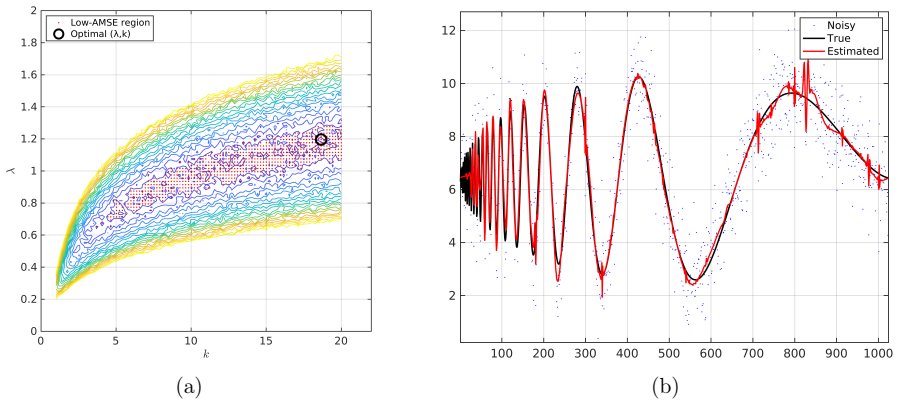
- Data-driven parameter selection for smooth subclasses is possible via Stein-type unbiased risk estimation.
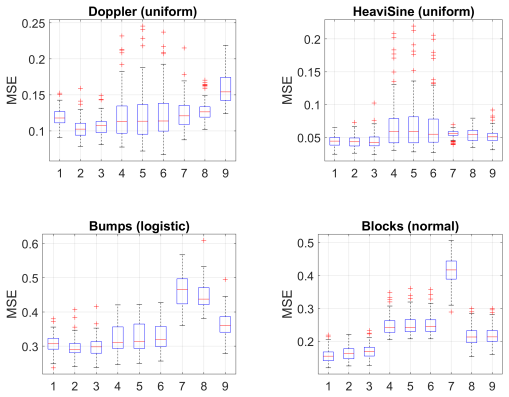
- The resulting rules achieve competitive denoising performance on standard test functions while preserving structural flexibility.
Reading between the lines
- The mixture representation may allow SCOPE to be viewed as a continuous relaxation of hard thresholding that could be substituted into other iterative estimation algorithms.
- Choice of base distribution offers a systematic way to tune shrinkage behavior to match specific coefficient sparsity patterns beyond the examples given.
- The separation of scale and shape parameters suggests straightforward extensions to adaptive or multivariate coefficient settings.
Editorial analysis
A structured set of objections, weighed in public.
Referee Report
Summary. The paper introduces Symmetric CDF Oriented Probability Enhanced (SCOPE) shrinkage, a unified family of sign-preserving shrinkage rules constructed from centered cumulative distribution functions of symmetric unimodal distributions. It develops a two-parameter formulation separating scale and shape effects, establishes structural properties (oddness, monotonicity, continuity, contractivity, mixture representation) under regularity assumptions, provides Bayesian/penalized likelihood interpretations including MAP estimators, discusses SURE-based data-driven parameter selection, and reports oracle-calibrated simulations on Donoho-Johnstone test functions demonstrating competitive performance with established wavelet denoising methods while retaining interpretability.
Significance. If the structural properties and simulation results hold, the framework provides a flexible, probabilistically grounded design principle for shrinkage rules that unifies thresholding behaviors through distribution shape, with independent control of threshold location and transition sharpness. The mixture representation and even penalty interpretations add theoretical connections to existing methods, and the emphasis on centered CDFs could serve as a versatile template for related estimation problems beyond wavelets.
major comments (1)
- [Abstract (simulation studies paragraph)] Abstract (simulation studies paragraph): The competitiveness claim rests on 'oracle calibrated simulation studies,' which the abstract distinguishes from the separately discussed data-driven SURE parameter selection. If the reported results rely on knowledge of the true signal or noise level to set the two SCOPE parameters, the performance advantage may not hold under practical data-driven selection, where the framework's separate scale/shape flexibility could increase estimation variability. This is load-bearing for the central performance claim and requires either additional results under SURE or explicit discussion of the gap.
Simulated Author's Rebuttal
We thank the referee for highlighting the important distinction between oracle-calibrated and data-driven results in the abstract. We agree this point merits clarification to avoid overstating practical performance and will revise the manuscript accordingly.
read point-by-point responses
-
Referee: The competitiveness claim rests on 'oracle calibrated simulation studies,' which the abstract distinguishes from the separately discussed data-driven SURE parameter selection. If the reported results rely on knowledge of the true signal or noise level to set the two SCOPE parameters, the performance advantage may not hold under practical data-driven selection, where the framework's separate scale/shape flexibility could increase estimation variability. This is load-bearing for the central performance claim and requires either additional results under SURE or explicit discussion of the gap.
Authors: We agree the abstract's competitiveness claim is based on oracle-calibrated parameter choices, which demonstrate the framework's potential under ideal tuning rather than fully data-driven selection. The manuscript discusses SURE-based selection for smooth subclasses but does not include simulation results comparing full two-parameter SCOPE under SURE to other methods. We will revise the abstract to state that the reported simulations use oracle calibration to illustrate attainable performance, and add an explicit discussion in Section 5 noting that the additional shape parameter may increase estimation variability under SURE, without claiming superiority in the data-driven regime. This addresses the gap directly. revision: yes
Circularity Check
No significant circularity in derivation chain
full rationale
The SCOPE framework is constructed directly from centered CDFs of symmetric unimodal distributions, with structural properties (oddness, monotonicity, contractivity, mixture representation) derived from explicit regularity assumptions on those distributions rather than from any fitted quantities or self-referential definitions. Bayesian/penalized interpretations and the separation of scale/shape parameters follow from the same construction. Oracle-calibrated simulations on Donoho-Johnstone functions serve as external empirical validation and are explicitly distinguished from the separate SURE-based data-driven selection; no load-bearing step reduces a claimed result to a parameter fit on the evaluation data or to a self-citation chain. The derivation is therefore self-contained against standard probabilistic primitives.
Assumptions & free parameters
assumptions (1)
- domain assumption The source distributions are symmetric and unimodal
invented entities (1)
-
SCOPE shrinkage rule
Cite this review
Pith. "Pith review of SCOPE Shrinkage: A Unified Framework for Wavelet Denoising." pith.science (2026). https://pith.science/paper/V3BUCYEV
@misc{pith2026260619572,
  author       = {Pith},
  title        = {Pith review of: SCOPE Shrinkage: A Unified Framework for Wavelet Denoising},
  year         = {2026},
  howpublished = {\url{https://pith.science/paper/V3BUCYEV}},
  note         = {Machine review of arXiv:2606.19572}
}
read the original abstract
We introduce Symmetric CDF Oriented Probability Enhanced (SCOPE) shrinkage, a unified family of sign-preserving shrinkage rules constructed from centered cumulative distribution functions of symmetric unimodal distributions. The proposed framework generates a broad class of attenuation profiles that interpolate between strong local shrinkage near zero and asymptotically unbiased behavior in the tails. A general formulation is developed that separates scale and shape effects through two interpretable parameters, allowing effective threshold location and transition sharpness to be controlled independently. Under explicit regularity assumptions, structural properties of SCOPE shrinkage are established, including oddness, monotonicity, continuity, contractivity, and a mixture representation that connects the rules to softened thresholding operators. A Bayesian and penalized likelihood interpretation is also developed: SCOPE rules admit even penalty representations that are nondecreasing in coefficient magnitude, and suitable subclasses arise as exact maximum a posteriori estimators under proper symmetric unimodal priors. Representative examples based on logistic, uniform, and Cauchy distributions illustrate how probabilistic shape governs shrinkage behavior. Data driven parameter selection for smooth subclasses is discussed via Stein-type unbiased risk estimation. Oracle calibrated simulation studies on standard Donoho-Johnstone test functions show that SCOPE shrinkage performs competitively with several established wavelet denoising methods, while retaining a high degree of interpretability and structural flexibility. The results highlight centered distribution functions as a natural and versatile design principle for shrinkage in wavelet denoising and related estimation problems.
Figures


Figures from the paper (2 more)

Reference graph
Works this paper leans on
-
[1]
and Johnstone, Iain M
Donoho, David L. and Johnstone, Iain M. , title =. Biometrika , volume =
-
[2]
and Johnstone, Iain M
Donoho, David L. and Johnstone, Iain M. , title =. Journal of the American Statistical Association , volume =
-
[3]
Journal of the American Statistical Association , volume =
Fan, Jianqing and Li, Runze , title =. Journal of the American Statistical Association , volume =
-
[4]
and Polson, Nicholas G
Carvalho, Carlos M. and Polson, Nicholas G. and Scott, James G. , title =. Biometrika , volume =
-
[5]
Sankhy\=
Vidakovic, Brani and Ruggeri, Fabrizio , title =. Sankhy\=. 2001 , note =
2001
-
[6]
Computational Statistics & Data Analysis , volume =
Abramovich, Felix and Benjamini, Yoav , title =. Computational Statistics & Data Analysis , volume =
-
[7]
Lecture Notes in Statistics , volume =
Abramovich, Felix and Benjamini, Yoav , title =. Lecture Notes in Statistics , volume =. 1995 , publisher =
1995
-
[8]
Vidakovic, Brani , title =
Show all 22 references
-
[9]
Journal of the American Statistical Association , volume =
Vidakovic, Brani , title =. Journal of the American Statistical Association , volume =
-
[10]
Journal of the American Statistical Association , volume =
Antoniadis, Anestis and Fan, Jianqing , title =. Journal of the American Statistical Association , volume =
-
[11]
and Kolaczyk, Eric D
Chipman, Hugh A. and Kolaczyk, Eric D. and McCulloch, Robert E. , title =. Journal of the American Statistical Association , volume =
-
[12]
Statistica Sinica , volume =
Ruggeri, Fabrizio and Vidakovic, Brani , title =. Statistica Sinica , volume =
-
[13]
and DasGupta, A
Vimalajeewa, D. and DasGupta, A. and Ruggeri, F. and Vidakovic, B. , title =. The New England Journal of Statistics in Data Science , volume =
-
[14]
Huang and N
H.-C. Huang and N. Cressie , title =. Technometrics , volume =
-
[15]
Computational Statistics & Data Analysis , volume =
Felix Abramovich and Panagiotis Besbeas and Theofanis Sapatinas , title =. Computational Statistics & Data Analysis , volume =
-
[16]
Tony Cai , title =
T. Tony Cai , title =. The Annals of Statistics , number =
-
[17]
Amato and D.T
U. Amato and D.T. Vuza , title =. Computers & Mathematics with Applications , volume =
-
[18]
Wavelet Estimators in Nonparametric Regression: A Comparative Simulation Study , volume =
Antoniadis, Anestis and Bigot, Jérémie and Sapatinas, Theofanis , year =. Wavelet Estimators in Nonparametric Regression: A Comparative Simulation Study , volume =. Journal of Statistical Software , doi =
-
[19]
Nason, G. P. , title =. Journal of the Royal Statistical Society, Series B , volume =. doi:10.1111/j.2517-6161.1996.tb02094.x , year =
1996 doi
-
[20]
2022 , eprint=
Gamma-Minimax Wavelet Shrinkage with Three-Point Priors , author=. 2022 , eprint=
2022
-
[21]
Khintchine, A. Y. , title =. Izvestiya Nauchno-Issledovatel'skogo Instituta Matematiki i Mekhaniki , year =
-
[22]
The New England Journal of Statistics in Data Science , year =
Vimalajeewa, Dixon and DasGupta, Anirban and Ruggeri, Fabrizio and Vidakovic, Brani , title =. The New England Journal of Statistics in Data Science , year =
Reviewed June 26, 2026 · model on record in the stance chip above.
Discussion (0). Continue with ORCID to comment.