REVIEW 2 major objections 5 minor 54 references
Reconstructing Core-Collapse Supernova Gravitational-Wave Signals with Transdimensional Bayesian Inference
T0 review · 2 major / 5 minor · reviewed 2026-08-08 · deepseek-v4-flash
Pith's one-line read Transdimensional Bayesian inference reconstructs core-collapse supernova gravitational-wave signals with up to 85% overlap, and the dominant proto-neutron star mode survives even at low overlap.
desk verdict A solid, honest methods paper for tBilby on CCSN signals whose central astrophysical payoff—PNS radius from low-overlap reconstructions—is asserted from spectrograms, not demonstrated. read the letter →
The pith
A machine-rendered reading of the paper's core claim, the machinery that carries it, and where it could break.
The reading
What carries the argument
The central object is the transdimensional Bayesian model tBilby, where the number of basis functions $N$ is a free parameter sampled alongside each wavelet's amplitude, central frequency, quality factor, time, and phase. The basis functions are sine-Gaussian wavelets and chirplets; a chirplet adds a frequency-derivative parameter $\dot{f}_0$, so the wavelet's frequency can sweep with time, and it reduces to a sine Gaussian when $\dot{f}_0 = 0$. A nested-sampling algorithm draws $N$ and all wavelet parameters jointly, treating parameters beyond the drawn $N$ as ghosts that are marginalized away. This lets the posterior automatically choose how many wavelets the data require, which is what makes the reconstruction morphology-independent.
What would settle it
Run the same tBilby pipeline on a CCSN waveform that includes prompt convection, SASI emission below 200 Hz, and a dominant mode that climbs past 1500 Hz, injected at a signal-to-noise ratio of 20 in the same noise; if the reconstructed spectrogram's dominant-mode track deviates from the injected track by more than the width required by the PNS universal relations, then the claim that low-overlap reconstructions still permit PNS size statements is falsified.
Extended reading notes
Core claim
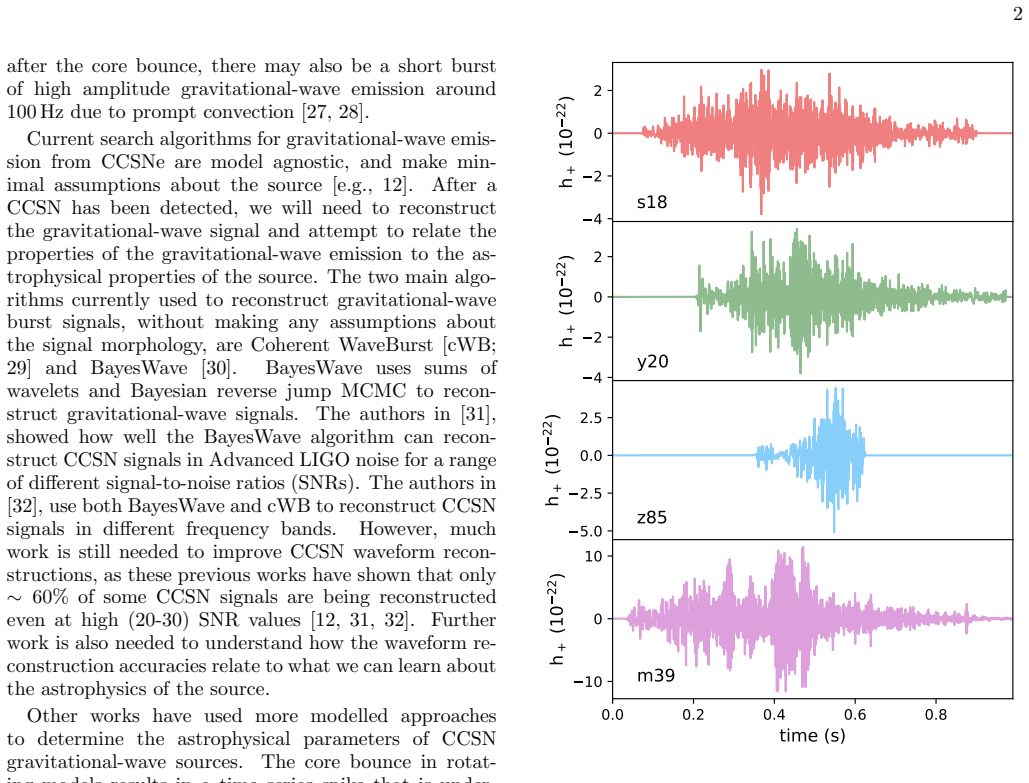
The paper claims that the transdimensional Bayesian framework tBilby, previously used for binary black holes, can reconstruct simulated core-collapse supernova gravitational-wave signals added to Gaussian noise at a two-detector design sensitivity. Overlaps between the injected and median-reconstructed waveforms reach about 0.85 for the rapidly rotating model m39 at the highest signal-to-noise ratios, with the other models between about 0.35 and 0.75. Crucially, even at low overlap values the reconstructed spectrogram preserves the dominant proto-neutron star f/g-mode, the feature that sweeps upward in frequency as the proto-neutron star contracts. The paper argues that this preservation, not the raw overlap, is what enables astrophysical inference about the size of the proto-neutron star, and that the method works down to a network signal-to-noise ratio of 20.
Load-bearing premise
The entire demonstration rests on four simulated waveforms that the paper itself calls 'the most simple first step,' because each mainly contains a single visible proto-neutron-star mode; real supernova signals are expected to add stochastic convection, SASI emission, extra modes, and frequencies above the 1024 Hz cutoff used here.
Editorial extensions
If this is right
- tBilby becomes a viable morphology-independent reconstruction tool for core-collapse supernova bursts.
- A single detected core-collapse supernova in the Milky Way could yield a measurement of the proto-neutron star's radius evolution even at marginal signal-to-noise ratios.
- Chirplets match sine-Gaussian reconstruction quality while needing roughly half the wavelets, so faster analyses are possible for the same fidelity.
- Overlap alone is not the right figure of merit for CCSN reconstruction: spectrogram-level capture of the dominant mode is what determines astrophysical usability.
Reading between the lines
- A natural extension, implicit in the paper, is to feed the reconstructed dominant-mode track directly into the PNS universal relations inside the same Bayesian framework, producing a posterior for the radius rather than a post-processing step.
- Because the method's utility lives in spectrogram features rather than overlap, future reconstruction studies could adopt frequency-track recovery as an explicit metric.
- The transdimensional approach should be tested on waveforms with multiple simultaneous modes and on the higher-frequency emission that real CCSNe are expected to show; the 1024 Hz cutoff is a computational choice, not a physical one.
Editorial analysis
A structured set of objections, weighed in public.
Referee Report
Summary. This paper applies the transdimensional Bayesian inference code tBilby to reconstruct four simulated core-collapse supernova gravitational-wave signals (s18, y20, m39, z85) injected into synthetic Advanced LIGO noise at network SNRs from 20 to 60, using two wavelet dictionaries (sine-Gaussians and chirplets). The authors report noise-weighted overlaps between injected and reconstructed waveforms of up to about 0.85, counts of the number of wavelets used, log Bayes factors for the two dictionaries, and spectrograms of example reconstructions. They conclude that tBilby can capture up to 85% of the CCSN signal features and that, even at low overlap, the dominant proto-neutron-star mode is sufficiently recovered to make statements about the evolving PNS radius.
Significance. The injection-recovery methodology is standard and the overlap computation is well defined; the use of simulated signals with known ground truth avoids circular reasoning, and the comparison between sine-Gaussian and chirplet dictionaries is a useful addition to the burst-reconstruction literature. If the quantitative PNS-radius inference were actually demonstrated, the paper would establish an important bridge between unmodelled burst reconstruction and astrophysical parameter estimation. However, as it stands the novel astrophysical payoff is asserted rather than measured, so the significance of the paper currently rests mainly on the reconstruction quality results.
major comments (2)
- [Abstract; Section IV; Section V] The paper's central astrophysical claim — that low-overlap reconstructions still capture enough of the dominant mode to make statements about the evolving PNS size — is not tested quantitatively. Section IV (Figures 6–8) supports this by visual inspection of spectrograms only; the authors never extract an instantaneous-frequency track from the reconstructions, never apply the universal relations of Refs. [35–37], and never compare a reconstructed PNS radius with the known radius of the injected waveform. Because the overlap is a single global scalar, equal overlap values do not guarantee equal fidelity of the mode's frequency evolution. I recommend adding a quantitative analysis: estimate the dominant-mode frequency evolution from each reconstruction, apply a universal relation, and report bias and uncertainty in PNS radius as a function of SNR and overlap, using the injected waveform's true radius as ground truth.
- [Section IV, Figure 8] At SNR 20, Figure 8 shows that most injections are reconstructed with one or two wavelets, and the text states that these capture only the highest-amplitude part of the signal, often around shock revival rather than the later PNS-mode evolution. This directly conflicts with the low-overlap PNS-size claim: if the reconstruction does not contain the frequency evolution of the mode, it cannot by itself support a radius estimate. The manuscript should state explicitly, with quantitative evidence, the lowest SNR or overlap at which a useful PNS-radius measurement is possible, and should separate shock-revival timing information from PNS-mode frequency evolution.
minor comments (5)
- [Section III, Eqs. (2)-(3)] The printed Fourier-domain wavelet expressions appear to contain typos; for example, the second term in Eq. (2) has \(\exp[-Q^2 f/f_0]\), which is not the standard negative-frequency component of a sine-Gaussian. Please check the equations against the implemented dictionary and correct them or provide the code.
- [Figure 3 caption] The caption states the overlap is 'calculated using Equation 5', but the overlap is defined in Eq. (4) and Eq. (5) defines the inner product; please correct the cross-reference.
- [Section IV and Figure 4 caption] The text says the number of wavelets is the maximum likelihood value, whereas the figure caption says 'maximum posterior values'; please use consistent terminology and state which point estimate is shown.
- [Section I and Section III] There are a few proofreading errors, including 'the SASI mode mode' and 'paramaters'; please correct these.
- [Section III] Please define 'network SNR' explicitly (e.g., quadrature sum of single-detector SNRs) and state whether each plotted point is a single noise realization or an average, since Figures 3–5 show no uncertainty estimates.
Circularity Check
No circularity found: the overlap benchmark is external to the method; the PNS-radius statement is an evidentiary gap, not a circular step.
full rationale
The paper's central quantitative claim is the overlap between injected and reconstructed waveforms, computed via Eq. (4) against simulated signals in synthetic Advanced LIGO noise at known SNRs. The injected CCSN waveforms are independent simulation outputs from Refs. [16,43,44], not derived from tBilby or from the overlap statistic, and the overlap is a goodness-of-fit measure against those injections rather than a fitted parameter renamed as a prediction. No uniqueness theorem or ansatz is imported from the authors' prior work in a way that forces the result: the tBilby code [40], the waveform models, and the universal relations [35-37] are prior independent inputs or targets for future work, not assumptions equivalent to the conclusion. The claim that low-overlap reconstructions still capture enough of the dominant f/g-mode to make statements about PNS size (Abstract; Section IV) is asserted from spectrogram inspection without a quantitative radius extraction, which is an evidentiary and support gap rather than a circular step. Because the benchmark is external to the reconstruction method, the derivation chain is self-contained; no circularity was identified.
Assumptions & free parameters
free parameters (5)
- Maximum number of wavelets, N_max =
15
- Maximum analysis frequency =
1024 Hz
- Lower frequency cutoff =
30 Hz
- Number of live points =
1500
- Signal-to-noise ratio range =
20 to 60
assumptions (6)
- domain assumption The four selected CCSN waveform models are representative of real CCSN gravitational-wave emission.
- domain assumption Detector noise is stationary, Gaussian, and described by the Advanced LIGO design-sensitivity PSD.
- domain assumption The universal relations between gravitational-wave frequency and proto-neutron-star properties are valid.
- domain assumption The time and sky position of the source are known exactly.
- standard math The standard gravitational-wave transient likelihood (Veitch et al. 2015) applies.
- standard math The tBilby implementation of transdimensional nested sampling is correct.
Cite this review
Pith. "Pith review of Reconstructing Core-Collapse Supernova Gravitational-Wave Signals with Transdimensional Bayesian Inference." pith.science (2026). https://pith.science/paper/V3YJDQE6
@misc{pith2026260805456,
  author       = {Pith},
  title        = {Pith review of: Reconstructing Core-Collapse Supernova Gravitational-Wave Signals with Transdimensional Bayesian Inference},
  year         = {2026},
  howpublished = {\url{https://pith.science/paper/V3YJDQE6}},
  note         = {Machine review of arXiv:2608.05456}
}
read the original abstract
Core-collapse supernovae (CCSNe) are promising future sources of gravitational waves for current and next-generation observatories. Reconstructing CCSN gravitational-wave signals is challenging as they contain stochastic elements, have multiple complex features, and cover a wide frequency band. The stochasticity of the signal in particular motivates the need for morphology-independent reconstruction techniques which, once observed, will enable us to infer properties of the newly born proto-neutron star, the rotation, and the unknown CCSN explosion mechanism. In this work, we investigate the reconstruction of gravitational-wave signals from CCSNe using the transdimensional Bayesian inference framework tBilby. We demonstrate the method using simulated signals in synthetic Advanced LIGO detector noise at a range of signal-to-noise ratios. We reconstruct the signals using two types of wavelets: sine Gaussians and chirplets. We calculate overlaps between injected and reconstructed signals of up to 85%. We find that even when reconstruction overlap values are low, enough of the time-frequency structure of the dominant mode is captured to still make statements about the size of the evolving proto-neutron star. These capabilities establish tBilby as a powerful tool for gravitational-wave astronomy with burst sources.
Figures


Figures from the paper (5 more)


Reference graph
Works this paper leans on
- [1]
-
[2]
frequency (Hz) 250 500 750 1000 . frequency (Hz) 0.1 0.2 0.3 0.4 0.5 0.6 0.7 250 500 750 1000 0.1 0.2 0.3 0.4 0.5 0.6 0.7 time (s) 0.1 0.2 0.3 0.4 0.5 0.6 0.7 250 500 750 1000 FIG. 7: Same as Figure 6, however the signal-to-noise of the injected signal is 35. A significant part of the mode is still visible. tralian Government, and from the Victorian Highe...
-
[3]
frequency (Hz) 250 500 750 1000 . frequency (Hz) 0.1 0.2 0.3 0.4 0.5 0.6 0.7 250 500 750 1000 0.1 0.2 0.3 0.4 0.5 0.6 0.7 time (s) 0.1 0.2 0.3 0.4 0.5 0.6 0.7 250 500 750 1000 FIG. 8: Same as Figure 6 and 7, however the signal-to-noise of the injected signal is 20. The majority of the injections are reconstructed with only a single wavelet
- [4]
-
[5]
A. Jerkstrand, D. Milisavljevic, and B. M¨ uller, in Encyclopedia of Astrophysics, Volume 2 (2026), vol. 2, pp. 639–668, 2503.01321
arXiv 2026
-
[6]
Janka, in Handbook of Supernovae, edited by A
H.-T. Janka, in Handbook of Supernovae, edited by A. W. Alsabti and P. Murdin (2017), p. 1095
work page 2017
- [7]
-
[8]
LIGO Scientific Collaboration, J. Aasi, B. P. Abbott, R. Abbott, T. Abbott, M. R. Abernathy, K. Ackley, C. Adams, T. Adams, P. Addesso, et al., Classical and Quantum Gravity32, 074001 (2015), 1411.4547
arXiv 2015
Show all 54 references
-
[9]
Acernese, M
F. Acernese, M. Agathos, K. Agatsuma, D. Aisa, N. Alle- mandou, A. Allocca, J. Amarni, P. Astone, G. Balestri, G. Ballardin, et al., Classical and Quantum Gravity32, 024001 (2015), 1408.3978
2015 arXiv
-
[10]
M. J. Szczepa´ nczyk, Y. Zheng, J. M. Antelis, M. Ben- jamin, M.-A. Bizouard, A. Casallas-Lagos, P. Cerd´ a- Dur´ an, D. Davis, D. Gondek-Rosi´ nska, S. Klimenko, et al., Phys. Rev. D110, 042007 (2024), 2305.16146
2024 arXiv
-
[11]
The LIGO Scientific Collaboration, the Virgo Collabo- ration, and the KAGRA Collaboration, arXiv e-prints arXiv:2605.27225 (2026), 2605.27225
2026 arXiv
- [12]
-
[13]
M¨ uller, arXiv e-prints arXiv:2403.18952 (2024), 2403.18952
B. M¨ uller, arXiv e-prints arXiv:2403.18952 (2024), 2403.18952
2024 arXiv
-
[14]
A. G. Abac, R. Abbott, I. Abouelfettouh, F. Acernese, K. Ackley, S. Adhicary, et al., Astrophys. J.985, 183 (2025), 2410.16565
2025 arXiv
-
[15]
M. J. Szczepa´ nczyk, J. M. Antelis, M. Benjamin, M. Cavagli` a, D. Gondek-Rosi´ nska, T. Hansen, S. Kli- menko, M. D. Morales, C. Moreno, S. Mukherjee, et al., Phys. Rev. D104, 102002 (2021), 2104.06462
2021 arXiv
-
[16]
Powell and B
J. Powell and B. M¨ uller, Mon. Not. Roy. Astron. Soc. 487, 1178 (2019), 1812.05738
2019 arXiv
-
[17]
Kuroda, K
T. Kuroda, K. Kotake, K. Hayama, and T. Takiwaki, Astrophys. J.851, 62 (2017), 1708.05252
2017 arXiv
-
[18]
E. P. O’Connor and S. M. Couch, Astrophys. J.865, 81 (2018), 1807.07579
2018 arXiv
- [19]
-
[20]
Andresen, E
H. Andresen, E. M¨ uller, H.-T. Janka, A. Summa, K. Gill, and M. Zanolin, Mon. Not. Roy. Astron. Soc.486, 2238 (2019), 1810.07638
2019 arXiv
-
[21]
Radice, V
D. Radice, V. Morozova, A. Burrows, D. Vartanyan, and H. Nagakura, Astrophys. J. Lett.876, L9 (2019), 1812.07703
2019 arXiv
-
[22]
Mezzacappa and M
A. Mezzacappa and M. Zanolin, arXiv e-prints arXiv:2401.11635 (2024), 2401.11635
2024 arXiv
-
[23]
K.-C. Pan, M. Liebend¨ orfer, S. M. Couch, and F.-K. Thielemann, Astrophys. J.914, 140 (2021), 2010.02453
2021 arXiv
-
[24]
Jakobus, B
P. Jakobus, B. M¨ uller, A. Heger, S. Zha, J. Powell, A. Motornenko, J. Steinheimer, and H. St¨ ocker, Phys. Rev. Lett.131, 191201 (2023), 2301.06515
2023 arXiv
-
[25]
L. Walk, T. Foglizzo, and I. Tamborra, Phys. Rev. D 107, 063014 (2023), 2212.07467
2023 arXiv
-
[26]
Burrows, T
A. Burrows, T. Wang, and D. Vartanyan, arXiv e-prints arXiv:2607.06664 (2026), 2607.06664
2026 arXiv
-
[27]
J. M. Blondin, A. Mezzacappa, and C. DeMarino, Astro- phys. J.584, 971 (2003), astro-ph/0210634. 9
2003 arXiv
-
[28]
Cusinato, M
M. Cusinato, M. Obergaulinger, and M. ´A. Aloy, Astron. Astrophys.705, A179 (2026), 2507.16903
2026
- [29]
-
[30]
S. W. Bruenn and A. Mezzacappa, Astrophys. J. Lett. 433, L45 (1994)
1994
-
[31]
N. Raza, J. McIver, G. D´ alya, and P. Raffai, Phys. Rev. D106, 063014 (2022), 2203.08960
2022 arXiv
-
[32]
Drago, S
M. Drago, S. Klimenko, C. Lazzaro, E. Milotti, G. Mitsel- makher, V. Necula, B. O’Brian, G. A. Prodi, F. Salemi, M. Szczepanczyk, et al., SoftwareX14, 100678 (2021), 2006.12604
2021 arXiv
-
[33]
N. J. Cornish and T. B. Littenberg, Classical and Quan- tum Gravity32, 135012 (2015), 1410.3835
2015 arXiv
-
[34]
Pastor-Marcos, P
C. Pastor-Marcos, P. Cerd´ a-Dur´ an, D. Walker, A. Torres- Forn´ e, E. Abdikamalov, S. Richers, and J. A. Font, Phys. Rev. D109, 063028 (2024), 2308.03456
2024 arXiv
-
[35]
Y. S. C. Lee, M. J. Szczepa´ nczyk, T. Mishra, M. Mill- house, and A. Melatos, Phys. Rev. D112, 082006 (2025), 2510.01614
2025
-
[36]
M. C. Edwards, Phys. Rev. D103, 024025 (2021), 2009.07367
2021 arXiv
- [37]
-
[38]
Torres-Forn´ e, P
A. Torres-Forn´ e, P. Cerd´ a-Dur´ an, M. Obergaulinger, B. M¨ uller, and J. A. Font, Phys. Rev. Lett.123, 051102 (2019), 1902.10048
2019 arXiv
-
[39]
Sotani, T
H. Sotani, T. Takiwaki, and H. Togashi, Phys. Rev. D 104, 123009 (2021), 2110.03131
2021 arXiv
-
[40]
H. Tong, N. Guttman, T. A. Clarke, P. D. Lasky, E. Thrane, E. Payne, R. Nathan, B. Farr, M. Fish- bach, G. Ashton, et al., Astrophys. J. Supp. Ser.276, 50 (2025), 2404.04460
2025 arXiv
-
[41]
Bruel, M.-A
T. Bruel, M.-A. Bizouard, M. Obergaulinger, P. Maturana-Russel, A. Torres-Forn´ e, P. Cerd´ a-Dur´ an, N. Christensen, J. A. Font, and R. Meyer, Phys. Rev. D 107, 083029 (2023), 2301.10019
2023 arXiv
-
[42]
Powell, A
J. Powell, A. Iess, M. Llorens-Monteagudo, M. Ober- gaulinger, B. M¨ uller, A. Torres-Forn´ e, E. Cuoco, and J. A. Font, Phys. Rev. D109, 063019 (2024), 2311.18221
2024 arXiv
-
[43]
Powell and B
J. Powell and B. M¨ uller, Mon. Not. Roy. Astron. Soc. 494, 4665 (2020), 2002.10115
2020 arXiv
-
[44]
Ashton et al., Astrophys
G. Ashton et al., Astrophys. J. Suppl.241, 27 (2019), 1811.02042
2019 arXiv
-
[45]
I. M. Romero-Shaw, C. Talbot, S. Biscoveanu, V. D’Emilio, G. Ashton, C. P. L. Berry, S. Coughlin, S. Galaudage, C. Hoy, M. H¨ ubner, et al., Mon. Not. Roy. Astron. Soc.499, 3295 (2020), 2006.00714
2020 arXiv
-
[46]
K. C. LIGO Scientific Collaboration, Virgo Collabora- tion, Virgo and kagra noise curves for use in simulations (2022), URL https://dcc.ligo.org/LIGO-T2200043
2022
-
[47]
Powell, B
J. Powell, B. M¨ uller, and A. Heger, Mon. Not. Roy. As- tron. Soc.503, 2108 (2021), 2101.06889
2021 arXiv
-
[48]
Veitch, V
J. Veitch, V. Raymond, B. Farr, W. Farr, P. Graff, S. Vi- tale, B. Aylott, K. Blackburn, N. Christensen, M. Cough- lin, et al., Phys. Rev. D91, 042003 (2015), 1409.7215
2015 arXiv
-
[49]
Powell, B
J. Powell, B. M¨ uller, D. R. Aguilera-Dena, and N. Langer, Mon. Not. Roy. Astron. Soc.522, 6070 (2023), 2212.00200
2023 arXiv
-
[50]
J. S. Speagle, Mon. Not. Roy. Astron. Soc.493, 3132 (2020), 1904.02180
2020 arXiv
-
[51]
Millhouse, N
M. Millhouse, N. J. Cornish, and T. Littenberg, Phys. Rev. D97, 104057 (2018), 1804.03239
2018 arXiv
-
[53]
Powell and B
J. Powell and B. M¨ uller, Mon. Not. Roy. Astron. Soc. 532, 4326 (2024), 2406.09691
2024 arXiv
-
[54]
L. Choi, A. Burrows, and D. Vartanyan, Astrophys. J. 975, 12 (2024), 2408.01525
2024 arXiv
-
[1000]
frequency (Hz) 0.1 0.2 0.3 0.4 0.5 0.6 0.7 250 500 750 1000 0.1 0.2 0.3 0.4 0.5 0.6 0.7 time (s) 0.1 0.2 0.3 0.4 0.5 0.6 0.7 250 500 750 1000 FIG
frequency (Hz) 250 500 750 1000 . frequency (Hz) 0.1 0.2 0.3 0.4 0.5 0.6 0.7 250 500 750 1000 0.1 0.2 0.3 0.4 0.5 0.6 0.7 time (s) 0.1 0.2 0.3 0.4 0.5 0.6 0.7 250 500 750 1000 FIG. 6: Gravitational-wave spectrograms. From top to bottom are models s18, y20, m39 and z85. The lef...
Reviewed August 8, 2026 · model on record in the stance chip above.
Discussion (0). Continue with ORCID to comment.