Sensitivity analysis for causal mediation: bridge score, sharp sensitivity bounds, and calibration
Pith reviewed 2026-05-20 08:03 UTC · model grok-4.3
The pith
The bridge score, built from treatment-specific mediator densities, acts as a balancing score that produces sharp pointwise bounds on the mediator-outcome confounding function using two latent parameters.
A machine-rendered reading of the paper's core claim, the machinery that carries it, and where it could break.
Core claim
The bridge score is a balancing score for the mediator stage of sequential ignorability. Conditional on the bridge score, a sharp pointwise envelope exists for the unidentified mediator-outcome confounding function in terms of two interpretable latent confounding parameters. Benchmark calibration against an observed covariate (including a rank-based version) and residual budget calibration make the bounds operational, and a scalar functional reduction combined with Bayesian g-computation propagates uncertainty into posterior draws of the mediation effect estimates.
What carries the argument
The bridge score, a low-dimensional vector formed from the two treatment-specific mediator densities evaluated at a common mediator value, which balances the mediator distributions and permits bounding the unidentified confounding function up to two scalars.
If this is right
- The pointwise bound on the confounding function becomes usable for sensitivity analysis once the two latent parameters are calibrated to observed covariates or residual outcome variation.
- A scalar functional reduction converts the pointwise envelope into a form suitable for estimating natural direct and indirect effects.
- Bayesian g-computation propagates uncertainty from the sensitivity bounds, the calibration, and the observed data into posterior distributions of the mediation effects.
- The approach applies whenever mediator-outcome confounding is the primary violation of sequential ignorability and the mediator densities can be estimated.
Where Pith is reading between the lines
- The same density-based balancing idea might reduce dimensionality in sensitivity analysis for time-varying mediators if analogous bridge scores can be constructed sequentially.
- When mediator densities are estimated nonparametrically, the bridge score could serve as a diagnostic for how much observed covariate adjustment already controls mediator-stage confounding.
- The two-parameter envelope might be compared against existing single-parameter sensitivity methods to quantify the gain from retaining the full pointwise form rather than collapsing early.
Load-bearing premise
The two treatment-specific mediator densities at a fixed mediator value are sufficient to construct a balancing score that renders the unidentified mediator-outcome confounding function identifiable up to two scalar latent parameters.
What would settle it
Simulate data from a known data-generating process with specified mediator-outcome confounding strength, compute the bridge score, set the two latent parameters to their true values, and verify whether the derived envelope always contains the true confounding function value at every mediator point.
Figures
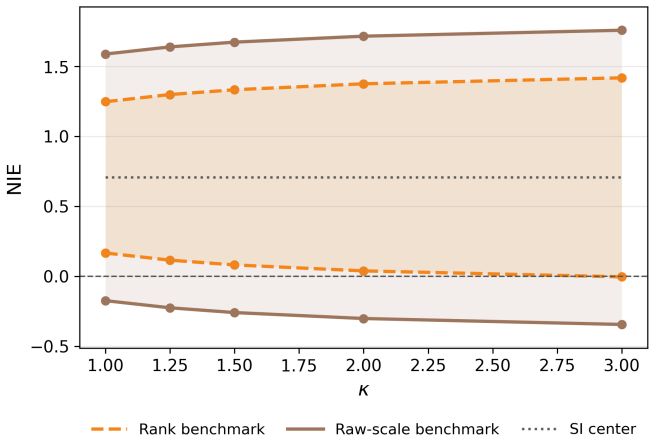

read the original abstract
Causal mediation analysis decomposes the total treatment effect into a portion operating through a hypothesized mediator and a residual direct portion. Identification of natural direct and indirect effects typically rests on the mediator stage of sequential ignorability, which cannot be empirically verified and requires explicit sensitivity analysis. We introduce the \emph{bridge score}, a low-dimensional vector formed from the two treatment-specific mediator densities at a common mediator value, and show that it is a balancing score for the mediator stage of sequential ignorability. Conditional on the bridge score, we then derive a sharp pointwise envelope on the unidentified mediator-outcome confounding function in terms of two interpretable latent confounding parameters. To make the bound operational for sensitivity analysis, we further introduce two calibration approaches. The first is benchmark calibration against an observed covariate, including a rank-based version that is invariant to monotone re-expressions of the benchmark; the second is residual budget calibration based on residual outcome variation. Finally, we show how the pointwise bound can be operationalized for inference through a scalar functional reduction and a Bayesian g-computation algorithm that propagates all sources of uncertainty into posterior draws of the mediation effect estimates.
Editorial analysis
A structured set of objections, weighed in public.
Referee Report
Summary. The paper introduces the bridge score, formed as a low-dimensional vector from the two treatment-specific mediator densities evaluated at a common mediator value. It establishes that this score is a balancing score for the mediator stage of sequential ignorability. Conditional on the bridge score, the authors derive a sharp pointwise envelope for the unidentified mediator-outcome confounding function expressed via two scalar latent confounding parameters. Two calibration strategies are proposed: benchmark calibration (including a rank-based variant invariant to monotone transformations) against an observed covariate, and residual budget calibration using residual outcome variation. Inference is operationalized via a scalar functional reduction and a Bayesian g-computation procedure that propagates uncertainty into posterior draws of natural direct and indirect effects.
Significance. If the balancing property and sharpness of the envelope hold, the framework supplies a dimension-reduced, interpretable sensitivity analysis for mediation that is more structured than fully nonparametric approaches while remaining operational through calibration to observables. The explicit construction of the bridge score from observable densities and the provision of both benchmark and residual-budget calibration routes are practical strengths; the Bayesian g-computation step ensures all sources of uncertainty are accounted for in the final mediation-effect posteriors.
major comments (1)
- The central claim that the bridge score is a balancing score for the mediator stage of sequential ignorability (and thereby permits a sharp pointwise envelope on the confounding function) rests on the sufficiency of the pair of treatment-specific mediator densities at a fixed mediator value. A concrete verification of this dimension-reduction step—e.g., showing that the conditional independence statements implied by sequential ignorability are preserved after conditioning on the bridge score—would strengthen the load-bearing derivation.
minor comments (2)
- The abstract states the central derivation and calibration steps but supplies no equations; adding a brief display of the bridge-score definition and the form of the envelope (even if only in the introduction) would improve readability for readers who begin with the abstract.
- Clarify whether the rank-based benchmark calibration remains valid when the benchmark covariate is itself a function of the mediator or treatment; a short remark or counter-example would prevent misapplication.
Simulated Author's Rebuttal
We thank the referee for their positive evaluation and constructive suggestion. We have revised the manuscript to provide a more explicit verification of the bridge score's balancing property as requested.
read point-by-point responses
-
Referee: The central claim that the bridge score is a balancing score for the mediator stage of sequential ignorability (and thereby permits a sharp pointwise envelope on the confounding function) rests on the sufficiency of the pair of treatment-specific mediator densities at a fixed mediator value. A concrete verification of this dimension-reduction step—e.g., showing that the conditional independence statements implied by sequential ignorability are preserved after conditioning on the bridge score—would strengthen the load-bearing derivation.
Authors: We appreciate the referee highlighting the need for a more explicit verification of the dimension-reduction step. The original manuscript establishes the balancing property in Theorem 1 by constructing the bridge score from the pair of treatment-specific mediator densities evaluated at the observed mediator value and showing that this low-dimensional vector is sufficient for the mediator stage of sequential ignorability. To address the comment directly, the revised manuscript now includes an expanded proof in Section 3.1 that walks through the conditional independence statements step by step: we verify that, conditional on the bridge score and treatment, the mediator is independent of the potential outcomes (Y(1,M(0)), Y(0,M(1)), etc.) in the sense required by sequential ignorability. This is shown by demonstrating that the bridge score captures all relevant information from the mediator density ratio, preserving the ignorability condition without loss of information. The added steps make the sufficiency argument fully transparent while leaving the subsequent sharp pointwise envelope and calibration procedures unchanged. revision: yes
Circularity Check
No significant circularity
full rationale
The derivation introduces the bridge score directly from the observable treatment-specific mediator densities at a fixed value and proves its balancing property for the mediator stage of sequential ignorability via standard conditional independence arguments. The subsequent sharp pointwise envelope on the mediator-outcome confounding function is then obtained by explicit maximization over the two latent parameters conditional on that score. Neither step reduces to a fitted quantity renamed as a prediction, a self-citation chain, or an ansatz smuggled from prior work; the construction remains self-contained with independent mathematical content.
Axiom & Free-Parameter Ledger
axioms (1)
- domain assumption Mediator stage of sequential ignorability cannot be empirically verified and therefore requires explicit sensitivity analysis.
invented entities (1)
-
bridge score
no independent evidence
Reference graph
Works this paper leans on
-
[1]
Wang Miao and Xu Shi and Yilin Li and Eric J. Tchetgen Tchetgen , title =. Statistical Theory and Related Fields , volume =. 2024 , publisher =. doi:10.1080/24754269.2024.2390748 , URL =
-
[2]
A flexible Bayesian g-formula for causal survival analyses with time-dependent confounding: X. Chen et al. , author=. Lifetime Data Analysis , volume=. 2025 , publisher=
work page 2025
-
[3]
Improved sensitivity bounds for mediation under unmeasured mediator–outcome confounding , title =
Arvid Sjölander and Ingeborg Waernbaum , pages =. Improved sensitivity bounds for mediation under unmeasured mediator–outcome confounding , title =. Journal of Causal Inference , doi =. 2024 , lastchecked =
work page 2024
-
[4]
Mediational E-values: approximate sensitivity analysis for unmeasured mediator--outcome confounding , author=. Epidemiology , volume=. 2019 , publisher=
work page 2019
-
[5]
Saskia le Cessie , journal =. Bias Formulas for Estimating Direct and Indirect Effects When Unmeasured Confounding Is Present , urldate =
-
[6]
Statistics in Medicine , volume=
Bayesian sensitivity analysis for unmeasured confounding in causal mediation analysis , author=. Statistics in Medicine , volume=. 2017 , publisher=
work page 2017
-
[7]
Statistics in Medicine , volume =
Guo, Yi and Chen, Dan and Xu, Xinming and Zhang, Zhicheng and Wen, Yu and Zheng, Xueying and Wu, Zhenyu and Qin, Xu , title =. Statistics in Medicine , volume =. doi:https://doi.org/10.1002/sim.70548 , url =. https://onlinelibrary.wiley.com/doi/pdf/10.1002/sim.70548 , note =
-
[8]
Identification and estimation of causal mechanisms in cluster-randomized trials with post-treatment confounding using Bayesian nonparametrics , author=. 2026 , eprint=
work page 2026
-
[9]
Cheng, Chao and Li, Fan , title =. Biometrics , volume =. 2026 , month =. doi:10.1093/biomtc/ujag017 , url =
-
[10]
DeBar, Lynn and Mayhew, Meghan and Benes, Lindsay and Bonifay, Allison and Deyo, Richard A. and Elder, Charles R. and Keefe, Francis J. and Leo, Michael C. and McMullen, Carmit and Owen-Smith, Ashli and Smith, David H. and Trinacty, Connie M. and Vollmer, William M. , title =. Annals of Internal Medicine , year =
-
[11]
Melnick, Edward R and Nath, Bidisha and Dziura, James D and Casey, Martin F and Jeffery, Molly M and Paek, Hyung and Soares, William E and Hoppe, Jason A and Rajeevan, Haseena and Li, Fangyong and Skains, Rachel M and Walter, Lauren A and Patel, Mehul D and Chari, Srihari V and Platts-Mills, Timothy F and Hess, Erik P and D. User centered clinical decisio...
work page 2022
-
[12]
Rosenbaum, Paul R. and Rubin, Donald B. , title =. Biometrika , volume =. 1983 , month =. doi:10.1093/biomet/70.1.41 , url =
-
[13]
Ding, Peng and Vanderweele, Tyler J. , title =. Biometrika , volume =. 2016 , month =. doi:10.1093/biomet/asw012 , url =
-
[14]
Cheng, Chao and Hu, Liangyuan and Li, Fan , title =. Biometrics , volume =. 2024 , month =. doi:10.1093/biomtc/ujae045 , url =
-
[15]
Journal of the Royal Statistical Society Series B: Statistical Methodology , volume =
Ding, Peng and Lu, Jiannan , title =. Journal of the Royal Statistical Society Series B: Statistical Methodology , volume =. 2016 , month =. doi:10.1111/rssb.12191 , url =
-
[16]
Li, Lingling and Shen, Changyu and Wu, Ann C. and Li, Xiaochun , title =. American Journal of Epidemiology , volume =. 2011 , month =. doi:10.1093/aje/kwr096 , url =
-
[17]
The Annals of Applied Statistics , number =
Liangyuan Hu and Jungang Zou and Chenyang Gu and Jiayi Ji and Michael Lopez and Minal Kale , title =. The Annals of Applied Statistics , number =. 2022 , doi =
work page 2022
-
[18]
Tchetgen Tchetgen and Ilya Shpitser , title =
Eric J. Tchetgen Tchetgen and Ilya Shpitser , title =. The Annals of Statistics , number =. 2012 , doi =
work page 2012
-
[19]
and Linero, Antonio and Roy, Jason , year=
Daniels, Michael J. and Linero, Antonio and Roy, Jason , year=. Bayesian Nonparametrics for Causal Inference and Missing Data , doi=
-
[20]
Journal of the American Statistical Association , volume =
Feng Liang and Rui Paulo and German Molina and Merlise A Clyde and Jim O Berger , title =. Journal of the American Statistical Association , volume =. 2008 , publisher =. doi:10.1198/016214507000001337 , URL =
-
[21]
George, EdwardI. and Foster, Dean P. , title =. Biometrika , volume =. 2000 , month =. doi:10.1093/biomet/87.4.731 , url =
-
[22]
and Dominici, Francesca and Wang, Yun , title =
Zigler, Corwin M. and Dominici, Francesca and Wang, Yun , title =. Biostatistics , volume =. 2012 , month =. doi:10.1093/biostatistics/kxr052 , url =
-
[23]
Electronic Journal of Statistics , publisher =
Guido Masarotto and Cristiano Varin , title =. Electronic Journal of Statistics , publisher =. 2012 , doi =
work page 2012
-
[24]
and Li, Fan and Gallis, John A
Turner, Elizabeth L. and Li, Fan and Gallis, John A. and Prague, Melanie and Murray, David M. , title =. American Journal of Public Health , volume =. 2017 , doi =. https://doi.org/10.2105/AJPH.2017.303706 , abstract =
-
[25]
Journal of Machine Learning Research , year =
Yuki Ohnishi and Bikram Karmakar and Arman Sabbaghi , title =. Journal of Machine Learning Research , year =
-
[26]
Dunson and Antonio Lijoi and Igor Pr
Federico Camerlenghi and David B. Dunson and Antonio Lijoi and Igor Pr. Bayesian Analysis , number =. 2019 , doi =
work page 2019
-
[27]
Probability Theory and Related Fields , author =
Pitman, Jim , title=. Probability Theory and Related Fields , year=. doi:10.1007/BF01213386 , url=
-
[28]
The Annals of Statistics , number =
Federico Camerlenghi and Antonio Lijoi and Peter Orbanz and Igor Pr. The Annals of Statistics , number =. 2019 , doi =
work page 2019
-
[29]
Journal of the American Statistical Association , volume =
Francesco Denti and Federico Camerlenghi and Michele Guindani and Antonietta Mira , title =. Journal of the American Statistical Association , volume =. 2023 , publisher =. doi:10.1080/01621459.2021.1933499 , note =
-
[30]
Journal of the American Statistical Association , volume =
Yuki Ohnishi and Fan Li , title =. Journal of the American Statistical Association , volume =. 2025 , publisher =. doi:10.1080/01621459.2025.2544366 , URL =
-
[31]
Bayesian inference and decision techniques: Essays in Honor of Bruno de Finetti , editor =
Zellner, Arnold , title =. Bayesian inference and decision techniques: Essays in Honor of Bruno de Finetti , editor =. 1986 , series =
work page 1986
-
[32]
Bae, Woojung and Daniels, Michael J and Perri, Michael G , title =. Biometrics , volume =. 2024 , month =. doi:10.1093/biomtc/ujae099 , url =
-
[33]
and Williams, Nicholas and Díaz, Iván , title =
Rudolph, Kara E. and Williams, Nicholas and Díaz, Iván , title =. Biometrics , volume =. doi:https://doi.org/10.1111/biom.13850 , url =. https://onlinelibrary.wiley.com/doi/pdf/10.1111/biom.13850 , abstract =
-
[34]
Hong, Guanglei and Yang, Fan and Qin, Xu , title =. Biometrics , volume =. doi:https://doi.org/10.1111/biom.13705 , url =. https://onlinelibrary.wiley.com/doi/pdf/10.1111/biom.13705 , abstract =
-
[35]
Truncation Approximation for Enriched Dirichlet Process Mixture Models , author=. 2023 , eprint=
work page 2023
-
[36]
Journal of the Royal Statistical Society Series B: Statistical Methodology , year =
Cheng, Chao and Li, Fan , title =. Journal of the Royal Statistical Society Series B: Statistical Methodology , year =. doi:10.1093/jrsssb/qkaf037 , url =
-
[37]
Sara Wade and Silvia Mongelluzzo and Sonia Petrone , title =. Bayesian Analysis , number =. 2011 , doi =
work page 2011
-
[38]
Dunson and Sonia Petrone and Lorenzo Trippa , title =
Sara Wade and David B. Dunson and Sonia Petrone and Lorenzo Trippa , title =. Journal of Machine Learning Research , year =
-
[39]
How Effective are Cash Transfers at Improving Nutritional Status? , journal =
James Manley and Seth Gitter and Vanya Slavchevska , keywords =. How Effective are Cash Transfers at Improving Nutritional Status? , journal =. 2013 , issn =. doi:https://doi.org/10.1016/j.worlddev.2013.03.010 , url =
-
[40]
Fonctions de repartition an dimensions et leurs marges , author=. Publ. inst. statist. univ. Paris , volume=
- [41]
-
[42]
Seymour Geisser and William F. Eddy , title =. Journal of the American Statistical Association , volume =. 1979 , publisher =
work page 1979
-
[43]
A. E. Gelfand and D. K. Dey , journal =. Bayesian Model Choice: Asymptotics and Exact Calculations , urldate =
-
[44]
Nonparametric inference for interventional effects with multiple mediators , title =
David Benkeser and Jialu Ran , pages =. Nonparametric inference for interventional effects with multiple mediators , title =. Journal of Causal Inference , doi =. 2021 , lastchecked =
work page 2021
- [45]
-
[46]
and Vansteelandt, Stijn and Robins, James M
VanderWeele, Tyler J. and Vansteelandt, Stijn and Robins, James M. , address =. Effect Decomposition in the Presence of an Exposure-Induced Mediator-Outcome Confounder , volume =. Epidemiology (Cambridge, Mass.) , keywords =. 2014 , abstract =
work page 2014
-
[47]
Aronow and Cyrus Samii , title =
Peter M. Aronow and Cyrus Samii , title =. The Annals of Applied Statistics , number =. 2017 , doi =
work page 2017
-
[48]
Statistical Methods in Medical Research , volume=
Demystifying estimands in cluster-randomised trials , author=. Statistical Methods in Medical Research , volume=. 2024 , publisher=
work page 2024
-
[49]
A Bayesian analysis of the multinomial probit model using marginal data augmentation , journal =
Kosuke Imai and David A. A Bayesian analysis of the multinomial probit model using marginal data augmentation , journal =. 2005 , issn =. doi:https://doi.org/10.1016/j.jeconom.2004.02.002 , url =
-
[50]
American Journal of Epidemiology , volume =
Charters, Thomas J and Kaufman, Jay S and Nandi, Arijit , title = ". American Journal of Epidemiology , volume =. 2023 , month =. doi:10.1093/aje/kwac165 , url =
-
[51]
Albert and Siddhartha Chib , title =
James H. Albert and Siddhartha Chib , title =. Journal of the American Statistical Association , volume =. 1993 , publisher =. doi:10.1080/01621459.1993.10476321 , URL =
-
[52]
Chib, Siddhartha and Greenberg, Edward , title = ". Biometrika , volume =. 1998 , month =. doi:10.1093/biomet/85.2.347 , url =
-
[53]
Journal of the American Statistical Association , volume =
Abel Rodríguez and David B Dunson and Alan E Gelfand , title =. Journal of the American Statistical Association , volume =. 2008 , publisher =
work page 2008
-
[54]
David B. Dunson and Abel Rodr. Bayesian Analysis , number =. 2011 , doi =
work page 2011
-
[55]
Dunson, David B. and Park, Ju-Hyun , title = ". Biometrika , volume =. 2008 , month =. doi:10.1093/biomet/asn012 , url =
-
[56]
Ogburn and Oleg Sofrygin and Iván Díaz and Mark J
Elizabeth L. Ogburn and Oleg Sofrygin and Iván Díaz and Mark J. van der Laan , title =. Journal of the American Statistical Association , volume =. 2024 , publisher =. doi:10.1080/01621459.2022.2131557 , URL =
-
[57]
James Robins , abstract =. A new approach to causal inference in mortality studies with a sustained exposure period—application to control of the healthy worker survivor effect , journal =. 1986 , issn =. doi:https://doi.org/10.1016/0270-0255(86)90088-6 , url =
-
[58]
Statistical Science , number =
Kosuke Imai and Luke Keele and Teppei Yamamoto , title =. Statistical Science , number =. 2010 , doi =
work page 2010
-
[59]
Bingkai Wang and Chan Park and Dylan S. Small and Fan Li , title =. Journal of the American Statistical Association , volume =. 2024 , publisher =. doi:10.1080/01621459.2023.2289693 , URL =
-
[60]
Daniels, Michael J. and Roy, Jason A. and Kim, Chanmin and Hogan, Joseph W. and Perri, Michael G. Bayesian inference for the causal effect of mediation. Biometrics
-
[61]
Statistics in Medicine , volume =
Kim, Chanmin and Daniels, Michael and Li, Yisheng and Milbury, Kathrin and Cohen, Lorenzo , title =. Statistics in Medicine , volume =. doi:https://doi.org/10.1002/sim.7572 , url =. https://onlinelibrary.wiley.com/doi/pdf/10.1002/sim.7572 , abstract =
-
[62]
Semiparametric causal mediation analysis in cluster-randomized experiments , author=. 2024 , eprint=
work page 2024
-
[63]
Yuki Ohnishi and Arman Sabbaghi , title =. Bayesian Analysis , number =. 2024 , doi =
work page 2024
-
[64]
Michael G. Hudgens and M. Elizabeth Halloran , doi =. Toward causal inference with interference , volume =. Journal of the American Statistical Association , keywords =
-
[65]
Multivariate Behavioral Research , volume =
Soojin Park and David Kaplan , title =. Multivariate Behavioral Research , volume =. 2015 , publisher =. doi:10.1080/00273171.2014.1003770 , note =
-
[66]
Roy, Samrat and Daniels, Michael J and Roy, Jason , title = ". Biostatistics , volume =. 2024 , month =. doi:10.1093/biostatistics/kxad038 , url =
-
[67]
Williams, Nathaniel J. Multilevel Mechanisms of Implementation Strategies in Mental Health: Integrating Theory, Research, and Practice. Administration and Policy in Mental Health and Mental Health Services Research
-
[68]
Proceedings of the Seventeenth Conference on Uncertainty in Artificial Intelligence , pages =
Pearl, Judea , title =. Proceedings of the Seventeenth Conference on Uncertainty in Artificial Intelligence , pages =. 2001 , isbn =
work page 2001
-
[69]
Identifiability and exchangeability for direct and indirect effects
Robins, J M and Greenland, S. Identifiability and exchangeability for direct and indirect effects. Epidemiology
-
[70]
Reich and Montserrat Fuentes , title =
Brian J. Reich and Montserrat Fuentes , title =. The Annals of Applied Statistics , number =. 2007 , doi =
work page 2007
-
[71]
Li, Fan and Ding, Peng and Mealli, Fabrizia , title =. Philosophical Transactions of the Royal Society A: Mathematical, Physical and Engineering Sciences , volume =. 2023 , doi =. https://royalsocietypublishing.org/doi/pdf/10.1098/rsta.2022.0153 , abstract =
-
[72]
Journal of the American Statistical Association , author =
Man-Wai Ho and Wanzhu Tu and Pulak Ghosh and Ram C. Tiwari , title =. Journal of the American Statistical Association , volume =. 2013 , publisher =. doi:10.1080/01621459.2012.734164 , URL =
-
[73]
A CONSTRUCTIVE DEFINITION OF DIRICHLET PRIORS , urldate =
Jayaram Sethuraman , journal =. A CONSTRUCTIVE DEFINITION OF DIRICHLET PRIORS , urldate =
-
[74]
Bayesian dynamic density estimation , volume =
Abel Rodr\'iguez and Enrique ter Horst , doi =. Bayesian dynamic density estimation , volume =. Bayesian Analysis , keywords =
-
[75]
Generalized Spatial Dirichlet Process Models , volume =
Jason A Duan and Michele Guindani and Alan E Gelfand , doi =. Generalized Spatial Dirichlet Process Models , volume =. Biometrika , pages =
-
[76]
De la Cruz-Mesía, Rolando and Quintana, Fernando A. and Müller, Peter , title = ". Journal of the Royal Statistical Society Series C: Applied Statistics , volume =. 2007 , month =. doi:10.1111/j.1467-9876.2007.00569.x , url =
-
[77]
Gelfand and Athanasios Kottas and Steven N
Alan E. Gelfand and Athanasios Kottas and Steven N. MacEachern , doi =. Bayesian nonparametric spatial modeling with dirichlet process mixing , volume =. Journal of the American Statistical Association , keywords =
-
[78]
Maria De Iorio and Peter Müller and Gary L. Rosner and Steven N. MacEachern , doi =. An anova model for dependent random measures , volume =. Journal of the American Statistical Association , keywords =
-
[79]
The Annals of Applied Statistics , number =
Alex Diana and Eleni Matechou and Jim Griffin and Alison Johnston , title =. The Annals of Applied Statistics , number =. 2020 , doi =
work page 2020
-
[80]
Covariate-dependent hierarchical Dirichlet process , author=. 2024 , eprint=
work page 2024
discussion (0)
Sign in with ORCID, Apple, or X to comment. Anyone can read and Pith papers without signing in.