REVIEW 4 major objections 5 minor 44 references
Learning Human-Aware Robot Policies for Adaptive Assistance
T0 review · 4 major / 5 minor · reviewed 2026-08-11 · deepseek-v4-flash
Pith's one-line read Assistive robots can infer individual user preferences from motion alone and adapt their assistance without asking, closing the gap between what robots are trained to do and what humans actually value.
desk verdict Anticipation module is a solid incremental contribution, but the utility inference is formally broken and never validated, so the headline claim of preference adaptation does not hold up. read the letter →
The pith
A machine-rendered reading of the paper's core claim, the machinery that carries it, and where it could break.
The reading
What carries the argument
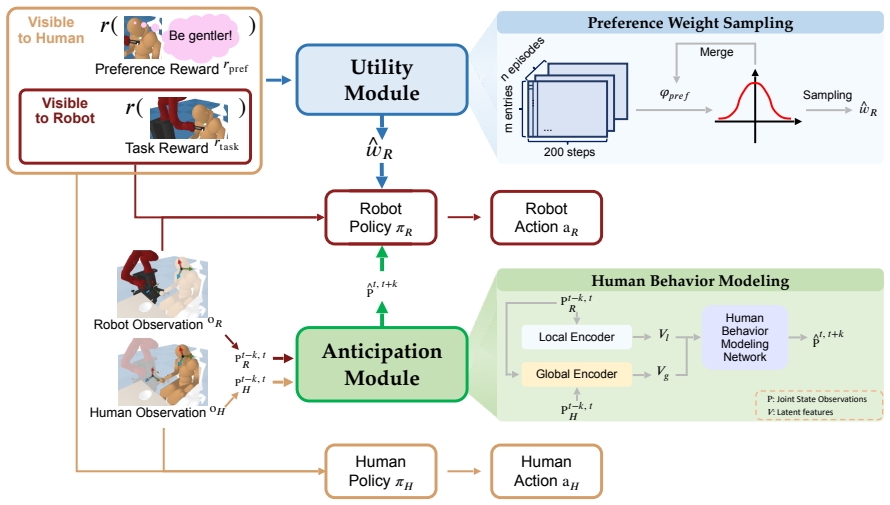
Two modules carry the argument. The anticipation module is a motion predictor $\mathcal{M}$ that takes the past $k$ steps of joint robot-human observations and predicts the human's joint positions $k$ steps ahead, optimized by L2 loss; the robot's policy is then conditioned on this predicted future motion. The utility module assumes the probability of a demonstrated trajectory under utility weights $w$ follows the exponential-family form $P(\xi_D \mid w, \pi) = \prod_i \exp(\phi_{\mathrm{pref}}(\xi_i) w)$, and it estimates $\hat{w}_H$ by MCMC sampling over a unit-ball weight space, progressively merging old and new estimates with a ratio $\gamma$. The sampled weight is converted into an estimated preference reward that is added to the task reward for the robot, shaping the robot's policy toward the inferred human utility.
What would settle it
Run the method in the same simulated feeding task but with a human policy whose preference weights change partway through an episode, then compare the robot's inferred weights to the ground-truth weights used to generate the human reward; if the inferred weights fail to track the change, the reward-shaping mechanism is not responsible for the reported gains.
Extended reading notes
Core claim
On the paper's own terms, the central discovery is that reward misalignment between human and robot can be substantially closed by learning a proxy for human preferences during interaction. The robot keeps its original task reward but adds an estimated preference term $\hat{r}_{\mathrm{pref}} = \phi_{\mathrm{pref}}(\xi; \hat{w}_H)$, where $\hat{w}_H$ is sampled from a distribution over utility weights using MCMC over the human's recent demonstrated trajectories. Combined with a motion anticipation module that predicts future human joint positions and conditions the robot's policy on that prediction, the framework yields behavior that matches or exceeds a co-optimized baseline where the robot is given the human's true reward. The paper reports, for example, a human reward of 118.656 with 100% success on the Sawyer feeding task, versus 109.063 and 98.8% for the misaligned PPO baseline.
Load-bearing premise
The robot's adaptation depends on the assumption that a person's natural movements during the task reliably expose what they care about, even while their behavior is still changing as they adapt to the robot.
Editorial extensions
If this is right
- Assistive robots for feeding, drinking, and bathing could personalize their behavior to each user without requiring the user to fill out preference surveys.
- Explicitly modeling the human partner's future motion and preferences appears to recover most of the benefit of centralized co-optimization, even when the robot never observes the true human reward.
- The framework is reported to transfer across four robotic arms and three tasks with different action patterns, suggesting a general mechanism rather than a task-specific fix.
- The ablation results indicate that the preference-weight merging ratio matters, so tuning this ratio is a practical lever for user satisfaction.
Reading between the lines
- A natural stress test not run in the paper would be to compare the inferred preference weights against ground-truth weights during training; if they do not track the true weights, the reported gains would need to be explained by the anticipation module alone.
- The same two-module recipe could be applied to other collaborative settings where one agent's objective is hidden, such as shared teleoperation or collaborative assembly, as long as the partner's behavior carries information about their preferences.
- The paper's own limitation statement notes that experiments are in simulation; a decisive extension would be a real-user study where satisfaction is measured directly, since simulated human policies may be more predictable than real users.
Signed reviews
Editorial analysis
A structured set of objections, weighed in public.
Referee Report
Summary. The paper addresses assistive human-robot collaboration under misaligned rewards: the robot receives only a task reward, while the human's behavior is driven by task reward plus an unknown preference reward. The authors propose a framework with two modules: an anticipation module that predicts future human joint positions from recent joint states and feeds these predictions into a PPO-based robot policy, and a utility module that is intended to infer the human preference weights from interaction trajectories and use them to shape the robot reward. Experiments are reported on feeding, drinking, and bed-bathing tasks with Sawyer, Baxter, Jaco, and PR2 robots, comparing against PPO, TD3, and MADDPG. The reported results show consistent improvements in human reward and success rate over the misaligned baselines, and ablations indicate that both modules contribute to the final performance.
Significance. If substantiated, the problem the paper targets is important: assistive robots that adapt to implicit, individual user preferences without explicit queries would be a meaningful advance over co-optimized or preference-query-based systems. The paper also ships code and demos, and the anticipation-module formulation is a reasonable and potentially transferable component. However, the central claim of preference adaptation rests entirely on the utility module, and the current manuscript does not establish that this module correctly recovers or uses preference weights. The empirical comparisons also lack statistical grounding. Because the contribution and the evidence are both contingent on fixing these issues, the significance is currently conditional rather than established.
major comments (4)
- [III-C, Eqs. (7)-(10)] The utility module's inference equations are not a well-defined probabilistic model. In Eq. (7), a product over n trajectories is written but no per-trajectory likelihood is specified. In Eq. (8), the right-hand side, exp(sum_j phi_pref(xi_j)^D / pi_t), does not depend on the weight vector w at all, so it cannot be a posterior distribution over w, and no prior or normalization is given. Eq. (10) is presented as an MCMC target, but the expression f(X) = -log(sum e^X + (phi_pref(xi_D) X)) is not recognizably a valid log-density or energy function for the weight distribution. Since the utility module is the mechanism by which the paper claims to adapt to individual preferences, this is load-bearing: until a correct derivation is provided, the reported gains cannot be attributed to preference inference. The authors should either give a rigorous derivation of the posterior and MCMC sampler, or replace this module with a standard inverse-reinforcement-learning formulation and verify that it is implemented as described.
- [IV-C, Table IV and VI] The utility module is never validated against the ground-truth preference weights that are available by construction. Table VI lists the exact weights used to generate the simulated user preferences for each setting, yet the paper reports no comparison between the estimated weights and the true weights, at any training stage or for any preference setting. This matters because Table IV shows that removing the utility module changes the human reward from 118.656 to 118.211, a 0.4% difference, and the success rate from 100.0% to 98.8%; without direct evidence that the inferred weights are accurate, the claim that the robot is 'adapting to individual preferences' is unsupported. Please add quantitative validation of weight recovery (e.g., MSE or correlation with the ground-truth weights over training) and ideally a convergence plot for the estimated distribution.
- [IV-B and Tables I-V] All empirical comparisons are reported as single numbers with no number of seeds, no standard deviations or confidence intervals, and no significance tests. Tables I, II, III, IV, and V and the training curves in Figures 4, 6, and 7 therefore do not establish that the differences between methods are stable or not due to random seed variation. For example, the difference between the full method and the version without the utility module in Table IV (118.656 vs 118.211) is small, and the success-rate difference (100.0% vs 98.8%) could easily arise from a single seed. Please report results over at least several seeds with measures of variance, and use appropriate significance tests where comparisons are claimed.
- [III-C and Algorithm 1] The utility module treats trajectories in the PPO buffer as if they were generated by the current policy pi_t in Eq. (7), but the human policy is itself being updated during training (Algorithm 1, line 15). The paper does not address the resulting non-stationarity of the data distribution, nor does it discuss whether the hand-selected preference features phi_pref identify the weight vector from the available trajectories. If the features are not informative enough, or if the trajectory buffer mixes samples from many different human policies, the inferred weights will be biased even when Eq. (8) is interpreted as intended. Please clarify the sampling procedure and either justify the stationarity assumption or correct for the off-policy data.
minor comments (5)
- [Table I vs Table IV] The PPO baseline's High Force Penalty is reported as -4.645 in Table I but as -18.581 in Table IV for what appears to be the same feeding task and preference settings; please reconcile these numbers.
- [Appendix A] Appendix A states that each experiment takes about 12 hours for the Feeding task and then '24 hours for bed bathing and feeding tasks'; the second phrase appears to be a copy-paste error and should be corrected.
- [IV-A.c] There is a typo, 'diffferent', in the description of the decomposed reward terms; please fix it.
- [IV-C.b] The merge-ratio ablation in Table V reports only four ratios and the conclusion that 'the proposed merging mechanism improves human satisfaction' is not supported by a comparison against a no-merging baseline with error bars; please either add the missing comparison or soften the claim.
- [III-C] The phrase 'we follow [28] and further give a specific update formula' would benefit from a precise statement of which quantities in Eq. (10) are analogous to the reference method, since the connection between the reference and the written formulas is not evident.
Circularity Check
No significant circularity: the utility module's preference inference is a standard IRL setup, and the human-reward metric is external ground truth.
full rationale
The paper's derivation chain is not circular. The utility module (Sec. III-C) is intended to recover the human preference weights \hat w_H from trajectories generated by a human policy whose reward is the ground-truth combination r_H = r_pref + r_task (Eq. 3); the robot never observes the true weights, so this is a standard inverse-RL estimation problem rather than a renaming of inputs. The evaluation metric "human reward" (Table I) is computed with the simulator's true weights, which are external to the robot's learning loop, so reporting it is not equivalent to reporting the robot's own shaped reward (Eq. 11), even though both use the same feature map \phi_pref; the link between them is precisely the estimated weight, which the paper should validate but does not. The self-citations ([7], [38]) are motivational and not load-bearing. Concerns raised in the reviewer note—that Eq. (8) is not a normalized posterior and that inferred weights are never compared to Table VI—are correctness and validation issues, not circularity, because no equation forces \hat w_H = w_true by construction.
Assumptions & free parameters
free parameters (3)
- merge ratio gamma =
swept 0.0-0.5; best 0.5 in Table V
- foresight schedule k(t) =
10 (steps 0-50), 8 (50-100), 5 (after 100)
- probability gate eta =
unspecified
assumptions (4)
- domain assumption Exponential-family trajectory likelihood P(xi|w,pi) proportional to exp(w dot phi(xi))
- domain assumption Simulated human PPO policy is a valid proxy for real human preference expression
- domain assumption Stationarity of the human policy across utility updates
- ad hoc to paper Probability gate heuristic
Cite this review
Pith. "Pith review of Learning Human-Aware Robot Policies for Adaptive Assistance." pith.science (2026). https://pith.science/paper/V435I5CE
@misc{pith2026241211913,
  author       = {Pith},
  title        = {Pith review of: Learning Human-Aware Robot Policies for Adaptive Assistance},
  year         = {2026},
  howpublished = {\url{https://pith.science/paper/V435I5CE}},
  note         = {Machine review of arXiv:2412.11913}
}
read the original abstract
Developing robots that can assist humans efficiently, safely, and adaptively is crucial for real-world applications such as healthcare. While previous work often assumes a centralized system for co-optimizing human-robot interactions, we argue that real-world scenarios are much more complicated, as humans have individual preferences regarding how tasks are performed. Robots typically lack direct access to these implicit preferences. However, to provide effective assistance, robots must still be able to recognize and adapt to the individual needs and preferences of different users. To address these challenges, we propose a novel framework in which robots infer human intentions and reason about human utilities through interaction. Our approach features two critical modules: the anticipation module is a motion predictor that captures the spatial-temporal relationship between the robot agent and user agent, which contributes to predicting human behavior; the utility module infers the underlying human utility functions through progressive task demonstration sampling. Extensive experiments across various robot types and assistive tasks demonstrate that the proposed framework not only enhances task success and efficiency but also significantly improves user satisfaction, paving the way for more personalized and adaptive assistive robotic systems. Code and demos are available at https://asonin.github.io/Human-Aware-Assistance/.
Figures


Figures from the paper (4 more)


Reference graph
Works this paper leans on
-
[1]
Assistive gym: A physics simulation framework for assistive robotics,
Z. Erickson, V . Gangaram, A. Kapusta, C. K. Liu, and C. C. Kemp, “Assistive gym: A physics simulation framework for assistive robotics,” in ICRA 2020. IEEE, 2020, pp. 10 169–10 176
work page 2020
-
[2]
Rcareworld: A human-centric sim- ulation world for caregiving robots,
R. Ye, W. Xu, H. Fu, R. K. Jenamani, V . Nguyen, C. Lu, K. Dim- itropoulou, and T. Bhattacharjee, “Rcareworld: A human-centric sim- ulation world for caregiving robots,” IROS, 2022
work page 2022
-
[3]
Learning representations that enable generalization in assistive tasks,
J. Z.-Y . He, Z. Erickson, D. S. Brown, A. Raghunathan, and A. Dragan, “Learning representations that enable generalization in assistive tasks,” in Conference on Robot Learning . PMLR, 2023, pp. 2105–2114
work page 2023
-
[4]
T. Osa and T. Harada, “Robustifying a policy in multi-agent rl with diverse cooperative behavior and adversarial style sampling for assistive tasks,” arXiv preprint arXiv:2403.00344 , 2024
work page Pith review arXiv 2024
-
[5]
M. Liu and C. Chen, “Task decoupling in preference-based rein- forcement learning for personalized human-robot interaction,” in 2022 IEEE/RSJ International Conference on Intelligent Robots and Systems (IROS). IEEE, 2022, pp. 848–855
work page 2022
-
[6]
Inferring human intent and predicting human action in human–robot collaboration,
G. Hoffman, T. Bhattacharjee, and S. Nikolaidis, “Inferring human intent and predicting human action in human–robot collaboration,” Annual Review of Control, Robotics, and Autonomous Systems , vol. 7, 2024
work page 2024
-
[7]
Language models represent beliefs of self and others,
W. Zhu, Z. Zhang, and Y . Wang, “Language models represent beliefs of self and others,” in Forty-first International Conference on Machine Learning, 2024
work page 2024
-
[8]
Recursive bayesian human intent recognition in shared-control robotics,
S. Jain and B. Argall, “Recursive bayesian human intent recognition in shared-control robotics,” in 2018 IEEE/RSJ International Conference on Intelligent Robots and Systems (IROS) . IEEE, 2018, pp. 3905– 3912
work page 2018
Show all 44 references
-
[9]
Robots for humanity: using assistive robotics to empower people with disabilities,
T. L. Chen, M. Ciocarlie, S. Cousins, P. M. Grice, K. Hawkins, K. Hsiao, C. C. Kemp, C.-H. King, D. A. Lazewatsky, A. E. Leeper et al. , “Robots for humanity: using assistive robotics to empower people with disabilities,” IEEE Robotics & Automation Magazine , vol. 20, no. 1, p...
2013
-
[10]
Robot-driven trajectory improvement for feeding tasks,
T. Rhodes and M. Veloso, “Robot-driven trajectory improvement for feeding tasks,” in IROS 2018. IEEE
2018
-
[11]
Design principles for robot-assisted feeding in social contexts,
A. Nanavati, P. Alves-Oliveira, T. Schrenk, E. K. Gordon, M. Cakmak, and S. S. Srinivasa, “Design principles for robot-assisted feeding in social contexts,” in Proceedings of the 2023 ACM/IEEE International Conference on Human-Robot Interaction , 2023, pp. 24–33
2023
-
[12]
A community-centered design framework for robot-assisted feeding systems,
T. Bhattacharjee, M. E. Cabrera, A. Caspi, M. Cakmak, and S. S. Srinivasa, “A community-centered design framework for robot-assisted feeding systems,” in Proceedings of the 21st International ACM SIGACCESS Conference on Computers and Accessibility , 2019, pp. 482–494
2019
-
[13]
A multimodal anomaly detector for robot-assisted feeding using an lstm-based variational autoen- coder,
D. Park, Y . Hoshi, and C. C. Kemp, “A multimodal anomaly detector for robot-assisted feeding using an lstm-based variational autoen- coder,” IEEE Robotics and Automation Letters, vol. 3, no. 3, pp. 1544– 1551, 2018
2018
-
[14]
Transfer depends on acquisition: Analyzing manipulation strategies for robotic feeding,
D. Gallenberger, T. Bhattacharjee, Y . Kim, and S. S. Srinivasa, “Transfer depends on acquisition: Analyzing manipulation strategies for robotic feeding,” in2019 14th ACM/IEEE International Conference on Human-Robot Interaction (HRI) . IEEE, 2019, pp. 267–276
2019
-
[15]
Human-robot gym: Benchmark- ing reinforcement learning in human-robot collaboration,
J. Thumm, F. Trost, and M. Althoff, “Human-robot gym: Benchmark- ing reinforcement learning in human-robot collaboration,” in 2024 IEEE International Conference on Robotics and Automation (ICRA) . IEEE, 2024, pp. 7405–7411
2024
-
[16]
Clothesnet: An information-rich 3d garment model repository with simulated clothes environment,
B. Zhou, H. Zhou, T. Liang, Q. Yu, S. Zhao, Y . Zeng, J. Lv, S. Luo, Q. Wang, X. Yu et al., “Clothesnet: An information-rich 3d garment model repository with simulated clothes environment,” in Proceedings of the IEEE/CVF International Conference on Computer Vision, 2023, pp. 2...
2023
-
[17]
igibson 1.0: A simulation environment for interactive tasks in large realistic scenes,
B. Shen, F. Xia, C. Li, R. Mart ´ın-Mart´ın, L. Fan, G. Wang, C. P ´erez- D’Arpino, S. Buch, S. Srivastava, L. Tchapmi et al., “igibson 1.0: A simulation environment for interactive tasks in large realistic scenes,” in 2021 IEEE/RSJ International Conference on Intelligent Robo...
2021
-
[18]
Robot workmate: a trustworthy coworker for the continuous automotive assembly line and its imple- mentation,
R. M ¨uller, M. Vette, and M. Scholer, “Robot workmate: a trustworthy coworker for the continuous automotive assembly line and its imple- mentation,” Procedia CIRP, vol. 44, pp. 263–268, 2016
2016
-
[19]
Human-aware robotic assistant for collab- orative assembly: Integrating human motion prediction with planning in time,
V . V . Unhelkar, P. A. Lasota, Q. Tyroller, R.-D. Buhai, L. Marceau, B. Deml, and J. A. Shah, “Human-aware robotic assistant for collab- orative assembly: Integrating human motion prediction with planning in time,” IEEE Robotics and Automation Letters , vol. 3, no. 3, pp. 239...
2018
-
[20]
Learning garment manipulation policies toward robot-assisted dressing,
F. Zhang and Y . Demiris, “Learning garment manipulation policies toward robot-assisted dressing,” Science robotics , vol. 7, no. 65, p. eabm6010, 2022
2022
-
[21]
Improving assistive robotics with deep reinforcement learning,
Y . Jakhotiya and I. Haque, “Improving assistive robotics with deep reinforcement learning,” arXiv preprint arXiv:2209.02160 , 2022
2022 arXiv
-
[22]
Discovering diverse solu- tions in deep reinforcement learning by maximizing state–action-based mutual information,
T. Osa, V . Tangkaratt, and M. Sugiyama, “Discovering diverse solu- tions in deep reinforcement learning by maximizing state–action-based mutual information,” Neural Networks, vol. 152, pp. 90–104, 2022
2022
-
[23]
Sparcs: Structuring phys- ically assistive robotics for caregiving with stakeholders-in-the-loop,
R. Madan, R. K. Jenamani, V . T. Nguyen, A. Moustafa, X. Hu, K. Dimitropoulou, and T. Bhattacharjee, “Sparcs: Structuring phys- ically assistive robotics for caregiving with stakeholders-in-the-loop,” in 2022 IEEE/RSJ International Conference on Intelligent Robots and Systems ...
2022
-
[24]
Bodies uncovered: Learning to manipulate real blankets around people via physics simulations,
K. Puthuveetil, C. C. Kemp, and Z. Erickson, “Bodies uncovered: Learning to manipulate real blankets around people via physics simulations,” IEEE Robotics and Automation Letters , vol. 7, no. 2, pp. 1984–1991, 2022
1984
-
[25]
Learning human-to-robot handovers from point clouds,
S. Christen, W. Yang, C. P ´erez-D’Arpino, O. Hilliges, D. Fox, and Y .-W. Chao, “Learning human-to-robot handovers from point clouds,” in Proceedings of the IEEE/CVF Conference on Computer Vision and Pattern Recognition, 2023, pp. 9654–9664
2023
-
[26]
Sadigh, A
D. Sadigh, A. Dragan, S. Sastry, and S. Seshia, Active preference- based learning of reward functions , 2017
2017
-
[27]
Asha: Assistive teleoperation via human-in-the-loop reinforcement learning,
S. Chen, J. Gao, S. Reddy, G. Berseth, A. D. Dragan, and S. Levine, “Asha: Assistive teleoperation via human-in-the-loop reinforcement learning,” in 2022 International Conference on Robotics and Automa- tion (ICRA). IEEE, 2022, pp. 7505–7512
2022
-
[28]
Learning re- ward functions by integrating human demonstrations and preferences,
M. Palan, N. C. Landolfi, G. Shevchuk, and D. Sadigh, “Learning re- ward functions by integrating human demonstrations and preferences,” arXiv preprint arXiv:1906.08928 , 2019
1906 arXiv
-
[29]
Learning to collaborate from simulation for robot-assisted dressing,
A. Clegg, Z. Erickson, P. Grady, G. Turk, C. C. Kemp, and C. K. Liu, “Learning to collaborate from simulation for robot-assisted dressing,” IEEE Robotics and Automation Letters , vol. 5, no. 2, pp. 2746–2753, 2020
2020
-
[30]
Handoversim: A simulation framework and benchmark for human-to-robot object handovers,
Y .-W. Chao, C. Paxton, Y . Xiang, W. Yang, B. Sundaralingam, T. Chen, A. Murali, M. Cakmak, and D. Fox, “Handoversim: A simulation framework and benchmark for human-to-robot object handovers,” in 2022 International Conference on Robotics and Automation (ICRA) . IEEE, 2022, pp...
2022
-
[31]
A bayesian approach for policy learning from trajectory preference queries,
A. Wilson, A. Fern, and P. Tadepalli, “A bayesian approach for policy learning from trajectory preference queries,” in Advances in Neural Information Processing Systems, F. Pereira, C. Burges, L. Bottou, and K. Weinberger, Eds., vol. 25. Curran Associates, Inc., 2012
2012
-
[32]
Preference-based reinforcement learn- ing: A policy iteration algorithm for learning from preference-based feedback,
C. Wirth and J. F ¨urnkranz, “Preference-based reinforcement learn- ing: A policy iteration algorithm for learning from preference-based feedback,” in Advances in Intelligent Data Analysis XII , A. Tucker, F. H¨oppner, A. Siebes, and S. Swift, Eds. Berlin, Heidelberg: Springer...
2013
-
[33]
A survey of preference-based reinforcement learning methods,
C. Wirth, R. Akrour, G. Neumann, and J. F ¨urnkranz, “A survey of preference-based reinforcement learning methods,” Journal of Ma- chine Learning Research , vol. 18, no. 136, pp. 1–46, 2017
2017
-
[34]
Pebble: Feedback-efficient interactive reinforcement learning via relabeling experience and un- supervised pre-training,
K. Lee, L. M. Smith, and P. Abbeel, “Pebble: Feedback-efficient interactive reinforcement learning via relabeling experience and un- supervised pre-training,” in International Conference on Machine Learning, 2021
2021
-
[35]
Human-guided robot behavior learning: A gan-assisted preference-based reinforcement learning approach,
H. Zhan, F. Tao, and Y . Cao, “Human-guided robot behavior learning: A gan-assisted preference-based reinforcement learning approach,” IEEE Robotics and Automation Letters , vol. 6, pp. 3545–3552, 2020
2020
-
[36]
Weak human preference supervi- sion for deep reinforcement learning,
Z. Cao, K. Wong, and C.-T. Lin, “Weak human preference supervi- sion for deep reinforcement learning,” IEEE Transactions on Neural Networks and Learning Systems , vol. 32, pp. 5369–5378, 2021
2021
-
[37]
Surf: Semi-supervised reward learning with data augmentation for feedback-efficient preference-based reinforcement learning,
J. Park, Y . Seo, J. Shin, H. Lee, P. Abbeel, and K. Lee, “Surf: Semi-supervised reward learning with data augmentation for feedback-efficient preference-based reinforcement learning,” ArXiv, vol. abs/2203.10050, 2022
2022 arXiv
-
[38]
Social motion prediction with cognitive hierarchies,
W. Zhu, J. Qin, Y . Lou, H. Ye, X. Ma, H. Ci, and Y . Wang, “Social motion prediction with cognitive hierarchies,” Advances in Neural Information Processing Systems , vol. 36, 2024
2024
-
[39]
Efficient training of artificial neural networks for autonomous navigation,
D. A. Pomerleau, “Efficient training of artificial neural networks for autonomous navigation,” Neural computation, vol. 3, no. 1, pp. 88–97, 1991
1991
-
[40]
Near-optimal reinforcement learning in polynomial time,
M. Kearns and S. Singh, “Near-optimal reinforcement learning in polynomial time,” Machine learning, vol. 49, pp. 209–232, 2002
2002
-
[41]
Mastering the game of go with deep neural networks and tree search,
D. Silver, A. Huang, C. J. Maddison, A. Guez, L. Sifre, G. Van Den Driessche, J. Schrittwieser, I. Antonoglou, V . Panneershelvam, M. Lanctot et al. , “Mastering the game of go with deep neural networks and tree search,” nature, vol. 529, no. 7587, pp. 484–489, 2016
2016
-
[42]
Proximal policy optimization algorithms,
J. Schulman, F. Wolski, P. Dhariwal, A. Radford, and O. Klimov, “Proximal policy optimization algorithms,” arXiv preprint arXiv:1707.06347, 2017
2017 arXiv
-
[43]
Addressing function approxi- mation error in actor-critic methods,
S. Fujimoto, H. Hoof, and D. Meger, “Addressing function approxi- mation error in actor-critic methods,” in International conference on machine learning. PMLR, 2018, pp. 1587–1596
2018
-
[44]
Multi-agent actor-critic for mixed cooperative-competitive environments,
R. Lowe, Y . I. Wu, A. Tamar, J. Harb, O. Pieter Abbeel, and I. Mor- datch, “Multi-agent actor-critic for mixed cooperative-competitive environments,” Advances in neural information processing systems , vol. 30, 2017. APPENDIX A. Implementation Details We train the proposed ap...
2017
Reviewed August 11, 2026 · model on record in the stance chip above.
Discussion (0). Continue with ORCID to comment.