Single-Shot Intensity-Correlation Diffractive X-ray Imaging of ICF Plasmas
Pith reviewed 2026-06-26 01:12 UTC · model grok-4.3
The pith
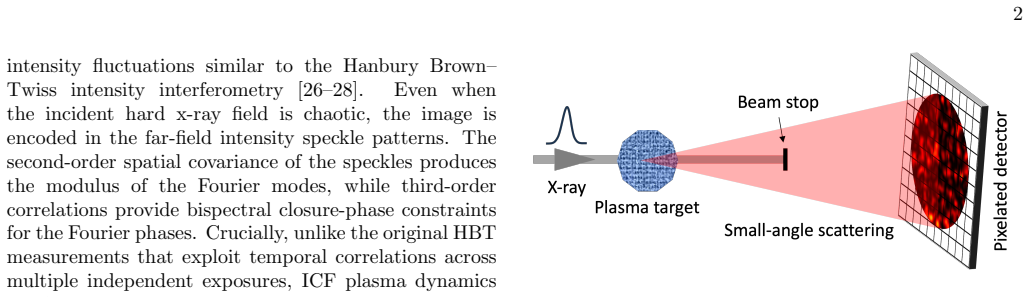
Intensity correlations of chaotic x-ray speckles enable single-shot submicron imaging of fusion plasmas without lenses.
A machine-rendered reading of the paper's core claim, the machinery that carries it, and where it could break.
Core claim
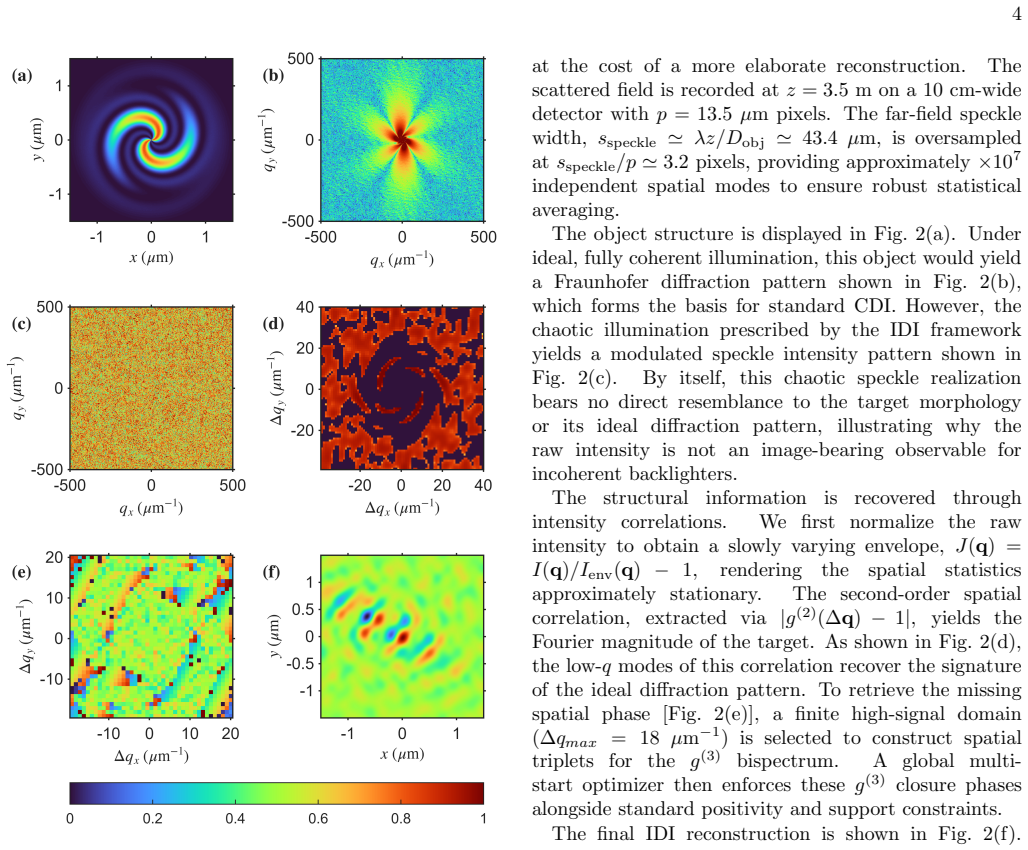
Single-shot intensity-correlation diffractive imaging reconstructs plasma morphology by Fourier transforming the spatial correlations of chaotic far-field speckles via the Hanbury Brown-Twiss effect, with the Fourier phase retrieved by applying bispectral closure-phase constraints derived from third-order intensity correlations, as demonstrated for a 50 keV x-ray probe scattered by a spiral plasma structure.
What carries the argument
Intensity-correlation diffractive imaging (IDI) that extracts amplitudes from Hanbury Brown-Twiss speckle correlations and phases from bispectral closure on third-order correlations.
If this is right
- Submicron resolution becomes available for single-shot measurements of plasma turbulence in inertial confinement fusion.
- Lensless imaging removes geometric blur and aperture tradeoffs that limit conventional x-ray radiography.
- The method works from intensity correlations alone, without needing direct phase measurements.
- Third-order correlations suffice to close the phase problem for the Fourier reconstruction.
Where Pith is reading between the lines
- The same correlation approach could be tested on other turbulent structures beyond the simulated spiral to map its range of applicability.
- If the low-emission condition can be met in experiments, the technique might integrate with existing ICF diagnostics for higher-resolution turbulence data.
- Extensions to different probe energies or multi-shot averaging could be explored to relax the single-shot chaotic-speckle requirement.
Load-bearing premise
The plasma must be under low-self-emission conditions so the probe x-rays dominate the detected signal and the far-field speckles must be sufficiently chaotic for accurate correlation-based phase retrieval.
What would settle it
A numerical test or real measurement in which self-emission exceeds the probe signal or speckles lack sufficient chaos, causing the bispectral phase retrieval to produce an incorrect reconstruction of the known spiral structure.
Figures
read the original abstract
X-ray radiography of inertial confinement fusion plasmas is currently limited to several-micron resolution by geometric blur, diffraction, and photon-throughput tradeoffs. We propose single-shot intensity-correlation diffractive imaging (IDI) as a lensless route to submicron plasma turbulence measurements under low-self-emission conditions. Rather than relying on physical apertures, IDI reconstructs plasma morphology by Fourier transforming the spatial correlations of chaotic far-field speckles via the Hanbury Brown-Twiss effect. The Fourier phase is retrieved by applying bispectral closure-phase constraints derived from third-order intensity correlations. We demonstrate this submicron capability in a numerical simulation using a $50~\mathrm{keV}$ x-ray probe scattered by a spiral plasma structure.
Editorial analysis
A structured set of objections, weighed in public.
Referee Report
Summary. The manuscript proposes single-shot intensity-correlation diffractive imaging (IDI) as a lensless technique for submicron-resolution x-ray radiography of inertial confinement fusion plasmas under low-self-emission conditions. It reconstructs plasma morphology from Fourier transforms of spatial correlations of chaotic far-field speckles using the Hanbury Brown-Twiss effect for amplitudes and bispectral closure-phase constraints from third-order intensity correlations for phases. The central claim is demonstrated via a numerical simulation of a 50 keV x-ray probe scattered by a spiral plasma structure.
Significance. If the numerical result holds under the stated conditions, the method could extend ICF plasma turbulence diagnostics beyond the current several-micron resolution limits imposed by geometric blur and diffraction. The approach applies established HBT and bispectral techniques to a plasma context without introducing new free parameters, which is a strength of the proposal.
major comments (2)
- [Numerical demonstration] Numerical demonstration section: the central claim of submicron reconstruction rests on a single simulation of one spiral structure; no quantitative error metrics (e.g., RMS deviation from ground truth), resolution quantification, or validation against simpler test cases (such as a known Gaussian or periodic density profile) are reported, limiting assessment of robustness.
- [Assumptions paragraph] Assumptions paragraph (near abstract): the requirement that the plasma be under low-self-emission conditions so that probe x-rays dominate is stated but not quantified (e.g., no threshold ratio of self-emission to probe intensity or corresponding signal-to-noise impact on the retrieved bispectrum is provided), which is load-bearing for the applicability claim.
minor comments (2)
- [Abstract] The abstract would benefit from a brief statement of the achieved spatial resolution (e.g., in nm) and the number of speckles or photons used in the simulation.
- [Methods] Notation for the bispectral closure relation should be defined explicitly with an equation number rather than described only in prose.
Simulated Author's Rebuttal
We thank the referee for their constructive feedback and positive assessment of the potential significance of the IDI technique. We address the two major comments point-by-point below, agreeing that both points warrant additions to strengthen the manuscript.
read point-by-point responses
-
Referee: Numerical demonstration section: the central claim of submicron reconstruction rests on a single simulation of one spiral structure; no quantitative error metrics (e.g., RMS deviation from ground truth), resolution quantification, or validation against simpler test cases (such as a known Gaussian or periodic density profile) are reported, limiting assessment of robustness.
Authors: We agree the current demonstration is limited and would benefit from quantitative validation. In the revised manuscript we will add RMS deviation from ground truth, a resolution metric (e.g., Fourier ring correlation), and reconstructions of simpler test objects including a Gaussian density profile and a periodic structure to demonstrate robustness. revision: yes
-
Referee: Assumptions paragraph (near abstract): the requirement that the plasma be under low-self-emission conditions so that probe x-rays dominate is stated but not quantified (e.g., no threshold ratio of self-emission to probe intensity or corresponding signal-to-noise impact on the retrieved bispectrum is provided), which is load-bearing for the applicability claim.
Authors: We agree that the low-self-emission condition requires quantification. In revision we will specify a threshold ratio (e.g., self-emission <10% of probe intensity) and include analysis of its impact on bispectrum SNR and phase-retrieval accuracy, supported by additional noise simulations. revision: yes
Circularity Check
No significant circularity
full rationale
The paper proposes single-shot intensity-correlation diffractive imaging using established Hanbury Brown-Twiss second-order correlations for amplitudes and bispectral closure for phases, then demonstrates the approach via numerical simulation on a 50 keV probe scattered by a spiral plasma structure. No load-bearing equations, fitted parameters, or self-citations are shown that would reduce the claimed submicron reconstruction to the simulation inputs by construction. The method is presented as an application of standard techniques under stated low-self-emission conditions, making the central numerical result self-contained rather than tautological.
Axiom & Free-Parameter Ledger
axioms (2)
- domain assumption Low-self-emission conditions allow the probe x-rays to dominate the detected signal.
- domain assumption Far-field speckles are chaotic, enabling Hanbury Brown-Twiss spatial correlations.
Reference graph
Works this paper leans on
-
[1]
Edwards, P
M. Edwards, P. Amendt, D. Batha, T. Boehly, F. Boody, D. Bradley, G. Burton, R. Craxton, C. Decker, S. Dixit, et al., Progress towards ignition on the National Ignition Facility, Physics of Plasmas20, 070501 (2013)
2013
-
[2]
O. A. Hurricane, D. Callahan, D. Casey, P. Celliers, C. Cerjan, E. Dewald, T. Dittrich, T. D¨ oppner, D. Hinkel, L. B. Hopkins,et al., Fuel gain exceeding unity in an inertially confined fusion implosion, Nature506, 343 (2014)
2014
-
[3]
Lindl, Development of the indirect-drive approach to inertial confinement fusion and the target physics basis for ignition and gain, Physics of Plasmas2, 3933 (1995)
J. Lindl, Development of the indirect-drive approach to inertial confinement fusion and the target physics basis for ignition and gain, Physics of Plasmas2, 3933 (1995)
1995
-
[4]
K. A. Nugent, Coherent methods in the X-ray sciences, Advances in Physics59, 1 (2010)
2010
-
[5]
Kozioziemski, B
B. Kozioziemski, B. Bachmann, A. Do, and R. Tommasini, X-ray imaging methods for high- energy density physics applications, Review of Scientific Instruments94, 041102 (2023)
2023
-
[6]
J. A. Koch, O. L. Landen, B. J. Kozioziemski, N. Izumi, E. L. Dewald, J. D. Salmonson, and B. A. Hammel, Refraction-enhanced x-ray radiography for inertial confinement fusion and laser-produced plasma applications, Journal of Applied Physics105, 113112 (2009)
2009
-
[7]
Landen, D
O. Landen, D. Farley, S. Glendinning, L. Logory, P. Bell, J. Koch, D. Bradley, P. Bradley, C. Decker, P. Dendooven,et al., X-ray backlighting for the National Ignition Facility (invited), Review of Scientific Instruments72, 627 (2001)
2001
-
[8]
Bodner, Rayleigh-Taylor instability and laser-pellet fusion, Physical Review Letters33, 761 (1974)
S. Bodner, Rayleigh-Taylor instability and laser-pellet fusion, Physical Review Letters33, 761 (1974)
1974
-
[9]
Kilkenny, S
J. Kilkenny, S. Glendinning, S. Haan, B. Hammel, J. Lindl, D. Munro, B. Remington, S. Weber, J. Knauer, and C. Verdon, Ablative stabilization of the Rayleigh-Taylor instability in regimes relevant to inertial confinement fusion, Physics of Plasmas1, 1379 (1994)
1994
-
[10]
Haan, Onset of nonlinear saturation for Rayleigh- Taylor growth in the presence of a full spectrum of modes, Physical Review A39, 5812 (1989)
S. Haan, Onset of nonlinear saturation for Rayleigh- Taylor growth in the presence of a full spectrum of modes, Physical Review A39, 5812 (1989)
1989
-
[11]
Atzeni and J
S. Atzeni and J. Meyer-Ter-Vehn,The physics of inertial 6 fusion: beam plasma interaction, hydrodynamics, hot dense matter(Oxford University Press, 2004)
2004
-
[12]
Asplund, N
M. Asplund, N. Grevesse, A. J. Sauval, and P. Scott, The chemical composition of the sun, Annual Review of Astronomy and Astrophysics47, 481 (2009)
2009
-
[13]
J. E. Bailey, T. Nagayama, G. P. Loisel, G. A. Rochau, C. Blancard, J. Colgan, P. Cosse, G. Faussurier, C. J. Fontes, F. Gilleron, I. B. Golovkin, S. B. Hansen, C. A. Iglesias, D. P. Kilcrease, J. J. MacFarlane, R. C. Mancini, J.-C. Pain, M. E. Sherrill, and B. G. Wilson, A higher- than-predicted measurement of iron opacity at solar interior temperatures,...
2015
-
[14]
D. J. Hoarty, L. Allan, J. Andrew, P. Beiersdorfer, C. R. Brown, J. Dunlop, J. A. Emig, M. Flaugher, F. Gilleron, R. F. Heeter, K. W. Hill, I. Hubeny, C. A. Iglesias, J. A. King, D. A. Liedahl, T. Lockard, Y. P. Opachich, J. C. Pain, Y. Podpaly, E. Popov, H. A. Scott, M. Trantham, C. R. Scullard, M. Sherrill, L. Suter, and J. L. Shinn, Radiation burnthrou...
2023
-
[15]
R. F. Heeter, J. E. Bailey, R. S. Craxton,et al., Conceptual design of initial opacity experiments on the national ignition facility, Journal of Plasma Physics83, 595830103 (2017)
2017
-
[16]
Heeter, T
R. Heeter, T. Perry, H. Johns, K. Opachich, M. Ahmed, J. Emig, J. Holder, C. Iglesias, D. Liedahl, R. London, et al., Iron X-ray Transmission at Temperature Near 150 eV Using the National Ignition Facility: First Measurements and Paths to Uncertainty Reduction, Atoms6, 57 (2018)
2018
-
[17]
Fetsch and N
H. Fetsch and N. J. Fisch, Enhancement to fusion reactivity in sheared flows, Physical Review Letters135, 155101 (2025)
2025
-
[18]
Fetsch and N
H. Fetsch and N. J. Fisch, Analytical models for the enhancement of fusion reactivity by turbulence, Physics of Plasmas32, 112703 (2025)
2025
-
[19]
R. S. Craxton, K. Anderson, T. Boehly, V. Goncharov, D. Harding, J. Knauer, R. McCrory, P. McKenty, D. Meyerhofer, J. Myatt,et al., Direct-drive inertial confinement fusion: A review, Physics of Plasmas22, 110501 (2015)
2015
-
[20]
I. K. Robinson, I. A. Vartanyants, G. J. Williams, M. A. Pfeifer, and J. A. Pitney, Reconstruction of the Shapes of Gold Nanocrystals Using Coherent X-Ray Diffraction, Phys. Rev. Lett.87, 195505 (2001)
2001
-
[21]
Seiboth, M
F. Seiboth, M. Scholz, J. Patommel, R. Hoppe, F. Wittwer, J. Reinhardt, J. Seidel, M. Knaut, A. Jahn, K. Richter, J. W. Bartha, G. Falkenberg, and C. G. Schroer, Hard x-ray nanofocusing by refractive lenses of constant thickness, Applied Physics Letters105, 131110 (2014)
2014
-
[22]
Abbey, L
B. Abbey, L. W. Whitehead, H. M. Quiney, D. J. Vine, G. A. Cadenazzi, C. A. Henderson, K. A. Nugent, E. Balaur, C. T. Putkunz, A. G. Peele, G. J. Williams, and I. McNulty, Lensless imaging using broadband X-ray sources, Nature Photonics5, 420 (2011)
2011
-
[23]
Classen, K
A. Classen, K. Ayyer, H. N. Chapman, R. R¨ ohlsberger, and J. von Zanthier, Incoherent diffractive imaging via intensity correlations of hard x rays, Phys. Rev. Lett. 119, 053401 (2017)
2017
-
[24]
Schneider, T
R. Schneider, T. Mehringer, G. Mercurio, L. Wenthaus, A. Classen, G. Brenner, O. Gorobtsov, A. Benz, D. Bhatti, L. Bocklage, B. Fischer, S. Lazarev, Y. Obukhov, K. Schlage, P. Skopintsev, J. Wagner, F. Waldmann, S. Willing, I. Zaluzhnyy, W. Wurth, I. A. Vartanyants, R. R¨ ohlsberger, and J. von Zanthier, Quantum imaging with incoherently scattered light f...
2018
-
[25]
Trost, K
F. Trost, K. Ayyer, M. Prasciolu, H. Fleckenstein, M. Barthelmess, O. Yefanov, J. L. Dresselhaus, C. Li, S. c. v. Bajt, J. Carnis, T. Wollweber, A. Mall, Z. Shen, Y. Zhuang, S. Richter, S. Karl, S. Cardoch, K. K. Patra, J. M¨ oller, A. Zozulya, R. Shayduk, W. Lu, F. Brauße, B. Friedrich, U. Boesenberg, I. Petrov, S. Tomin, M. Guetg, A. Madsen, N. Timneanu...
2023
-
[26]
Hanbury Brown and R
R. Hanbury Brown and R. Q. Twiss, Correlation between photons in two coherent beams of light, Nature177, 27 (1956)
1956
-
[27]
R. J. Glauber, The quantum theory of optical coherence, Physical Review130, 2529 (1963)
1963
-
[28]
J. W. Goodman, Some fundamental properties of speckle, Journal of the Optical Society of America66, 1145 (1976)
1976
-
[29]
Glenzer and R
S. Glenzer and R. Redmer, Thomson scattering from inertial-confinement-fusion plasmas, Reviews of Modern Physics81, 1625 (2009)
2009
-
[30]
Glenzer, L
S. Glenzer, L. Fletcher, E. Gauthier, M. Gauthier, H. Lee, S. Morton, P. Neumayer, A. Ravasio, C. Roedel, S. Weathersby,et al., Matter under extreme conditions experiments at the Linac Coherent Light Source, Journal of Physics B: Atomic, Molecular and Optical Physics49, 092001 (2016)
2016
-
[31]
J. R. Fienup, Phase retrieval algorithms: a comparison, Applied Optics21, 2758 (1982)
1982
-
[32]
J. Miao, P. Charalampopoulos, J. Kirz, and D. Sayre, Extending the methodology of X-ray crystallography to allow imaging of micrometre-sized non-crystalline specimens, Nature400, 342 (1999)
1999
-
[33]
Trost, K
F. Trost, K. Ayyer, D. Oberthuer, O. Yefanov, S. Bajt, C. Caleman, A. Weimer, A. Feld, H. Weller, S. Boutet, J. Koglin, N. Timneanu, J. von Zanthier, R. R¨ ohlsberger, and H. N. Chapman, Speckle contrast of interfering fluorescence X-rays, Journal of Synchrotron Radiation 30, 11 (2023)
2023
-
[34]
Peard, K
N. Peard, K. Ayyer, and H. N. Chapman, Ab initio spatial phase retrieval via intensity triple correlations, Opt. Express31, 25082 (2023)
2023
-
[35]
Bojer, J
M. Bojer, J. Eckert, S. Karl, S. Richter, and J. v. Zanthier, Phase retrieval in incoherent diffractive imaging using higher-order photon correlation functions, New Journal of Physics26, 063014 (2024)
2024
-
[36]
K. Qu and N. J. Fisch, Detecting solenoidal plasma turbulence via laser polarization rotation (2026), arXiv:2601.19890 [physics.plasm-ph]
Pith/arXiv arXiv 2026
discussion (0)
Sign in with ORCID, Apple, or X to comment. Anyone can read and Pith papers without signing in.