REVIEW 4 major objections 5 minor 15 references
Density of Stable Interval Translation Maps
T0 review · 4 major / 5 minor · reviewed 2026-08-12 · deepseek-v4-flash
Pith's one-line read This paper proves that for every number r≥2 of intervals, the stable interval translation maps—those of finite type whose first return maps are circle rotations—are dense in the space of all interval translation maps.
desk verdict A serious and likely correct proof of the topological Boshernitzan–Kornfeld conjecture for all r, but the load-bearing Theorem 4.6 is only proved in a generic case with the remaining cases relegated to 'analogous' arguments. read the letter →
The pith
A machine-rendered reading of the paper's core claim, the machinery that carries it, and where it could break.
The reading
What carries the argument
The engine is a transversality theorem, Theorem 4.6 (Coefficients of Linear Dependence), for coefficient vectors in the space $W(r)=\mathbb{R}^r \oplus \mathbb{R}^{r-1}$. To each landing of a discontinuity on another discontinuity, to each return of a branch to a distinguished interval, and to each critical connection, the paper attaches a vector whose coordinates record how many times the orbit visits each partition piece and which discontinuity is hit. Theorem 4.6 states that any linear relation among these dynamically defined vectors forces the coefficients to be equal in a rigid cascade, and Corollary 4.8 turns this into linear independence. That independence lets the authors prescribe small parameter changes that alter one critical return while leaving all other returns and itineraries intact, which is what makes the perturbative approximation of eventually periodic maps by stable maps possible.
What would settle it
Find an ITM in one of the cases Theorem 4.6 leaves out—say a component interval whose boundary points do not land on discontinuities—whose landing, return, and critical-connection vectors are linearly dependent with non-zero coefficients; the approximation argument would then fail at that point, since every later perturbation is built on that independence.
Extended reading notes
Core claim
The central discovery is that stability, despite being defined through continuous variation of the non-wandering set, is not a rare property among interval translation maps. The paper establishes Main Theorem I: the set S(r) of stable ITMs on r intervals is dense in ITM(r). Since stable maps are always of finite type, Main Theorem II follows: finite-type maps contain an open and dense subset of ITM(r), while the set of infinite-type maps has empty interior. Density is proved in three stages: eventually periodic maps are dense; a finite-type map is stable exactly when it satisfies the Absence of Critical Connections and Matching conditions; and every eventually periodic map can be perturbed arbitrarily little into a map satisfying those two conditions.
Load-bearing premise
The paper's chain of proofs depends on the full statement of its linear-independence theorem for all boundary cases, but the printed proof only handles the case where boundary points of the distinguished interval land on discontinuities and each relevant point lands on at least two others; the remaining cases are declared analogous.
Editorial extensions
If this is right
- Every ITM on r intervals can be approximated arbitrarily well by a stable map of finite type whose first return maps on the components of its non-wandering set are circle rotations.
- The set of infinite-type ITMs has empty interior in ITM(r), giving the topological form of the 1995 measure-theoretic conjecture.
- Stability for finite-type ITMs is characterized entirely by two open conditions: no iterate of a discontinuity lands on another discontinuity, and each return map to a component of the non-wandering set has exactly one discontinuity.
- If the original measure-theoretic conjecture is true, then almost every ITM actually corresponds to a union of irrational circle rotations.
- In the Bruin–Troubetzkoy two-parameter family, the stable maps form a dense subset and the stable regions are exactly the interiors of the coloured triangles shown in the paper.
Reading between the lines
- The transversality machinery is not tied to the full space ITM(r): the same perturbation-by-independence scheme should make stable maps dense in any rational parameter family that treats the interval endpoints as variable parameters, as the paper itself demonstrates for the Bruin–Troubetzkoy family.
- A complete proof covering the omitted boundary cases of Theorem 4.6 would also give a direct route to the paper's Conjecture 8.9, that every eventually periodic map lies in the closure of some stable region, because the current approximation loses control of which stable region is approached as the perturbation shrinks.
- Ghost preimages—discontinuities that almost land on each other—are the mechanism by which the non-wandering set can jump upward under perturbation; counting and pruning them could yield combinatorial bounds on the boundary structure of stable regions, bearing on the paper's open questions about convexity and local connectedness.
Editorial analysis
A structured set of objections, weighed in public.
Referee Report
Summary. The paper proves a topological version of the Boshernitzan–Kornfeld conjecture for interval translation maps: for every r ≥ 2, stable ITMs are dense in the parameter space ITM(r), and consequently finite type maps contain an open dense set while infinite type maps have empty interior. The proof is organized around three theorems: eventual periodic maps are dense (Theorem A); for finite type maps stability is equivalent to the absence of critical connections together with Matching (Theorem B); and every eventually periodic map can be perturbed to a stable map (Theorem C). The central technical input is Theorem 4.6, a linear-independence statement for dynamically defined landing, return, and critical-connection vectors, which is used throughout Sections 5, 6, and 7. The paper closes with a discussion of the Bruin–Troubetzkoy family and several open problems.
Significance. If correct, the paper resolves a natural topological strengthening of the Boshernitzan–Kornfeld conjecture and introduces a stability theory for ITMs that is likely to be influential. The proof is largely self-contained, and the main theorems are proved by direct perturbation constructions rather than by renormalization or by importing external results. The three-step architecture (density of eventually periodic maps, stability equivalence, approximation of eventually periodic maps) is clean and convincing in outline. The paper also explicitly identifies open questions about the geometry of stable regions, which should stimulate further work. However, the central linear-independence theorem is proved only under simplifying assumptions, and several later arguments rely on the full statement in ways that the printed text does not justify. The result is therefore plausible but not yet fully verified as written.
major comments (4)
- [Section 4.1, paragraph after Definition 4.3] Theorem 4.6 is proved only in the case where the boundary points of the distinguished interval J0 land on discontinuities and where every point a_j^{0,±} lands on at least two discontinuities before returning to J0. The remaining cases are declared 'analogous' or 'simpler', but no proof is given. This is load-bearing because Corollary 4.8, which is the form in which Theorem 4.6 is used, is invoked in Proposition 5.16, Theorem 5.22, Lemma 6.7, Theorem 6.1, and Lemma 7.8. If any omitted case admitted a nontrivial dependence, the perturbation steps that remove critical connections could fail, and the density theorem would not follow. The revision should either supply complete proofs for the omitted cases or state precisely which version of Theorem 4.6 is proved and verify that this version is sufficient for every later application.
- [Theorem 5.22, proof of A3] The perturbation argument in the A3 part of the proof is not fully specified. The text prescribes values ⟨v_j, δ⟩ = −ϵ for odd j and +ϵ for even j and invokes linear independence of the vectors, but if the same landing vector appears more than once along the ghost cycle, linear independence of the set does not permit assigning different dot products to identical vectors. Moreover, with the stated alternating signs, the total prescribed displacement around a cycle is not zero, so it is not clear that the orbit closes up to a periodic point as claimed. Please rewrite this step with explicit indexing of the ghost-tree path, a statement of which vectors are being solved for, and a verification that the resulting perturbation makes β_{i_1}^+ periodic in the sense required to enlarge X.
- [Section 8.1, Theorem 8.1] The extension of Theorem 4.6 to the parameter space where β_0^+ and β_r^- are free parameters is asserted but not proved. These points are not discontinuities, so Definitions 4.1–4.4 do not directly associate landing, return, or critical-connection vectors to them. The statement 'The proof remains unchanged otherwise' is not a proof, and Theorem 8.1 depends on this extension. The revision should give the modified statement of Theorem 4.6 for the extended parameter space and indicate which parts of the proof of Section 4 carry over verbatim and which require change.
- [Lemma 7.8] The proof of Lemma 7.8 again invokes Theorem 4.6 in a boundary-point case that is not covered by the printed proof: when both boundary points of the return interval do not land on discontinuities, the argument reduces the number of independent vectors from n−1 to n−2 and says it is 'simple to check' that the larger set is linearly dependent for n=3 and n=2. Since Lemma 7.8 is used in Lemma 7.7 and Theorem 7.1, this reduction should be written out explicitly, and the needed case of Theorem 4.6 should be included among the omitted cases supplied in the revision.
minor comments (5)
- [Definition 5.7] The definition of ghost preimage contains an internal variable confusion: it says a discontinuity β_*^- that lands on β_*^- is a ghost preimage of β_*^+, but the two occurrences of β_*^- should refer to different discontinuities, with the landing target being the −-side of the signed point corresponding to β_*^+. Please rewrite the clause so that the source and target of the landing are unambiguous.
- [Lemma 6.7] The displayed identity involving C^{i,−}(1, m_i^{−1}) has mismatched indices: the final index is written as m_i^- in one place and m_i^+ in the summation range, and the expression is not syntactically well formed. Please correct the indexing so that the identity can be checked.
- [Section 8.1, rescaling argument] In the rescaling step after the proof of Theorem 8.1, the text says that multiplying all parameters by 1/β_1^- gives that the left boundary point is now 1^+. This should presumably refer to normalizing the right endpoint β_r^- to 1, and the label β_1^- appears to be a typo for β_r^-.
- [Introduction, Section 1.1] The list of translation factors is written as γ_1, γ_2, ..., γ_3 in the first displayed paragraph of Section 1.1; it should be γ_1, ..., γ_r.
- [Section 8.2] The text refers to 'Figure 8.1' but the figure illustrating the Bruin–Troubetzkoy triangles appears earlier; please recheck the figure numbering or add an explicit cross-reference.
Circularity Check
No significant circularity: the main derivation is self-contained; the proof gap in Theorem 4.6 is an incompleteness concern, not a circularity.
full rationale
The paper's central claim is proved by a direct constructive chain: Theorem A (eventually periodic maps are dense via rational parameters), Theorem B (stability iff ACC and Matching), and Theorem C (stable maps approximate eventually periodic maps via perturbations whose existence follows from the linear independence of dynamically defined vectors). No step defines its target into its assumptions. Theorem 4.6 is not derived from stability; it is a transversality statement about itinerary vectors, proved by partition refinement, and it is then used to prove both directions of Theorem B and Theorem C. Corollary 4.8 is a formal consequence of Theorem 4.6, not an input. The citations to earlier work (Boshernitzan--Kornfeld, Bruin--Troubetzkoy, Schmeling--Troubetzkoy) provide context and background; none of them is used to justify the key transversality or approximation statements. The printed proof of Theorem 4.6 restricts to the case where boundary points land on discontinuities and declares the remaining cases analogous or simpler; this is a genuine completeness gap that the reader should weigh as a correctness risk, but it is not circularity, because the omitted cases are not used to define the conclusion and no fitted parameters or self-citations force the result. Section 8.1's extension to the Bruin--Troubetzkoy family also states that the proof 'remains unchanged' rather than reproducing it, again a gap in exposition rather than a reduction of the claim to its input. Overall the derivation is self-contained against external benchmarks and does not reduce by construction to its assumptions.
Assumptions & free parameters
assumptions (4)
- domain assumption The parameter space ITM(r) is a convex polytope in R^{2r-1} with the subspace topology.
- domain assumption The non-wandering set X(T) is the nested intersection of finitely many intervals and decomposes as a finite union of intervals plus a Cantor set.
- standard math Standard facts about topological Cantor sets and about countable unions of codimension-one subspaces having Lebesgue measure zero are used without proof.
- standard math Background results on interval exchange transformations and prior ITM results are cited as established.
Cite this review
Pith. "Pith review of Density of Stable Interval Translation Maps." pith.science (2026). https://pith.science/paper/V4JYV3QN
@misc{pith2026241114312,
  author       = {Pith},
  title        = {Pith review of: Density of Stable Interval Translation Maps},
  year         = {2026},
  howpublished = {\url{https://pith.science/paper/V4JYV3QN}},
  note         = {Machine review of arXiv:2411.14312}
}
abstract
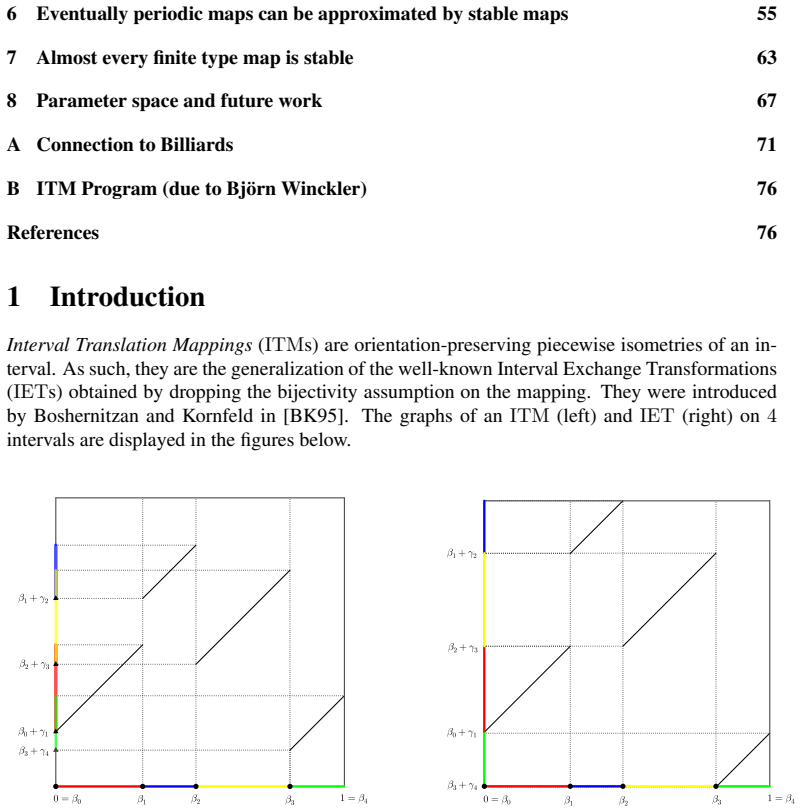
Assume that the interval $I=[0,1)$ is partitioned into finitely many intervals $I_1,\dots,I_r$ and consider a map $T\colon I\to I$ so that $T_{\vert I_s}$ is a translation for each $1 \le s \le r$. We do not assume that the images of these intervals are disjoint. Such maps are called Interval Translation Maps. Let $ITM(r)$ be the space of all such transformations, where we fix $r$ but not the intervals $I_1,\dots,I_r$, nor the translations. The set $X(T):=\bigcap_{n\ge 0} T^n[0,1)$ can be a finite union of intervals (in which case the map is called of finite type), or is a disjoint union of finitely many intervals and a Cantor set (in which case the map is called of infinite type). In this paper we show that there exists an open and dense subset $\mathcal{S}(r)$ of $ITM(r)$ consisting of stable maps, i.e. each $T\in \mathcal{S}(r)$ is of finite type, the first return map to any component of $X(T)$ corresponds to a circle rotation and $\mathcal{S}(r) \ni T \mapsto X(T)$ is continuous in the Hausdorff topology.
Figures


Figures from the paper (7 more)


Reference graph
Works this paper leans on
-
[1]
On the geometry of orientation-preserving planar piecewise isometries
[AF02] Peter Ashwin and Xin-Chu Fu. “On the geometry of orientation-preserving planar piecewise isometries”. In: J. Nonlinear Sci. 12.3 (2002), pp. 207–240. [AHS24] Mauro Artigiani, Pascal Hubert, and Alexandra Skripchenko. “Renormalization for Bruin-Troubetzkoy ITMs”. In: arXiv preprint arXiv:2412.07928 (2024). [Art+21] Mauro Artigiani, Charles Fougeron,...
arXiv 2002
-
[2]
Amer. Math. Soc., Providence, RI, 1999, pp. 135–178. 79
work page 1999
-
[8]
Translated from the Portuguese by Silvio Levy
Ergebnisse der Mathematik und ihrer Grenzgebiete (3) [Results in Mathematics and Related Areas (3)]. Translated from the Portuguese by Silvio Levy. Springer-Verlag, Berlin, 1987, pp. xii+317. [MS93] Welington de Melo and Sebastian van Strien. One-dimensional dynamics. V ol
work page 1987
-
[10]
Topological transitivity of billiards in polygons
Clay Math. Proc. Amer. Math. Soc., Providence, RI, 2010, pp. 1–69. [ZK75] Alexander N. Zemljakov and Anatole B. Katok. “Topological transitivity of billiards in polygons”. In: Mat. Zametki 18.2 (1975), pp. 291–300. [Zor06] Anton Zorich. “Flat surfaces”. In: Frontiers in number theory, physics, and geometry. I. Springer, Berlin, 2006, pp. 437–583. [Zor96] ...
work page 1975
-
[11]
The non-monotonicity of the entropy of α-continued fraction transformations
Handbook of Dynam- ical Systems. Elsevier Science, 2002, pp. 1015–1089. [NN08] Hitoshi Nakada and Rie Natsui. “The non-monotonicity of the entropy of α-continued fraction transformations”. In: Nonlinearity 21.6 (2008), pp. 1207–1225. [Sch11] Richard Evan Schwartz. Mostly surfaces . V ol
work page 2008
-
[14]
Density of hyperbolicity in dimension one
[KSS07] Oleg Kozlovski, Weixiao Shen, and Sebastian van Strien. “Density of hyperbolicity in dimension one”. In: Ann. of Math. (2) 166.1 (2007), pp. 145–182. [KZ03] Maxim Kontsevich and Anton Zorich. “Connected components of the moduli spaces of Abelian differentials with prescribed singularities”. In:Invent. Math.153.3 (2003), pp. 631–678. [Lev93] Gilber...
work page 2007
-
[20]
Interval Translation Maps with Weakly Mixing Attractors
[BR23] Henk Bruin and Silvia Radinger. “Interval Translation Maps with Weakly Mixing Attractors”. In: arXiv preprint arXiv:2312.10533 (2023). [Bru07] Henk Bruin. “Renormalization in a class of interval translation maps of d branches”. In: Dyn. Syst. 22.1 (2007), pp. 11–24. [Bru+19] Henk Bruin, Carlo Carminati, Stefano Marmi, and Alessandro Profeti. “Match...
arXiv 2023
-
[25]
Ergebnisse der Mathematik und ihrer Grenzgebiete (3) [Results in Mathematics and Related Areas (3)]. Springer-Verlag, Berlin, 1993, pp. xiv+605. [MS98] Curtis T. McMullen and Dennis P. Sullivan. “Quasiconformal homeomorphisms and dynamics. III. The Teichmüller space of a holomorphic dynamical system”. In: Adv. Math. 135.2 (1998), pp. 351–395. [MT02] Howar...
work page 1998
Show all 15 references
-
[30]
Interval exchange transformations
Student Mathematical Library. American Mathematical Society, Providence, 2005, pp. xii+176. [Vee78] William A. Veech. “Interval exchange transformations”. In: J. Analyse Math. 33 (1978), pp. 222–272. [Vee82] William A. Veech. “Gauss measures for transformations on the space of...
1978
-
[31]
Non-ergodic interval exchange transformations
[Kea77] Michael Keane. “Non-ergodic interval exchange transformations”. In: Israel J. Math. 26.2 (1977), pp. 188–196. [KFS82] Isaac P. Kornfeld, Sergei V . Fomin, and Yakov G. Sinai. Ergodic theory. V ol
1977
-
[60]
Double rotations
Student Mathematical Library. American Mathematical Society, Providence, RI, 2011, pp. xiv+314. [SIA05] Hideyuki Suzuki, Shunji Ito, and Kazuyuki Aihara. “Double rotations”. In: Discrete Contin. Dyn. Syst. 13.2 (2005), pp. 515–532. [ST00] Jörg Schmeling and Serge Troubetzkoy. ...
2005
-
[135]
Princeton University Press, Princeton, NJ, 1994, pp
Annals of Mathematics Studies. Princeton University Press, Princeton, NJ, 1994, pp. x+214. [Mn87] Ricardo Mañé. Ergodic theory and differentiable dynamics . V ol
1994
-
[245]
Quadratic ra- tional rotations of the torus and dual lattice maps
Grundlehren der mathematischen Wissenschaften [Fundamental Principles of Math- ematical Sciences]. Translated from the Russian by A. B. Sosinski˘i. Springer-Verlag, New York, 1982, pp. x+486. [KLV02] Konstantin L. Kouptsov, John H. Lowenstein, and Franco Vivaldi. “Quadratic ra...
2002
-
[395]
Interval exchange transformations and measured foliations
[Mas82] Howard Masur. “Interval exchange transformations and measured foliations”. In: Ann. of Math. (2) 115.1 (1982), pp. 169–200. [McM94] Curtis T. McMullen. Complex dynamics and renormalization . V ol
1982
-
[2001]
Sofic subshifts and piecewise isometric systems
Trends Math. Birkhäuser, Basel, 2003, pp. 135–144. [Goe99] Arek Goetz. “Sofic subshifts and piecewise isometric systems”. In: Ergodic Theory Dynam. Systems 19.6 (1999), pp. 1485–1501. [GQ09] Arek Goetz and Anthony Quas. “Global properties of a family of piecewise isome- tries”...
1999
Reviewed August 12, 2026 · model on record in the stance chip above.
Discussion (0). Continue with ORCID to comment.