REVIEW 3 major objections 5 minor 45 references
H.E.S.S. Monitoring of PKS 2155-304 in 2015 and 2016
T0 review · 3 major / 5 minor · reviewed 2026-08-14 · deepseek-v4-flash
Pith's one-line read Two years of monitoring of the blazar PKS 2155-304 show a 2015 flare at all wavelengths and a 2016 outburst confined to optical and ultraviolet light, reported as the first orphan optical flare for this source.
desk verdict A useful two-year monitoring dataset with a well-documented 2015 flare, but the 2016 orphan optical/UV claim needs contemporaneous coverage details and a date fix before it stands. read the letter →
The pith
A machine-rendered reading of the paper's core claim, the machinery that carries it, and where it could break.
The reading
What carries the argument
The central machinery is the multiwavelength monitoring campaign itself: H.E.S.S. and Fermi-LAT for gamma rays, Swift-XRT for X-rays, and Swift-UVOT and ATOM for optical and ultraviolet light, all covering the same two-year window. The argument is carried by cross-band correlation diagrams and the fractional variability amplitude $F_{\rm var} = \sqrt{S^2 - \sigma^2_{\rm err}}/\langle F \rangle$, which quantify how the two years differ. The crucial comparison is between the 2015 state, where the same emission region appears to light up across all bands, and the 2016 state, where the optical/UV synchrotron component flares alone. An orphan flare is a flare seen in one band with no counterpart in the others.
What would settle it
Re-analyze the Swift-XRT and Fermi-LAT data from the exact days of the 2016 optical/UV maximum with daily or shorter binning and compute flux upper limits; a flare of comparable relative amplitude in either band would overturn the orphan claim, while empty exposures would leave it untested.
Extended reading notes
Core claim
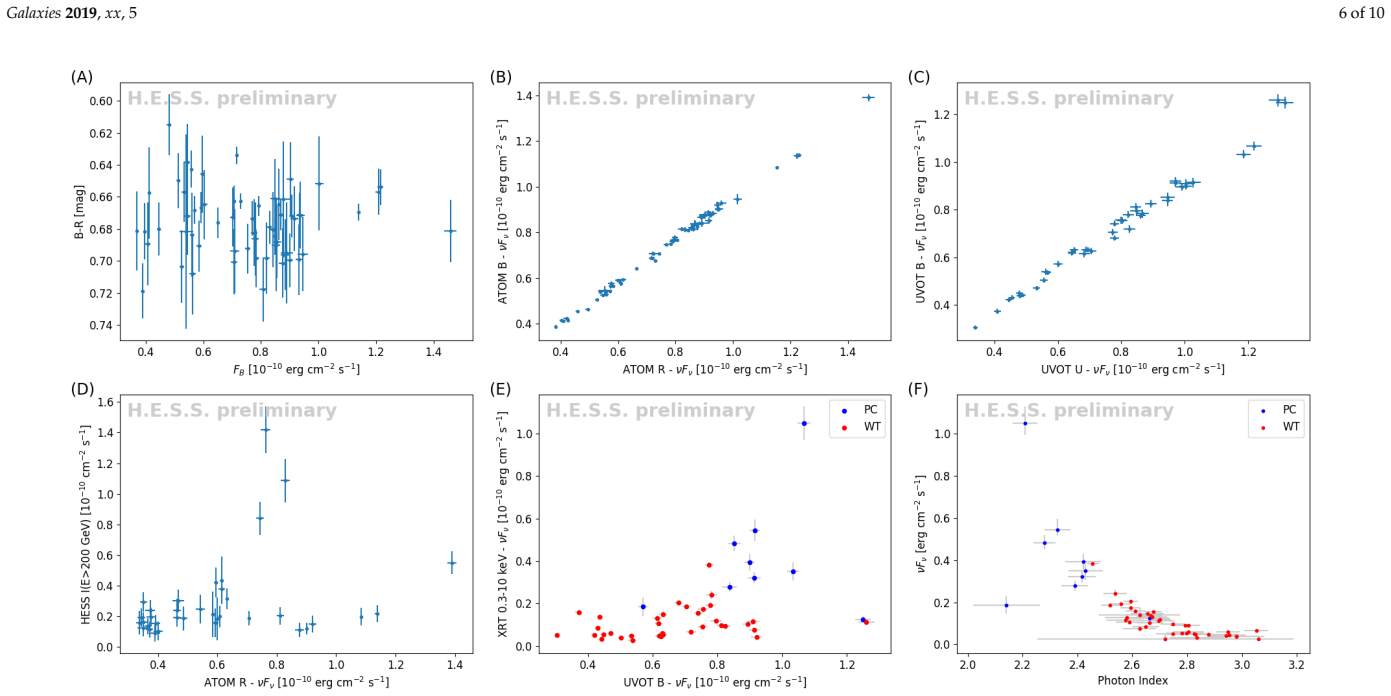
At its core, the paper claims that PKS 2155-304 displayed two distinct activity states in 2015-2016. During 2015, a flare was detected simultaneously in optical, ultraviolet, X-ray, and gamma-ray bands, with no measurable interband lag, along with a harder-when-brighter X-ray trend. In 2016, by contrast, an outburst appeared in the optical and UV bands alone, with no detected X-ray or gamma-ray counterpart. The authors report this as the first orphan optical/UV activity observed for PKS 2155-304. They interpret the contrast as evidence that the physical process driving the two outbursts differed, and that simultaneous multiwavelength monitoring is needed to catch such anomalous states.
Load-bearing premise
The orphan classification assumes that the X-ray and gamma-ray monitors would have seen a high-energy flare had one occurred during the 2016 optical/UV outburst; sparse sampling during that epoch could hide a counterpart.
Editorial extensions
If this is right
- In 2015, the absence of measurable time lags across optical, ultraviolet, X-ray, and gamma-ray bands implies the flare originated in a single emission region with a common electron population.
- The 2016 orphan optical/UV flare implies that the synchrotron-emitting electrons can be energized independently of the processes that produce the X-ray and gamma-ray emission.
- The lack of a color-magnitude relation across both years means the optical spectral shape stayed roughly constant while the flux changed.
- The harder-when-brighter X-ray trend, with correlation coefficient $-0.75 \pm 0.05$, continues the behavior previously seen in PKS 2155-304 and other high-energy-peaked BL Lac objects.
- The two contrasting outbursts support the view that blazar correlation patterns are epoch-dependent, so single-epoch correlation studies can mislead.
Reading between the lines
- Editorial inference: If the orphan event is genuine, it points to a jet region where optical/UV synchrotron emission is produced without the higher-energy components, such as a distinct emission zone or acceleration episode that does not reach the X-ray and gamma-ray bands.
- Editorial inference: A re-analysis of Fermi-LAT and Swift-XRT data with shorter time bins centered on the 2016 optical maximum could confirm or refute the orphan classification; the paper's published 10-day Fermi bins and sparse X-ray pointings are too coarse to exclude a short high-energy flare.
- Editorial inference: The same year-by-year comparison could be applied to archival light curves of other well-monitored high-energy-peaked BL Lac objects; orphan optical/UV flares may be more common than recognized and would be missed by campaigns that trigger only on gamma-ray flares.
- Editorial inference: Since the orphan flare shows no color change, a natural interpretation is a change in the normalization, such as the Doppler factor or particle density, of the existing optical/UV component rather than the injection of a new spectral component.
Signed reviews
Editorial analysis
A structured set of objections, weighed in public.
Referee Report
Summary. This paper presents multiwavelength monitoring of the HBL blazar PKS 2155-304 in 2015-2016 with H.E.S.S., Fermi-LAT, Swift-XRT/UVOT, and ATOM. The authors compute fractional variability amplitudes, present correlation plots between optical bands, optical-UV, optical-X-ray, optical-VHE, and X-ray flux versus photon index, and identify two distinct activity states: a 2015 flare seen at all wavelengths with no reported lags, and a 2016 outburst limited to optical/UV, which they call an orphan optical flare and claim is the first reported for this source.
Significance. The paper is valuable as a descriptive monitoring study: it adds two years of homogeneous multiwavelength coverage of a well-known HBL, reports high optical-optical correlation coefficients (0.98-0.99), a harder-when-brighter X-ray trend quantified at -0.75+/-0.05, and a useful table of fractional variability amplitudes. The claimed 2016 orphan flare, if confirmed, would be a notable constraint on jet emission models, indicating decoupled synchrotron variability between the optical/UV and X-ray emitting regions. However, the orphan classification depends on negative evidence; the paper must demonstrate adequate contemporaneous sampling and provide upper limits to sustain the claim.
major comments (3)
- [Abstract; Section 3.1] The central claim of an orphan optical/UV flare in 2016 with no counterpart either in X rays or in gamma rays is not yet supported because the paper gives no contemporaneous X-ray or gamma-ray exposure windows, flux upper limits, or detection thresholds at the time of the optical flare. Fermi-LAT data are binned into 10-day intervals (Section 2.2), while H.E.S.S. obtained only 40 runs/16.5 h over all of 2016 (Section 2.1); an optical flare occurring inside one 10-day bin or on a night without Swift-XRT/H.E.S.S. pointings would appear orphan regardless of any X-ray or gamma-ray activity. The authors should provide exact observation dates and upper limits for all instruments around the 2016 optical/UV flare, or soften the claim accordingly.
- [Section 3.2] The manuscript contains a direct date inconsistency in the sentence identifying the orphan event: panel D's description says 'The lower one corresponds to the data collected during the orphan optical flare observed in 2015,' whereas the abstract, Section 3.1, and panel E date the same orphan flare to 2016. This must be corrected and reconciled, because it appears in the key statement of the paper's novel result.
- [Abstract; Section 3.2; Discussion] The abstract and Discussion state that the 2015 broadband flare is well correlated without any time lags, but no lag analysis is described: only contemporaneous Pearson coefficients are presented (0.98-0.99 optical-optical, 0.45 X-ray-optical, and 0.45 VHE-optical). A claim of zero lag requires an interpolation or cross-correlation procedure with uncertainties; otherwise the statement should be weakened to 'no evidence of lags at the available sampling.'
minor comments (5)
- [Abstract] 'only orphan outburst' should be 'only an orphan outburst' for grammatical correctness.
- [Section 1] 'one of the brightest blazar located in Southern Hemisphere' should be 'one of the brightest blazars' with an article before 'Southern Hemisphere'.
- [Section 3.2] 'X-ray-optical correction studies' should be 'X-ray-optical correlation studies'.
- [Section 3.1] The sentence 'The larger increasing activity corresponds to constant Fermi-LAT photon index values and hardening of the X-ray photon flux observed with Swift-XRT' is unclear and should be reworded.
- [Section 2.3] 'were analysis' should be 'were analyzed'.
Circularity Check
No circularity; the paper is an observational monitoring report using descriptive statistics, with no fitted model or self-citation chain that forces its conclusions.
full rationale
The paper reports multiwavelength light curves, fractional variability amplitudes, and Pearson correlation coefficients for PKS 2155-304 in 2015-2016. No quantity is fitted to a subset of data and then presented as a prediction of a closely related quantity. F_var is computed directly from the fluxes via Eq. (1), and the correlation coefficients are direct descriptive statistics on the same light curves; these are characterizations, not derived predictions. The central new claim, the 2016 orphan optical/UV outburst, is an empirical classification: an optical/UV flare is seen in the monitoring data while no X-ray or gamma-ray counterpart is claimed. This is not circular, because the statement is a reading of the observed light curves (subject to sampling caveats), not an output of a model whose input was the claimed absence. Self-citations to prior H.E.S.S./ATOM work (e.g., refs. [20], [45]) are used only for context (defining quiescent flux) and do not carry the load of the orphan-flare claim. Two correctness concerns should be weighed separately from circularity: the paper does not give contemporaneous Swift-XRT or H.E.S.S. exposure windows or upper limits at the epoch of the 2016 optical flare, and 10-day Fermi-LAT bins plus sparse VHE pointings could conceal a counterpart; moreover, Section 3.2 text dates the orphan flare to 2015 ('the orphan optical flare observed in 2015') while the abstract and Section 3.1 date it to 2016. These affect robustness and internal consistency, but neither constitutes a circular derivation. Accordingly, the circularity score is 0.
Assumptions & free parameters
assumptions (4)
- domain assumption Fermi-LAT diffuse background models (gll_iem_v06 and iso_P8R2_SOURCE_V6_v06) correctly describe the gamma-ray backgrounds toward PKS 2155-304.
- domain assumption A single power-law with fixed Galactic absorption N_H = 1.52e20 cm^-2 is adequate for all Swift-XRT spectra.
- domain assumption H.E.S.S. ImPACT Loose Cuts analysis and the independent Model Analysis chain correctly reconstruct the VHE gamma-ray fluxes.
- ad hoc to paper A non-detection in X-ray and gamma-ray light curves during the 2016 optical/UV flare indicates absence of a flare, not sparse sampling.
Cite this review
Pith. "Pith review of H.E.S.S. Monitoring of PKS 2155-304 in 2015 and 2016." pith.science (2026). https://pith.science/paper/V4YLY662
@misc{pith2026190801232,
  author       = {Pith},
  title        = {Pith review of: H.E.S.S. Monitoring of PKS 2155-304 in 2015 and 2016},
  year         = {2026},
  howpublished = {\url{https://pith.science/paper/V4YLY662}},
  note         = {Machine review of arXiv:1908.01232}
}
read the original abstract
PKS 2155-304 is one of the brightest blazar located in Southern Hemisphere, monitored with H.E.S.S. since the first light of the experiment. Here we report multiwavelength monitoring observations collected during the period of 2015-2016 with H.E.S.S.,Fermi-LAT, Swift-XRT, Swift-UVOT, and ATOM. Two years of multiwavelength data with very good temporal coverage allowed to characterize broadband emission observed from the region of PKS 2155-304 and study potential multifrequency correlations. During the period of monitoring, PKS 2155-304 revealed complex multiwavelength variability with two outbursts characterized by completely different multiband properties. The 2015 activity of the blazar is characterized by a flare observed at all wavelengths studied. The broadband emission observed during the outburst is well correlated without any time lags. Contrary to 2015, in 2016, only orphan outburst in the optical and ultraviolet wavelengths was observed. Such an orphan activity is reported for the first time for the blazar PKS 2155-304.
Figures

Reference graph
Works this paper leans on
-
[1]
Unified Schemes for Radio-Loud Active Galactic Nuclei
Urry, C.M.; Padovani, P . Unified Schemes for Radio-Loud Active Galactic Nuclei. Publ. Astron. Soc. Pac. 1995, 107, 803, doi:10.1086/133630
doi:10.1086/133630 1995
-
[2]
Theory of extragalactic radio sources
Begelman, M.C.; Blandford, R.D.; Rees, M.J. Theory of extragalactic radio sources. Rev. Mod. Phys. 1984, 56, 255–351, doi:10.1103/RevModPhys.56.255
-
[3]
Multiwavelength observations of Blazars
Wagner, S. Multiwavelength observations of Blazars. In Astrophysics with All-Sky X-ray Observations , Proceedings of the RIKEN Symposium, RIKEN, and JAXA Suzuki Umetaro Hall, RIKEN Wako, Saitama, Japan, 10–12 June 2008; p. 186
work page 2008
-
[4]
Swift/XRT view of S5 0716+714 during a flare
Wierzcholska, A.; Siejkowski, H. Swift/XRT view of S5 0716+714 during a flare. Mon. Not. R. Astron. Soc. Lett. 2015, 452, L11–L15, doi:10.1093/mnrasl/slv075
-
[5]
Siejkowski, H.; Wierzcholska, A. Characterizing long-term optical, ultraviolet and X-ray variability in different activity states of OJ 287. Mon. Not. R. Astron. Soc. Lett. 2017, 468, 426–434, doi:10.1093/mnras/stx495
-
[6]
Wierzcholska, A.; Siejkowski, H. First hard X-ray observations of the blazar S5 0716+714 with NuSTAR during a multiwavelength campaign. Mon. Not. R. Astron. Soc. Lett. 2016, 458, 2350–2359, doi:10.1093/mnras/stw425
-
[7]
A jet model for the gamma-ray emitting blazar 3C 279
Maraschi, L.; Ghisellini, G.; Celotti, A. A jet model for the gamma-ray emitting blazar 3C 279. Astrophys. J. 1992, 397, L5–L9, doi:10.1086/186531
doi:10.1086/186531 1992
-
[8]
Particle acceleration and synchrotron emission in blazar jets
Kirk, J.G.; Rieger, F.M.; Mastichiadis, A. Particle acceleration and synchrotron emission in blazar jets. Astron. Astrophys. 1998, 333, 452–458,
work page 1998
Show all 45 references
-
[9]
High-energy gamma radiation from extragalactic radio sources
Dermer, C.D.; Schlickeiser, R.; Mastichiadis, A. High-energy gamma radiation from extragalactic radio sources. Astron. Astrophys. 1992, 256, L27–L30
1992
-
[10]
Comptonization of diffuse ambient radiation by a relativistic jet: The source of gamma rays from blazars? Astrophys
Sikora, M.; Begelman, M.C.; Rees, M.J. Comptonization of diffuse ambient radiation by a relativistic jet: The source of gamma rays from blazars? Astrophys. J. 1994, 421, 153–162, doi:10.1086/173633
1994 doi
-
[11]
TeV gamma rays from BL Lac objects due to synchrotron radiation of extremely high energy protons
Aharonian, F.A. TeV gamma rays from BL Lac objects due to synchrotron radiation of extremely high energy protons. New Astron. 2000, 5, 377–395, doi:10.1016/S1384-1076(00)00039-7
-
[12]
Neutral Beams from Blazar Jets
Atoyan, A.M.; Dermer, C.D. Neutral Beams from Blazar Jets. Astrophys. J. 2003, 586, 79–96, doi:10.1086/346261
2003 doi
-
[13]
Leptonic and Hadronic Modeling of Fermi-detected Blazars
Böttcher, M.; Reimer, A.; Sweeney, K.; Prakash, A. Leptonic and Hadronic Modeling of Fermi-detected Blazars. Astrophys. J. 2013, 768, 54, doi:10.1088/0004-637X/768/1/54
2013 doi
-
[14]
A unifying view of the spectral energy distributions of blazars
Fossati, G.; Maraschi, L.; Celotti, A.; Comastri, A.; Ghisellini, G. A unifying view of the spectral energy distributions of blazars. Mon. Not. R. Astron. Soc. Lett. 1998, 299, 433–448, doi:10.1046/j.1365-8711.1998.01828.x
1998
-
[15]
The Spectral Energy Distribution of Fermi Bright Blazars
Abdo, A.A.; Ackermann, M.; Agudo, I.; Ajello, M.; Aller, H.D.; Aller, M.F.; Angelakis, E.; Arkharov, A.A.; Axelsson, M.; Bach, U.; et al. The Spectral Energy Distribution of Fermi Bright Blazars. Astrophys. J. 2010, 716, 30–70, doi:10.1088/0004-637X/716/1/30
2010 doi
-
[16]
The Parkes 2700 MHz Survey (Sixth Part): Catalogue for the Declination zone −30◦ to −35◦
Shimmins, A.J.; Bolton, J.G. The Parkes 2700 MHz Survey (Sixth Part): Catalogue for the Declination zone −30◦ to −35◦. Australian J. Phys. Astrophys. Suppl. 1974, 32, 1
1974
-
[17]
A revised optical catalog of quasi-stellar objects
Hewitt, A.; Burbidge, G. A revised optical catalog of quasi-stellar objects. Astrophys. J. Suppl. Ser. 1980, 43, 57–158, doi:10.1086/190667
1980 doi
-
[18]
An Exceptional Very High Energy Gamma-Ray Flare of PKS 2155-304
Aharonian, F.; Akhperjanian, A.G.; Bazer-Bachi, A.R.; Behera, B.; Beilicke, M.; Benbow, W.; Berge, D.; Bernlöhr, K.; Boisson, C.; Bolz, O.; et al. An Exceptional Very High Energy Gamma-Ray Flare of PKS 2155-304. Astrophys. J. 2007, 664, L71–L74, doi:10.1086/520635
2007 doi
-
[19]
Simultaneous multiwavelength observations of the second exceptional γ-ray flare of PKS 2155-304 in July 2006
Aharonian, F.; Akhperjanian, A.G.; Anton, G.; Barres de Almeida, U.; Bazer-Bachi, A.R.; Becherini, Y.; Behera, B.; Benbow, W.; Bernlöhr, K.; Boisson, C.; et al. Simultaneous multiwavelength observations of the second exceptional γ-ray flare of PKS 2155-304 in July 2006. Astron....
2006 doi
-
[20]
Collaboration; Abdalla, H.; Abramowski, A.; Aharonian, F.; Ait Benkhali, F.; Akhperjanian, A.G.; Andersson, T.; Angüner, E.O.; Arrieta, M.; Aubert, P .; et al
H.E.S.S. Collaboration; Abdalla, H.; Abramowski, A.; Aharonian, F.; Ait Benkhali, F.; Akhperjanian, A.G.; Andersson, T.; Angüner, E.O.; Arrieta, M.; Aubert, P .; et al. Characterizing the γ-ray long-term variability of PKS 2155-304 with H.E.S.S. and Fermi-LAT. Astron. Astrophy...
2017 doi
-
[21]
Observations of the Crab nebula with HESS.Astron
Aharonian, F.; Akhperjanian, A.G.; Bazer-Bachi, A.R.; Beilicke, M.; Benbow, W.; Berge, D.; Bernlöhr, K.; Boisson, C.; Bolz, O.; Borrel, V .; et al. Observations of the Crab nebula with HESS.Astron. Astrophys. 2006, 457, 899–915, doi:10.1051/0004-6361:20065351
2006 doi
-
[22]
A Monte Carlo template based analysis for air-Cherenkov arrays
Parsons, R.D.; Hinton, J.A. A Monte Carlo template based analysis for air-Cherenkov arrays. Astropart. Phys. 2014, 56, 26–34, doi:10.1016/j.astropartphys.2014.03.002
2014 doi
-
[23]
A high performance likelihood reconstruction of γ-rays for imaging atmospheric Cherenkov telescopes
de Naurois, M.; Rolland, L. A high performance likelihood reconstruction of γ-rays for imaging atmospheric Cherenkov telescopes. Astropart. Phys. 2009, 32, 231–252, doi:10.1016/j.astropartphys.2009.09.001
2009 doi
-
[24]
Pass 8: Toward the Full Realization of the Fermi-LAT Scientific Potential
Atwood, W.; Albert, A.; Baldini, L.; Tinivella, M.; Bregeon, J.; Pesce-Rollins, M.; Sgrò, C.; Bruel, P .; Charles, E.; Drlica-Wagner, A.; et al. Pass 8: Toward the Full Realization of the Fermi-LAT Scientific Potential. arXiv 2013, arXiv:1303.3514
2013 arXiv
-
[25]
Likelihood Analysis of EGRET Data
Mattox, J.R.; Bertsch, D.L.; Chiang, J.; Dingus, B.L.; Digel, S.W.; Esposito, J.A.; Fierro, J.M.; Hartman, R.C.; Hunter, S.D.; Kanbach, G.; et al. Likelihood Analysis of EGRET Data. Astrophys. J. 1996, 461, 396, doi:10.1086/177068
1996 doi
-
[26]
The Leiden/Argentine/Bonn (LAB) Survey of Galactic HI
Kalberla, P .M.W.; Burton, W.B.; Hartmann, D.; Arnal, E.M.; Bajaja, E.; Morras, R.; Pöppel, W.G.L. The Leiden/Argentine/Bonn (LAB) Survey of Galactic HI. Final data release of the combined LDS and IAR surveys with improved stray-radiation corrections. Astron. Astrophys. 2005, ...
2005 doi
-
[27]
Photometric calibration of the Swift ultraviolet/optical telescope
Poole, T.S.; Breeveld, A.A.; Page, M.J.; Landsman, W.; Holland, S.T.; Roming, P .; Kuin, N.P .M.; Brown, P .J.; Gronwall, C.; Hunsberger, S.; et al. Photometric calibration of the Swift ultraviolet/optical telescope. Mon. Not. R. Astron. Soc. Lett. 2008, 383, 627–645, doi:10.1...
2008
-
[28]
Maps of Dust Infrared Emission for Use in Estimation of Reddening and Cosmic Microwave Background Radiation Foregrounds
Schlegel, D.J.; Finkbeiner, D.P .; Davis, M. Maps of Dust Infrared Emission for Use in Estimation of Reddening and Cosmic Microwave Background Radiation Foregrounds. Astrophys. J. 1998, 500, 525–553, doi:10.1086/305772
1998 doi
-
[29]
Measuring Reddening with Sloan Digital Sky Survey Stellar Spectra and Recalibrating SFD
Schlafly, E.F.; Finkbeiner, D.P . Measuring Reddening with Sloan Digital Sky Survey Stellar Spectra and Recalibrating SFD. Astrophys. J. 2011, 737, 103, doi:10.1088/0004-637X/737/2/103
2011 doi
-
[30]
ATOM—An Automatic Telescope for Optical Monitoring
Hauser, M.; Möllenhoff, C.; Pühlhofer, G.; Wagner, S.J.; Hagen, H.J.; Knoll, M. ATOM—An Automatic Telescope for Optical Monitoring. Astron. Nachr. 2004, 325, 659–659, doi:10.1002/asna.200410305
2004 doi
-
[31]
Galaxy Colors in Various Photometric Band Systems
Fukugita, M.; Shimasaku, K.; Ichikawa, T. Galaxy Colors in Various Photometric Band Systems. Publ. Astron. Soc. Pac. 1995, 107, 945, doi:10.1086/133643
1995 doi
-
[32]
On the nebulosity surrounding the BL Lacertae object PKS 2155-304
Falomo, R.; Giraud, E.; Maraschi, L.; Melnick, J.; Tanzi, E.G.; Treves, A. On the nebulosity surrounding the BL Lacertae object PKS 2155-304. Astrophys. J. 1991, 380, L67–L69, doi:10.1086/186175
1991 doi
-
[33]
On characterizing the variability properties of X-ray light curves from active galaxies
Vaughan, S.; Edelson, R.; Warwick, R.S.; Uttley, P . On characterizing the variability properties of X-ray light curves from active galaxies. Mon. Not. R. Astron. Soc. Lett. 2003, 345, 1271–1284, doi:10.1046/j.1365-2966.2003.07042.x
2003
-
[34]
Nine years of multi-frequency monitoring of the blazar PKS 0048-097: spectral and temporal variability
Wierzcholska, A. Nine years of multi-frequency monitoring of the blazar PKS 0048-097: spectral and temporal variability. Astron. Astrophys. 2015, 580, A104, doi:10.1051/0004-6361/201525649
2015 doi
-
[35]
A change in the optical polarization associated with a γ-ray flare in the blazar 3C279
Abdo, A.A.; Ackermann, M.; Ajello, M.; Axelsson, M.; Baldini, L.; Ballet, J.; Barbiellini, G.; Bastieri, D.; Baughman, B.M.; Bechtol, K.; et al. A change in the optical polarization associated with a γ-ray flare in the blazar 3C279. Nature 2010, 463, 919–923, doi:10.1038/nature08841
2010 doi
-
[36]
Radio to gamma-ray variability study of blazar S5 0716+714
Rani, B.; Krichbaum, T.P .; Fuhrmann, L.; Böttcher, M.; Lott, B.; Aller, H.D.; Aller, M.F.; Angelakis, E.; Bach, U.; Bastieri, D.; et al. Radio to gamma-ray variability study of blazar S5 0716+714. Astron. Astrophys. 2013, 552, A11, doi:10.1051/0004-6361/201321058
2013 doi
-
[37]
Implications of the Anomalous Outburst in the Blazar PKS 0208-512
Chatterjee, R.; Nalewajko, K.; Myers, A.D. Implications of the Anomalous Outburst in the Blazar PKS 0208-512. Astrophys. J. 2013, 771, L25, doi:10.1088/2041-8205/771/2/L25
2013 doi
-
[38]
The extreme HBL behaviour of Markarian 501 during 2012
Ahnen, M.L.; Ansoldi, S.; Antonelli, L.A.; Arcaro, C.; Babi´ c, A.; Banerjee, B.; Bangale, P .; Barres de Almeida, U.; Barrio, J.A.; Becerra González, J.; et al. The extreme HBL behaviour of Markarian 501 during 2012. arXiv 2018, arXiv:1808.04300
2012
-
[39]
Simultaneous Observations of PKS 2155-304 with HESS, Galaxies 2019, xx, 5 10 of 10 Fermi, RXTE, and Atom: Spectral Energy Distributions and Variability in a Low State
Aharonian, F.; Akhperjanian, A.G.; Anton, G.; Barres de Almeida, U.; Bazer-Bachi, A.R.; Becherini, Y.; Behera, B.; Bernlöhr, K.; Boisson, C.; Bochow, A.; et al. Simultaneous Observations of PKS 2155-304 with HESS, Galaxies 2019, xx, 5 10 of 10 Fermi, RXTE, and Atom: Spectral E...
2019 doi
-
[40]
Collaboration; Abramowski, A.; Aharonian, F.; Ait Benkhali, F.; Akhperjanian, A.G.; Angüner, E.O.; Backes, M.; Balenderan, S.; Balzer, A.; Barnacka, A.; et al
H.E.S.S. Collaboration; Abramowski, A.; Aharonian, F.; Ait Benkhali, F.; Akhperjanian, A.G.; Angüner, E.O.; Backes, M.; Balenderan, S.; Balzer, A.; Barnacka, A.; et al. Long-term monitoring of PKS 2155-304 with ATOM and H.E.S.S.: investigation of optical/γ-ray correlations in ...
2014 doi
-
[41]
XMM-Newton View of PKS 2155-304: Characterizing the X-Ray Variability Properties with EPIC pn
Zhang, Y.H.; Treves, A.; Celotti, A.; Qin, Y.P .; Bai, J.M. XMM-Newton View of PKS 2155-304: Characterizing the X-Ray Variability Properties with EPIC pn. Astrophys. J. 2005, 629, 686–699, doi:10.1086/431719
2005 doi
-
[42]
Multiwavelength Observations of the BL Lacertae Object PKS 2155-304 with XMM-Newton
Zhang, Y.H.; Bai, J.M.; Zhang, S.N.; Treves, A.; Maraschi, L.; Celotti, A. Multiwavelength Observations of the BL Lacertae Object PKS 2155-304 with XMM-Newton. Astrophys. J. 2006, 651, 782–790, doi:10.1086/507601
2006 doi
-
[43]
The X-ray behaviour of the high-energy peaked BL Lacertae source PKS 2155-304 in the 0.3–10 keV band
Kapanadze, B.; Romano, P .; Vercellone, S.; Kapanadze, S. The X-ray behaviour of the high-energy peaked BL Lacertae source PKS 2155-304 in the 0.3–10 keV band. Mon. Not. R. Astron. Soc. Lett. 2014, 444, 1077–1094, doi:10.1093/mnras/stu1504
2014 doi
-
[44]
Photopolarimetric Monitoring of Blazars in the Optical and Near-Infrared Bands with the Kanata Telescope
Ikejiri, Y.; Uemura, M.; Sasada, M.; Ito, R.; Yamanaka, M.; Sakimoto, K.; Arai, A.; Fukazawa, Y.; Ohsugi, T.; Kawabata, K.S.; et al. Photopolarimetric Monitoring of Blazars in the Optical and Near-Infrared Bands with the Kanata Telescope. I. Correlations between Flux, Color, a...
2011 doi
-
[45]
Longterm optical monitoring of bright BL Lacertae objects with ATOM: Spectral variability and multiwavelength correlations
Wierzcholska, A.; Ostrowski, M.; Stawarz, Ł.; Wagner, S.; Hauser, M. Longterm optical monitoring of bright BL Lacertae objects with ATOM: Spectral variability and multiwavelength correlations. Astron. Astrophys. 2015, 573, A69, doi:10.1051/0004-6361/201423967. c© 2019 by the a...
2015 doi
Reviewed August 14, 2026 · model on record in the stance chip above.
Discussion (0). Continue with ORCID to comment.