REVIEW 4 major objections 5 minor 1 cited by
Variance-Reduced Model Predictive Path Integral via Quadratic Model Approximation
T0 review · 4 major / 5 minor · reviewed 2026-08-03 · deepseek-v4-flash
Pith's one-line read The paper claims that decomposing the MPPI objective into a quadratic model and a low-variance residual, then sampling from the induced Gaussian prior, makes sampling-based control converge faster and with far fewer samples.
desk verdict A clean derivation of a model-guided MPPI, but the main sample-efficiency claim rests on an unequal comparison where the proposed method gets 3x the function evaluation budget. read the letter →
The pith
A machine-rendered reading of the paper's core claim, the machinery that carries it, and where it could break.
The reading
What carries the argument
The model–residual decomposition f = m + r with m a quadratic expansion of the cost about the current mean (gradient g and Hessian H). The product of the Gaussian prior with exp(-m/λ) yields a closed-form Gaussian guided prior with covariance (Σ^{-1} + H/λ)^{-1} and a Newton-like mean shift; the residual r is then used for self-normalized importance weights. The Hessian can come from exact derivatives, Gauss-Newton, BFGS, or randomized smoothing, and a variance-control step enforces a lower bound on the guided covariance to prevent collapse.
What would settle it
Run the method on a deliberately difficult objective—say a highly multimodal function with a narrow global basin and broad local basins, initialized far from the global minimum—and record the effective sample size and final distance to the true optimum. If the ESS collapses to near 1 and convergence matches vanilla MPPI, the claimed low-sample robustness fails in that regime.
Extended reading notes
Core claim
By factoring the Boltzmann update into a model-guided prior and a residual correction, the method injects geometric information into the sampling process: the product of a Gaussian prior and the exponential of a quadratic model is again Gaussian, so the guided prior has closed form. Sampling is then done from this guided Gaussian and only the residual is used in the importance weights. The paper demonstrates that this raises effective sample size (e.g., from 1.1 to 23.4 on a narrow-valley example) and that with accurate curvature the convergence curve collapses onto nearly a single trajectory for sample counts from 2 to 1024, whereas vanilla MPPI and CMA-ES degrade sharply in low-sample regi
Load-bearing premise
The residual between the true objective and the quadratic model must have low variance relative to the full cost; if the quadratic model is not locally accurate (far from a basin, poor smoothing scale, or indefinite Hessian), the guided sampler degenerates exactly like vanilla MPPI.
Editorial extensions
If this is right
- With reliable second-order information, MPPI can operate effectively in extremely low-sample regimes (N as low as 2), decoupling performance from the sampling budget.
- Gauss-Newton and BFGS curvature approximations achieve similar high-precision convergence to an exact analytical Hessian, so the method does not require true Hessians.
- Randomized smoothing extends the framework to non-smooth, black-box dynamics such as contact-rich manipulation, where analytical gradients are unavailable.
- Higher effective sample size translates to less weight degeneracy, meaning each retained sample carries more information and the optimizer is more stable across seeds.
- The model construction adds a per-iteration computational overhead, most notably for randomized smoothing, though those evaluations are parallelizable.
Reading between the lines
- If the residual variance is bounded and small relative to the full cost, importance-sampling theory implies the estimator variance scales with residual variance, so any model that captures a large fraction of cost variance should yield gains—the quadratic is one tractable instance, not the only one.
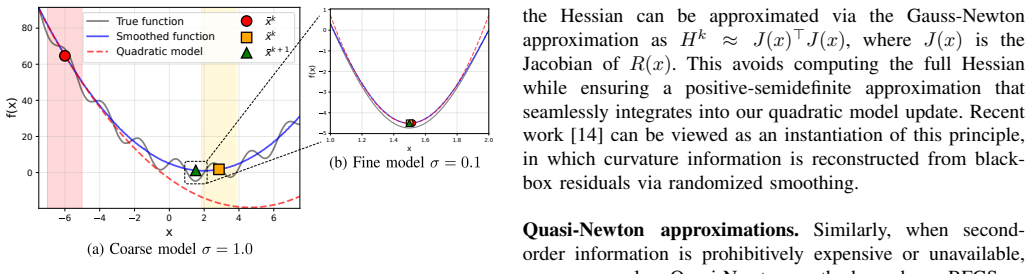
- The coarse-to-fine smoothing schedule (large sigma first, then small sigma) resembles an annealing strategy; an editor's testable extension is to adapt sigma and temperature online by monitoring residual effective sample size instead of hand-tuning.
- The same model-residual factorization could be applied to other Boltzmann-based samplers, such as the cross-entropy method, or to control formulations with terminal costs, potentially giving similar low-sample robustness.
- A concrete risky case: on a heavily multimodal landscape where the quadratic model is initialized far from the global basin, the method may converge to a local minimum just like Newton's method; failure there would not refute the variance-reduction claim but would show the model guidance is only as good as the local model.
Editorial analysis
A structured set of objections, weighed in public.
Referee Report
Summary. The paper proposes a variance-reduced Model Predictive Path Integral (MPPI) framework by decomposing the objective into a quadratic model and a residual. It derives a closed-form model-guided Gaussian prior (Eqs. 8–9) and an incremental update (Eqs. 16–17), and supports several ways to obtain curvature information (analytical, Gauss-Newton, quasi-Newton, randomized smoothing). The method is evaluated on static benchmarks, a cart-pole swing-up, and a contact-rich sphere manipulation task, reporting faster convergence, higher effective sample size, and better robustness than vanilla MPPI and CMA-ES.
Significance. The core idea of factoring the Boltzmann update into a model-guided prior and a residual correction is elegant and could make sampling-based control more practical in low-sample regimes. The algebraic derivation is sound, and the framework's agnosticism to the source of curvature information is a practical strength. However, the central variance-reduction claim is not supported by a bound or careful empirical validation of the residual's variance, and the main empirical comparison in the contact task uses an unequal total evaluation budget, which undermines the headline claim of sample efficiency. If these issues are addressed, the method could be a valuable contribution to sample-based control.
major comments (4)
- [Section IV-D and V] The contact-task experiment is not run on equal footing: Model-Guided MPPI uses 128 randomized-smoothing evaluations for the quadratic model plus 64 planning samples per iteration, while vanilla MPPI and CMA-ES use only 64 total evaluations. This is a 3× larger total budget. The paper acknowledges the overhead in Section V but still concludes 'greater robustness in low-sample regimes' without qualification. The claim as stated is misleading. The authors should either rerun the comparison with matched total evaluations or clearly separate 'planning samples' from 'model-construction evaluations' and adjust the conclusions accordingly.
- [Section III, after Eq. (11)] The central variance-reduction claim is asserted without a bound. The paper states that the residual r_k = f - m_k 'typically' has smaller magnitude and variance than f, but no conditions, quantitative analysis, or empirical verification is provided. If the quadratic model is not locally accurate (far from a basin, wrong σ, ill-regularized indefinite H), the residual is as difficult as f and the guided sampler degenerates exactly like vanilla MPPI. The paper must either provide a formal result linking model quality to the effective sample size or importance-weight variance, or at least an empirical study of the residual variance. This is load-bearing for the 'variance-reduced' label.
- [Equations (8), (16), (28)] The Hessian regularization/convexification step is left unspecified. For indefinite H_k, the paper says 'appropriate regularization or convexification is applied' but never defines the procedure. This is a free parameter that changes both the guided mean and covariance, so all experimental results depend on it. Moreover, the variance-control bound in Eq. (28) can be infeasible when κ_max ≥ λ/σ²_target (the denominator becomes nonpositive); the paper does not discuss this case or how it is handled. The method is not fully reproducible without specifying the regularization rule and its parameters.
- [Section IV-B] The cart-pole experiments treat analytical derivatives (gradient and Hessian from automatic differentiation) as free. The comparison counts only trajectory samples; the computational cost of computing g_k and H_k is not measured or accounted for. If derivative evaluation has non-negligible cost, the observed 'sample invariance' is not a fair sample-efficiency comparison. The authors should either quantify the wall-clock time or the equivalent function-evaluation cost of the AD oracle, or scope the claim to 'samples of the trajectory cost function' while acknowledging that the derivative oracle has its own computational price.
minor comments (5)
- [Section II] The feasible set is written as 'Ω ⊆ R' but the problems are multi-dimensional; it should be 'Ω ⊆ R^n'.
- [Equations (12)–(13)] The randomized-smoothing estimators for gradient and Hessian are stated without derivation. A short proof or reference to the standard control-variate form would help the reader verify the scaling with σ² and σ⁴.
- [Figure 1 caption] The caption says 'The cross indicates the vanilla MPPI update' but the cross is not labeled in the figure; please add a legend or text marker for clarity.
- [Section V] The conclusion repeats the low-sample-regime claim without referencing the computational overhead of randomized smoothing in the contact task, which is partly acknowledged two paragraphs earlier. Please harmonize the conclusion with the stated limitations.
- [References] Some references are incomplete (e.g., [30] has only a URL; [7] has a DOI but no page numbers). Please format all references consistently.
Circularity Check
No circular derivation: Eq. (6) is an exact factorization of the Boltzmann update, the closed-form guided prior follows from standard Gaussian algebra, and the only self-citations are software/infrastructure references.
full rationale
The derivation chain is self-contained. Starting from the KL-regularized update (Eq. 3) and its Boltzmann solution (Eq. 5), the paper inserts a decomposition f = m_k + r_k and obtains Eq. (6): p*(x) ∝ p_θk(x) exp(-m_k/λ) exp(-r_k/λ). This is an algebraic identity, since m_k + r_k = f; no target result is being assumed. The quadratic instantiation (Eq. 7) is a second-order model chosen for tractability, and the guided parameters (8)-(9) follow by completing the square for the product of a Gaussian and the exponential of a quadratic. These formulas are standard and parameter-free once g_k and H_k are supplied. The final weighting (Eqs. 11 and 21) is ordinary self-normalized importance sampling with the guided Gaussian as proposal and the residual as log-weight. No fitted parameter is renamed as a prediction: g_k and H_k are constructed from analytical derivatives, structural approximations, or randomized smoothing estimates (12)-(13), and the convergence claims are empirical benchmark results rather than algebraic consequences of the construction. The paper's only self-references are to the authors' software libraries Pinocchio [5,6] and robotic [30], and to prior NLP-sampling [31] for task generation; none is invoked to justify the central derivation, to forbid alternatives, or to supply a uniqueness theorem. The statement that the residual 'typically' has smaller variance is a modeling premise, not a derived result; the paper itself flags the reliance on local model validity as a limitation in Sec. V. The unequal evaluation budget in Sec. IV-D (128 randomized-smoothing evaluations in addition to 64 planning samples) is a legitimate benchmarking fairness concern and is acknowledged in Sec. V, but it affects the interpretation of the empirical comparison, not the circularity of the derivation. I find no circular step.
Assumptions & free parameters
free parameters (6)
- lambda (Boltzmann temperature) =
0.1 in Fig. 1; per-task otherwise
- sigma (randomized smoothing scale) =
0.2 (Fig. 1); 1.5 then 0.1 (Rastrigin)
- sigma_target^2 (minimum guided variance)
- alpha_delta, alpha_Sigma (EMA smoothing factors)
- Hessian regularization/convexification rule
- Initial covariance Sigma_0/sigma_0^2
assumptions (6)
- domain assumption The residual r_k = f - m_k has smaller magnitude and variance than f, so residual-only weighting avoids weight degeneracy.
- standard math The product of a Gaussian density and the exponential of a quadratic function is a normalizable Gaussian.
- standard math Stein's identity gives unbiased gradient and Hessian estimators for the Gaussian-smoothed objective.
- domain assumption Finite-M randomized-smoothing estimates remain informative after exponential averaging and regularization.
- ad hoc to paper An unspecified regularization/convexification of an indefinite H preserves enough curvature information.
- ad hoc to paper A hand-scheduled coarse-to-fine smoothing scale (sigma=1.5 -> 0.1) is sufficient to escape local minima.
Cite this review
Pith. "Pith review of Variance-Reduced Model Predictive Path Integral via Quadratic Model Approximation." pith.science (2026). https://pith.science/paper/V5YZ47ZE
@misc{pith2026260203639,
  author       = {Pith},
  title        = {Pith review of: Variance-Reduced Model Predictive Path Integral via Quadratic Model Approximation},
  year         = {2026},
  howpublished = {\url{https://pith.science/paper/V5YZ47ZE}},
  note         = {Machine review of arXiv:2602.03639}
}
read the original abstract
Sampling-based controllers, such as Model Predictive Path Integral (MPPI) methods, offer substantial flexibility but often suffer from high variance and low sample efficiency. To address these challenges, we introduce a hybrid variance-reduced MPPI framework that integrates a prior model into the sampling process. Our key insight is to decompose the objective function into a known approximate model and a residual term. Since the residual captures only the discrepancy between the model and the objective, it typically exhibits a smaller magnitude and lower variance than the original objective. Although this principle applies to general modeling choices, we demonstrate that adopting a quadratic approximation enables the derivation of a closed-form, model-guided prior that effectively concentrates samples in informative regions. Crucially, the framework is agnostic to the source of geometric information, allowing the quadratic model to be constructed from exact derivatives, structural approximations (e.g., Gauss- or Quasi-Newton), or gradient-free randomized smoothing. We validate the approach on standard optimization benchmarks, a nonlinear, underactuated cart-pole control task, and a contact-rich manipulation problem with non-smooth dynamics. Across these domains, we achieve faster convergence and superior performance in low-sample regimes compared to standard MPPI. These results suggest that the method can make sample-based control strategies more practical in scenarios where obtaining samples is expensive or limited.
Figures


Figures from the paper (2 more)


Forward citations
Cited by 1 Pith paper
-
Information-Theoretic Adaptive Cooling for Deterministic MPPI via Entropy Feedback
Entropy of MPPI importance weights as online feedback yields an adaptive cooling schedule that provably drives temperature to zero and, on tested STL planning tasks, converges in fewer iterations than a fixed geometric decay.
Reference graph
Works this paper leans on
-
[1]
Jacob Abernethy, Chansoo Lee, and Ambuj Tewari.Per- turbation Techniques in Online Learning and Optimiza- tion, pages 233–264. 12 2016. ISBN 9780262337939. doi: 10.7551/mitpress/10761.003.0009
-
[2]
Joel A E Andersson, Joris Gillis, Greg Horn, James B Rawlings, and Moritz Diehl. CasADi – A software framework for nonlinear optimization and optimal con- trol.Mathematical Programming Computation, 11(1): 1–36, 2019. doi: 10.1007/s12532-018-0139-4
-
[3]
Learning with differentiable perturbed optimizers
Quentin Berthet, Mathieu Blondel, Olivier Teboul, Marco Cuturi, Jean-Philippe Vert, and Francis Bach. Learning with differentiable perturbed optimizers. InAdvances in Neural Information Processing Systems (NeurIPS), pages 9508–9519, 2020
2020
-
[4]
L ´eon Bottou, Frank E. Curtis, and Jorge Nocedal. Op- timization methods for large-scale machine learning. ArXiv, abs/1606.04838, 2016
arXiv 2016
-
[5]
Pinocchio: fast forward and inverse dy- namics for poly-articulated systems
Justin Carpentier, Florian Valenza, Nicolas Mansard, et al. Pinocchio: fast forward and inverse dy- namics for poly-articulated systems. https://stack-of- tasks.github.io/pinocchio, 2015–2021
2015
-
[6]
The pinocchio c++ library – a fast and flexible implementation of rigid body dynamics algorithms and their analytical derivatives
Justin Carpentier, Guilhem Saurel, Gabriele Buondonno, Joseph Mirabel, Florent Lamiraux, Olivier Stasse, and Nicolas Mansard. The pinocchio c++ library – a fast and flexible implementation of rigid body dynamics algorithms and their analytical derivatives. InIEEE International Symposium on System Integrations (SII), 2019
2019
-
[7]
Pietro Noah Crestaz, Ludovic De Matteis, Elliot Chane- Sane, Nicolas Mansard, and Andrea Del Prete. Td-cd- mppi: Temporal-difference constraint-discounted model predictive path integral control.IEEE Robotics and Automation Letters, 11(1):498–505, 2026. doi: 10.1109/ LRA.2025.3632612
arXiv 2026
-
[8]
Duchi, Peter L
John C. Duchi, Peter L. Bartlett, and Martin J. Wain- wright. Randomized smoothing for stochastic optimiza- tion.SIAM Journal on Optimization, 22(2):674–701,
Show all 44 references
-
[9]
Brax - a differentiable physics engine for large scale rigid body simulation
Daniel Freeman, Erik Frey, Anton Raichuk, Sertan Girgin, Igor Mordatch, and Olivier Bachem. Brax - a differentiable physics engine for large scale rigid body simulation. In J. Vanschoren and S. Yeung, editors, Proceedings of the Neural Information Processing Systems Track on D...
-
[10]
Monte carlo methods in financial engineering
Paul Glasserman. Monte carlo methods in financial engineering. 2003
2003
-
[11]
Springer Berlin Heidelberg, Berlin, Heidelberg, 2006
Nikolaus Hansen.The CMA Evolution Strategy: A Comparing Review, pages 75–102. Springer Berlin Heidelberg, Berlin, Heidelberg, 2006. ISBN 978-3-540- 32494-2. doi: 10.1007/3-540-32494-1 4
2006 doi
-
[12]
Completely derandomized self-adaptation in evolution strategies
Nikolaus Hansen and Andreas Ostermeier. Completely derandomized self-adaptation in evolution strategies. Evolutionary Computation, 9(2):159–195, 2001
2001
-
[13]
CMA-ES/pycma on Github
Nikolaus Hansen, Youhei Akimoto, and Petr Baudis. CMA-ES/pycma on Github. Zenodo, DOI:10.5281/zenodo.2559634, February 2019
2019 doi
-
[14]
Gauss-newton accelerated mppi control, 2026
Hannes Homburger, Katrin Baumg ¨artner, Moritz Diehl, and Johannes Reuter. Gauss-newton accelerated mppi control, 2026
2026
-
[15]
Predictive sampling: Real-time behaviour synthesis with mujoco,
Taylor Howell, Nimrod Gileadi, Saran Tunyasuvunakool, Kevin Zakka, Tom Erez, and Yuval Tassa. Predictive sampling: Real-time behaviour synthesis with mujoco,
-
[16]
Hilbert J. Kappen. Linear theory for control of non- linear stochastic systems.Physical review letters, 95 20:200201, 2004. URL https://api.semanticscholar.org/ CorpusID:5774276
2004
-
[17]
Muhammad Kazim, JunGee Hong, Min-Gyeom Kim, and Kwang-Ki K. Kim. Recent advances in path in- tegral control for trajectory optimization: An overview in theoretical and algorithmic perspectives.An- nual Reviews in Control, 57:100931, 2024. ISSN 1367-5788. doi: https://doi.org/1...
2024 doi
-
[18]
Lasserre
Jean B. Lasserre. Global Optimization with Polynomials and the Problem of Moments.SIAM Journal on Opti- mization, 11(3):796–817, 2001
2001
-
[19]
Differentiable simula- tion for physical system identification.IEEE Robotics Autom
Quentin Le Lidec, Igor Kalevatykh, Ivan Laptev, Cordelia Schmid, and Justin Carpentier. Differentiable simula- tion for physical system identification.IEEE Robotics Autom. Lett., 6(2):3413–3420, 2021. doi: 10.1109/LRA. 2021.3062323. URL https://doi.org/10.1109/LRA.2021. 3062323
2021
-
[20]
Effective sample size for importance sampling based on discrepancy measures.Signal Processing, 131:386–401,
Luca Martino, V ´ıctor Elvira, and Francisco Louzada. Effective sample size for importance sampling based on discrepancy measures.Signal Processing, 131:386–401,
-
[21]
Jorge Nocedal and Stephen J. Wright. Numerical optimization. InFundamental Statistical Inference,
-
[22]
Pablo A. Parrilo. Semidefinite programming relaxations for semialgebraic problems.Mathematical Programming, 96(2):293–320, 2003
2003
-
[23]
Policy gradient methods for robotics.2006 IEEE/RSJ International Conference on Intelligent Robots and Systems, pages 2219–2225, 2006
Jan Peters and Stefan Schaal. Policy gradient methods for robotics.2006 IEEE/RSJ International Conference on Intelligent Robots and Systems, pages 2219–2225, 2006. URL https://api.semanticscholar.org/CorpusID:613022
2006
-
[24]
Rubinstein
Reuven Y . Rubinstein. Simulation and the monte carlo method. InWiley series in probability and mathematical statistics, 1981. URL https://api.semanticscholar.org/ CorpusID:39230485
1981
-
[25]
Rubinstein
Reuven Y . Rubinstein. The cross-entropy method for combinatorial and continuous optimization.Methodol- ogy And Computing In Applied Probability, 1:127–190,
-
[26]
Finding global minima via kernel approxima- tions: Finding global minima via kernel approximations
Alessandro Rudi, Ulysse Marteau-Ferey, and Francis Bach. Finding global minima via kernel approxima- tions: Finding global minima via kernel approximations. Math. Program., 209(1):703–784, April 2024. ISSN 0025-5610. doi: 10.1007/s10107-024-02081-4. URL https://doi.org/10.1007...
2024 doi
-
[27]
Theodorou and Emanuel Todorov
Evangelos A. Theodorou and Emanuel Todorov. Relative entropy and free energy dualities: Connections to path integral and kl control.2012 IEEE 51st IEEE Conference on Decision and Control (CDC), pages 1466–1473, 2012
2012
-
[28]
Linearly-solvable markov decision problems
Emanuel Todorov. Linearly-solvable markov decision problems. InNeural Information Processing Systems, 2006
2006
-
[29]
Mu- JoCo: A physics engine for model-based control
Emanuel Todorov, Tom Erez, and Yuval Tassa. Mu- JoCo: A physics engine for model-based control. In 2012 IEEE/RSJ International Conference on Intelligent Robots and Systems, pages 5026–5033. IEEE, 2012. doi: 10.1109/IROS.2012.6386109
2012
-
[30]
Robotic: Robotic control interface & manipulation planning library
Marc Toussaint. Robotic: Robotic control interface & manipulation planning library. https://github.com/ MarcToussaint/robotic
-
[31]
Braun, and Joaquim Ortiz de Haro
Marc Toussaint, Cornelius V . Braun, and Joaquim Ortiz de Haro. NLP Sampling: Combining MCMC and NLP Methods for Diverse Constrained Sampling.ArXiv, abs/2407.03035, 2024
2024
-
[32]
Giulio Turrisi, Valerio Modugno, Lorenzo Amatucci, Dimitrios Kanoulas, and Claudio Semini. On the Ben- efits of GPU Sample-Based Stochastic Predictive Con- trollers for Legged Locomotion.2024 IEEE/RSJ Inter- national Conference on Intelligent Robots and Systems (IROS), pages 1...
2024
-
[33]
Karen Liu
Keenon Werling, Dalton Omens, Jeongseok Lee, Ioan- nis Exarchos, and C. Karen Liu. Fast and feature- complete differentiable physics engine for articulated rigid bodies with contact constraints. In Dylan A. Shell, Marc Toussaint, and M. Ani Hsieh, editors,Robotics: Science and...
2021 doi
-
[34]
Theodorou
Grady Williams, Andrew Aldrich, and Evangelos A. Theodorou. Model predictive path integral control: From theory to parallel computation.Journal of Guidance Control and Dynamics, 40:344–357, 2017
2017
-
[35]
Rehg, and Evangelos A
Grady Williams, Paul Drews, Brian Goldfain, James M. Rehg, and Evangelos A. Theodorou. Information- theoretic model predictive control: Theory and appli- cations to autonomous driving.IEEE Transactions on Robotics, 34:1603–1622, 2017. URL https://api. semanticscholar.org/Corpu...
2017
-
[36]
Williams
Ronald J. Williams. Simple statistical gradient-following algorithms for connectionist reinforcement learning.Ma- chine Learning, 8:229–256, 2004
2004
-
[37]
Full-order sampling-based mpc for torque- level locomotion control via diffusion-style annealing
Haoru Xue, Chaoyi Pan, Zeji Yi, Guannan Qu, and Guanya Shi. Full-order sampling-based mpc for torque- level locomotion control via diffusion-style annealing. In2025 IEEE International Conference on Robotics and Automation (ICRA), pages 4974–4981, 2025. doi: 10.1109/ICRA55743.2...
2025
-
[38]
Pa- mppi: Perception-aware model predictive path integral control for quadrotor navigation in unknown environ- ments.ArXiv, abs/2509.14978, 2025
Yifan Zhai, Rudolf Reiter, and Davide Scaramuzza. Pa- mppi: Perception-aware model predictive path integral control for quadrotor navigation in unknown environ- ments.ArXiv, abs/2509.14978, 2025. URL https://api. semanticscholar.org/CorpusID:281394267
2025
-
[1999]
URL https://api.semanticscholar.org/CorpusID: 18838459
-
[2012]
doi: 10.1137/110831659
-
[2017]
doi: https://doi.org/10.1016/j
ISSN 0165-1684. doi: https://doi.org/10.1016/j. sigpro.2016.08.025
2016 doi
-
[2018]
URL https://api.semanticscholar.org/CorpusID: 189864167
-
[2021]
neurips.cc/paper files/paper/2021/file/ d1f491a404d6854880943e5c3cd9ca25-Paper-round1
URL https://datasets-benchmarks-proceedings. neurips.cc/paper files/paper/2021/file/ d1f491a404d6854880943e5c3cd9ca25-Paper-round1. pdf
2021
-
[2022]
URL https://arxiv.org/abs/2212.00541
Reviewed August 3, 2026 · model on record in the stance chip above.
Discussion (0). Sign in to comment.