REVIEW 2 major objections 5 minor 87 references
A New Approach to Modeling Line Shapes with Quasi-H$_2^+$ Satellites in Stellar Atmospheres
T0 review · 2 major / 5 minor · reviewed 2026-08-03 · deepseek-v4-flash
Pith's one-line read By switching between atomic and molecular bases in a line-shape simulation, the new method yields Lyman-series quasi-H2+ satellites that are broader than standard profiles and closer to observed white-dwarf ultraviolet spectra.
desk verdict Genuinely new multi-basis method for quasi-molecular line shapes, honestly written, but the untested infinite-separation overlap projection is a load-bearing approximation that needs checking before the claimed spectral agreement can be trusted. read the letter →
The pith
A machine-rendered reading of the paper's core claim, the machinery that carries it, and where it could break.
The reading
What carries the argument
The load-bearing mechanism is a critical-radius basis switch: when the separation R between the radiating atom and the nearest perturbing ion drops below a chosen radius, the time-evolution operator U(t) and the dipole operator are transformed into a precomputed H2+ molecular basis; when R rises again, they are transformed back. The molecular Hamiltonian uses Born-Oppenheimer potential energy curves and dipole moments as functions of R, while distant perturbers are included through the same multipole electric-field interaction used in the atomic phase. Unitarity is retained by enlarging the atomic basis to include perturber states and using infinite-separation overlap integrals, and the off-
What would settle it
Compute the multi-basis profiles using R-dependent overlap integrals in the dipole transformation and check whether the 1400 angstrom Ly-alpha and the 1060/1080 angstrom Ly-beta satellites move or change width. If they do, the qualitative match to the observed white-dwarf spectrum is not decisive; a controlled laboratory measurement of hydrogen plasma at roughly 10,000 K and 10^17 cm^-3 would settle which profile family is correct.
Extended reading notes
Core claim
The paper's central claim is that a single simulation line shape code can account for close-collision quasi-molecules by time-evolving the system in a molecular basis whenever the nearest-neighbor ion falls inside a critical radius, and in the usual atomic basis otherwise. To keep the two representations equivalent, the atomic basis is extended to include both radiator and perturber states and the transformation uses overlap integrals evaluated at infinite separation; this preserves unitarity and, after the collision, produces nonzero 'inter-atomic' blocks in the time-evolved dipole that encode charge exchange. The resulting hydrogen Lyman profiles have quasi-H2+ resonances that are broader
Load-bearing premise
The assumption that the dipole-moment transformation between atomic and molecular bases can be done with overlap integrals evaluated at infinite separation, even while the collision distance R is arbitrarily small, is the load-bearing premise; the paper itself states this is no longer valid as R becomes small.
Editorial extensions
If this is right
- Quasi-molecular resonances no longer have to be bolted onto Stark-broadened profiles afterward; they emerge from the same time-dependent simulation that handles ordinary Stark broadening.
- Simultaneous ion and electron broadening replaces the usual separate treatment, so line cores are no longer distorted by convolving or adding independent ion- and electron-only profiles.
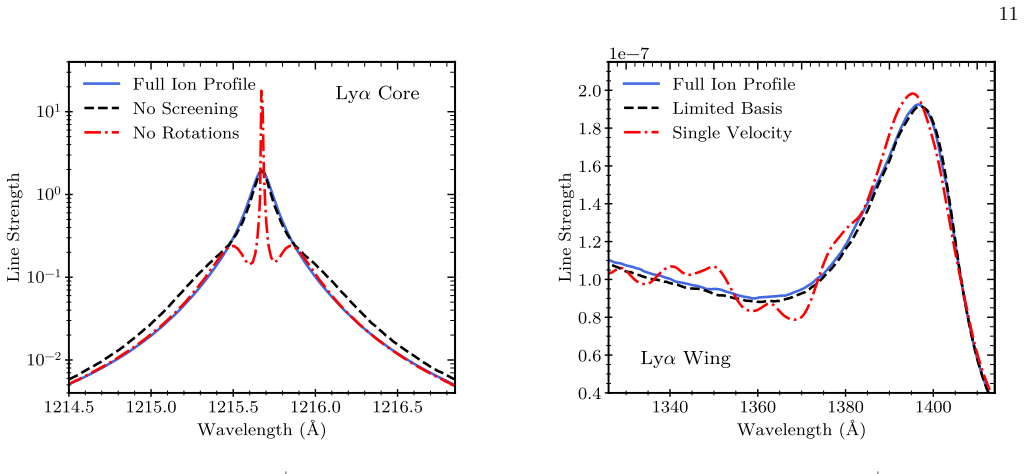
- Inclusion of inter-atomic transitions is required: without them, the far wing is too weak relative to the core.
- The broader, smoother satellites change the model flux between Ly-alpha and Ly-beta and improve the slope of the Ly-beta red wing compared with an observed ultraviolet white-dwarf spectrum.
- The approach is the first simulation line shape implementation to include quasi-molecular structure, bringing Lyman-series profiles into the same simulation machinery used for ordinary Stark broadening.
Reading between the lines
- A systematic fit to many ultraviolet white-dwarf spectra would test whether the broader satellites actually resolve the known ultraviolet-optical discrepancies in effective temperature and mass; the paper only demonstrates qualitative agreement with one star and explicitly defers such fits.
- The approximation the paper itself flags in Section 4.3—infinite-separation overlap integrals used at arbitrarily small R—means the very features being compared to observations could shift if R-dependent overlaps were used; recomputing with R-dependent overlaps is the natural next test.
- Because the same dipole basis transformation is central, the method should transfer to Balmer lines, heavier perturbers, and two-electron quasi-molecules; the paper lists these as future work, and the mechanism has no evident Lyman-specific barrier.
- A laboratory spectrum of a hydrogen plasma at white-dwarf photosphere conditions could discriminate between the broader multi-basis satellites and the standard semi-analytic satellites, since the paper's comparison to one star is qualitative.
Editorial analysis
A structured set of objections, weighed in public.
Referee Report
Summary. The paper introduces a multi-basis method for simulation-based Stark-broadening line shape codes, in which the radiating system is evolved in a single-center atomic basis when the nearest-neighbor perturber is far, and in a two-center molecular basis during close collisions (Sec. 4.1). The time-evolution operator is transformed between bases using infinite-separation overlap integrals (Eqs. 16, 21, 26), and the molecular dipole is similarly projected onto atomic states after time evolution (Eq. 33). The method is implemented in the Xenomorph code and applied to hydrogen Lyman-alpha and Lyman-beta lines with quasi-H2+ satellites at white-dwarf photosphere conditions. The resulting profiles are compared with ULBT profiles (Figs. 4–6), and a grid of profiles is inserted into Tlusty to generate model spectra, which are compared qualitatively with a FUSE spectrum of the DA white dwarf Wolf 1346 (Fig. 15). The paper reports broader quasi-molecular features than ULBT and good qualitative agreement with the observed spectrum.
Significance. If the method holds up, it is a substantial advance: it provides the first simulation-based line shape implementation of quasi-molecular structure, removes several ULBT approximations (single-velocity, no screening, separate ion/electron broadening, no directional correlations), and reproduces ULBT profiles in a simplified limit (Fig. 6). The model-spectrum comparison to Wolf 1346 is suggestive and could help resolve known UV/optical discrepancies in DA white dwarfs. However, the central validation rests on at least one approximation that the authors explicitly concede is not valid in the regime where the quasi-molecular satellites form, and at least one additional ad hoc symmetry assumption in the appendices. These need to be tested or justified quantitatively before the observational agreement can be taken as evidence for the method.
major comments (2)
- [Sec. 4.3, Eq. (33)] The transformation of the time-dependent molecular dipole D_m(t) into the atomic basis uses infinite-separation overlap integrals at every internuclear separation R. The paper concedes in Sec. 4.3 that this approximation is 'no longer valid as R can be arbitrarily small.' This is precisely the regime that produces the quasi-H2+ satellites: Sec. 5.3 notes the 1400 Å Ly-alpha feature forms at R ~ 10 a0, and the 1060/1080 Å Ly-beta features are governed by similar close collisions. Because the line shape is obtained by Fourier-transforming D_fi(t) (Eq. 11), any systematic misassignment of molecular oscillator strength among atomic final states at small R will directly modify the width, strength, and position of the satellites that drive the agreement in Fig. 15. The paper provides no test of this approximation; Fig. 10 varies only r_crit, not the overlap prescription. A recomputation with R
- [App. B, Eqs. (B11)-(B12)] The inter-atomic contribution to the line shape is retained through the symmetry approximations F{U^†_pp D_p U_pr} ≈ F{U^†_rr D_r U_rp} and F{U^†_pr D_p U_pr} ≈ F{U^†_rp D_r U_rp}. These are asserted on the basis of H2+ symmetry and a 'time-averaged power spectrum' equivalence, but no test is shown. They are load-bearing: Sec. 5.8 and Fig. 11 demonstrate that the inter-atomic term is comparable to the single-site term in the line wings, exactly where the quasi-molecular satellites appear. Replacing these two terms with a symmetry assumption, without quantitative verification against a two-center simulation that tracks both atoms, re-introduces an uncontrolled approximation into a method whose stated goal is to remove ad hoc ULBT-style truncations.
minor comments (5)
- [Sec. 6] The text says 'observational data shown later in Ch. 6' but the comparison is in the same section; 'Ch. 6' should be 'Sec. 6'.
- [Fig. 4] The legend uses 'dot-dash' for the Pelisoli+ (2015) profile, but the line style in the figure is not obvious in the printed version. Consider making the line styles more distinct and matching the caption wording.
- [Sec. 5.7] The r_crit convergence test in Fig. 10 is shown only for the Ly-beta red-wing features. Since the 1400 Å Ly-alpha satellite is also used in the spectral comparison, it would be useful to show r_crit convergence for that feature as well.
- [Data Availability] The new line shapes are said to be 'available from the corresponding author upon request.' For reproducibility, a permanent archive (e.g., Zenodo or a journal repository) would be preferable, especially because the model comparison in Fig. 15 depends on the exact numerical profiles.
- [Affiliation] Author affiliation 7 contains the typo 'Tuscon' and should read 'Tucson'.
Circularity Check
No significant circularity: the quasi-H2+ line shapes emerge from ab initio molecular data and a simulation-time basis change, not from parameters fitted to the target spectrum.
full rationale
The claimed derivation chain is self-contained at the level of the new method. The multi-basis line shape is computed from standard simulation line-shape equations (Eqs. 4-11), the basis-change transformation (Eqs. 16, 21, 33), and molecular data (potential curves, dipoles, overlaps) taken from Zammit et al. (2017, 2018, 2019) and the 2D Schrödinger solver of Gomez et al. (2018). Those cited inputs are ab initio calculations, not fits to the Wolf 1346 FUSE spectrum, so the spectral comparison in Fig. 15 is an external, qualitative benchmark rather than a circular prediction. The broader quasi-molecular features are attributed in Sec. 5.4 to removing the mean-velocity approximation and using a Maxwellian velocity distribution, with additional effects from simultaneous ion+electron broadening (Sec. 5.6); none of these are fitted to the observed spectrum. The paper's admitted approximation in Sec. 4.3, that the infinite-separation overlap integrals in Eq. (33) are no longer valid for small R, is a real physical/technical limitation and a correctness risk, but it is not a circularity: the approximation is acknowledged and not hidden, and the resulting profiles are not equal to the input data by construction. Similarly, the critical-radius choice in Sec. 5.7 is described as somewhat arbitrary but tested for convergence in Fig. 10, so it is not a fitted parameter that forces the claimed agreement. The recovery of the ULBT in Fig. 6 is a validation check, not a circular step. Self-citations to Xenomorph, Tlusty, and molecular-data papers are normal tooling citations; the load-bearing molecular data are independent of the present spectral fit. The Wolf 1346 comparison is explicitly qualitative and normalized by χ2 in the red wing, which is a normalization convention rather than a fit of the line-shape parameters. Overall no step in the derivation reduces to its own input by definition or by fitted-parameter renaming.
Assumptions & free parameters
free parameters (3)
- r_crit (critical radius for basis switching) =
45-50 a0 (values used)
- Atomic basis truncation (n_max) =
n=1,2,3 (expanded basis)
- Low-density rescaling approximation =
profiles at n_e<=1e16 cm^-3 rescaled from n_e=1e17 cm^-3 profile
assumptions (5)
- domain assumption Born-Oppenheimer approximation for H2+ molecular data
- domain assumption µ-ion model with straight-line perturber trajectories
- ad hoc to paper Infinite-separation overlap integrals for basis transformations
- ad hoc to paper Symmetry approximations in App. B (Eqs. B11-B12)
- domain assumption Debye screening with electron-only screening for both ions and electrons
Cite this review
Pith. "Pith review of A New Approach to Modeling Line Shapes with Quasi-H$_2^+$ Satellites in Stellar Atmospheres." pith.science (2026). https://pith.science/paper/V6REFIJA
@misc{pith2026260728920,
  author       = {Pith},
  title        = {Pith review of: A New Approach to Modeling Line Shapes with Quasi-H$_2^+$ Satellites in Stellar Atmospheres},
  year         = {2026},
  howpublished = {\url{https://pith.science/paper/V6REFIJA}},
  note         = {Machine review of arXiv:2607.28920}
}
abstract
Theoretical spectral line shapes describe the distribution of opacity due to bound electronic transitions in hot dense plasmas and are used to fit emergent spectra from many astrophysical sources. Deficiencies in line broadening theory have been proposed as a possible explanation for unresolved discrepancies between theoretical and observed spectra in white dwarf star atmospheres and laboratory experiments at white dwarf star photosphere conditions. One possible source of these discrepancies is the formation of quasi-molecules. Quasi-molecules are close (unbound) collisions between atoms, which broaden line shapes and create additional satellite lines. Quasi-molecules are challenging to implement into traditional line shape codes and have historically required a number of physical approximations beyond what is used in standard Stark broadening models. Here we present a new approach to calculating line shapes with quasi-molecular resonances, using a novel multiple-basis method that considers both atomic and molecular states. We implement this approach into a simulation line shape code, present hydrogen Lyman-series line shapes with quasi-H$_2^+$ resonances, and demonstrate the impact our new line shapes have on hydrogen-atmosphere white dwarf star model spectra. We find that our new approach leads to broader quasi-molecular features that agree well with observed spectra in initial comparisons.
Figures


Figures from the paper (8 more)




Reference graph
Works this paper leans on
-
[1]
1991, A&A, 242, 133
Allard, N., & Kielkopf, J. 1991, A&A, 242, 133
1991
-
[2]
Allard, N. F., & Alekseev, V. A. 2014, Advances in Space Research, 54, 1248, doi: 10.1016/j.asr.2013.09.027
-
[3]
Allard, N. F., Allard, F., Hauschildt, P. H., Kielkopf, J. F., & Machin, L. 2003, A&A, 411, L473, doi: 10.1051/0004-6361:20031299
-
[4]
F., Kielkopf, J., Drira, I., & Schmelcher, P
Allard, N. F., Kielkopf, J., Drira, I., & Schmelcher, P. 2000, European Physical Journal D, 12, 263, doi: 10.1007/s100530070021
-
[5]
Allard, N. F., Kielkopf, J. F., Blouin, S., et al. 2018, A&A, 619, A152, doi: 10.1051/0004-6361/201834067
-
[6]
Allard, N. F., Kielkopf, J. F., & Loeillet, B. 2004, A&A, 424, 347, doi: 10.1051/0004-6361:20040427
-
[7]
F., & Koester, D
Allard, N. F., & Koester, D. 1992, A&A, 258, 464
1992
-
[8]
F., Koester, D., Feautrier, N., & Spielfiedel, A
Allard, N. F., Koester, D., Feautrier, N., & Spielfiedel, A. 1994, A&AS, 108, 417
1994
Show all 87 references
-
[9]
F., Noselidze, I., & Kruk, J
Allard, N. F., Noselidze, I., & Kruk, J. W. 2009, A&A, 506, 993, doi: 10.1051/0004-6361/200912511
2009 doi
-
[10]
F., Royer, A., Kielkopf, J
Allard, N. F., Royer, A., Kielkopf, J. F., & Feautrier, N. 1999, PhRvA, 60, 1021, doi: 10.1103/PhysRevA.60.1021
1999 doi
-
[11]
F., Spiegelman, F., Kielkopf, J
Allard, N. F., Spiegelman, F., Kielkopf, J. F., & Bourdreux, S. 2022, A&A, 657, A121, doi: 10.1051/0004-6361/202141461
2022 doi
-
[12]
M., Hermes, J
Arseneau, S. M., Hermes, J. J., Zakamska, N. L., et al. 2025, ApJ, 991, 190, doi: 10.3847/1538-4357/adf8dd
2025 doi
-
[13]
1958, Physical Review, 111, 494, doi: 10.1103/PhysRev.111.494
Baranger, M. 1958, Physical Review, 111, 494, doi: 10.1103/PhysRev.111.494
1958 doi
-
[14]
1984, A&A, 131, 378
Baschek, B., Koeppen, J., Scholz, M., et al. 1984, A&A, 131, 378
1984
-
[15]
2019, ApJ, 876, 67, doi: 10.3847/1538-4357/ab153a
Bergeron, P., Dufour, P., Fontaine, G., et al. 2019, ApJ, 876, 67, doi: 10.3847/1538-4357/ab153a
2019 doi
-
[16]
2019, ApJ, 875, 137, doi: 10.3847/1538-4357/ab1266
Dufour, P. 2019, ApJ, 875, 137, doi: 10.3847/1538-4357/ab1266
2019 doi
-
[17]
C., Hubeny, I., & Rauch, T
Bohlin, R. C., Hubeny, I., & Rauch, T. 2020, AJ, 160, 21, doi: 10.3847/1538-3881/ab94b4
2020 doi
-
[18]
2014, Atoms, 2, 259, doi: 10.3390/atoms2020259
Calisti, A., Demura, A., Gigosos, M., et al. 2014, Atoms, 2, 259, doi: 10.3390/atoms2020259
2014 doi
-
[19]
B., Gomez, T
Cho, P. B., Gomez, T. A., Montgomery, M. H., et al. 2022, ApJ, 927, 70, doi: 10.3847/1538-4357/ac4df3
2022 doi
-
[20]
Cowan, R. D. 1981, The theory of atomic structure and spectra
1981
-
[21]
V., Lisitsa, V
Demura, A. V., Lisitsa, V. S., & Sholin, G. V. 1977, Soviet Journal of Experimental and Theoretical Physics, 46, 209
1977
-
[22]
V., & Stambulchik, E
Demura, A. V., & Stambulchik, E. 2014, Atoms, 2, 334, doi: 10.3390/atoms2030334
2014 doi
-
[23]
E., Rochau, G
Falcon, R. E., Rochau, G. A., Bailey, J. E., et al. 2015, ApJ, 806, 214, doi: 10.1088/0004-637X/806/2/214
2015 doi
-
[24]
E., Rochau, G
Falcon, R. E., Rochau, G. A., Bailey, J. E., et al. 2013, High Energy Density Physics, 9, 82, doi: 10.1016/j.hedp.2012.10.005
2013 doi
-
[25]
1963, Physical Review, 131, 259, doi: 10.1103/PhysRev.131.259
Fano, U. 1963, Physical Review, 131, 259, doi: 10.1103/PhysRev.131.259
1963 doi
-
[26]
T., & Koester, D
Farihi, J., G¨ ansicke, B. T., & Koester, D. 2013, Science, 342, 218, doi: 10.1126/science.1239447
2013 doi
-
[27]
2021, Matter and Radiation at Extremes, 7, 015901, doi: 10.1063/5.0058552
Ferri, S., Peyrusse, O., & Calisti, A. 2021, Matter and Radiation at Extremes, 7, 015901, doi: 10.1063/5.0058552
2021 doi
-
[28]
2014, Atoms, 2, 299, doi: 10.3390/atoms2030299
Ferri, S., Calisti, A., Moss´ e, C., et al. 2014, Atoms, 2, 299, doi: 10.3390/atoms2030299
2014 doi
-
[29]
Fuchs, J. T. 2017, PhD thesis, University of North
2017
-
[31]
2019, ApJ, 871, 169, doi: 10.3847/1538-4357/aafac6
Genest-Beaulieu, C., & Bergeron, P. 2019, ApJ, 871, 169, doi: 10.3847/1538-4357/aafac6
2019 doi
-
[32]
2012, ApJS, 199, 29, doi: 10.1088/0067-0049/199/2/29
Giammichele, N., Bergeron, P., & Dufour, P. 2012, ApJS, 199, 29, doi: 10.1088/0067-0049/199/2/29
2012 doi
-
[33]
A., & Cardenoso, V
Gigosos, M. A., & Cardenoso, V. 1987, Journal of Physics B Atomic Molecular Physics, 20, 6005, doi: 10.1088/0022-3700/20/22/013
1987 doi
-
[34]
A., Gonz´ alez-Herrero, D., Lara, N., et al
Gigosos, M. A., Gonz´ alez-Herrero, D., Lara, N., et al. 2018, PhRvE, 98, 033307, doi: 10.1103/PhysRevE.98.033307
2018 doi
-
[35]
2018, Atoms, 6, 22, doi: 10.3390/atoms6020022
Gomez, T., Nagayama, T., Fontes, C., et al. 2018, Atoms, 6, 22, doi: 10.3390/atoms6020022
2018 doi
-
[36]
A., Nagayama, T., Cho, P
Gomez, T. A., Nagayama, T., Cho, P. B., et al. 2022, Journal of Physics B Atomic Molecular Physics, 55, 034002, doi: 10.1088/1361-6455/ac4f31
2022 doi
-
[37]
H., & Winget, D
Montgomery, M. H., & Winget, D. E. 2016, PhRvA, 94, 022501, doi: 10.1103/PhysRevA.94.022501
2016 doi
-
[38]
A., Stambulchik, E., & White, J
Gomez, T. A., Stambulchik, E., & White, J. 2024, Phys. Rev. A, 109, 052804, doi: 10.1103/PhysRevA.109.052804
2024 doi
-
[39]
A., Nagayama, T., Cho, P
Gomez, T. A., Nagayama, T., Cho, P. B., et al. 2021, PhRvL, 127, 235001, doi: 10.1103/PhysRevLett.127.235001
2021 doi
-
[40]
A., Zammit, M
Gomez, T. A., Zammit, M. C., White, J. R., et al. 2025, ApJ, 986, 52, doi: 10.3847/1538-4357/adc9ae
2025 doi
-
[41]
D., Bohlin, R., Sloan, G
Gordon, K. D., Bohlin, R., Sloan, G. C., et al. 2022, AJ, 163, 267, doi: 10.3847/1538-3881/ac66dc
2022 doi
-
[42]
Griem, H. R. 1974, Spectral line broadening by plasmas H´ ebrard, G., Allard, N. F., Kielkopf, J. F., et al. 2003, A&A, 405, 1153, doi: 10.1051/0004-6361:20030715 19
1974 doi
-
[43]
Holberg, J. B. 2001, A FUSE Search for Nitrogen and Carbon in Hot White Dwarfs,, FUSE Proposal ID B119
2001
-
[44]
Holweger, H., Koester, D., & Allard, N. F. 1994, A&A, 290, L21
1994
- [45]
-
[46]
1995, ApJ, 439, 875, doi: 10.1086/175226
Hubeny, I., & Lanz, T. 1995, ApJ, 439, 875, doi: 10.1086/175226
1995 doi
-
[47]
2011, Synspec: General Spectrum Synthesis Program,, Astrophysics Source Code Library, record ascl:1109.022 http://ascl.net/1109.022
Hubeny, I., & Lanz, T. 2011, Synspec: General Spectrum Synthesis Program,, Astrophysics Source Code Library, record ascl:1109.022 http://ascl.net/1109.022
2011
- [48]
-
[49]
Iglesias, C. A. 2013, High Energy Density Physics, 9, 737, doi: 10.1016/j.hedp.2013.08.003
2013 doi
-
[50]
Haynes, D. A., J. 2000, PhRvE, 62, 5584, doi: 10.1103/PhysRevE.62.5584
2000 doi
- [51]
-
[52]
P., Mancini, R
Kilcrease, D. P., Mancini, R. C., & Hooper, C. F. 1993, Physical Review E, 48, 3901–3913, doi: 10.1103/PhysRevE.48.3901
1993 doi
-
[53]
2026, private communication
Koester, D. 2026, private communication
2026
-
[54]
1985, A&A, 142, L5
Vauclair, G. 1985, A&A, 142, L5
1985
-
[55]
1999, in American Institute of Physics Conference Series, Vol
Leboucher-Dalimier, E., Sauvan, P., Angelo, P., et al. 1999, in American Institute of Physics Conference Series, Vol. 467, Spectral Line Shapes, ed. R. M. Herman (AIP), 64–76, doi: 10.1063/1.58349
1999 doi
-
[56]
M., & Peek, J
Madsen, M. M., & Peek, J. M. 1971, Atomic Data, 2, 171, doi: 10.1016/S0092-640X(70)80008-0
1971 doi
-
[57]
W., Cash, W
Moos, H. W., Cash, W. C., Cowie, L. L., et al. 2000, ApJL, 538, L1, doi: 10.1086/312795
2000 doi
- [58]
-
[59]
G., & Kepler, S
Pelisoli, I., Santos, M. G., & Kepler, S. O. 2015, MNRAS, 448, 2332, doi: 10.1093/mnras/stv167
2015 doi
-
[60]
E., & Peek, J
Ramaker, D. E., & Peek, J. M. 1972, Journal of Physics B Atomic Molecular Physics, 5, 2175, doi: 10.1088/0022-3700/5/12/011
1972 doi
-
[61]
2020, Journal of Quantitative Spectroscopy and Radiative Transfer, 249, 107002, doi: 10.1016/j.jqsrt.2020.107002
Rosato, J., Marandet, Y., & Stamm, R. 2020, Journal of Quantitative Spectroscopy and Radiative Transfer, 249, 107002, doi: 10.1016/j.jqsrt.2020.107002
2020
-
[62]
1980, PhRvA, 22, 1625, doi: 10.1103/PhysRevA.22.1625
Royer, A. 1980, PhRvA, 22, 1625, doi: 10.1103/PhysRevA.22.1625
1980 doi
-
[63]
J., Moos, H
Sahnow, D. J., Moos, H. W., Ake, T. B., et al. 2000, ApJL, 538, L7, doi: 10.1086/312794
2000 doi
-
[64]
T., Tremblay, P.-E., et al
Sahu, S., G¨ ansicke, B. T., Tremblay, P.-E., et al. 2023, MNRAS, doi: 10.1093/mnras/stad2663
2023 doi
-
[65]
G., & Kepler, S
Santos, M. G., & Kepler, S. O. 2012, MNRAS, 423, 68, doi: 10.1111/j.1365-2966.2012.20631.x
2012
-
[66]
2022, PhR, 988, 1, doi: 10.1016/j.physrep.2022.09.001
Saumon, D., Blouin, S., & Tremblay, P.-E. 2022, PhR, 988, 1, doi: 10.1016/j.physrep.2022.09.001
2022 doi
-
[67]
A., Nagayama, T., Bailey, J
Schaeuble, M. A., Nagayama, T., Bailey, J. E., et al. 2019, ApJ, 885, 86, doi: 10.3847/1538-4357/ab479d
2019 doi
-
[68]
A., Nagayama, T., Bailey, J
Schaeuble, M. A., Nagayama, T., Bailey, J. E., et al. 2022, ApJ, 940, 181, doi: 10.3847/1538-4357/ac9df5
2022 doi
-
[69]
1982, JQSRT, 27, 499, doi: 10.1016/0022-4073(82)90102-9
Seidel, J., & Stamm, R. 1982, JQSRT, 27, 499, doi: 10.1016/0022-4073(82)90102-9
1982 doi
-
[70]
Stambulchik, E., & Demura, A. V. 2016, Journal of Physics B: Atomic, Molecular and Optical Physics, 49, 035701, doi: 10.1088/0953-4075/49/3/035701
2016 doi
-
[71]
2007, High Energy Density Physics, 3, 272, doi: 10.1016/j.hedp.2007.02.021
Alexiou, S. 2007, High Energy Density Physics, 3, 272, doi: 10.1016/j.hedp.2007.02.021
2007 doi
-
[72]
Stambulchik, E., & Iglesias, C. A. 2022, PhRvE, 105, 055210, doi: 10.1103/PhysRevE.105.055210
2022 doi
-
[73]
2006, JQSRT, 99, 730, doi: 10.1016/j.jqsrt.2005.05.058
Stambulchik, E., & Maron, Y. 2006, JQSRT, 99, 730, doi: 10.1016/j.jqsrt.2005.05.058
2006 doi
-
[74]
2020, ApJ, 901, 104, doi: 10.3847/1538-4357/abb0e5
Tremblay, P., Beauchamp, A., & Bergeron, P. 2020, ApJ, 901, 104, doi: 10.3847/1538-4357/abb0e5
2020 doi
-
[75]
2009, ApJ, 696, 1755, doi: 10.1088/0004-637X/696/2/1755
Tremblay, P.-E., & Bergeron, P. 2009, ApJ, 696, 1755, doi: 10.1088/0004-637X/696/2/1755
2009 doi
-
[76]
S., & Gianninas, A
Tremblay, P.-E., Bergeron, P., Kalirai, J. S., & Gianninas, A. 2010, ApJ, 712, 1345, doi: 10.1088/0004-637X/712/2/1345 Van Horn, H. M. 2015, Unlocking the Secrets of White Dwarf Stars (Cham:Springer), doi: 10.1007/978-3-319-09369-7
2010 doi
-
[77]
J., Dennihy, E., et al
Vanderbosch, Z., Hermes, J. J., Dennihy, E., et al. 2020, ApJ, 897, 171, doi: 10.3847/1538-4357/ab9649
2020 doi
-
[78]
R., Cooper, J., & Smith, E
Vidal, C. R., Cooper, J., & Smith, E. W. 1970, JQSRT, 10, 1011, doi: 10.1016/0022-4073(70)90121-4
1970 doi
-
[79]
L., Kelleher, D
Wiese, W. L., Kelleher, D. E., & Paquette, D. R. 1972, PhRvA, 6, 1132, doi: 10.1103/PhysRevA.6.1132
1972 doi
-
[80]
E., Hansen, C
Winget, D. E., Hansen, C. J., Liebert, J., et al. 1987, ApJL, 315, L77, doi: 10.1086/184864
1987 doi
-
[81]
A., & Hooper, Jr., C
Woltz, L. A., & Hooper, Jr., C. F. 1984, PhRvA, 30, 468, doi: 10.1103/PhysRevA.30.468
1984 doi
-
[82]
2019, AJ, 158, 242, doi: 10.3847/1538-3881/ab4cee
Xu, S., Dufour, P., Klein, B., et al. 2019, AJ, 158, 242, doi: 10.3847/1538-3881/ab4cee
2019 doi
-
[83]
C., Fursa, D
Zammit, M. C., Fursa, D. V., & Bray, I. 2013, Phys. Rev. A, 88, 062709, doi: 10.1103/PhysRevA.88.062709
2013 doi
-
[84]
C., Fursa, D
Zammit, M. C., Fursa, D. V., & Bray, I. 2014, Phys. Rev. A, 90, 022711, doi: 10.1103/PhysRevA.90.022711
2014 doi
-
[85]
C., Savage, J
Zammit, M. C., Savage, J. S., Colgan, J., et al. 2017, ApJ, 851, 64, doi: 10.3847/1538-4357/aa9712 20
2017 doi
-
[86]
C., Savage, J
Zammit, M. C., Savage, J. S., Colgan, J., et al. 2018, in Astronomical Society of the Pacific Conference Series, Vol. 515, Workshop on Astrophysical Opacities, 145
2018
-
[87]
C., Charlton, M., Jonsell, S., et al
Zammit, M. C., Charlton, M., Jonsell, S., et al. 2019, PhRvA, 100, 042709, doi: 10.1103/PhysRevA.100.042709
2019 doi
- [88]
Reviewed August 3, 2026 · model on record in the stance chip above.
Discussion (0). Continue with ORCID to comment.