Emergency Management Systems and Algorithms: a Comprehensive Survey
Pith reviewed 2026-05-25 18:16 UTC · model grok-4.3
The pith
This survey consolidates state-of-the-art research on emergency management systems and algorithms from design and engineering perspectives.
A machine-rendered reading of the paper's core claim, the machinery that carries it, and where it could break.
Core claim
The paper states that it delivers a comprehensive and systemic review of emergency management research by covering its history and evolution, the two central topics of emergency navigation and emergency search and rescue planning, and the emerging challenges and opportunities in system optimisation, evacuee behaviour modelling and optimisation, computing patterns, data analysis, energy and cyber security.
What carries the argument
The division into system design aspect and algorithm engineering aspect, applied to the two main topics of emergency navigation and emergency search and rescue planning.
If this is right
- The review identifies concrete directions for system optimisation in emergency settings.
- It points to the need for better evacuee behaviour modelling and optimisation techniques.
- It flags requirements in computing patterns, data analysis, energy management and cyber security for future emergency systems.
Where Pith is reading between the lines
- A consolidated map of the field could reduce overlap between separate research groups working on similar navigation or planning problems.
- The listed challenges may guide funding bodies when allocating resources across computing, behavioural science and security for disaster applications.
Load-bearing premise
The chosen papers and topics together cover the full multidisciplinary field without major gaps or selection biases.
What would settle it
Discovery of several recent, highly cited papers on emergency navigation systems or rescue planning algorithms that the survey neither cites nor discusses.
Figures
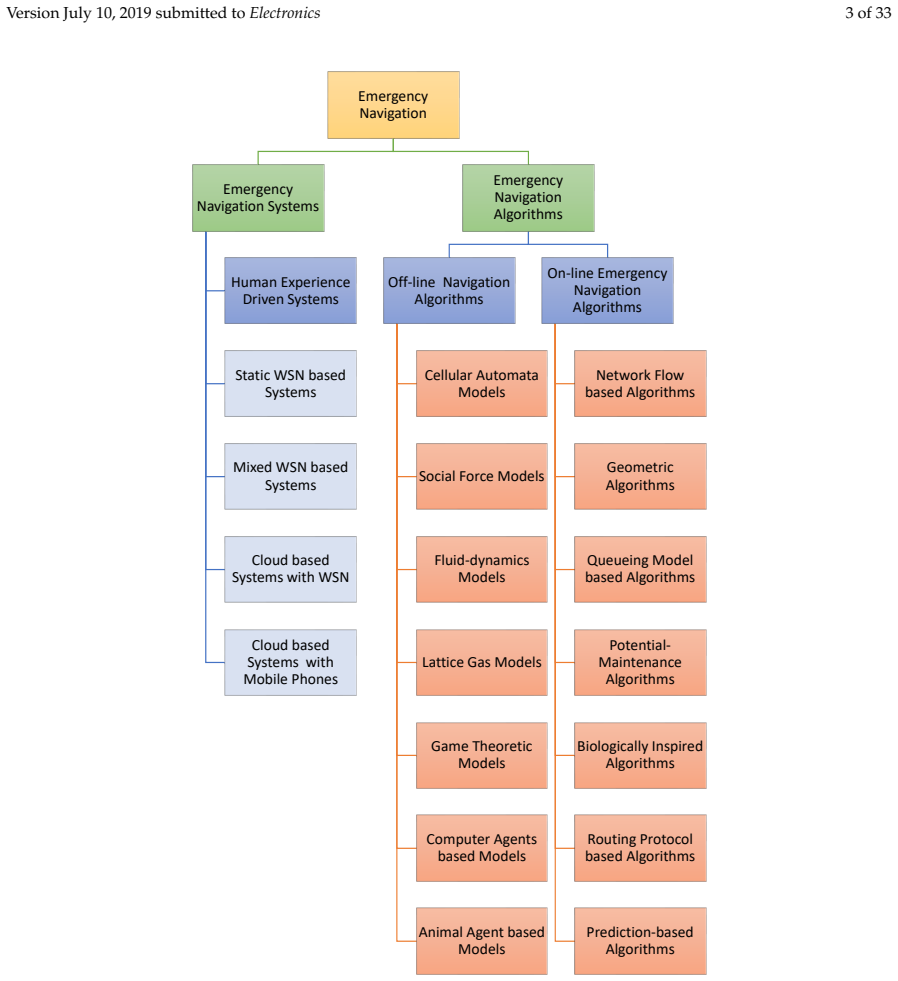


read the original abstract
Owing to the increasing frequency and destruction of natural and manmade disasters to modern highly-populated societies, emergency management, which provides solutions to prevent or address disasters, have drawn considerable research over the last few decades and become a multidisciplinary area. Because of its open and inclusive nature, new technologies always tend to influence, change or even revolutionise this research area. Hence, it is imperative to consolidate the state-of-the-art studies and knowledge to meet the research needs and identify the future research directions. The paper presents a comprehensive and systemic review of the existing research in the field of emergency management from both the system design aspect and algorithm engineering aspect. We begin with the history and evolution of the emergency management research. Then the two main research topics of this area, "emergency navigation" and "emergency search and rescue planning", are introduced and discussed. Finally, we suggest the emerging challenges and opportunities from system optimisation, evacuee behaviour modelling and optimisation, computing patterns, data analysis, energy and cyber security aspects.
Editorial analysis
A structured set of objections, weighed in public.
Referee Report
Summary. The paper claims to present a comprehensive and systemic review of emergency management research from both system design and algorithm engineering perspectives. It covers the history and evolution of the field, introduces and discusses the main topics of emergency navigation and emergency search-and-rescue planning, and concludes by suggesting emerging challenges and opportunities in system optimisation, evacuee behaviour modelling and optimisation, computing patterns, data analysis, energy, and cyber security.
Significance. If the coverage is thorough and balanced, the survey could consolidate state-of-the-art knowledge in a multidisciplinary area and help identify future research directions. The dual focus on systems and algorithms is a positive structural choice.
major comments (2)
- [Abstract] Abstract: The central claim of a 'comprehensive and systemic review' of existing research lacks any supporting description of the literature selection process (databases searched, keywords, date ranges, inclusion/exclusion criteria, or quality screening). This is load-bearing because the review's value as a reference depends on verifiable coverage without ad-hoc sampling or bias, and no such protocol appears in the described structure.
- [Introduction] Introduction (history and evolution section): Without an explicit search methodology or audit trail for the papers selected on history, navigation, and search-and-rescue planning, it is impossible to assess whether the synthesis is representative across the multidisciplinary domain or omits key works.
minor comments (1)
- [Abstract] Abstract: 'systemic' may be intended as 'systematic'; consider standard terminology for surveys.
Simulated Author's Rebuttal
We thank the referee for the constructive feedback. The comments highlight an opportunity to improve transparency regarding literature selection in our survey. We address each point below and will revise the manuscript accordingly.
read point-by-point responses
-
Referee: [Abstract] Abstract: The central claim of a 'comprehensive and systemic review' of existing research lacks any supporting description of the literature selection process (databases searched, keywords, date ranges, inclusion/exclusion criteria, or quality screening). This is load-bearing because the review's value as a reference depends on verifiable coverage without ad-hoc sampling or bias, and no such protocol appears in the described structure.
Authors: We agree that the abstract's claim of a comprehensive review would be strengthened by greater transparency on literature selection. This survey is a narrative review drawing on key works identified through domain expertise and citation networks rather than a formal systematic protocol (as is common in many computer science surveys). In the revised version, we will add a short subsection in the Introduction describing the general selection approach, main publication venues considered, and criteria for relevance to the core topics of emergency navigation and search-and-rescue planning. revision: yes
-
Referee: [Introduction] Introduction (history and evolution section): Without an explicit search methodology or audit trail for the papers selected on history, navigation, and search-and-rescue planning, it is impossible to assess whether the synthesis is representative across the multidisciplinary domain or omits key works.
Authors: We accept that an explicit description would help readers evaluate representativeness. The history and evolution section was constructed around major milestones and influential papers rather than an exhaustive search. We will revise this section to include a brief paragraph outlining the rationale for paper selection (focus on works that shaped system design and algorithmic approaches) and note the multidisciplinary scope considered. This addition will clarify the synthesis without altering the paper's narrative structure. revision: yes
Circularity Check
No circularity: survey paper contains no derivations or self-referential predictions
full rationale
This is a literature review paper with no mathematical derivations, predictions, fitted parameters, uniqueness theorems, or ansatzes. The central claim is simply that the authors have consolidated state-of-the-art studies; no step reduces by construction to its own inputs or to a self-citation chain. The paper is self-contained as an external synthesis against the cited literature.
Axiom & Free-Parameter Ledger
Reference graph
Works this paper leans on
-
[1]
Emergency Search and Rescue Planning Originating from maritime search and rescue operations, search and rescue planning in emergency situations has motivated considerable research over the last several decades owing to the unfortunate increasing threat of both manmade and natural disasters. During a disaster-related emergency evacuation, evacuees may beco...
work page 2019
-
[2]
and planetary exploration [ 176]. The philosophy behind team-based search and rescue is to convert a complex problem into simpler sub-problems that are more efficient to solve. These algorithms are be classified into three types: first, searching algorithms, which are dedicated to search and locate injured evacuees in unknown environments, specifically concen...
work page 2019
-
[3]
Emerging Challenges and Opportunities After decades of study and exploration, emergency management has become a mature research field. However, due to its open and inclusive nature, new technologies always tend to influence, change or even revolutionise this research area. In this section we discuss open issues and provide possible directions for future wor...
work page 2019
-
[4]
Conclusion In this paper, we provide a systemic review of the emergency management research. In the first section, we review the history and evolution of this field, trace its transformation from a reactive manner to a proactive manner. We also explore the impact of the development of computer technologies, which has shaped the current research. In the seco...
-
[5]
Emergency management: Principles and practice for local government
Drabek, T.E.; Hoetmer, G.J. Emergency management: Principles and practice for local government. Washington, DC: International City Management Association 1991
work page 1991
-
[6]
Cronstedt, M.; others. Prevention, preparedness, response, recovery-an outdated concept? Australian Journal of Emergency Management, The 2002, 17, 10
work page 2002
-
[7]
Introduction to emergency management; Butterworth-Heinemann, 2017
Haddow, G.; Bullock, J.; Coppola, D.P . Introduction to emergency management; Butterworth-Heinemann, 2017
work page 2017
-
[9]
Autonomous search for mines.Journal of Systems and Software 2005, 74, 255–268
Gelenbe, E.; Hussain, K.; Kaptan, V . Autonomous search for mines.Journal of Systems and Software 2005, 74, 255–268
work page 2005
-
[10]
An investigation of system design considerations for emergency management decision support
Belardo, S.; Karwan, K.R.; Wallace, W. An investigation of system design considerations for emergency management decision support. Systems, Man and Cybernetics, IEEE Transactions on 1984, pp. 795–804. Version July 10, 2019 submitted to Electronics 26 of 33
work page 1984
-
[11]
Network models for building evacuation
Chalmet, L.; Francis, R.; Saunders, P . Network models for building evacuation. Fire Technology 1982, 18, 90–113
work page 1982
-
[12]
Graph processing by which to evacuate a mine
Hughes, T. Graph processing by which to evacuate a mine. Applied Computing, 1990., Proceedings of the 1990 Symposium on, 1990, pp. 137–141
work page 1990
-
[13]
A telemetric monitoring and analysis system for use during large scale population evacuations
Southworth, F.; Chin, S.M.; Cheng, P . A telemetric monitoring and analysis system for use during large scale population evacuations. Road Traffic Monitoring, 1989., Second International Conference on, 1989, pp. 99–103
work page 1989
-
[14]
The critical problems of hurricane evacuation and alternative solutions
Griffith, D. The critical problems of hurricane evacuation and alternative solutions. OCEANS 82, 1982, pp. 990–994
work page 1982
-
[15]
Zorpette, G. Evacuation planning for Lilco’s Shoreham plant: Lack of an approved emergency evacuation strategy may prevent full operation of a $5 billion nuclear power plant on long Island’s north shore. Spectrum, IEEE 1987, 24, 22–24
work page 1987
-
[16]
Emergency Monitoring, Assessment and Response System for Diablo Canyon Nuclear Power Plant
Serpa, D.P .; Walker, D.M.; Jenckes, T.A. Emergency Monitoring, Assessment and Response System for Diablo Canyon Nuclear Power Plant. Nuclear Science, IEEE Transactions on 1981, 28, 236–241
work page 1981
-
[17]
A distributed decision support system for Building Evacuation
Filippoupolitis, A.; Gelenbe, E. A distributed decision support system for Building Evacuation. Human System Interactions, 2009. HSI ’09. 2nd Conference on, 2009, pp. 323–330
work page 2009
-
[18]
Wireless sensor networks for emergency navigation
Tseng, Y.C.; Pan, M.S.; Tsai, Y.Y. Wireless sensor networks for emergency navigation. Computer 2006, 39, 55–62
work page 2006
-
[19]
A highly adaptive distributed routing algorithm for mobile wireless networks
Park, V .D.; Corson, M.S. A highly adaptive distributed routing algorithm for mobile wireless networks. INFOCOM’97. Sixteenth Annual Joint Conference of the IEEE Computer and Communications Societies. Driving the Information Revolution., Proceedings IEEE. IEEE, 1997, Vol. 3, pp. 1405–1413
work page 1997
-
[20]
Distributed algorithms for guiding navigation across a sensor network
Li, Q.; De Rosa, M.; Rus, D. Distributed algorithms for guiding navigation across a sensor network. Proceedings of the 9th annual international conference on Mobile computing and networking. ACM, 2003, pp. 313–325
work page 2003
-
[21]
Robot planning and control via potential functions
Koditschek, D.E. Robot planning and control via potential functions. The robotics review 1989, p. 349
work page 1989
-
[22]
Opportunistic communications for emergency support systems
Gorbil, G.; Gelenbe, E. Opportunistic communications for emergency support systems. Procedia Computer Science 2011, 5, 39–47
work page 2011
-
[23]
Wireless networks in emergency management
Gelenbe, E.; Gorbil, G. Wireless networks in emergency management. Proceedings of the first ACM international workshop on Practical issues and applications in next generation wireless networks. ACM, 2012, pp. 1–6
work page 2012
-
[24]
Resilient emergency evacuation using opportunistic communications
Gorbil, G.; Gelenbe, E. Resilient emergency evacuation using opportunistic communications. In Computer and Information Sciences III; Springer, 2013; pp. 249–257
work page 2013
-
[25]
Opportunistic networking: data forwarding in disconnected mobile ad hoc networks
Pelusi, L.; Passarella, A.; Conti, M. Opportunistic networking: data forwarding in disconnected mobile ad hoc networks. Communications Magazine, IEEE 2006, 44, 134–141
work page 2006
-
[26]
Autonomous navigation systems for emergency management in buildings
Filippoupolitis, A.; Gorbil, G.; Gelenbe, E. Autonomous navigation systems for emergency management in buildings. GLOBECOM Workshops (GC Wkshps), 2011 IEEE, 2011, pp. 1056–1061
work page 2011
-
[27]
Zubair, S.; bnt Fisal, N.; Yerima, S.; Salihu, B.; Salihu, Y. CoWiSMoN: A framework for cognitive wireless sensor mobile network system for emergency rescue management. Adaptive Science and Technology (ICAST), 2011 3rd IEEE International Conference, 2011, pp. 237–241
work page 2011
-
[28]
Indoor Emergency Evacuation Service on Autonomous Navigation System using Mobile Phone
Inoue, Y.; Sashima, A.; Ikeda, T.; Kurumatani, K. Indoor Emergency Evacuation Service on Autonomous Navigation System using Mobile Phone. Universal Communication, 2008. ISUC ’08. Second International Symposium on, 2008, pp. 79–85
work page 2008
-
[29]
iMouse: An Integrated Mobile Surveillance and Wireless Sensor System
Tseng, Y.C.; Wang, Y.C.; Cheng, K.Y.; Hsieh, Y.Y. iMouse: An Integrated Mobile Surveillance and Wireless Sensor System. Computer 2007, 40, 60–66
work page 2007
-
[30]
Multicloud-Based Evacuation Services for Emergency Management
Dong, M.; Li, H.; Ota, K.; Yang, L.; Zhu, H. Multicloud-Based Evacuation Services for Emergency Management. Cloud Computing, IEEE 2014, 1, 50–59
work page 2014
-
[31]
An Integrated Building Fire Evacuation System with RFID and Cloud Computing
Chu, L.; Wu, S.J. An Integrated Building Fire Evacuation System with RFID and Cloud Computing. Intelligent Information Hiding and Multimedia Signal Processing (IIH-MSP), 2011 Seventh International Conference on, 2011, pp. 17–20
work page 2011
-
[32]
Enabling Cloud Computing in Emergency Management Systems
Qiu, M.; Ming, Z.; Wang, J.; Yang, L.T.; Xiang, Y. Enabling Cloud Computing in Emergency Management Systems. IEEE Cloud Computing 2014, 1, 60–67
work page 2014
-
[33]
Emergency Navigation without an Infrastructure
Gelenbe, E.; Bi, H. Emergency Navigation without an Infrastructure. Sensors 2014, 14, 15142–15162
work page 2014
-
[34]
Simulating dynamical features of escape panic
Helbing, D.; Farkas, I.; Vicsek, T. Simulating dynamical features of escape panic. Nature 2000, 407, 487–490. Version July 10, 2019 submitted to Electronics 27 of 33
work page 2000
-
[35]
Simulation of the kin behavior in building occupant evacuation based on cellular automaton
Yang, L.; Zhao, D.; Li, J.; Fang, T. Simulation of the kin behavior in building occupant evacuation based on cellular automaton. Building and Environment 2005, 40, 411–415
work page 2005
-
[36]
A review of the methodologies used in evacuation modelling
Gwynne, S.; Galea, E.; Owen, M.; Lawrence, P .J.; Filippidis, L.; others. A review of the methodologies used in evacuation modelling. Fire and Materials 1999, 23, 383–388
work page 1999
-
[37]
Modeling crowd evacuation of a building based on seven methodological approaches
Zheng, X.; Zhong, T.; Liu, M. Modeling crowd evacuation of a building based on seven methodological approaches. Building and Environment 2009, 44, 437–445
work page 2009
-
[38]
Statistical mechanics of cellular automata
Wolfram, S. Statistical mechanics of cellular automata. Reviews of modern physics 1983, 55, 601
work page 1983
-
[39]
Situated Cellular Agents: a model to simulate crowding dynamics
Bandini, S.; Manzoni, S.; Vizzari, G. Situated Cellular Agents: a model to simulate crowding dynamics. IEICE Transactions on Information and Systems: Special Issue on Cellular Automata 2004, E87-D(3), 669–676
work page 2004
-
[40]
Cellular automaton simulation of pedestrian counter flow considering the surrounding environment
Yu, Y.; Song, W. Cellular automaton simulation of pedestrian counter flow considering the surrounding environment. Physical Review E 2007, 75, 046112
work page 2007
-
[41]
CA Crowd Modeling for a Retirement House Evacuation with Guidance
Spartalis, E.; Georgoudas, I.G.; Sirakoulis, G.C. CA Crowd Modeling for a Retirement House Evacuation with Guidance. In Cellular Automata; Springer, 2014; pp. 481–491
work page 2014
-
[42]
Study of Influence of Groups on Evacuation Dynamics Using a Cellular Automaton Model
Müller, F.; Wohak, O.; Schadschneider, A. Study of Influence of Groups on Evacuation Dynamics Using a Cellular Automaton Model. Transportation Research Procedia2014, 2, 168–176
-
[43]
Social force model for pedestrian dynamics
Helbing, D.; Molnar, P . Social force model for pedestrian dynamics. Physical review E 1995, 51, 4282
work page 1995
-
[44]
Microscopic dynamics of pedestrian evacuation
Parisi, D.; Dorso, C. Microscopic dynamics of pedestrian evacuation. Physica A: Statistical Mechanics and its Applications 2005, 354, 606–618
work page 2005
-
[45]
Basics of modelling the pedestrian flow
Seyfried, A.; Steffen, B.; Lippert, T. Basics of modelling the pedestrian flow. Physica A: Statistical Mechanics and its Applications 2006, 368, 232–238
work page 2006
-
[46]
Henderson, L. The statistics of crowd fluids. Nature 1971, 229, 381–383
work page 1971
-
[47]
Simulation of pedestrian crowds in normal and evacuation situations
Helbing, D.; Farkas, I.J.; Molnar, P .; Vicsek, T. Simulation of pedestrian crowds in normal and evacuation situations. Pedestrian and evacuation dynamics 2002, 21, 21–58
work page 2002
-
[48]
Conservative logic; Springer, 2002
Fredkin, E.; Toffoli, T. Conservative logic; Springer, 2002
work page 2002
-
[49]
Scaling of pedestrian channel flow with a bottleneck
Tajima, Y.; Takimoto, K.; Nagatani, T. Scaling of pedestrian channel flow with a bottleneck. Physica A: Statistical Mechanics and its Applications 2001, 294, 257–268
work page 2001
-
[50]
Spatio-temporal distribution of escape time in evacuation process
Takimoto, K.; Nagatani, T. Spatio-temporal distribution of escape time in evacuation process. Physica A: Statistical Mechanics and its Applications 2003, 320, 611–621
work page 2003
-
[51]
Simulation of pedestrian flows by optimal control and differential games
Hoogendoorn, S.; HL Bovy, P . Simulation of pedestrian flows by optimal control and differential games. Optimal Control Applications and Methods 2003, 24, 153–172
work page 2003
-
[52]
A game theory based exit selection model for evacuation.Fire Safety Journal 2006, 41, 364–369
Lo, S.M.; Huang, H.C.; Wang, P .; Yuen, K. A game theory based exit selection model for evacuation.Fire Safety Journal 2006, 41, 364–369
work page 2006
-
[53]
Modeling evacuees’ exit selection with best response dynamics
Ehtamo, H.; Heliövaara, S.; Hostikka, S.; Korhonen, T. Modeling evacuees’ exit selection with best response dynamics. In Pedestrian and Evacuation Dynamics 2008; Springer, 2010; pp. 309–319
work page 2008
-
[54]
Modeling cooperative and competitive behaviors in emergency evacuation: A game-theoretical approach
Zheng, X.; Cheng, Y. Modeling cooperative and competitive behaviors in emergency evacuation: A game-theoretical approach. Computers & Mathematics with Applications 2011, 62, 4627–4634
work page 2011
-
[55]
Agent-based modeling: Methods and techniques for simulating human systems
Bonabeau, E. Agent-based modeling: Methods and techniques for simulating human systems. Proceedings of the National Academy of Sciences of the United States of America 2002, 99, 7280–7287
work page 2002
-
[56]
Searching efficient plans for emergency rescue through simulation: the case of a metro fire
Zarboutis, N.; Marmaras, N. Searching efficient plans for emergency rescue through simulation: the case of a metro fire. Cognition, Technology & Work2004, 6, 117–126
-
[57]
Computational models of collective behavior
Goldstone, R.L.; Janssen, M.A. Computational models of collective behavior. Trends in cognitive sciences 2005, 9, 424–430
work page 2005
-
[58]
Pan, X.; Han, C.S.; Dauber, K.; Law, K.H. A multi-agent based framework for the simulation of human and social behaviors during emergency evacuations. Ai & Society 2007, 22, 113–132
work page 2007
-
[59]
Self-organized queuing and scale-free behavior in real escape panic
Saloma, C.; Perez, G.J.; Tapang, G.; Lim, M.; Palmes-Saloma, C. Self-organized queuing and scale-free behavior in real escape panic. Proceedings of the National Academy of Sciences 2003, 100, 11947–11952
work page 2003
-
[60]
Symmetry breaking in escaping ants
Altshuler, E.; Ramos, O.; Núñez, Y.; Fernández, J.; Batista-Leyva, A.; Noda, C. Symmetry breaking in escaping ants. The American Naturalist 2005, 166, 643–649
work page 2005
-
[61]
Pelechano, N.; Malkawi, A. Evacuation simulation models: Challenges in modeling high rise building evacuation with cellular automata approaches. Automation in construction 2008, 17, 377–385
work page 2008
-
[62]
Perez, G.J.; Tapang, G.; Lim, M.; Saloma, C. Streaming, disruptive interference and power-law behavior in the exit dynamics of confined pedestrians. Physica A: Statistical Mechanics and its Applications 2002, 312, 609–618. Version July 10, 2019 submitted to Electronics 28 of 33
work page 2002
-
[63]
Simulation of pedestrian dynamics using a two-dimensional cellular automaton
Burstedde, C.; Klauck, K.; Schadschneider, A.; Zittartz, J. Simulation of pedestrian dynamics using a two-dimensional cellular automaton. Physica A 2004, 295, 507–525
work page 2004
-
[64]
Zheng, M.; Kashimori, Y.; Kambara, T. A model describing collective behaviors of pedestrians with various personalities in danger situations. Neural Information Processing, 2002. ICONIP ’02. Proceedings of the 9th International Conference on, 2002, Vol. 4, pp. 2083–2087 vol.4
work page 2002
-
[65]
Applications of counterpropagation networks
Hecht-Nielsen, R. Applications of counterpropagation networks. Neural networks 1988, 1, 131–139
work page 1988
-
[66]
A continuum theory for the flow of pedestrians
Hughes, R.L. A continuum theory for the flow of pedestrians. Transportation Research Part B: Methodological 2002, 36, 507–535
work page 2002
-
[67]
Pedestrian flows and non-classical shocks
Colombo, R.M.; Rosini, M.D. Pedestrian flows and non-classical shocks. Mathematical Methods in the Applied Sciences 2005, 28, 1553–1567
work page 2005
-
[68]
Lighthill, M.J.; Whitham, G.B. On kinematic waves. II. A theory of traffic flow on long crowded roads. Proceedings of the Royal Society of London A: Mathematical, Physical and Engineering Sciences. The Royal Society, 1955, Vol. 229, pp. 317–345
work page 1955
-
[69]
Liu, T.P . The Riemann problem for general systems of conservation laws.Journal of Differential Equations 1975, 18, 218–234
work page 1975
-
[70]
The quantum mechanics of many-body systems; Courier Corporation, 2013
Thouless, D.J. The quantum mechanics of many-body systems; Courier Corporation, 2013
work page 2013
-
[71]
Simulation of competitive egress behavior: comparison with aircraft evacuation data
Kirchner, A.; Klüpfel, H.; Nishinari, K.; Schadschneider, A.; Schreckenberg, M. Simulation of competitive egress behavior: comparison with aircraft evacuation data. Physica A: Statistical Mechanics and its Applications 2003, 324, 689–697
work page 2003
-
[72]
Fudenberg, D.; Tirole, J. Game theory, 1991. Cambridge, Massachusetts 1991, 393
work page 1991
-
[73]
Nash, J. Non-cooperative games. Annals of mathematics 1951, pp. 286–295
work page 1951
-
[74]
Motion sketch: Acquisition of visual motion guided behaviors
Nakamura, T.; Asada, M. Motion sketch: Acquisition of visual motion guided behaviors. IJCAI, 1995, Vol. 95, pp. 126–132
work page 1995
-
[75]
Primer on decision making: How decisions happen; Simon and Schuster, 1994
March, J.G. Primer on decision making: How decisions happen; Simon and Schuster, 1994
work page 1994
-
[76]
Kuligowski, E.D.; Peacock, R.D.; Hoskins, B. A review of building evacuation models ; US Department of Commerce, National Institute of Standards and Technology, 2005
work page 2005
-
[77]
Large scale simulation for human evacuation and rescue
Gelenbe, E.; Wu, F.J. Large scale simulation for human evacuation and rescue. Computers & Mathematics with Applications 2012, 64, 3869–3880
work page 2012
-
[78]
Future research on cyber-physical emergency management systems
Gelenbe, E.; Wu, F.J. Future research on cyber-physical emergency management systems. Future Internet 2013, 5, 336–354
work page 2013
-
[79]
Francis, R. A negative exponential solution to an evacuation problem; National Bureau of Standards, Center for Fire Research, 1984
work page 1984
-
[80]
EVACNET+: a computer program to determine optimal building evacuation plans
Kisko, T.M.; Francis, R.L. EVACNET+: a computer program to determine optimal building evacuation plans. Fire Safety Journal 1985, 9, 211–220
work page 1985
-
[81]
Evacuation planning: a capacity constrained routing approach
Lu, Q.; Huang, Y.; Shekhar, S. Evacuation planning: a capacity constrained routing approach. InIntelligence and Security Informatics; Springer, 2003; pp. 111–125
work page 2003
discussion (0)
Sign in with ORCID, Apple, or X to comment. Anyone can read and Pith papers without signing in.