REVIEW 4 major objections 5 minor 30 references
PolicyPulse: LLM-Synthesis Tool for Policy Researchers
T0 review · 4 major / 5 minor · reviewed 2026-08-07 · deepseek-v4-flash
Pith's one-line read PolicyPulse turns Reddit discussions into policy research themes, matching 73–84% of the themes in authoritative reports on the two topics tested.
desk verdict Useful work-in-progress with a genuine and load-bearing verification gap: PolicyPulse's quotes are not checkable, and every downstream claim inherits that risk. read the letter →
The pith
A machine-rendered reading of the paper's core claim, the machinery that carries it, and where it could break.
The reading
What carries the argument
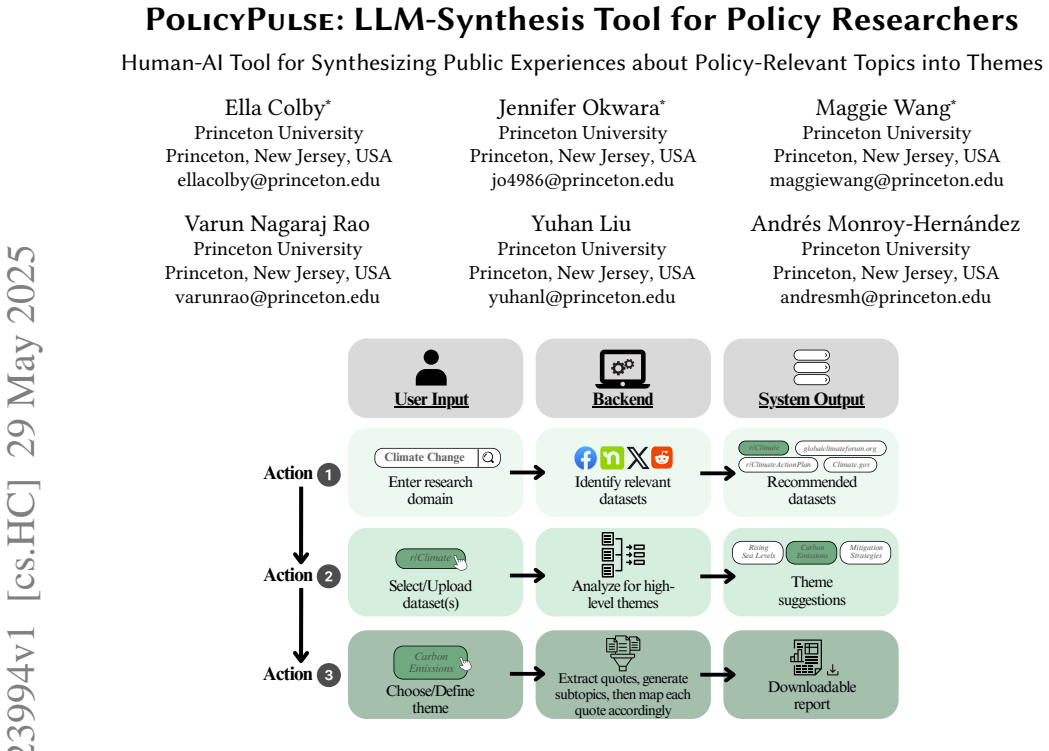
The load-bearing mechanism is a four-stage prompt pipeline running on GPT-4 over aggregated Reddit discussion threads. First, a data-source recommendation prompt matches the user's topic to relevant subreddits. Second, a theme-generation prompt proposes high-level policy-relevant themes or accepts user-defined ones. Third, a quote-extraction prompt pulls out personal anecdotes and experiences relevant to the chosen theme, with instructions meant to reduce bias. Fourth, subtopic-analysis and quote-mapping prompts group quotes into subtopics, assign each quote to one subtopic, and generate short summaries, producing a downloadable report. The quote extraction and mapping steps are what carry the argument: they convert raw forum text into the themed, quote-backed structure that the evaluation compares against authoritative reports.
What would settle it
Take a sample of quotes from a PolicyPulse report for a known subreddit and topic, then search the underlying Reddit archive (the paper uses The Eye) for the exact post text, post ID, or author. If a substantial fraction of sampled quotes cannot be found or are materially altered, the central claim that the tool surfaces genuine public experiences would be undercut. A systematic audit with, say, 50–100 sampled quotes per topic would settle it.
Extended reading notes
Core claim
The central discovery is that a structured, LLM-driven pipeline can transform unstructured forum posts into a policy-ready thematic report that overlaps substantially with expert-produced authoritative reports while adding anecdotal texture those reports lack. For the two test topics, PolicyPulse's themes covered most of the themes in the WMO and Pew reports, and it surfaced unique insights such as a parent's decision to delay buying a child a computer or console and a teen's explanation of why bullying goes unreported. In a user study with 11 policy researchers, participants rated the tool positively on speed, breadth of perspectives, and ease of analysis, gathered on average two more themes than with their own non-AI approach, and said it was especially useful in unfamiliar domains and for informing survey or interview design. The authors frame the result as validation of the tool's functionality rather than proof that it reproduces expert analysis: it is designed to complement primary and secondary sources by surfacing diverse public experiences early in the research workflow.
Load-bearing premise
The load-bearing premise is that the quotes extracted by the language model are real Reddit posts rather than fabrications, since the pipeline includes no post ID, URL, or independent verification step.
Editorial extensions
If this is right
- For the two evaluated topics, PolicyPulse covers most authoritative-report themes (73% for Climate Change, 84% for Social Media and Kids) while adding real-user anecdotes, so researchers can use it as a low-cost first pass over public opinion.
- In the 11-participant comparison, PolicyPulse users gathered more themes on average than with their own non-AI approach within the same time limit, suggesting an order-of-magnitude speedup in the public-opinion gathering stage.
- Participants said the tool is most valuable in unfamiliar domains and for informing survey or interview design, not for replacing primary data collection.
- The system's modular design allows user-uploaded datasets and expansion beyond Reddit, so the same prompt pipeline could be applied to other online communities or private data.
Reading between the lines
- A direct test of the weakest assumption would be to compare a sample of PolicyPulse quotes against the source archive using post IDs; the paper's own participants asked for such links, and adding them would likely raise trust more than any interface change.
- If the pipeline is extended to platforms with richer metadata (age, location, verified accounts), the demographic-context limitation could be addressed without changing the prompt architecture, since the mapping stage already preserves source IDs.
- The 73% and 84% coverage numbers are specific to two topics and one authoritative-report pairing; the authors' claim that narrower topics work better is testable across a broader topic sample.
- The cost figures of $150–$300 per report suggest that at scale, this approach could make qualitative public-opinion synthesis accessible to smaller policy organizations that cannot afford surveys costing thousands of dollars.
Editorial analysis
A structured set of objections, weighed in public.
Referee Report
Summary. PolicyPulse is an LLM-powered interactive tool that synthesizes online community discussions (currently Reddit) into policy-relevant themes and supporting quotes. The paper describes a three-stage pipeline (data-source recommendation, theme generation, report generation) and evaluates it in two ways: (1) comparing PolicyPulse's themes against themes extracted from authoritative reports (WMO on climate change and Pew on social media and kids), yielding claimed coverage of 73% (11/15) and 84% (16/19); and (2) a user study with 11 policy researchers who used PolicyPulse and their own non-AI approach on two topics, with results suggesting faster and broader thematic collection, positive user perceptions, and several areas for improvement (e.g., demographic context, data verification, AI trust). The paper concludes that PolicyPulse is a promising complement to traditional policy research methods.
Significance. If the claims hold, PolicyPulse addresses a real gap: making LLM-based synthesis of public forum data accessible to policy researchers without programming expertise, while preserving user agency over data sources. The paper's strengths include a concrete, reproducible system description with detailed prompts (Appendix A.1), a user study with relevant experts (N=11), and honest reporting of limitations (Section 6.2). The mixed-methods evaluation is appropriate in spirit. However, the central quantitative claims rest on an unvalidated theme-mapping procedure and on the unverified authenticity of extracted quotes, both of which are load-bearing for the paper's value proposition. These issues need substantive revision.
major comments (4)
- [§3.1.3, Appendix A.1.3, §6.1, §6.2] The paper repeatedly asserts that PolicyPulse's output consists of genuine Reddit posts (e.g., "the AI backend exclusively generates results from real Reddit user posts," §6.1), and the coverage and user-study claims are anchored on quotes being real. However, the Quote Extraction prompt (Appendix A.1.3) asks the LLM to output only a "quote" and a "summary," with no source identifier, post ID, or URL; the pipeline has no verification step checking that quoted strings exist in the input. In fact, §5.4 reports participants requesting links to original posts, and §6.2 lists "linking original posts to actual URLs" as future work, confirming that no such verification currently exists. Because LLMs are known to paraphrase or hallucinate extracted quotes, the paper must either (a) implement and report a quote-fidelity verification step (e.g., exact-match or semantic-match against source data), (b) provide evidence that quotes are verbatim, or (c) explicitly re-scope all claims to "AI-generated summaries of forum discussions" rather than "real-world anecdotes." Without this, a core trust and correctness pillar is missing.
- [§5.1, Appendix A.5 (Tables 1 and 2)] The headline coverage numbers (73% and 84%) are computed from an author-constructed mapping between themes in the authoritative reports and themes generated by PolicyPulse. The mapping methodology is not described in enough detail: there is no mention of independent coders, inter-rater reliability, or a coding rubric. More concerning, some mappings appear semantically strained—for example, Table 1 maps "Atmospheric Composition and Global Climate Drivers" to PolicyPulse themes 6 and 9, which are "Causes and Effects of Global Deforestation" and "Land Degradation and Desertification," with no explanation of how those constitute coverage of atmospheric composition. Similarly, Table 1 maps "Natural Resource Management" to theme 4, "Environmental Justice and Equity." Because this coverage metric is the primary quantitative evidence that PolicyPulse is valid, the authors should either (a) present the mapping with at least two independent annotators and report agreement, (b) justify each mapping with explicit theme-description alignment, or (c) downgrade the claim to an illustrative comparison rather than a formal coverage score.
- [§5.2, Figure 6] Figure 6 is used to support the claim that participants "collected a higher number of themes for both topics" using PolicyPulse and that this "points to the process being an order of magnitude faster." The figure shows group averages without error bars, individual data points, or any statistical test. With N=11 and a within-subjects design, a paired analysis (e.g., Wilcoxon signed-rank test, effect size, and per-participant differences) is necessary to determine whether the observed differences are meaningful or within variation. Without these, the quantitative support for the speed/breadth benefit is anecdotal, which undermines the 'order of magnitude faster' claim in the caption.
- [§5.2, Appendix A.1] The paper states that "listening sessions and surveys cost between $4,000-$80,000 respectively, while PolicyPulse can operate at much more reduced cost." However, the only cost figure given for PolicyPulse is in Appendix A.1 ($150-$300 per report for LLM processing), which does not include researcher time for data selection, report interpretation, or verification, nor the one-time cost of data acquisition and pipeline maintenance. The cost comparison is therefore incomplete and potentially misleading. The claim should be re-framed as a per-report API cost estimate, not an end-to-end cost comparison, or supported with a fuller cost model.
minor comments (5)
- [Figure 6 caption] The caption states the observed differences "point to the process being an order of magnitude faster," but the y-axis measures number of themes/anecdotes, not time. This is an unsupported leap; either remove the 'order of magnitude' language or present time-to-first-insight data collected in the study (§A.3.3 asks for time to first insight).
- [Appendix A.1.5] The Quote Categorization prompt says it assigns one of "1-6" codes, but the preceding Subtopic Identification prompt asks for "top 9" codes. The numbering is inconsistent and should be unified.
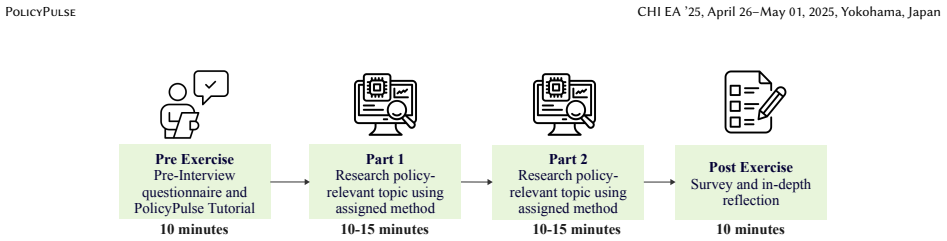
- [§4] The randomization procedure is described only as participants being "randomly divided into two groups" based on topic order and "further divided" by method order. More detail is needed on how random assignment was performed and whether the design is fully counterbalanced (e.g., Latin square).
- [§5.1] The claim that PolicyPulse "performed better for the more focused 'Social Media and Kids' topic compared to the broader 'Climate Change' topic" is attributed to topic specificity, but with only two topics this difference could be due to many confounds (e.g., subreddit selection, data quality, report structure). This sentence should be softened to an observation with possible explanations.
- [Figure 3 and §3.1.3] The numbering of prompts is confusing: Figure 3 labels the pipeline stages as Prompt 2 for Quote Extraction, Prompt 2 again for Subtopic Analysis, and Prompt 3 for Mapping, while the text says "Quotes are mapped to appropriate subtopics (Figure 3: Prompt 3)". Please align the figure labels with the textual description.
Circularity Check
No circular derivation: evaluation is externally anchored; only minor non-load-bearing self-citation of QuaLLM.
full rationale
PolicyPulse's central claims are not circular because the evaluation is anchored to external ground truth. The 73% and 84% theme-coverage figures in Section 5.1 are produced by mapping the system's LLM-generated themes to independently authored WMO and Pew reports; the themes are not fitted parameters and the reports are not generated by the tool, so the coverage ratio is not true by construction. The user study in Sections 4 and 5.2 similarly relies on 11 policy researchers comparing PolicyPulse with their own non-AI expert approach using worksheets and post-task surveys, not on self-confirmation by the system. The only self-citation is the statement in Section 3.2.1 that the pipeline 'draw[s] upon the four-stage multi-prompting strategy from QuaLLM with modifications,' where QuaLLM shares two co-authors; this is design inheritance rather than a load-bearing proof, and the paper's own external evaluation provides independent content. The acknowledged limitation that quotes are not linked to original posts (Sections 5.4 and 6.2) is a factual reliability concern, not an equation-level reduction of a claimed result to its inputs. Therefore there is no significant circularity; the score reflects only the minor, non-load-bearing self-citation.
Assumptions & free parameters
free parameters (2)
- Number of high-level themes generated per report =
9
- Number of subtopics coded per theme =
9
assumptions (3)
- domain assumption Reddit discussions provide authentic, candid public experiences relevant to policy research
- domain assumption LLM-extracted quotes are verbatim and accurate representations of the source posts
- ad hoc to paper Thematic coverage against authoritative reports is a valid validity metric
Cite this review
Pith. "Pith review of PolicyPulse: LLM-Synthesis Tool for Policy Researchers." pith.science (2026). https://pith.science/paper/V6ZL6HTE
@misc{pith2026250523994,
  author       = {Pith},
  title        = {Pith review of: PolicyPulse: LLM-Synthesis Tool for Policy Researchers},
  year         = {2026},
  howpublished = {\url{https://pith.science/paper/V6ZL6HTE}},
  note         = {Machine review of arXiv:2505.23994}
}
read the original abstract
Public opinion shapes policy, yet capturing it effectively to surface diverse perspectives remains challenging. This paper introduces PolicyPulse, an LLM-powered interactive system that synthesizes public experiences from online community discussions to help policy researchers author memos and briefs, leveraging curated real-world anecdotes. Given a specific topic (e.g., "Climate Change"), PolicyPulse returns an organized list of themes (e.g., "Biodiversity Loss" or "Carbon Pricing"), supporting each theme with relevant quotes from real-life anecdotes. We compared PolicyPulse outputs to authoritative policy reports. Additionally, we asked 11 policy researchers across multiple institutions in the Northeastern U.S to compare using PolicyPulse with their expert approach. We found that PolicyPulse's themes aligned with authoritative reports and helped spark research by analyzing existing data, gathering diverse experiences, revealing unexpected themes, and informing survey or interview design. Participants also highlighted limitations including insufficient demographic context and data verification challenges. Our work demonstrates how AI-powered tools can help influence policy-relevant research and shape policy outcomes.
Figures


Figures from the paper (7 more)


Reference graph
Works this paper leans on
-
[1]
2020.Parenting Children in the Age of Screens
Pew Research Center. 2020.Parenting Children in the Age of Screens. https://www.pewresearch.org/internet/2020/07/28/parenting- children-in-the-age-of-screens/
work page 2020
-
[2]
Kaiping Chen and David Tomblin. 2021. Using data from reddit, public deliberation, and surveys to measure public opinion about autonomous vehicles.Public Opinion Quarterly85, S1 (2021), 289–322
2021
-
[3]
Janet Davis, Harry Hochheiser, Juan Pablo Hourcade, Jeff Johnson, Lisa Nathan, and Janice Tsai. 2012. Occupy CHI! engaging US policymakers. InCHI’12 Extended Abstracts on Human Factors in Computing Systems. 1139–1142
work page 2012
-
[4]
Alyssa Engler. 2020. What all policy analysts need to know about data science
2020
-
[5]
Casey Fiesler, Michael Zimmer, Nicholas Proferes, Sarah Gilbert, and Naiyan Jones. 2024. Remember the human: A systematic review of ethical considerations in reddit research.Proceedings of the ACM on Human- Computer Interaction8, GROUP (2024), 1–33
work page 2024
-
[6]
Justin T Huang, Jangwon Choi, and Yuqin Wan. 2024. Politically biased moderation drives echo chamber formation: An analysis of user-driven content removals on Reddit.A vailable at SSRN(2024)
2024
-
[7]
Steven J Jackson, Tarleton Gillespie, and Sandy Payette. 2014. The policy knot: Re-integrating policy, practice and design in CSCW studies of so- cial computing. InProceedings of the 17th ACM conference on Computer supported cooperative work & social computing. 588–602
work page 2014
-
[8]
Jacobs and Robert Y
Lawrence R. Jacobs and Robert Y. Shapiro (Eds.). 2011.The Oxford Handbook of American Public Opinion and the Media. Oxford University Press
2011
Show all 30 references
-
[9]
Michelle S Lam, Janice Teoh, James A Landay, Jeffrey Heer, and Michael S Bernstein. 2024. Concept Induction: Analyzing Unstructured Text with High-Level Concepts Using LLooM. InProceedings of the CHI Conference on Human Factors in Computing Systems. 1–28
2024
-
[10]
Hélène Landemore. 2021. Open Democracy and Digital Technologies. InDigital Technology and Democratic Theory, Lucy Bernholz, Hélène PolicyPulse CHI EA ’25, April 26–May 01, 2025, Yokohama, Japan Landemore, and Rob Reich (Eds.). University of Chicago Press, Chicago. https://doi....
2021
-
[11]
Jonathan Lazar. 2015. Public policy and HCI: making an impact in the future.Interactions22, 5 (2015), 69–71
2015
-
[12]
Morelli (Harvard Graduate School of Education, Writing Specialist)
Katherine E. Morelli (Harvard Graduate School of Education, Writing Specialist). 2024. Policy Memo Writing. https://communicate.gse.harvard. edu/sites/projects.iq.harvard.edu/files/commlab/files/policy_memo_ writing_writing_services_hgse_morelli.pdf
2024
-
[13]
Varun Nagaraj Rao, Eesha Agarwal, Samantha Dalal, Dana Calacci, and Andrés Monroy-Hernández. 2025. QuaLLM: An LLM-based Framework to Extract Quantitative Insights from Online Forums. InFindings of the Association for Computational Linguistics: NAACL 2025
2025
-
[14]
Varun Nagaraj Rao, Samantha Dalal, Eesha Agarwal, Dana Calacci, and Andrés Monroy-Hernández. 2025. Rideshare Transparency: Translating Gig Worker Insights on AI Platform Design to Policy.Proceedings of the ACM on Human-Computer Interaction, CSCW(2025)
2025
-
[15]
2021.The Global Climate 2011-2020: A Decade of Acceleration
World Meteorological Organization. 2021.The Global Climate 2011-2020: A Decade of Acceleration. https://wmo.int/publication-series/global-climate- 2011-2020-decade-of-acceleration
2021
-
[16]
Chau Pham, Alexander Hoyle, Simeng Sun, Philip Resnik, and Mohit Iyyer. 2024. TopicGPT: A Prompt-based Topic Modeling Framework. In Proceedings of the 2024 Conference of the North American Chapter of the Association for Computational Linguistics: Human Language Technologies (V...
2024
-
[17]
Schulman and S
L. Schulman and S. Berger. 2024. Methods and Leading Practices for Advancing Public Participation and Community Engagement with the Fed- eral Government.Federal Register(2024). https://www.federalregister.gov/ documents/2024/03/20/2024-05882/methods-and-leading-practices-for- ...
2024
-
[18]
Shreya Shankar, Aditya G Parameswaran, and Eugene Wu. 2024. Do- cETL: Agentic Query Rewriting and Evaluation for Complex Document Processing.arXiv preprint arXiv:2410.12189(2024)
2024 arXiv
-
[19]
Anne Spaa, Abigail Durrant, Chris Elsden, and John Vines. 2019. Under- standing the Boundaries between Policymaking and HCI. InProceedings of the 2019 CHI Conference on Human Factors in Computing Systems. 1–15
2019
-
[20]
2018.Public opinion in America: Moods, cycles, and swings
James Stimson. 2018.Public opinion in America: Moods, cycles, and swings. Routledge
2018
-
[21]
The Writing Center, University of North Carolina at Chapel Hill. 2024. Policy Briefs. https://writingcenter.unc.edu/tips-and-tools/policy-briefs/
2024
-
[22]
Zhaoxiang Xu, Qingguo Fang, Yanbo Huang, and Mingjian Xie. 2024. The public attitude towards ChatGPT on reddit: A study based on unsupervised learning from sentiment analysis and topic modeling.Plos one19, 5 (2024), e0302502
2024
-
[23]
Remember the Human
Qian Yang, Richmond Y Wong, Steven Jackson, Sabine Junginger, Mar- garet D Hagan, Thomas Gilbert, and John Zimmerman. 2024. The Future of HCI-Policy Collaboration. InProceedings of the CHI Conference on Human Factors in Computing Systems. 1–15. CHI EA ’25, April 26–May 01, 202...
2024
-
[24]
Directly reference \{\ $theme \ _focus } concerns
-
[25]
Address specific risks , dangers , or ethical concerns related to \{\ $concerns \ _scope }
-
[26]
entries
Include personal anecdotes or experiences discussing \{\ $theme \ _focus } implications of \{\ $topic }. For each relevant quote , create an output entry in JSON format with the following structure : { " entries ": [ { " quote ": " Full quote of a personal experience or opinio...
2025
-
[27]
The theme name should be specific and not too broad
Provide a clear , concise name . The theme name should be specific and not too broad
-
[28]
codes ": [ {
Provide a brief description . Respond in valid JSON format with the following structure : { " codes ": [ { " name ": " Theme Name " , " description ": " Brief description of what this theme represents " } ] } A.1.5 Processing Pipeline Stage 3: Quote Categorization Prompt. The ...
-
[29]
A numbered list of codes (1 -9) with their descriptions
-
[30]
c at e go r i ze d _ qu o t es
A list of quotes to categorize . For each quote , assign the ONE MOST appropriate code number (1 -9) based on the themes present in the quote . Respond in valid JSON format with the following structure : { " c at e go r i ze d _ qu o t es ": [ { " quote ": " original quote tex...
2025
Reviewed August 7, 2026 · model on record in the stance chip above.
Discussion (0). Sign in to comment.