REVIEW 3 major objections 5 minor 47 references
The alternating 'changing-look' blazar OQ 334 (B2 1420+32): New observational clues to the blazar state transitions
T0 review · 3 major / 5 minor · reviewed 2026-08-07 · deepseek-v4-flash
Pith's one-line read The paper finds that all four FSRQ-to-BL Lac transitions observed in OQ 334 over the past five years coincided with an optical flare of 1.5-2.5 magnitudes.
desk verdict Plausible and clearly written, but the all-four claim leans on an unverified gamma-ray state tracer from a prior paper. read the letter →
The pith
A machine-rendered reading of the paper's core claim, the machinery that carries it, and where it could break.
The reading
What carries the argument
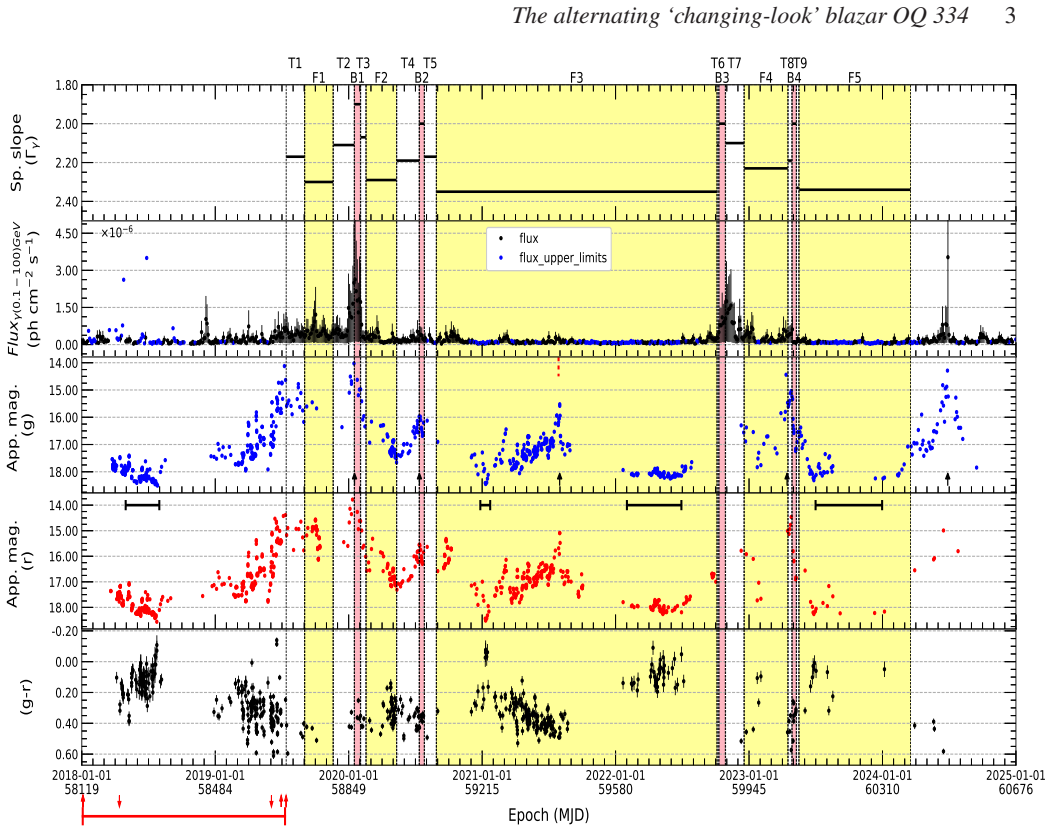
The central mechanism is the gamma-ray photon spectral slope $\Gamma_\gamma$ (0.1-300 GeV) used as a continuous, unbiased classifier of the blazar state: $\Gamma_\gamma < 2.0$ identifies the BL Lac state, $\Gamma_\gamma > 2.2$ the FSRQ state, and intermediate values mark transitions, following the multi-epoch calibration against MgII equivalent width in R24. This converts the sparse optical spectroscopy of M21 into a sub-day-cadence state history over 4.7 years, because Fermi-LAT monitors the source continuously. The companion data are the ZTF $g$- and $r$-band optical light curves, with an optical flare defined as a >1.5 mag brightening with rise and decay times under about a month. The argument is carried by aligning these two time series: every BLL slot in the gamma-ray state sequence falls on an optical flare, and the reverse check (a similar flare inside an FSRQ slot near MJD 59424) is flagged as a case worth re-examining.
What would settle it
Measure the gamma-ray slope and take optical spectra simultaneously during a future sharp flare of OQ 334. If a >1.5 mag optical flare occurs while $\Gamma_\gamma$ remains above 2.2 and MgII equivalent width stays above 5 Å, the claim that every FSRQ-to-BLL transition has an optical flare would be contradicted. A cheaper check is to reprocess the Fermi-LAT data in a narrow window around the 2021 July 29 flare (MJD 59424): a $\Gamma_\gamma > 2.2$ there, paired with strong MgII, would turn the paper's candidate counterexample into a definite one.
Extended reading notes
Core claim
The paper's central claim is that each of the four FSRQ-to-BLL transitions of OQ 334 observed during the past ~5 years was accompanied by an optical continuum flare of approximately 1.5-2.5 mag. The transitions are identified with the diagnostic $\Gamma_\gamma < 2.0$ for the BL Lac state after $\Gamma_\gamma > 2.2$ for the FSRQ state, as calibrated against MgII equivalent width by R24; the flares are apparent in the ZTF $g$- and $r$-band light curves, with three of the four BLL episodes well resolved in both bands and the fourth showing a brightening in the only available band. The authors take this as support for the broad-emission-line (BEL) swamping hypothesis, in which the jet's flaring optical continuum dilutes the MgII line below the 5 Å equivalent-width threshold. They caution that the apparent day-like offset between the optical peak and the gamma-ray-inferred BLL phase, overlapping the post-peak fading part of the flare, may require additional ingredients beyond simple swamping.
Load-bearing premise
The assumption that carries the result is that the gamma-ray spectral slope faithfully tracks the spectroscopically defined blazar state over the entire 4.7-year interval, even though optical spectroscopy samples only a few nights; if $\Gamma_\gamma$ mislabels states during those unobserved stretches, the four transitions and their pairing with flares would be wrong.
Editorial extensions
If this is right
- If the claim is right, an FSRQ-to-BLL transition in OQ 334 should not occur during an optical quiescent state, so a state switch seen without an accompanying flare would require a different mechanism.
- The BEL-swamping interpretation becomes the default explanation for this source's alternating states, and the 5 Å equivalent-width threshold can be used to predict how large a flare must be to trigger a transition.
- The apparent offset between the optical peak and the gamma-ray-inferred BLL phase implies a delay of order days in the state classification, so the transition may be diagnosed after the continuum peak rather than at it.
- Gamma-ray spectral slope monitoring can serve as a practical continuous state tracer for other changing-look blazars, making the phenomenon easier to identify than through sparse optical spectroscopy alone.
Reading between the lines
- If the flare-transition link generalizes to other changing-look blazars, then an optical flare is not merely a symptom of the transition but part of the causal chain; a transition without a flare would be evidence for an accretion-rate-driven state change rather than beaming-driven line dilution.
- A dense optical-spectroscopic campaign across one full flare of OQ 334 could separate the two scenarios: if MgII equivalent width drops only as the continuum rises above a threshold and recovers as it fades, swamping is confirmed; if the drop lags the continuum by days, an additional state-change process is at work.
- The 'redder when brighter' color behavior suggests the accretion disk dominates the faint base level; subtracting that blue disk component from the light curves would give the intrinsic jet flare amplitude and a sharper threshold for the state transition.
- With high-cadence optical and gamma-ray monitoring from ongoing all-sky surveys, the same 4-of-4 test could be run on a population of changing-look blazars, converting a single-object correlation into a statistical test of the BEL-swamping hypothesis.
Editorial analysis
A structured set of objections, weighed in public.
Referee Report
Summary. This paper investigates the relationship between optical continuum flaring and FSRQ-to-BLL state transitions in the changing-look blazar OQ 334. The authors compare ZTF g- and r-band light curves over roughly the past five years with the gamma-ray spectral-slope state classification of Ren et al. (2024), and they claim that all four transitions from FSRQ to BLL state during that interval were accompanied by an optical flare of approximately 1.5-2.5 mag. They also report a tentative few-day offset between the optical flare peaks and the gamma-ray-inferred BLL phases, and they discuss the consistency of their result with the broad-emission-line (BEL) swamping hypothesis. The paper is short, uses public data, and is candid about the preliminary nature of the lag estimate and about the sparse sampling of one of the four claimed associations.
Significance. If established, the central claim would be a valuable observational result: it would extend the earlier two-transition spectroscopic result of Mishra et al. (2021) to a longer, nearly continuous state history and provide the first systematic evidence that optical synchrotron flares are a regular, perhaps necessary, companion of FSRQ-to-BLL transitions in OQ 334, thereby strengthening the BEL-swamping scenario. The paper's data selection is transparent (single ZTF observation ID, catflag cuts, 3-day Fermi bins), and the authors are careful to label the time-lag result as a hint rather than a measurement. The result is also falsifiable, since it makes a specific prediction about the next transition. However, the central claim relies entirely on a gamma-ray spectral-slope state classification imported from Ren et al. (2024), and the paper does not demonstrate that this tracer is robust enough to define the transition list.
major comments (3)
- [Section 4 / Section 3.1] The entire classification of BLL and FSRQ states is taken from Ren et al. (2024), and the Gamma_gamma values are shown in Fig. 1 without error bars or a statement of the time binning. Because the central claim depends on which epochs satisfy Gamma_gamma < 2.0, the authors should demonstrate that the four BLL slots are robust to the uncertainties in the photon indices, for example by quoting the 1-sigma ranges from R24 for the relevant bins or by re-fitting the Fermi-LAT spectra with a publicly available pipeline. Without this, the list of four transitions is an assumed input rather than a verified basis for the flare-association claim.
- [Section 5.1 / Fig. 2] The flare-transition association is made by eye and is not quantified. The working definition in Section 2 requires a brightening of >1.5 mag with rise and decay times under ~1 month, but no amplitude, timescale, or temporal-separation threshold is given for each of B1-B4, and for B3 the text only says 'a brightening of the continuum can be seen' in a sparse r-band light curve. The claim that all four flares have amplitudes 1.5-2.5 mag is therefore not supported by the evidence shown for B3. A table listing peak MJD, peak magnitude, amplitude above a defined base level, rise/decay time, and the offset from the Gamma<2.0 interval for each BLL slot would make the claim testable.
- [Section 5.1(b) and Conclusions] The treatment of the sharp optical flare near MJD 59424 inside the FSRQ slot F3 is post hoc: the authors suggest it 'is also likely to represent the BLL phase' based on high optical polarization, but they do not perform the proposed targeted Fermi-LAT analysis. This does not by itself contradict the one-way claim, but it exposes a possible incompleteness in the adopted Gamma_gamma state map; if a strong flare with high polarization can occur inside a nominal FSRQ interval, the same tracer may have missed other BLL episodes, which would change the denominator of the 'all 4' claim. The paper should either close this loop with the targeted analysis or explicitly state the claim as conditional on the completeness of the R24 state map.
minor comments (5)
- [Section 6] Typo: 'alteranting' should be 'alternating' in the opening sentence of the Conclusions.
- [Section 2] The flare definition 'brightening of the source by >1.5-mag' does not specify the base level used to compute the amplitude; please define it (e.g., median of quasi-quiescent intervals or the minimum of the light curve).
- [Fig. 2] No zoomed panel is shown for B3; a zoom, even with sparse sampling, would help the reader judge whether the B3 brightening actually meets the stated flare definition.
- [Section 5.1(c)] The identification of the four 'base-level' time slots is made from visual inspection; please state the quantitative criterion used to define these slots.
- [Section 4 / Table 1 of R24] The paper would benefit from a table reproducing the BLL, FSRQ, and transition time intervals from Ren et al. (2024), since readers cannot easily inspect Fig. 1 to verify the temporal boundaries on which the claim rests.
Circularity Check
No significant circularity: the flare-transition association is an overlay of independent R24 gamma-ray states and ZTF optical light curves.
full rationale
The paper's central claim is that all four FSRQ-to-BLL transitions, classified by the gamma-ray spectral-slope criterion from Ren et al. (2024), were accompanied by optical flares in ZTF data. The state sequence is not derived in this paper; it is imported from R24's independent multi-epoch comparison between MgII equivalent width and gamma-ray slope. The optical flare identification uses public ZTF light curves with an explicit operational definition (>1.5 mag brightening with rise and decay under about a month). No parameter in the present paper is fitted to the target claim, and no equation defines the blazar state in terms of the optical flare. The gamma-ray and optical data are physically independent, so the coincidence is an empirical finding rather than a construction. The only self-citations (Chand & Gopal-Krishna 2022 and Negi et al. 2022) are peripheral literature references and do not carry the load-bearing argument. The caveat about the flare near MJD 59424 falling inside a designated FSRQ state is an honest admission that the imported classification may miss a BLL episode, which affects statistical completeness but not circularity. Therefore the derivation chain is self-contained with respect to its external inputs, and no circular step is present.
Assumptions & free parameters
free parameters (3)
- Optical flare amplitude threshold =
1.5 mag
- Optical flare timescale threshold =
rise and decay under about 1 month
- Flare-transition association window =
not defined quantitatively; judged visually
assumptions (4)
- domain assumption The gamma-ray spectral slope Gamma_gamma is a valid continuous tracer of FSRQ/BLL state, with cutoffs 2.0 and 2.2 adopted from Ren et al. (2024).
- domain assumption The R24 state sequence over MJD 58678 to 60387 is complete, unbiased, and correctly identifies all FSRQ, BLL, and transition episodes.
- domain assumption ZTF light curves selected by observation ID with the highest number of data points and catflag equal to zero accurately trace the optical continuum without significant calibration breaks.
- domain assumption Fermi-LAT 3-day binned light curves and the R24 spectral slope values are accurate enough to resolve state transitions on the timescales discussed.
Cite this review
Pith. "Pith review of The alternating 'changing-look' blazar OQ 334 (B2 1420+32): New observational clues to the blazar state transitions." pith.science (2026). https://pith.science/paper/VACHKQZY
@misc{pith2026250515900,
  author       = {Pith},
  title        = {Pith review of: The alternating 'changing-look' blazar OQ 334 (B2 1420+32): New observational clues to the blazar state transitions},
  year         = {2026},
  howpublished = {\url{https://pith.science/paper/VACHKQZY}},
  note         = {Machine review of arXiv:2505.15900}
}
abstract
The high-luminosity blazar OQ 334 is a leading exponent of the intriguing rare phenomenon of alternating between a flat-spectrum radio quasar (FSRQ) and a BL Lac (BLL) states. Its two optical continuum outbursts observed during the $\sim$ 1.5-year long time span, starting Jan 2018, had been shown to coincide with transition from the FSRQ to BLL state, manifested by a sharp drop in the equivalent width of MgII broad emission-line. Recently, a continuous monitoring of its blazar state, over a much longer duration (past $\sim$ 5 years) has become possible by deploying the observed $\gamma-ray$ spectral slope ($\Gamma_{\gamma}$) as a diagnostic. This opens prospects of making a much less biased and statistically more robust check on the association of optical flaring with FSRQ $\rightarrow$ BLL transition. We find that all 4 such transitions ($\Gamma_{\gamma}$ becoming < 2.0), observed during the past $\sim$ 5 years, were accompanied by an optical flare. While this appears consistent with the transition to BL Lac state happening purely due to an enhanced optical continuum (flaring) swamping out the broad emission-lines, this simple scheme may need additional ingredients, considering the hint found for a day-like offset between the flaring and the state transition.
Figures

Reference graph
Works this paper leans on
-
[1]
, " * write output.state after.block = add.period write newline
ENTRY address author booktitle chapter edition editor howpublished institution journal key month note number organization pages publisher school series title type volume year label extra.label sort.label short.list INTEGERS output.state before.all mid.sentence after.sentence after.block FUNCTION init.state.consts #0 'before.all := #1 'mid.sentence := #2 '...
-
[2]
write newline
" write newline "" before.all 'output.state := FUNCTION n.dashify 't := "" t empty not t #1 #1 substring "-" = t #1 #2 substring "--" = not "--" * t #2 global.max substring 't := t #1 #1 substring "-" = "-" * t #2 global.max substring 't := while if t #1 #1 substring * t #2 global.max substring 't := if while FUNCTION word.in bbl.in " " * FUNCTION format....
-
[3]
write newline
" write newline "" before.all 'output.state := FUNCTION fin.entry write newline FUNCTION new.block output.state before.all = 'skip after.block 'output.state := if FUNCTION new.sentence output.state after.block = 'skip output.state before.all = 'skip after.sentence 'output.state := if if FUNCTION not #0 #1 if FUNCTION and 'skip pop #0 if FUNCTION or pop #1...
-
[4]
Abdo A. A., et al., 2010, @doi [ ] 10.1088/0004-637X/710/2/1271 , https://ui.adsabs.harvard.edu/abs/2010ApJ...710.1271A 710, 1271
-
[5]
Abdollahi S., et al., 2020, @doi [ ] 10.3847/1538-4365/ab6bcb , https://ui.adsabs.harvard.edu/abs/2020ApJS..247...33A 247, 33
-
[6]
Ackermann M., et al., 2011, @doi [ ] 10.1088/0004-637X/743/2/171 , https://ui.adsabs.harvard.edu/abs/2011ApJ...743..171A 743, 171
-
[7]
Antonucci R., 1993, @doi [ ] 10.1146/annurev.aa.31.090193.002353 , https://ui.adsabs.harvard.edu/abs/1993ARA&A..31..473A 31, 473
arXiv 1993
-
[8]
Antonucci R. R. J., 2023, @doi [Galaxies] 10.3390/galaxies11050102 , https://ui.adsabs.harvard.edu/abs/2023Galax..11..102A 11, 102
Show all 47 references
-
[9]
B., et al., 2009, @doi [ ] 10.1088/0004-637X/697/2/1071 , https://ui.adsabs.harvard.edu/abs/2009ApJ...697.1071A 697, 1071
Atwood W. B., et al., 2009, @doi [ ] 10.1088/0004-637X/697/2/1071 , https://ui.adsabs.harvard.edu/abs/2009ApJ...697.1071A 697, 1071
2009 doi
-
[10]
C., Blandford R
Begelman M. C., Blandford R. D., Rees M. J., 1984, @doi [Reviews of Modern Physics] 10.1103/RevModPhys.56.255 , https://ui.adsabs.harvard.edu/abs/1984RvMP...56..255B 56, 255
1984 doi
-
[11]
C., et al., 2019, @doi [ ] 10.1088/1538-3873/aaecbe , https://ui.adsabs.harvard.edu/abs/2019PASP..131a8002B 131, 018002
Bellm E. C., et al., 2019, @doi [ ] 10.1088/1538-3873/aaecbe , https://ui.adsabs.harvard.edu/abs/2019PASP..131a8002B 131, 018002
2019 doi
-
[12]
Blandford R., Meier D., Readhead A., 2019, @doi [ ] 10.1146/annurev-astro-081817-051948 , https://ui.adsabs.harvard.edu/abs/2019ARA&A..57..467B 57, 467
2019 doi
-
[13]
Boula S., Kazanas D., Mastichiadis A., 2019, @doi [ ] 10.1093/mnrasl/sly189 , https://ui.adsabs.harvard.edu/abs/2019MNRAS.482L..80B 482, L80
2019 doi
-
[14]
S., Singh V., Runnoe J., 2015, @doi [ ] 10.1093/mnras/stv2186 , https://ui.adsabs.harvard.edu/abs/2015MNRAS.454.3864B 454, 3864
Brotherton M. S., Singh V., Runnoe J., 2015, @doi [ ] 10.1093/mnras/stv2186 , https://ui.adsabs.harvard.edu/abs/2015MNRAS.454.3864B 454, 3864
2015 doi
-
[15]
Chand K., Gopal-Krishna 2022, @doi [ ] 10.1093/mnrasl/slac066 , https://ui.adsabs.harvard.edu/abs/2022MNRAS.516L..18C 516, L18
2022 doi
-
[16]
Chatterjee R., et al., 2009, @doi [ ] 10.1088/0004-637X/704/2/1689 , https://ui.adsabs.harvard.edu/abs/2009ApJ...704.1689C 704, 1689
2009 doi
-
[17]
A., Robinson A., Axon D
Corbett E. A., Robinson A., Axon D. J., Hough J. H., Jeffries R. D., Thurston M. R., Young S., 1996, @doi [ ] 10.1093/mnras/281.3.737 , https://ui.adsabs.harvard.edu/abs/1996MNRAS.281..737C 281, 737
1996 doi
-
[18]
W., Stocke J
Danforth C. W., Stocke J. T., France K., Begelman M. C., Perlman E., 2016, @doi [ ] 10.3847/0004-637X/832/1/76 , https://ui.adsabs.harvard.edu/abs/2016ApJ...832...76D 832, 76
2016 doi
-
[19]
Elitzur M., Shlosman I., 2006, @doi [ ] 10.1086/508158 , https://ui.adsabs.harvard.edu/abs/2006ApJ...648L.101E 648, L101
2006 doi
- [20]
-
[21]
Foschini L., 2012, @doi [Research in Astronomy and Astrophysics] 10.1088/1674-4527/12/4/001 , https://ui.adsabs.harvard.edu/abs/2012RAA....12..359F 12, 359
2012 doi
-
[22]
Ghisellini G., Celotti A., Fossati G., Maraschi L., Comastri A., 1998, @doi [ ] 10.1046/j.1365-8711.1998.02032.x , https://ui.adsabs.harvard.edu/abs/1998MNRAS.301..451G 301, 451
1998
-
[24]
Ghisellini G., Tavecchio F., Foschini L., Bonnoli G., Tagliaferri G., 2013, @doi [ ] 10.1093/mnrasl/slt041 , https://ui.adsabs.harvard.edu/abs/2013MNRAS.432L..66G 432, L66
2013 doi
-
[25]
Giommi P., Padovani P., Polenta G., Turriziani S., D'Elia V., Piranomonte S., 2012, @doi [ ] 10.1111/j.1365-2966.2011.20044.x , https://ui.adsabs.harvard.edu/abs/2012MNRAS.420.2899G 420, 2899
2012
-
[26]
F., Lee C
Gu M. F., Lee C. U., Pak S., Yim H. S., Fletcher A. B., 2006, @doi [ ] 10.1051/0004-6361:20054271 , https://ui.adsabs.harvard.edu/abs/2006A&A...450...39G 450, 39
2006 doi
-
[28]
Kang S.-J., Zheng Y.-G., Wu Q., 2023, @doi [ ] 10.1093/mnras/stad2456 , https://ui.adsabs.harvard.edu/abs/2023MNRAS.525.3201K 525, 3201
2023 doi
-
[29]
Kang S.-J., Lyu B., Wu Q., Zheng Y.-G., Fan J., 2024, @doi [ ] 10.3847/1538-4357/ad0fdf , https://ui.adsabs.harvard.edu/abs/2024ApJ...962..122K 962, 122
2024 doi
-
[30]
D., Taylor G
Linford J. D., Taylor G. B., Schinzel F. K., 2012, @doi [ ] 10.1088/0004-637X/757/1/25 , https://ui.adsabs.harvard.edu/abs/2012ApJ...757...25L 757, 25
2012 doi
-
[31]
P., Jorstad S
Marscher A. P., Jorstad S. G., G \'o mez J.-L., Aller M. F., Ter \"a sranta H., Lister M. L., Stirling A. M., 2002, @doi [ ] 10.1038/nature00772 , https://ui.adsabs.harvard.edu/abs/2002Natur.417..625M 417, 625
2002 doi
-
[32]
D., et al., 2021, @doi [ ] 10.3847/1538-4357/abf63d , https://ui.adsabs.harvard.edu/abs/2021ApJ...913..146M 913, 146
Mishra H. D., et al., 2021, @doi [ ] 10.3847/1538-4357/abf63d , https://ui.adsabs.harvard.edu/abs/2021ApJ...913..146M 913, 146
2021 doi
-
[33]
C., Singh R
Negi V., Joshi R., Chand K., Chand H., Wiita P., Ho L. C., Singh R. S., 2022, @doi [ ] 10.1093/mnras/stab3591 , https://ui.adsabs.harvard.edu/abs/2022MNRAS.510.1791N 510, 1791
2022 doi
-
[34]
Nyland K., et al., 2020, @doi [ ] 10.3847/1538-4357/abc341 , https://ui.adsabs.harvard.edu/abs/2020ApJ...905...74N 905, 74
2020 doi
-
[35]
R., Marshall K., Ryle W
Osterman Meyer A., Miller H. R., Marshall K., Ryle W. T., Aller H., Aller M., Balonek T., 2009, @doi [ ] 10.1088/0004-6256/138/6/1902 , https://ui.adsabs.harvard.edu/abs/2009AJ....138.1902O 138, 1902
2009 doi
-
[36]
Pandey A., et al., 2025, @doi [ ] 10.3847/1538-4357/ad9b7c , https://ui.adsabs.harvard.edu/abs/2025ApJ...978..120P 978, 120
2025 doi
-
[37]
R., Wevers T., 2019, @doi [Research Notes of the American Astronomical Society] 10.3847/2515-5172/ab304a , https://ui.adsabs.harvard.edu/abs/2019RNAAS...3...92P 3, 92
Pasham D. R., Wevers T., 2019, @doi [Research Notes of the American Astronomical Society] 10.3847/2515-5172/ab304a , https://ui.adsabs.harvard.edu/abs/2019RNAAS...3...92P 3, 92
2019 doi
-
[38]
Rani B., et al., 2010, @doi [ ] 10.1111/j.1365-2966.2010.16419.x , https://ui.adsabs.harvard.edu/abs/2010MNRAS.404.1992R 404, 1992
2010
-
[39]
S., Zhou R
Ren S. S., Zhou R. X., Zheng Y. G., Kang S. J., 2024, @doi [ ] 10.3847/1538-4357/ad83ce , https://ui.adsabs.harvard.edu/abs/2024ApJ...976..124R 976, 124
2024 doi
-
[40]
Ricci C., Trakhtenbrot B., 2023, @doi [Nature Astronomy] 10.1038/s41550-023-02108-4 , https://ui.adsabs.harvard.edu/abs/2023NatAs...7.1282R 7, 1282
2023 doi
-
[41]
J., Anderson S
Ruan J. J., Anderson S. F., Plotkin R. M., Brandt W. N., Burnett T. H., Myers A. D., Schneider D. P., 2014, @doi [ ] 10.1088/0004-637X/797/1/19 , https://ui.adsabs.harvard.edu/abs/2014ApJ...797...19R 797, 19
2014 doi
-
[42]
S., Chazov M
Savchenko S. S., Chazov M. I., Nazarova A. E., Shishkina E. V., Larionova E. G., 2021, The Astronomer's Telegram, https://ui.adsabs.harvard.edu/abs/2021ATel14819....1S 14819, 1
2021
-
[43]
S., et al., 2012, @doi [ ] 10.1088/0004-637X/748/1/49 , https://ui.adsabs.harvard.edu/abs/2012ApJ...748...49S 748, 49
Shaw M. S., et al., 2012, @doi [ ] 10.1088/0004-637X/748/1/49 , https://ui.adsabs.harvard.edu/abs/2012ApJ...748...49S 748, 49
2012 doi
-
[44]
Z., Kochanek C
Stanek K. Z., Kochanek C. S., Thompson T. A., Shappee B. J., Holoien T. W. S., Prieto J. L., Dong S., Dai X., 2017, The Astronomer's Telegram, https://ui.adsabs.harvard.edu/abs/2017ATel11110....1S 11110, 1
2017
-
[45]
M., Fried J
Stickel M., Padovani P., Urry C. M., Fried J. W., Kuehr H., 1991, @doi [ ] 10.1086/170133 , http://adsabs.harvard.edu/abs/1991ApJ...374..431S 374, 431
1991 doi
-
[46]
T., Morris S
Stocke J. T., Morris S. L., Gioia I. M., Maccacaro T., Schild R., Wolter A., Fleming T. A., Henry J. P., 1991, @doi [ ] 10.1086/191582 , https://ui.adsabs.harvard.edu/abs/1991ApJS...76..813S 76, 813
1991 doi
-
[47]
M., Padovani P., 1995, @doi [ ] 10.1086/133630 , http://adsabs.harvard.edu/abs/1995PASP..107..803U 107, 803
Urry C. M., Padovani P., 1995, @doi [ ] 10.1086/133630 , http://adsabs.harvard.edu/abs/1995PASP..107..803U 107, 803
1995 doi
-
[48]
C., Ogle P
Vermeulen R. C., Ogle P. M., Tran H. D., Browne I. W. A., Cohen M. H., Readhead A. C. S., Taylor G. B., Goodrich R. W., 1995, @doi [ ] 10.1086/309716 , https://ui.adsabs.harvard.edu/abs/1995ApJ...452L...5V 452, L5
1995 doi
-
[49]
G., et al., 2000, @doi [ ] 10.1086/301513 , http://adsabs.harvard.edu/abs/2000AJ....120.1579Y 120, 1579
York D. G., et al., 2000, @doi [ ] 10.1086/301513 , http://adsabs.harvard.edu/abs/2000AJ....120.1579Y 120, 1579
2000 doi
Reviewed August 7, 2026 · model on record in the stance chip above.
Discussion (0). Sign in to comment.