REVIEW 3 major objections 6 minor 35 references
Experimental Investigation of the Inelastic Response of Pig and Rat Skin under Uniaxial Cyclic Mechanical Loading
T0 review · 3 major / 6 minor · reviewed 2026-08-14 · deepseek-v4-flash
Pith's one-line read Cyclic tension tests on pig and rat skin show a strong Mullins effect: irreversible softening plus persistent hysteresis at quasistatic rates, so skin is more inelastic than viscoelastic.
desk verdict A genuinely useful experimental dataset on cyclic skin mechanics, but the paper's central claim that skin is 'more inelastic than viscoelastic' rests on a quasistatic-rate argument that the authors' own relaxation-time citation undercuts. read the letter →
The pith
A machine-rendered reading of the paper's core claim, the machinery that carries it, and where it could break.
The reading
What carries the argument
The central mechanism is the strain-controlled partial-unloading cyclic test, which produces internal loops between the unloading path and the subsequent reloading path; the area of each loop gives the dissipated energy per unit volume. The named phenomenon the paper identifies is the Mullins effect, the irreversible softening and stress reduction that appears after the first loading cycle and is familiar from filled rubber. The paper uses normalized peak stresses to quantify softening, loop areas to quantify hysteresis, and stained histological sections to quantify collagen fiber orientation before and after deformation. Together these measurements connect the macroscopic stress-strain behavior to the microstructural claim that fibers are recruited, reoriented, and left in a permanently straightened configuration.
What would settle it
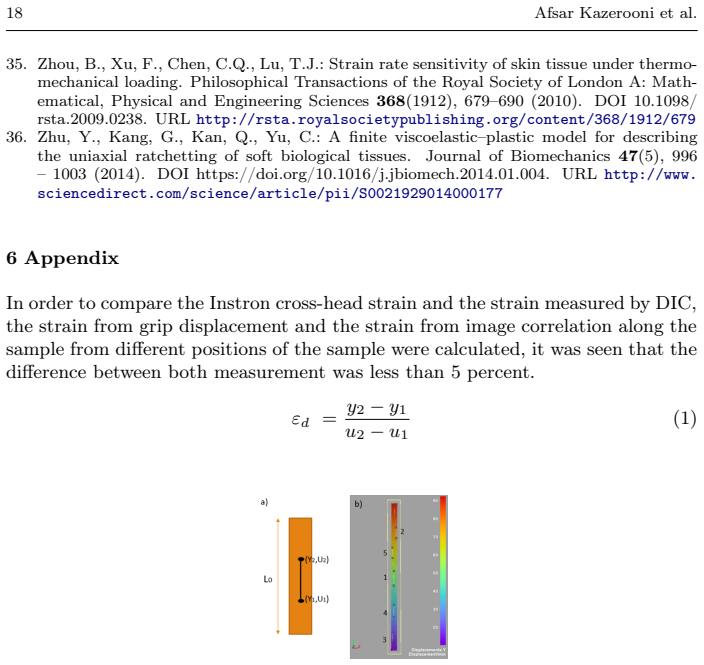
Run the same cyclic protocol while measuring local surface strain with digital image correlation on the 20 mm by 7 mm dog-bone specimens. If the local strain differs from the grip strain by more than the 5 percent margin reported for the larger validation samples, the reported stress-strain loops, hysteresis areas, and softening percentages would shift by a comparable amount.
Extended reading notes
Core claim
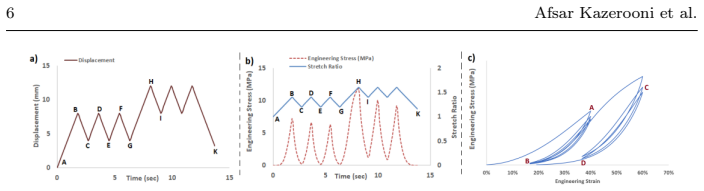
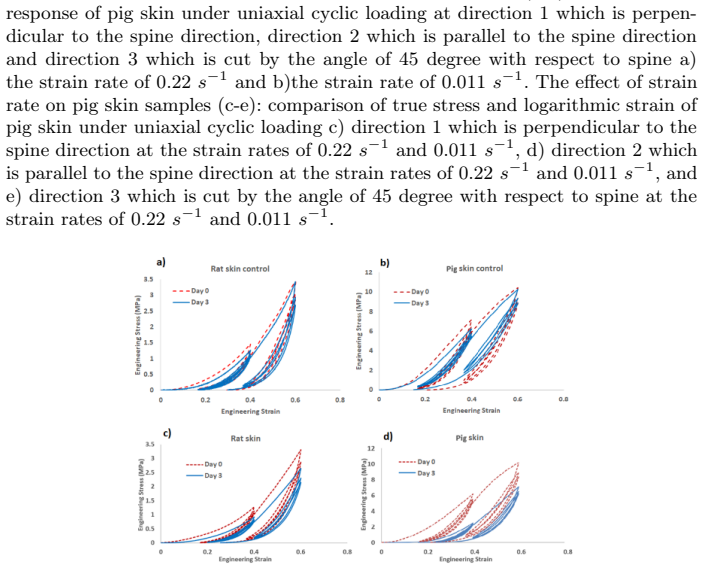
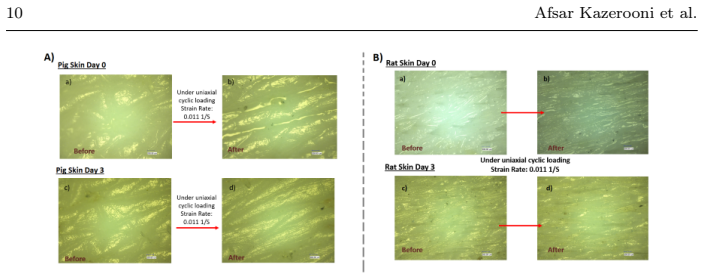
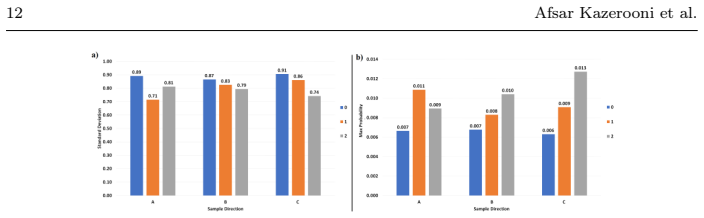
Under strain-controlled cyclic tension with partial unloading, both pig and rat skin display a pronounced Mullins effect: after the first extension the stress-strain path drops, reloading follows a new path close to but not identical with the unloading curve, and the original response is not recovered on the timescale studied. Softening is larger at higher strain rates and at larger maximum strains, while sample orientation relative to the spine changes stiffness more than it changes the amount of softening. Hysteresis, measured as dissipated energy per unit volume, persists even at strain rates slow enough that the tissue should relax, and specimens retain a permanent stretch after three days of unloading. Histology shows collagen fibers reorient toward the loading direction and stay oriented. From this evidence the paper concludes that skin's response is rate dependent but genuinely inelastic, so purely viscoelastic models cannot capture the first-cycle and partially unloaded response.
Load-bearing premise
The paper assumes that the strain calculated from the testing machine's grip displacement equals the true strain in the middle of each skin specimen, but that equality was checked only on larger, differently shaped samples than the ones used in the reported cyclic tests.
Editorial extensions
If this is right
- Purely viscoelastic models that recover fully after unloading cannot reproduce the first-cycle response or the reloading paths seen after partial unloading.
- Constitutive models of skin need internal state variables for permanent softening, fiber reorientation, and residual strain, not just a relaxation spectrum.
- The reloading path after partial unloading is close to the unloading curve but not identical, giving modelers an additional constraint from the internal-loop shape.
- Because softening depends more on strain rate than on orientation, experiments and models should report the full loading history and rate rather than only the preconditioned steady-state response.
Reading between the lines
- One consequence the paper leaves implicit is that preconditioning protocols, which are standard in soft-tissue testing, may be discarding the most clinically relevant part of the response: the first cycle of a fresh tissue.
- A clean test of the inelasticity claim would be to match loading and unloading rates exactly and make them arbitrarily slow; if the enclosed hysteresis area does not vanish, the residual dissipation cannot be viscous.
- If the same behavior appears under biaxial stretching, then models for skin grafting, wound closure, and surgical retraction should probably treat the virgin state as the reference state and track permanent set explicitly.
Signed reviews
Editorial analysis
A structured set of objections, weighed in public.
Referee Report
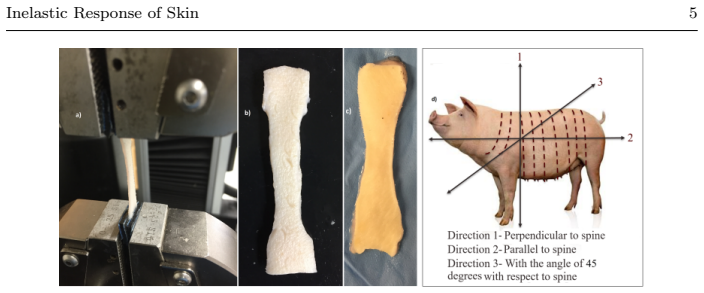
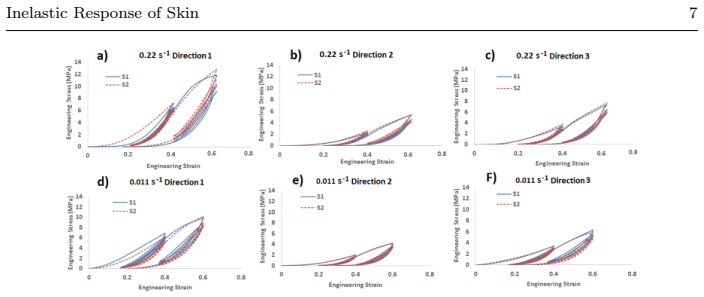
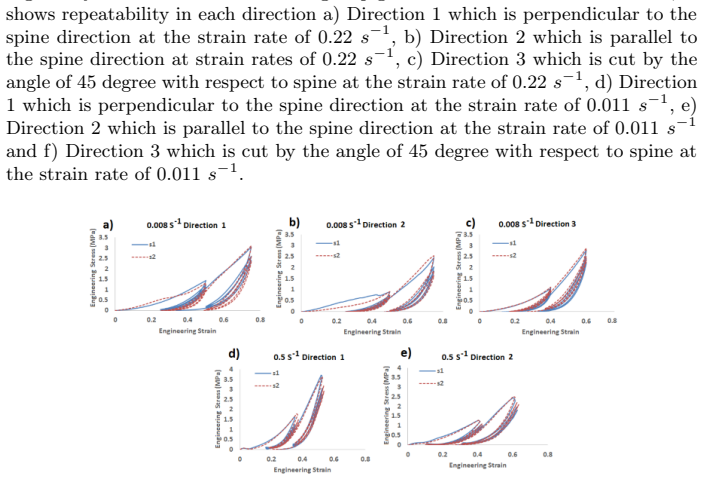
Summary. The paper reports uniaxial cyclic tension experiments on pig and rat skin at different strain rates (0.011 and 0.22 s^-1 for pig; 0.008 and 0.5 s^-1 for rat) and orientations relative to the spine, using strain-controlled partial loading/unloading protocols. The main observations are a large first-cycle softening and hysteresis reminiscent of the Mullins effect in filled rubbers, rate-dependent stress levels, anisotropic stiffening, persistent deformation after unloading that is only partially recovered after three days, and histology showing collagen fiber reorientation. The authors interpret the persistence of hysteresis at their lowest strain rates as evidence that skin is 'more inelastic than viscoelastic' and propose that purely viscoelastic models are insufficient.
Significance. If the central claim were established, the paper would provide useful experimental constraints for constitutive modeling of skin, particularly the need for internal state variables to capture permanent softening and fiber reorientation. The paper's strengths include testing virgin (unpreconditioned) tissue with partial unloading loops, documenting orientation and rate effects, and providing quantitative fiber-orientation histology. These data are potentially valuable to the biomechanics community. However, the paper's main interpretive conclusion - that hysteresis at low strain rates proves inelastic rather than viscoelastic behavior - is not supported by the data as presented, and the quantitative tables are compromised by missing statistics and unexplained negative values. The experimental data themselves may still be publishable if the claims are reframed or the analysis is strengthened.
major comments (3)
- [Section 4.2, Conclusions, Table 3] The central inference that persistent hysteresis at the lowest tested rates 'is a marker for inelasticity' is not supported by the data. At 0.008 s^-1 (rat) and 0.011 s^-1 (pig), reaching 60% strain takes about 75 s and 55 s, respectively. The authors themselves cite Eshel and Lanir (ref. 8) with a relaxation time on the order of hundreds of seconds. Thus the loading time is comparable to, not much larger than, the relaxation time, so a purely viscoelastic material would also exhibit substantial hysteresis under this protocol. To claim quasistatic conditions, the loading time should exceed the relaxation time by at least an order of magnitude, or the hysteresis loop area should be shown to approach a nonzero plateau as strain rate decreases. Table 3 instead shows rate-dependent dissipated energy (pig 60% strain: 0.30 MJ/m^3 at 0.011 s^-1 vs 0.18 MJ/m^3 at 0.22 s^-1), which is consistent with viscoelastic rate dependence. In addition, the negative 'dissipated energy' values for rat skin at 0.5 s^-1 (-0.05 to -1.39 MJ/m^3) are never explained; if the reloading curve lies below the unloading curve, the area is not a dissipated energy in the usual sense, and these entries undermine the quantitative basis of the table. The permanent set after three days is separate evidence of damage or inelasticity, but it does not establish that the cyclic hysteresis at the tested rates is inelastic rather than viscoelastic.
- [Section 2.2, Appendix (Fig. 11, Table 4)] The validation that crosshead displacement equals local tissue strain was performed on specimens of 54 mm length and 10.4 mm width under monotonic tension, not on the 20 mm by 7 mm dog-bone specimens used in the cyclic tests. The difference between DIC and crosshead strain was reported as less than 5 percent for those larger specimens, but this does not guarantee that the same holds for the smaller cyclic-test specimens, especially under cyclic loading with partial unloading. Since all reported stress-strain curves, hysteresis areas, and softening percentages are computed from crosshead displacement, a systematic difference would shift every quantitative result. Please provide DIC validation on the actual test geometry and loading protocol, or a quantitative argument for why the previous validation transfers.
- [Section 2.2, Figures 3-4, Tables 1-3] Only two samples were tested per condition, and no error bars, standard deviations, or statistical comparisons are reported. The statement that tests 'show a repeatable response within the margin of less than 8 percent' is asserted but not documented with per-sample curves or quantitative variability. This is a load-bearing issue for the quantitative claims, such as the 11% versus 15% softening differences at different strain rates and the dissipated-energy comparisons in Table 3. Please provide the individual replicate data or a statistical summary (e.g., mean plus or minus SD) for each condition, and state the number of samples used in each quantitative entry.
minor comments (6)
- [Throughout] There are numerous typographical errors, including 'uniaixal' for 'uniaxial', 'mullins' for 'Mullins', 'angel' for 'angle', 'hystereses' for 'hysteresis', and 'an rat skin sample' for 'a rat skin sample'. A careful proofreading pass is needed.
- [Introduction, reference [16]] Reference [16] is Lokshin and Lanir, but the text refers to 'Lanir et al. [16]' and contains a sentence fragment ('Lanir et al. [16]. Primarily focused on ...'). This should be corrected to refer to Lokshin and Lanir and edited into a complete sentence.
- [Figure 2(b) caption] The caption states that 'positions of the peak and valley coincide showing that, at this slow rate, there is no lag,' but the figure plots stress and strain versus time and it is not clear how 'coincide' is defined or why this demonstrates no lag. Please clarify.
- [Table 3] The units in the header ('M J/m3') should be typeset as 'MJ/m^3'. The negative entries for rat skin at 0.5 s^-1 should either be explained in the text or omitted, since a negative 'dissipated energy' requires clarification of the sign convention.
- [Section 4.1] The permanent stretch is reported as '3 mm' without reference to the initial gauge length; please report this as a residual strain percentage or with the specimen dimensions so it is meaningful.
- [Abstract] The phrase 'the skin response is rate dependent but inelastic' is confusing; 'rate-dependent and inelastic' or 'rate-dependent yet inelastic' would be clearer, since rate dependence and inelasticity are not mutually exclusive.
Circularity Check
No significant circularity: direct experimental observations drive the conclusions; self-citations are minor and non-load-bearing.
full rationale
The paper's central claims—Mullins-type softening, persistent hysteresis, rate dependence, permanent set, and fiber reorientation—are supported by direct measurements: force-displacement loops, hysteresis areas computed from measured stress-strain curves, day-0/day-3 retests on the same samples, and histology. No constitutive model is fitted to the data and no quantity is predicted from a fitted parameter; the claim that skin is 'more inelastic than viscoelastic' is an interpretation of measured loop areas and permanent deformation. The references to the authors' own work are (i) the companion modeling paper [13], described as under review/future work and used only to phrase a microstructural narrative ('These observations helped us to model the behavior of skin [13]'), and (ii) the general inelasticity criterion 'hysteresis still exists, which is a marker for inelasticity [31] and [27]'. Neither citation supplies the experimental result, and neither is fitted to, or derived from, the present data. The paper's genuinely weak point is scientific rather than circular: the slowest rates (0.008-0.011 s^-1) give loading times of 55-75 s to 60% strain, comparable to the cited tissue relaxation time of 'hundreds of seconds' [8], so the claim of quasistatic conditions is questionable. That is a validity concern, not a circularity.
Assumptions & free parameters
assumptions (5)
- domain assumption Grip displacement strain equals gauge-section strain within 5%.
- domain assumption Skin is nearly incompressible.
- domain assumption Relaxation time of rat dorsal skin is on the order of hundreds of seconds.
- domain assumption Cold storage at 0 C for 3 days does not alter the mechanical response except for prior cyclic loading.
- domain assumption The cyclic loading protocol does not tear the tissue.
Cite this review
Pith. "Pith review of Experimental Investigation of the Inelastic Response of Pig and Rat Skin under Uniaxial Cyclic Mechanical Loading." pith.science (2026). https://pith.science/paper/VB32ZMY6
@misc{pith2026190806572,
  author       = {Pith},
  title        = {Pith review of: Experimental Investigation of the Inelastic Response of Pig and Rat Skin under Uniaxial Cyclic Mechanical Loading},
  year         = {2026},
  howpublished = {\url{https://pith.science/paper/VB32ZMY6}},
  note         = {Machine review of arXiv:1908.06572}
}
read the original abstract
Skin is a highly non-linear, anisotropic, rate dependent inelastic, and nearly incompressible material which exhibits substantial hysteresis even under very slow (quasistatic) loading conditions. In this paper, a series of uniaxial cyclic loading tests of porcine and rat skin at different strain rates and with samples oriented in different directions (with respect to the spine) were conducted to study the effect of strain rate and samples orientations with respect to spine on mullins effect and skin inelastic response. A noteworthy feature of skin is that, similar to certain filled rubbers, its mechanical response shifts after the first extension and exhibits softening and hysteresis when loaded under cyclic tension and mullins effect is observed. The results of these strain-controlled cyclic loading tests also indicated that the extent of softening is different for different strain rates and orientations. Also a substantial hysteresis persists even at very low strain rates indicating inelastic behavior beyond the rate sensitive viscoelastic response. Through this series of experiments, by investigating the effect of strain rate on pig skin and rat skin, we conclude that the skin response is rate dependent but inelastic and shows irreversible changes in fiber orientation which are observed in histology results. Also, skin shows persistent deformation that is only partially recovered even after a long period of unloading.
Figures
Figures from the paper (8 more)



Reference graph
Works this paper leans on
-
[1]
Journal of the Mechanical Behavior of Biomedical Materials 5(1), 139 – 148 (2012)
Annaidh, A.N., Bruyère, K., Destrade, M., Gilchrist, M.D., Otténio, M.: Character- ization of the anisotropic mechanical properties of excised human skin. Journal of the Mechanical Behavior of Biomedical Materials 5(1), 139 – 148 (2012). DOI http: //doi.org/10.1016/j.jmbbm.2011.08.016. URL http://www.sciencedirect.com/science/ article/pii/S1751616111002219
-
[2]
Minimally Invasive Therapy & Allied Tech- nologies 9(5), 333–339 (2000)
Avis, N.J.: Virtual environment technologies. Minimally Invasive Therapy & Allied Tech- nologies 9(5), 333–339 (2000). DOI 10.3109/13645700009061455
-
[3]
Scientific reports8(1), 4947 (2018)
Benias, P.C., Wells, R.G., Sackey-Aboagye, B., Klavan, H., Reidy, J., Buonocore, D., Miranda, M., Kornacki, S., Wayne, M., Carr-Locke, D.L., et al.: Structure and distribution of an unrecognized interstitium in human tissues. Scientific reports8(1), 4947 (2018)
work page 2018
-
[4]
Berardesca, E., Elsner, P., Wilhelm, K.P., Maibach, H.I.: Bioengineering of the skin: meth- ods and instrumentation, vol. 3. CRC Press (1995)
work page 1995
-
[5]
British Journal of Dermatology89(4), 383–393 (1973)
Brown, I.A.: A scanning electron microscope study of the effects of uniaxial tension on human skin. British Journal of Dermatology89(4), 383–393 (1973)
work page 1973
-
[6]
European Polymer Journal 45(3), 601–612 (2009)
Diani, J., Fayolle, B., Gilormini, P.: A review on the mullins effect. European Polymer Journal 45(3), 601–612 (2009)
work page 2009
-
[7]
Journal of Surgical Research 54(1), 21 – 28 (1993)
Dombi, G.W., Haut, R.C., Sullivan, W.G.: Correlation of high-speed tensile strength with collagen content in control and lathyritic rat skin. Journal of Surgical Research 54(1), 21 – 28 (1993). DOI http://dx.doi.org/10.1006/jsre.1993.1004. URL http: //www.sciencedirect.com/science/article/pii/S0022480483710048
-
[8]
Annals of Biomedical Engineering 29(2), 164–172 (2001)
Eshel, H., Lanir, Y.: Effects of strain level and proteoglycan depletion on preconditioning and viscoelastic responses of rat dorsal skin. Annals of Biomedical Engineering 29(2), 164–172 (2001)
work page 2001
Show all 35 references
-
[9]
Springer Science & Business Media (2013)
Fung, Y.c.: Biomechanics: mechanical properties of living tissues. Springer Science & Business Media (2013)
2013
-
[10]
Journal of biomechanical engineering111(2), 136–140 (1989)
Haut, R.: The effects of orientation and location on the strength of dorsal rat skin in high and low speed tensile failure experiments. Journal of biomechanical engineering111(2), 136–140 (1989)
1989
-
[11]
Journal of Biomechanics 45(5), 762 – 771 (2012)
Hill, M.R., Duan, X., Gibson, G.A., Watkins, S., Robertson, A.M.: A theoretical and non- destructive experimental approach for direct inclusion of measured collagen orientation and recruitment into mechanical models of the artery wall. Journal of Biomechanics 45(5), 762 – 771 ...
2012 doi
-
[12]
Journal of the Mechanical Behavior of Biomedical Materials4(3), 498 – 506 (2011)
Kang, G., Wu, X.: Ratchetting of porcine skin under uniaxial cyclic loading. Journal of the Mechanical Behavior of Biomedical Materials4(3), 498 – 506 (2011). DOI http: //doi.org/10.1016/j.jmbbm.2010.12.015. URL http://www.sciencedirect.com/science/ article/pii/S1751616110001906
2011 doi
-
[13]
International Journal of Engineering Science (Under Review) Inelastic Response of Skin 17
Kazerooni, N.A., Srinivasa, A., Criscione, J.: Inelastic response of skin under uniaxial cyclic mechanical loading-multinetwork model comparison with experiments. International Journal of Engineering Science (Under Review) Inelastic Response of Skin 17
-
[14]
Biorheology 16(3), 191 (1979)
Lanir, Y.: The rheological behavior of the skin: experimental results and a structural model. Biorheology 16(3), 191 (1979)
1979
-
[15]
Journal of Biomechanics32(2), 183 – 188 (1999)
Liao, H., Belkoff, S.M.: A failure model for ligaments. Journal of Biomechanics32(2), 183 – 188 (1999). DOI https://doi.org/10.1016/S0021-9290(98)00169-9. URL http://www. sciencedirect.com/science/article/pii/S0021929098001699
1999 doi
-
[16]
Journal of biomechanical engineer- ing 131(3), 031009 (2009)
Lokshin, O., Lanir, Y.: Viscoelasticity and preconditioning of rat skin under uniaxial stretch: microstructural constitutive characterization. Journal of biomechanical engineer- ing 131(3), 031009 (2009)
2009
-
[17]
McGrath, J.A., Uitto, J.: Anatomy and Organization of Human Skin, chap. 3, pp. 1–53. Wiley-Blackwell (2010). DOI 10.1002/9781444317633.ch3. URLhttps://onlinelibrary. wiley.com/doi/abs/10.1002/9781444317633.ch3
2010 doi
-
[19]
Rubber Chemistry and Technology 21(2), 281–300 (1948)
Mullins, L.: Effect of stretching on the properties of rubber. Rubber Chemistry and Technology 21(2), 281–300 (1948). DOI 10.5254/1.3546914. URLhttps://doi.org/10. 5254/1.3546914
1948 doi
-
[20]
RubberChemistryandTechnology 22(4), 1036–1044 (1949)
Mullins,L.:Permanentsetinvulcanizedrubber. RubberChemistryandTechnology 22(4), 1036–1044 (1949). DOI 10.5254/1.3543010. URLhttp://dx.doi.org/10.5254/1.3543010
1949 doi
-
[21]
Journal of Biomechanics41(1), 93 – 99 (2008)
Muñoz, M., Bea, J., Rodríguez, J., Ochoa, I., Grasa, J., del Palomar, A.P., Zaragoza, P., Osta, R., Doblaré, M.: An experimental study of the mouse skin behaviour: Damage and inelastic aspects. Journal of Biomechanics41(1), 93 – 99 (2008). DOI http://doi.org/ 10.1016/j.jbiomec...
2008 doi
-
[22]
Nava, A., Mazza, E., Haefner, O., Bajka, M.: Experimental observation and modelling of preconditioning in soft biological tissues. In: S. Cotin, D. Metaxas (eds.) Medical Simulation, pp. 1–8. Springer Berlin Heidelberg, Berlin, Heidelberg (2004)
2004
-
[23]
Maturitas 69(3), 249 – 256 (2011)
Naylor, E.C., Watson, R.E., Sherratt, M.J.: Molecular aspects of skin ageing. Maturitas 69(3), 249 – 256 (2011). DOI http://dx.doi.org/10.1016/j.maturitas.2011.04.011. URL http://www.sciencedirect.com/science/article/pii/S0378512211001496
2011 doi
-
[24]
Journal of biomechanics 11(4), 203207–205 (1978)
North, J.F., Gibson, F.: Volume compressibility of human abdominal skin. Journal of biomechanics 11(4), 203207–205 (1978)
1978
-
[25]
Journal of the Mechanical Behavior of Biomedical Materials41, 241 – 250 (2015)
Ottenio, M., Tran, D., Annaidh, A.N., Gilchrist, M.D., Bruyère, K.: Strain rate and anisotropy effects on the tensile failure characteristics of human skin. Journal of the Mechanical Behavior of Biomedical Materials41, 241 – 250 (2015). DOI http://doi.org/ 10.1016/j.jmbbm.2014....
2015 doi
-
[26]
Journal of Biomechanics 21(3), 213 – 218 (1988)
Oxlund, H., Manschot, J., Viidik, A.: The role of elastin in the mechanical properties of skin. Journal of Biomechanics 21(3), 213 – 218 (1988). DOI http://dx.doi.org/ 10.1016/0021-9290(88)90172-8. URL http://www.sciencedirect.com/science/article/ pii/0021929088901728
1988
-
[27]
Zeitschrift für ange- wandte Mathematik und Physik67(4), 86 (2016)
Rajagopal, K.R., Srinivasa, A.R.: An implicit three-dimensional model for describing the inelastic response of solids undergoing finite deformation. Zeitschrift für ange- wandte Mathematik und Physik67(4), 86 (2016). DOI 10.1007/s00033-016-0671-x. URL http://dx.doi.org/10.1007/...
2016 doi
-
[28]
Cold Spring Harbor perspectives in biology3(1), a004978 (2011)
Ricard-Blum, S.: The collagen family. Cold Spring Harbor perspectives in biology3(1), a004978 (2011)
2011
-
[29]
Bmj319(7220), 1305 (1999)
Satava, R.M., et al.: Virtual reality in medicine. Bmj319(7220), 1305 (1999)
1999
-
[30]
Journal of Biomedical Materials Research Part A80(1), 194–205 (2007)
Sellaro, T.L., Hildebrand, D., Lu, Q., Vyavahare, N., Scott, M., Sacks, M.S.: Effects of collagen fiber orientation on the response of biologically derived soft tissue biomaterials to cyclic loading. Journal of Biomedical Materials Research Part A80(1), 194–205 (2007)
2007
-
[31]
Srinivasa, A.R., Srinivasan, S.M.: Inelasticity of materials: an engineering approach and a practical guide, vol. 80. World Scientific Publishing Company (2009)
2009
-
[32]
Lea & Febiger (1990)
Swaim, S.F., Henderson, R.A., Pidgeon, R.S., et al.: Small animal wound management. Lea & Febiger (1990)
1990
-
[33]
Xu, F., Lu, T.: Skin Mechanical Behaviour, chap. 5, pp. 87–104. Springer Berlin Hei- delberg, Berlin, Heidelberg (2011). DOI 10.1007/978-3-642-13202-5_5. URL https: //doi.org/10.1007/978-3-642-13202-5_5
2011 doi
-
[34]
Journal of the Mechanics and Physics of Solids56(5), 1852 – 1884 (2008)
Xu, F., Lu, T., Seffen, K.: Biothermomechanics of skin tissues. Journal of the Mechanics and Physics of Solids56(5), 1852 – 1884 (2008). DOI https://doi.org/10.1016/j.jmps.2007. 11.011. URL http://www.sciencedirect.com/science/article/pii/S002250960700227X 18 Afsar Kazerooni et al
2008 doi
-
[35]
Philosophical Transactions of the Royal Society of London A: Math- ematical, Physical and Engineering Sciences368(1912), 679–690 (2010)
Zhou, B., Xu, F., Chen, C.Q., Lu, T.J.: Strain rate sensitivity of skin tissue under thermo- mechanical loading. Philosophical Transactions of the Royal Society of London A: Math- ematical, Physical and Engineering Sciences368(1912), 679–690 (2010). DOI 10.1098/ rsta.2009.0238...
1912
-
[36]
Journal of Biomechanics 47(5), 996 – 1003 (2014)
Zhu, Y., Kang, G., Kan, Q., Yu, C.: A finite viscoelastic–plastic model for describing the uniaxial ratchetting of soft biological tissues. Journal of Biomechanics 47(5), 996 – 1003 (2014). DOI https://doi.org/10.1016/j.jbiomech.2014.01.004. URLhttp://www. sciencedirect.com/sci...
2014 doi
Reviewed August 14, 2026 · model on record in the stance chip above.
Discussion (0). Continue with ORCID to comment.