REVIEW 1 major objections 4 minor 43 references
Totally positive skew-symmetric matrices
T0 review · 1 major / 4 minor · reviewed 2026-08-11 · deepseek-v4-flash
Pith's one-line read Total positivity of a real skew-symmetric matrix is exactly equivalent to positivity of $n(n-1)/2$ particular signed minors, and this is the fewest inequalities any such test can use.
desk verdict A real, carefully proved positivity criterion for skew-symmetric matrices, with one under-supported minimality claim that should be fixed before publication. read the letter →
The pith
A machine-rendered reading of the paper's core claim, the machinery that carries it, and where it could break.
The reading
What carries the argument
The load-bearing object is the family of signed minors $M_{j,k}$, each a left-justified minor of the skew-symmetric matrix up to the sign $(-1)^{jk}$. The argument's engine is the Lindström-Gessel-Viennot diagram attached to a fixed reduced expression of the longest Weyl-group element: it turns each $M_{j,k}$ into the weight of a unique non-intersecting path collection, hence a signed monomial in the Marsh-Rietsch parameters, with exponent vectors forming a triangular system that lets the sign of $t_{\#(j,k)}$ be isolated from earlier minors. For the Pfaffian sign pattern, the machinery is the half-spin representation, where each Pfaffian appears, up to positive constants, as a generalized minor, so Lusztig positivity forces the intrinsic sign.
What would settle it
For $n=4$, compute the six minors $M_{j,k}$ from Definition 1.2 for a matrix $A(t_1,\dots,t_6)$ whose parameters in the fixed reduced expression (11) are chosen with mixed signs; if all six minors are positive while some $t_i$ is negative, Theorem 1.4 is false. The same check can be run for larger $n$ by searching the real parameter space with signed parameters.
Extended reading notes
Core claim
On the paper's own terms, the central discovery is that total positivity of $A \in S_n$ is equivalent to positivity of the $N = n(n-1)/2$ signed minors $M_{j,k}(A)$ for $1 \leq j \leq k \leq n-1$, where $M_{j,k}$ is the signed minor with rows $\{1,\dots,n-j\}$ and columns $\{1,\dots,n-k-1,n-k+j,\dots,n\}$, multiplied by $(-1)^{jk}$. The proof runs through the Marsh-Rietsch parametrization of the totally positive orthogonal Grassmannian: each $M_{j,k}$ is a signed monomial in the parameters $t_1,\dots,t_N$, and the signs of the parameters can be recovered one by one from the signs of the minors in reverse lexicographic order. The theorem also states that $N$ inequalities are the fewest possible for any regular-function positivity test. Beyond this, the paper shows that Pfaffians of a totally positive skew-symmetric matrix have the fixed sign pattern $\operatorname{sgn}(I,[n]) = (-1)^{\sum_{i \in I} i - \binom{|I|+1}{2}}$, and that the totally nonnegative part decomposes into positive Richardson cells whose identity can be read from the matroid of $[\mathrm{Id}_n \mid A]$.
Load-bearing premise
The proof that positivity of all the selected minors forces total positivity rests on the claim that each $M_{j,k}$ is, up to sign, a monomial in the Marsh-Rietsch parameters and that the sign of each newly introduced parameter can be separated from the signs of earlier minors in reverse lexicographic order; if that triangular structure or the sign cancellation failed, the criterion could stop being sufficient.
Editorial extensions
If this is right
- Total positivity of skew-symmetric matrices is certified by exactly $N = n(n-1)/2$ explicit polynomial inequalities, and no regular-function test can use fewer.
- The selected minors alone cannot detect total nonnegativity, but perturbing a matrix by a totally positive one-parameter family into $SO_{>0}(2n)$ and reading leading Taylor coefficients of the same minors gives a nonnegativity test.
- Every totally positive skew-symmetric matrix has Pfaffians with the explicit sign $\operatorname{sgn}(I,[n])$; conversely, Pfaffian-positivity is strictly weaker and holds for matrices that are not totally nonnegative.
- The totally nonnegative part $S_{\geq 0}^n$ is a disjoint union of positive Richardson cells, and the cell containing a matrix $A$ is determined by the matroid of $[\mathrm{Id}_n \mid A]$ through a lowering algorithm.
- Because the parameter signs are Laurent monomials in the minors, the sign pattern of all $M_{j,k}$ completely determines $A$ among matrices with all $M_{j,k}$ nonzero.
Reading between the lines
- One could turn the criterion into a practical certification routine: evaluate the $n(n-1)/2$ signed minors exactly or with interval arithmetic to certify total positivity without checking any other minor.
- The triangular monomial structure suggests that the minors $M_{j,k}$ may form a cluster in some signed cluster structure on the orthogonal Grassmannian; the paper raises this possibility but does not prove it.
- The strict inclusion $S_{\geq 0}^n \subset SPf_{\geq 0}^n$ points to a separate hierarchy of positivity cones for skew-symmetric matrices; analyzing the cell structure of the Pfaffian-positive cone would need tools beyond Weyl-group combinatorics.
- A natural testable extension is to use the matroid-lowering algorithm to enumerate the Richardson cells for small $n$ and compare the resulting stratification with a direct sampling of random skew-symmetric matrices.
Editorial analysis
A structured set of objections, weighed in public.
Referee Report
Summary. The paper studies the space S_n of real skew-symmetric n×n matrices as an affine chart of the orthogonal Grassmannian OGr(n,2n). Total positivity is defined through Lusztig's positive part, using the Marsh–Rietsch parametrization relative to a fixed reduced expression. The central result, Theorem 1.4, asserts that A∈S_n is totally positive if and only if the N=n(n−1)/2 signed minors M_{j,k}(A) of Definition 1.2 are all positive, and that this test is minimal in the number of inequalities used. The proof is built from a monomial analysis in the LGV diagram: Lemma 3.4 shows the M_{j,k} are monomials in the Marsh–Rietsch parameters and that the parameters can be recovered in reverse lexicographic order, Lemma 3.7 handles the signs, and Lemma 3.8 uses a density argument to extend the recovery from the parametrized set to all matrices with nonzero M_{j,k}. The paper also proves a nonnegativity test via limits of totally positive deformations (Theorem 1.5), a matroid-based determination of the Richardson cell containing a given point (Theorem 1.6 and Theorem 4.25), and a fixed sign pattern for Pfaffians (Theorem 1.7).
Significance. If it stands, the main equivalence gives an explicit and practical positivity criterion: total positivity of a skew-symmetric matrix is checked by N honest minor inequalities, exactly mirroring the classical type-A picture. The monomial/triangularity analysis in Lemmas 3.4 and 3.7 is detailed and internally consistent, and I found no gap in the central derivation. The matroid-based cell identification of Theorem 4.25 is a further genuine contribution toward orthogonal positroids, and the Pfaffian sign theorem is elegant. The manuscript also ships Macaulay2 code backing the examples, which is a reproducible-checking strength. The main weakness is the minimality assertion in Theorem 1.4: the lower bound on which it rests is stated without proof or reference, so the advertised minimality is not established, although the 'if and only if' criterion itself appears sound.
major comments (1)
- [Theorem 1.4 (second sentence), proof at end of Section 3] The minimality assertion is not proved. The proof reduces any positivity test by regular functions to r polynomial inequalities cutting out the positive orthant (R_{>0})^N, and then invokes the statement that the orthant in R^N cannot be cut out by fewer than N polynomial inequalities. No proof or citation is supplied. This lower bound is nontrivial: the case r=1 can be handled by showing a polynomial positive on the orthant and nonpositive on its complement must vanish on every coordinate hyperplane, but the general case requires a genuine argument, and the scope of the claim should be stated explicitly (e.g., 'among tests that are conjunctions of strict inequalities by regular functions'). Without a proof or reference, the second sentence of Theorem 1.4 is unsupported, even though the first sentence—the positivity criterion itself—is unaffected. The theorem statement, the abstract, and the introduction advertise the test as minimal, so this is a load-bearing point that needs to be fixed.
minor comments (4)
- [Proposition 4.27] The statement as printed is incomplete: the displayed union is over v∈W_{[n−1]} only, and the symbol w is not introduced. It should be a union over all minimal coset representatives w and all v≤w, consistent with equation (4). This is likely a typographical omission, but it should be corrected.
- [Lemma 3.8] The rational map φ from U to V is defined by 'determining the t_i as described in the proof of Lemma 3.4', but Lemma 3.4 is stated and proved for points already in the parametrized set V. The intended argument is valid: one first uses the Laurent-monomial formulas to define a rational map on U, observes that it restricts to the identity on V, and then uses density to conclude. Making this two-step definition explicit would improve readability and remove a perceived circularity.
- [Conventions around Definition 1.2] The notation M_{j,k} is used both for the signed minors and, inside the proof of Lemma 3.4, for the left-greedy monomial minor; the unsigned variant is introduced but the switch is easy to miss. A brief note near the start of Section 3 would help.
- [Theorem 1.5] The theorem states the equivalence for any smooth one-parameter family Z(ε) in SO_{>0}(2n) tending to the identity, and then adds that Z(ε) can be chosen so that the minors M_{j,k}(B(ε)) are polynomials in ε. The proof is clear, but the hypothesis that the family be smooth enough to possess Taylor expansions should be stated up front, since condition (3) is phrased in terms of leading coefficients.
Circularity Check
No circularity: Theorem 1.4 is a proved coordinate-change equivalence; cited self-work is not load-bearing.
full rationale
The central derivation of Theorem 1.4 is self-contained in the relevant sense: total positivity is defined through the Marsh-Rietsch parametrization (Definition 2.2 and equation (13)), and the criterion M_{j,k}(A)>0 is proved rather than assumed. Lemma 3.4 shows that each M_{j,k} is a monomial in the parameters t_i and that the sign of each t_i can be recovered from the signs of the M_{j,k} by reverse induction; Lemma 3.7 computes the monomial signs; Lemma 3.8 uses Zariski density to show that the M_{j,k} determine the matrix. Neither quantity is defined as the other, so the equivalence is a coordinate-change theorem rather than an identity. The parametrization [35, Theorem 11.3] and the positivity projection results [32,33] are external to this paper's authors; self-citations to [9] (an LGV corollary) and [10] (Macaulay2 code) support exposition and computation and are not load-bearing for the main equivalence. The only flagged weakness is non-circular: the minimality sentence in Theorem 1.4 rests on the asserted fact that (R_{>0})^N cannot be cut out by fewer than N polynomial inequalities, stated without proof at the end of Section 3; this is an unsupported lower-bound claim, not a reduction of the criterion to its inputs.
Assumptions & free parameters
assumptions (8)
- standard math Definition and properties of the totally positive part of a reductive group and its flag varieties in the sense of Lusztig, including projection from complete flags to partial flags.
- standard math Marsh-Rietsch parametrization of the totally positive complete flag variety and of its Deodhar components, Theorem 11.3 and Section 5 of [35].
- standard math Lindström-Gessel-Viennot lemma as applied to concatenations of directed weighted graphs, Corollary 2.21 of [9] and also [21,31].
- standard math Semigroup property: for Z in SO>0(2n) and X in OGr≥0(n,2n), X·Z is in OGr>0(n,2n), citing [32, Proposition 8.17] and [33, Theorem 3.4].
- standard math Expression of minors of a skew-symmetric matrix in terms of its Pfaffians, from [14, Theorem 1].
- standard math Every rank-k matroid has a unique Gale-maximal basis with respect to any total order on the ground set, [19, Theorem 4].
- standard math The Richardson/Deodhar decomposition of the totally nonnegative part of a flag variety, with positive Richardson cells indexed by pairs (v,w) in Bruhat order, [28,35].
- ad hoc to paper The positive orthant (R>0)^N cannot be defined by fewer than N polynomial inequalities.
Cite this review
Pith. "Pith review of Totally positive skew-symmetric matrices." pith.science (2026). https://pith.science/paper/VBFZ6S7J
@misc{pith2026241217233,
  author       = {Pith},
  title        = {Pith review of: Totally positive skew-symmetric matrices},
  year         = {2026},
  howpublished = {\url{https://pith.science/paper/VBFZ6S7J}},
  note         = {Machine review of arXiv:2412.17233}
}
abstract
A matrix is totally positive if all of its minors are positive. This notion of positivity coincides with the type A version of Lusztig's more general total positivity in reductive real-split algebraic groups. Since skew-symmetric matrices always have nonpositive entries, they are not totally positive in the classical sense. The space of skew-symmetric matrices is an affine chart of the orthogonal Grassmannian $\mathrm{OGr}(n,2n)$. Thus, we define a skew-symmetric matrix to be totally positive if it lies in the totally positive orthogonal Grassmannian. We provide a positivity criterion for these matrices in terms of a fixed collection of minors, and show that their Pfaffians have a remarkable sign pattern. The totally positive orthogonal Grassmannian is a CW cell complex and is subdivided into Richardson cells. We introduce a method to determine which cell a given point belongs to in terms of its associated matroid.
Figures


Figures from the paper (2 more)

Reference graph
Works this paper leans on
-
[9]
Matroids over partial hyperstructures
Baker, M., and Bowler, N. Matroids over partial hyperstructures. Adv. Math. 343 (2019), 821–863
work page 2019
-
[10]
Mathrepo code repository for totally pos- itive skew symmetric matrices
Boretsky, J., Calvo Cortes, V., and El Maazouz, Y. Mathrepo code repository for totally pos- itive skew symmetric matrices. Available at https://mathrepo.mis.mpg.de/PositiveSkewMatrices
-
[1]
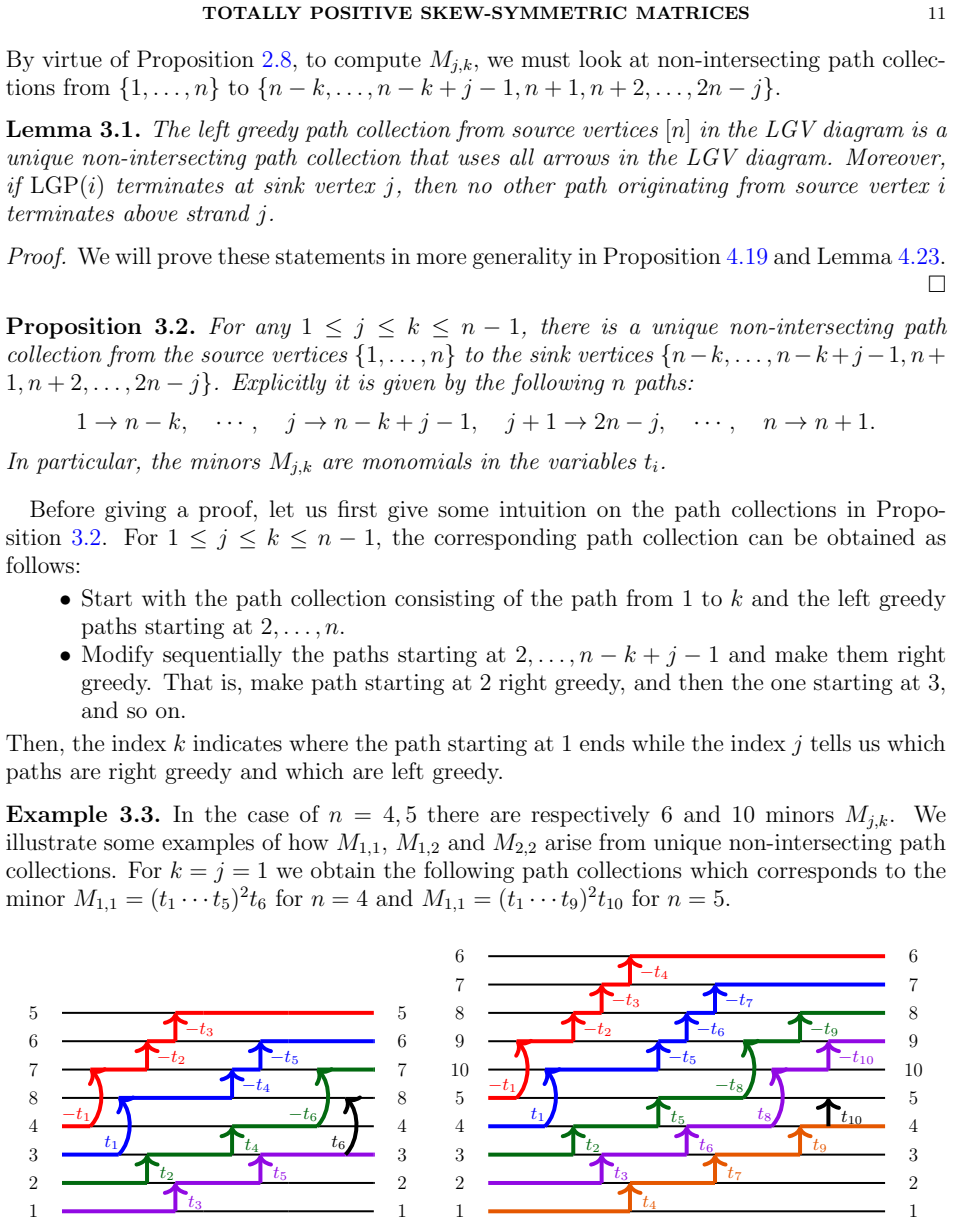
By Lemma 3.1, the left greedy path collection originating from [ n] unique and uses all arrows in the LGV diagram, so M = (t1 · · · tN )2. For k = 1, j = 1, the unique path collection ( n − 1, 2n − 1, . . . , n+ 1) is almost identical to the left greedy path collection originating from [ n], only the path originating at 1 is modified. Recall from the proof...
-
[2]
Positive geometries and canonical forms
Arkani-Hamed, N., Bai, Y., and Lam, T. Positive geometries and canonical forms. J. High Energy Phys. 2017 , 11 (2017), 039, front matter+121
work page 2017
-
[3]
and ( 4). The paths in this path collection are all left greedy, proving ( 3). We next show that for k ∈ [n−1] the path originating from source vertex k terminates below the path originating from source vertex k +1. The only place where this might break is if the left greedy paths pa ths in the truncation of Gu,w in (i) originating at k and k + 1 terminat...
-
[4]
Each path is directed from i to w−1(i) for some i ∈ [n]
is satisfied as well. Each path is directed from i to w−1(i) for some i ∈ [n]. Since w ∈ W [n−1], by Remark 4.16, w−1(1) ≺ · · · ≺ w−1(n), proving (2). In this base case, ( 1) does not assert anything. Finally, the next lemma implies it is a unique path collection. Lemma 4.20. Suppose Gv,w has all vertical edges pointing upwards. Let P be a non- intersecti...
-
[5]
Positively oriented matroids are realizable
Ardila, F., Rinc ´on, F., and Williams, L. Positively oriented matroids are realizable. J. Eur. Math. Soc. (JEMS) 19 , 3 (2017), 815–833
work page 2017
-
[6]
On two notions of total positivity for generalized partial flag varieties of classical Lie types
Barkley, G., Boretsky, J., Eur, C., and Gao, J. On two notions of total positivity for generalized partial flag varieties of classical lie types. arxiv:2410.11804 (2024)
work page Pith review arXiv 2024
Show all 43 references
-
[7]
Grassmannian geometry of scattering amplitudes
Arkani-Hamed, N., Bourjaily, J., Cachazo, F., Goncharov, A ., Postnikov, A., and Trnka, J. Grassmannian geometry of scattering amplitudes . Cambridge: Cambridge University Press, 2016
2016
-
[8]
The amplituhedron
Arkani-Hamed, N., and Trnka, J. The amplituhedron. Journal of High Energy Physics 2014 , 10 (2014), 30
2014
-
[11]
Cluster algebras
Berenstein, A., Fomin, S., and Zelevinsky, A. Cluster algebras. III. Upper bounds and double Bruhat cells. Duke Math. J. 126 , 1 (2005), 1–52
2005
-
[12]
M., and Karp, S
Bloch, A. M., and Karp, S. N. On two notions of total positivity for partial flag varieties. Adv. Math. 414 (2023), Paper No. 108855, 24
2023
-
[13]
Totally nonnegative tropical flags and the totally nonnegative flag d ressian, 2022
Boretsky, J. Totally nonnegative tropical flags and the totally nonnegative flag d ressian, 2022
2022
-
[14]
W., Veliche, O., and Weyman, J
Christensen, L. W., Veliche, O., and Weyman, J. Minors of a skew symmetric matrix: a combi- natorial approach. Electron. J. Linear Algebra 36 (2020), 658–663
2020
-
[15]
Cluster structures on spinor helicity and momentum twistor varietie s
Bossinger, L., and Li, J.-R. Cluster structures on spinor helicity and momentum twistor varietie s. arXiv:2408.14956 (2024)
2024 arXiv
-
[16]
Total positivity criteria for partial flag varieties
Chevalier, N. Total positivity criteria for partial flag varieties. J. Algebra 348 (2011), 402–415
2011
-
[17]
Collected works
Chevalley, C. Collected works. Vol. 2: The algebraic theory of spinors and Clifford algebras. Edited and with a foreword by Pierre Cartier and Catherine Chevalle y. With a postface by J.-P. Bourguignon . Berlin: Springer, 1997
1997
-
[18]
Ising model and the positive orthogonal Grassmannian
Galashin, P., and Pylyavskyy, P. Ising model and the positive orthogonal Grassmannian. Duke Math. J. 169 , 10 (2020), 1877–1942. 38 J. BORETSKY, V. CAL VO CORTES, AND Y. EL MAAZOUZ
2020
-
[19]
Deodhar, V. V. On some geometric aspects of Bruhat orderings. I. A finer decomp osition of Bruhat cells. Invent. Math. 79 , 3 (1985), 499–511
1985
-
[20]
A cluster of results on amplituhedron tiles
Even-Zohar, C., Lakrec, T., Parisi, M., Sherman-Bennett, M ., Tessler, R., and Williams, L. A cluster of results on amplituhedron tiles. Lett. Math. Phys. 114 , 5 (2024), Paper No. 111, 48
2024
-
[21]
The vector space S can be endowed with an action of the spin group Spin(2 n)
appears in [ 34, Section 2.3] up to a sign and constant incon- sistency, which is not relevant for their purposes. The vector space S can be endowed with an action of the spin group Spin(2 n). This is the half-spin representation. It is an irreducible representation c orrespon...
-
[22]
N., and Lam, T
Galashin, P., Karp, S. N., and Lam, T. The totally nonnegative Grassmannian is a ball. Adv. Math. 397 (2022), 23. Id/No 108123
2022
-
[23]
Optimal assignments in an ordered set: An application of matroid the ory
Gale, D. Optimal assignments in an ordered set: An application of matroid the ory. J. Combinatorial Theory 4 (1968), 176–180
1968
-
[24]
Partial flag varieties and preprojective algebras
Geiß, C., Leclerc, B., and Schr ¨oer, J. Partial flag varieties and preprojective algebras. Annales de l’Institut Fourier 58 , 3 (2008), 825–876
2008
-
[25]
Determinants, paths, and plane partitions
Gessel, I., and Viennot, X. Determinants, paths, and plane partitions. Preprint (1989)
1989
-
[26]
R., and Stillman, M
Grayson, D. R., and Stillman, M. E. Macaulay2, a software system for research in algebraic geometry. Available at http://www2.macaulay2.com
-
[27]
Lie groups, Lie algebras, and representations , second ed., vol
Hall, B. Lie groups, Lie algebras, and representations , second ed., vol. 222 of Graduate Texts in Mathematics. Springer, Cham, 2015. An elementary introduction
2015
-
[28]
ABJM amplitudes and the positive orthogonal grassmannian
Huang, Y.-t., and Wen, C. ABJM amplitudes and the positive orthogonal grassmannian. Journal of High Energy Physics 2014 , 2 (2014), 104
2014
-
[29]
Humphreys, J. E. Introduction to Lie algebras and representation theory. 3r d printing, rev , vol. 9 of Grad. Texts Math. Springer, Cham, 1980
1980
-
[30]
Humphreys, J. E. Reflection groups and Coxeter groups , vol. 29 of Cambridge Studies in Advanced Mathematics. Cambridge University Press, Cambridge, 1990
1990
-
[31]
Positroid Stratification of Orthogonal Grassmannian and ABJM Amp litudes
Kim, J., and Lee, S. Positroid Stratification of Orthogonal Grassmannian and ABJM Amp litudes. JHEP 09 (2014), 085
2014
-
[32]
The deodhar decomposition of the grassmannian and the regularity of KP solitons
Kodama, Y., and Williams, L. The deodhar decomposition of the grassmannian and the regularity of KP solitons. Advances in Mathematics 244 (2013), 979–1032
2013
-
[33]
Total positivity for cominuscule Grassmannians
Lam, T., and Williams, L. Total positivity for cominuscule Grassmannians. New York J. Math. 14 (2008), 53–99
2008
-
[34]
Lawson, H. B. j., and Michelsohn, M.-L. Spin geometry, vol. 38 of Princeton Math. Ser. Princeton, NJ: Princeton University Press, 1989
1989
-
[35]
On the vector representations of induced matroids
Lindstr¨om, B. On the vector representations of induced matroids. Bull. London Math. Soc. 5 (1973), 85–90
1973
-
[36]
Total positivity in reductive groups
Lusztig, G. Total positivity in reductive groups. In Lie theory and geometry , vol. 123 of Progr. Math. Birkh¨ auser Boston, Boston, MA, 1994, pp. 531–568
1994
-
[37]
Total positivity in partial flag manifolds
Lusztig, G. Total positivity in partial flag manifolds. Represent. Theory 2 (1998), 70–78
1998
-
[38]
On spinor varieties and their secants
Manivel, L. On spinor varieties and their secants. SIGMA Symmetry Integrability Geom. Methods Appl. 5 (2009), Paper 078, 22
2009
-
[39]
J., and Rietsch, K
Marsh, R. J., and Rietsch, K. Parametrizations of flag varieties. Represent. Theory 8 (2004), 212– 242
2004
-
[40]
Total positivity, grassmannians, and networks
Postnikov, A. Total positivity, grassmannians, and networks. arXiv:0609764 (2006)
2006
-
[41]
Lie groups: An approach through invariants and representat ions
Procesi, C. Lie groups: An approach through invariants and representat ions. Universitext. Springer, New York, 2007
2007
-
[42]
Speyer, D., and Williams, L. K. The positive Dressian equals the positive tropical Grassmannian. Trans. Amer. Math. Soc. Ser. B 8 (2021), 330–353
2021
-
[43]
Williams, L. K. The positive Grassmannian, the amplituhedron, and cluster algebra s. In ICM— International Congress of Mathematicians. Vol. 6. Section s 12–14 . EMS Press, Berlin, [2023] ©2023, pp. 4710–4737. Jonathan Boretsky (MPI MiS) Email address : jonathan.boretsky@mis.mp...
2023
Reviewed August 11, 2026 · model on record in the stance chip above.
Discussion (0). Continue with ORCID to comment.