REVIEW 4 major objections 9 minor 3 cited by
WiLLM: an Open Framework for LLM Services over Wireless Systems
T0 review · 4 major / 9 minor · reviewed 2026-08-15 · deepseek-v4-flash
Pith's one-line read LLM services over wireless are not just heavier DNN traffic: WiLLM's 5G testbed and 1.6 million measurements make the differences visible.
desk verdict A genuinely useful open wireless-LLM testbed and dataset, wrapped in an overclaimed 'fundamental differences' narrative that needs a same-testbed DNN baseline. read the letter →
The pith
A machine-rendered reading of the paper's core claim, the machinery that carries it, and where it could break.
The reading
What carries the argument
The load-bearing object is WiLLM itself, a working end-to-end wireless testbed built by extending an open-source 5G protocol stack with GPU inference placed in the core network. Three named mechanisms carry the design: the Tree-Branch-Fruit slicing hierarchy (shared radio 'tree,' standard 5G slice 'branches,' and LLM-specific 'fruit' slices), application-layer tunneling that lets ordinary devices reach slice resources without protocol changes, and dual-mode scheduling that can act inside the scheduler or through an external optimization engine. The empirical case rests on an NTP-synchronized measurement pipeline that records 58 synchronized metrics across UE, radio access, and core/edge layers, yielding the 1,649,996-record dataset used to derive the three insights.
What would settle it
Run the same smart-glasses scenario on the same testbed with a conventional DNN task (for example, image classification or object detection) using matched image sizes and response sizes, then compare latency-component shares, slice-induced bottleneck movement, and byte-transmission burstiness. If the conventional workload reproduces the same asymmetry, migration, and burstiness, the paper's three fundamental distinctions are not LLM-specific.
Extended reading notes
Core claim
The paper's central claim is that LLM services differ from traditional DNN applications in three fundamental ways: bidirectional heavy-load asymmetry, computation–communication coupling in slicing, and token-stream unpredictability. The evidence shows inference accounting for 74–87% of latency in uplink-heavy image requests and network transmission for 81–86% of latency in downlink-heavy image generation; slice-resource increases moving the dominant latency component from inference to transmission; and byte transmission varying non-linearly with controlled physical-resource-block allocation. These observations are presented as intrinsic to generative multimodal LLMs, not as artifacts of the testbed. On that basis, the paper proposes WiLLM, an open platform whose Tree-Branch-Fruit slicing, application-layer tunneling, dual-mode scheduling, and cross-layer APIs let non-experts test LLM-aware scheduling and slicing, backed by 1,649,996 synchronized records across 58 metrics.
Load-bearing premise
The three claimed LLM-specific properties are inferred from a single testbed configuration, with one base station, two model families, and no side-by-side measurement of a conventional DNN workload under the same conditions.
Editorial extensions
If this is right
- Schedulers should become direction-aware, allocating resources according to which direction is currently bottleneck-bound rather than treating the service as a fixed uplink or downlink flow.
- Network slice parameters need runtime reconfiguration, because the computation–communication bottleneck migrates as slice resources change.
- Resource management must respond to token bursts in fine granularity, since average-based allocation misses deadline violations and peak provisioning wastes resources.
- Researchers without wireless expertise can evaluate scheduling and slicing algorithms on realistic cellular hardware, and can compare them against the released dataset.
- Placing LLM inference in the core network, rather than at the edge or in the cloud, gives operators coordinated control of communication and computation resources.
Reading between the lines
- If the three properties generalize across models and base stations, LLM wireless traffic should be modeled as a state-dependent generative process rather than by Markovian or fixed-bitrate models; the released dataset is directly usable to test which model class predicts observed scheduling failures.
- The synchronized multi-layer records open a concrete machine-learning task the paper does not pursue: predicting next-interval PRB demand or detecting an imminent bottleneck migration from UE and RAN metrics.
- The bidirectional asymmetry points to a design the paper motivates but only partially develops: slicing parameters that differ per direction, such as separate uplink and downlink resource guarantees for the same LLM slice.
- A direct reproducibility check of the paper's central thesis would be to re-run its measurement protocol with a non-generative DNN workload on the same radios; the design claims stand or fall on that contrast, not on the platform itself.
Signed reviews
Editorial analysis
A structured set of objections, weighed in public.
Referee Report
Summary. This paper argues that LLM services 'fundamentally differ' from traditional DNN applications when carried over wireless networks, and that this difference demands new wireless system design. The argument rests on three insights from measurements on an OpenAirInterface-based testbed (USRP B210 gNB, GPU-equipped core network, LLaVA and Llama 3.2 models): bidirectional heavy-load asymmetry with opposite bottlenecks for image-to-text versus text-to-image workloads; computation-communication coupling producing dynamic bottleneck migration as slice resources change; and token-stream burstiness with state dependencies that the paper claims defeat Markovian traffic models. The paper then presents WiLLM, an open-source platform extending OpenAirInterface with dynamic slice compatibility, application-layer tunneling for universal UE compatibility, multi-UE multi-slice scheduling, dual-mode resource allocation, and cross-layer APIs, validated through a smart-glasses case study that targets a stable 2-second response time. The paper also releases a dataset of 1,649,996 synchronized records across four operational scenarios and proposes two appendix benchmarking metrics (LAREI and LSEQ).
Significance. If the central claim is adequately supported, the contribution is significant on two fronts. The open platform and the roughly 1.6-million-record synchronized dataset are valuable community resources: the scenario record counts in Section 5.2 are internally consistent, the implementation claims are concrete (USRP B210, RTX 4090, specific OAI extensions, released code and videos), and the smart-glasses demonstration is a realistic use case. Second, the three insights, if they survive a controlled comparison against a conventional DNN workload in the same testbed, would provide a falsifiable motivation for LLM-aware scheduling and slicing. That comparison is currently absent, and two of the three insights rest on unsupported assertions (the '>300%' inference-time variation in Section 2.2 and the non-Markovian claim in Section 2.3). The platform and dataset stand regardless; the scientific narrative would be strengthened either by adding the DNN control or by re-scoping the claims to the studied LLM services.
major comments (4)
- [Section 2 (Insights 1-3) and Abstract] The central thesis, stated in the abstract and Section 1, is that LLM services 'fundamentally differ' from traditional DNN applications, and every WiLLM design decision (direction-aware scheduling, dynamic slice optimization, adaptive resource management) is justified by that thesis. The evidence in Section 2, however, consists entirely of LLM workloads: Figures 3 and 4 compare two LLM tasks (image-to-text versus text-to-image), Figure 5 compares three slice configurations of the same LLM service, and Figures 6 and 7 show PRB allocation and byte transmission for LLM traffic only. The contrasts with DNNs are taken from the literature, not from the testbed: Section 2.1 describes image classification services that 'upload raw images and receive lightweight labels,' and Section 2.2 cites ResNet-50 as requiring 'approximately 4 GFLOPs per image,' but no such workload is run under the same USRP B210 radio and slice conditions. A control workload such as ResNet-50 classification or YOLO detection could plausibly exhibit the same latency-composition asymmetry and bursty byte transmission, which would undermine the claimed 'fundamental' distinction. Since Section 1 states that the measurements 'reveal that LLM services violate core assumptions' of current wireless design, I recommend running at least one representative DNN workload on the same testbed with the same decompositions, or explicitly re-scoping the three insights to the measured LLM services.
- [Section 2.2] Section 2.2 asserts that 'identical prompts can result in inference times varying by over 300% based on these generation parameters,' but no supporting data appears anywhere in the manuscript. No distribution, box plot, CDF, or parameter sweep accompanies this claim, even though it is the direct empirical basis for the computation-communication coupling insight. Please either present the evidence (for example, the inference-time distribution for a fixed prompt under swept generation parameters such as temperature, beam width, or context length) or weaken the statement to match what is actually shown.
- [Section 2.3] Section 2.3 claims that LLM token streams 'defy traditional Markovian models,' yet no Markov model is fitted and no statistical test is reported. Establishing non-Markovianity would require quantifying temporal dependence (for example, lagged autocorrelation of the byte or token stream, or prediction-error comparison against a Markov baseline) and a goodness-of-fit assessment; as published, Figures 6 and 7 are illustrative time series of LLM traffic that do not support the claim. Please add the statistical analysis or soften the claim to one of strong temporal correlation and burstiness.
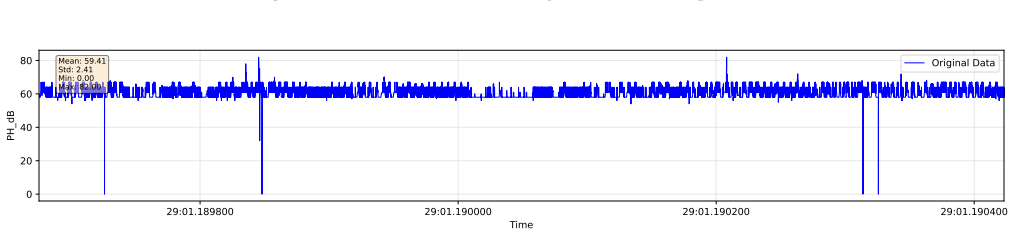
- [Section 2.1, Figures 3-5] The component-latency panels in Figures 3 and 4 are ambiguous. The legend on the right panels lists 'Uplink Downlink Inference,' but only two rows of percentages are printed (for example, Figure 3 shows 11.8-24.8% and 74.6-87.1%), and the text attributes the 74-87% share to inference for image-to-text while a naive legend-order reading would assign that share to downlink. Figure 5's right panel is similarly incomplete: it omits one component value for Slice 3 (54.7 + 43.1 = 97.8%). Since these figures are the primary evidence for Insights 1 and 2, please redraw the panels so each component's segment is explicitly labeled, show all components so the percentages sum to 100%, and verify that the mapping of segments to uplink, downlink, and inference matches the text.
minor comments (9)
- [Appendix F] Appendix F states that 'More importantly, we conducted a causal analysis of the results shown in Figure 3 to Figure 7 of the dataset,' but no causal analysis appears in the appendix or the main text; no causal method, intervention, or confounder analysis is presented. Please either add the analysis or delete the sentence.
- [Appendix G] LAREI and LSEQ depend on a normalization coefficient omega and a calibration parameter delta whose values and fitting procedures are never specified, so a third party cannot compute either metric as published. Both metrics are also derived from the same dataset used to support the qualitative insights; please describe the calibration protocol and validate on held-out data, or label the metrics as descriptive summaries rather than benchmarking tools.
- [Appendix C, Table 2] The legend of Table 2 uses the identical glyph for all three support levels (full, partial, and not supported), which makes the matrix unreadable; please use distinct symbols for the three levels.
- [Section 5.2] The dataset metric count is inconsistent: Section 5.2 says '58 metrics' but then enumerates 22 UE-layer, 25 gNB-layer, and 18 core/edge-layer metrics (65 total), while the tables in Appendix H list 12 UE, 12 server, and 29 RAN metrics (53 total). Please reconcile the stated count with the tables and the enumeration.
- [Section 5.3.2, Figure 13] Figure 13 appears corrupted: it contains glyph sequences such as '/uni00000013 /uni00000015/...' instead of a learning curve, and the caption claims it demonstrates online learning progress. Please replace it with an actual plot of the UCB convergence.
- [Section 2.2, Figure 5] The middle panel of Figure 5 shows total latency increasing from 1.536 s (Slice 1) to 1.957 s (Slice 3) as slice resources increase, but the text does not discuss this counterintuitive trend; please explain what differs across the slices (for example, request sizes, concurrency, or service class).
- [Section 4.2] In Challenge 5, the text claims 'microsecond-level sampling precision' from an NTP-based synchronizer while also stating that synchronization errors are maintained within ±1.0 milliseconds; these statements are inconsistent, and microsecond-level precision is not credible for NTP. Please align the two statements.
- [Throughout] Please fix minor language errors, including 'A simple query may yield trigger a terse response' (Section 2.3), 'Figure 1 and 2 illustrates' (Section 1), 'Core Netowork' (Figure 10), 'Deplays' (Figure 11 caption), and 'WiLLM is an extend of OAI' (Appendix C note).
- [Section 2.3, wording] The phrase 'unprecedented burstiness' is stronger than the evidence presented; consider 'pronounced' unless a quantitative comparison to non-LLM traffic is added.
Circularity Check
No circularity: the platform and dataset contributions are self-contained; the weak DNN baseline is an empirical-design limitation, not a circular derivation.
full rationale
WiLLM's central contributions are an open-source testbed, a ~1.6-million-record dataset, and an empirical description of LLM traffic over that testbed. None of these is derived by substituting a conclusion into its own premise. Section 2's three insights summarize measurements taken with WiLLM ("We deployed WiLLM to systematically characterize LLM service behavior..."), and Section 3 invokes those insights as design motivation; that is an iterative systems narrative, not an equation-level reduction of a predicted quantity to a fitted input. The appendix metrics LAREI and LSEQ are defined post hoc from the same dataset, with normalization coefficients omega and delta explicitly described as system-specific calibration parameters rather than as fitted values used to "predict" held-out outcomes, so no fitted-input-called-prediction step is present. The only self-citation, [20], appears in a figure caption and does not carry any load-bearing argument. The absence of a same-testbed traditional-DNN baseline weakens the comparative claim that LLM services "fundamentally differ" from DNN applications, but that is a validity/experimental-design limitation, not circularity: the paper's own definitions and equations do not make the conclusion true by construction. No circular step can be exhibited, so the appropriate finding is no significant circularity.
Assumptions & free parameters
free parameters (2)
- omega (LAREI normalization coefficient) =
not specified
- delta (LSEQ calibration parameter) =
not specified
assumptions (4)
- domain assumption The single small-cell testbed (USRP B210, one gNB, i9 host) is representative of real cellular networks.
- domain assumption LLaVA and Llama 3.2 workloads represent LLM services in general.
- domain assumption NTP-based synchronization with +/-1.0 ms error is sufficient for the cross-layer causal analysis.
- domain assumption Existing literature on DNN traffic characteristics is a sufficient implicit baseline for the fundamental-differences claim.
invented entities (1)
-
Fruit slices (Tree-Branch-Fruit slicing hierarchy)
independent evidence
Cite this review
Pith. "Pith review of WiLLM: an Open Framework for LLM Services over Wireless Systems." pith.science (2026). https://pith.science/paper/VC3ZHWML
@misc{pith2026250619030,
  author       = {Pith},
  title        = {Pith review of: WiLLM: an Open Framework for LLM Services over Wireless Systems},
  year         = {2026},
  howpublished = {\url{https://pith.science/paper/VC3ZHWML}},
  note         = {Machine review of arXiv:2506.19030}
}
read the original abstract
Large Language Model (LLM) services fundamentally differ from traditional Deep Neural Network (DNN) applications in wireless networks. We identify three critical distinctions: (1) unlike traditional DNNs with unidirectional data flows, LLM's multimodal interactions create bidirectional heavy loads with contrasting bottlenecks, requiring direction-aware resource scheduling; (2) while traditional DNNs exhibit fixed computational patterns, LLM's highly variable inference times interact complexly with network slicing, causing dynamic bottleneck migration; and (3) in contrast to predictable DNN traffic, LLM's token streams demonstrate unprecedented burstiness and state dependencies. These insights motivate WiLLM, the first open-source framework, implemented as a wireless platform, for LLM service research. Built on OpenAirInterface, WiLLM introduces several technical innovations: dynamic slice compatibility, universal UE compatibility through application-layer tunneling, multi-UE multi-slice scheduling, dual-mode resource allocation, and cross-layer APIs. In addition, WiLLM eliminates the need for specialized wireless expertise, enabling researchers and developers to experiment with LLM services over realistic cellular networks. We demonstrate the platform's capabilities through a smart glasses case study and provide a comprehensive dataset of \~1.6 million synchronized measurements. The complete system, dataset, and appendix are available at https://openwillm.github.io.
Figures


Figures from the paper (17 more)




Forward citations
Cited by 3 Pith papers
-
LLM-Empowered Agentic MAC Protocols: A Dynamic Stackelberg Game Approach
An LLM-based multi-agent reinforcement learning framework that models uplink MAC scheduling as a Stackelberg game reports 77.6% higher throughput and 65.2% better fairness in simulation.
-
Secure Multi-LLM Agentic AI and Agentification for Edge General Intelligence by Zero-Trust: A Survey
A survey proposing zero-trust architecture for multi-LLM systems in edge computing, with a taxonomy of model- and system-level defenses and a conceptual framework.
-
The LLM as a Network Operator: A Vision for Generative AI in the 6G Radio Access Network
The authors formalize the LLM-RAN operator as a mapping from intents and network states to actions, and state conditional expressiveness and convergence results based on universal approximation and Banach's fixed-poin...
Reference graph
Works this paper leans on
-
[1]
Mohammad Alsmirat, Yousef Sharrab, Monther Tarawneh, Sana’a Al- shboul, and Nabil Sarhan. 2023. Video coding deep learning-based modeling for long life video streaming over next network generation. Cluster Computing 26, 2 (2023), 1159–1167
work page 2023
-
[2]
Maiko Andrade and Juliano Araujo Wickboldt. 2025. A Study on 5G Network Slice Isolation Based on Native Cloud and Edge Computing Tools. arXiv preprint arXiv:2502.02842 (2025)
work page Pith review arXiv 2025
-
[3]
Maria Barbosa, Marcelo Silva, Ednelson Cavalcanti, and Kelvin Dias
-
[4]
Lina Bariah, Qiyang Zhao, Hang Zou, Yu Tian, Faouzi Bader, and Merouane Debbah. 2024. Large generative ai models for telecom: The next big thing? IEEE Communications Magazine 62, 11 (2024), 84–90
work page 2024
-
[5]
Gordon Owusu Boateng, Hani Sami, Ahmed Alagha, Hanae Elmekki, Ahmad Hammoud, Rabeb Mizouni, Azzam Mourad, Hadi Otrok, Jamal Bentahar, Sami Muhaidat, et al. 2024. A Survey on Large Language Models for Communication, Network, and Service Management: Ap- plication Insights, Challenges, and Future Directions. arXiv preprint arXiv:2412.19823 (2024)
arXiv 2024
-
[6]
Fenglong Cai, Dong Yuan, Zhe Yang, and Lizhen Cui. 2024. Edge- llm: A collaborative framework for large language model serving in edge computing. In 2024 IEEE International Conference on Web Services (ICWS). IEEE, 799–809
work page 2024
-
[7]
Abdelaali Chaoub and Muslim Elkotob. 2025. Mobile Network- specialized Large Language Models for 6G: Architectures, Innovations, Challenges, and Future Trends. arXiv preprint arXiv:2502.04933 (2025)
arXiv 2025
-
[8]
Yuxuan Chen, Rongpeng Li, Zhifeng Zhao, Chenghui Peng, Jianjun Wu, Ekram Hossain, and Honggang Zhang. 2024. NetGPT: An AI- native network architecture for provisioning beyond personalized generative services. IEEE Network (2024)
work page 2024
Show all 45 references
-
[9]
Abdulhalim Dandoush, Viswanath Kumarskandpriya, Mueen Uddin, and Usman Khalil. 2024. Large language models meet network slicing management and orchestration.arXiv preprint arXiv:2403.13721(2024)
2024 arXiv
-
[10]
Qifei Dong, Xiangliang Chen, and Mahadev Satyanarayanan. 2024. Creating edge ai from cloud-based llms. In Proceedings of the 25th International Workshop on Mobile Computing Systems and Applications . 8–13
2024
-
[11]
Wojciech Flakowski, Maciej Krasicki, and Rafał Krenz. 2023. Implemen- tation of a 4g/5g base station using the srsran software and the usrp software radio module. Journal of Telecommunications and Information Technology 3 (2023), 30–40
2023
-
[12]
Xenofon Foukas, Bozidar Radunovic, Matthew Balkwill, and Zhihua Lai. 2023. Taking 5G RAN analytics and control to a new level. In Proceedings of the 29th Annual International Conference on Mobile Computing and Networking. 1–16
2023
-
[13]
ggml-org. 2025. llama.cpp: LLM inference in C/C++. https://github. com/ggml-org/llama.cpp Accessed: 2025-02-27
2025
-
[14]
Sutton, Pablo Serrano, Cristina Cano, and Douglas J
Ismael Gomez-Miguelez, Andres Garcia-Saavedra, Paul D. Sutton, Pablo Serrano, Cristina Cano, and Douglas J. Leith. 2016. srsLTE: An Open-Source Platform for LTE Evolution and Experimentation. In Proceedings of the Tenth ACM International Workshop on Wireless Network Testbeds, ...
2016
-
[15]
Ying He, Jingcheng Fang, F Richard Yu, and Victor C Leung. 2024. Large language models (LLMs) inference offloading and resource allo- cation in cloud-edge computing: An active inference approach. IEEE Transactions on Mobile Computing (2024)
2024
-
[16]
Marco C Jacobs, Mark A Livingston, and Andrei State. 1997. Managing latency in complex augmented reality systems. In Proceedings of the 1997 symposium on Interactive 3D graphics . 49–ff
1997
-
[17]
Shashank Mohan Jain. 2022. Hugging face. In Introduction to trans- formers for NLP: With the hugging face library and models to solve problems. Springer, 51–67
2022
-
[18]
Shaoqing Ren Kaiming He, Xiangyu Zhang and Jian Sun. 2015. Deep Residual Learning for Image Recognition. arXiv preprint (2015)
2015
-
[19]
Alex Krizhevsky, Ilya Sutskever, and Geoffrey E Hinton. 2017. Ima- geNet classification with deep convolutional neural networks. Com- mun. ACM 60, 6 (2017), 84–90
2017
-
[20]
Boyi Liu, Jingwen Tong, and Jun Zhang. 2024. Llm-slice: Dedicated wireless network slicing for large language models. In Proceedings of the 22nd ACM Conference on Embedded Networked Sensor Systems . 853–854
2024
-
[21]
Haotian Liu, Chunyuan Li, Qingyang Wu, and Yong Jae Lee. 2023. Visual Instruction Tuning
2023
-
[22]
Purbesh Mitra, Priyanka Kaswan, and Sennur Ulukus. 2024. Dis- tributed Mixture-of-Agents for Edge Inference with Large Language Models. arXiv preprint arXiv:2412.21200 (2024)
2024 arXiv
-
[23]
Mahdi Nabiyouni, Siroberto Scerbo, Doug A Bowman, and Tobias Höllerer. 2017. Relative effects of real-world and virtual-world latency on an augmented reality training task: an ar simulation experiment. Frontiers in ICT 3 (2017), 34
2017
-
[24]
Sean Huver Nigel Nelson and Mostafa Toloui. 2023. Deploy Large Language Models at the Edge with NVIDIA IGX Orin Developer Kit
2023
-
[25]
Marina, Saravana Manickam, Alex Dawson, Raymond Knopp, and Christian Bonnet
Navid Nikaein, Mahesh K. Marina, Saravana Manickam, Alex Dawson, Raymond Knopp, and Christian Bonnet. 2014. OpenAirInterface: A Flexible Platform for 5G Research. ACM SIGCOMM Computer Com- munication Review 44, 5 (October 2014), 33–38
2014
-
[26]
NVIDIA. 2025. TensorRT-LLM: High-Performance Inference for Large Language Models. https://github.com/NVIDIA/TensorRT-LLM. Ac- cessed: 2025-02-28
2025
-
[27]
Ollama. 2025. Ollama: An Open Source Project on GitHub. https: //github.com/ollama/ollama. Accessed: 2025-02-28
2025
-
[28]
Khandu Om, Tanya McGill, Michael Dixon, Kok Wai Wong, and Poly- chronis Koutsakis. 2022. H. 264 and H. 265 video traffic modeling using neural networks. Computer Communications 184 (2022), 149–159
2022
-
[29]
Open5GS. 2025. Open5GS: Open Source 5G Core Network. https: //open5gs.org/. Accessed: 2025-02-28
2025
-
[30]
Jeff Rasley, Samyam Rajbhandari, Olatunji Ruwase, and Yuxiong He
-
[31]
Joseph Redmon, Santosh Divvala, Ross Girshick, and Ali Farhadi. 2016. You only look once: Unified, real-time object detection. In Proceedings of the IEEE conference on computer vision and pattern recognition . 779– 788
2016
-
[32]
Tony Saboorian and Amanda Xiang. 2017. Network Slicing and 3GPP Service and Systems Aspects (SA) Standard. IEEE Software Defined Networks (December 2017)
2017
-
[33]
Robert Schmidt, Mikel Irazabal, and Navid Nikaein. 2021. FlexRIC: An SDK for next-generation SD-RANs. In Proceedings of the 17th Interna- tional Conference on emerging Networking EXperiments and Technolo- gies. 411–425
2021
-
[34]
Jovan Stojkovic, Chaojie Zhang, Íñigo Goiri, Josep Torrellas, and Esha Choukse. 2025. Dynamollm: Designing llm inference clusters for per- formance and energy efficiency. In 2025 IEEE International Symposium on High Performance Computer Architecture (HPCA). IEEE, 1348–1362
2025
-
[35]
Haotian Tang, Shang Yang, Ji Lin, Jiaming Tang, Wei-Ming Chen, Wei- Chen Wang, and Song Han. 2023. TinyChat: Large Language Model on the Edge. MIT HAN Lab Blog (2023). https://hanlab.mit.edu/blog/ tinychat
2023
-
[36]
Huaming Wu, Xiangyi Li, and Yingjun Deng. 2020. Deep learning- driven wireless communication for edge-cloud computing: opportuni- ties and challenges. Journal of Cloud Computing 9, 1 (2020), 21
2020
-
[37]
Minrui Xu, Dusit Niyato, and Christopher G Brinton. 2025. Serv- ing Long-Context LLMs at the Mobile Edge: Test-Time Reinforce- ment Learning-based Model Caching and Inference Offloading. arXiv preprint arXiv:2501.14205 (2025)
2025 arXiv
-
[38]
Nan Xue, Yaping Sun, Zhiyong Chen, Meixia Tao, Xiaodong Xu, Liang Qian, Shuguang Cui, Wenjun Zhang, and Ping Zhang. 2024. WDMoE: Wireless Distributed Mixture of Experts for Large Language Models. WiLLM: an Open Framework for LLM Services over Wireless Systems arXiv preprint ar...
2024 arXiv
-
[39]
Xiaoyu Zhang et al. 2025. Beyond the Cloud: Edge Inference for Gener- ative Large Language Models in Wireless Networks. IEEE Transactions on Wireless Communications (2025)
2025
-
[40]
Zhong-Qiu Zhao, Peng Zheng, Shou-tao Xu, and Xindong Wu. 2019. Object detection with deep learning: A review. IEEE transactions on neural networks and learning systems 30, 11 (2019), 3212–3232
2019
-
[41]
Tree- Branch- Fruit
Yue Zheng, Yuhao Chen, Bin Qian, Xiufang Shi, Yuanchao Shu, and Jiming Chen. 2024. A Review on edge large language models: Design, Execution, and Applications. Comput. Surveys (2024). Boyi Liu, Yongguang Lu, Jianguo Zhao, Qiang Yang, Wen Wu, Lin Chen, Jagmohan Chauhan, and Jun...
2024
-
[44]
LLM only ✗ LLM de- ployment ✗ ✗ Computation Only Server ✗ TensorRT- LLM [26] LLM only ✗ Lightweight reasoning ✗ ✗ Computation Only Server ✗ DeepSpeed
-
[45]
Tree-Branch-Fruit
LLM only ✗ Distributed training and reasoning ✗ ✗ Computation Only Server ✗ Legend: ✓ Support ✗ Not Considered Blue text: key comparisons Note: This comparison contrasts systems with different foundations: OAI, srsRAN, and Open5GS are ground-up implementations, while WiLLM str...
1970
-
[2020]
In Proceedings of the 26th ACM SIGKDD international conference on knowledge discovery & data mining
Deepspeed: System optimizations enable training deep learning models with over 100 billion parameters. In Proceedings of the 26th ACM SIGKDD international conference on knowledge discovery & data mining. 3505–3506
-
[2024]
arXiv preprint arXiv:2412.21162 (2024)
Open-Source 5G Core Platforms: A Low-Cost Solution and Performance Evaluation. arXiv preprint arXiv:2412.21162 (2024)
2024 arXiv
Reviewed August 15, 2026 · model on record in the stance chip above.
Discussion (0). Continue with ORCID to comment.