REVIEW 1 major objections 6 minor 14 references
Measurement of the multi-TeV neutrino cross section with IceCube using Earth absorption
T0 review · 1 major / 6 minor · reviewed 2026-08-14 · deepseek-v4-flash
Pith's one-line read The first multi-TeV neutrino cross-section measurement with IceCube is 1.30 times the Standard Model prediction.
desk verdict A clean status report from IceCube: no new measurement, but an honest summary of the 2017 result and a sensible preview of the 8-year follow-up. read the letter →
The pith
A machine-rendered reading of the paper's core claim, the machinery that carries it, and where it could break.
The reading
What carries the argument
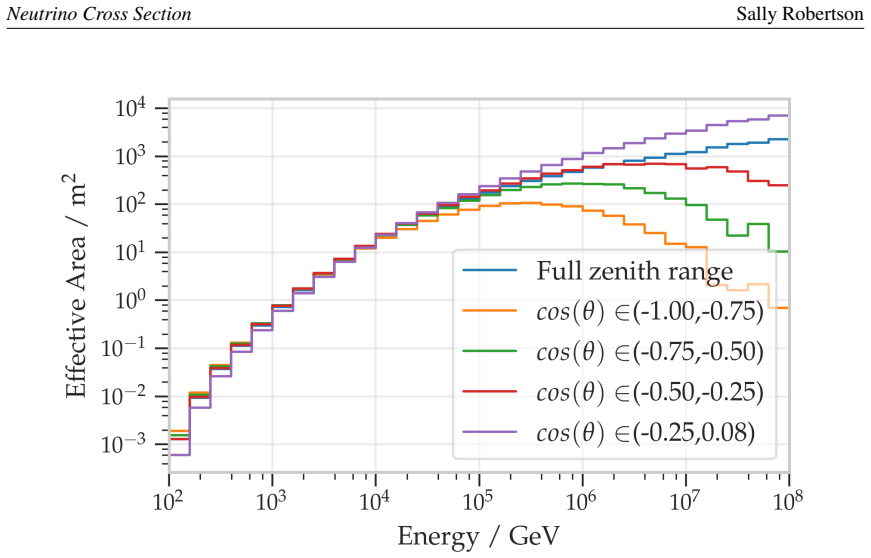
The central mechanism is Earth absorption: a neutrino's transmission probability through the Earth, computed as a function of energy and zenith angle by propagating neutrinos through the Preliminary Reference Earth Model (PREM) density profile, with the interaction cross-section scaled by a free multiple of the Standard Model value. Horizon neutrinos with no significant absorption provide the baseline, while near-vertical neutrinos are absorbed more strongly above about 30 TeV, and the difference between these regimes carries the cross-section information. The fit works on the product of flux and cross-section rather than the event rate alone, so an increase in cross-section lowers the fitted flux and the total number of events stays tied to prior data; the information used is the spectral and zenith-angle shape of absorption, not the overall normalization. For the planned extension, the newly developed propagation code SQuIDs separately varies charged-current and neutral-current transmission probabilities so the two interaction types can be fit independently.
What would settle it
Fit the 8-year sample to the cross-section separately in several energy bins; if the measured multiple varies with energy instead of staying flat at the Standard Model value, the single 1.30 overall number has missed energy-dependent new physics. As a cleaner check, re-fit the 1-year events without fixing the astrophysical flux from Standard-Model-based priors; if the cross-section multiple moves beyond the reported uncertainties, the consistency claim rests on that prior.
Extended reading notes
Core claim
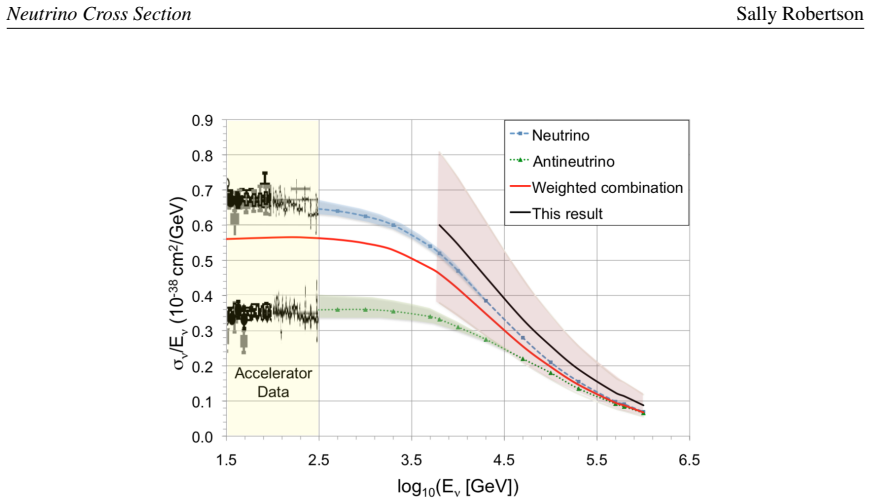
The discovery, on the paper's own terms, is that the multi-TeV neutrino cross-section measured by IceCube equals the Standard Model prediction within uncertainties: $1.30^{+0.21}_{-0.19}\ (\mathrm{stat.})^{+0.39}_{-0.43}\ (\mathrm{syst.})$ times the Standard Model value. The measurement works by comparing neutrinos that pass through little Earth (near the horizon, effectively an unabsorbed baseline) with neutrinos whose path crosses the Earth's core and is absorbed more strongly at high energy; the energy and zenith-angle dependence of that absorption encodes the cross-section. A maximum-likelihood fit, with the cross-section as a free multiple of the Standard Model and the flux priors constrained so that the total number of events is conserved, returns the quoted multiple. The paper treats this consistency as the key result: no large beyond-Standard-Model enhancement, such as leptoquarks, sphalerons, or extra dimensions would produce, survives at multi-TeV energies.
Load-bearing premise
The measurement assumes that earlier IceCube estimates of the neutrino flux, made using the Standard Model cross-section, are still correct when the cross-section is varied; if the true cross-section differs from the Standard Model, those flux estimates would be biased and could hide or mimic a real deviation.
Editorial extensions
If this is right
- If the result is correct, the multi-TeV neutrino-nucleon cross-section is consistent with the Standard Model, and any beyond-Standard-Model effect large enough to change Earth absorption is excluded at these energies.
- The method yields cross-section information at energies far above accelerator beams, which reach only a few hundred GeV, filling the multi-TeV gap with data rather than extrapolation.
- With 8 years of data and roughly 300,000 events, the statistical uncertainty becomes small enough that systematics dominate, allowing the cross-section to be measured in discrete energy bins rather than as a single overall multiple.
- Separating charged-current and neutral-current interactions in the extension lets new-physics models that remove neutrinos from the flux (such as leptoquarks, sphalerons, and extra dimensions) be tested through an apparent excess of charged-current absorption.
- Nuclear shadowing from heavy-nucleus parton distributions would show up most clearly for near-vertical trajectories through the Earth's core, where the neutrino path lies almost entirely in dense matter.
Reading between the lines
- My inference: the reported $1.30$ multiple is conditioned on flux priors that assume the Standard Model cross-section, so a fit that floats the astrophysical flux and the cross-section jointly from the same data could test how much of the consistency conclusion is carried by that assumption.
- A sharper test than a single normalization would be the slope of the cross-section ratio versus energy in the 8-year sample; energy-dependent new physics could average out in one overall multiple while appearing as a tilt across bins.
- Because the fit conserves total event count, an invisible-neutrino channel that changes opacity without changing the total event rate would be partially degenerate with flux normalization; the extension's separate charged-current and neutral-current energy-bin information is what would break that degeneracy.
Signed reviews
Editorial analysis
A structured set of objections, weighed in public.
Referee Report
Summary. This proceedings paper (ICRC 2019) summarizes the first IceCube measurement of the multi-TeV neutrino-nucleon cross section via Earth absorption, using 10,784 through-going muon neutrino events from one year of data. The analysis uses a binned maximum likelihood fit in energy and zenith, with a transmission probability computed for a cross-section scaled by a multiple of the Standard Model value. The reported result is 1.30+0.21/−0.19 (stat.) +0.39/−0.43 (syst.) times the SM prediction. The paper also outlines an 8-year extension (≈300,000 events) that will measure the cross-section multiplier in energy bins and separately for charged and neutral current interactions, using the SQuIDs propagation code. The content is a review of a published Nature result plus a forward-looking plan.
Significance. The described measurement is the first multi-TeV neutrino cross-section result and extends coverage by orders of magnitude beyond accelerator beams; consistency with the SM at this energy is an important input for neutrino astronomy and BSM searches. The paper is transparent about the use of SM-based flux priors, and the extension plan is concrete and well-motivated, including separate CC/NC fits and consideration of nuclear shadowing. As a proceedings contribution, its primary value is archival dissemination of the IceCube result to the community, and it correctly attributes the underlying analysis to the peer-reviewed Nature paper.
major comments (1)
- [Section 1, nuisance parameters paragraph] The paper states that the astrophysical neutrino spectrum prior is derived from measurements that assume the Standard Model cross-section, and that the fit multiplies each flux by the cross-section to conserve the total event count. This construction removes the normalization degeneracy but not the energy-dependent shape degeneracy: a cross-section that deviates from the SM would bias the prior spectrum shape, particularly at high energies and near-vertical trajectories where absorption is strongest, and the fitted cross-section multiple could partially absorb that bias. The quoted systematic uncertainties include astrophysical spectral uncertainties but the paper does not demonstrate that they cover this shape degeneracy. Since the manuscript is a proceedings summary of a published measurement, this is not a fatal flaw, but a sentence explicitly acknowledging this limitation and referring to any joint-fit checks (or to the Nature paper's treatment) would strengthen the consistency claim.
minor comments (6)
- [Abstract and Section 2] The phrase 'the cross section will be measure' should read 'the cross section will be measured'.
- [Section 1, first paragraph] 'has only measured' should be 'has only been measured'.
- [Section 1, transmission probability description] The energy range '102−108GeV' should read '10^2 to 10^8 GeV'; the exponent formatting appears to have been lost.
- [Section 2, statistics uncertainty claim] The statement 'reduction of statistics uncertainty by 8-10%' is ambiguous and seems inconsistent with the naive 1/sqrt(N) scaling from 10,784 to ~300,000 events (which would reduce the statistical error by roughly a factor of five). Please clarify whether the intended meaning is that the total uncertainty will be 8-10% or that the statistical uncertainty will be reduced to that level.
- [Section 2, event sample description] The phrase 'through going muon' should be hyphenated as 'through-going muon'.
- [Section 2, HESE comparison] The phrase 'the cross section of interaction over all zenith angles' could be rephrased as 'the cross section for interactions over all zenith angles' for clarity.
Circularity Check
SM-based astrophysical flux prior is the main caveat; the measurement is not formally circular but its cross-section consistency claim inherits an SM-shaped input.
-
other
[Section 1, paragraph beginning 'The nuisance parameters for this fit include previous IceCube measurements...']
"The nuisance parameters for this fit include previous IceCube measurements of the astrophysical spectrum which are based on the assumption that the Standard Model cross section is correct. An increase in neutrino cross section would result in fewer neutrinos at the detector, which will affect the number of events in the fit. To insure this measurement conserves the total number of events this fit uses the product of each flux with the cross section in order to constrain to prior data. Thus, as the cross section increases the fluxes decrease to preserve the total number of events."
The input astrophysical flux prior is itself a previous IceCube measurement made under the assumption that the Standard Model cross-section is correct. The fit then multiplies that flux by the cross-section and constrains the product to prior data, so the overall normalization is absorbed by construction. Only the energy- and zenith-dependent shape of the prior remains to constrain deviations from the Standard Model. If the true cross-section differs from the Standard Model, the prior's spectral shape can absorb part of that difference, making the quoted consistency with the Standard Model less independent than it appears.
full rationale
This is a conference proceedings summarizing a published IceCube measurement rather than a new derivation, and most of the analysis chain is independent: the absorption pattern is fitted in bins of energy and zenith against Monte Carlo simulations with the cross-section as a multiplicative parameter, and that fit is not equivalent to the input flux by construction. The one relevant circularity-adjacent step is the treatment of the astrophysical spectrum as a nuisance input: previous IceCube spectrum measurements assumed the Standard Model cross-section, and the analysis then multiplies that flux by the cross-section while conserving total event count. That construction removes the normalization degeneracy but leaves the energy/zenith shape of the prior as a potential absorber of cross-section effects, so the headline 1.30+0.21/-0.19 (stat.) +0.39/-0.43 (syst.) consistency claim is not fully independent of the SM-assumed prior. The paper flags the normalization part explicitly but does not quantify the residual shape degeneracy. This is a genuine limitation worth a joint-fit cross-check, but it is a moderate model-dependence rather than a forced identity, so the circularity score is low.
Assumptions & free parameters
free parameters (5)
- Cross-section multiplier =
1.30 +0.21/-0.19 (stat.) +0.39/-0.43 (syst.) x SM
- Astrophysical neutrino flux normalization =
not quoted in this paper
- Astrophysical neutrino spectral index =
not quoted in this paper
- Prompt atmospheric neutrino flux normalization =
not quoted in this paper
- Detector and Earth-model nuisance parameters =
not quoted in this paper
assumptions (5)
- domain assumption The Standard Model neutrino-nucleon cross-section prediction (reference [8]) is the correct baseline for the multiplier.
- domain assumption The Preliminary Reference Earth Model (PREM) correctly describes the Earth's density profile used in propagation.
- domain assumption The astrophysical neutrino spectrum measured by IceCube under the SM cross-section assumption is a valid prior for the unabsorbed flux.
- domain assumption The detected muon neutrino sample has the assumed composition of neutrino and antineutrino events from atmospheric and astrophysical sources.
- domain assumption The detector simulation (including DOM response, ice model, and effective area) accurately models the event rate and energy response.
Cite this review
Pith. "Pith review of Measurement of the multi-TeV neutrino cross section with IceCube using Earth absorption." pith.science (2026). https://pith.science/paper/VC4YBQIG
@misc{pith2026190806123,
  author       = {Pith},
  title        = {Pith review of: Measurement of the multi-TeV neutrino cross section with IceCube using Earth absorption},
  year         = {2026},
  howpublished = {\url{https://pith.science/paper/VC4YBQIG}},
  note         = {Machine review of arXiv:1908.06123}
}
read the original abstract
IceCube detects neutrinos at energies orders of magnitude higher than any neutrinos produced at particle accelerators. Neutrinos are weakly interacting particles but at energies above 30 TeV the Earth becomes opaque to neutrinos. The neutrino cross section is well predicted in the Standard Model. Any unexpected increase in the cross-section could be a sign of beyond the standard model physics. In this analysis IceCube's through-going muon neutrino flux is used to fit for the cross section of neutrino interaction, the through-going high energy neutrinos will be absorbed as they travel through the Earth and a maximum likelihood fit allows for the cross section to be determined as a multiple of the Standard Model prediction. We will review the measurement of the neutrino cross section using 1 year of IceCube data, containing 10,000 events, which was found to be consistent with Standard Model predictions. In this contribution, we present plans for an extension to this analysis using 8 years of IceCube data, approximately 300,000 events. In the extension the cross section will be measure per neutrino energy for both charged and neutral current interactions. This will be the most accurate high-energy muon neutrino cross section measurement available, while also being sensitive to any beyond the Standard Model components.
Figures

Reference graph
Works this paper leans on
-
[1]
P. Jain, J. P. Ralston, and G. M. Frichter, Astroparticle Physics 12 (1999) 193 – 198
work page 1999
-
[2]
Hooper, Physical Review D 65 (May, 2002) 097303
D. Hooper, Physical Review D 65 (May, 2002) 097303
work page 2002
-
[3]
IceCube Collaboration, M. G. Aartsen and et al., Nature 551 (Nov, 2017) 596–600
work page 2017
-
[4]
IceCube Collaboration, M. G. Aartsen and et al., The Astrophysical Journal 833 (Dec., 2016) 3
work page 2016
-
[5]
IceCube Collaboration, M. G. Aartsen and et al., Journal of Instrumentation 12 (Mar., 2017) P03012
work page 2017
-
[6]
A. M. Dziewonski and D. L. Anderson, Physics of the Earth and Planetary Interiors 25 (1981) 297 – 356. 4 Neutrino Cross Section Sally Robertson
work page 1981
-
[7]
Particle Data Group Collaboration, K. A. Olive et al., Chin. Phys. C38 (2014) 090001
work page 2014
-
[8]
A. Cooper-Sarkar, P. Mertsch, and S. Sarkar, Journal of High Energy Physics 2011 (Aug, 2011) 42
work page 2011
Show all 14 references
-
[9]
IceCube Collaboration, PoS(ICRC2019)1017 (these proceedings)
-
[10]
C. A. Arguelles Delgado, J. Salvado, and C. N. Weaver, arXiv e-prints (Dec, 2014) arXiv:1412.3832
2014 arXiv
-
[11]
S. R. Klein, arXiv e-prints (Jun, 2019) arXiv:1906.02221
2019 arXiv
-
[12]
IceCube Collaboration, M. G. e. a. Aartsen, Science 342 (Nov., 2013) 1242856
2013
-
[13]
IceCube Collaboration, PoS(ICRC2019)1040 (these proceedings)
-
[14]
Bustamante and A
M. Bustamante and A. Connolly, Phys. Rev. Lett. 122 (Jan, 2019) 041101. 5
2019
Reviewed August 14, 2026 · model on record in the stance chip above.
Discussion (0). Continue with ORCID to comment.