REVIEW 3 major objections 3 minor 40 references
Responsibility in Actor-Based Systems
T0 review · 3 major / 3 minor · reviewed 2026-08-11 · deepseek-v4-flash
Pith's one-line read This paper shows how Shapley values can be used to assign responsibility for safety violations to the modules, variable values, or actions of a reactive program.
desk verdict A useful synthesis with two solid actor-extraction schemes and one flawed action-based scheme whose responsibility values depend on an arbitrary action ordering. read the letter →
The pith
A machine-rendered reading of the paper's core claim, the machinery that carries it, and where it could break.
The reading
What carries the argument
The load-bearing object is the Shapley value of a coalitional game defined by a safety game: for a coalition $C$ of actors, the game value $\gamma(C)$ is 1 if the coalition plus auxiliary states can force a run that never enters a bad state, and 0 otherwise, and $\mathrm{Shap}_\gamma(a)$ averages the marginal contributions $\gamma(C \cup \{a\}) - \gamma(C)$ over all coalitions not containing $a$. The two model transformations carry the argument: the scheduler construction splits states where several modules can act, and the action-separation construction splits each state's actions into auxiliary ?-states, !-states, and a demonic state. The soundness lemmas 4.3 and 4.10 connect the transformed games back to the original program by showing that bad-state reachability is preserved.
What would settle it
Take a program with a state that has at least two actions, reverse the ordering of those actions in Definition 4.9, recompute the action-based Shapley values for all actors, and compare; if any value changes, the responsibility score is an artifact of the ordering rather than a well-defined property of the program.
Extended reading notes
Core claim
The central claim is that Shapley-value responsibility, previously defined for arbitrary sets of states, can be attached to natural syntactic units of a reactive program without changing the safety semantics. For modules, the paper adds a scheduler module whose single variable records which module or synchronizing action is active, so each module becomes the set of states where it is active. For actions, it expands each state into a chain of auxiliary states that offer or skip each action, so each action becomes an actor that can be individually removed from a coalition. Lemmas 4.3 and 4.10 show both constructions preserve reachability of the bad states, and the reported case studies use the resulting values to identify the responsible module, time value, or action in a specification violation.
Load-bearing premise
The load-bearing premise is that the arbitrary ordering of a state's actions chosen in the action-separation construction does not affect the resulting responsibility values, and the paper does not prove this independence.
Editorial extensions
If this is right
- If a safety invariant is violated, module-based responsibility values rank system components by how much influence they have on avoiding that violation.
- Value-based actors group states by partial variable assignments, so their responsibility values identify which control points or variable values are most critical.
- Action-based actors do the same for program instructions; the puzzle-box example shows that an unused action can receive responsibility zero.
- The soundness of the scheduler and action-separation transformations means these rankings are not artifacts of the transformations, because bad states are reachable exactly when they were reachable in the original program.
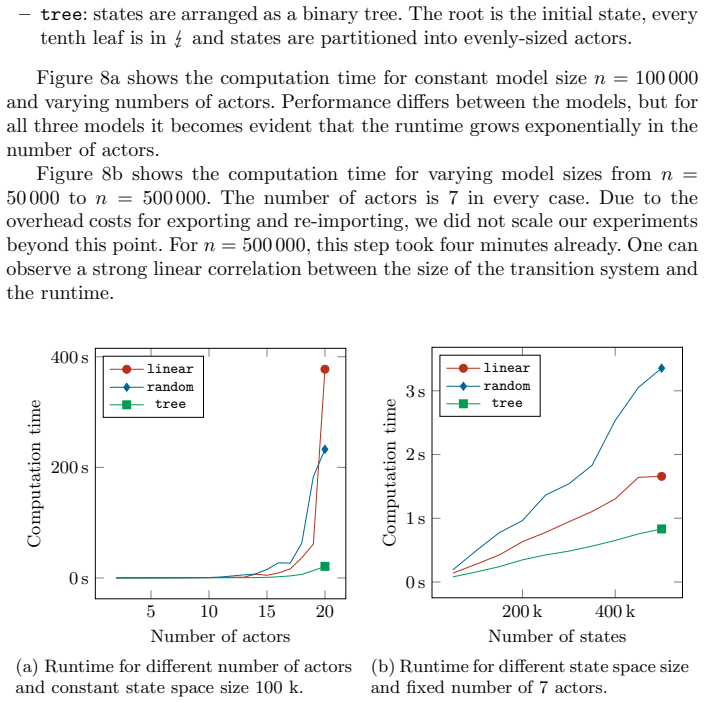
- Since computation is exponential in the number of actors but polynomial in model size, choosing a coarse actor signature makes the method feasible on models with hundreds of thousands of states.
Reading between the lines
- The arbitrary ordering of actions fixed in Definition 4.9 is an implementation choice; until order-independence is proved or a canonical order is fixed, two tools using different orders could report different responsibility values for the same program.
- The same machinery could be applied to per-state action actors rather than global action names, attaching responsibility to individual transitions and making the output closer to a line of code; the paper lists this as future work.
- A responsibility value is an average over all coalitions, so it measures how often an actor is pivotal rather than whether it caused this particular violation; pairing forward and backward values could separate prevention ability from observed role.
Signed reviews
Editorial analysis
A structured set of objections, weighed in public.
Referee Report
Summary. The paper presents a uniform framework for forward and backward responsibility based on Shapley values in transition systems with safety properties, then proposes three schemes for deriving actors from reactive module programs: module-based actors via a scheduler transformation, value-based actors via partitioning by variable values, and action-based actors via an action-separation transformation. It proves soundness lemmas for the two transformations, states complexity results from prior work, and reports initial experiments with a prototypical implementation.
Significance. If the formalization is corrected, the paper provides a useful practical bridge between Shapley-based responsibility theory and program-level debugging, with concrete actor-extraction algorithms and an available implementation. The direct proofs of Lemmas 4.3 and 4.10 and the reproducible experimental setup are strengths. However, the novel action-separation construction currently has formal defects, and the paper does not fully establish that the proposed action-based values are well-defined properties of the program rather than artifacts of arbitrary choices.
major comments (3)
- [Section 4.4, Definition 4.9] The definition of S' as S? ∪ S! ∪ SX omits the original state set S, yet the transition relation is defined by clauses 's_α → t' and 's_X → t' with t ∈ S. Since t is not an element of S', these clauses do not define a transition system. The proof of Lemma 4.10 uses the intended transitions from s_α and s_X to First(t) (for example, 'By construction, there exists a transition to First(ρ_{i+1})'), so the corrected definition should replace t by First(t). This is a load-bearing formal error that must be fixed.
- [Section 4.4, Definition 4.9] The sentence 'If there are multiple actions that produce the same transition, we arbitrarily choose one of them' introduces an arbitrary tie-break that changes the responsibility values. For example, let s have transitions s→t via both α and β, and a transition s→bad via γ, with t safe and bad absorbing. If the duplicate transition is assigned to α, then Act(s)={α,γ}; for coalition C={β}, no action in C is available at s, and the transformed game is losing because Reach proceeds to s_X and chooses bad. If the duplicate transition is assigned to β, then Act(s)={β,γ}; C controls s_β? and can move to s_β! and then to First(t), winning. Hence the Shapley value of β is 0 in the first case and positive in the second, purely from the arbitrary tie-break. The paper must provide a canonical treatment (for example, giving each action's !-state all successors produced by that action) or prove invariance.
- [Section 4.4, Definition 4.9] The action-based responsibility values are defined relative to an arbitrary ordering of the actions per state, but the paper gives no proof that they are independent of this ordering. The simple two-action counterexample that one might construct with one safe and one bad successor does not actually demonstrate a dependence, since in both orders the coalition containing the action leading to the safe successor wins and the other coalition loses; nevertheless, the general question of order-independence is left open. The paper should either prove that the values are order-independent or fix a canonical order so that the values are a well-defined property of the program.
minor comments (3)
- [Section 4.2, Definition 4.4] The definition says 'let S be the state space of T(P, ϕ)' and then defines module-based actors by the value of the variable 'active', but T(P, ϕ) does not contain the variable 'active'. The state space should be that of T(WithSched(P), ϕ).
- [Lemma 4.10 proof] The expression 'Next(ρ'_last, α)' is formally undefined because Next is defined on pairs (s, α) for original states s and actions α, not on ?-states; it should be Next(ρ_i, α). With the corrected transition relation from Definition 4.9, the run construction should also explicitly state that the transition from ρ_{i,α(i)} goes to First(ρ_{i+1}).
- [Section 5.3] The sentence 'we investigate the time taken to actually compute responsibility only 3' contains a dangling footnote marker '3' with no corresponding footnote text; it should be removed or the footnote should be supplied.
Circularity Check
No circular derivation: the actor-set transformations and their soundness lemmas are self-contained, and cited prior work is independent background rather than load-bearing input.
full rationale
The paper's central new content is the extraction of module-, value-, and action-based actor sets and the two model transformations that support them. Lemma 4.3 and Lemma 4.10 prove reachability equivalence between the original transition system and the transformed systems by direct run-projection arguments; neither proof assumes the Shapley-based responsibility values it is meant to support. The forward and backward responsibility notions in Section 3 are definitions built on standard Shapley values and safety games, not quantities fitted to data or predicted from hidden parameters. The complexity statements are attributed to the prior papers [33] and [2], which are separate published works with their own proofs; the present paper adapts those results rather than using them as an unverified premise for a circular conclusion. The self-citations are therefore not load-bearing in a way that makes the derivation equivalent to its inputs. One non-circular concern deserves explicit note: Definition 4.9 fixes an arbitrary ordering of the actions of each state when constructing the action-separated system, and the paper does not show that the resulting action-based Shapley values are independent of that ordering. This is a well-definedness and correctness question about the proposed notion, not a circularity: the responsibility values are still computed from the constructed game rather than being assumed or fitted. Overall, the derivation chain is self-contained for the claims it proves, and no step reduces to its own input by construction.
Assumptions & free parameters
assumptions (3)
- standard math Safety games are determined and winning regions can be computed in linear time
- domain assumption The operational semantics of the reactive modules language in Section 4.1 correctly captures the behavior of the program
- ad hoc to paper The arbitrary ordering of actions in Definition 4.9 does not affect the resulting responsibility values
invented entities (2)
-
Scheduler module (Definition 4.2)
-
Action-separation states s_alpha?, s_alpha, s_X (Definition 4.9)
Cite this review
Pith. "Pith review of Responsibility in Actor-Based Systems." pith.science (2026). https://pith.science/paper/VCIGFQT3
@misc{pith2026241205162,
  author       = {Pith},
  title        = {Pith review of: Responsibility in Actor-Based Systems},
  year         = {2026},
  howpublished = {\url{https://pith.science/paper/VCIGFQT3}},
  note         = {Machine review of arXiv:2412.05162}
}
read the original abstract
The enormous growth of the complexity of modern computer systems leads to an increasing demand for techniques that support the comprehensibility of systems. This has motivated the very active research field of formal methods that enhance the understanding of why systems behave the way they do. One important line of research within the verification community relies on formal notions that measure the degree of responsibility of different actors. In this paper, we first provide a uniform presentation of recent work on responsibility notions based on Shapley values for reactive systems modeled by transition systems and considering safety properties. The paper then discusses how to use these formal responsibility notions and corresponding algorithms for three different types of actor sets: the module-based notion serves to reason about the impact of system components on the satisfaction or violation of a safety property. Responsibility values for value-based actor sets and action-based actors allow for the identification of program instructions and control points that have the most influence on a specification violation. Beyond the theoretical considerations, this paper reports on experimental results that provide initial insights into applicability and scalability.
Figures


Figures from the paper (5 more)


Reference graph
Works this paper leans on
-
[1]
Rajeev Alur and Thomas A Henzinger. “Reactive modules”. In: Formal methods in system design 15 (1999), pp. 7–48. doi: 10.1023/A:1008739929481. url: https://doi.org/10.1023/A:1008739929481
-
[2]
Backward responsibility in transitio n systems using general power indices
Christel Baier, Roxane van den Bossche, Sascha Kl¨ uppelholz, Johannes Lehmann, and Jakob Piribauer. “Backward responsibility in transitio n systems using general power indices”. In: Proceedings of the AAAI Con- ference on Artificial Intelligence . Vol. 38. 18. 2024, pp. 20320–20327. doi: 10.1609/aaai.v38i18.30013. url: https://doi.org/10.1609/aaai. v38i18.30013
-
[3]
From Verification to Causality-Based Explications (Invited Talk)
Christel Baier, Clemens Dubslaff, Florian Funke, Simon Jantsch, R upak Majumdar, Jakob Piribauer, and Robin Ziemek. “From Verification to Causality-Based Explications (Invited Talk)”. In: 48th International Col- loquium on Automata, Languages, and Programming (ICALP) . Vol. 198. LIPIcs. Schloss Dagstuhl - Leibniz-Zentrum f¨ ur Informatik, 2021, 1:1–1:20. do...
-
[4]
A Game-Th eoretic Account of Responsibility Allocation
Christel Baier, Florian Funke, and Rupak Majumdar. “A Game-Th eoretic Account of Responsibility Allocation”. In: Proceedings of the Thirti- eth International Joint Conference on Artificial Intellige nce, IJCAI-21 . Ed. by Zhi-Hua Zhou. Main Track. International Joint Conference s on Artificial Intelligence Organization, Aug. 2021, pp. 1773–1779. doi: 10.249...
-
[5]
Responsib il- ity Attribution in Parameterized Markovian Models
Christel Baier, Florian Funke, and Rupak Majumdar. “Responsib il- ity Attribution in Parameterized Markovian Models”. In: Thirty-Fifth AAAI Conference on Artificial Intelligence (AAAI) . AAAI Press, 2021, pp. 11734–11743. doi: 10.1609/AAAI.V35I13.17395. url: https://doi. org/10.1609/aaai.v35i13.17395
-
[6]
Christel Baier and Joost-Pieter Katoen. Principles of model checking . MIT Press, 2008. isbn: 978-0-262-02649-9
work page 2008
-
[7]
From symptom to cause: localizing errors in counterexample traces
Thomas Ball, Mayur Naik, and Sriram K. Rajamani. “From symptom to cause: localizing errors in counterexample traces”. In: Proceedings of the 30th ACM SIGPLAN-SIGACT Symposium on Principles of Prog ram- ming Languages . POPL ’03. New Orleans, Louisiana, USA: Association for Computing Machinery, 2003, pp. 97–105. isbn: 1581136285. doi: 10.1145/604131.604140...
arXiv 2003
-
[8]
Explaining counterexamples using causality
Ilan Beer, Shoham Ben-David, Hana Chockler, Avigail Orni, and Ric hard J. Trefler. “Explaining counterexamples using causality”. In: Formal Meth- ods Syst. Des. 40.1 (2012), pp. 20–40. doi: 10.1007/S10703-011-0132-2 . url: https://doi.org/10.1007/s10703-011-0132-2
Show all 40 references
-
[9]
On correctness, precision, and performance in quantitative verifica tion: QComp 2020 competition report
Carlos E Budde, Arnd Hartmanns, Michaela Klauck, Jan Kˇ ret ´ ıns k´ y, David Parker, Tim Quatmann, Andrea Turrini, and Zhen Zhang. “On correctness, precision, and performance in quantitative verifica tion: QComp 2020 competition report”. In: International symposium on lever- a...
2020 doi
-
[10]
A Fr ame- work for Certified Program Analysis and Its Applications to Mobile-Co de Safety
Bor-Yuh Evan Chang, Adam Chlipala, and George C. Necula. “A Fr ame- work for Certified Program Analysis and Its Applications to Mobile-Co de Safety”. In: Verification, Model Checking, and Abstract Interpretation , 7th International Conference, VMCAI 2006, Charleston, SC, USA , J...
2006 doi
-
[11]
Causality and Responsibility for Formal Verifica tion and Beyond
Hana Chockler. “Causality and Responsibility for Formal Verifica tion and Beyond”. In: First Workshop on Causal Reasoning for Embed- ded and safety-critical Systems Technologies (CREST) . Ed. by Gregor G¨ ossler and Oleg Sokolsky. Vol. 224. EPTCS. 2016, pp. 1–8. doi: 10.4204/EP...
2016 doi
-
[12]
Efficient Aut omatic STE Refinement Using Responsibility
Hana Chockler, Orna Grumberg, and Avi Yadgar. “Efficient Aut omatic STE Refinement Using Responsibility”. In: 14th International Conference on Tools and Algorithms for the Construction and Analysis of Systems (TACAS). Vol. 4963. Lecture Notes in Computer Science. Springer, 2008, ...
2008 doi
-
[13]
Responsibility and Blame: A Structural-Model Approach
Hana Chockler and Joseph Y. Halpern. “Responsibility and Blame: A Structural-Model Approach”. In: J. Artif. Intell. Res. 22 (2004), pp. 93–
2004
-
[14]
Wha t causes a system to satisfy a specification?
Hana Chockler, Joseph Y. Halpern, and Orna Kupferman. “Wha t causes a system to satisfy a specification?” In: ACM Trans. Comput. Log. 9.3 (2008), 20:1–20:26. doi: 10.1145/1352582.1352588. url: https://doi. org/10.1145/1352582.1352588
2008
-
[15]
Clarke, Orna Grumberg, and Doron A
Edmund M. Clarke, Orna Grumberg, and Doron A. Peled. Model check- ing, 1st Edition . MIT Press, 2001. isbn: 978-0-262-03270-4. url: http:// books.google.de/books?id=Nmc4wEaLXFEC
2001
-
[16]
Clarke, Thomas A
Edmund M. Clarke, Thomas A. Henzinger, Helmut Veith, and Rode rick Bloem, eds. Handbook of Model Checking . Springer, 2018. isbn: 978-3-319- 10574-1. doi: 10.1007/978-3-319-10575-8 . url: https://doi.org/10. 1007/978-3-319-10575-8
2018 doi
-
[17]
Responsibility of AI Sy stems
Mehdi Dastani and Vahid Yazdanpanah. “Responsibility of AI Sy stems”. In: AI Soc. 38.2 (2023), pp. 843–852. doi: 10.1007/S00146-022-01481-4 . url: https://doi.org/10.1007/s00146-022-01481-4
2023 doi
-
[18]
Games on Graphs
Nathana¨ el Fijalkow, Nathalie Bertrand, Patricia Bouyer-Dec itre, Romain Brenguier, Arnaud Carayol, John Fearnley, Hugo Gimbert, Florian H orn, Rasmus Ibsen-Jensen, Nicolas Markey, Benjamin Monmege, Petr N ovotn´ y, Mickael Randour, Ocan Sankur, Sylvain Schmitz, Olivier Serre...
-
[19]
Automata, Logics, and Infinite Games: A Guide to Current Research [outc ome of a Dagstuhl seminar, February 2001]
Erich Gr¨ adel, Wolfgang Thomas, and Thomas Wilke, eds. Automata, Logics, and Infinite Games: A Guide to Current Research [outc ome of a Dagstuhl seminar, February 2001] . Vol. 2500. Lecture Notes in Computer Science. Springer, 2002. isbn: 3-540-00388-6. doi: 10.1007/3-540-3638...
2001 doi
-
[20]
Error explanation with distance metrics
Alex Groce, Sagar Chaki, Daniel Kroening, and Ofer Strichman. “Error explanation with distance metrics”. In: International Jour- nal on Software Tools for Technology Transfer 8 (2006), pp. 229–247. doi: 10.1007/s10009-005-0202-0 . url: https://doi.org/10.1007/ s10009-005-0202-0
2006 doi
-
[21]
What went wrong: Explaining counte rex- amples
Alex Groce and Willem Visser. “What went wrong: Explaining counte rex- amples”. In: International SPIN Workshop on Model Checking of Soft- ware. Springer. 2003, pp. 121–136. doi: 10.1007/3-540-44829-2_8 . url: https://doi.org/10.1007/3-540-44829-2_8
2003 doi
-
[22]
Causes and explanations: A structural-model approach. Part I: Causes
Joseph Y Halpern and Judea Pearl. “Causes and explanations: A structural-model approach. Part I: Causes”. In: The British journal for the philosophy of science (2005)
2005
-
[23]
Causes and explanations: A structural-model approach. Part II: Explanations
Joseph Y Halpern and Judea Pearl. “Causes and explanations: A structural-model approach. Part II: Explanations”. In: The British journal for the philosophy of science (2005)
2005
-
[24]
A Modification of the Halpern-Pearl Definit ion of Causality
Joseph Y. Halpern. “A Modification of the Halpern-Pearl Definit ion of Causality”. In: IJCAI. AAAI Press, 2015, pp. 3022–3033
2015
-
[25]
Temporal-Safety Proofs for Systems Code
Thomas A. Henzinger, Ranjit Jhala, Rupak Majumdar, George C . Necula, Gr´ egoire Sutre, and Westley Weimer. “Temporal-Safety Proofs for Systems Code”. In: 14th International Conference on Computer Aided Verificati on (CAV). Vol. 2404. Lecture Notes in Computer Science. Springer...
2002 doi
-
[26]
Cert i- fication for µ-Calculus with Winning Strategies
Martin Hofmann, Christian Neukirchen, and Harald Rueß. “Cert i- fication for µ-Calculus with Winning Strategies”. In: 23rd Interna- tional Symposium on Model Checking Software (SPIN) . Vol. 9641. Lecture Notes in Computer Science. Springer, 2016, pp. 111–128 . doi: 10.1007/978-...
2016 doi
-
[27]
PRISM 4.0: Verific ation of Probabilistic Real-time Systems
M. Kwiatkowska, G. Norman, and D. Parker. “PRISM 4.0: Verific ation of Probabilistic Real-time Systems”. In: Proc. 23rd International Conference on Computer Aided Verification (CAV’11) . Ed. by G. Gopalakrishnan and S. Qadeer. Vol. 6806. LNCS. Springer, 2011, pp. 585–591. doi: 1...
2011 doi
-
[28]
The PR ISM benchmark suite
Marta Kwiatkowska, Gethin Norman, and David Parker. “The PR ISM benchmark suite”. In: 9th International Conference on Quantita- tive Evaluation of SysTems . IEEE CS press. 2012, pp. 203–204. doi: 10.1109/QEST.2012.14. url: https://doi.org/10.1109/QEST.2012. 14
2012 doi
-
[29]
Evaluation of Measures for Statistical Fault Localisation and an Op - timising Scheme
David Landsberg, Hana Chockler, Daniel Kroening, and Matt Le wis. “Evaluation of Measures for Statistical Fault Localisation and an Op - timising Scheme”. In: 18th International Conference on Fundamental Approaches to Software Engineering (F ASE) . Ed. by Alexander Egyed and I...
2015 doi
-
[30]
Tool to compute actor-based responsibility
Johannes Lehmann. Tool to compute actor-based responsibility . Sept
-
[31]
SpinCause: a tool f or causality checking
Florian Leitner-Fischer and Stefan Leue. “SpinCause: a tool f or causality checking”. In: International Symposium on Model Checking of Software (SPIN). ACM, 2014, pp. 117–120. doi: 10.1145/2632362.2632371. url: https://doi.org/10.1145/2632362.2632371
2014
-
[32]
A formally verified compiler back-end
Xavier Leroy. “A formally verified compiler back-end”. In: Journal of Auto- mated Reasoning 43.4 (2009), pp. 363–446. doi: 10.1007/s10817-009-9155-4 . url: http://xavierleroy.org/publi/compcert-backend.pdf
2009 doi
-
[33]
Responsibility and verification: Importance value in tempor al log- ics
Corto Mascle, Christel Baier, Florian Funke, Simon Jantsch, an d Stefan Kiefer. “Responsibility and verification: Importance value in tempor al log- ics”. In: 2021 36th Annual ACM/IEEE Symposium on Logic in Computer Science (LICS). IEEE. 2021, pp. 1–14. doi: 10.1109/LICS52264.2...
2021
-
[34]
Certifying Model Checkers
Kedar S. Namjoshi. “Certifying Model Checkers”. In: 13th Interna- tional Conference on Computer Aided Verification (CAV) . Vol. 2102. Lecture Notes in Computer Science. Springer, 2001, pp. 2–13. doi: 10.1007/3-540-44585-4\_2 . url: https://doi.org/10.1007/3-540- 44585-4%5C_2
2001 doi
-
[35]
Proof-Carrying Code
George C. Necula. “Proof-Carrying Code”. In: Encyclopedia of Cryptogra- phy and Security, 2nd Ed . Ed. by Henk C. A. van Tilborg and Sushil Jajo- dia. Springer, 2011, pp. 984–986. doi: 10.1007/978-1-4419-5906-5\_864 . url: https://doi.org/10.1007/978-1-4419-5906-5%5C_864
2011 doi
-
[36]
The Relation Between Forward-Looking and Ba ckward- Looking Responsibility
Ibo van de Poel. “The Relation Between Forward-Looking and Ba ckward- Looking Responsibility”. In: Moral Responsibility: Beyond Free Will and Determinism. Ed. by Nicole A. Vincent, Ibo van de Poel, and Jeroen van den Hoven. Dordrecht: Springer Netherlands, 2011, pp. 37–52. isb...
2011 doi
-
[37]
A value for n-person games
Lloyd S Shapley. “A value for n-person games”. In: Contributions to the Theory of Games 2 (1953)
1953
-
[38]
Strategic Responsibility Under Imper- fect Information
Vahid Yazdanpanah, Mehdi Dastani, Wojciech Jamroga, Natas ha Alechina, and Brian Logan. “Strategic Responsibility Under Imper- fect Information”. In: Proceedings of the 18th International Conference on Autonomous Agents and MultiAgent Systems, AAMAS ’19, Montr eal, QC, Canada,...
2019
-
[115]
url: https://doi.org/10.1613/jair
doi: 10.1613/JAIR.1391. url: https://doi.org/10.1613/jair. 1391
-
[2024]
url: https://doi.org/10
doi: 10.5281/zenodo.13738447. url: https://doi.org/10. 5281/zenodo.13738447
Reviewed August 11, 2026 · model on record in the stance chip above.
Discussion (0). Continue with ORCID to comment.