Construction of Lyapunov density for nonautonomous dynamical systems on hypertorus
Pith reviewed 2026-06-26 02:33 UTC · model grok-4.3
The pith
A semidefinite programming framework constructs time-varying Lyapunov densities for nonautonomous systems on the hypertorus using hybrid polynomial Gram matrices and block decomposition.
A machine-rendered reading of the paper's core claim, the machinery that carries it, and where it could break.
Core claim
We present a semidefinite programming framework for constructing time-varying Lyapunov densities for nonautonomous dynamical systems on a hypertorus. The formulation leverages Gram matrix representations of hybrid polynomials. In addition, we introduce a novel block decomposition of these Gram representations to confine the blow-up of the resulting density to a prescribed set. The results are then applied to establish the almost global synchronization of a time-varying Kuramoto model and the robust almost-global stability of a parameter-varying nonautonomous system.
What carries the argument
Gram matrix representations of hybrid (real-trigonometric) polynomials together with a novel block decomposition that confines density blow-up to a prescribed set, turning Lyapunov density search into a feasible semidefinite program.
If this is right
- Almost global synchronization is established for the time-varying Kuramoto model on the hypertorus.
- Robust almost-global stability holds for the examined parameter-varying nonautonomous system.
- The method supplies a reproducible computational pipeline via the referenced open-source MATLAB implementation.
- Feasibility of the semidefinite program directly yields a certificate of the desired stability property.
Where Pith is reading between the lines
- The block decomposition technique may transfer to positivity certificates on other compact manifolds where trigonometric polynomials appear.
- If hybrid polynomial approximations remain accurate, the same framework could certify stability for systems with periodic forcing on the circle or torus.
- Engineering applications such as coupled oscillators with slowly varying parameters could be analyzed by solving the corresponding semidefinite programs numerically.
Load-bearing premise
The dynamical systems of interest can be represented or approximated sufficiently well by hybrid polynomials so that the semidefinite programs remain feasible and the resulting densities are valid.
What would settle it
An explicit nonautonomous system on the hypertorus that possesses a time-varying Lyapunov density but for which the semidefinite program returns infeasible or produces a function that fails the Lyapunov inequality.
Figures


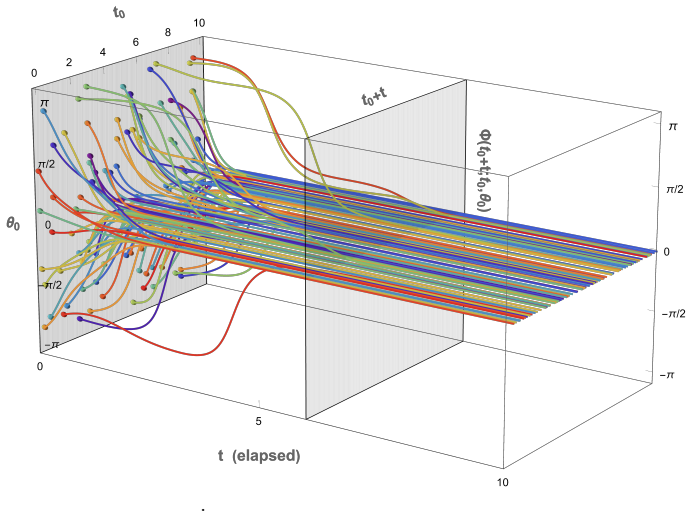
read the original abstract
We present a semidefinite programming framework for constructing time-varying Lyapunov densities for nonautonomous dynamical systems on a hypertorus. The formulation leverages Gram matrix representations of hybrid (real-trigonometric) polynomials. In addition, we introduce a novel block decomposition of these Gram representations to confine the blow-up of the resulting density to a prescribed set. The results are then applied to establish the almost global synchronization of a time-varying Kuramoto model and the robust almost-global stability of a parameter-varying nonautonomous system. These examples demonstrate the applicability of the proposed method and validate the theoretical results. All computational results are obtained using an open-source MATLAB implementation, as referenced in the text, thereby facilitating reproducibility of the reported examples.
Editorial analysis
A structured set of objections, weighed in public.
Referee Report
Summary. The manuscript presents a semidefinite programming (SDP) framework for constructing time-varying Lyapunov densities for nonautonomous dynamical systems on the hypertorus. It employs Gram matrix representations of hybrid (real-trigonometric) polynomials and introduces a novel block decomposition of these representations to localize the blow-up of the density to a prescribed set. The approach is applied to prove almost global synchronization in a time-varying Kuramoto model and robust almost-global stability for a parameter-varying nonautonomous system, with all examples computed via an open-source MATLAB implementation.
Significance. If the SDP constructions are valid, the work supplies a computational certificate for almost-global stability properties in explicitly time-dependent systems on compact manifolds, extending Lyapunov density methods beyond autonomous cases. The emphasis on reproducibility through referenced open-source code strengthens the contribution for the dynamical systems community.
major comments (2)
- [Abstract and applications] The central claim that feasible SDP solutions yield valid Lyapunov densities (satisfying δ_t ho + div(f ho) ≤ 0 a.e. with the required positivity and integrability properties) depends on the nonautonomous vector field being exactly representable or sufficiently approximated by hybrid polynomials; this assumption is load-bearing but its error control is not addressed in the formulation or applications.
- [Method description] The novel block decomposition is asserted to confine blow-up without introducing hidden conservatism in the inequality; however, no explicit verification is provided that the decomposed Gram matrices preserve the original semidefinite constraint and the divergence inequality after decomposition.
minor comments (2)
- Notation for the hypertorus and hybrid polynomial basis should be introduced with explicit definitions early in the text for clarity.
- The open-source MATLAB implementation reference should include a direct link or repository identifier to facilitate immediate reproducibility.
Simulated Author's Rebuttal
Thank you for the careful review and constructive comments. We address each major point below with clarifications based on the manuscript content. Where the comments identify gaps in exposition, we indicate revisions that will be incorporated.
read point-by-point responses
-
Referee: [Abstract and applications] The central claim that feasible SDP solutions yield valid Lyapunov densities (satisfying δ_t ρ + div(f ρ) ≤ 0 a.e. with the required positivity and integrability properties) depends on the nonautonomous vector field being exactly representable or sufficiently approximated by hybrid polynomials; this assumption is load-bearing but its error control is not addressed in the formulation or applications.
Authors: The applications in the manuscript (time-varying Kuramoto synchronization and robust stability of the parameter-varying system) use vector fields that are exactly expressible as hybrid polynomials, so the SDP yields densities satisfying the inequality exactly with no approximation. We agree that error control for non-polynomial fields is not treated and lies outside the paper's scope. We will add a clarifying remark in the introduction and method section stating the exact-representation assumption. revision: yes
-
Referee: [Method description] The novel block decomposition is asserted to confine blow-up without introducing hidden conservatism in the inequality; however, no explicit verification is provided that the decomposed Gram matrices preserve the original semidefinite constraint and the divergence inequality after decomposition.
Authors: The block decomposition is defined algebraically so that each block inherits positive-semidefiniteness from the original Gram matrix and the divergence inequality is unchanged because the decomposition acts only on the support of the density without modifying the polynomial coefficients in the Lie derivative term. To address the request for explicit verification we will insert a short proposition (with proof) in the revised Section 3 confirming preservation of both the SDP constraint and the pointwise inequality. revision: yes
Circularity Check
No circularity: constructive SDP framework with independent validation
full rationale
The paper presents a semidefinite programming framework that constructs time-varying Lyapunov densities via Gram matrix representations of hybrid polynomials and a block decomposition for localizing blow-up. This is an optimization-based certificate construction, not a derivation that reduces by definition or self-citation to its inputs. Applications to the Kuramoto model and parameter-varying systems are presented as separate validations using open-source code, with no load-bearing steps that equate predictions to fitted parameters or import uniqueness via self-citation chains. The central claim remains self-contained against external benchmarks.
Axiom & Free-Parameter Ledger
Reference graph
Works this paper leans on
-
[1]
Uncertainty in phase-frequency synchronization of large populations of globally coupled nonlinear oscillators.Physica D: Nonlinear Phenomena, 141(1-2):65–79, 2000
JA Acebr´ on and R Spigler. Uncertainty in phase-frequency synchronization of large populations of globally coupled nonlinear oscillators.Physica D: Nonlinear Phenomena, 141(1-2):65–79, 2000
2000
-
[2]
Some remarks on density functions for dual Lyapunov methods
David Angeli. Some remarks on density functions for dual Lyapunov methods. In42nd IEEE Interna- tional Conference on Decision and Control (IEEE Cat. No. 03CH37475), volume 5, pages 5080–5082. IEEE, 2003
2003
-
[3]
Linear parameter-varying and time-delay systems.Analysis, observation, filtering & control, 3(5-7):254, 2014
Corentin Briat. Linear parameter-varying and time-delay systems.Analysis, observation, filtering & control, 3(5-7):254, 2014
2014
-
[4]
CVX Research
Inc. CVX Research. CVX: Matlab software for disciplined convex programming, version 2.0.https: //cvxr.com/cvx, August 2012
2012
-
[5]
Bogdan Dumitrescu.Positive trigonometric polynomials and signal processing applications, volume
-
[6]
Bogdan Dumitrescu, Bogdan C S ¸icleru, and Radu S ¸tefan. Positive hybrid real-trigonometric polyno- mials and applications to adjustable filter design and absolute stability analysis.Circuits, Systems and Signal Processing, 29:881–899, 2010
2010
-
[7]
Overviews on the applications of the Kuramoto model in modern power system analysis.International Journal of Electrical Power & Energy Systems, 129:106804, 2021
Yufeng Guo, Dongrui Zhang, Zhuchun Li, Qi Wang, and Daren Yu. Overviews on the applications of the Kuramoto model in modern power system analysis.International Journal of Electrical Power & Energy Systems, 129:106804, 2021
2021
-
[8]
An extended Lyapunov-density condition for nonlinear time-varying systems.IFAC- PapersOnLine, 56(2):4478–4483, 2023
Izumi Masubuchi. An extended Lyapunov-density condition for nonlinear time-varying systems.IFAC- PapersOnLine, 56(2):4478–4483, 2023. 21
2023
-
[9]
Lyapunov density for almost attraction of nonlinear time- varying systems: A condition without assuming local stability
Izumi Masubuchi and Takahiro Kikuchi. Lyapunov density for almost attraction of nonlinear time- varying systems: A condition without assuming local stability. In2017 25th Mediterranean Conference on Control and Automation (MED), pages 169–173. IEEE, 2017
2017
-
[10]
Lyapunov density criteria for time-varying and periodically time-varying nonlinear systems with converse results.SIAM Journal on Control and Optimization, 59(1):223–241, 2021
Izumi Masubuchi and Takahiro Kikuchi. Lyapunov density criteria for time-varying and periodically time-varying nonlinear systems with converse results.SIAM Journal on Control and Optimization, 59(1):223–241, 2021
2021
-
[11]
On Rantzer’s density function
Gjerrit Meinsma. On Rantzer’s density function. In25th Benelux Meeting on Systems and Control 2006, pages 50–50. Technische Universiteit Eindhoven, 2006
2006
-
[12]
Almost global stability of time-varying systems
Pablo Monz´ on. Almost global stability of time-varying systems. InCongresso Brasileiro de Autom´ atica, Bahia, Brasil, 2006, 2006
2006
-
[13]
Kuramoto model with time-varying parameters.Phys
Spase Petkoski and Aneta Stefanovska. Kuramoto model with time-varying parameters.Phys. Rev. E, 86:046212, Oct 2012
2012
-
[14]
Nonlinear control synthesis by convex opti- mization.IEEE Transactions on Automatic Control, 49(2):310–314, 2004
Stephen Prajna, Pablo A Parrilo, and Anders Rantzer. Nonlinear control synthesis by convex opti- mization.IEEE Transactions on Automatic Control, 49(2):310–314, 2004
2004
-
[15]
A dual to Lyapunov’s stability theorem.Systems & Control Letters, 42(3):161–168, 2001
Anders Rantzer. A dual to Lyapunov’s stability theorem.Systems & Control Letters, 42(3):161–168, 2001
2001
-
[16]
Software: Nonautonomous Lyapunov Density on Torus solver.https://github
Swapnil Tripathi. Software: Nonautonomous Lyapunov Density on Torus solver.https://github. com/Swap-Tripathi/NautLDT-Solver/, May 2026
2026
-
[17]
Certification of stability for systems of coupled phase oscillators.Nonlinear Analysis: Hybrid Systems, 61:101739, 2026
Swapnil Tripathi, Mahmut Kudeyt, Alkım G¨ ok¸ cen, Ferruh˙Ilhan, Sava¸ s S ¸ahin, and¨Ozkan Karabacak. Certification of stability for systems of coupled phase oscillators.Nonlinear Analysis: Hybrid Systems, 61:101739, 2026
2026
-
[18]
Construction of Lyapunov certificates for oscillatory systems.Preprints, February 2026
Swapnil Tripathi, Ferruh ˙Ilhan, Alkım G¨ ok¸ cen, Mahmut Kudeyt, Sava¸ s S ¸ahin, and Ozkan Karabacak. Construction of Lyapunov certificates for oscillatory systems.Preprints, February 2026. 22
2026
discussion (0)
Sign in with ORCID, Apple, or X to comment. Anyone can read and Pith papers without signing in.